Cocoa Pulp Functional Ingredients Market Size, Share, Growth and Forecast (2026 - 2036)
The Cocoa Pulp Functional Ingredients Market is segmented by Ingredient Type (Cocoa Pulp Extracts/Concentrates, Cocoa Juice, Fermented Pulp Ingredients, and Powdered Pulp Ingredients), Application (Food and Beverages, Nutraceuticals, and Personal Care), Functionality (Natural Sweetener and Flavor Enhancer, Antioxidant, Digestive Health/Prebiotic, and Energy and Hydration Support) and Region. Forecast for 2026 to 2036.
FACT.MR highlights a waste-to-value shift in the cocoa pulp functional ingredients market. Discarded cacao by-products are being repositioned as premium clean-label ingredients. This creates tension between processors focused on pulp upcycling and brands securing traceable supply. Demand for cocoa juice and prebiotic concentrates is increasing. EU sustainability regulations are tightening sourcing requirements. This is reinforcing premium positioning and supply competition.
Cocoa Pulp Functional Ingredients Market Forecast and Outlook By Fact.MR
In 2025, the cocoa pulp functional ingredients market was valued at USD 0.4 billion. Based on Fact.MR analysis, demand for cocoa pulp functional ingredients is estimated to grow to USD 0.5 billion in 2026 and USD 1.2 billion by 2036. FACT.MR projects a CAGR of 10.2% during the forecast period.
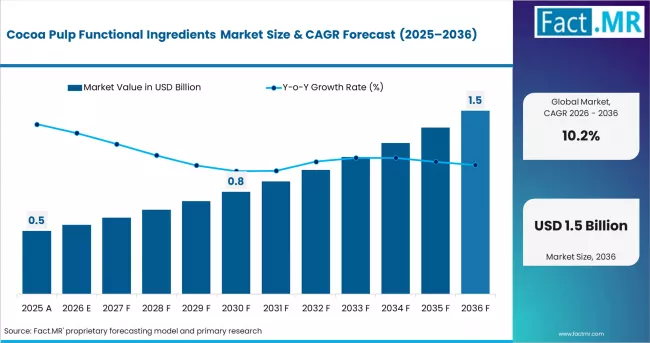
| Metric | Value |
|---|---|
| Estimated Value in 2026 | USD 0.5 billion |
| Forecast Value in 2036 | USD 1.2 billion |
| Forecast CAGR (2026 to 2036) | 10.2% |
Summary of Cocoa Pulp Functional Ingredients Market
- Market Definition
- The market covers functional ingredients from cocoa pulp including extracts, juice, fermented, and powdered formats supplying food and beverage, nutraceutical, and personal care applications globally.
- Demand Drivers
- EU sustainable cocoa sourcing regulations are accelerating traceable pulp ingredient procurement by European food brands.
- India's urban premiumisation trend is expanding functional beverage and nutraceutical demand for cocoa-derived prebiotic and antioxidant ingredients.
- Clean-label and upcycled ingredient mandates by U.S. food brands are driving cocoa juice and concentrate adoption in beverage and supplement formulations.
- Key Segments Analyzed
- By Ingredient Type: Cocoa pulp extracts and concentrates lead 40% in 2026, driven by natural sweetener and flavour enhancement use in beverages and confectionery.
- By Application: Food and beverages lead 48% in 2026, driven by cocoa juice and concentrate use in functional drinks, dairy, and confectionery formulations.
- By Functionality: Natural sweetener and flavor enhancement leads 30% in 2026, driven by clean-label reformulation demand across food and beverage categories.
- By Geography: India leads at 8.8% CAGR, driven by urban premiumisation and functional food retail expansion.
- Analyst Opinion at FACT.MR
- Shambhu Nath Jha, Principal Consultant at Fact.MR, opines, CXOs will find that traceable and certified cocoa pulp ingredients are outperforming standard pulp extracts. Documented prebiotic and antioxidant efficacy is becoming essential. Buyers prefer verified and transparent sourcing. Companies with direct farmer networks hold a clear advantage. Sustainability certification strengthens supplier positioning.
- Strategic Implications
- Invest in origin traceability systems and Rainforest Alliance certification to qualify for EU sustainable cocoa sourcing-compliant ingredient procurement programmes.
- Develop clinically documented prebiotic and antioxidant efficacy data for cocoa pulp ingredients targeting nutraceutical and functional beverage brand procurement in India and the United States.
- Build direct farmer sourcing partnerships in Ghana, Ivory Coast, and Ecuador to secure cocoa pulp supply and support premium positioning in bean-to-bar and specialty food channels.
- Methodology
- Market sizing uses cocoa pulp producer revenues and ingredient volume data, validated with 2024-2025 sustainability programme procurement benchmarks.
- Analysis includes EU sustainable cocoa regulation data, FSSAI novel ingredient frameworks, and India functional food retail growth statistics.
Forecasts incorporate upcycled ingredient demand trends, prebiotic adoption rates, and expert interviews with food formulation and specialty ingredient procurement specialists.
Between 2026 and 2036, the market is projected to create USD 0.7 billion in absolute opportunity. Growth is driven by rising demand for upcycled ingredients in food and beverages. Nutraceutical prebiotic use is increasing. Personal care is adopting natural antioxidants. Expansion is limited by low pulp extraction capacity at farms. Fermentation standardization remains a challenge. Cold-chain logistics from origin regions add complexity.
Procurement is shifting toward traceable cocoa pulp ingredients. Buyers prefer certified and documented sourcing. Food and nutraceutical companies are consolidating supplier bases. Preference is for partners with direct farmer networks. Certifications such as Rainforest Alliance and UTZ are important. Functional validation of prebiotic and antioxidant benefits is required. Commodity suppliers face pressure.
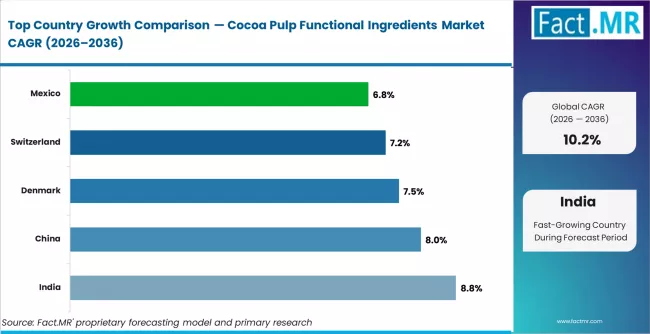
India leads with a CAGR of 8.8% through 2036. Growth is supported by premiumisation and functional food demand. China follows at 8.0%, driven by bakery and ready-to-drink beverages. Denmark records 7.5%, supported by organic and specialty ingredient adoption. Switzerland records 7.2%, driven by premium ethical sourcing. Mexico records 6.8%, supported by domestic cocoa ingredient commercialization and retail expansion.
Drivers, Restraints, and Opportunities
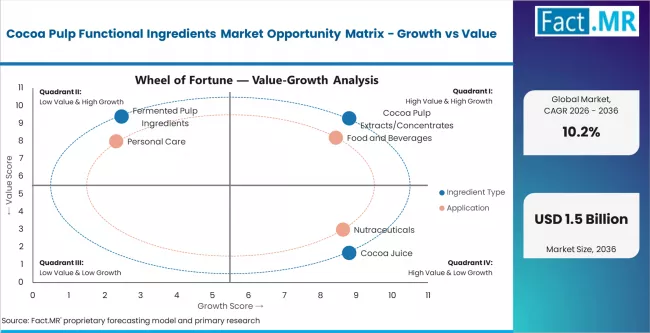
FACT.MR notes the cocoa pulp functional ingredients market is a nascent but scaling upcycled segment. Demand is driven by natural sweetener replacement and prebiotic adoption. Clean-label and sustainability trends support growth.
The market shows clear quality segmentation. Commodity pulp extracts face margin pressure. Logistics and processing costs remain high. Certified and traceable ingredients command 35–55% premiums. Functional validation supports premium pricing. Revenue growth is driven by value, not volume.
- EU Deforestation Regulation Sourcing Driver: The EU Deforestation Regulation (EUDR), effective December 2025, mandates traceable sourcing. This drives procurement from certified suppliers. Barry Callebaut and Olam Food Ingredients expanded certified programmes in 2024–2025. [1]
- India Functional Food Premiumisation: India’s functional food market crossed USD 16 billion in 2024. Demand is driven by urban health trends. FSSAI expanded natural ingredient pathways. Nestlé India increased cocoa pulp sourcing. [2]
- Upcycled Ingredient Brand Adoption: The Upcycled Food Association certified over 500 products in 2024. Cocoa pulp is among the fastest-growing categories. Brands like Tony's Chocolonely and Koa Switzerland expanded usage. [3]
Segmental Analysis
Cocoa Pulp Functional Ingredients Market Analysis by Ingredient Type
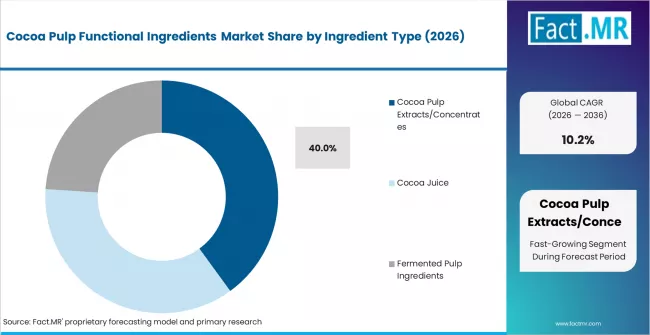
Cocoa pulp extracts and concentrates hold 40% share in 2026. They lead due to versatility in food applications. They act as natural sweeteners and flavour enhancers. High Brix formats enable easy formulation.
- Barry Callebaut WholeFruit Innovation: Barry Callebaut expanded WholeFruit cocoa in 2024. It supports cocoa pulp use in confectionery. [4]
- Koa Cocoa Juice Commercialisation: Koa Switzerland launched Brix-controlled cocoa juice in 2025. It targets beverage and nutraceutical markets. [5]
- Fermented Pulp Adoption Trend: The International Cocoa Organization reported rising interest in fermented pulp in 2024. Demand is driven by probiotic trends. [6]
Cocoa Pulp Functional Ingredients Market Analysis by Application
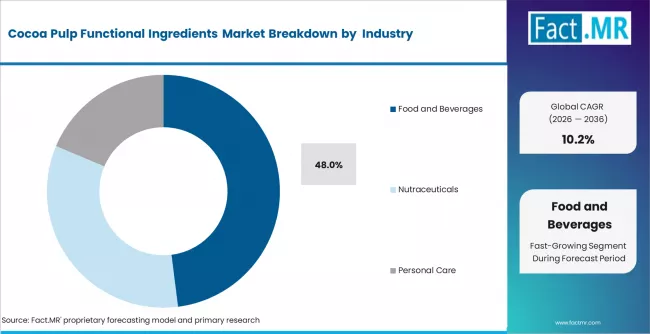
Food and beverages hold 48% share in 2026. This segment leads due to functional utility in formulations. Cocoa pulp is used as a sweetener and fibre source. Clean-label reformulation supports adoption.
- Cargill Cocoa Pulp Programme Expansion: Cargill expanded CocoaWise in 2024. It supports EUDR-compliant sourcing.
- Olam Nutraceutical Channel Development: Olam Food Ingredients launched nutraceutical pulp products in 2025. These include prebiotic-rich concentrates. [7]
- Personal Care Antioxidant Adoption Trend: Mintel reported rising cocoa pulp antioxidant use in 2024. Growth is driven by natural beauty trends. [8]
Regional Analysis
The cocoa pulp functional ingredients market is assessed across Asia Pacific, Europe, North America, Latin America, and Middle East and Africa, covering 40+ countries with distinct demand profiles shaped by functional ingredient regulation maturity, sustainability sourcing mandate intensity, clean-label food brand procurement frameworks, and upcycled ingredient retail infrastructure. The full report offers market attractiveness analysis by region and country.
.webp "Top Country Growth Comparison Cocoa Pulp Functional Ingredients Market Cagr (2026 2036)")
| Country | CAGR (2026 to 2036) |
|---|---|
| India | 8.8% |
| China | 8.0% |
| Denmark | 7.5% |
| Switzerland | 7.2% |
| Mexico | 6.8% |
Source: Fact.MR (FACT.MR) analysis, based on proprietary forecasting model and primary research
Asia Pacific Cocoa Pulp Functional Ingredients Market Analysis
Asia Pacific represents the fastest-expanding consumption base, driven by premiumisation in India and large-scale food processing in China. Regional dynamics differ between compliance-led demand and volume-driven procurement. Barry Callebaut and Olam Food Ingredients serve both structured and bulk sourcing channels across the region.
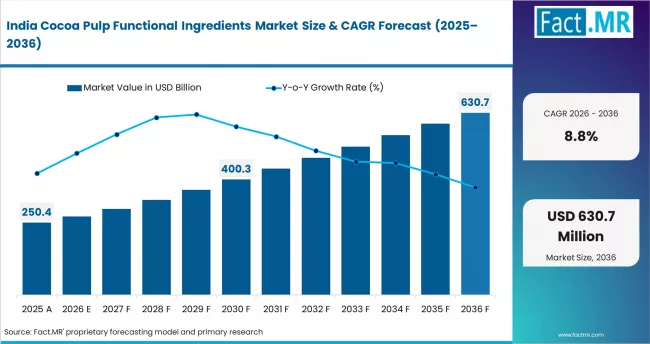
- India: India shows an 8.8% CAGR through 2036. Urban consumers are shifting toward functional and clean-label foods. FSSAI regulatory updates in 2024 enabled structured health claims for fruit-derived ingredients. Procurement is documentation-driven, with emphasis on traceability and certification. Nestlé India and domestic brands are increasing cocoa pulp sourcing for beverages and health products.
- China: China records an 8.0% CAGR through 2036. Growth is linked to bakery, confectionery, and ready-to-drink beverage expansion. Procurement is embedded within large-scale OEM manufacturing supply chains. Ingredient selection is driven by processor specifications rather than retail positioning. Updated 2024 guidelines expanded approvals for cocoa-derived prebiotic fibres. Cargill and Barry Callebaut increased supply to domestic manufacturers.
FACT.MR covers China, India, Japan, South Korea, ASEAN, and Australia & New Zealand. It includes regulatory data, consumption trends, and forecasts.
Europe Cocoa Pulp Functional Ingredients Market Analysis
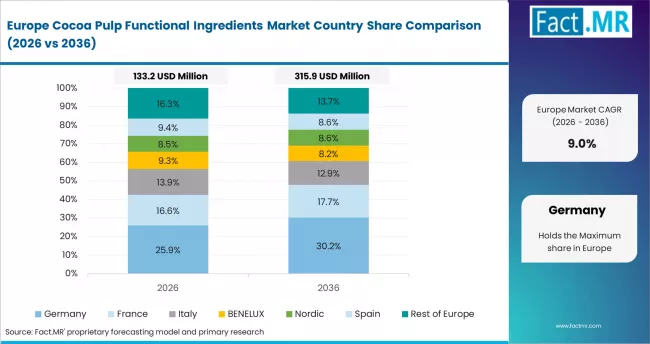
Europe acts as a regulatory and sustainability benchmark, with strong emphasis on traceability and certified sourcing. Demand is shaped by EUDR compliance and premium food positioning. Koa Switzerland and Touton SA support high-value ingredient supply chains.
- Denmark: Denmark posts a 7.5% CAGR through 2036. The country leads in organic and clean-label adoption. Updated 2024 labelling rules support upcycled ingredient positioning. Food brands are integrating cocoa pulp into premium beverages and snack formats. Consumer preference for sustainable sourcing is a key driver.
- Switzerland: Switzerland registers a 7.2% CAGR through 2036. Demand is tied to premium confectionery and ethical sourcing standards. Cocoa pulp is used as a natural sweetener and flavour enhancer in high-end products. Koa Switzerland supports direct sourcing from Ghana. Regulatory updates in 2024 improved market access for novel ingredients.
FACT.MR covers Germany, France, the UK, Italy, Spain, Denmark, Switzerland, and Rest of Europe. It includes compliance benchmarks, sourcing trends, and forecasts.
North America Cocoa Pulp Functional Ingredients Market Analysis
North America reflects a clean-label and upcycled ingredient-driven environment. Demand is supported by functional food, beverage, and supplement channels. Barry Callebaut and Cargill maintain strong positions through certified supply networks.
- Mexico: Mexico shows a 6.8% CAGR through 2036. It combines domestic cocoa origin supply with rising functional food demand. Regions such as Tabasco and Oaxaca support local sourcing and processing. GI protection expanded in 2024, strengthening premium positioning. Local beverage and chocolate brands are increasing cocoa pulp usage.
FACT.MR covers the U.S., Canada, and Mexico. It includes clean-label trends, regulatory data, and forecasts.
Latin America Cocoa Pulp Functional Ingredients Market Analysis
Latin America serves as the primary origin and early-stage processing base for cocoa pulp ingredients. Countries such as Brazil and Ecuador are key suppliers for global markets. Touton SA and Olam Food Ingredients operate integrated origin sourcing networks.
- Brazil: Brazil records a 6.2% CAGR through 2036. The country plays a dual role as both supplier and consumer. Research in 2024 improved extraction efficiency for cocoa pulp. Regulatory updates enabled commercialisation in food and nutraceutical products. Domestic brands are incorporating cocoa pulp into functional formulations.
FACT.MR covers Brazil, Ecuador, Colombia, and Rest of Latin America. It includes origin certification data, production benchmarks, and forecasts.
Competitive Aligners for Market Players
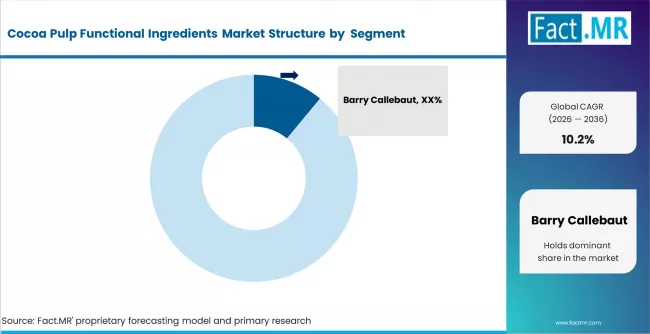
The cocoa pulp functional ingredients market is developing into a two-track competitive landscape. On one side are large, vertically integrated cocoa processors, and on the other are smaller, innovation-led specialty players. The key battleground is no longer just price or volume, but traceability, sustainability, and proven functionality. Buyers increasingly expect clear origin data, certifications, and evidence of health benefits. Suppliers that cannot provide this are finding it difficult to access premium markets, especially in Europe and North America.
Major companies such as Barry Callebaut, Cargill, and Olam Food Ingredients hold a strong advantage because they control large parts of the value chain. Their direct relationships with farmers and established sourcing systems allow them to offer fully traceable, certified cocoa pulp ingredients. They also benefit from existing ties with global food manufacturers, making it easier to introduce cocoa pulp into new applications without building new customer bases.
At the same time, niche players like Koa Switzerland and Touton SA are carving out space by focusing on premium positioning. They emphasize direct farmer partnerships, transparent sourcing, and strong branding around sustainability and origin. Procurement patterns are also evolving. Food, beverage, and nutraceutical companies are moving toward fewer, more reliable suppliers. Long-term agreements are becoming common, often tied to certification standards and documented functional benefits. This shift is helping certified suppliers maintain stable pricing, while lower-cost, non-certified producers face increasing pressure and limited market access.
Key Players
- Barry Callebaut
- Cargill
- Olam Food Ingredients
- Nestlé
- Touton
- Koa Switzerland
Bibliography
- [1] European Commission. (2023). EU Deforestation Regulation (EUDR) 2023/1115: Mandatory Deforestation-Free Supply Chain Traceability Requirements for Cocoa and Cocoa Products Entering European Union Markets, Effective December 2025. ec.europa.eu/environment/forests/deforestation_en.htm
- [2] Food Safety and Standards Authority of India (FSSAI). (2024). Functional Food Labelling Standards Update 2024: Novel Fruit-Derived Functional Ingredient Health Claim Registration Pathways Under Food Safety and Standards Act 2006 for Category 13 Health and Supplement Products. fssai.gov.in
- [3] Upcycled Food Association. (2024). Annual Upcycled Certified Product Report 2024: Certified Upcycled Product Growth Including Cocoa Pulp Ingredient Category Expansion and Brand Adoption Data Across North American Functional Food and Beverage Retail Channels. upcycledfood.org
- [4] Barry Callebaut AG. (2024). Annual Report 2024: WholeFruit Cocoa Concept Commercial Expansion Including Certified Cocoa Pulp Concentrate and Juice Ingredient Supply Programme Growth for European Food and Confectionery Brand Partners Under EUDR-Compliant Sourcing. barrycallebaut.com/investor-relations
- [5] Koa Switzerland. (2025). Product Launch Announcement: Standardised Brix-Controlled Cocoa Pulp Juice Concentrate for European Functional Beverage and Nutraceutical Manufacturers with Traceable Ghanaian Smallholder-Origin Certification and Full Supply Chain Documentation. koa.eco/news
- [6] International Cocoa Organization. (2024). Cocoa Pulp Valorisation Industry Report 2024: Fermented and Concentrated Cocoa Pulp Ingredient Adoption Trends Among European Specialty Food Manufacturers Including Antioxidant Health Claim Assessment Data. icco.org
- [7] Olam Food Ingredients. (2025). Product Launch: Prebiotic Fibre-Enriched Cocoa Pulp Concentrate Range for Nutraceutical and Functional Food Manufacturers with Documented SCFA Fermentation Activity Data Supporting Gut Health Ingredient Positioning. olamgroup.com/investor-relations
- [8] Mintel Group. (2024). Global Beauty Ingredient Trends Report 2024: Upcycled and Natural Antioxidant Active Ingredients Including Cocoa Pulp-Derived Polyphenol Antioxidants in European and South Korean Personal Care Brand Formulations. mintel.com
This Report Addresses
- Strategic insights on cocoa pulp functional ingredient demand across food and beverage clean-label reformulation, nutraceutical prebiotic adoption, and personal care natural antioxidant ingredient procurement.
- Market forecast from USD 0.5 billion in 2026 to USD 1.2 billion by 2036, at 10.2% CAGR.
- Opportunity mapping across India FSSAI functional ingredient expansion, China bakery and beverage segment growth, EU EUDR-driven sustainable sourcing compliance, and North American upcycled ingredient retail adoption.
- Segment analysis by ingredient type, application, and functionality. Covers cocoa juice, concentrates, fermented and powdered formats across food, nutraceutical, and personal care end uses.
- Regional outlook covering Asia Pacific premiumisation-driven growth, Europe EU EUDR sustainability-led procurement, and North America clean-label functional food brand adoption.
- Competitive landscape of Barry Callebaut, Cargill, Olam Food Ingredients, Nestlé, Touton, and Koa Switzerland covering origin traceability, sustainability certification, and functional ingredient positioning.
- Regulatory analysis covering EU Deforestation Regulation EUDR compliance requirements, FSSAI 2024 functional food labelling standards, India novel ingredient frameworks, and European EFSA antioxidant health claim assessment.
- Report delivery in PDF, Excel, and presentation formats supported by validated producer data, sustainability programme procurement benchmarks, and industry expert inputs.
Cocoa Pulp Functional Ingredients Market Definition
The cocoa pulp functional ingredients market includes natural extracts, concentrates, juices, and fermented or dried ingredients derived from the white mucilaginous pulp surrounding cacao beans. Key products include cocoa juice, pulp concentrates, fermented pulp ingredients, and powdered pulp formats.
Cocoa Pulp Functional Ingredients Market Inclusions
Covers global and regional forecasts from 2026 to 2036 by ingredient type, application, and functionality. Includes cocoa pulp extracts, concentrates, juice, fermented, and powdered formats across food and beverage, nutraceutical, and personal care channels. Includes sustainability certification, origin traceability, and functional activity benchmarks.
Cocoa Pulp Functional Ingredients Market Exclusions
Excludes cocoa bean, cocoa butter, cocoa powder, and cocoa liquor. Finished confectionery and chocolate products incorporating pulp as a flavour component are not included. Standard cocoa processing by-products without functional ingredient processing or standardisation are also excluded. Focus remains on value-added cocoa pulp ingredient supply to food, nutraceutical, and personal care manufacturers.
Cocoa Pulp Functional Ingredients Market Research Methodology
- Primary Research: Interviews with cocoa pulp ingredient producers, food and beverage formulators, nutraceutical procurement teams, and sustainability certification specialists across key origin and consumption markets.
- Desk Research: Uses data from Barry Callebaut, Cargill, and Olam Food Ingredients annual reports, EU sustainable cocoa sourcing regulation updates, FSSAI novel ingredient frameworks, and 2024-2025 specialty ingredient trade data.
- Market-Sizing and Forecasting: Applies a hybrid model using cocoa pulp producer revenues, ingredient volume estimates by type and application, and functional ingredient selling price benchmarks by format and certification grade.
- Data Validation and Update Cycle: Validated using producer revenue data, sustainability programme procurement volumes, and food industry functional ingredient demand benchmarks. Supported by expert interviews.
Scope of Report
| Attribute | Details |
|---|---|
| Quantitative Units | USD 0.5 billion (2026) to USD 1.2 billion (2036), at a CAGR of 10.2% |
| Market Definition | Functional ingredient fractions derived from cocoa pulp including extracts, concentrates, juice, fermented, and powdered formats, supplied with sustainability certification and functional activity documentation for food and beverage, nutraceutical, and personal care applications globally. |
| Ingredient Type Segmentation | Cocoa Pulp Extracts/Concentrates, Cocoa Juice, Fermented Pulp Ingredients, Powdered Pulp Ingredients |
| Application Segmentation | Food and Beverages, Nutraceuticals, Personal Care |
| Functionality Segmentation | Natural Sweetener and Flavor Enhancer, Antioxidant, Digestive Health/Prebiotic, Energy and Hydration Support |
| Application Coverage | Clean-label natural sweetener and flavour replacement in beverage and confectionery formulations, prebiotic fibre nutraceutical supplement supply, antioxidant active personal care ingredient sourcing, and functional food and ready-to-drink cocoa beverage ingredient applications. |
| Regions Covered | North America, Europe, Asia Pacific, Latin America, Middle East and Africa |
| Countries Covered | USA, Canada, Mexico, Germany, UK, France, Italy, Spain, Denmark, Switzerland, Nordic, BENELUX, China, Japan, South Korea, India, ASEAN, Australia and New Zealand, Brazil, Ecuador, Colombia, Saudi Arabia, GCC, Turkey, South Africa, Rest of MEA |
| Key Companies Profiled | Barry Callebaut, Cargill, Olam Food Ingredients, Nestlé, Touton, Koa Switzerland |
| Forecast Period | 2026 to 2036 |
| Approach | Hybrid top-down and bottom-up model using cocoa pulp ingredient producer revenues, ingredient volume estimates by type and application, average selling prices by format and certification grade, sustainability programme procurement benchmarks, and primary interviews with food ingredient buyers and nutraceutical formulators. |
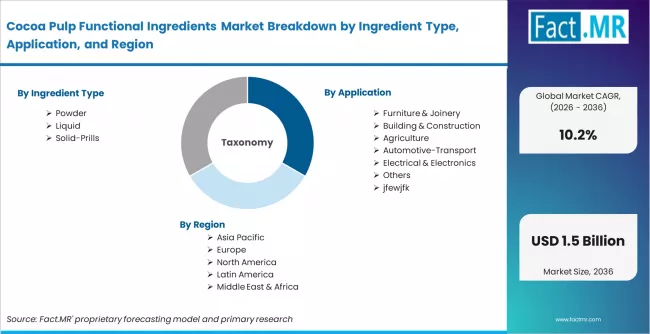
Cocoa Pulp Functional Ingredients Market by Segments
-
By Ingredient Type:
- Cocoa Pulp Extracts/Concentrates
- Cocoa Juice
- Fermented Pulp Ingredients
- Powdered Pulp Ingredients
-
By Application:
- Food and Beverages
- Nutraceuticals
- Personal Care
-
By Functionality:
- Natural Sweetener and Flavor Enhancer
- Antioxidant
- Digestive Health/Prebiotic
- Energy and Hydration Support
-
By Region:
- North America
- United States
- Canada
- Mexico
- Latin America
- Brazil
- Ecuador
- Colombia
- Argentina
- Rest of Latin America
- Western Europe
- Germany
- United Kingdom
- France
- Italy
- Spain
- Denmark
- Switzerland
- Nordic Countries
- BENELUX
- Rest of Western Europe
- Eastern Europe
- Russia
- Poland
- Hungary
- Balkan and Baltic
- Rest of Eastern Europe
- East Asia
- China
- Japan
- South Korea
- South Asia and Pacific
- India
- ASEAN
- Australia and New Zealand
- Rest of South Asia and Pacific
- Middle East and Africa
- Kingdom of Saudi Arabia
- Other GCC Countries
- Turkey
- South Africa
- Ivory Coast
- Ghana
- Rest of Middle East and Africa
- North America
- Frequently Asked Questions -
How large is the global cocoa pulp functional ingredients market in 2025?
The global cocoa pulp functional ingredients market was valued at USD 0.4 billion in 2025.
What will the market size be in 2026?
Based on Fact.MR analysis, demand for cocoa pulp functional ingredients is estimated to grow to USD 0.5 billion in 2026.
What is the projected market size by 2036?
The market is projected to reach USD 1.2 billion by 2036, generating USD 0.7 billion in absolute dollar opportunity over the forecast period.
What is the expected CAGR from 2026 to 2036?
FACT.MR projects a CAGR of 10.2% for the global cocoa pulp functional ingredients market during the 2026 to 2036 forecast period.
Which ingredient type segment is poised to lead the market?
Cocoa pulp extracts and concentrates lead with approximately 40% share in 2026, driven by natural sweetener and flavour enhancement use in beverage and confectionery applications.
Which application segment holds the largest share?
Food and beverages leads with approximately 48% share in 2026, driven by cocoa juice and concentrate use in functional drinks, dairy, and confectionery formulations.
Which country shows the fastest growth in the market?
India leads at 8.8% CAGR through 2036, driven by urban premiumisation and functional food retail expansion supported by FSSAI novel ingredient regulatory frameworks.
What are cocoa pulp functional ingredients used for?
They are used as natural sweeteners and flavour enhancers in food and beverages, prebiotic fibre actives in nutraceutical supplements, and antioxidant ingredients in personal care formulations.
What drives demand in this market?
EU EUDR sustainable cocoa sourcing compliance, India functional food premiumisation, U.S. clean-label and upcycled ingredient brand mandates, and K-Beauty natural antioxidant personal care procurement drive growth.
Who are the key players in the market?
Major players include Barry Callebaut, Cargill, Olam Food Ingredients, Nestlé, Touton, and Koa Switzerland.
Table of Content
- Executive Summary
- Global Market Outlook
- Demand to side Trends
- Supply to side Trends
- Technology Roadmap Analysis
- Analysis and Recommendations
- Market Overview
- Market Coverage / Taxonomy
- Market Definition / Scope / Limitations
- Research Methodology
- Chapter Orientation
- Analytical Lens and Working Hypotheses
- Market Structure, Signals, and Trend Drivers
- Benchmarking and Cross-market Comparability
- Market Sizing, Forecasting, and Opportunity Mapping
- Research Design and Evidence Framework
- Desk Research Programme (Secondary Evidence)
- Company Annual and Sustainability Reports
- Peer-reviewed Journals and Academic Literature
- Corporate Websites, Product Literature, and Technical Notes
- Earnings Decks and Investor Briefings
- Statutory Filings and Regulatory Disclosures
- Technical White Papers and Standards Notes
- Trade Journals, Industry Magazines, and Analyst Briefs
- Conference Proceedings, Webinars, and Seminar Materials
- Government Statistics Portals and Public Data Releases
- Press Releases and Reputable Media Coverage
- Specialist Newsletters and Curated Briefings
- Sector Databases and Reference Repositories
- Fact.MR Internal Proprietary Databases and Historical Market Datasets
- Subscription Datasets and Paid Sources
- Social Channels, Communities, and Digital Listening Inputs
- Additional Desk Sources
- Expert Input and Fieldwork (Primary Evidence)
- Primary Modes
- Qualitative Interviews and Expert Elicitation
- Quantitative Surveys and Structured Data Capture
- Blended Approach
- Why Primary Evidence is Used
- Field Techniques
- Interviews
- Surveys
- Focus Groups
- Observational and In-context Research
- Social and Community Interactions
- Stakeholder Universe Engaged
- C-suite Leaders
- Board Members
- Presidents and Vice Presidents
- R&D and Innovation Heads
- Technical Specialists
- Domain Subject-matter Experts
- Scientists
- Physicians and Other Healthcare Professionals
- Governance, Ethics, and Data Stewardship
- Research Ethics
- Data Integrity and Handling
- Primary Modes
- Tooling, Models, and Reference Databases
- Desk Research Programme (Secondary Evidence)
- Data Engineering and Model Build
- Data Acquisition and Ingestion
- Cleaning, Normalisation, and Verification
- Synthesis, Triangulation, and Analysis
- Quality Assurance and Audit Trail
- Market Background
- Market Dynamics
- Drivers
- Restraints
- Opportunity
- Trends
- Scenario Forecast
- Demand in Optimistic Scenario
- Demand in Likely Scenario
- Demand in Conservative Scenario
- Opportunity Map Analysis
- Product Life Cycle Analysis
- Supply Chain Analysis
- Investment Feasibility Matrix
- Value Chain Analysis
- PESTLE and Porter’s Analysis
- Regulatory Landscape
- Regional Parent Market Outlook
- Production and Consumption Statistics
- Import and Export Statistics
- Market Dynamics
- Global Market Analysis 2021 to 2025 and Forecast, 2026 to 2036
- Historical Market Size Value (USD Million) Analysis, 2021 to 2025
- Current and Future Market Size Value (USD Million) Projections, 2026 to 2036
- Y to o to Y Growth Trend Analysis
- Absolute $ Opportunity Analysis
- Global Market Pricing Analysis 2021 to 2025 and Forecast 2026 to 2036
- Global Market Analysis 2021 to 2025 and Forecast 2026 to 2036, By Ingredient Type
- Introduction / Key Findings
- Historical Market Size Value (USD Million) Analysis By Ingredient Type , 2021 to 2025
- Current and Future Market Size Value (USD Million) Analysis and Forecast By Ingredient Type , 2026 to 2036
- Cocoa Pulp Extracts/Concentrates
- Cocoa Juice
- Fermented Pulp Ingredients
- Cocoa Pulp Extracts/Concentrates
- Y to o to Y Growth Trend Analysis By Ingredient Type , 2021 to 2025
- Absolute $ Opportunity Analysis By Ingredient Type , 2026 to 2036
- Global Market Analysis 2021 to 2025 and Forecast 2026 to 2036, By Application
- Introduction / Key Findings
- Historical Market Size Value (USD Million) Analysis By Application, 2021 to 2025
- Current and Future Market Size Value (USD Million) Analysis and Forecast By Application, 2026 to 2036
- Food and Beverages
- Nutraceuticals
- Personal Care
- Food and Beverages
- Y to o to Y Growth Trend Analysis By Application, 2021 to 2025
- Absolute $ Opportunity Analysis By Application, 2026 to 2036
- Global Market Analysis 2021 to 2025 and Forecast 2026 to 2036, By Region
- Introduction
- Historical Market Size Value (USD Million) Analysis By Region, 2021 to 2025
- Current Market Size Value (USD Million) Analysis and Forecast By Region, 2026 to 2036
- North America
- Latin America
- Western Europe
- Eastern Europe
- East Asia
- South Asia and Pacific
- Middle East & Africa
- Market Attractiveness Analysis By Region
- North America Market Analysis 2021 to 2025 and Forecast 2026 to 2036, By Country
- Historical Market Size Value (USD Million) Trend Analysis By Market Taxonomy, 2021 to 2025
- Market Size Value (USD Million) Forecast By Market Taxonomy, 2026 to 2036
- By Country
- USA
- Canada
- Mexico
- By Ingredient Type
- By Application
- By Country
- Market Attractiveness Analysis
- By Country
- By Ingredient Type
- By Application
- Key Takeaways
- Latin America Market Analysis 2021 to 2025 and Forecast 2026 to 2036, By Country
- Historical Market Size Value (USD Million) Trend Analysis By Market Taxonomy, 2021 to 2025
- Market Size Value (USD Million) Forecast By Market Taxonomy, 2026 to 2036
- By Country
- Brazil
- Chile
- Rest of Latin America
- By Ingredient Type
- By Application
- By Country
- Market Attractiveness Analysis
- By Country
- By Ingredient Type
- By Application
- Key Takeaways
- Western Europe Market Analysis 2021 to 2025 and Forecast 2026 to 2036, By Country
- Historical Market Size Value (USD Million) Trend Analysis By Market Taxonomy, 2021 to 2025
- Market Size Value (USD Million) Forecast By Market Taxonomy, 2026 to 2036
- By Country
- Germany
- UK
- Italy
- Spain
- France
- Nordic
- BENELUX
- Rest of Western Europe
- By Ingredient Type
- By Application
- By Country
- Market Attractiveness Analysis
- By Country
- By Ingredient Type
- By Application
- Key Takeaways
- Eastern Europe Market Analysis 2021 to 2025 and Forecast 2026 to 2036, By Country
- Historical Market Size Value (USD Million) Trend Analysis By Market Taxonomy, 2021 to 2025
- Market Size Value (USD Million) Forecast By Market Taxonomy, 2026 to 2036
- By Country
- Russia
- Poland
- Hungary
- Balkan & Baltic
- Rest of Eastern Europe
- By Ingredient Type
- By Application
- By Country
- Market Attractiveness Analysis
- By Country
- By Ingredient Type
- By Application
- Key Takeaways
- East Asia Market Analysis 2021 to 2025 and Forecast 2026 to 2036, By Country
- Historical Market Size Value (USD Million) Trend Analysis By Market Taxonomy, 2021 to 2025
- Market Size Value (USD Million) Forecast By Market Taxonomy, 2026 to 2036
- By Country
- China
- Japan
- South Korea
- By Ingredient Type
- By Application
- By Country
- Market Attractiveness Analysis
- By Country
- By Ingredient Type
- By Application
- Key Takeaways
- South Asia and Pacific Market Analysis 2021 to 2025 and Forecast 2026 to 2036, By Country
- Historical Market Size Value (USD Million) Trend Analysis By Market Taxonomy, 2021 to 2025
- Market Size Value (USD Million) Forecast By Market Taxonomy, 2026 to 2036
- By Country
- India
- ASEAN
- Australia & New Zealand
- Rest of South Asia and Pacific
- By Ingredient Type
- By Application
- By Country
- Market Attractiveness Analysis
- By Country
- By Ingredient Type
- By Application
- Key Takeaways
- Middle East & Africa Market Analysis 2021 to 2025 and Forecast 2026 to 2036, By Country
- Historical Market Size Value (USD Million) Trend Analysis By Market Taxonomy, 2021 to 2025
- Market Size Value (USD Million) Forecast By Market Taxonomy, 2026 to 2036
- By Country
- Kingdom of Saudi Arabia
- Other GCC Countries
- Turkiye
- South Africa
- Other African Union
- Rest of Middle East & Africa
- By Ingredient Type
- By Application
- By Country
- Market Attractiveness Analysis
- By Country
- By Ingredient Type
- By Application
- Key Takeaways
- Key Countries Market Analysis
- USA
- Pricing Analysis
- Market Share Analysis, 2025
- By Ingredient Type
- By Application
- Canada
- Pricing Analysis
- Market Share Analysis, 2025
- By Ingredient Type
- By Application
- Mexico
- Pricing Analysis
- Market Share Analysis, 2025
- By Ingredient Type
- By Application
- Brazil
- Pricing Analysis
- Market Share Analysis, 2025
- By Ingredient Type
- By Application
- Chile
- Pricing Analysis
- Market Share Analysis, 2025
- By Ingredient Type
- By Application
- Germany
- Pricing Analysis
- Market Share Analysis, 2025
- By Ingredient Type
- By Application
- UK
- Pricing Analysis
- Market Share Analysis, 2025
- By Ingredient Type
- By Application
- Italy
- Pricing Analysis
- Market Share Analysis, 2025
- By Ingredient Type
- By Application
- Spain
- Pricing Analysis
- Market Share Analysis, 2025
- By Ingredient Type
- By Application
- France
- Pricing Analysis
- Market Share Analysis, 2025
- By Ingredient Type
- By Application
- India
- Pricing Analysis
- Market Share Analysis, 2025
- By Ingredient Type
- By Application
- ASEAN
- Pricing Analysis
- Market Share Analysis, 2025
- By Ingredient Type
- By Application
- Australia & New Zealand
- Pricing Analysis
- Market Share Analysis, 2025
- By Ingredient Type
- By Application
- China
- Pricing Analysis
- Market Share Analysis, 2025
- By Ingredient Type
- By Application
- Japan
- Pricing Analysis
- Market Share Analysis, 2025
- By Ingredient Type
- By Application
- South Korea
- Pricing Analysis
- Market Share Analysis, 2025
- By Ingredient Type
- By Application
- Russia
- Pricing Analysis
- Market Share Analysis, 2025
- By Ingredient Type
- By Application
- Poland
- Pricing Analysis
- Market Share Analysis, 2025
- By Ingredient Type
- By Application
- Hungary
- Pricing Analysis
- Market Share Analysis, 2025
- By Ingredient Type
- By Application
- Kingdom of Saudi Arabia
- Pricing Analysis
- Market Share Analysis, 2025
- By Ingredient Type
- By Application
- Turkiye
- Pricing Analysis
- Market Share Analysis, 2025
- By Ingredient Type
- By Application
- South Africa
- Pricing Analysis
- Market Share Analysis, 2025
- By Ingredient Type
- By Application
- USA
- Market Structure Analysis
- Competition Dashboard
- Competition Benchmarking
- Market Share Analysis of Top Players
- By Regional
- By Ingredient Type
- By Application
- Competition Analysis
- Competition Deep Dive
- Barry Callebaut
- Overview
- Product Portfolio
- Profitability by Market Segments (Product/Age /Sales Channel/Region)
- Sales Footprint
- Strategy Overview
- Marketing Strategy
- Product Strategy
- Channel Strategy
- Cargill
- Olam Food Ingredients
- Nestlé
- Touton
- Koa Switzerland
- Barry Callebaut
- Competition Deep Dive
- Assumptions & Acronyms Used
List Of Table
- Table 1: Global Market Value (USD Million) Forecast by Region, 2021 to 2036
- Table 2: Global Market Value (USD Million) Forecast by Ingredient Type , 2021 to 2036
- Table 3: Global Market Value (USD Million) Forecast by Application, 2021 to 2036
- Table 4: North America Market Value (USD Million) Forecast by Country, 2021 to 2036
- Table 5: North America Market Value (USD Million) Forecast by Ingredient Type , 2021 to 2036
- Table 6: North America Market Value (USD Million) Forecast by Application, 2021 to 2036
- Table 7: Latin America Market Value (USD Million) Forecast by Country, 2021 to 2036
- Table 8: Latin America Market Value (USD Million) Forecast by Ingredient Type , 2021 to 2036
- Table 9: Latin America Market Value (USD Million) Forecast by Application, 2021 to 2036
- Table 10: Western Europe Market Value (USD Million) Forecast by Country, 2021 to 2036
- Table 11: Western Europe Market Value (USD Million) Forecast by Ingredient Type , 2021 to 2036
- Table 12: Western Europe Market Value (USD Million) Forecast by Application, 2021 to 2036
- Table 13: Eastern Europe Market Value (USD Million) Forecast by Country, 2021 to 2036
- Table 14: Eastern Europe Market Value (USD Million) Forecast by Ingredient Type , 2021 to 2036
- Table 15: Eastern Europe Market Value (USD Million) Forecast by Application, 2021 to 2036
- Table 16: East Asia Market Value (USD Million) Forecast by Country, 2021 to 2036
- Table 17: East Asia Market Value (USD Million) Forecast by Ingredient Type , 2021 to 2036
- Table 18: East Asia Market Value (USD Million) Forecast by Application, 2021 to 2036
- Table 19: South Asia and Pacific Market Value (USD Million) Forecast by Country, 2021 to 2036
- Table 20: South Asia and Pacific Market Value (USD Million) Forecast by Ingredient Type , 2021 to 2036
- Table 21: South Asia and Pacific Market Value (USD Million) Forecast by Application, 2021 to 2036
- Table 22: Middle East & Africa Market Value (USD Million) Forecast by Country, 2021 to 2036
- Table 23: Middle East & Africa Market Value (USD Million) Forecast by Ingredient Type , 2021 to 2036
- Table 24: Middle East & Africa Market Value (USD Million) Forecast by Application, 2021 to 2036
List Of Figures
- Figure 1: Global Market Pricing Analysis
- Figure 2: Global Market Value (USD Million) Forecast 2021-2036
- Figure 3: Global Market Value Share and BPS Analysis by Ingredient Type, 2026 and 2036
- Figure 4: Global Market Y-o-Y Growth Comparison by Ingredient Type, 2026 to 2036
- Figure 5: Global Market Attractiveness Analysis by Ingredient Type
- Figure 6: Global Market Value Share and BPS Analysis by Application, 2026 and 2036
- Figure 7: Global Market Y-o-Y Growth Comparison by Application, 2026 to 2036
- Figure 8: Global Market Attractiveness Analysis by Application
- Figure 9: Global Market Value (USD Million) Share and BPS Analysis by Region, 2026 and 2036
- Figure 10: Global Market Y-o-Y Growth Comparison by Region, 2026 to 2036
- Figure 11: Global Market Attractiveness Analysis by Region
- Figure 12: North America Market Incremental Dollar Opportunity, 2026 to 2036
- Figure 13: Latin America Market Incremental Dollar Opportunity, 2026 to 2036
- Figure 14: Western Europe Market Incremental Dollar Opportunity, 2026 to 2036
- Figure 15: Eastern Europe Market Incremental Dollar Opportunity, 2026 to 2036
- Figure 16: East Asia Market Incremental Dollar Opportunity, 2026 to 2036
- Figure 17: South Asia and Pacific Market Incremental Dollar Opportunity, 2026 to 2036
- Figure 18: Middle East & Africa Market Incremental Dollar Opportunity, 2026 to 2036
- Figure 19: North America Market Value Share and BPS Analysis by Country, 2026 and 2036
- Figure 20: North America Market Value Share and BPS Analysis by Ingredient Type, 2026 and 2036
- Figure 21: North America Market Y-o-Y Growth Comparison by Ingredient Type, 2026 to 2036
- Figure 22: North America Market Attractiveness Analysis by Ingredient Type
- Figure 23: North America Market Value Share and BPS Analysis by Application, 2026 and 2036
- Figure 24: North America Market Y-o-Y Growth Comparison by Application, 2026 to 2036
- Figure 25: North America Market Attractiveness Analysis by Application
- Figure 26: Latin America Market Value Share and BPS Analysis by Country, 2026 and 2036
- Figure 27: Latin America Market Value Share and BPS Analysis by Ingredient Type, 2026 and 2036
- Figure 28: Latin America Market Y-o-Y Growth Comparison by Ingredient Type, 2026 to 2036
- Figure 29: Latin America Market Attractiveness Analysis by Ingredient Type
- Figure 30: Latin America Market Value Share and BPS Analysis by Application, 2026 and 2036
- Figure 31: Latin America Market Y-o-Y Growth Comparison by Application, 2026 to 2036
- Figure 32: Latin America Market Attractiveness Analysis by Application
- Figure 33: Western Europe Market Value Share and BPS Analysis by Country, 2026 and 2036
- Figure 34: Western Europe Market Value Share and BPS Analysis by Ingredient Type, 2026 and 2036
- Figure 35: Western Europe Market Y-o-Y Growth Comparison by Ingredient Type, 2026 to 2036
- Figure 36: Western Europe Market Attractiveness Analysis by Ingredient Type
- Figure 37: Western Europe Market Value Share and BPS Analysis by Application, 2026 and 2036
- Figure 38: Western Europe Market Y-o-Y Growth Comparison by Application, 2026 to 2036
- Figure 39: Western Europe Market Attractiveness Analysis by Application
- Figure 40: Eastern Europe Market Value Share and BPS Analysis by Country, 2026 and 2036
- Figure 41: Eastern Europe Market Value Share and BPS Analysis by Ingredient Type, 2026 and 2036
- Figure 42: Eastern Europe Market Y-o-Y Growth Comparison by Ingredient Type, 2026 to 2036
- Figure 43: Eastern Europe Market Attractiveness Analysis by Ingredient Type
- Figure 44: Eastern Europe Market Value Share and BPS Analysis by Application, 2026 and 2036
- Figure 45: Eastern Europe Market Y-o-Y Growth Comparison by Application, 2026 to 2036
- Figure 46: Eastern Europe Market Attractiveness Analysis by Application
- Figure 47: East Asia Market Value Share and BPS Analysis by Country, 2026 and 2036
- Figure 48: East Asia Market Value Share and BPS Analysis by Ingredient Type, 2026 and 2036
- Figure 49: East Asia Market Y-o-Y Growth Comparison by Ingredient Type, 2026 to 2036
- Figure 50: East Asia Market Attractiveness Analysis by Ingredient Type
- Figure 51: East Asia Market Value Share and BPS Analysis by Application, 2026 and 2036
- Figure 52: East Asia Market Y-o-Y Growth Comparison by Application, 2026 to 2036
- Figure 53: East Asia Market Attractiveness Analysis by Application
- Figure 54: South Asia and Pacific Market Value Share and BPS Analysis by Country, 2026 and 2036
- Figure 55: South Asia and Pacific Market Value Share and BPS Analysis by Ingredient Type, 2026 and 2036
- Figure 56: South Asia and Pacific Market Y-o-Y Growth Comparison by Ingredient Type, 2026 to 2036
- Figure 57: South Asia and Pacific Market Attractiveness Analysis by Ingredient Type
- Figure 58: South Asia and Pacific Market Value Share and BPS Analysis by Application, 2026 and 2036
- Figure 59: South Asia and Pacific Market Y-o-Y Growth Comparison by Application, 2026 to 2036
- Figure 60: South Asia and Pacific Market Attractiveness Analysis by Application
- Figure 61: Middle East & Africa Market Value Share and BPS Analysis by Country, 2026 and 2036
- Figure 62: Middle East & Africa Market Value Share and BPS Analysis by Ingredient Type, 2026 and 2036
- Figure 63: Middle East & Africa Market Y-o-Y Growth Comparison by Ingredient Type, 2026 to 2036
- Figure 64: Middle East & Africa Market Attractiveness Analysis by Ingredient Type
- Figure 65: Middle East & Africa Market Value Share and BPS Analysis by Application, 2026 and 2036
- Figure 66: Middle East & Africa Market Y-o-Y Growth Comparison by Application, 2026 to 2036
- Figure 67: Middle East & Africa Market Attractiveness Analysis by Application
- Figure 68: Global Market - Tier Structure Analysis
- Figure 69: Global Market - Company Share Analysis

Related Reports

Cocoa Pulp Functional Ingredients Market