- Base Value(2026): 120.0 Mn
- Estimated Value(2026): 120.0 Mn
- Forecast Value (2036): 335.0 Mn
- CAGR (2026 - 2036): 10.8%
AR-Enabled Retail Sleeves Market Forecast and Outlook 2026 to 2036
The global AR-enabled retail sleeves market is valued at USD 120.0 million in 2026 and is set to reach USD 335.0 million by 2036, recording a compound annual growth rate (CAGR) of 10.8% between 2026 and 2036. In 2026, the retail promotions & product storytelling application segment is projected to hold a 40% share, while removable retail sleeves account for 55% by packaging format.
Key Takeaways from the AR-Enabled Retail Sleeves Market Report
- Market Value of the AR-Enabled Retail Sleeves Market (2026): USD 120.0 Million
- Market Forecast Value of the AR-Enabled Retail Sleeves Market (2036): USD 335.0 Million
- Forecast CAGR of the AR-Enabled Retail Sleeves Market (2026-2036): 10.8%
- Leading Application Segment of the AR-Enabled Retail Sleeves Market: Retail Promotions & Product Storytelling (40%)
- Leading Packaging Format of the AR-Enabled Retail Sleeves Market: Removable Retail Sleeves (55%)
- Key Growth Regions of the AR-Enabled Retail Sleeves Market: North America, Europe, Asia Pacific, Latin America, MEA
- Key Players in the AR-Enabled Retail Sleeves Market: Toppan Inc., Zappar, DS Smith plc., Amcor plc., UFlex, Klabin, Miyako Paper
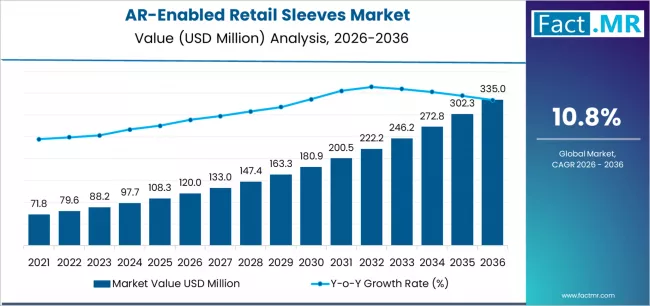
Ar Enabled Retail Sleeves Market Market Value Analysis | Source: Fact.MR
Market expansion is driven by the urgent need for brands to cut through digital clutter and create tangible, memorable consumer interactions at the point of sale. These sleeves transform static packaging into dynamic gateways for digital content, enabling immersive storytelling, detailed product demonstrations, and direct e-commerce links. This fusion of physical and digital marketing addresses the growing demand for experiential retail and measurable engagement.
Growth over the forecast period will be shaped by technological convergence and marketing sophistication. Advances in marker printing precision and smartphone app compatibility are making AR activation more seamless and reliable for consumers. Simultaneously, brands are leveraging richer data analytics from AR interactions to understand consumer behavior and personalize marketing content, elevating the sleeve from a simple packager to a critical data-driven marketing tool.
AR-Enabled Retail Sleeves Market
| Metric | Value |
|---|---|
| Estimated Value in (2026E) | USD 120.0 Million |
| Forecast Value in (2036F) | USD 335.0 Million |
| Forecast CAGR (2026 to 2036) | 10.8% |
Source: Fact.MR analysis. Updated Dec 19, 2025
Category
| Category | Segments |
|---|---|
| End-use/Application | Retail Promotions & Product Storytelling, Luxury Goods & Cosmetics, FMCG Engagement, Event Marketing, Others |
| Packaging Format/Type | Removable Retail Sleeves, Decorative AR Sleeves, Interactive Promo Sleeves, Low-cost AR Sleeves, Others |
| Material | Coated Paperboard, Virgin/Recycled Board, Coated Kraft, Recycled Paper, Others |
| Technology | AR Marker Printing & App Integration, Image-recognition AR, WeChat-integrated AR, Scan-to-AR, Others |
| Region | North America, Europe, Asia Pacific, Latin America, MEA |
Source: Fact.MR analysis. Updated Dec 19, 2025
Segmental Analysis
Why does Retail Promotions & Product Storytelling account for the leading Application Segment?
The retail promotions and product storytelling segment is projected to account for 40% of the market in 2026. This dominance is rooted in the segment's direct address of a core marketing challenge: capturing consumer attention in a crowded retail environment. AR sleeves provide an immediate, interactive value-add, turning a standard product launch or promotional campaign into an immersive experience.
Brands utilize this format for tutorials, ingredient storytelling, and gamified promotions that not only engage but also significantly increase dwell time and information retention compared to traditional packaging. The measurable engagement data from AR interactions, such as scan rates and content view duration, offers brands unprecedented insight into campaign performance at the shelf level. This data-driven justification for marketing spend solidifies the segment's value proposition.
- The need for differentiated in-store experiences and the rising cost of digital customer acquisition are pushing brand managers to invest in packaging-based engagement tools.
- This segment benefits from the flexibility of AR content, which can be updated remotely without changing the physical sleeve, allowing for dynamic, cost-effective campaign management.
What Positions Removable Retail Sleeves as the Leading Segment by Packaging Format/Type?
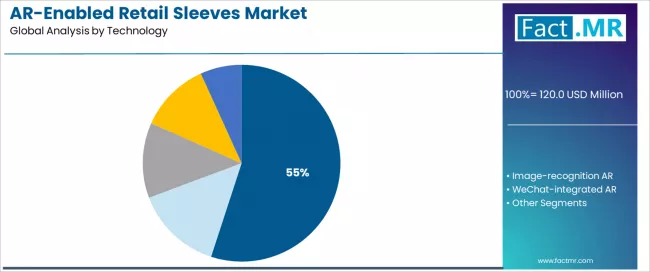
Ar Enabled Retail Sleeves Market Analysis By Technology | Source: Fact.MR
Removable retail sleeves are set to hold a 55% share by format in 2026. Their primary advantage is operational and strategic flexibility. For retailers and brands, these sleeves allow for the temporary transformation of existing packaging for seasonal campaigns, limited editions, or regional promotions without the need for costly, permanent package redesigns or separate SKU production. The sleeve can be applied post-manufacturing, enabling rapid go-to-market strategies for time-sensitive marketing initiatives.
For the consumer, the removable nature enhances perceived value; the sleeve often becomes a collectible or reusable item, extending brand interaction beyond the initial purchase. This format also addresses sustainability considerations, as it can be removed for easier recycling of the primary container.
- The format allows for efficient inventory management, as a single stock-keeping unit can be adapted for multiple marketing campaigns through different sleeve designs.
- Advances in sleeve adhesion technology ensure secure application during shipping and retail handling while still allowing for clean removal by the end-user.
What are the Drivers, Restraints, and Trends in the AR-Enabled Retail Sleeves Market?
The market is driven by brands seeking deeper consumer engagement and quantifiable marketing ROI in an omnichannel retail landscape. The proliferation of smartphone ownership and improved AR software development kits (SDKs) have lowered the technical barrier for consumer adoption.
A key restraint remains the additional per-unit cost compared to standard sleeves, requiring a clear demonstration of uplift in sales or engagement metrics to justify investment. The market is trending towards greater integration with social commerce platforms, allowing AR experiences to facilitate direct sharing and purchasing within apps like WeChat or Instagram, blurring the lines between physical retail and digital storefronts.
Analysis of the AR-Enabled Retail Sleeves Market by Key Countries
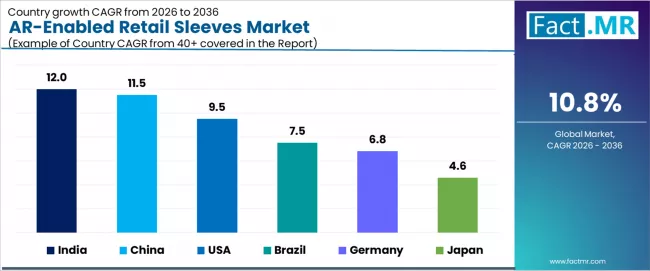
Ar Enabled Retail Sleeves Market Cagr Analysis By Country | Source: Fact.MR
| Country | CAGR (2026-2036) |
|---|---|
| India | 12.0% |
| China | 11.5% |
| USA | 9.5% |
| Brazil | 7.5% |
| Germany | 6.8% |
| Japan | 4.6% |
Source: Fact.MR analysis. Updated Dec 19, 2025
How is Digital-First Consumerism Propelling India's High-Growth Trajectory?
The market for AR-enabled retail sleeves in India is projected to expand at a leading CAGR of 12.0% through 2036. This growth is fueled by the country's vast, young, digitally-native population and the explosive growth of its FMCG and smartphone markets. Brands are aggressively adopting AR to educate consumers on product use and differentiate in highly competitive segments like personal care and snacks. The low-cost AR sleeve format is particularly viable for this price-sensitive yet tech-enthusiastic market.
- Local innovation in scan-to-AR technology, which requires less data bandwidth, is overcoming connectivity challenges and driving adoption in tier-2 and tier-3 cities.
- Major domestic FMCG companies are leveraging AR sleeves for regional language content and celebratory campaigns, creating hyper-localized engagement.
What role do Social Commerce and Premiumization Play in China's Market?
Deployment of AR-enabled retail sleeves in China is forecast to grow at a CAGR of 11.5%. The market is uniquely shaped by the dominance of integrated super-apps like WeChat. AR experiences are seamlessly built into these platforms, enabling instant social sharing, influencer collaboration, and direct e-commerce conversion from a physical package scan. In the luxury and cosmetics sector, AR sleeves are used for virtual try-ons and brand heritage storytelling, aligning with premiumization trends.
- The ecosystem allows for sophisticated data capture, linking offline package interaction with online user profiles and purchase history.
- Brands utilize AR for limited-edition launches and interactive gift-giving experiences, driving both engagement and perceived value.
How do Experiential Marketing Demands shape USA’s Market?
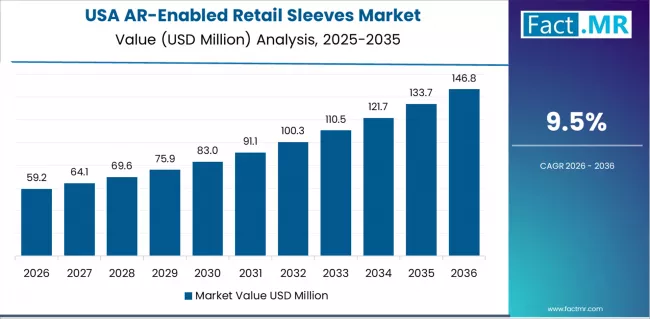
Ar Enabled Retail Sleeves Market Country Value Analysis | Source: Fact.MR
Demand for AR-enabled retail sleeves in the USA is projected to grow at a CAGR of 9.5%. Growth is driven by a mature retail sector where experiential marketing is key to attracting in-store shoppers. Brands across beverages, electronics, and entertainment use AR sleeves for immersive game promotions, exclusive video content access, and detailed product provenance stories. The focus is on creating shareable moments that generate organic social media buzz.
- The need for innovative shopper marketing solutions that deliver measurable footfall and engagement metrics is a primary driver for brand investment.
- Partnerships between packaging firms and dedicated AR software platforms (e.g., Zappar) are creating sophisticated, reliable user experiences.
How does Event Culture and Cost Innovation drive Adoption in Brazil?
AR-enabled retail sleeves deployment in Brazil is set to grow at a CAGR of 7.5%. The market is energized by the country's strong event marketing culture, where AR sleeves are used for festival merchandise, promotional giveaways, and interactive campaign launches. Brands favor the low-cost AR sleeve format to achieve high-impact engagement without the expense of permanent packaging changes. The use of recycled paper materials aligns with growing environmental awareness.
- The scan-to-AR model is popular for its simplicity, requiring minimal user instruction for activation at busy events or in retail environments.
- Local packaging converters are developing integrated solutions that combine vibrant graphics with reliable AR triggers for the fast-moving event sector.
How does Precision and Retail Efficiency define the Market for AR-Enabled Retail Sleeves Market in Germany?
The market for AR-enabled retail sleeves in Germany is projected to grow at a CAGR of 6.8%. Growth is characterized by a focus on precision engineering and measurable retail efficiency. German brands in automotive, engineering, and premium consumer goods use AR sleeves not for gamification, but for delivering precise technical specifications, assembly instructions, or detailed origin stories. The emphasis is on high-quality coated paperboard and flawless AR marker printing to ensure a premium, reliable user experience.
- Integration focuses on utility, providing tangible after-sales value and reducing the need for printed manuals, which aligns with efficiency and sustainability goals.
- Adoption is steady in retail promotions, where AR is used to demonstrate product complexity or customization options in sectors like DIY and tools.
What Defines the Niche, High-Value Applications in Japan's Market?
Demand for AR-enabled retail sleeves in Japan is expected to grow at a CAGR of 4.6%. The market is mature and defined by niche, high-value applications rather than mass adoption. Primary use is found in luxury goods, high-end cosmetics, and collectibles, where AR sleeves add a layer of exclusive digital content such as artist interviews, authentication certificates, or animated artwork that reinforces product rarity and value. The focus is on exquisite material quality and subtle, sophisticated AR integration.
- Adoption is careful and quality-driven, with a preference for virgin/recycled board that offers superior print fidelity for the intricate designs common in this market.
- AR experiences are often designed for quiet immersion and deep storytelling, reflecting local consumer preferences for detailed, respectful brand interactions.
Competitive Landscape of the AR-Enabled Retail Sleeves Market
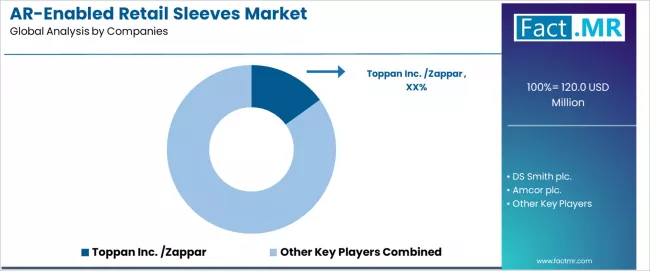
Ar Enabled Retail Sleeves Market Analysis By Company | Source: Fact.MR
The landscape is defined by partnerships between traditional packaging giants and specialized AR technology firms. Packaging companies like Toppan and DS Smith contribute expertise in high-quality printing, material science, and global supply chains. AR tech partners like Zappar provide the software platform, app development, and content management systems.
Competition centers on the seamless integration of physical and digital design, the reliability of the AR trigger mechanism, and the richness of the analytics dashboard provided to brands. Key players are developing proprietary marker technologies for better scan reliability and exploring sustainable material options for sleeves to align with broader corporate ESG goals.
Key Players in the AR-Enabled Retail Sleeves Market
- Toppan Inc.
- Zappar
- DS Smith plc.
- Amcor plc.
- UFlex
- Klabin
- Miyako Paper
Segmentation
Scope of the Report
| Items | Values |
|---|---|
| Quantitative Units (2026) | USD 120.0 Million |
| End-use/Application | Retail Promotions & Product Storytelling, Luxury Goods & Cosmetics, FMCG Engagement, Event Marketing, Others |
| Packaging Format/Type | Removable Retail Sleeves, Decorative AR Sleeves, Interactive Promo Sleeves, Low-cost AR Sleeves, Others |
| Material | Coated Paperboard, Virgin/Recycled Board, Coated Kraft, Recycled Paper, Others |
| Technology | AR Marker Printing & App Integration, Image-recognition AR, WeChat-integrated AR, Scan-to-AR, Others |
| Regions Covered | North America, Europe, Asia Pacific, Latin America, MEA |
| Key Companies Profiled | Toppan Inc., Zappar, DS Smith plc., Amcor plc., UFlex, Klabin, Miyako Paper, and other leading players |
| Additional Attributes | Market share analysis, case studies of AR campaign ROI, analysis of technology integration costs, insights into content management platforms and consumer engagement metrics. |
Source: Fact.MR analysis. Updated Dec 19, 2025
AR-Enabled Retail Sleeves Market by Segments
-
By End-use/Application :
- Retail Promotions & Product Storytelling
- Luxury Goods & Cosmetics
- FMCG Engagement
- Event Marketing
- Others
-
By Packaging Format/Type :
- Removable Retail Sleeves
- Decorative AR Sleeves
- Interactive Promo Sleeves
- Low-cost AR Sleeves
- Others
-
By Material :
- Coated Paperboard
- Virgin/Recycled Board
- Coated Kraft
- Recycled Paper
- Others
-
By Technology :
- AR Marker Printing & App Integration
- Image-recognition AR
- WeChat-integrated AR
- Scan-to-AR
- Others
-
By Region :
-
North America
- USA
- Canada
- Mexico
-
Europe
- Germany
- UK
- France
- Italy
- Spain
- Nordic Countries
- BENELUX
- Rest of Europe
-
Asia Pacific
- China
- India
- Japan
- South Korea
- Australia
- Rest of Asia Pacific
-
Latin America
- Brazil
- Argentina
- Rest of Latin America
-
MEA
- Saudi Arabia
- UAE
- South Africa
- Rest of MEA
-
Frequently Asked Questions
How big is the AR-enabled retail sleeves market in 2026?
What will be the size of AR-enabled retail sleeves market in 2036?
How much will be the AR-enabled retail sleeves market growth between 2026 and 2036?
What are the key product types in the AR-enabled retail sleeves market?
Which packaging format/type segment to contribute significant share in the AR-enabled retail sleeves market in 2026?
Who worked on this report


Preview the report firsthand - request a free sample
Free SampleGet the brochure for pricing and purchase details
Download PDF