- Market Value (2025): USD 801.1 Mn
- Estimated Value (2026): USD 910.0 Mn
- Forecast Value (2036): USD 3257.1 Mn
- CAGR (2026-2036): 13.6%
What is the Architectural BMB Additives Market forecast to be worth by 2036?
USD 910.0 million in 2026 to USD 3257.1 million by 2036 at a 13.6% CAGR.
- The Architectural BMB Additives Market reached USD 801.1 million in 2025.
- Demand is projected to increase from USD 910.0 million in 2026 to USD 3257.1 million by 2036.
- The market is forecast to record 13.6% CAGR from 2026 to 2036 as paint formulators, architectural-coating producers, raw-material distributors and building-product specifiers expand qualified purchasing and deployment.
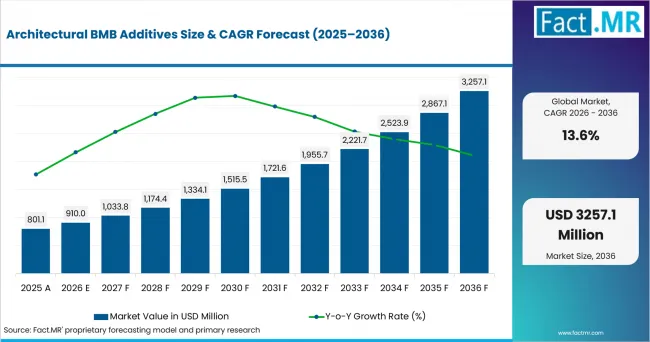
Architectural Bmb Additives Value Analysis | Source: Fact.MR
What are the defining numbers behind Architectural BMB Additives Market growth?
An absolute opportunity of USD 2347.1 million is expected between 2026 and 2036.
- Demand Drivers in the Market
- Certified biomass-balanced architectural-coating additives are commercially available with lower product-carbon-footprint claims while retaining the performance of corresponding conventional grades, reducing the need for reformulation in some product families.
- Waterborne architectural coatings continue to use rheology, pigment-wetting and foam-control additives; supplier portfolios now include biomass- or mass-balance grades for these functions.
- ISCC PLUS provides chain-of-custody options, including mass balance, for tracking alternative feedstocks through certified supply chains.
- Key Segments Analyzed
- By Additive Type: Rheology modifiers are expected to hold 29.0% share in 2026 because architectural paints require controlled low-shear stability, brush loading, roller-spatter control and sag resistance across extended shelf life.
- By Paint Platform: Waterborne acrylic is projected to account for 44.0% share in 2026 as its broad interior and exterior use creates sustained demand for wetting, foam-control and rheology additives.
- By BMB Claim: Mass-balance renewable is anticipated to capture 54.0% share in 2026 because mass-balance chain-of-custody systems allow certified and non-certified materials to be physically mixed while certified quantities are tracked through verifiable bookkeeping.
- By Application: Interior wall paint is estimated to represent 37.0% share in 2026 because high production volumes and close attention to odor, application behavior and environmental claims create strong demand for performance-enhancing additives.
- Analyst Opinion at Fact.MR
- Shambhu Nath Jha, Principal Consultant, Fact.MR, states, "Biomass balance will gain credibility only when formulation performance and claim documentation travel together. Coating makers want carbon reduction that does not destabilize viscosity, color development or application behavior."
- Strategic Implications
- Evidence packages supporting verified low-PCF additive packages should draw selectively on performance coating additives test and service practices relevant to formulation credibility for renewable-content claims.
- Engineering teams working on waterborne formulation drop-ins can benchmark paints and coatings only where the comparison improves execution of formulation credibility for renewable-content claims.
- Supplier claims for EPD-linked paint programs become more credible when checked against specialty coating binders methods that support formulation credibility for renewable-content claims.
- To position certified circular-bio blends precisely, commercial teams can contrast it with polyurethane dispersion materials and keep the discussion centered on formulation credibility for renewable-content claims.
- Product roadmaps built around verified low-PCF additive packages should be compared with automotive coating technologies before interfaces affecting formulation credibility for renewable-content claims are frozen.
How does the Architectural BMB Additives Market break down by segment?
The Architectural BMB Additives Market is analyzed by Additive Type, Paint Platform, BMB Claim, and Application.
Why does Rheology modifiers lead Additive Type?
The Rheology modifiers category holds 29.0% share of Additive Type in 2026.
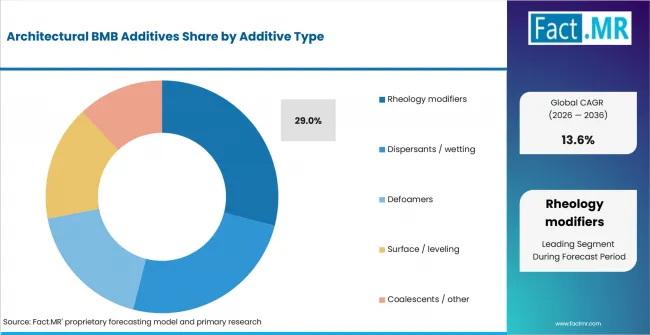
Architectural Bmb Additives Analysis By Additive Type | Source: Fact.MR
Architectural paints depend on controlled low-shear stability, brush loading, roller spatter and sag resistance across long shelf lives. The lead over Dispersants / wetting comes from application breadth, not from the segment name itself.
Recurring Rheology modifiers demand depends on a workable handoff between product and service. That means delivering verified low-PCF additive packages without leaving paint formulators, architectural-coating producers, raw-material distributors and building-product specifiers to absorb certificate and allocation complexity.
Why does Waterborne acrylic lead Paint Platform?
The Waterborne acrylic category accounts for 44.0% share of Paint Platform in 2026.
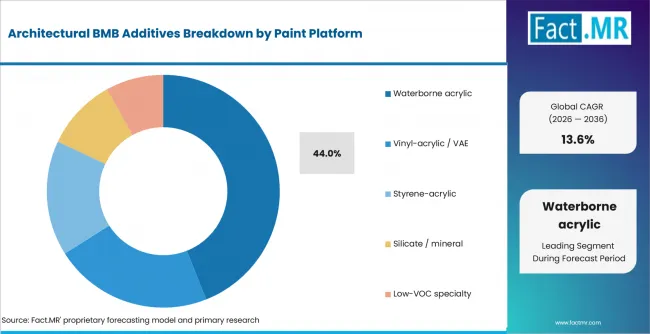
Architectural Bmb Additives Analysis By Paint Platform | Source: Fact.MR
Waterborne acrylic paint combines broad exterior and interior use with an established need for wetting, foam and rheology additives. Vinyl-acrylic / VAE remains technically credible, but buyer evaluation of formulation credibility for renewable-content claims maps more closely to Waterborne acrylic.
The route from specification to volume is shaped by waterborne formulation drop-ins, not by headline share alone. Buyers will still test Waterborne acrylic against renewable feedstock premiums and the economics of formulation credibility for renewable-content claims.
Why does Mass-balance renewable lead BMB Claim?
The Mass-balance renewable category leads with 54.0% share of BMB Claim in 2026.
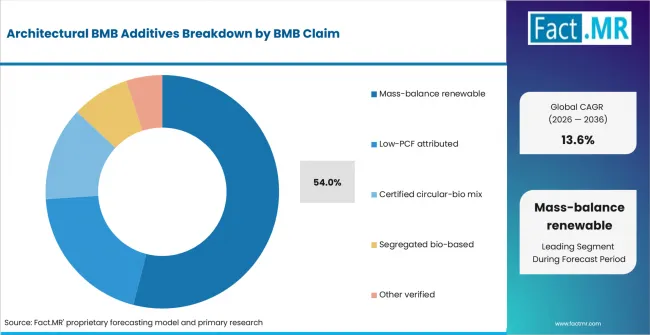
Architectural Bmb Additives Analysis By Bmb Claim | Source: Fact.MR
Under ISCC PLUS mass balance, certified and non-certified materials can be physically mixed while certified quantities and sustainability characteristics are controlled through verifiable bookkeeping.
The commercial test for Mass-balance renewable is whether EPD-linked paint programs can be documented without allowing claim comparability to erode the buyer case. That is especially relevant to paint formulators, architectural-coating producers, raw-material distributors and building-product specifiers.
Why does Interior wall paint lead Application?
The Interior wall paint category holds 37.0% share of Application in 2026.
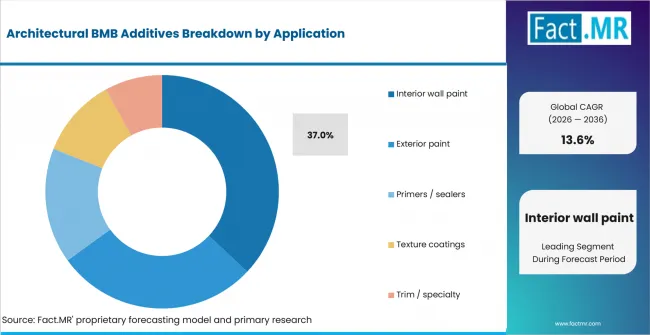
Architectural Bmb Additives Analysis By Application | Source: Fact.MR
Interior wall paint is produced at high volume and is closely scrutinized for odor, application behavior and environmental claims. Specifications built around Exterior paint address narrower cases, while the purchasing logic for Interior wall paint reaches further across application decisions.
The lead held by Interior wall paint can persist when vendors connect the category with certified circular-bio blends. Commercial momentum weakens where customer requalification cycles transfer excessive risk to the customer.
What is accelerating Architectural BMB Additives Market adoption, and what is holding it back?
Adoption is supported by lower-PCF formulation goals, continuing demand for rheology, wetting and foam-control functions, and ISCC PLUS chain-of-custody routes for alternative feedstocks. Expansion is constrained by certificate and allocation complexity, renewable feedstock premiums, claim comparability, and customer requalification cycles.
Drivers Impact Analysis
| DRIVER | (~) % IMPACT ON CAGR | GEOGRAPHIC RELEVANCE | IMPACT TIMELINE |
|---|---|---|---|
| Certified BMB additives can lower PCF without reformulation | +2.4% | Global | Short term (<= 2 years) |
| Waterborne coatings require rheology, wetting and foam control | +1.9% | Germany and USA | Medium term (2-4 years) |
| ISCC PLUS provides mass-balance chain-of-custody tracking | +1.5% | USA and France | Long term (>= 4 years) |
Opportunity Impact Analysis
| OPPORTUNITY | (~) % IMPACT ON CAGR | GEOGRAPHIC RELEVANCE | IMPACT TIMELINE |
|---|---|---|---|
| Verified low-PCF additive packages | +1.6% | Global | Medium term (2-4 years) |
| Waterborne formulation drop-ins | +1.4% | Germany and USA | Short term (<= 2 years) |
| EPD-linked paint programs | +1.1% | USA and France | Long term (>= 4 years) |
| Certified circular-bio blends | +0.8% | Global | Medium term (2-4 years) |
Restraints Impact Analysis
| RESTRAINT | (~) % IMPACT ON CAGR | GEOGRAPHIC RELEVANCE | IMPACT TIMELINE |
|---|---|---|---|
| Certificate and allocation complexity | -1.2% | Global | Short term (<= 2 years) |
| Renewable feedstock premiums | -1.0% | Germany and USA | Medium term (2-4 years) |
| Claim comparability | -0.7% | Global | Long term (>= 4 years) |
| Customer requalification cycles | -0.5% | France and Netherlands | Medium term (2-4 years) |
Which countries are scaling the Architectural BMB Additives Market through 2036?
- Germany: Growth of 12.4% reflects a route to market built around verified low-PCF additive packages; certificate and allocation complexity remains the near-term watchpoint.
- USA: The expected 14.7% pace is supported by waterborne formulation drop-ins, although renewable feedstock premiums can still delay scale.
- France: The demand case, measured at 14.4%, is strongest around Mass-balance renewable and projects requiring EPD-linked paint programs.
- Netherlands: The 12.8% trajectory is application-led. Buyers are expected to use Interior wall paint as a reference while assessing certified circular-bio blends.
- UK: The 17.4% outlook is tied to verified low-PCF additive packages, with Rheology modifiers gaining attention where certificate and allocation complexity can be contained.
The five markets illustrate distinct demand mechanisms rather than one global rollout pattern. The regional lens also includes North America, Latin America, Western Europe, Eastern Europe, East Asia, South Asia & Pacific, and Middle East & Africa. These pathways frame the Architectural BMB Additives Market outlook.
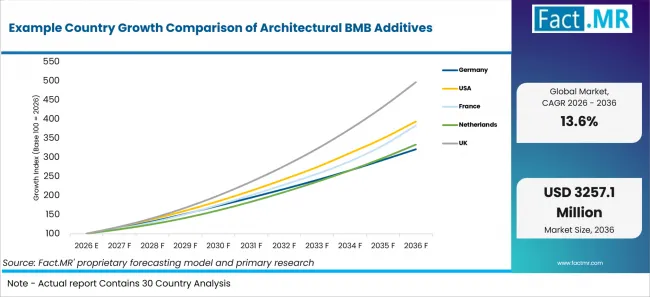
Example Country Growth Comparison Of Architectural Bmb Additives | Source: Fact.MR
| Country | CAGR (2026-2036) |
|---|---|
| Germany | 12.4% |
| USA | 14.7% |
| France | 14.4% |
| Netherlands | 12.8% |
| UK | 17.4% |
What is driving Germany's growth through 2036?
Germany's market trajectory is 12.4% CAGR between 2026 and 2036.
EU Directive 2004/42/EC sets maximum VOC-content limits for specified paints and varnishes placed on the EU market. In Germany, the Directive is implemented through the ChemVOCFarbV, providing a regulatory framework for lower-VOC coating formulations.
The conversion from interest to revenue depends on verified low-PCF additive packages. In parallel, paint formulators, architectural-coating producers, raw-material distributors and building-product specifiers will scrutinize certificate and allocation complexity before widening deployment.
What is driving USA's growth through 2036?
Demand in the USA is expected to rise at 14.7% CAGR through 2036.
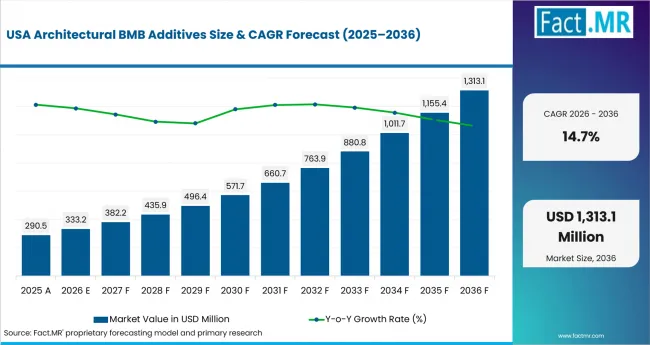
Architectural Bmb Additives Country Value Analysis | Source: Fact.MR
U.S. EPA's architectural-coatings rule generally requires manufacturers and importers of covered architectural coatings to comply with applicable VOC-content limits, subject to specified exceedance-fee and tonnage-exemption provisions.
Adoption will still be uneven. Orders should favor applications where formulation credibility for renewable-content claims is measurable and renewable feedstock premiums can be assigned before contract award.
What is driving France's growth through 2036?
At 14.4% CAGR, France develops around a market-specific mix of qualification and deployment.
France applies VOC-content requirements for specified paints and varnishes under EU Directive 2004/42/EC, which has been transposed into French law. These requirements provide a regulatory backdrop for lower-VOC coating formulation. Any linkage to EPD-related paint programs or mass-balance additives represents separate market analysis rather than a conclusion of Directive 2004/42/EC.
Suppliers still face a local proof burden. They must show paint formulators, architectural-coating producers, raw-material distributors and building-product specifiers how the offer manages claim comparability across installation, operation and service.
What is driving Netherlands' growth through 2036?
The ten-year forecast for Netherlands is 12.8% CAGR, with formulation credibility for renewable-content claims setting the direction.
Coatings marketed in the Netherlands that fall within the scope of EU Directive 2004/42/EC are subject to applicable VOC-content limits. Separately, ISCC PLUS provides a voluntary certification framework with mass balance as one of its chain-of-custody methods for tracking alternative feedstocks.
Commercial expansion depends on certified circular-bio blends. It also depends on how convincingly suppliers address customer requalification cycles for buyers working under local technical and budget rules.
What is driving UK's growth through 2036?
17.4% CAGR through 2036, shaped by formulation credibility for renewable-content claims.
UK regulations set maximum VOC-content limits for specified decorative paints and varnishes. These requirements provide a regulatory backdrop for the formulation of architectural coatings.
The second clue comes from purchasing. Buyers will reward verified low-PCF additive packages only if the commercial package documents control of certificate and allocation complexity.
Who leads the Architectural BMB Additives Market?
Publicly evidenced suppliers with relevant biomass-balance or mass-balance coating offerings include BASF, Evonik, Clariant, and Arkema.
Market positions are shaped by the ability to move from additive performance to a supported commercial solution. That favors companies with credible channels into paint formulators, architectural-coating producers, raw-material distributors and building-product specifiers. This is the competitive frame for the Architectural BMB Additives Market.
In this market, verified low-PCF additive packages create the opening, while offers exposed to certificate and allocation complexity tend to remain one-off projects.
Which companies are the key providers?
Key companies include BASF, Evonik, Clariant, Arkema.
- BASF
- Evonik
- Clariant
- Arkema
Bibliography
- BASF. (2026, July 13). BASF expands certified biomass-balanced additives portfolio for architectural coatings.
- Evonik. (2025, March 12). Evonik Coating Additives launches first mass balanced products for coatings and inks.
- Clariant. (2026, April 30). Hostaphat 1309 MB Terra.
- Arkema. (2025, July 8). Arkema achieves mass balance ISCC PLUS certification at its coating resin facility in Navi Mumbai (India).
- ISCC System GmbH. (2026). ISCC PLUS: Chain of custody [Presentation].
- European Parliament, & Council of the European Union. (2004, April 21). Directive 2004/42/EC of the European Parliament and of the Council of 21 April 2004 on the limitation of emissions of volatile organic compounds due to the use of organic solvents in certain paints and varnishes and vehicle refinishing products and amending Directive 1999/13/EC.
- U.S. Environmental Protection Agency. (2026, March 4). Architectural Coatings: National Volatile Organic Compounds Emission Standards.
- Regulatory Policy Committee. (2025, March 11). RPC opinion: The Volatile Organic Compounds in Paints, Varnishes and Vehicle Refinishing Products Regulations 2012, post implementation review.
This Report Answers
- The report explains how the Architectural BMB Additives Market develops across Additive Type and Paint Platform.
- Segment analysis identifies Rheology modifiers and Waterborne acrylic as the principal 2026 reference points.
- Country analysis examines Germany, USA, France, Netherlands, and UK.
- Competitive analysis reviews BASF, Evonik, Clariant, Arkema.
- Opportunity analysis covers verified low-PCF additive packages, waterborne formulation drop-ins, EPD-linked paint programs, and certified circular-bio blends.
- Risk analysis evaluates certificate and allocation complexity, renewable feedstock premiums, claim comparability, and customer requalification cycles.
What does the Architectural BMB Additives Market cover?
The Architectural BMB Additives Market covers rheology modifiers, dispersants, defoamers, surface additives and coalescent systems sold with eligible biomass-balance or related verified claims.
Commercial coverage follows purchases made by paint formulators, architectural-coating producers, raw-material distributors and building-product specifiers. Revenue is counted when the qualifying product, platform or integrated system is supplied for an in-scope application.
What is included in the scope?
The scope includes rheology modifiers, dispersants, defoamers, surface additives and coalescent systems sold with eligible biomass-balance or related verified claims across Additive Type, Paint Platform, BMB Claim, and Application.
Inclusions extend to configuration and integration elements that are inseparable from the in-scope commercial offer. The boundary is applied consistently across Germany, USA, France, Netherlands, and UK and the seven global regions.
What is excluded from the scope?
The scope excludes conventional additives without an eligible claim, finished paint revenue, unverified carbon-neutral marketing and segregated bio-based binders sold outside additive packages.
Adjacent categories enter the Architectural BMB Additives Market only when the sold product or service performs the defining function described above. This prevents broader equipment, chemical, software or project revenue from being counted twice.
How Was the Analysis Built?
The analysis draws on 120+ sources, 35+ company portfolios, 25+ countries, and more than 20 industry interviews.
- Primary Research: Primary research includes discussions with manufacturers, service providers, technology developers, distributors, end users, and subject-matter experts. These conversations examine purchasing priorities, product adoption, operational challenges, approval requirements, competitive positioning, and the factors that influence wider market acceptance.
- Desk Research: Desk research covers government statistics, regulatory publications, company filings, trade data, technical studies, industry associations, standards, public policy, and other authoritative sources. Every source used in the analysis is documented in the bibliography.
- Market Sizing and Forecasting: Market estimates combine historical performance, demand indicators, pricing and volume trends, segment shares, company participation, country-level growth, adoption patterns, investment activity, and barriers to market expansion.
- Data Validation and Update Cycle: Findings are validated by comparing primary interviews with public data, company activity, regulatory changes, trade patterns, and industry developments. Regular updates review new product launches, capacity changes, partnerships, approvals, and shifts in commercial adoption.
What is the report's scope and coverage?
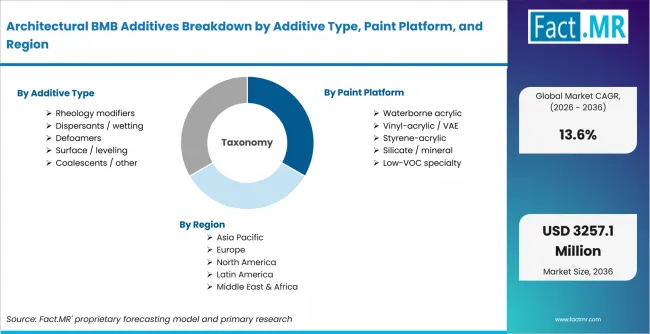
Architectural Bmb Additives Breakdown By Additive Type, Paint Platform, And Region | Source: Fact.MR
| Attribute | Details |
|---|---|
| Quantitative Units | USD Million |
| Market Definition | Architectural-coating additives carrying biomass-balanced, mass-balance renewable or comparable verified low-carbon feedstock attribution. |
| Additive Type | Rheology modifiers; Dispersants / wetting; Defoamers; Surface / leveling; Coalescents / other |
| Paint Platform | Waterborne acrylic; Vinyl-acrylic / VAE; Styrene-acrylic; Silicate / mineral; Low-VOC specialty |
| BMB Claim | Mass-balance renewable; Low-PCF attributed; Certified circular-bio mix; Segregated bio-based; Other verified |
| Application | Interior wall paint; Exterior paint; Primers / sealers; Texture coatings; Trim / specialty |
| Regions Covered | North America; Latin America; Western Europe; Eastern Europe; East Asia; South Asia & Pacific; Middle East & Africa |
| Countries Covered | Germany; USA; France; Netherlands; UK |
| Key Companies | BASF; Evonik; Clariant; Arkema |
| Forecast Period | 2026 to 2036 |
| Approach | Hybrid top-down and bottom-up assessment using Additive Type, Paint Platform, BMB Claim, and Application, country deployment, replacement demand and company participation. |
How is the market segmented?
-
By Additive Type
- Rheology modifiers
- Dispersants / wetting
- Defoamers
- Surface / leveling
- Coalescents / other
-
By Paint Platform
- Waterborne acrylic
- Vinyl-acrylic / VAE
- Styrene-acrylic
- Silicate / mineral
- Low-VOC specialty
-
By BMB Claim
- Mass-balance renewable
- Low-PCF attributed
- Certified circular-bio mix
- Segregated bio-based
- Other verified
-
By Application
- Interior wall paint
- Exterior paint
- Primers / sealers
- Texture coatings
- Trim / specialty
-
By Region
- North America
- Latin America
- Western Europe
- Eastern Europe
- East Asia
- South Asia & Pacific
- Middle East & Africa