- Market Value (2025): USD 4.5 Bn
- Estimated Value (2026): USD 4.8 Bn
- Forecast Value (2036): USD 7.9 Bn
- CAGR (2026-2036): 5.2%
What is the Architectural Additive Modifiers Market forecast to be worth by 2036?
USD 7.9 billion by 2036 at a 5.2% CAGR.
- 2025 market value: USD 4.5 billion.
- 2026 to 2036 value progression: USD 4.8 billion to USD 7.9 billion.
- 2026 to 2036 CAGR: 5.2%.
What are the defining numbers behind Architectural Additive Modifiers Market growth?
The market is expected to create an absolute opportunity of USD 3.2 billion between 2026 and 2036.
- Demand Drivers in the Market
- Waterborne and lower-VOC architectural paints require more precise formulation control because replacing organic solvent changes viscosity development, pigment wetting, foam behavior and film formation. The U.S. Environmental Protection Agency regulates VOCs in architectural coatings under the Clean Air Act, while the EU Decopaint Directive sets VOC limits for categories such as interior wall paints, exterior wall coatings and primers. These requirements increase formulation work around rheology modifiers, dispersants, defoamers and surface-control additives.
- The shift is especially relevant to the wider architectural coatings value chain because formulators must preserve hiding, flow and washability while reducing volatile content. Modifier suppliers therefore gain demand when a paint maker reformulates an existing product, develops a new waterborne grade or localizes a formulation for a different regulatory market.
- Building renovation creates recurring repaint demand even when new construction slows. The European Commission states that roughly 75% of EU buildings have poor energy performance and that the annual energy-renovation rate is around 1%, with policy aimed at increasing the pace of renovation. Renovation work frequently triggers interior repainting, façade renewal, primer use and surface repair, creating repeat consumption of architectural additives through the coatings applied after building work.
- Environmental product criteria are tightening around ingredient safety as well as VOC content. The European Commission adopted revised EU Ecolabel criteria for decorative paints and related products in December 2025, valid through 2032, with requirements covering reduced hazardous substances, lower VOC content and verified performance. This creates demand for additives that can meet low-emission and restricted-substance requirements without causing defects or forcing large formulation changes.
- Key Segments Analyzed
- Modifier Type: Rheology modifiers account for 30.0% in 2026 as wall paints need controlled storage viscosity and leveling across different shear conditions.
- Paint Platform: Waterborne acrylic holds 42.0% in 2026 as low-VOC architectural systems rely on acrylic dispersions and compatible additives to maintain application and film performance.
- Performance Target: Application rheology represents 27.0% in 2026 because brush and spray behavior directly affects film build, spatter, sag and finish quality at the point of use.
- Application: Interior wall paints account for 38.0% in 2026 because frequent repainting and broad residential and commercial use create recurring demand for viscosity and preservation additives.
- Analyst Opinion at Fact.MR
- “Architectural paint formulators are buying modifiers to solve connected problems inside the same can. A change made to reduce VOCs, improve tint acceptance or remove a restricted ingredient can alter viscosity, foam and leveling at the same time. Suppliers that can show compatibility across the full formulation and shorten qualification work will have a stronger route into recurring paint programs,” says Shambhu Nath Jha, Principal Consultant, Fact.MR.
- Strategic Implications
- Paint manufacturers should qualify additive packages as a system rather than optimize each additive in isolation. Rheology, pigment dispersion, foam control and surface wetting interact with binder chemistry, pigment loading, pH and application method. A modifier that improves one property can shift another, so laboratory screening should reproduce the actual shear profile and tinting conditions of the finished paint.
- Additive suppliers should build technical service around waterborne compatibility and low-emission reformulation. Buyers need evidence that a modifier works across acrylic, vinyl-acrylic and styrene-acrylic platforms while retaining color development and application consistency. This expands the value of adjacent coating additives portfolios that combine rheology, wetting, dispersion and foam-control functions.
- Procurement teams should also weigh formulation efficiency against nominal additive price. A higher-efficiency rheology modifier or dispersant can reduce dosage, improve pigment use or lower rework from foam and application defects. The purchase decision therefore depends on total formulation performance and production reliability rather than cost per kilogram alone.
How does the Architectural Additive Modifiers Market break down by segment?
The market is segmented by Modifier Type, Paint Platform, Performance Target and Application.
Why do Rheology modifiers lead Modifier Type?
Rheology modifiers account for 30.0% of Modifier Type in 2026.
Architectural paints must remain stable in the can, load onto a brush or roller, spread under shear, and then recover structure quickly enough to resist sagging on a vertical wall. This gives rheology control a direct role in both manufacturing stability and application quality.
Research published in Progress in Organic Coatings on waterborne architectural paints shows that rheological properties are central to flow-leveling and sag resistance, while cellulosic and associative thickeners create different application profiles. Current supplier portfolios reflect this same operating need: Dow and BASF offer rheology modifiers targeted at low-, medium- and high-shear behavior in waterborne architectural systems.
This makes rheology modifiers a broad formulation tool rather than a single-function thickener. Their role overlaps with the architectural rheology market where formulators balance storage structure, spatter control, brush drag, film build and leveling across different paint grades.
Why does Waterborne acrylic lead Paint Platform?
Waterborne acrylic accounts for 42.0% of Paint Platform in 2026.
Acrylic dispersions provide a versatile base for interior and exterior architectural paints, while waterborne processing aligns with VOC limits applied to decorative coatings in the USA and Europe.
The regulatory shift changes the job of modifiers. Waterborne formulations depend on dispersants to keep pigments separated, rheology modifiers to shape shear response, defoamers to control air entrainment and wetting additives to improve substrate and pigment interaction. Dow currently markets ACRYSOL rheology modifiers specifically for water-based architectural paints, including grades designed for low-VOC formulations and acrylic binder systems.
Waterborne acrylic also increases the importance of wetting agents because pigment incorporation and long-term dispersion must be achieved without relying on solvent-rich formulation routes. This supports a broader package of modifiers around the acrylic binder rather than a single additive choice.
Why does Application rheology lead Performance Target?
Application rheology accounts for 27.0% of Performance Target in 2026.
Architectural paint is commonly applied by brush, roller or spray, so viscosity must change predictably across different shear conditions and then recover after the coating reaches the wall. Poor control can create spatter, brush marks, sagging or uneven film build.
BASF states that its water-based rheology modifiers are used to reduce dripping and spattering while improving sag resistance through controlled viscosity recovery. Dow similarly positions HEUR and HASE modifiers around roller loading, flow, leveling and film build. These application outcomes are directly visible to contractors and consumers, which keeps rheology performance close to the purchasing decision.
The requirement becomes more demanding when a paint is tinted or reformulated for lower VOC content because pigment concentration, surfactants and binder interactions can change the shear profile. Formulators therefore test application rheology as a complete system rather than rely on in-can viscosity alone.
Why do Interior wall paints lead Application?
Interior wall paints account for 38.0% of Application in 2026.
They are used across residential, commercial and institutional spaces and face frequent repaint cycles compared with many exterior surfaces. The volume base creates recurring consumption of rheology modifiers, dispersants, defoamers and preservation chemistry.
Interior formulations also face tight expectations for odor, spatter, touch-up, washability and finish uniformity. The European Commission’s revised EU Ecolabel criteria for decorative paints combine lower hazardous-substance and VOC requirements with performance testing for indoor and outdoor use, reinforcing the need for additives that maintain application quality while meeting environmental criteria.
Interior paints also use broad tinting systems, which increases the need for stable pigment dispersion and color acceptance. That connects interior-wall demand with substrate wetting and related wetting technologies used to prevent application defects and improve uniform film formation.
What is accelerating Architectural Additive Modifiers Market adoption, and what is holding it back?
Adoption is being accelerated by waterborne reformulation, building renovation and tighter environmental product criteria. The main restraint is formulation sensitivity. Preservation and restricted-substance requirements create another constraint.
Drivers Impact Analysis
| Factor | (~) % Impact on CAGR | Geographic Relevance | Impact Timeline |
|---|---|---|---|
| Waterborne and lower-VOC reformulation | +0.9% | USA and Europe | Near to Long term (2026-2036) |
| Building renovation and recurring repaint demand | +0.7% | Europe and North America | Near to Long term (2026-2036) |
| Eco-label and safer-ingredient formulation requirements | +0.5% | Europe and premium global paint lines | Near to Mid term (2026-2032) |
Source: Fact.MR analysis. Updated Sep 7, 2026
Opportunity Impact Analysis
| Factor | (~) % Impact on CAGR | Geographic Relevance | Impact Timeline |
|---|---|---|---|
| Multifunctional modifier packages for waterborne paints | +0.6% | Global architectural paint producers | Mid term (2029-2032) |
| Biocide-free, APEO-free and lower-hazard additive grades | +0.5% | Europe and USA | Near to Mid term (2026-2032) |
| High-performance modifiers for renovation-grade coatings | +0.4% | Europe and mature housing markets | Mid to Long term (2029-2036) |
Source: Fact.MR analysis. Updated Sep 7, 2026
Restraints Impact Analysis
| Factor | (~) % Impact on CAGR | Geographic Relevance | Impact Timeline |
|---|---|---|---|
| Binder, pigment and additive compatibility complexity | -0.5% | Global formulators | Near to Long term (2026-2036) |
| Restricted-substance and preservation reformulation burden | -0.3% | Europe and regulated markets | Near to Mid term (2026-2032) |
| Qualification time and cost pressure in value paint grades | -0.2% | Global | Near term (2026-2028) |
Source: Fact.MR analysis. Updated Sep 7, 2026
Which countries are scaling the Architectural Additive Modifiers Market through 2036?
- USA: A large ongoing construction and improvement base supports recurring demand for interior and exterior coatings, while federal VOC rules keep waterborne and lower-emission formulation work active.
- Germany: Federal building-efficiency funding continues to support renovation of existing residential and non-residential buildings, creating repaint and surface-renewal work alongside demanding European coatings rules.
- France: MaPrimeRénov’ continues to move households into renovation projects, which can generate downstream demand for primers, wall paints and façade coatings after energy and building-envelope work is completed.
- UK: The Warm Homes Plan targets upgrades across an ageing building stock, supporting refurbishment activity where repainting and interior finishing are part of the wider renovation cycle.
- Italy: Tax-supported building efficiency and housing-renovation programs continue to generate work on existing properties, supporting decorative coatings demand tied to refurbishment and façade renewal.
Country CAGR (2026-2036)
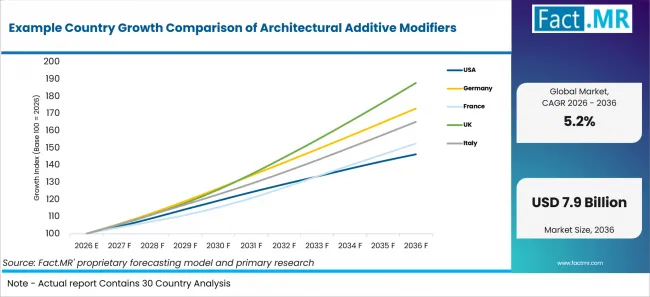
Example Country Growth Comparison Of Architectural Additive Modifiers | Source: Fact.MR
| Country | CAGR (2026-2036) |
|---|---|
| USA | 3.9% |
| Germany | 5.6% |
| France | 4.3% |
| UK | 6.5% |
| Italy | 5.1% |
Source: Fact.MR analysis. Updated Sep 7, 2026
What is driving USA's growth through 2036?
The USA is projected to expand at a 3.9% CAGR through 2036.
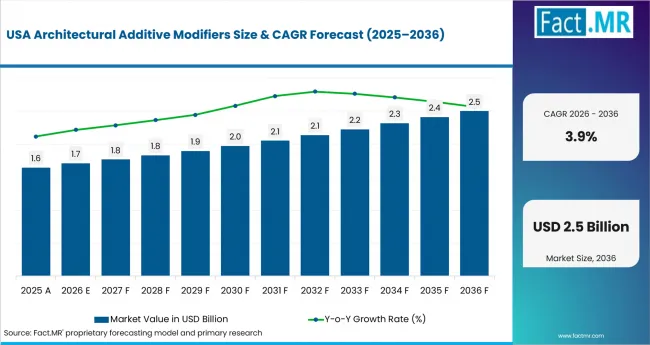
Architectural Additive Modifiers Country Value Analysis | Source: Fact.MR
The U.S. Census Bureau reported private residential construction at a seasonally adjusted annual rate of USD 859.0 billion in July 2026, while its construction-spending survey also captures improvements to existing structures. This gives architectural coatings a broad base across new work, maintenance and refurbishment.
VOC rules add a formulation-specific mechanism. The U.S. Environmental Protection Agency regulates VOCs in architectural coatings under the Clean Air Act. Paint producers therefore continue to optimize waterborne systems and low-VOC grades, creating recurring qualification demand for rheology modifiers, dispersants, defoamers and surface-control additives.
What is driving Germany's growth through 2036?
Germany is projected to expand at a 5.6% CAGR through 2036.
In July 2026, KfW updated the Federal Funding for Efficient Buildings program while continuing support for renovation of existing residential and non-residential properties. Eligible renovation programs explicitly target buildings that have been in use for several years, keeping refurbishment activity focused on the installed building stock.
The Federal Ministry for Economic Affairs and Energy also confirmed in July 2026 that building renovation support would continue under the reformed program. For architectural paint formulators, renovation creates demand for primers, interior repainting and exterior surface renewal, while EU VOC and ecolabel requirements favor additive packages compatible with waterborne and low-emission paints.
What is driving France's growth through 2036?
France is projected to expand at a 4.3% CAGR through 2036.
The National Housing Agency reported that 110,835 homes were renovated through MaPrimeRénov’ in the first half of 2026, including 41,409 extensive renovations. These projects support demand for finishing materials after insulation, envelope or interior improvement work.
France Rénov’ also consolidated access to housing-improvement support through a unified personal account in August 2026. Easier access to renovation assistance can support a continuing project pipeline, giving architectural coatings producers a stable refurbishment channel for interior wall paints, exterior coatings, primers and related additive systems.
What is driving UK's growth through 2036?
The UK is projected to expand at a 6.5% CAGR through 2036.
The government’s Warm Homes Plan, published in January 2026 and updated in March, is designed to upgrade homes and improve the performance of an ageing building stock. Renovation programs create downstream finishing demand as walls, ceilings and façades are repaired or renewed after retrofit work.
The English Housing Survey reported approximately 25.0 million households in self-contained accommodation in 2024-25. This broad installed housing base supports recurring repaint cycles and maintenance demand, while low-odor and waterborne formulation requirements increase the value of rheology, dispersion and foam-control additives in interior paints.
What is driving Italy's growth through 2036?
Italy is projected to expand at a 5.1% CAGR through 2036.
ENEA’s 2026 report on tax deductions for energy efficiency tracks 2025 interventions under Ecobonus, Bonus Casa and SuperEcobonus, confirming that renovation incentives remain linked to a substantial pipeline of work on existing buildings.
The refurbishment mechanism matters to architectural modifiers because façade work, insulation, window replacement and interior upgrades often require repainting or surface restoration around the construction activity. ENEA is also participating in 2026 programs aimed at accelerating public-building renovation, which adds another route for primers, wall coatings and performance additives in institutional projects.
Who Leads the Architectural Additive Modifiers Market?
Key players in the Architectural Additive Modifiers Market include Dow, Ashland, BASF, Evonik, Nouryon and BYK. Competition is shaped by formulation efficiency, compatibility with waterborne binders, technical service, regulatory documentation and the ability to supply multiple additive functions across interior and exterior paint systems.
Dow markets ACRYSOL rheology modifiers, TAMOL dispersants and silicone additives across architectural coatings. BASF expanded its biomass-balanced architectural-additives portfolio in July 2026 with dispersant and rheology grades designed to retain application performance while reducing product carbon footprint. Ashland continues to supply rheology modifiers, foam-control agents and related architectural-coating additives, including technologies positioned for low-VOC and lower-hazard formulations.
Evonik supplies TEGO, SURFYNOL and related additives for wetting, defoaming and surface control, and reported in June 2026 that more than 95% of its active siloxane coating-additives portfolio contained less than 0.1% of specified substances of very high concern. Nouryon supplies Bermocoll cellulose ethers, Alcogum rheology modifiers and wetting and dispersing agents for architectural paints. BYK operates as ALTANA’s Additives & Instruments division and supplies rheology, wetting, dispersing, defoaming and surface additives for decorative coatings.
Which companies are the key providers?
Key providers include Dow, Ashland, BASF, Evonik, Nouryon and BYK.
- Dow
- Ashland
- BASF
- Evonik
- Nouryon
- BYK
Bibliography
- U.S. Environmental Protection Agency. (2026). Does EPA regulate volatile organic compounds in household products? U.S. EPA.
- European Parliament and Council of the European Union. (2004). Directive 2004/42/EC on the limitation of emissions of volatile organic compounds due to the use of organic solvents in certain paints and varnishes. European Union.
- European Commission. (2025). Commission Decision (EU) 2025/2607 establishing revised EU Ecolabel criteria for paints and varnishes. European Commission.
- European Commission. (2026). EU Ecolabel: Paints and Varnishes. Directorate-General for Environment.
- Joint Research Centre. (2026). Technical report supporting revised EU Ecolabel criteria for decorative paints, varnishes and related products. Publications Office of the European Union.
- European Commission. (2026). Energy renovation of buildings. Directorate-General for Energy.
- U.S. Census Bureau. (2026, September 1). Monthly Construction Spending, July 2026. U.S. Department of Commerce.
- KfW. (2026). Adjustments to the Federal Funding for Efficient Buildings program. KfW.
- Federal Ministry for Economic Affairs and Energy, Germany. (2026, July 8). Reform of federal building-efficiency funding. Government of Germany.
- Agence nationale de l’habitat. (2026). Results of Anah housing-improvement assistance for the first half of 2026. Government of France.
- Agence nationale de l’habitat. (2026, July 23). France Rénov’ introduces a unified personal account for housing-improvement assistance. Government of France.
- UK Department for Energy Security and Net Zero. (2026). Warm Homes Plan. Government of the United Kingdom.
- UK Ministry of Housing, Communities and Local Government. (2026). English Housing Survey 2024 to 2025. Government of the United Kingdom.
- ENEA. (2026). Annual report on tax deductions for energy efficiency and renewable energy in existing buildings. Italian National Agency for New Technologies, Energy and Sustainable Economic Development.
- ENEA. (2026). RENOVA project for accelerating renovation of public buildings. Italian National Agency for New Technologies, Energy and Sustainable Economic Development.
- Progress in Organic Coatings. (2016). Evolving empirical rheological limits to predict flow-levelling and sag resistance of waterborne architectural paints. Elsevier.
- Dow. (2026). Paint and Coatings Additives and Architectural Coatings Solutions. Dow Inc.
- BASF. (2026, July 13). BASF expands certified biomass-balanced additives portfolio for architectural coatings. BASF SE.
- Ashland. (2026, May 4). Ashland showcases architectural and industrial coatings additives at the American Coatings Show. Ashland Inc.
- Evonik. (2026, June 11). Evonik reports purity performance across its siloxane coating and inks additive portfolio. Evonik Industries AG.
- Nouryon. (2026). Performance additives for architectural paints. Nouryon.
- ALTANA. (2026). BYK: Additives & Instruments division. ALTANA AG.
This Report Answers
- How are low-VOC and waterborne paint formulations changing additive requirements?
- Why do rheology modifiers account for 30.0% of Modifier Type in 2026?
- How do pigment dispersion, foam control and application rheology interact in architectural paints?
- Why do renovation programs create recurring demand for modifier packages?
- How do environmental product criteria influence additive selection and reformulation?
- Which supplier capabilities matter when paint manufacturers qualify new additive grades?
What does the Architectural Additive Modifiers Market cover?
The market covers specialty additives sold to architectural paint and coating manufacturers to modify rheology, dispersion, wetting, foam, surface behavior, preservation and durability. Revenue is counted when these additives are sold for use in decorative wall paints, exterior coatings, primers, sealers, texture coatings and trim or specialty architectural finishes.
The scope spans waterborne acrylic, vinyl-acrylic and VAE, styrene-acrylic, silicate and mineral, and low-VOC specialty paint platforms. It includes modifier grades used during pigment grind, let-down, final formulation and application-performance adjustment where the additive is part of the finished architectural coating formulation.
What is included in the scope?
Included products are rheology modifiers, dispersants and wetting agents, defoamers, surface and leveling additives, and biocides or preservation modifiers used in the architectural paint categories defined in the segmentation. Interior and exterior wall paints, primers, sealers, texture coatings, trim paints and specialty decorative coatings are included when the modifier is sold as a formulation ingredient.
What is excluded from the scope?
Finished architectural paints, binder emulsions sold without modifier function, pigments, fillers, solvents, coalescents sold as base formulation media, raw monomers, construction admixtures, industrial coatings and automotive coatings are excluded. Additives used only in adhesives, printing inks, plastics or non-coating construction materials are also outside the market boundary.
How Was the Analysis Built?
- Primary Research
- Primary research focuses on architectural paint formulators, coatings technical managers, additive suppliers, distributor technical teams, procurement managers, application-laboratory specialists, raw-material buyers and contractors or applicators who evaluate brush, roller and spray performance.
- Desk Research
- Desk research uses government VOC rules, EU product criteria, building-renovation policy, national construction and housing statistics, peer-reviewed coatings research, current supplier technical literature and company disclosures relevant to architectural additives.
- Market Sizing and Forecasting
- Market sizing evaluates architectural paint output, repaint and renovation activity, waterborne versus other platform mix, additive dosage by function, pricing by modifier class, interior versus exterior application mix, formulation changes and supplier revenue exposure to decorative coatings.
- Data Validation and Update Cycle
- Forecasts are reviewed against construction and renovation indicators, changes in VOC and ingredient rules, shifts in waterborne formulation share, supplier portfolio changes, new additive technology and evidence from paint-formulation and application testing.
Segmentation
What is the report's scope and coverage?
| Parameter | Details |
|---|---|
| Quantitative Units | USD Billion |
| Market Definition | Specialty additives used to modify rheology, dispersion, foam, surface behavior, preservation and durability in architectural paints |
| Segments | Modifier Type; Paint Platform; Performance Target; Application |
| Regions | Global |
| Countries | USA; Germany; France; UK; Italy |
| Key Companies | Dow; Ashland; BASF; Evonik; Nouryon; BYK |
| Forecast Period | 2026 to 2036 |
| Base Year | 2026 |
| Market Value, 2026 | USD 4.8 billion |
| Market Value, 2036 | USD 7.9 billion |
| CAGR, 2026-2036 | 5.2% |
| Absolute Opportunity | USD 3.2 billion |
| Approach | Paint output, platform mix, additive dosage, renovation demand and supplier-revenue assessment |
Source: Fact.MR analysis. Updated Sep 7, 2026
How is the market segmented?
-
By Modifier Type:
- Rheology modifiers
- Dispersants and wetting agents
- Defoamers
- Surface and leveling additives
- Biocides and preservation modifiers
-
By Paint Platform:
- Waterborne acrylic
- Vinyl-acrylic and VAE
- Styrene-acrylic
- Silicate and mineral
- Low-VOC specialty
-
By Performance Target:
- Application rheology
- Color and dispersion
- Surface finish
- Foam control
- Durability and resistance
-
By Application:
- Interior wall paints
- Exterior paints
- Primers and sealers
- Texture coatings
- Trim and specialty
-
By Region:
- North America
- Latin America
- Western Europe
- Eastern Europe
- East Asia
- South Asia and Pacific
- Middle East & Africa
Frequently Asked Questions
What is the Architectural Additive Modifiers Market value in 2026?
At what CAGR is the market projected to grow?
What is the projected market value by 2036?
Which Modifier Type accounts for 30.0% share in 2026?
Which Paint Platform accounts for 42.0% share in 2026?
Which Performance Target accounts for 27.0% share in 2026?
Which Application accounts for 38.0% share in 2026?
Which countries are included in the country growth analysis?
What is a main demand driver for architectural additive modifiers?
What is a main restraint on adoption?
Which companies are included among key providers?
Who worked on this report


Preview the report firsthand - request a free sample
Free SampleGet the brochure for pricing and purchase details
Download PDF