- Market Value (2025): USD 1.7 Bn
- Estimated Value (2026): USD 1.8 Bn
- Forecast Value (2036): USD 3.5 Bn
- CAGR (2026-2036): 7.0%
What is the Architectural Rheology Modifiers Market forecast to be worth by 2036?
USD 1.8 billion in 2026 to USD 3.5 billion by 2036 at a 7.0% CAGR.
- The Architectural Rheology Modifiers Market crossed a valuation of USD 1.7 billion in 2025.
- Demand is projected to increase from USD 1.8 billion in 2026 to USD 3.5 billion by 2036.
- The market is forecast to record a 7.0% CAGR from 2026 to 2036 as formulators refine waterborne architectural paint systems.
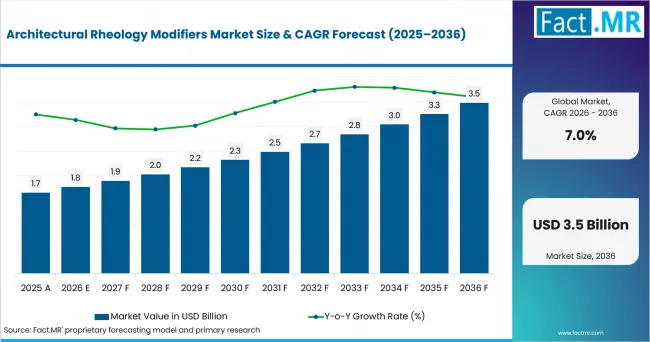
Architectural Rheology Modifiers Market Value Analysis | Source: Fact.MR
What are the defining numbers behind Architectural Rheology Modifiers Market growth?
USD 1.71 billion absolute opportunity by 2036, led by Cellulosic HEC and HMHEC, interior wall paints and acrylic latex.
- Demand Drivers in the Market
- Paint formulators need low-shear structure so wall paints stay stable in storage and resist sag during vertical application.
- Contractor channels need coatings that roll cleanly across uneven walls and reduce spatter during repeat application.
- Brand teams need low-VOC paints that retain brush feel without relying on solvent-heavy viscosity packages.
- Tint-center operators need repeatable viscosity after colorants are added to base paints.
- Construction and renovation cycles keep repaint demand active. The U.S. Census Bureau reported in February 2026 that construction spending reached USD 2,164.4 billion in 2025.
- Key Segments Analyzed
- By Chemistry: Cellulosic HEC and HMHEC are expected to hold 34.00% share in 2026 due to broad use in waterborne architectural paints and dependable storage viscosity.
- By Shear Regime: Low-shear and sag control is projected to account for 30.00% share in 2026 since vertical-wall application keeps anti-sag performance central to product design.
- By Paint Segment: Interior wall paints are anticipated to capture 38.00% share in 2026 owing to repaint frequency and do-it-yourself channel breadth.
- By Formulation Platform: Acrylic latex is estimated to represent 36.00% share in 2026 supported by its position in washable, low-odor and durable architectural coatings.
- Analyst Opinion at Fact.MR
- Shambhu Nath Jha, Principal Consultant at Fact.MR, states, "Rheology is now a performance language inside architectural paints. Formulators are expected to select modifiers by application feel, storage stability and low-VOC binder fit. Suppliers need cellulosic depth, associative thickening know-how and clear lab guidance."
- Strategic Implications
- Additive suppliers should document sag and spatter results in common acrylic latex systems before pitching premium modifiers.
- Paint brands should qualify more than one chemistry route before preservative or binder changes move into commercial batches.
- Distributors should train sales teams on shear-regime language used by contractors and tint-center technicians.
- Manufacturers should align modifier selection with low-VOC claims and renewable-content documentation where premium paints justify it.
Germany is expected to record 7.9% CAGR through 2036 driven by permit recovery and renovation-grade paint demand. The USA is projected to post 7.5% CAGR due to construction scale and repaint-channel depth. The UK is anticipated to advance at 7.0% CAGR as repair work supports coating consumption. The Netherlands is estimated to reach 6.7% CAGR through housing additions and waterborne paint use. Japan is forecast to register 6.3% CAGR as commercial work supports project coatings.
How does the Architectural Rheology Modifiers Market break down by segment?
Cellulosic HEC and HMHEC lead at 34.00%; Acrylic latex leads at 36.00%.
Which Chemistry segment dominates?
Cellulosic HEC and HMHEC hold 34.0% share in 2026.
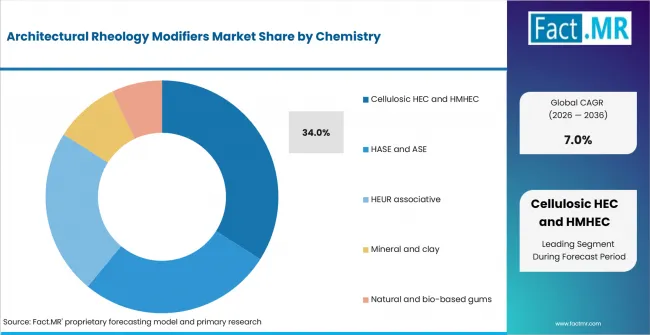
Architectural Rheology Modifiers Market Analysis By Chemistry | Source: Fact.MR
Cellulosic HEC and HMHEC are expected to lead Chemistry because they give waterborne paints storage viscosity and sag resistance. HASE and ASE serve latex systems that need pH response and mid-shear build. HEUR products address higher-end flow and leveling. BASF SE stated in June 2025 that its Rheovis range moved to bio-based ethyl acrylate, with up to 35% biogenic content and up to 30% lower product carbon footprint versus fossil-based versions.
What leads the Shear Regime segment?
Low-shear and sag control holds 30.0% share in 2026.
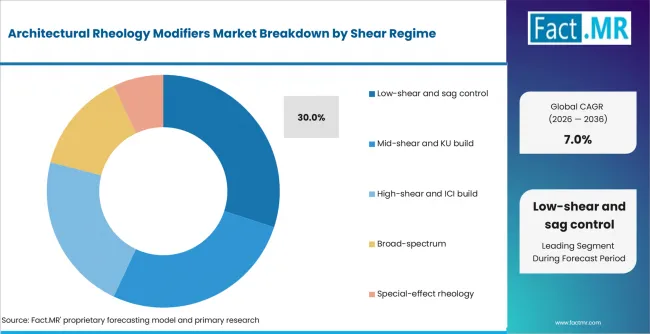
Architectural Rheology Modifiers Market Analysis By Shear Regime | Source: Fact.MR
Low-shear and sag control is projected to account for the leading Shear Regime share because wall paints must stay stable and resist runs. Mid-shear and KU build guide brush loading and roller pickup. High-shear and ICI build shape faster spreading. Dow Inc. positions ACRYSOL™ DR-125 as a hydrophobically modified, alkali-soluble associative rheology modifier designed to provide medium-shear KU viscosity in interior and exterior paints.
How does Paint Segment shape demand?
Interior wall paints hold 38.0% share in 2026.
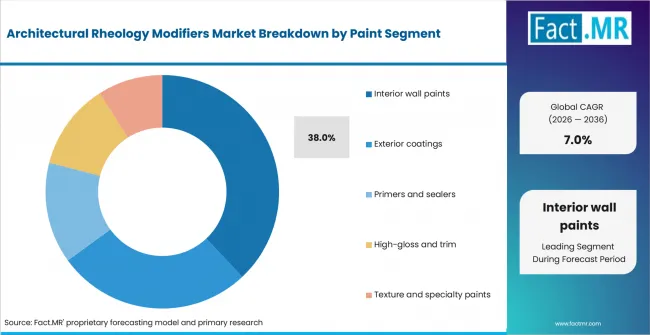
Architectural Rheology Modifiers Market Analysis By Paint Segment | Source: Fact.MR
Interior wall paints are anticipated to lead because repainting creates regular demand for easy application and consistent finish. Exterior coatings require weathering resistance. Primers and sealers need controlled penetration on porous surfaces. Statistics Netherlands reported in February 2026 that nearly 80,000 homes were added to the Netherlands’ housing stock in 2025, supporting potential demand for interior coating and finishing applications.
What supports Acrylic latex within Formulation Platform?
Acrylic latex holds 36.0% share in 2026.
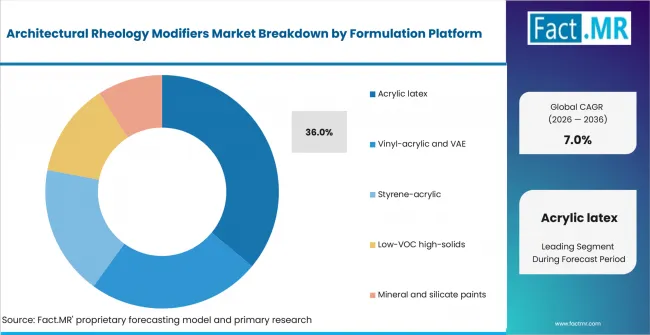
Architectural Rheology Modifiers Market Analysis By Formulation Platform | Source: Fact.MR
Acrylic latex is estimated to lead Formulation Platform because it supports durability and low-odor positioning in mainstream paints. The platform also links with emulsion polymers used across waterborne coating systems. Vinyl-acrylic and VAE serve value interiors, while styrene-acrylic platforms remain useful where stain resistance is needed.
What is accelerating Architectural Rheology Modifiers Market adoption, and what is holding it back?
Low-VOC reformulation drives it; cost and compatibility pressure restrain it.
Drivers Impact Analysis
| DRIVER | (~) % IMPACT ON CAGR | GEOGRAPHIC RELEVANCE | IMPACT TIMELINE |
|---|---|---|---|
| Low-VOC architectural paint reformulation | +1.4% | North America, Europe | Short term (<= 2 years) |
| Interior repaint and renovation cycles | +1.2% | USA, UK, Germany | Medium term (2-4 years) |
| Sag and spatter control for contractor use | +0.9% | Global | Short term (<= 2 years) |
| Waterborne acrylic latex penetration | +0.8% | USA, Europe, Japan | Medium term (2-4 years) |
| Bio-based and preservative-reduced additive design | +0.6% | Western Europe, North America | Long term (>= 4 years) |
- Low-VOC architectural paint reformulation: Formulators are replacing solvent-heavy viscosity packages with additives that maintain application feel, flow, and finish quality in premium interior paints. Rheology modifiers that support waterborne and lower-VOC systems are becoming more important in architectural coating reformulation.
- Interior repaint and renovation cycles: Repainting and renovation activity creates recurring demand for viscosity-control additives across retail and contractor paint channels. Repair and maintenance work supports continued use of rheology modifiers in interior coatings where manufacturers need consistent application behavior and dependable finish quality.
- Sag and spatter control for contractor use: Professional applicators evaluate paint performance during rolling, brushing, and edging. Rheology modifiers that build low-shear structure can reduce sagging and spatter while improving brush loading, flow, leveling, and application consistency in water-based coatings.
- Waterborne acrylic latex penetration: Acrylic latex paints require additives that balance viscosity, flow, leveling, and final appearance across multiple paint bases. Rheology modifiers designed for waterborne architectural coatings help formulators manage both mid-shear and high-shear viscosity during manufacturing and application.
- Bio-based and preservative-reduced additive design: Additive suppliers are increasingly developing rheology systems around renewable-content, lower-VOC, and preservative-reduction goals. These formulations support coating manufacturers seeking improved environmental positioning without compromising viscosity control, application properties, or finished-coating performance.
Opportunity Impact Analysis
| OPPORTUNITY | (~) % IMPACT ON CAGR | GEOGRAPHIC RELEVANCE | IMPACT TIMELINE |
|---|---|---|---|
| Biocide-free cellulosic and associative additives | +0.9% | Europe, North America | Medium term (2-4 years) |
| Formulation support for tinting and low odor | +0.7% | Global | Short term (<= 2 years) |
| Texture and specialty architectural paints | +0.5% | USA, Japan, Western Europe | Long term (>= 4 years) |
| Distributor-led technical service packages | +0.4% | Emerging and mature markets | Medium term (2-4 years) |
- Biocide-free cellulosic and associative additives: Paint brands are seeking rheology modifiers that reduce preservative dependence while maintaining reliable viscosity control. Biocide-free and solvent-free additive systems can support cleaner formulation strategies across water-based architectural coatings.
- Formulation support for tinting and low odor: Tint bases can place additional stress on viscosity packages after colorants are introduced. Supplier guidance becomes more valuable where retailers and manufacturers work with multiple paint bases and need consistent viscosity, application feel, and low-odor performance.
- Texture and specialty architectural paints: Decorative and specialty finishes require controlled body, suspension, and application consistency. Rheology modifiers support textured, multicolor, trim, and sand-containing coatings where formulators need stable particle suspension and dependable film appearance.
- Distributor-led technical service packages: Regional paint manufacturers often depend on local laboratory and formulation support to move from trial batches to repeat production. Distributors with strong knowledge of HEC, HASE, and HEUR selection can help shorten reformulation cycles and improve additive qualification.
Restraints Impact Analysis
| RESTRAINT | (~) % IMPACT ON CAGR | GEOGRAPHIC RELEVANCE | IMPACT TIMELINE |
|---|---|---|---|
| Raw-material and additive-cost sensitivity | -0.6% | Global | Short term (<= 2 years) |
| Compatibility limits across latex platforms | -0.4% | Global | Medium term (2-4 years) |
| Reformulation risk in legacy paint lines | -0.3% | North America, Europe, Japan | Medium term (2-4 years) |
| Construction-cycle softness in some countries | -0.2% | USA, UK, Japan | Short term (<= 2 years) |
- Raw-material and additive-cost sensitivity: Specialty rheology packages compete with lower-cost thickeners when paint manufacturers focus on margin protection. Higher additive and formulation costs can slow adoption, particularly in price-sensitive architectural coatings where suppliers must demonstrate clear performance benefits.
- Compatibility limits across latex platforms: A rheology modifier can behave differently across acrylic, VAE, and styrene-acrylic systems. This variation can extend laboratory testing and formulation adjustment before a product moves into commercial production.
- Reformulation risk in legacy paint lines: Established paint formulations can be sensitive to small viscosity changes, particularly in application feel, flow, leveling, and tint response. Manufacturers therefore require careful validation before replacing existing rheology packages in mature product lines.
- Construction-cycle softness in some countries: Weaker new-build activity can reduce first-coat architectural paint demand even when repaint and renovation activity remains active. This creates uneven demand for rheology modifiers across markets with different construction and maintenance cycles.
Which countries are scaling the Architectural Rheology Modifiers Market through 2036?
- The country comparison spans 1.61 percentage points and forms a narrow growth band across mature architectural coatings markets.
- Germany remains 0.42 percentage point above the USA through permit recovery and higher-value renovation paint needs.
- The USA remains 0.52 percentage point above the UK through construction scale and deep repaint-channel coverage.
- The UK remains 0.32 percentage point above the Netherlands through repair work and low-odor interior paint demand.
- The Netherlands remains 0.35 percentage point above Japan through housing additions and waterborne coating use.
- Japan closes the displayed range through commercial projects and controlled application requirements in compact interiors.
Architectural Rheology Modifiers Market is segmented into North America, Latin America, Western Europe, Eastern Europe, East Asia, South Asia & Pacific, and Middle East & Africa.
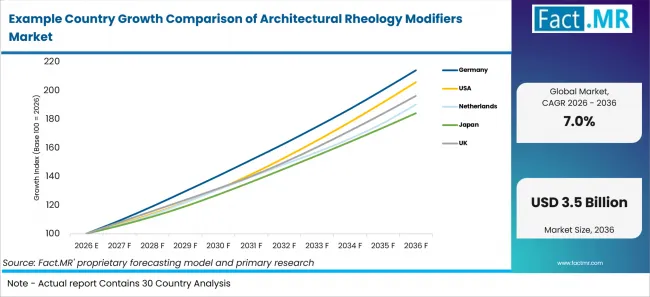
Example Country Growth Comparison Of Architectural Rheology Modifiers Market | Source: Fact.MR
| Country | CAGR (2026-2036) |
|---|---|
| Germany | 7.9% |
| USA | 7.5% |
| UK | 7.0% |
| Netherlands | 6.7% |
| Japan | 6.3% |
What is powering Germany's lead?
7.9% CAGR through 2036, driven by permit recovery and renovation-grade paint demand.
German paint formulators are expected to gain from a housing permit recovery that feeds repaint and first-coat cycles. Destatis reported in February 2026 that 238,500 dwellings were approved in 2025, up 10.8% from 2024. Rheology suppliers with HEC, HMHEC and associative options are expected to support latex paints tested for roller feel and storage stability.
How is the USA scaling demand?
7.5% CAGR through 2036, supported by construction scale and repaint-channel depth.
Large paint brands in the USA are expected to keep rheology systems tied to contractor productivity and do-it-yourself application quality. The U.S. Census Bureau reported in May 2026 that local permit offices authorized 1,431,616 privately owned housing units during 2025. That pipeline supports acrylic latex systems that need reliable sag control across tinted interior paints.
What supports the UK outlook?
7.0% CAGR through 2036, backed by repair activity and cost-conscious reformulation.
UK paint producers are expected to prioritize low-odor interior coatings that work well in occupied homes. The Office for National Statistics reported in August 2026 that construction output growth in the three months to May 2026 had been revised to 1.5%, from the 1.6% estimate published in July. Repair-led activity keeps value in additives that improve roller pickup and limit visible application defects.
What underpins the Netherlands' growth?
6.7% CAGR through 2036, driven by housing additions and waterborne paint needs.
Dutch architectural paint demand is expected to benefit from a steady flow of new and converted homes. Interior wall paints in those homes need additives that balance leveling, storage viscosity and low-odor positioning.
How does Japan perform?
6.3% CAGR through 2036, led by commercial project demand and controlled application performance.
Japanese formulators are expected to emphasize smooth application and clean finish quality in compact residential and commercial spaces. MLIT reported in April 2026 that private construction orders among 50 major contractors rose 13.7% in fiscal 2025. Commercial project work supports higher-value paints where flow control and touch-up behavior are visible to end users.
Who leads the Architectural Rheology Modifiers Market?
Ashland Inc. is active through Aquaflow™ and Aquavis™ associative thickener platforms used in waterborne paints and coatings. Its May 2026 American Coatings Show release highlighted Aquavis™ ULS 250 and ULS 255 for Stormer (KU) viscosity build, formulation control, flow and leveling, and identified ULS 255 specifically as a low-VOC option. The company supports formulators across architectural, interior, exterior and industrial waterborne coating applications.
Dow Inc. participates through ACRYSOL™ rheology modifiers for waterborne architectural coatings. ACRYSOL™ DR-125 targets medium-shear KU viscosity in interior and exterior paints, while ACRYSOL™ DR-73 builds mid-shear KU and high-shear ICI viscosity in waterborne architectural coatings. Dow’s HASE rheology-modifier portfolio supports formulation across multiple binder chemistries.
Nouryon is active through Bermocoll® cellulose ethers and architectural paint additives. In March 2025, the company featured Bermocoll® EHM MAX for architectural paints and described it as up to 10% more efficient than comparable products. Its portfolio also covers thickeners, stabilizers and water-retaining agents for water-based paints.
BASF SE competes through Rheovis®, Attagel®, Attaflow® and Efka® rheology modifiers. Its July 2026 architectural-coatings additives launch included Rheovis® PU 1333 MB and Rheovis® HS 1169 MB for controlled rheology and application behavior. Elementis plc and The Lubrizol Corporation add further competition through rheology modifiers used in waterborne and building-coatings formulations. Elementis plc markets RHEOLATE® rheology modifiers for architectural paints, while The Lubrizol Corporation positions Solthix™ A100 as a water-based HMASE rheology modifier for aqueous paints and building and construction coatings.
Which companies are the key providers?
Key companies include Ashland Inc.; Dow Inc.; Nouryon; BASF SE; Elementis plc; and The Lubrizol Corporation.
- Ashland Inc.
- Dow Inc.
- Nouryon
- BASF SE
- Elementis plc
- The Lubrizol Corporation
Bibliography
- Ashland. (2025, March 24). Ashland showcases innovative, environmentally sustainable additives for coatings and specialty markets at European Coatings Show.
- Ashland. (2026, May 4). Ashland showcases innovative additives supporting sustainable solutions for architectural and industrial coatings at American Coatings trade show.
- BASF. (2025, June 10). BASF's Rheovis® range transitions to bio-based Ethyl Acrylate (EA).
- BASF. (2026, July 13). BASF expands certified biomass-balanced additives portfolio for architectural coatings.
- U.S. Bureau of Labor Statistics. (2026, August 13). Producer Price Index by Industry: Paint and Coating Manufacturing [Series PCU325510325510].
- Statistisches Bundesamt (Destatis). (2026, February 18). 10,8 % mehr Baugenehmigungen für Wohnungen im Jahr 2025.
- Nouryon. (2025, March 25). Featuring Bermocoll® EHM MAX: A premium performing rheology modifier for architectural paints at ECS 2025.
- Office for National Statistics. (2026, February 12). Construction output in Great Britain: December 2025, new orders and Construction Output Price Indices, October to December 2025.
- Office for National Statistics. (2026, August 13). GDP monthly estimate, UK: June 2026.
- Statistics Netherlands. (2026, February 4). Growth of housing stock slows for third year in a row.
- U.S. Census Bureau. (2026, February 27). Monthly construction spending, December 2025.
- U.S. Census Bureau. (2026, May 14). 2025 annual building permits.
- Lubrizol. (2026, February 20). Solthix™ A100 [Product data sheet].
This Report Addresses
- The report explains where architectural rheology modifiers fit within wall paints and adjacent coating additives used for application control.
- Segment analysis identifies leading subsegments and connects rheology choice with formulation additives used in waterborne coating design.
- Country analysis examines construction indicators across Germany, the USA, the UK, the Netherlands and Japan.
- Competitive analysis reviews cellulosic, HASE and HEUR portfolios alongside polymer binders that shape latex compatibility.
- Application analysis assesses how leveling, tint acceptance and spatter control interact with low-foam wetting agents in decorative coatings.
What does the Architectural Rheology Modifiers Market cover?
The Architectural Rheology Modifiers Market covers additives used to control flow and viscosity in wall paints, trim coatings, primers and textured finishes. It connects with architectural coatings where application feel and final appearance influence brand choice.
The assessment includes rheology chemistry inside waterborne paints and paints and coatings that need sag resistance, leveling and storage stability. It treats finished coating sales as the application base for additive demand.
What is included in the scope?
The scope includes cellulosic HEC and HMHEC, HASE and ASE, HEUR associative modifiers, mineral and clay rheology additives, and natural or bio-based gums. Related cellulose nanofibrils are covered only where the function is paint rheology control.
The scope includes supplier sales into interior wall paints, exterior coatings, primers, sealers, gloss trim paints and texture finishes.
What is excluded from the scope?
The scope excludes commodity fillers, binders, colorants, preservatives and opacifying ingredients when the sold function is opacity or color performance rather than rheology control.
Industrial coatings, automotive coatings, printing inks and construction mortars are outside scope when architectural paint rheology is outside the direct end use. Adjacent wetting and dispersing agents remain separate unless they are bundled with rheology-control systems.
How Was the Analysis Built?
The analysis draws on 120+ sources, 35+ company portfolios, 25+ countries and 20+ interviews.
- Primary Research: Primary research includes discussions with additive suppliers, paint formulators, distributors, contractors and brand teams. These conversations examine application performance, qualification needs and channel priorities.
- Desk Research: Desk research covers government construction statistics, official price indices, company launches, investor updates and public policy sources.
- Market Sizing and Forecasting: Market estimates combine construction activity, repaint indicators, platform mix, chemistry share, country adoption and supplier portfolio activity.
- Data Validation and Update Cycle: Findings are validated by comparing interview feedback with official data, company activity and construction indicators. Updates review launches, costs and coating demand shifts.
What is the report's scope and coverage?
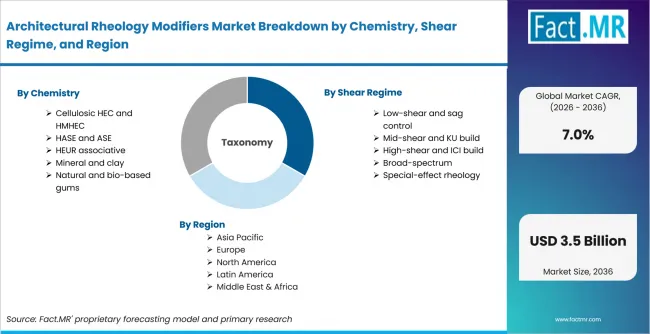
Architectural Rheology Modifiers Market Breakdown By Chemistry, Shear Regime, And Region | Source: Fact.MR
| Attribute | Details |
|---|---|
| Quantitative Units | USD billion |
| Market Definition | Rheology modifiers used in architectural paints to manage viscosity, sag resistance, leveling, storage stability, spatter control and application feel. |
| Chemistry | Cellulosic HEC and HMHEC; HASE and ASE; HEUR associative; Mineral and clay; Natural and bio-based gums |
| Shear Regime | Low-shear and sag control; Mid-shear and KU build; High-shear and ICI build; Broad-spectrum; Special-effect rheology |
| Paint Segment | Interior wall paints; Exterior coatings; Primers and sealers; High-gloss and trim; Texture and specialty paints |
| Formulation Platform | Acrylic latex; Vinyl-acrylic and VAE; Styrene-acrylic; Low-VOC high-solids; Mineral and silicate paints |
| Regions Covered | North America; Latin America; Western Europe; Eastern Europe; East Asia; South Asia & Pacific; Middle East & Africa |
| Countries Covered | Germany; USA; UK; Netherlands; Japan |
| Key Companies Profiled | Ashland Inc.; Dow Inc.; Nouryon; BASF SE; Elementis plc; The Lubrizol Corporation |
| Forecast Period | 2026 to 2036 |
| Approach | Hybrid top-down and bottom-up approach using construction activity, paint-segment demand, formulation platform mix, company portfolio review and country-level adoption indicators. |
How is the market segmented?
-
By Chemistry
- Cellulosic HEC and HMHEC
- HASE and ASE
- HEUR associative
- Mineral and clay
- Natural and bio-based gums
-
By Shear Regime
- Low-shear and sag control
- Mid-shear and KU build
- High-shear and ICI build
- Broad-spectrum
- Special-effect rheology
-
By Paint Segment
- Interior wall paints
- Exterior coatings
- Primers and sealers
- High-gloss and trim
- Texture and specialty paints
-
By Formulation Platform
- Acrylic latex
- Vinyl-acrylic and VAE
- Styrene-acrylic
- Low-VOC high-solids
- Mineral and silicate paints
-
By Region
- North America
- Latin America
- Western Europe
- Eastern Europe
- East Asia
- South Asia & Pacific
- Middle East & Africa