Emulsion Polymers Market (2026 - 2036)

Emulsion Polymers Market is segmented by Product Type (Acrylics, Vinyl Acetate Polymers, Styrene-Butadiene Latex, Styrene-Acrylic Copolymers, Vinyl-Acrylic Copolymers, Polyurethane Dispersions, and Others) and End-Use Industry (Paints and Coatings, Adhesives and Sealants, Paper and Paperboard, Textiles and Nonwovens, Construction, and Others). Forecast for 2026 to 2036.

Core Findings

    Emulsion Polymers Market Forecast 2026 to 2036

    In 2025, the emulsion polymers market was valued at USD 36.3 billion. Based on Fact MR analysis, demand for emulsion polymers is estimated to grow to USD 38.7 billion in 2026 and USD 68.2 billion by 2036. FMR projects a CAGR of 6.5% during the forecast period.

    The absolute dollar growth from 2026 to 2036 is USD 29.5 billion. This growth is driven by increasing demand for emulsion polymers in industries such as paints and coatings, adhesives, textiles, and paper. Their versatility, cost-effectiveness, and environmental benefits over solvent-based alternatives are key factors supporting the market's expansion. However, challenges such as fluctuating raw material prices and regulatory restrictions on emissions could impact market growth in some regions.

    As Vivekkumar Jagtap, Managing Director of Arkema Coating Resins, noted regarding demand for advanced waterborne coating resins (emulsion‑based solutions), ‘At Arkema, we are committed to creating materials that advance sustainability as well as performance, and we partner across the value chain to accelerate the development of new solutions.’

    China leads with a CAGR of 8.9%, driven by its large manufacturing base and expanding demand for emulsion polymers in industries like coatings and adhesives. India follows with 8.2%, supported by rapid industrialization and demand for affordable and effective polymer solutions. Germany grows at 7.5%, benefiting from the strong demand for emulsion polymers in high-performance applications in Europe. Brazil shows growth at 6.8%, fueled by increasing adoption of emulsion-based solutions in the construction and automotive sectors. The USA grows at 6.1%, reflecting steady demand in the automotive, adhesives, and construction industries.
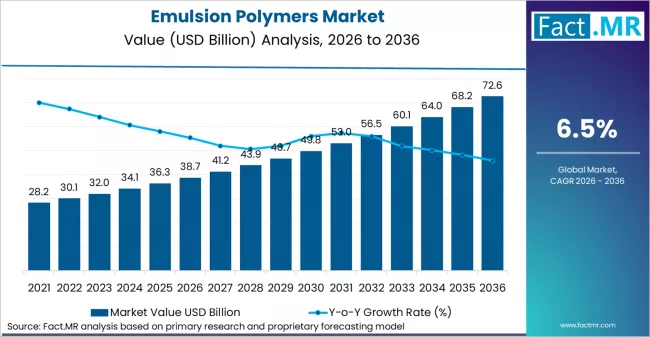
    Emulsion Polymers Market Market Value Analysis

    Emulsion Polymers Market

    Metric Value
    Estimated Value in (2026E) USD 38.7 billion
    Forecast Value in (2036F) USD 68.2 billion
    Forecast CAGR (2026 to 2036) 6.5%

    Emulsion Polymers Market Definition

    The Emulsion Polymers Market involves the production and sale of polymer dispersions created by polymerizing monomers in a liquid phase to form fine particles suspended in water, used to impart specific performance properties in coatings, adhesives, textiles, paper, and construction materials.

    Market Inclusions

    This report covers global and regional market sizes for emulsion polymers over a defined forecast period, including polymer types (styrene‑butadiene, acrylics, vinyl acetate ethylene), application segments (paint & coatings, adhesives, textiles, paper), and end‑use industries.

    Market Exclusions

    The scope excludes solvent‑based polymers, neat resins not marketed as aqueous emulsions, and finished products where emulsion polymer content is not separately quantified.

    Research Methodology

    • Primary Research: Interviews were conducted with polymer producers, formulation engineers, and industry specialists.
    • Desk Research: Data was sourced from industry reports, chemical publications, and trade association statistics.
    • Market‑Sizing and Forecasting: A hybrid model combining top‑down application demand forecasts with bottom‑up shipment and revenue data was used.
    • Data Validation and Update Cycle: Findings were validated through expert review and aligned with recent production and trade figures.

    Summary of the Emulsion Polymers Market

    • Market Definition
      • The Emulsion Polymers Market involves the production and application of polymer dispersions used in industries like paints, coatings, adhesives, textiles, and construction.
    • Demand Drivers
      • Demand for Sustainable Coatings: Increased focus on eco-friendly, low-VOC coatings is driving the adoption of water-based emulsion polymers.
      • Growth in Industrial Applications: Rising demand for durable and high-performance materials in construction, automotive, and packaging sectors is boosting market growth.
      • Technological Advancements: Ongoing innovations in polymer chemistry are enhancing the performance of emulsion polymers in various applications.
    • Key Segments Analyzed
      • Product Type: Acrylics are expected to hold 30% of the market share by 2026, driven by their use in paints, coatings, and adhesives.
      • End-Use Industry: Paints and coatings are projected to account for 35% of the market share by 2026 due to increasing demand for high-performance coatings.
      • Geography: China leads with a CAGR of 8.9%, driven by a large manufacturing base and increasing demand for eco-friendly solutions.
    • Analyst Opinion at Fact MR
      • Shambhu Nath Jha, Principal Consultant at Fact MR, noted, "The growing focus on sustainability, especially in the construction and automotive sectors, is expected to continue fueling the demand for emulsion polymers, particularly those made from acrylics."
    • Strategic Implications/Executive Takeaways
      • Focus on Eco-Friendly Solutions: Companies should invest in the development of low-VOC, sustainable emulsion polymers for paints and coatings.
      • Leverage Technological Innovations: Enhance product performance by integrating advanced polymer technologies that meet industry-specific needs.
      • Target Emerging Markets: Expanding market presence in China, India, and other growing economies will be key to capitalizing on increased industrialization and demand for sustainable materials.
    • Methodology
      • Primary Research: Interviews with polymer producers, formulation engineers, and industry specialists.
      • Desk Research: Data sourced from industry reports, chemical publications, and trade association statistics.
      • Market Sizing & Forecasting: A hybrid model combining top-down demand forecasts with bottom-up shipment and revenue data.

    Segmental Analysis

    Emulsion Polymers Market Analysis by Product Type
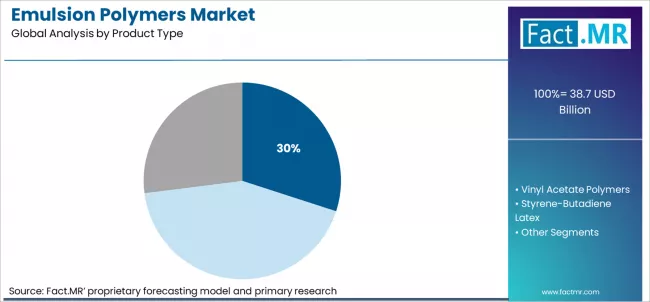
    Emulsion Polymers Market Analysis By Product Type

    • Market Overview: Acrylics are expected to hold 30% of the market share by 2026. Acrylic-based emulsion polymers are widely used in applications such as paints and coatings, adhesives, and textiles due to their excellent properties, including high durability, good adhesion, and resistance to weathering. Acrylics offer superior clarity and color retention, making them ideal for both decorative and functional applications.
    • Demand Drivers:
      • Superior Performance in Coatings: Acrylic emulsions provide excellent resistance to UV degradation and weathering, making them highly desirable in the paints and coatings industry.
      • Versatility Across Applications: Acrylics are highly versatile, used in a variety of industries including adhesives, textiles, and construction, driving their sustained demand.
      • Environmental and Regulatory Compliance: The growing emphasis on low-VOC (volatile organic compound) coatings aligns with the increasing adoption of acrylic-based emulsion polymers in eco-friendly formulations.

    Emulsion Polymers Market Analysis by End-Use Industry
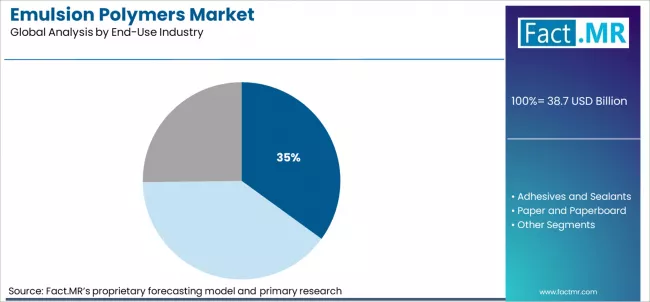
    Emulsion Polymers Market Analysis By End Use Industry

    • Market Overview: Paints and coatings are projected to capture 35% of the market share by 2026. Emulsion polymers are essential in the formulation of paints and coatings due to their ability to provide smooth application, durability, and resistance to environmental factors, making them a preferred choice in both residential and industrial applications.
    • Demand Drivers:
      • Growth in Construction and Renovation Activities: The rising demand for construction and renovation is driving the need for high-performance paints and coatings, which use emulsion polymers for enhanced durability and aesthetics.
      • Environmental Regulations: Increased regulatory pressure for low-VOC and eco-friendly coatings is leading to a higher adoption of water-based emulsion polymers in paints and coatings.
      • Demand for High-Quality and Long-Lasting Coatings: The growing consumer preference for long-lasting, maintenance-free surfaces in both interior and exterior applications is boosting the demand for emulsion polymers in the coatings sector.

    Emulsion Polymers Market Drivers, Restraints, and Opportunities

    FMR analysts observe that the emulsion polymers market is a mature, performance‑driven segment rooted in broad use across paints & coatings, adhesives, textiles, and paper. Historically, vinyl and acrylic emulsions replaced solvent‑borne systems to reduce VOC emissions, creating structural demand aligned with regulatory shifts toward low‑emission products. The 2026 valuation reflects ongoing adoption tied to industrial and construction activity where water‑based, environmentally compliant binders are standard.

    While conventional solvent‑based binders remain in some cost‑sensitive niches, water‑borne emulsion polymers are gaining share because they meet stricter environmental and performance criteria. These advanced emulsions carry higher per‑unit pricing, contributing to net market value growth even as unit volumes grow in line with end‑use sector cycles. The market exists because formulators balance performance, environmental compliance, and application needs across mature and evolving industries.

    • Environmental & Regulatory Pressure: VOC reduction regulations in coatings and adhesives push adoption of water‑based emulsion polymers that meet defined emission limits.
    • Performance & Application Demand: End‑users favor emulsions with improved adhesion, durability, and film properties over traditional binders in coatings and specialty applications.
    • Regional End‑Use Dynamics: In North America and Europe, strict environmental standards and established industrial bases drive higher uptake, while Asia‑Pacific shows rapid growth with expanding infrastructure and manufacturing activity.

    Regional Analysis

    The market analysis covers key global regions, including East Asia, South Asia, Western Europe, North America, and Latin America. It is segmented geographically, with specific market dynamics for each region. The full report provides a detailed market attractiveness analysis.
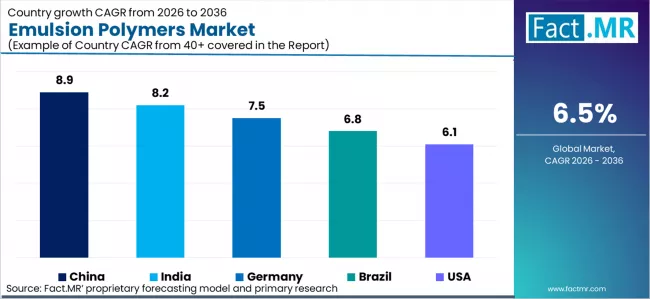
    Emulsion Polymers Market Cagr Analysis By Country

    Country CAGR (2026-2036)
    China 8.9%
    India 8.2%
    Germany 7.5%
    Brazil 6.8%
    USA 6.1%

    Source: Fact MR (FMR) analysis, based on proprietary forecasting model and primary research.

    East Asia:

    In East Asia, China is the leading market for emulsion polymers, driven by the country’s large manufacturing base, growing demand for coatings and adhesives, and increasing applications in construction, automotive, and packaging sectors.

    • China: Demand for emulsion polymers in China is projected to rise at 8.9% CAGR through 2036. China’s strong industrial base, growing demand for coatings, adhesives, and increasing adoption of eco-friendly solutions continue to fuel market growth.

    South Asia:

    In South Asia, India is a significant market for emulsion polymers, supported by the country’s expanding manufacturing sector, increasing demand for coatings and adhesives, and rising awareness about the environmental benefits of water-based polymers.

    • India: Demand for emulsion polymers in India is projected to rise at 8.2% CAGR through 2036. India’s booming industrial sector, growth in construction and automotive industries, and increased demand for sustainable solutions continue to contribute to market growth.

    Western Europe:

    In Western Europe, Germany is the key market for emulsion polymers, driven by rising demand from the automotive, construction, and packaging industries, as well as growing awareness of the environmental benefits of emulsion polymer-based solutions.

    • Germany: Demand for emulsion polymers in Germany is projected to rise at 7.5% CAGR through 2036. Germany’s strong automotive and construction sectors, rising demand for water-based solutions, and focus on environmental sustainability continue to drive market demand.

    North America:
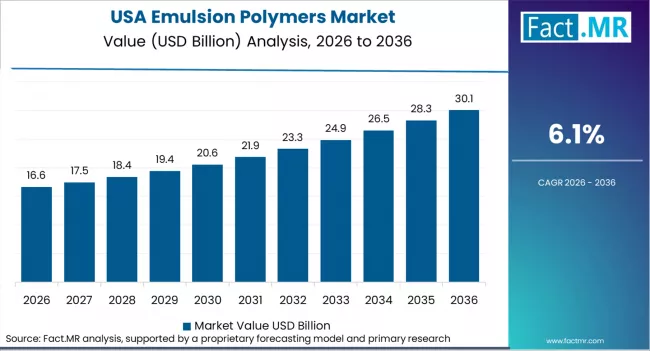
    Emulsion Polymers Market Country Value Analysis

    In North America, the USA remains a significant market for emulsion polymers, supported by the increasing demand for eco-friendly coatings, adhesives, and sealants in various applications, including automotive, packaging, and construction.

    • USA: Demand for emulsion polymers in the U.S. is projected to rise at 6.1% CAGR through 2036. The USA’s strong manufacturing sector, increased demand for environmentally friendly solutions, and growing applications across industries continue to support steady market growth.

    Latin America:

    In Latin America, Brazil is the largest market for emulsion polymers, driven by the country’s growing demand for coatings and adhesives in the construction and automotive industries, along with an increasing focus on eco-friendly solutions.

    • Brazil: Demand for emulsion polymers in Brazil is projected to rise at 6.8% CAGR through 2036. Brazil’s expanding construction and automotive sectors, rising demand for water-based coatings, and growing preference for sustainable polymers continue to contribute to market growth.

    Fact MR's analysis of the Emulsion Polymers Market in East Asia, South Asia, Western Europe, North America, and Latin America consists of country-wise assessments that include China, India, Germany, Brazil, and the USA. Readers can find detailed trends, regulatory updates, and company-specific investments shaping the market’s growth in these countries.

    What is the Competitive Structure and Buyer Behavior in the Emulsion Polymers Market?
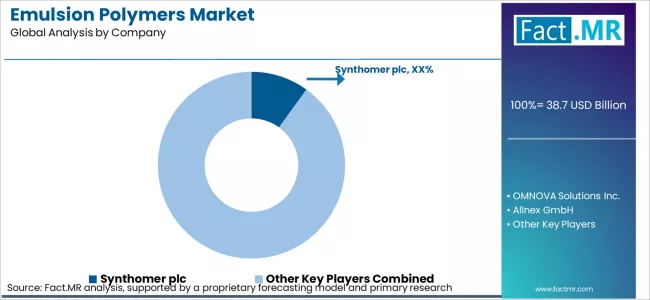
    Emulsion Polymers Market Analysis By Company

    The emulsion polymers market is moderately concentrated, with major chemical producers such as Synthomer plc, Allnex GmbH, Arkema S.A., BASF SE, and DIC Corporation holding a significant share alongside other established suppliers including OMNOVA Solutions Inc., Celanese Corporation, Wacker Chemie AG, Momentive Performance Materials Inc., Mallard Creek Polymers, Inc., and Solvay S.A.. Product performance, such as stability, polymerization control, and application‑specific properties, is the primary competitive variable, driving differentiation in coatings, adhesives, textiles, and construction segments. Companies with vertically integrated feedstock access, broad product portfolios, and global manufacturing footprints hold structural advantages, enabling consistent quality, scale efficiencies, and responsive supply. Large industrial buyers and formulators exert considerable leverage by qualifying multiple suppliers, negotiating long‑term agreements, and specifying performance standards tied to end‑use requirements. To manage supplier dependency, these buyers often diversify sources and standardise technical specifications, which limits individual suppliers’ pricing power. As a result, competition centres on delivering consistent performance, technical support, and reliable supply rather than on price alone.

    Recent Industry Developments

    • 2026 "Price-Shock" from Major Producers: In early March 2026, BASF announced immediate price increases for essential monomers-specifically butyl acrylate (BA) and 2-ethylhexyl acrylate (2-EHA)-across Asia-Pacific and North America. These monomers are the primary building blocks for acrylic emulsions used in coatings and adhesives. The move follows similar 2026 price adjustments from Wacker (silicone emulsions up to 25%) and Celanese (VAM and derivatives).
    • European Union "Ecolabel" Refresh (February 2026): On February 5, 2026, the European Commission released revised EU Ecolabel criteria for Paints & Varnishes. These new standards introduce significantly lower limits for VOCs (Volatile Organic Compounds) and SVOCs, forcing emulsion polymer manufacturers to provide "cleaner" binders that reduce long-term indoor exposure and improve air quality.
    • Scaling of "Circular" and Bio-Based Elium® Resins: In February 2026, Arkema showcased a major breakthrough in the industrialization of its Elium® thermoplastic liquid resins. These emulsion-based systems are now being utilized for fully recyclable boat hulls and wind turbine blades, marking a shift where emulsion polymers are no longer just "additives" but core structural materials that enable a circular economy

    Key Players of the Emulsion Polymers Market

    • Synthomer plc
    • OMNOVA Solutions Inc.
    • Allnex GmbH
    • Arkema S.A.
    • DIC Corporation
    • BASF SE
    • Celanese Corporation
    • Wacker Chemie AG
    • Momentive Performance Materials Inc.
    • Mallard Creek Polymers, Inc.
    • Solvay S.A.

    Report Scope

    Metric Value
    Quantitative Units USD 38.7 billion (2026) to USD 68.2 billion (2036), at a CAGR of 6.5%
    Market Definition The Emulsion Polymers Market involves the production and application of emulsion polymers used in various industries, including paints and coatings, adhesives, and textiles.
    By Product Type Acrylics, Vinyl Acetate Polymers, Styrene-Butadiene Latex, Styrene-Acrylic Copolymers, Vinyl-Acrylic Copolymers, Polyurethane Dispersions, Others
    By End-Use Industry Paints and Coatings, Adhesives and Sealants, Paper and Paperboard, Textiles and Nonwovens, Construction, Others
    Regions Covered North America, Latin America, Europe, East Asia, South Asia, Oceania, Middle East and Africa
    Countries Covered United States, Canada, Mexico, Brazil, Argentina, Germany, France, United Kingdom, Italy, Spain, China, India, Japan, South Korea, Indonesia, Australia, and 40+ countries
    Key Companies Profiled Synthomer plc, OMNOVA Solutions Inc., Allnex GmbH, Arkema S.A., DIC Corporation, BASF SE, Celanese Corporation, Wacker Chemie AG, Momentive Performance Materials Inc., Mallard Creek Polymers, Inc., Solvay S.A.
    Forecast Period 2026 to 2036
    Approach Hybrid top-down and bottom-up market modeling validated through primary interviews with manufacturers and supported by trade data benchmarking and market research.

    Emulsion Polymers Market Key Segments

    • Product Type :

      • Acrylics
      • Vinyl Acetate Polymers
      • Styrene-Butadiene Latex
      • Styrene-Acrylic Copolymers
      • Vinyl-Acrylic Copolymers
      • Polyurethane Dispersions
      • Others
    • End-Use Industry :

      • Paints and Coatings
      • Adhesives and Sealants
      • Paper and Paperboard
      • Textiles and Nonwovens
      • Construction
      • Others
    • Region :

      • North America
        • USA
        • Canada
        • Mexico
      • Europe
        • Germany
        • UK
        • France
        • Italy
        • Spain
        • Nordic Countries
        • BENELUX
        • Rest of Europe
      • Asia Pacific
        • China
        • Japan
        • South Korea
        • India
        • Australia
        • Rest of Asia Pacific
      • Latin America
        • Brazil
        • Argentina
        • Rest of Latin America
      • Middle East and Africa
        • Kingdom of Saudi Arabia
        • United Arab Emirates
        • South Africa
        • Rest of Middle East and Africa
      • Other Regions
        • Oceania
        • Central Asia
        • Other Markets

    Bibliographies

    • Arkema S.A. (2023). Driving sustainability through innovative emulsion polymer technologies. Arkema S.A.
    • BASF SE. (2023). Innovating for a sustainable future in emulsion polymer solutions. BASF SE.
    • DIC Corporation. (2023). Emulsion polymer technologies for paints, coatings, and adhesives applications. DIC Corporation.
    • Synthomer plc. (2023). Leading the development of innovative emulsion polymers for sustainable applications. Synthomer plc.
    • BASF. (2026, March 2). Price increase for acrylic monomers in North America and Asia-Pacific [Industry announcement]. BASF.
    • European Commission. (2026, February 5). A fresh coat: EU ecolabel levels up for paints & varnishes [Regulatory update]. European Commission.
    • Arkema. (2026, February 24). Pioneering circularity in composites at JEC World 2026 [Event report]. Arkema.

    This report addresses:

    • Market intelligence enabling comprehensive assessment of leading countries and product segments across the Emulsion Polymers Market globally.
    • Market volume (sales units) estimates and 10-year revenue forecasts from 2026 to 2036, validated through manufacturer shipment data, channel partner surveys, and country-level demand modeling.
    • Growth opportunity mapping across product types (Acrylics, Vinyl Acetate Polymers, Styrene-Butadiene Latex, Styrene-Acrylic Copolymers, Vinyl-Acrylic Copolymers, Polyurethane Dispersions, Others), applications (Paints and Coatings, Adhesives and Sealants, Paper and Paperboard, Textiles and Nonwovens, Construction, Others), and end-use industries.
    • Segment and regional revenue forecasts by product type, application, end-user industry, and geography across 40+ countries.
    • Competition strategy analysis covering dealer network structure, recent developments, product portfolio, USPs, and market share analysis.
    • Product and regulatory compliance tracking aligned with VOC reduction standards, environmentally compliant coatings, and sustainable polymer regulations.
    • Regulatory impact analysis addressing environmental regulations, building codes, and performance certifications across key markets.
    • Report delivery in PDF, Excel, PowerPoint, and interactive dashboard formats for executive, procurement, and operational planning use.

    Table of Content

    1. Executive Summary
      • Global Market Outlook
      • Demand to side Trends
      • Supply to side Trends
      • Technology Roadmap Analysis
      • Analysis and Recommendations
    2. Market Overview
      • Market Coverage / Taxonomy
      • Market Definition / Scope / Limitations
    3. Research Methodology
      • Chapter Orientation
      • Analytical Lens and Working Hypotheses
        • Market Structure, Signals, and Trend Drivers
        • Benchmarking and Cross-market Comparability
        • Market Sizing, Forecasting, and Opportunity Mapping
      • Research Design and Evidence Framework
        • Desk Research Programme (Secondary Evidence)
          • Company Annual and Sustainability Reports
          • Peer-reviewed Journals and Academic Literature
          • Corporate Websites, Product Literature, and Technical Notes
          • Earnings Decks and Investor Briefings
          • Statutory Filings and Regulatory Disclosures
          • Technical White Papers and Standards Notes
          • Trade Journals, Industry Magazines, and Analyst Briefs
          • Conference Proceedings, Webinars, and Seminar Materials
          • Government Statistics Portals and Public Data Releases
          • Press Releases and Reputable Media Coverage
          • Specialist Newsletters and Curated Briefings
          • Sector Databases and Reference Repositories
          • FMR Internal Proprietary Databases and Historical Market Datasets
          • Subscription Datasets and Paid Sources
          • Social Channels, Communities, and Digital Listening Inputs
          • Additional Desk Sources
        • Expert Input and Fieldwork (Primary Evidence)
          • Primary Modes
            • Qualitative Interviews and Expert Elicitation
            • Quantitative Surveys and Structured Data Capture
            • Blended Approach
          • Why Primary Evidence is Used
          • Field Techniques
            • Interviews
            • Surveys
            • Focus Groups
            • Observational and In-context Research
            • Social and Community Interactions
          • Stakeholder Universe Engaged
            • C-suite Leaders
            • Board Members
            • Presidents and Vice Presidents
            • R&D and Innovation Heads
            • Technical Specialists
            • Domain Subject-matter Experts
            • Scientists
            • Physicians and Other Healthcare Professionals
          • Governance, Ethics, and Data Stewardship
            • Research Ethics
            • Data Integrity and Handling
        • Tooling, Models, and Reference Databases
      • Data Engineering and Model Build
        • Data Acquisition and Ingestion
        • Cleaning, Normalisation, and Verification
        • Synthesis, Triangulation, and Analysis
      • Quality Assurance and Audit Trail
    4. Market Background
      • Market Dynamics
        • Drivers
        • Restraints
        • Opportunity
        • Trends
      • Scenario Forecast
        • Demand in Optimistic Scenario
        • Demand in Likely Scenario
        • Demand in Conservative Scenario
      • Opportunity Map Analysis
      • Product Life Cycle Analysis
      • Supply Chain Analysis
      • Investment Feasibility Matrix
      • Value Chain Analysis
      • PESTLE and Porter’s Analysis
      • Regulatory Landscape
      • Regional Parent Market Outlook
      • Production and Consumption Statistics
      • Import and Export Statistics
    5. Global Market Analysis 2021 to 2025 and Forecast, 2026 to 2036
      • Historical Market Size Value (USD Million) Analysis, 2021 to 2025
      • Current and Future Market Size Value (USD Million) Projections, 2026 to 2036
        • Y to o to Y Growth Trend Analysis
        • Absolute $ Opportunity Analysis
    6. Global Market Pricing Analysis 2021 to 2025 and Forecast 2026 to 2036
    7. Global Market Analysis 2021 to 2025 and Forecast 2026 to 2036, By Product Type
      • Introduction / Key Findings
      • Historical Market Size Value (USD Million) Analysis By Product Type , 2021 to 2025
      • Current and Future Market Size Value (USD Million) Analysis and Forecast By Product Type , 2026 to 2036
        • Acrylics
        • Vinyl Acetate Polymers
        • Styrene-Butadiene Latex
      • Y to o to Y Growth Trend Analysis By Product Type , 2021 to 2025
      • Absolute $ Opportunity Analysis By Product Type , 2026 to 2036
    8. Global Market Analysis 2021 to 2025 and Forecast 2026 to 2036, By End-Use Industry
      • Introduction / Key Findings
      • Historical Market Size Value (USD Million) Analysis By End-Use Industry, 2021 to 2025
      • Current and Future Market Size Value (USD Million) Analysis and Forecast By End-Use Industry, 2026 to 2036
        • Paints and Coatings
        • Adhesives and Sealants
        • Paper and Paperboard
      • Y to o to Y Growth Trend Analysis By End-Use Industry, 2021 to 2025
      • Absolute $ Opportunity Analysis By End-Use Industry, 2026 to 2036
    9. Global Market Analysis 2021 to 2025 and Forecast 2026 to 2036, By Region
      • Introduction
      • Historical Market Size Value (USD Million) Analysis By Region, 2021 to 2025
      • Current Market Size Value (USD Million) Analysis and Forecast By Region, 2026 to 2036
        • North America
        • Latin America
        • Western Europe
        • Eastern Europe
        • East Asia
        • South Asia and Pacific
        • Middle East & Africa
      • Market Attractiveness Analysis By Region
    10. North America Market Analysis 2021 to 2025 and Forecast 2026 to 2036, By Country
      • Historical Market Size Value (USD Million) Trend Analysis By Market Taxonomy, 2021 to 2025
      • Market Size Value (USD Million) Forecast By Market Taxonomy, 2026 to 2036
        • By Country
          • USA
          • Canada
          • Mexico
        • By Product Type
        • By End-Use Industry
      • Market Attractiveness Analysis
        • By Country
        • By Product Type
        • By End-Use Industry
      • Key Takeaways
    11. Latin America Market Analysis 2021 to 2025 and Forecast 2026 to 2036, By Country
      • Historical Market Size Value (USD Million) Trend Analysis By Market Taxonomy, 2021 to 2025
      • Market Size Value (USD Million) Forecast By Market Taxonomy, 2026 to 2036
        • By Country
          • Brazil
          • Chile
          • Rest of Latin America
        • By Product Type
        • By End-Use Industry
      • Market Attractiveness Analysis
        • By Country
        • By Product Type
        • By End-Use Industry
      • Key Takeaways
    12. Western Europe Market Analysis 2021 to 2025 and Forecast 2026 to 2036, By Country
      • Historical Market Size Value (USD Million) Trend Analysis By Market Taxonomy, 2021 to 2025
      • Market Size Value (USD Million) Forecast By Market Taxonomy, 2026 to 2036
        • By Country
          • Germany
          • UK
          • Italy
          • Spain
          • France
          • Nordic
          • BENELUX
          • Rest of Western Europe
        • By Product Type
        • By End-Use Industry
      • Market Attractiveness Analysis
        • By Country
        • By Product Type
        • By End-Use Industry
      • Key Takeaways
    13. Eastern Europe Market Analysis 2021 to 2025 and Forecast 2026 to 2036, By Country
      • Historical Market Size Value (USD Million) Trend Analysis By Market Taxonomy, 2021 to 2025
      • Market Size Value (USD Million) Forecast By Market Taxonomy, 2026 to 2036
        • By Country
          • Russia
          • Poland
          • Hungary
          • Balkan & Baltic
          • Rest of Eastern Europe
        • By Product Type
        • By End-Use Industry
      • Market Attractiveness Analysis
        • By Country
        • By Product Type
        • By End-Use Industry
      • Key Takeaways
    14. East Asia Market Analysis 2021 to 2025 and Forecast 2026 to 2036, By Country
      • Historical Market Size Value (USD Million) Trend Analysis By Market Taxonomy, 2021 to 2025
      • Market Size Value (USD Million) Forecast By Market Taxonomy, 2026 to 2036
        • By Country
          • China
          • Japan
          • South Korea
        • By Product Type
        • By End-Use Industry
      • Market Attractiveness Analysis
        • By Country
        • By Product Type
        • By End-Use Industry
      • Key Takeaways
    15. South Asia and Pacific Market Analysis 2021 to 2025 and Forecast 2026 to 2036, By Country
      • Historical Market Size Value (USD Million) Trend Analysis By Market Taxonomy, 2021 to 2025
      • Market Size Value (USD Million) Forecast By Market Taxonomy, 2026 to 2036
        • By Country
          • India
          • ASEAN
          • Australia & New Zealand
          • Rest of South Asia and Pacific
        • By Product Type
        • By End-Use Industry
      • Market Attractiveness Analysis
        • By Country
        • By Product Type
        • By End-Use Industry
      • Key Takeaways
    16. Middle East & Africa Market Analysis 2021 to 2025 and Forecast 2026 to 2036, By Country
      • Historical Market Size Value (USD Million) Trend Analysis By Market Taxonomy, 2021 to 2025
      • Market Size Value (USD Million) Forecast By Market Taxonomy, 2026 to 2036
        • By Country
          • Kingdom of Saudi Arabia
          • Other GCC Countries
          • Turkiye
          • South Africa
          • Other African Union
          • Rest of Middle East & Africa
        • By Product Type
        • By End-Use Industry
      • Market Attractiveness Analysis
        • By Country
        • By Product Type
        • By End-Use Industry
      • Key Takeaways
    17. Key Countries Market Analysis
      • USA
        • Pricing Analysis
        • Market Share Analysis, 2025
          • By Product Type
          • By End-Use Industry
      • Canada
        • Pricing Analysis
        • Market Share Analysis, 2025
          • By Product Type
          • By End-Use Industry
      • Mexico
        • Pricing Analysis
        • Market Share Analysis, 2025
          • By Product Type
          • By End-Use Industry
      • Brazil
        • Pricing Analysis
        • Market Share Analysis, 2025
          • By Product Type
          • By End-Use Industry
      • Chile
        • Pricing Analysis
        • Market Share Analysis, 2025
          • By Product Type
          • By End-Use Industry
      • Germany
        • Pricing Analysis
        • Market Share Analysis, 2025
          • By Product Type
          • By End-Use Industry
      • UK
        • Pricing Analysis
        • Market Share Analysis, 2025
          • By Product Type
          • By End-Use Industry
      • Italy
        • Pricing Analysis
        • Market Share Analysis, 2025
          • By Product Type
          • By End-Use Industry
      • Spain
        • Pricing Analysis
        • Market Share Analysis, 2025
          • By Product Type
          • By End-Use Industry
      • France
        • Pricing Analysis
        • Market Share Analysis, 2025
          • By Product Type
          • By End-Use Industry
      • India
        • Pricing Analysis
        • Market Share Analysis, 2025
          • By Product Type
          • By End-Use Industry
      • ASEAN
        • Pricing Analysis
        • Market Share Analysis, 2025
          • By Product Type
          • By End-Use Industry
      • Australia & New Zealand
        • Pricing Analysis
        • Market Share Analysis, 2025
          • By Product Type
          • By End-Use Industry
      • China
        • Pricing Analysis
        • Market Share Analysis, 2025
          • By Product Type
          • By End-Use Industry
      • Japan
        • Pricing Analysis
        • Market Share Analysis, 2025
          • By Product Type
          • By End-Use Industry
      • South Korea
        • Pricing Analysis
        • Market Share Analysis, 2025
          • By Product Type
          • By End-Use Industry
      • Russia
        • Pricing Analysis
        • Market Share Analysis, 2025
          • By Product Type
          • By End-Use Industry
      • Poland
        • Pricing Analysis
        • Market Share Analysis, 2025
          • By Product Type
          • By End-Use Industry
      • Hungary
        • Pricing Analysis
        • Market Share Analysis, 2025
          • By Product Type
          • By End-Use Industry
      • Kingdom of Saudi Arabia
        • Pricing Analysis
        • Market Share Analysis, 2025
          • By Product Type
          • By End-Use Industry
      • Turkiye
        • Pricing Analysis
        • Market Share Analysis, 2025
          • By Product Type
          • By End-Use Industry
      • South Africa
        • Pricing Analysis
        • Market Share Analysis, 2025
          • By Product Type
          • By End-Use Industry
    18. Market Structure Analysis
      • Competition Dashboard
      • Competition Benchmarking
      • Market Share Analysis of Top Players
        • By Regional
        • By Product Type
        • By End-Use Industry
    19. Competition Analysis
      • Competition Deep Dive
        • Synthomer plc
          • Overview
          • Product Portfolio
          • Profitability by Market Segments (Product/Age /Sales Channel/Region)
          • Sales Footprint
          • Strategy Overview
            • Marketing Strategy
            • Product Strategy
            • Channel Strategy
        • OMNOVA Solutions Inc.
        • Allnex GmbH
        • Arkema S.A.
        • DIC Corporation
        • BASF SE
        • Celanese Corporation
    20. Assumptions & Acronyms Used

    List Of Table

    • Table 1: Global Market Value (USD Million) Forecast by Region, 2021 to 2036
    • Table 2: Global Market Value (USD Million) Forecast by Product Type , 2021 to 2036
    • Table 3: Global Market Value (USD Million) Forecast by End-Use Industry, 2021 to 2036
    • Table 4: North America Market Value (USD Million) Forecast by Country, 2021 to 2036
    • Table 5: North America Market Value (USD Million) Forecast by Product Type , 2021 to 2036
    • Table 6: North America Market Value (USD Million) Forecast by End-Use Industry, 2021 to 2036
    • Table 7: Latin America Market Value (USD Million) Forecast by Country, 2021 to 2036
    • Table 8: Latin America Market Value (USD Million) Forecast by Product Type , 2021 to 2036
    • Table 9: Latin America Market Value (USD Million) Forecast by End-Use Industry, 2021 to 2036
    • Table 10: Western Europe Market Value (USD Million) Forecast by Country, 2021 to 2036
    • Table 11: Western Europe Market Value (USD Million) Forecast by Product Type , 2021 to 2036
    • Table 12: Western Europe Market Value (USD Million) Forecast by End-Use Industry, 2021 to 2036
    • Table 13: Eastern Europe Market Value (USD Million) Forecast by Country, 2021 to 2036
    • Table 14: Eastern Europe Market Value (USD Million) Forecast by Product Type , 2021 to 2036
    • Table 15: Eastern Europe Market Value (USD Million) Forecast by End-Use Industry, 2021 to 2036
    • Table 16: East Asia Market Value (USD Million) Forecast by Country, 2021 to 2036
    • Table 17: East Asia Market Value (USD Million) Forecast by Product Type , 2021 to 2036
    • Table 18: East Asia Market Value (USD Million) Forecast by End-Use Industry, 2021 to 2036
    • Table 19: South Asia and Pacific Market Value (USD Million) Forecast by Country, 2021 to 2036
    • Table 20: South Asia and Pacific Market Value (USD Million) Forecast by Product Type , 2021 to 2036
    • Table 21: South Asia and Pacific Market Value (USD Million) Forecast by End-Use Industry, 2021 to 2036
    • Table 22: Middle East & Africa Market Value (USD Million) Forecast by Country, 2021 to 2036
    • Table 23: Middle East & Africa Market Value (USD Million) Forecast by Product Type , 2021 to 2036
    • Table 24: Middle East & Africa Market Value (USD Million) Forecast by End-Use Industry, 2021 to 2036

    List Of Figures

    • Figure 1: Global Market Pricing Analysis
    • Figure 2: Global Market Value (USD Million) Forecast 2021 to 2036
    • Figure 3: Global Market Value Share and BPS Analysis by Product Type , 2026 and 2036
    • Figure 4: Global Market Y to o to Y Growth Comparison by Product Type , 2026 to 2036
    • Figure 5: Global Market Attractiveness Analysis by Product Type
    • Figure 6: Global Market Value Share and BPS Analysis by End-Use Industry, 2026 and 2036
    • Figure 7: Global Market Y to o to Y Growth Comparison by End-Use Industry, 2026 to 2036
    • Figure 8: Global Market Attractiveness Analysis by End-Use Industry
    • Figure 9: Global Market Value (USD Million) Share and BPS Analysis by Region, 2026 and 2036
    • Figure 10: Global Market Y to o to Y Growth Comparison by Region, 2026 to 2036
    • Figure 11: Global Market Attractiveness Analysis by Region
    • Figure 12: North America Market Incremental Dollar Opportunity, 2026 to 2036
    • Figure 13: Latin America Market Incremental Dollar Opportunity, 2026 to 2036
    • Figure 14: Western Europe Market Incremental Dollar Opportunity, 2026 to 2036
    • Figure 15: Eastern Europe Market Incremental Dollar Opportunity, 2026 to 2036
    • Figure 16: East Asia Market Incremental Dollar Opportunity, 2026 to 2036
    • Figure 17: South Asia and Pacific Market Incremental Dollar Opportunity, 2026 to 2036
    • Figure 18: Middle East & Africa Market Incremental Dollar Opportunity, 2026 to 2036
    • Figure 19: North America Market Value Share and BPS Analysis by Country, 2026 and 2036
    • Figure 20: North America Market Value Share and BPS Analysis by Product Type , 2026 and 2036
    • Figure 21: North America Market Y to o to Y Growth Comparison by Product Type , 2026 to 2036
    • Figure 22: North America Market Attractiveness Analysis by Product Type
    • Figure 23: North America Market Value Share and BPS Analysis by End-Use Industry, 2026 and 2036
    • Figure 24: North America Market Y to o to Y Growth Comparison by End-Use Industry, 2026 to 2036
    • Figure 25: North America Market Attractiveness Analysis by End-Use Industry
    • Figure 26: Latin America Market Value Share and BPS Analysis by Country, 2026 and 2036
    • Figure 27: Latin America Market Value Share and BPS Analysis by Product Type , 2026 and 2036
    • Figure 28: Latin America Market Y to o to Y Growth Comparison by Product Type , 2026 to 2036
    • Figure 29: Latin America Market Attractiveness Analysis by Product Type
    • Figure 30: Latin America Market Value Share and BPS Analysis by End-Use Industry, 2026 and 2036
    • Figure 31: Latin America Market Y to o to Y Growth Comparison by End-Use Industry, 2026 to 2036
    • Figure 32: Latin America Market Attractiveness Analysis by End-Use Industry
    • Figure 33: Western Europe Market Value Share and BPS Analysis by Country, 2026 and 2036
    • Figure 34: Western Europe Market Value Share and BPS Analysis by Product Type , 2026 and 2036
    • Figure 35: Western Europe Market Y to o to Y Growth Comparison by Product Type , 2026 to 2036
    • Figure 36: Western Europe Market Attractiveness Analysis by Product Type
    • Figure 37: Western Europe Market Value Share and BPS Analysis by End-Use Industry, 2026 and 2036
    • Figure 38: Western Europe Market Y to o to Y Growth Comparison by End-Use Industry, 2026 to 2036
    • Figure 39: Western Europe Market Attractiveness Analysis by End-Use Industry
    • Figure 40: Eastern Europe Market Value Share and BPS Analysis by Country, 2026 and 2036
    • Figure 41: Eastern Europe Market Value Share and BPS Analysis by Product Type , 2026 and 2036
    • Figure 42: Eastern Europe Market Y to o to Y Growth Comparison by Product Type , 2026 to 2036
    • Figure 43: Eastern Europe Market Attractiveness Analysis by Product Type
    • Figure 44: Eastern Europe Market Value Share and BPS Analysis by End-Use Industry, 2026 and 2036
    • Figure 45: Eastern Europe Market Y to o to Y Growth Comparison by End-Use Industry, 2026 to 2036
    • Figure 46: Eastern Europe Market Attractiveness Analysis by End-Use Industry
    • Figure 47: East Asia Market Value Share and BPS Analysis by Country, 2026 and 2036
    • Figure 48: East Asia Market Value Share and BPS Analysis by Product Type , 2026 and 2036
    • Figure 49: East Asia Market Y to o to Y Growth Comparison by Product Type , 2026 to 2036
    • Figure 50: East Asia Market Attractiveness Analysis by Product Type
    • Figure 51: East Asia Market Value Share and BPS Analysis by End-Use Industry, 2026 and 2036
    • Figure 52: East Asia Market Y to o to Y Growth Comparison by End-Use Industry, 2026 to 2036
    • Figure 53: East Asia Market Attractiveness Analysis by End-Use Industry
    • Figure 54: South Asia and Pacific Market Value Share and BPS Analysis by Country, 2026 and 2036
    • Figure 55: South Asia and Pacific Market Value Share and BPS Analysis by Product Type , 2026 and 2036
    • Figure 56: South Asia and Pacific Market Y to o to Y Growth Comparison by Product Type , 2026 to 2036
    • Figure 57: South Asia and Pacific Market Attractiveness Analysis by Product Type
    • Figure 58: South Asia and Pacific Market Value Share and BPS Analysis by End-Use Industry, 2026 and 2036
    • Figure 59: South Asia and Pacific Market Y to o to Y Growth Comparison by End-Use Industry, 2026 to 2036
    • Figure 60: South Asia and Pacific Market Attractiveness Analysis by End-Use Industry
    • Figure 61: Middle East & Africa Market Value Share and BPS Analysis by Country, 2026 and 2036
    • Figure 62: Middle East & Africa Market Value Share and BPS Analysis by Product Type , 2026 and 2036
    • Figure 63: Middle East & Africa Market Y to o to Y Growth Comparison by Product Type , 2026 to 2036
    • Figure 64: Middle East & Africa Market Attractiveness Analysis by Product Type
    • Figure 65: Middle East & Africa Market Value Share and BPS Analysis by End-Use Industry, 2026 and 2036
    • Figure 66: Middle East & Africa Market Y to o to Y Growth Comparison by End-Use Industry, 2026 to 2036
    • Figure 67: Middle East & Africa Market Attractiveness Analysis by End-Use Industry
    • Figure 68: Global Market - Tier Structure Analysis
    • Figure 69: Global Market - Company Share Analysis

    - FAQs -

    How large is the demand for Emulsion Polymers in the global market in 2026?

    Demand for Emulsion Polymers in the global market is estimated to be valued at USD 38.7 billion in 2026.

    What will be the market size of Emulsion Polymers in the global market by 2036?

    The market size for Emulsion Polymers is projected to reach USD 68.2 billion by 2036.

    What is the expected demand growth for Emulsion Polymers in the global market between 2026 and 2036?

    Demand for Emulsion Polymers in the global market is expected to grow at a CAGR of 6.5% between 2026 and 2036.

    Which end-use industry is expected to dominate the market?

    Paints and Coatings is expected to dominate the market, accounting for 35% of the market share in 2026, driven by increasing demand for high-performance coatings in various applications such as construction, automotive, and industrial sectors.

    Which region is expected to show the highest growth rate for Emulsion Polymers?

    China is projected to show the highest regional CAGR at 8.9% during the forecast period, driven by rapid industrialization, strong demand for coatings and adhesives, and growing construction activities in the country.

    How significant is the growth outlook for India in this market?

    India is expected to grow at a CAGR of 8.2%, reflecting the expanding industrial sector, increasing demand for paints and coatings, and the growing need for emulsion polymers in construction, automotive, and manufacturing industries.

    What is the growth outlook for Germany in the Emulsion Polymers market?

    Germany is expected to grow at a CAGR of 7.5%, supported by the country’s strong manufacturing and automotive sectors, rising demand for sustainable coating solutions, and increasing use of emulsion polymers in industrial applications.

    What is the growth forecast for Brazil in the Emulsion Polymers market?

    Brazil is expected to grow at a CAGR of 6.8%, driven by growing demand for paints and coatings, expanding infrastructure projects, and the rising adoption of emulsion polymer-based products in various industrial sectors.

    What is the growth forecast for the United States in the Emulsion Polymers market?

    The United States is projected to grow at a CAGR of 6.1% from 2026 to 2036, driven by the strong demand for coatings in construction and automotive industries, increased focus on sustainability, and innovations in polymer-based products.

    Which company is identified as a leading player in the Emulsion Polymers market?

    Synthomer plc is recognized as a leading player in this market, providing high-performance emulsion polymers used in a variety of applications, including paints, coatings, adhesives, and textiles.

    What are Emulsion Polymers used for?

    Emulsion Polymers are primarily used in the production of paints and coatings, adhesives, textiles, and construction materials. They provide key properties like adhesion, flexibility, and durability, making them essential in a wide range of industrial applications.

    What does the Emulsion Polymers market include in this report?

    The market scope includes various types of emulsion polymers, with a focus on paints and coatings as the dominant end-use industry, which drives the demand for these polymers in sectors like construction, automotive, and industrial applications.

    How is the market forecast developed in this report?

    The forecast is developed using historical data on the adoption of emulsion polymers in various industries, trends in construction, automotive, and paints sectors, and insights from key industry players in the production and development of emulsion polymer technologies.

    What is meant by the Emulsion Polymers market in this report?

    The market refers to the global production, trade, and consumption of emulsion polymers, with a focus on their use in paints and coatings, which represent a significant portion of the demand due to the growing need for high-performance and sustainable coating solutions.

    Emulsion Polymers Market