Athlete Recovery Centers Market Size, Share, Growth and Forecast (2026 - 2036)

The Athlete Recovery Centers Market is segmented by Service Mix, by Facility Model, by Revenue Model, by Delivery Setting, by Customer Type, by Booking Channel, by End Use, and Region. Forecast for 2026 to 2036.

What is the athlete recovery centers market forecast to be worth by 2036?

USD 1.5 billion in 2026 to USD 10.8 billion by 2036, at 21.8% CAGR.

  • The athlete recovery centers market crossed a valuation of USD 1.2 billion in 2025.
  • Demand is expected to increase from USD 1.5 billion in 2026 to USD 10.8 billion by 2036.
  • The market is forecast to record 21.8% CAGR during 2026 to 2036 as recovery rooms move into franchise studios, premium clubs and athlete-focused wellness centers.
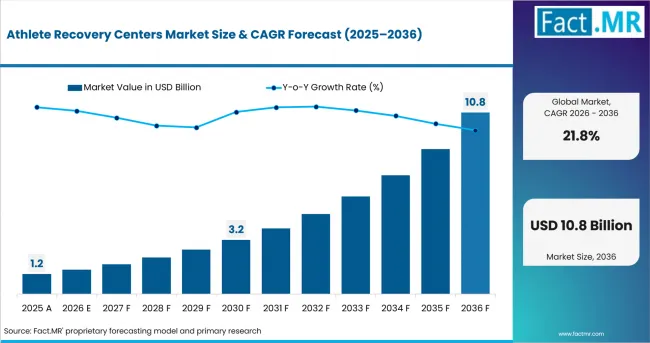
Athlete Recovery Centers Market Market Value Analysis

What are the defining numbers behind athlete recovery centers growth?

USD 9.3 billion absolute opportnity by 2036. United Arab Emirates, United States and United Kingdom lead the country view.

  • Demand Drivers in the Market
    • Fitness members are buying recovery as a scheduled habit because frequent training creates soreness and time pressure.
    • Franchise chains reduce buyer risk by putting cryotherapy, compression, sauna and red light rooms behind one counter.
    • Premium clubs and studios add recovery rooms because members compare the full wellness stack before renewing.
    • Medical oversight matters because intravenous hydration and injections increase licensing exposure when stores use health claims.
  • Key Segments Analyzed
    • By Revenue Model: Monthly Memberships are expected to account for 51.0% share in 2026 because recurring access improves visit discipline and helps studios forecast labor demand.
    • By Facility Model: Multi-Service Studios are projected to capture 49.0% share in 2026 as buyers prefer one location for cold and heat. Compression and bodywork increase repeat visits.
    • By Delivery Setting: Franchise Studios are estimated to hold 45.0% share in 2026 because brand playbooks reduce site-opening risk for new operators.
    • By Service Mix: Cryo-Cold-Contrast is likely to represent 37.0% share in 2026 since cold exposure remains the most visible reason for trial visits.
    • By Customer Type: Recreational Athletes are forecast to secure 36.0% share in 2026 because marathon runners, gym members and court-sport players create weekly recovery traffic.
    • By Booking Channel: App-Web Booking is anticipated to contribute 34.0% share in 2026 as centers need scheduled capacity for rooms and staffed services.
    • By End Use: Post-Exercise Recovery is expected to account for 33.0% share in 2026 because soreness management is the simplest service promise for first-time users.
    • By Geography: United Arab Emirates is expected to register 26.4% CAGR through 2036 due to premium wellness spending and dense urban service pricing.
  • Analyst Opinion
    • Shambhu Nath Jha, Principal Analyst at Fact.MR states, "Recovery retail has become a habit business. I would underwrite these studios by weekly repeat visits and clinical guardrails. The winner is not the brand with the longest menu. The winner is the operator that turns recovery into a safe routine after training."
  • Strategic Implications
    • Recovery center operators should measure weekly repeat visits before adding more service rooms.
    • Franchise systems need stronger training evidence for cryotherapy screening, hydration protocols and contraindication checks.
    • Investors should test site economics by room use, staff mix and membership churn rather than by menu length.

Walk-in recovery studios and membership recovery rooms form the core of this market. Global Wellness Institute placed physical activity spending at USD 1,143.90 billion in 2024. [1] This supports demand for paid recovery services that sit around fitness participation and active wellness routines without counting home devices or clinical rehabilitation revenue.

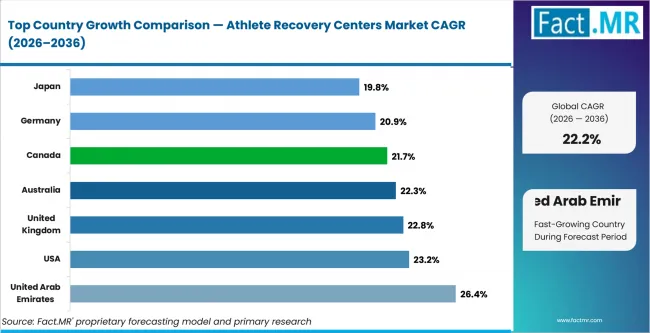
The United Arab Emirates is projected to record 26.4% CAGR through 2036 as luxury wellness spending and high service pricing support premium recovery formats. The United States is expected to expand at 23.2% CAGR because fitness facility use and franchise density support recurring recovery memberships. The United Kingdom is forecast to grow at 22.8% CAGR as dense urban fitness and adult activity levels support recovery rooms near gyms. Australia is expected to advance at 22.3% CAGR as sport participation and injury visibility create demand for recovery services. Canada is projected to rise at 21.7% CAGR as organized sport and indoor fitness routines support scheduled recovery visits.

How does the athlete recovery centers market break down by segment?

Monthly Memberships lead at 51.0%. Multi-Service Studios follow with 49.0% share in 2026.

Which revenue model leads?

Monthly Memberships hold 51.0% share in 2026.
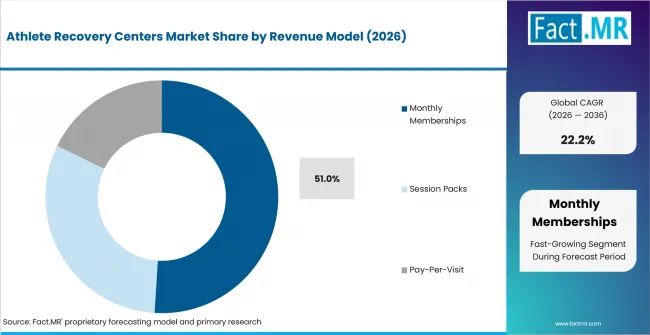
Athlete Recovery Centers Market Analysis By Revenue Model

Monthly Memberships are expected to hold 51.0% share in 2026 because recovery centers need repeat visits to cover staffed services. Members also use cold, heat and compression more often when access is prepaid. This structure works because operators sell habit formation rather than a single treatment.

Which facility model leads?

Multi-Service Studios hold 49.0% share in 2026.
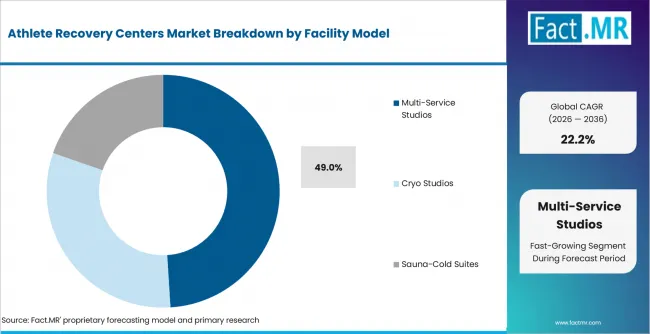
Athlete Recovery Centers Market Analysis By Facility Model

Multi-Service Studios are projected to account for 49.0% share in 2026 because one customer can move across cold plunge and sauna. Compression and stretch add a second reason to return. The format reduces the risk that revenue depends on one modality. Recovery suites help health and fitness clubs add an amenity that can be priced above the standard membership.

Which delivery setting leads?

Franchise Studios hold 45.0% share in 2026.
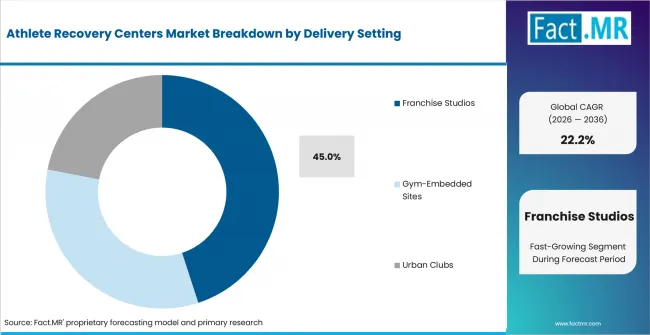
Athlete Recovery Centers Market Analysis By Delivery Setting

Franchise Studios are forecast to account for 45.0% share in 2026 because local owners need brand training and vendor playbooks. Build-out costs vary by cryotherapy chamber, sauna room and hydration area. Standardized sourcing helps franchisees compare recovery tools before opening a site.

Which service mix leads?

Cryo-Cold-Contrast holds 37.0% share in 2026.
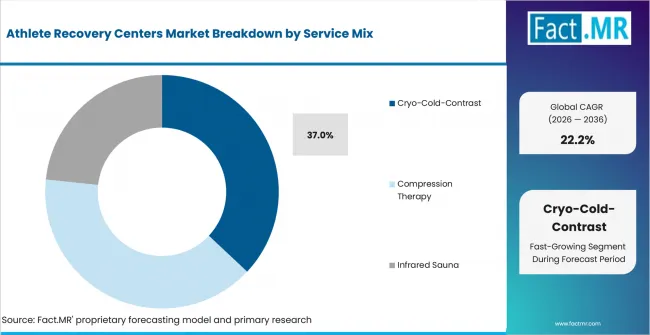
Athlete Recovery Centers Market Analysis By Service Mix

Cryo-Cold-Contrast is likely to capture 37.0% share in 2026 because cold exposure is the clearest entry service for first-time users. Compression therapy improves the second-visit pathway for endurance athletes and gym members. Centers that add compression therapy devices can extend visit time without rebuilding the store.

Which customer type leads?

Recreational Athletes hold 36.0% share in 2026.
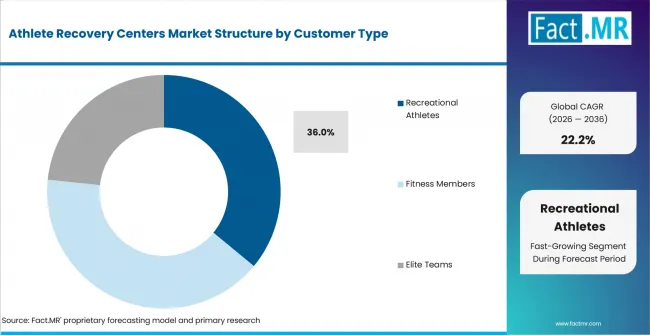
Athlete Recovery Centers Market Analysis By Customer Type

Recreational Athletes are estimated to hold 36.0% share in 2026 because this group trains often enough to feel soreness but rarely has pro-team support. They compare studio access with app-led training plans and at-home recovery routines. The same buyer base overlaps with home fitness apps because hybrid training creates regular recovery needs.

Which booking channel leads?

App-Web Booking holds 34.0% share in 2026.
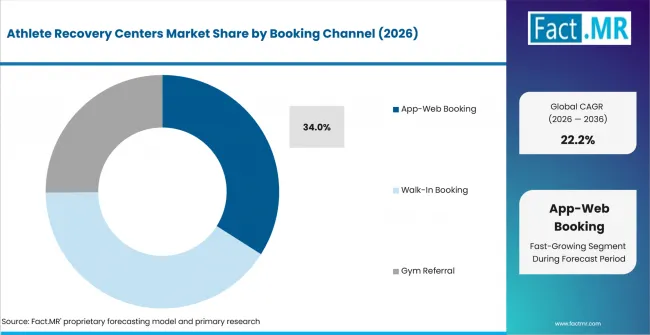
Athlete Recovery Centers Market Analysis By Booking Channel

App-Web Booking is expected to hold 34.0% share in 2026 because centers must reserve rooms, devices and staff time. The channel also helps operators shift customers into packages after a trial visit. Customers managing minor overuse issues may compare recovery sessions with support products when they want help between training days.

Which end use leads?

Post-Exercise Recovery holds 33.0% share in 2026.
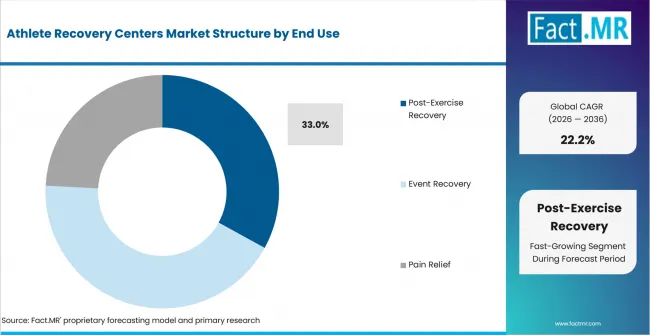
Athlete Recovery Centers Market Analysis By End Use

Post-Exercise Recovery is projected to hold 33.0% share in 2026 because it is easy for staff to explain and easy for customers to schedule. Event recovery has a shorter peak window after races and tournaments. Knee soreness after running and court sports can also support demand for recovery visits when staff provide clear care guidance.

What is accelerating athlete recovery center demand, and what is holding it back?

Franchise site density and fitness facility use support demand. Medical claims and room use risk restrain wider rollout.

Athlete Recovery Centers Market Opportunity Matrix Growth Vs Value

Fitness participation gives recovery centers a repeat customer base. The Sports & Fitness Industry Association reported 247.1 million active Americans in 2024. The Health & Fitness Association reported 81.0 million United States fitness facility members in 2025. Those figures matter because recovery studios need customers who train often enough to justify weekly visits.

Expansion is constrained by clinical oversight and room use. Intravenous hydration, injections and hyperbaric oxygen services need medical screening and clear disclaimers. The United States Food and Drug Administration warning letter to Healthy Living Clinic in September 2025 shows how health claims can create enforcement exposure. Studios also face weaker economics when expensive rooms sit idle outside evening and weekend peaks.

Where do the biggest athlete recovery center opportunities sit?

Membership routines, gym-embedded recovery rooms and medically supervised protocols.

  • Membership Routine Design: Operators can build plans around two or three weekly visits and connect recovery education with general post-training guidance when staff avoid disease claims.
  • Gym-Embedded Recovery Rooms: Health clubs can use recovery rooms to defend renewals when members compare amenities across premium facilities.
  • Clinical Oversight Stack: Centers can add hyperbaric oxygen therapy devices only when screening, scheduling and staff training are built into the operating model.

Which countries are scaling athlete recovery centers fastest?

United Arab Emirates 26.4% and United States 23.2% lead the country view. United Kingdom 22.8%, Australia 22.3% and Canada 21.7% follow. Germany 20.9% and Japan 19.8% complete the top seven.

Based on regional analysis, the athlete recovery centers market is segmented into North America and Western Europe. Asia Pacific, Latin America, and Middle East & Africa are also covered, but remain smaller in the early forecast period.

Top Country Growth Comparison Athlete Recovery Centers Market Cagr (2026 2036)

Country CAGR
United Arab Emirates 26.4%
United States 23.2%
United Kingdom 22.8%
Australia 22.3%
Canada 21.7%
Germany 20.9%
Japan 19.8%

Athlete Recovery Centers Market Cagr Analysis By Country

What powers the United Arab Emirates lead?

26.4% CAGR, supported by luxury wellness spending and high service pricing.

The United Arab Emirates combines premium wellness real estate with a service culture built around private booking. Global Wellness Institute valued the country wellness economy at USD 40.80 billion in 2024. Recovery centers benefit because visitors and residents already pay for spa, fitness and personal care services. Suppliers should prioritize high-capacity cold rooms and concierge booking before low-price formats.

Why does the United States matter?

23.2% CAGR, driven by fitness facility use and franchise density.
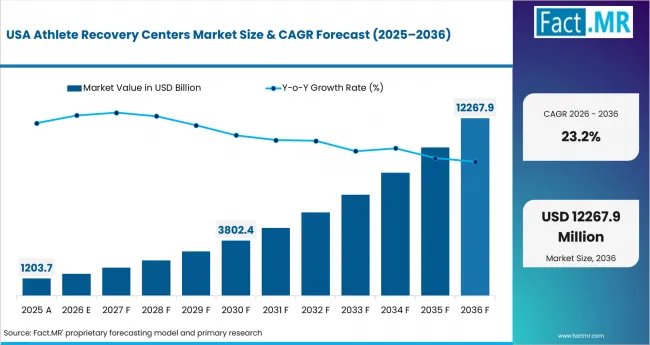
Athlete Recovery Centers Market Country Value Analysis

United States buyers already understand monthly studio memberships and add-on recovery services. The Health & Fitness Association reported 81.0 million United States fitness facility members in 2025. Restore Hyper Wellness and iCRYO give the market visible franchise playbooks. Operators that document screening and session safety should convert active consumers into recurring recovery members.

What supports the United Kingdom outlook?

22.8% CAGR, attributable to record adult activity levels.

United Kingdom demand is shaped by dense urban fitness, boutique studios and sports-club participation. Sport England reported that 30.9 million adults in England met activity guidelines in the 12 months to November 2025. Recovery centers can cluster near gyms, run clubs and commuter hubs. Faster expansion depends on landlords accepting smaller service suites with higher ventilation and utility needs.

How is Australia scaling recovery demand?

22.3% CAGR, supported by sport participation and injury visibility.

Australia has a deep sport culture and a clear injury-recovery conversation. The Australian Institute of Health and Welfare reported that nearly 85.0% of Australians aged 15 years and over joined sport or physical activity during 2023-24. Recovery centers should work near clubs, physiotherapy precincts and endurance-event communities. The main limit is the smaller number of dense metro catchments compared with the United States.

What makes Canada relevant?

21.7% CAGR, driven by organized sport and fitness guideline gaps.

Canada offers a clear base of active consumers but a smaller city network than the United States. The Government of Canada reported in August 2025 that 27.0% of Canadian adults participated in organized sport in 2024. Recovery centers can use team and club relationships to build first visits. Operators still need careful pricing because winter utility costs and staffing can narrow site margins.

Why is Germany a quality-sensitive market?

20.9% CAGR, led by structured sport health programs.

Germany approaches physical activity through clubs, insurers and prevention programs. The World Health Organization Regional Office for Europe reported in 2024 that 26.0% of German adults met both aerobic and muscle-strengthening activity indicators. Recovery providers should frame services around training continuity and safe use. Suppliers with documented screening and structured protocols should fit better than quick-service formats.

How does Japan create a steady premium channel?

19.8% CAGR, backed by high sport participation and aging wellness spending.

Athlete Recovery Centers Market Japan Market Share Analysis By Revenue Model

Japan combines premium urban wellness spending with an aging consumer base that values low-impact activity. The Statistics Bureau of Japan reported a 66.5% sports participation rate in the Statistical Handbook of Japan 2025. Recovery centers can serve fitness clubs, run groups and senior active-lifestyle customers. Site expansion is likely to stay disciplined because rent and staffing costs favor compact premium rooms.

Who leads the athlete recovery centers landscape?

Restore Hyper Wellness, iCRYO and Pause Studio lead through site visibility and service bundling. Premium clubs and recovery-device brands add another route.

Athlete Recovery Centers Market Analysis By Company

Restore Hyper Wellness dominates with their cryotherapy, red light therapy, infrared sauna, compression, mild hyperbaric oxygen therapy and intravenous drip therapy. Buyers compare Restore-style operators on service breadth, visit frequency and medical-screening discipline.

iCRYO focuses on a franchise model and a longer health and longevity menu. Its own franchise page lists more than 50 open locations and more than 280 awarded territories. The system also flags medical consultation for services that need screening. That makes franchise training a buyer concern rather than a back-office detail.

Buyer comparisons focus on room uptime, appointment availability, service variety and staff training. Pause Studio and Remedy Place use a premium wellness-club feel. Next Health and The DRIPBaR lean more heavily toward medically supervised hydration and longevity services. Next Health also connects recovery with blood-based biomarker testing for customers who want a premium intake layer.

The main barrier is not lack of consumer interest. The barrier is proving safe operation across cryotherapy, hydration and device-led services. Life Time also shows how large clubs can absorb recovery and longevity services inside an existing member base. Providers that can document utilization, staff training and claims control should be better placed through 2036.

Which companies are the key players?

Restore Hyper Wellness, iCRYO and Pause Studio are key players. Remedy Place, Next Health, The DRIPBaR and SweatHouz are also profiled.

  • Restore Hyper Wellness
  • iCRYO
  • Pause Studio
  • Remedy Place
  • Next Health
  • The DRIPBaR
  • SweatHouz

Bibliography

  • [1] Global Wellness Institute. (2025, November). Wellness economy statistics and facts. Global Wellness Institute.
  • [2] Global Wellness Institute. (2026, January). Global wellness economy country rankings 2019 to 2024 data. Global Wellness Institute.
  • [3] Sports & Fitness Industry Association. (2025, February 27). SFIA Topline Participation Report shows 247.1 million Americans were active in 2024. Sports & Fitness Industry Association.
  • [4] Health & Fitness Association. (2026, April 9). 81 million Americans were members of a fitness facility in 2025, new HFA report finds. Health & Fitness Association.
  • [5] Sport England. (2026, April 23). England is getting more active but not everyone is benefiting. Sport England.
  • [6] Australian Institute of Health and Welfare. (2025, July 30). Sports injury in Australia. Australian Institute of Health and Welfare.
  • [7] Government of Canada, Department of Canadian Heritage. (2025, August 28). Why sport is important to Canadians and Canada. Government of Canada.
  • [8] Statistics Canada. (2025, October 17). Directly measured physical activity and sedentary time in Canada. Statistics Canada.
  • [9] World Health Organization Regional Office for Europe. (2024, October 2). Physical activity factsheet: Germany 2024. World Health Organization.
  • [10] Statistics Bureau of Japan, Ministry of Internal Affairs and Communications. (2025, September). Statistical Handbook of Japan 2025. Statistics Bureau of Japan.
  • [11] Global Wellness Institute. (2025, November 20). New Global Wellness Institute report shows United Arab Emirates wellness economy now worth USD 40.8 billion. Global Wellness Institute.
  • [12] Restore Hyper Wellness. (2026, June). Store locator and service menu. Restore Hyper Wellness.
  • [13] Restore Hyper Wellness. (2026, June). Global studio locations. Restore Hyper Wellness.
  • [14] iCRYO. (2025, August 12). iCRYO named to Inc. 5000 list of fastest-growing companies. iCRYO.
  • [15] iCRYO. (2026, June). iCRYO health and longevity franchise. iCRYO.
  • [16] SweatHouz. (2026, June). Cold plunge and infrared sauna studio. SweatHouz.
  • [17] Life Time Group Holdings, Inc. (2025, February 27). Form 10-K annual report. Life Time Group Holdings, Inc.
  • [18] Life Time Group Holdings, Inc. (2025, November 4). Form 10-Q quarterly report. Life Time Group Holdings, Inc.
  • [19] United States Food and Drug Administration. (2025, September 9). Healthy Living Clinic warning letter. U.S. Food and Drug Administration.

This Report Addresses

  • Strategic intelligence on athlete recovery centers across service mix, facility model, revenue model and customer type.
  • Segment analysis covering Monthly Memberships, Multi-Service Studios, Franchise Studios, Cryo-Cold-Contrast and App-Web Booking.
  • Regional outlook covering United Arab Emirates, United States, United Kingdom, Australia, Canada, Germany and Japan.
  • Competitive analysis of Restore Hyper Wellness, iCRYO and Pause Studio. Remedy Place, Next Health, The DRIPBaR and SweatHouz are also profiled.
  • Service assessment covering cryotherapy, contrast therapy, compression, infrared sauna, intravenous hydration and assisted stretch.
  • Operating assessment covering room use, staffing, screening, membership churn and medical-claim exposure.
  • Source-led market sizing using provider counts, service menus, public activity data, association statistics and official company disclosures.

What does the athlete recovery centers market cover?

Walk-in and membership recovery studios that sell recovery sessions to athletes, fitness members and active wellness consumers.

The athlete recovery centers market covers paid studios that combine recovery modalities inside one scheduled service setting. Whole-body cryotherapy and cold plunge are included when sold by a recovery center. Contrast therapy, infrared sauna and compression therapy are also included. Red light therapy, assisted stretch and intravenous hydration complete the counted service set. Membership plans and session packs are counted when they give the customer access to recovery services.

What is included in the scope?

Recovery studios, recovery lounges and club-embedded rooms. Franchise sites and independent centers are also included.

The scope includes standalone recovery studios and fitness-club recovery rooms. Athlete recovery lounges and sauna-cold suites are also covered. Bodywork rooms and medically supervised hydration rooms are included when they operate under a recovery center model. Revenue includes memberships, session packs, team contracts and corporate plans. Studio software fees are included only when they are bundled into the service price paid by the operator.

What is excluded from the scope?

At-home devices, clinical rehabilitation revenue and ordinary gym memberships without a paid recovery service layer.

The scope excludes recovery boots and massage guns sold for home use. Cold tubs and red light panels are also excluded when they are direct device sales. It also excludes sports medicine treatment, physical therapy billing, hospital rehabilitation and supplement sales. Hotel spa revenue is excluded unless the site sells athlete recovery sessions as a recurring service. Ordinary sauna access inside a gym is excluded when it is not priced as a recovery center service.

How was the analysis built?

90+ sources and 40+ company or regulator pages were reviewed. 20+ countries were checked with 18+ interviews.

  • Primary Research:
    • Interviews covered recovery studio operators and franchise consultants. Fitness club buyers and sports performance coaches were also included.
  • Desk Research:
    • Desk research reviewed government health and activity data. Association reports, company service pages and official filings were checked.
  • Market-Sizing and Forecasting:
    • Forecasting used provider counts and current site evidence. Service menus and average revenue per center assumptions supported the model.
  • Data Validation and Update Cycle:
    • Estimates were checked against Restore Hyper Wellness site evidence and iCRYO franchise disclosures. Life Time filings and physical activity benchmarks supported the update cycle.

What is the report’s scope and coverage?
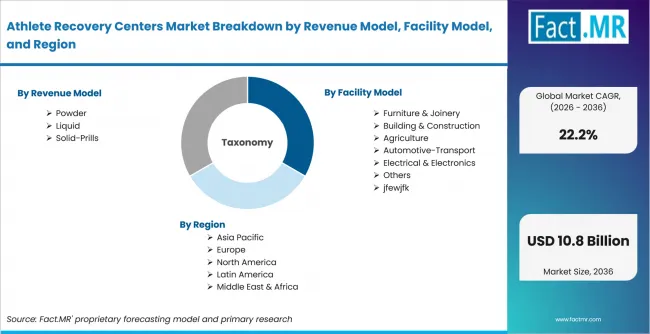
Athlete Recovery Centers Market Breakdown By Revenue Model, Facility Model, And Region

Attribute Details
Quantitative Units USD Billion in 2026 to USD Billion by 2036 at CAGR
Market Definition Paid recovery studios and recovery center rooms serving athletes, fitness members and active wellness consumers
Service Mix Cryo-Cold-Contrast, Compression Therapy, Infrared Sauna, Intravenous Hydration, Assisted Stretch
Facility Model Multi-Service Studios, Cryo Studios, Sauna-Cold Suites, Hydration Lounges, Bodywork Rooms
Revenue Model Monthly Memberships, Session Packs, Pay-Per-Visit, Corporate Plans, Team Contracts
Delivery Setting Franchise Studios, Gym-Embedded Sites, Urban Clubs, Hotel Suites, Mobile Pop-Ups
Customer Type Recreational Athletes, Fitness Members, Elite Teams, Wellness Consumers, Corporate Members
Booking Channel App-Web Booking, Walk-In Booking, Member App, Gym Referral, Concierge Booking
End Use Post-Exercise Recovery, Event Recovery, Travel Recovery, Pain Relief, Routine Wellness
Regions Covered North America, Europe, Asia Pacific, Latin America, Middle East and Africa
Countries Covered United Arab Emirates, United States, United Kingdom, Australia, Canada, Germany and Japan
Key Companies Profiled Restore Hyper Wellness, iCRYO, Pause Studio, Remedy Place, Next Health, The DRIPBaR and SweatHouz
Forecast Period 2026 to 2036
Approach Hybrid top-down and bottom-up approach using site counts, service menus, membership economics, activity benchmarks and company validation

How is the market segmented?

  • By Service Mix:

    • Cryo-Cold-Contrast
    • Compression Therapy
    • Infrared Sauna
    • Intravenous Hydration
    • Assisted Stretch
  • By Facility Model:

    • Multi-Service Studios
    • Cryo Studios
    • Sauna-Cold Suites
    • Hydration Lounges
    • Bodywork Rooms
  • By Revenue Model:

    • Monthly Memberships
    • Session Packs
    • Pay-Per-Visit
    • Corporate Plans
    • Team Contracts
  • By Delivery Setting:

    • Franchise Studios
    • Gym-Embedded Sites
    • Urban Clubs
    • Hotel Suites
    • Mobile Pop-Ups
  • By Customer Type:

    • Recreational Athletes
    • Fitness Members
    • Elite Teams
    • Wellness Consumers
    • Corporate Members
  • By Booking Channel:

    • App-Web Booking
    • Walk-In Booking
    • Member App
    • Gym Referral
    • Concierge Booking
  • By End Use:

    • Post-Exercise Recovery
    • Event Recovery
    • Travel Recovery
    • Pain Relief
    • Routine Wellness
  • By Region:

    • North America
      • United States
      • Canada
      • Mexico
    • Latin America
      • Brazil
      • Argentina
      • Rest of Latin America
    • Europe
      • Germany
      • United Kingdom
      • France
      • Italy
      • Spain
      • Rest of Europe
    • Asia Pacific
      • China
      • India
      • Japan
      • South Korea
      • Australia
      • ASEAN
    • Middle East & Africa
      • GCC Countries
      • United Arab Emirates
      • Saudi Arabia
      • South Africa
      • Rest of Middle East & Africa

- Frequently Asked Questions -

How large is the Athlete Recovery Centers Market expected to be in the near term?

The market is expanding as recovery services shift from occasional visits to structured, recurring memberships.

What is the long term outlook for the Athlete Recovery Centers Market?

The outlook remains strong as recovery rooms become standard features within franchise studios and premium fitness clubs.

How fast is the Athlete Recovery Centers Market expected to grow?

Growth is supported by rising fitness participation, franchise rollout, and demand for repeat recovery routines.

What is the main driver of athlete recovery center demand?

Demand is driven by athletes and fitness members seeking scheduled recovery to manage soreness and training load.

Which regions show strong adoption of athlete recovery centers?

North America, Western Europe, and the Middle East show strong adoption through premium fitness and wellness spending.

Which countries are key markets for athlete recovery centers?

The United Arab Emirates, United States, United Kingdom, Australia, Canada, Germany, and Japan are key markets.

What supports the United Arab Emirates’ leading position?

Luxury wellness culture and high willingness to pay support premium recovery studio formats.

Why is the United States an important market?

High fitness facility membership and established franchise models support recurring recovery demand.

What restrains wider market expansion?

Medical oversight requirements, staffing intensity, and room utilization risk restrain rapid scaling.

Who are the leading companies in the Athlete Recovery Centers Market?

Leading players include Restore Hyper Wellness, iCRYO, Pause Studio, Remedy Place, Next Health, The DRIPBaR, and SweatHouz.

How do recovery center operators differentiate their services?

Operators differentiate through service bundling, safety protocols, staff training, and visit frequency programs.

Where do future opportunities in the market lie?

Opportunities lie in membership led recovery routines, gym embedded recovery rooms, and clinically supervised services.

Table of Content

  1. Key Takeaways
    • Market Size and CAGR
    • Top Growth Driver
    • Fastest Growing Segment
    • Leading Region
    • Key Companies
    • Emerging Opportunities
  2. Executive Summary
    • Global Market Outlook
    • Demand-side Trends
    • Supply-side Trends
    • Technology Roadmap Analysis
    • Analysis and Recommendations
    • Analyst Perspective (What is happening? Why now? What should investors know?)
    • Key Questions Answered
      • How large is the market?
      • What is the CAGR?
      • What are key trends?
      • Which region dominates?
      • Who are the leaders?
  3. Market Overview
    • Market Coverage / Taxonomy
    • Market Definition / Scope / Limitations
  4. Research Methodology
    • Chapter Orientation
    • Analytical Lens and Working Hypotheses
      • Market Structure, Signals, and Trend Drivers
      • Benchmarking and Cross-market Comparability
      • Market Sizing, Forecasting, and Opportunity Mapping
    • Research Design and Evidence Framework
      • Desk Research Programme (Secondary Evidence)
      • Expert Input and Fieldwork (Primary Evidence)
      • Tooling, Models, and Reference Databases
    • Data Engineering and Model Build
    • Quality Assurance and Audit Trail
  5. Market Background
    • Market Dynamics (Drivers, Restraints, Opportunity, Trends)
    • Scenario Forecast (Optimistic, Likely, Conservative)
    • Impact Analysis
      • AI Impact
      • Sustainability Impact
      • Regulatory Impact
      • Technology Impact
    • Consumer / Buyer Analysis
      • Purchase Drivers
      • Adoption Barriers
      • Buyer Journey
    • Opportunity Map Analysis
    • Product Life Cycle Analysis
    • Supply Chain Analysis
    • Investment Feasibility Matrix
    • Value Chain Analysis
    • PESTLE and Porter's Analysis
    • Regulatory Landscape
    • Regional Parent Market Outlook
    • Production and Consumption Statistics
    • Import and Export Statistics
  6. Global Market Analysis and Forecast, 2021 to 2036
    • Historical Market Size Value (USD Million) Analysis, 2021 to 2025
    • Current and Future Market Size Value (USD Million) Projections, 2026 to 2036
      • Y-o-Y Growth Trend Analysis
      • Absolute $ Opportunity Analysis
  7. Global Market Pricing Analysis, 2021 to 2036
  8. Global Market Analysis and Forecast, By Revenue Model, 2021 to 2036
    • Introduction / Key Findings
    • Historical Market Size Value (USD Million) Analysis By Revenue Model, 2021 to 2025
    • Current and Future Market Size Value (USD Million) Analysis and Forecast By Revenue Model, 2026 to 2036
      • Monthly Memberships
      • Session Packs
      • Pay-Per-Visit
    • Y-o-Y Growth Trend Analysis By Revenue Model, 2021 to 2025
    • Absolute $ Opportunity Analysis By Revenue Model, 2026 to 2036
  9. Global Market Analysis and Forecast, By Facility Model, 2021 to 2036
    • Introduction / Key Findings
    • Historical Market Size Value (USD Million) Analysis By Facility Model, 2021 to 2025
    • Current and Future Market Size Value (USD Million) Analysis and Forecast By Facility Model, 2026 to 2036
      • Multi-Service Studios
      • Cryo Studios
      • Sauna-Cold Suites
    • Y-o-Y Growth Trend Analysis By Facility Model, 2021 to 2025
    • Absolute $ Opportunity Analysis By Facility Model, 2026 to 2036
  10. Global Market Analysis and Forecast, By Delivery Setting, 2021 to 2036
    • Introduction / Key Findings
    • Historical Market Size Value (USD Million) Analysis By Delivery Setting, 2021 to 2025
    • Current and Future Market Size Value (USD Million) Analysis and Forecast By Delivery Setting, 2026 to 2036
      • Franchise Studios
      • Gym-Embedded Sites
      • Urban Clubs
    • Y-o-Y Growth Trend Analysis By Delivery Setting, 2021 to 2025
    • Absolute $ Opportunity Analysis By Delivery Setting, 2026 to 2036
  11. Global Market Analysis and Forecast, By Service Mix, 2021 to 2036
    • Introduction / Key Findings
    • Historical Market Size Value (USD Million) Analysis By Service Mix, 2021 to 2025
    • Current and Future Market Size Value (USD Million) Analysis and Forecast By Service Mix, 2026 to 2036
      • Cryo-Cold-Contrast
      • Compression Therapy
      • Infrared Sauna
    • Y-o-Y Growth Trend Analysis By Service Mix, 2021 to 2025
    • Absolute $ Opportunity Analysis By Service Mix, 2026 to 2036
  12. Global Market Analysis and Forecast, By Customer Type, 2021 to 2036
    • Introduction / Key Findings
    • Historical Market Size Value (USD Million) Analysis By Customer Type, 2021 to 2025
    • Current and Future Market Size Value (USD Million) Analysis and Forecast By Customer Type, 2026 to 2036
      • Recreational Athletes
      • Fitness Members
      • Elite Teams
    • Y-o-Y Growth Trend Analysis By Customer Type, 2021 to 2025
    • Absolute $ Opportunity Analysis By Customer Type, 2026 to 2036
  13. Global Market Analysis and Forecast, By Booking Channel
    • Introduction / Key Findings
    • Historical Market Size Value (USD Million) Analysis By Booking Channel, 2021 to 2025
    • Current and Future Market Size Value (USD Million) Analysis and Forecast By Booking Channel, 2026 to 2036
      • App-Web Booking
      • Walk-In Booking
      • Gym Referral
    • Y-o-Y Growth Trend Analysis By Booking Channel, 2021 to 2025
    • Absolute $ Opportunity Analysis By Booking Channel, 2026 to 2036
  14. Global Market Analysis and Forecast, By End Use
    • Introduction / Key Findings
    • Historical Market Size Value (USD Million) Analysis By End Use, 2021 to 2025
    • Current and Future Market Size Value (USD Million) Analysis and Forecast By End Use, 2026 to 2036
      • Post-Exercise Recovery
      • Event Recovery
      • Pain Relief
    • Y-o-Y Growth Trend Analysis By End Use, 2021 to 2025
    • Absolute $ Opportunity Analysis By End Use, 2026 to 2036
  15. Global Market Analysis and Forecast, By Region, 2021 to 2036
    • Introduction
    • Historical Market Size Value (USD Million) Analysis By Region, 2021 to 2025
    • Current Market Size Value (USD Million) Analysis and Forecast By Region, 2026 to 2036
      • North America
      • Latin America
      • Western Europe
      • Eastern Europe
      • East Asia
      • South Asia and Pacific
      • Middle East & Africa
    • Market Attractiveness Analysis By Region
  16. North America Market Analysis and Forecast, By Country, 2021 to 2036
    • Historical Market Size Value (USD Million) Trend Analysis By Market Taxonomy, 2021 to 2025
    • Market Size Value (USD Million) Forecast By Market Taxonomy, 2026 to 2036
      • By Country
        • United States
        • Canada
        • Mexico
      • By Revenue Model
      • By Facility Model
      • By Delivery Setting
      • By Service Mix
      • By Customer Type
      • By Booking Channel
      • By End Use
    • Market Attractiveness Analysis
      • By Country
      • By Revenue Model
      • By Facility Model
      • By Delivery Setting
      • By Service Mix
      • By Customer Type
      • By Booking Channel
      • By End Use
    • Key Takeaways
  17. Latin America Market Analysis and Forecast, By Country
    • Historical Market Size Value (USD Million) Trend Analysis By Market Taxonomy, 2021 to 2025
    • Market Size Value (USD Million) Forecast By Market Taxonomy, 2026 to 2036
      • By Country
        • Brazil
        • Chile
        • Rest of Latin America
      • By Revenue Model
      • By Facility Model
      • By Delivery Setting
      • By Service Mix
      • By Customer Type
      • By Booking Channel
      • By End Use
    • Market Attractiveness Analysis
      • By Country
      • By Revenue Model
      • By Facility Model
      • By Delivery Setting
      • By Service Mix
      • By Customer Type
      • By Booking Channel
      • By End Use
    • Key Takeaways
  18. Western Europe Market Analysis and Forecast, By Country
    • Historical Market Size Value (USD Million) Trend Analysis By Market Taxonomy, 2021 to 2025
    • Market Size Value (USD Million) Forecast By Market Taxonomy, 2026 to 2036
      • By Country
        • Germany
        • UK
        • Italy
        • Spain
        • France
        • Nordic
        • BENELUX
        • Rest of Western Europe
      • By Revenue Model
      • By Facility Model
      • By Delivery Setting
      • By Service Mix
      • By Customer Type
      • By Booking Channel
      • By End Use
    • Market Attractiveness Analysis
      • By Country
      • By Revenue Model
      • By Facility Model
      • By Delivery Setting
      • By Service Mix
      • By Customer Type
      • By Booking Channel
      • By End Use
    • Key Takeaways
  19. Eastern Europe Market Analysis and Forecast, By Country
    • Historical Market Size Value (USD Million) Trend Analysis By Market Taxonomy, 2021 to 2025
    • Market Size Value (USD Million) Forecast By Market Taxonomy, 2026 to 2036
      • By Country
        • Russia
        • Poland
        • Hungary
        • Balkan & Baltic
        • Rest of Eastern Europe
      • By Revenue Model
      • By Facility Model
      • By Delivery Setting
      • By Service Mix
      • By Customer Type
      • By Booking Channel
      • By End Use
    • Market Attractiveness Analysis
      • By Country
      • By Revenue Model
      • By Facility Model
      • By Delivery Setting
      • By Service Mix
      • By Customer Type
      • By Booking Channel
      • By End Use
    • Key Takeaways
  20. East Asia Market Analysis and Forecast, By Country
    • Historical Market Size Value (USD Million) Trend Analysis By Market Taxonomy, 2021 to 2025
    • Market Size Value (USD Million) Forecast By Market Taxonomy, 2026 to 2036
      • By Country
        • China
        • Japan
        • South Korea
      • By Revenue Model
      • By Facility Model
      • By Delivery Setting
      • By Service Mix
      • By Customer Type
      • By Booking Channel
      • By End Use
    • Market Attractiveness Analysis
      • By Country
      • By Revenue Model
      • By Facility Model
      • By Delivery Setting
      • By Service Mix
      • By Customer Type
      • By Booking Channel
      • By End Use
    • Key Takeaways
  21. South Asia and Pacific Market Analysis and Forecast, By Country
    • Historical Market Size Value (USD Million) Trend Analysis By Market Taxonomy, 2021 to 2025
    • Market Size Value (USD Million) Forecast By Market Taxonomy, 2026 to 2036
      • By Country
        • India
        • ASEAN
        • Australia & New Zealand
        • Rest of South Asia and Pacific
      • By Revenue Model
      • By Facility Model
      • By Delivery Setting
      • By Service Mix
      • By Customer Type
      • By Booking Channel
      • By End Use
    • Market Attractiveness Analysis
      • By Country
      • By Revenue Model
      • By Facility Model
      • By Delivery Setting
      • By Service Mix
      • By Customer Type
      • By Booking Channel
      • By End Use
    • Key Takeaways
  22. Middle East & Africa Market Analysis and Forecast, By Country
    • Historical Market Size Value (USD Million) Trend Analysis By Market Taxonomy, 2021 to 2025
    • Market Size Value (USD Million) Forecast By Market Taxonomy, 2026 to 2036
      • By Country
        • Kingdom of Saudi Arabia
        • Other GCC Countries
        • Turkiye
        • South Africa
        • Other African Union
        • Rest of Middle East & Africa
      • By Revenue Model
      • By Facility Model
      • By Delivery Setting
      • By Service Mix
      • By Customer Type
      • By Booking Channel
      • By End Use
    • Market Attractiveness Analysis
      • By Country
      • By Revenue Model
      • By Facility Model
      • By Delivery Setting
      • By Service Mix
      • By Customer Type
      • By Booking Channel
      • By End Use
    • Key Takeaways
  23. Key Countries Market Analysis
    • United States
      • Pricing Analysis
      • Market Share Analysis, 2025
        • By Revenue Model
        • By Facility Model
        • By Delivery Setting
        • By Service Mix
        • By Customer Type
        • By Booking Channel
        • By End Use
    • Canada
      • Pricing Analysis
      • Market Share Analysis, 2025
        • By Revenue Model
        • By Facility Model
        • By Delivery Setting
        • By Service Mix
        • By Customer Type
        • By Booking Channel
        • By End Use
    • Mexico
      • Pricing Analysis
      • Market Share Analysis, 2025
        • By Revenue Model
        • By Facility Model
        • By Delivery Setting
        • By Service Mix
        • By Customer Type
        • By Booking Channel
        • By End Use
    • Brazil
      • Pricing Analysis
      • Market Share Analysis, 2025
        • By Revenue Model
        • By Facility Model
        • By Delivery Setting
        • By Service Mix
        • By Customer Type
        • By Booking Channel
        • By End Use
    • Chile
      • Pricing Analysis
      • Market Share Analysis, 2025
        • By Revenue Model
        • By Facility Model
        • By Delivery Setting
        • By Service Mix
        • By Customer Type
        • By Booking Channel
        • By End Use
    • Germany
      • Pricing Analysis
      • Market Share Analysis, 2025
        • By Revenue Model
        • By Facility Model
        • By Delivery Setting
        • By Service Mix
        • By Customer Type
        • By Booking Channel
        • By End Use
    • UK
      • Pricing Analysis
      • Market Share Analysis, 2025
        • By Revenue Model
        • By Facility Model
        • By Delivery Setting
        • By Service Mix
        • By Customer Type
        • By Booking Channel
        • By End Use
    • Italy
      • Pricing Analysis
      • Market Share Analysis, 2025
        • By Revenue Model
        • By Facility Model
        • By Delivery Setting
        • By Service Mix
        • By Customer Type
        • By Booking Channel
        • By End Use
    • Spain
      • Pricing Analysis
      • Market Share Analysis, 2025
        • By Revenue Model
        • By Facility Model
        • By Delivery Setting
        • By Service Mix
        • By Customer Type
        • By Booking Channel
        • By End Use
    • France
      • Pricing Analysis
      • Market Share Analysis, 2025
        • By Revenue Model
        • By Facility Model
        • By Delivery Setting
        • By Service Mix
        • By Customer Type
        • By Booking Channel
        • By End Use
    • India
      • Pricing Analysis
      • Market Share Analysis, 2025
        • By Revenue Model
        • By Facility Model
        • By Delivery Setting
        • By Service Mix
        • By Customer Type
        • By Booking Channel
        • By End Use
    • ASEAN
      • Pricing Analysis
      • Market Share Analysis, 2025
        • By Revenue Model
        • By Facility Model
        • By Delivery Setting
        • By Service Mix
        • By Customer Type
        • By Booking Channel
        • By End Use
    • Australia & New Zealand
      • Pricing Analysis
      • Market Share Analysis, 2025
        • By Revenue Model
        • By Facility Model
        • By Delivery Setting
        • By Service Mix
        • By Customer Type
        • By Booking Channel
        • By End Use
    • China
      • Pricing Analysis
      • Market Share Analysis, 2025
        • By Revenue Model
        • By Facility Model
        • By Delivery Setting
        • By Service Mix
        • By Customer Type
        • By Booking Channel
        • By End Use
    • Japan
      • Pricing Analysis
      • Market Share Analysis, 2025
        • By Revenue Model
        • By Facility Model
        • By Delivery Setting
        • By Service Mix
        • By Customer Type
        • By Booking Channel
        • By End Use
    • South Korea
      • Pricing Analysis
      • Market Share Analysis, 2025
        • By Revenue Model
        • By Facility Model
        • By Delivery Setting
        • By Service Mix
        • By Customer Type
        • By Booking Channel
        • By End Use
    • Russia
      • Pricing Analysis
      • Market Share Analysis, 2025
        • By Revenue Model
        • By Facility Model
        • By Delivery Setting
        • By Service Mix
        • By Customer Type
        • By Booking Channel
        • By End Use
    • Poland
      • Pricing Analysis
      • Market Share Analysis, 2025
        • By Revenue Model
        • By Facility Model
        • By Delivery Setting
        • By Service Mix
        • By Customer Type
        • By Booking Channel
        • By End Use
    • Hungary
      • Pricing Analysis
      • Market Share Analysis, 2025
        • By Revenue Model
        • By Facility Model
        • By Delivery Setting
        • By Service Mix
        • By Customer Type
        • By Booking Channel
        • By End Use
    • Kingdom of Saudi Arabia
      • Pricing Analysis
      • Market Share Analysis, 2025
        • By Revenue Model
        • By Facility Model
        • By Delivery Setting
        • By Service Mix
        • By Customer Type
        • By Booking Channel
        • By End Use
    • Turkiye
      • Pricing Analysis
      • Market Share Analysis, 2025
        • By Revenue Model
        • By Facility Model
        • By Delivery Setting
        • By Service Mix
        • By Customer Type
        • By Booking Channel
        • By End Use
    • South Africa
      • Pricing Analysis
      • Market Share Analysis, 2025
        • By Revenue Model
        • By Facility Model
        • By Delivery Setting
        • By Service Mix
        • By Customer Type
        • By Booking Channel
        • By End Use
  24. Market Structure Analysis
    • Competition Dashboard
    • Competition Benchmarking
    • Market Share Analysis of Top Players
      • By Regional
      • By Revenue Model
      • By Facility Model
      • By Delivery Setting
      • By Service Mix
      • By Customer Type
      • By Booking Channel
      • By End Use
    • Emerging Startups
    • Innovation Benchmarking
  25. Competition Analysis
    • Competition Deep Dive
      • Restore Hyper Wellness
        • Overview
        • Product Portfolio
        • Profitability by Market Segments (Product/Age /Sales Channel/Region)
        • Sales Footprint
        • Strategy Overview
          • Marketing Strategy
          • Product Strategy
          • Channel Strategy
      • iCRYO
      • Pause Studio
      • Remedy Place
      • Next Health
      • The DRIPBaR
  26. Case Studies
  27. Success Stories
  28. Recent Developments
  29. Assumptions & Acronyms Used

List Of Table

  • Table 1: Global Market Value (USD Million) Forecast by Region, 2021 to 2036
  • Table 2: Global Market Value (USD Million) Forecast by Revenue Model, 2021 to 2036
  • Table 3: Global Market Value (USD Million) Forecast by Facility Model, 2021 to 2036
  • Table 4: Global Market Value (USD Million) Forecast by Delivery Setting, 2021 to 2036
  • Table 5: Global Market Value (USD Million) Forecast by Service Mix, 2021 to 2036
  • Table 6: Global Market Value (USD Million) Forecast by Customer Type, 2021 to 2036
  • Table 7: Global Market Value (USD Million) Forecast by Booking Channel, 2021 to 2036
  • Table 8: Global Market Value (USD Million) Forecast by End Use, 2021 to 2036
  • Table 9: Global Market Value (USD Million) Forecast by End Use, 2021 to 2036
  • Table 10: North America Market Value (USD Million) Forecast by Country, 2021 to 2036
  • Table 11: North America Market Value (USD Million) Forecast by Revenue Model, 2021 to 2036
  • Table 12: North America Market Value (USD Million) Forecast by Facility Model, 2021 to 2036
  • Table 13: North America Market Value (USD Million) Forecast by Delivery Setting, 2021 to 2036
  • Table 14: North America Market Value (USD Million) Forecast by Service Mix, 2021 to 2036
  • Table 15: North America Market Value (USD Million) Forecast by Customer Type, 2021 to 2036
  • Table 16: North America Market Value (USD Million) Forecast by Booking Channel, 2021 to 2036
  • Table 17: North America Market Value (USD Million) Forecast by End Use, 2021 to 2036
  • Table 18: Latin America Market Value (USD Million) Forecast by Country, 2021 to 2036
  • Table 19: Latin America Market Value (USD Million) Forecast by Revenue Model, 2021 to 2036
  • Table 20: Latin America Market Value (USD Million) Forecast by Facility Model, 2021 to 2036
  • Table 21: Latin America Market Value (USD Million) Forecast by Delivery Setting, 2021 to 2036
  • Table 22: Latin America Market Value (USD Million) Forecast by Service Mix, 2021 to 2036
  • Table 23: Latin America Market Value (USD Million) Forecast by Customer Type, 2021 to 2036
  • Table 24: Latin America Market Value (USD Million) Forecast by Booking Channel, 2021 to 2036
  • Table 25: Latin America Market Value (USD Million) Forecast by End Use, 2021 to 2036
  • Table 26: Western Europe Market Value (USD Million) Forecast by Country, 2021 to 2036
  • Table 27: Western Europe Market Value (USD Million) Forecast by Revenue Model, 2021 to 2036
  • Table 28: Western Europe Market Value (USD Million) Forecast by Facility Model, 2021 to 2036
  • Table 29: Western Europe Market Value (USD Million) Forecast by Delivery Setting, 2021 to 2036
  • Table 30: Western Europe Market Value (USD Million) Forecast by Service Mix, 2021 to 2036
  • Table 31: Western Europe Market Value (USD Million) Forecast by Customer Type, 2021 to 2036
  • Table 32: Western Europe Market Value (USD Million) Forecast by Booking Channel, 2021 to 2036
  • Table 33: Western Europe Market Value (USD Million) Forecast by End Use, 2021 to 2036
  • Table 34: Eastern Europe Market Value (USD Million) Forecast by Country, 2021 to 2036
  • Table 35: Eastern Europe Market Value (USD Million) Forecast by Revenue Model, 2021 to 2036
  • Table 36: Eastern Europe Market Value (USD Million) Forecast by Facility Model, 2021 to 2036
  • Table 37: Eastern Europe Market Value (USD Million) Forecast by Delivery Setting, 2021 to 2036
  • Table 38: Eastern Europe Market Value (USD Million) Forecast by Service Mix, 2021 to 2036
  • Table 39: Eastern Europe Market Value (USD Million) Forecast by Customer Type, 2021 to 2036
  • Table 40: Eastern Europe Market Value (USD Million) Forecast by Booking Channel, 2021 to 2036
  • Table 41: Eastern Europe Market Value (USD Million) Forecast by End Use, 2021 to 2036
  • Table 42: East Asia Market Value (USD Million) Forecast by Country, 2021 to 2036
  • Table 43: East Asia Market Value (USD Million) Forecast by Revenue Model, 2021 to 2036
  • Table 44: East Asia Market Value (USD Million) Forecast by Facility Model, 2021 to 2036
  • Table 45: East Asia Market Value (USD Million) Forecast by Delivery Setting, 2021 to 2036
  • Table 46: East Asia Market Value (USD Million) Forecast by Service Mix, 2021 to 2036
  • Table 47: East Asia Market Value (USD Million) Forecast by Customer Type, 2021 to 2036
  • Table 48: East Asia Market Value (USD Million) Forecast by Booking Channel, 2021 to 2036
  • Table 49: East Asia Market Value (USD Million) Forecast by End Use, 2021 to 2036
  • Table 50: South Asia and Pacific Market Value (USD Million) Forecast by Country, 2021 to 2036
  • Table 51: South Asia and Pacific Market Value (USD Million) Forecast by Revenue Model, 2021 to 2036
  • Table 52: South Asia and Pacific Market Value (USD Million) Forecast by Facility Model, 2021 to 2036
  • Table 53: South Asia and Pacific Market Value (USD Million) Forecast by Delivery Setting, 2021 to 2036
  • Table 54: South Asia and Pacific Market Value (USD Million) Forecast by Service Mix, 2021 to 2036
  • Table 55: South Asia and Pacific Market Value (USD Million) Forecast by Customer Type, 2021 to 2036
  • Table 56: South Asia and Pacific Market Value (USD Million) Forecast by Booking Channel, 2021 to 2036
  • Table 57: South Asia and Pacific Market Value (USD Million) Forecast by End Use, 2021 to 2036
  • Table 58: Middle East & Africa Market Value (USD Million) Forecast by Country, 2021 to 2036
  • Table 59: Middle East & Africa Market Value (USD Million) Forecast by Revenue Model, 2021 to 2036
  • Table 60: Middle East & Africa Market Value (USD Million) Forecast by Facility Model, 2021 to 2036
  • Table 61: Middle East & Africa Market Value (USD Million) Forecast by Delivery Setting, 2021 to 2036
  • Table 62: Middle East & Africa Market Value (USD Million) Forecast by Service Mix, 2021 to 2036
  • Table 63: Middle East & Africa Market Value (USD Million) Forecast by Customer Type, 2021 to 2036
  • Table 64: Middle East & Africa Market Value (USD Million) Forecast by Booking Channel, 2021 to 2036
  • Table 65: Middle East & Africa Market Value (USD Million) Forecast by End Use, 2021 to 2036

List Of Figures

  • Figure 1: Global Market Pricing Analysis
  • Figure 2: Global Market Value (USD Million) Forecast 2021-2036
  • Figure 3: Global Market Value Share and BPS Analysis by Revenue Model, 2026 and 2036
  • Figure 4: Global Market Y-o-Y Growth Comparison by Revenue Model, 2026-2036
  • Figure 5: Global Market Attractiveness Analysis by Revenue Model
  • Figure 6: Global Market Value Share and BPS Analysis by Facility Model, 2026 and 2036
  • Figure 7: Global Market Y-o-Y Growth Comparison by Facility Model, 2026-2036
  • Figure 8: Global Market Attractiveness Analysis by Facility Model
  • Figure 9: Global Market Value Share and BPS Analysis by Delivery Setting, 2026 and 2036
  • Figure 10: Global Market Y-o-Y Growth Comparison by Delivery Setting, 2026-2036
  • Figure 11: Global Market Attractiveness Analysis by Delivery Setting
  • Figure 12: Global Market Value Share and BPS Analysis by Service Mix, 2026 and 2036
  • Figure 13: Global Market Y-o-Y Growth Comparison by Service Mix, 2026-2036
  • Figure 14: Global Market Attractiveness Analysis by Service Mix
  • Figure 15: Global Market Value Share and BPS Analysis by Customer Type, 2026 and 2036
  • Figure 16: Global Market Y-o-Y Growth Comparison by Customer Type, 2026-2036
  • Figure 17: Global Market Attractiveness Analysis by Customer Type
  • Figure 18: Global Market Value Share and BPS Analysis by Booking Channel, 2026 and 2036
  • Figure 19: Global Market Y-o-Y Growth Comparison by Booking Channel, 2026-2036
  • Figure 20: Global Market Attractiveness Analysis by Booking Channel
  • Figure 21: Global Market Value Share and BPS Analysis by End Use, 2026 and 2036
  • Figure 22: Global Market Y-o-Y Growth Comparison by End Use, 2026-2036
  • Figure 23: Global Market Attractiveness Analysis by End Use
  • Figure 24: Global Market Value (USD Million) Share and BPS Analysis by Region, 2026 and 2036
  • Figure 25: Global Market Y-o-Y Growth Comparison by Region, 2026-2036
  • Figure 26: Global Market Attractiveness Analysis by Region
  • Figure 27: North America Market Incremental Dollar Opportunity, 2026-2036
  • Figure 28: Latin America Market Incremental Dollar Opportunity, 2026-2036
  • Figure 29: Western Europe Market Incremental Dollar Opportunity, 2026-2036
  • Figure 30: Eastern Europe Market Incremental Dollar Opportunity, 2026-2036
  • Figure 31: East Asia Market Incremental Dollar Opportunity, 2026-2036
  • Figure 32: South Asia and Pacific Market Incremental Dollar Opportunity, 2026-2036
  • Figure 33: Middle East & Africa Market Incremental Dollar Opportunity, 2026-2036
  • Figure 34: North America Market Value Share and BPS Analysis by Country, 2026 and 2036
  • Figure 35: North America Market Value Share and BPS Analysis by Revenue Model, 2026 and 2036
  • Figure 36: North America Market Y-o-Y Growth Comparison by Revenue Model, 2026-2036
  • Figure 37: North America Market Attractiveness Analysis by Revenue Model
  • Figure 38: North America Market Value Share and BPS Analysis by Facility Model, 2026 and 2036
  • Figure 39: North America Market Y-o-Y Growth Comparison by Facility Model, 2026-2036
  • Figure 40: North America Market Attractiveness Analysis by Facility Model
  • Figure 41: North America Market Value Share and BPS Analysis by Delivery Setting, 2026 and 2036
  • Figure 42: North America Market Y-o-Y Growth Comparison by Delivery Setting, 2026-2036
  • Figure 43: North America Market Attractiveness Analysis by Delivery Setting
  • Figure 44: North America Market Value Share and BPS Analysis by Service Mix, 2026 and 2036
  • Figure 45: North America Market Y-o-Y Growth Comparison by Service Mix, 2026-2036
  • Figure 46: North America Market Attractiveness Analysis by Service Mix
  • Figure 47: North America Market Value Share and BPS Analysis by Customer Type, 2026 and 2036
  • Figure 48: North America Market Y-o-Y Growth Comparison by Customer Type, 2026-2036
  • Figure 49: North America Market Attractiveness Analysis by Customer Type
  • Figure 50: North America Market Value Share and BPS Analysis by Booking Channel, 2026 and 2036
  • Figure 51: North America Market Y-o-Y Growth Comparison by Booking Channel, 2026-2036
  • Figure 52: North America Market Attractiveness Analysis by Booking Channel
  • Figure 53: North America Market Value Share and BPS Analysis by End Use, 2026 and 2036
  • Figure 54: North America Market Y-o-Y Growth Comparison by End Use, 2026-2036
  • Figure 55: North America Market Attractiveness Analysis by End Use
  • Figure 56: Latin America Market Value Share and BPS Analysis by Country, 2026 and 2036
  • Figure 57: Latin America Market Value Share and BPS Analysis by Revenue Model, 2026 and 2036
  • Figure 58: Latin America Market Y-o-Y Growth Comparison by Revenue Model, 2026-2036
  • Figure 59: Latin America Market Attractiveness Analysis by Revenue Model
  • Figure 60: Latin America Market Value Share and BPS Analysis by Facility Model, 2026 and 2036
  • Figure 61: Latin America Market Y-o-Y Growth Comparison by Facility Model, 2026-2036
  • Figure 62: Latin America Market Attractiveness Analysis by Facility Model
  • Figure 63: Latin America Market Value Share and BPS Analysis by Delivery Setting, 2026 and 2036
  • Figure 64: Latin America Market Y-o-Y Growth Comparison by Delivery Setting, 2026-2036
  • Figure 65: Latin America Market Attractiveness Analysis by Delivery Setting
  • Figure 66: Latin America Market Value Share and BPS Analysis by Service Mix, 2026 and 2036
  • Figure 67: Latin America Market Y-o-Y Growth Comparison by Service Mix, 2026-2036
  • Figure 68: Latin America Market Attractiveness Analysis by Service Mix
  • Figure 69: Latin America Market Value Share and BPS Analysis by Customer Type, 2026 and 2036
  • Figure 70: Latin America Market Y-o-Y Growth Comparison by Customer Type, 2026-2036
  • Figure 71: Latin America Market Attractiveness Analysis by Customer Type
  • Figure 72: Latin America Market Value Share and BPS Analysis by Booking Channel, 2026 and 2036
  • Figure 73: Latin America Market Y-o-Y Growth Comparison by Booking Channel, 2026-2036
  • Figure 74: Latin America Market Attractiveness Analysis by Booking Channel
  • Figure 75: Latin America Market Value Share and BPS Analysis by End Use, 2026 and 2036
  • Figure 76: Latin America Market Y-o-Y Growth Comparison by End Use, 2026-2036
  • Figure 77: Latin America Market Attractiveness Analysis by End Use
  • Figure 78: Western Europe Market Value Share and BPS Analysis by Country, 2026 and 2036
  • Figure 79: Western Europe Market Value Share and BPS Analysis by Revenue Model, 2026 and 2036
  • Figure 80: Western Europe Market Y-o-Y Growth Comparison by Revenue Model, 2026-2036
  • Figure 81: Western Europe Market Attractiveness Analysis by Revenue Model
  • Figure 82: Western Europe Market Value Share and BPS Analysis by Facility Model, 2026 and 2036
  • Figure 83: Western Europe Market Y-o-Y Growth Comparison by Facility Model, 2026-2036
  • Figure 84: Western Europe Market Attractiveness Analysis by Facility Model
  • Figure 85: Western Europe Market Value Share and BPS Analysis by Delivery Setting, 2026 and 2036
  • Figure 86: Western Europe Market Y-o-Y Growth Comparison by Delivery Setting, 2026-2036
  • Figure 87: Western Europe Market Attractiveness Analysis by Delivery Setting
  • Figure 88: Western Europe Market Value Share and BPS Analysis by Service Mix, 2026 and 2036
  • Figure 89: Western Europe Market Y-o-Y Growth Comparison by Service Mix, 2026-2036
  • Figure 90: Western Europe Market Attractiveness Analysis by Service Mix
  • Figure 91: Western Europe Market Value Share and BPS Analysis by Customer Type, 2026 and 2036
  • Figure 92: Western Europe Market Y-o-Y Growth Comparison by Customer Type, 2026-2036
  • Figure 93: Western Europe Market Attractiveness Analysis by Customer Type
  • Figure 94: Western Europe Market Value Share and BPS Analysis by Booking Channel, 2026 and 2036
  • Figure 95: Western Europe Market Y-o-Y Growth Comparison by Booking Channel, 2026-2036
  • Figure 96: Western Europe Market Attractiveness Analysis by Booking Channel
  • Figure 97: Western Europe Market Value Share and BPS Analysis by End Use, 2026 and 2036
  • Figure 98: Western Europe Market Y-o-Y Growth Comparison by End Use, 2026-2036
  • Figure 99: Western Europe Market Attractiveness Analysis by End Use
  • Figure 100: Eastern Europe Market Value Share and BPS Analysis by Country, 2026 and 2036
  • Figure 101: Eastern Europe Market Value Share and BPS Analysis by Revenue Model, 2026 and 2036
  • Figure 102: Eastern Europe Market Y-o-Y Growth Comparison by Revenue Model, 2026-2036
  • Figure 103: Eastern Europe Market Attractiveness Analysis by Revenue Model
  • Figure 104: Eastern Europe Market Value Share and BPS Analysis by Facility Model, 2026 and 2036
  • Figure 105: Eastern Europe Market Y-o-Y Growth Comparison by Facility Model, 2026-2036
  • Figure 106: Eastern Europe Market Attractiveness Analysis by Facility Model
  • Figure 107: Eastern Europe Market Value Share and BPS Analysis by Delivery Setting, 2026 and 2036
  • Figure 108: Eastern Europe Market Y-o-Y Growth Comparison by Delivery Setting, 2026-2036
  • Figure 109: Eastern Europe Market Attractiveness Analysis by Delivery Setting
  • Figure 110: Eastern Europe Market Value Share and BPS Analysis by Service Mix, 2026 and 2036
  • Figure 111: Eastern Europe Market Y-o-Y Growth Comparison by Service Mix, 2026-2036
  • Figure 112: Eastern Europe Market Attractiveness Analysis by Service Mix
  • Figure 113: Eastern Europe Market Value Share and BPS Analysis by Customer Type, 2026 and 2036
  • Figure 114: Eastern Europe Market Y-o-Y Growth Comparison by Customer Type, 2026-2036
  • Figure 115: Eastern Europe Market Attractiveness Analysis by Customer Type
  • Figure 116: Eastern Europe Market Value Share and BPS Analysis by Booking Channel, 2026 and 2036
  • Figure 117: Eastern Europe Market Y-o-Y Growth Comparison by Booking Channel, 2026-2036
  • Figure 118: Eastern Europe Market Attractiveness Analysis by Booking Channel
  • Figure 119: Eastern Europe Market Value Share and BPS Analysis by End Use, 2026 and 2036
  • Figure 120: Eastern Europe Market Y-o-Y Growth Comparison by End Use, 2026-2036
  • Figure 121: Eastern Europe Market Attractiveness Analysis by End Use
  • Figure 122: East Asia Market Value Share and BPS Analysis by Country, 2026 and 2036
  • Figure 123: East Asia Market Value Share and BPS Analysis by Revenue Model, 2026 and 2036
  • Figure 124: East Asia Market Y-o-Y Growth Comparison by Revenue Model, 2026-2036
  • Figure 125: East Asia Market Attractiveness Analysis by Revenue Model
  • Figure 126: East Asia Market Value Share and BPS Analysis by Facility Model, 2026 and 2036
  • Figure 127: East Asia Market Y-o-Y Growth Comparison by Facility Model, 2026-2036
  • Figure 128: East Asia Market Attractiveness Analysis by Facility Model
  • Figure 129: East Asia Market Value Share and BPS Analysis by Delivery Setting, 2026 and 2036
  • Figure 130: East Asia Market Y-o-Y Growth Comparison by Delivery Setting, 2026-2036
  • Figure 131: East Asia Market Attractiveness Analysis by Delivery Setting
  • Figure 132: East Asia Market Value Share and BPS Analysis by Service Mix, 2026 and 2036
  • Figure 133: East Asia Market Y-o-Y Growth Comparison by Service Mix, 2026-2036
  • Figure 134: East Asia Market Attractiveness Analysis by Service Mix
  • Figure 135: East Asia Market Value Share and BPS Analysis by Customer Type, 2026 and 2036
  • Figure 136: East Asia Market Y-o-Y Growth Comparison by Customer Type, 2026-2036
  • Figure 137: East Asia Market Attractiveness Analysis by Customer Type
  • Figure 138: East Asia Market Value Share and BPS Analysis by Booking Channel, 2026 and 2036
  • Figure 139: East Asia Market Y-o-Y Growth Comparison by Booking Channel, 2026-2036
  • Figure 140: East Asia Market Attractiveness Analysis by Booking Channel
  • Figure 141: East Asia Market Value Share and BPS Analysis by End Use, 2026 and 2036
  • Figure 142: East Asia Market Y-o-Y Growth Comparison by End Use, 2026-2036
  • Figure 143: East Asia Market Attractiveness Analysis by End Use
  • Figure 144: South Asia and Pacific Market Value Share and BPS Analysis by Country, 2026 and 2036
  • Figure 145: South Asia and Pacific Market Value Share and BPS Analysis by Revenue Model, 2026 and 2036
  • Figure 146: South Asia and Pacific Market Y-o-Y Growth Comparison by Revenue Model, 2026-2036
  • Figure 147: South Asia and Pacific Market Attractiveness Analysis by Revenue Model
  • Figure 148: South Asia and Pacific Market Value Share and BPS Analysis by Facility Model, 2026 and 2036
  • Figure 149: South Asia and Pacific Market Y-o-Y Growth Comparison by Facility Model, 2026-2036
  • Figure 150: South Asia and Pacific Market Attractiveness Analysis by Facility Model
  • Figure 151: South Asia and Pacific Market Value Share and BPS Analysis by Delivery Setting, 2026 and 2036
  • Figure 152: South Asia and Pacific Market Y-o-Y Growth Comparison by Delivery Setting, 2026-2036
  • Figure 153: South Asia and Pacific Market Attractiveness Analysis by Delivery Setting
  • Figure 154: South Asia and Pacific Market Value Share and BPS Analysis by Service Mix, 2026 and 2036
  • Figure 155: South Asia and Pacific Market Y-o-Y Growth Comparison by Service Mix, 2026-2036
  • Figure 156: South Asia and Pacific Market Attractiveness Analysis by Service Mix
  • Figure 157: South Asia and Pacific Market Value Share and BPS Analysis by Customer Type, 2026 and 2036
  • Figure 158: South Asia and Pacific Market Y-o-Y Growth Comparison by Customer Type, 2026-2036
  • Figure 159: South Asia and Pacific Market Attractiveness Analysis by Customer Type
  • Figure 160: South Asia and Pacific Market Value Share and BPS Analysis by Booking Channel, 2026 and 2036
  • Figure 161: South Asia and Pacific Market Y-o-Y Growth Comparison by Booking Channel, 2026-2036
  • Figure 162: South Asia and Pacific Market Attractiveness Analysis by Booking Channel
  • Figure 163: South Asia and Pacific Market Value Share and BPS Analysis by End Use, 2026 and 2036
  • Figure 164: South Asia and Pacific Market Y-o-Y Growth Comparison by End Use, 2026-2036
  • Figure 165: South Asia and Pacific Market Attractiveness Analysis by End Use
  • Figure 166: Middle East & Africa Market Value Share and BPS Analysis by Country, 2026 and 2036
  • Figure 167: Middle East & Africa Market Value Share and BPS Analysis by Revenue Model, 2026 and 2036
  • Figure 168: Middle East & Africa Market Y-o-Y Growth Comparison by Revenue Model, 2026-2036
  • Figure 169: Middle East & Africa Market Attractiveness Analysis by Revenue Model
  • Figure 170: Middle East & Africa Market Value Share and BPS Analysis by Facility Model, 2026 and 2036
  • Figure 171: Middle East & Africa Market Y-o-Y Growth Comparison by Facility Model, 2026-2036
  • Figure 172: Middle East & Africa Market Attractiveness Analysis by Facility Model
  • Figure 173: Middle East & Africa Market Value Share and BPS Analysis by Delivery Setting, 2026 and 2036
  • Figure 174: Middle East & Africa Market Y-o-Y Growth Comparison by Delivery Setting, 2026-2036
  • Figure 175: Middle East & Africa Market Attractiveness Analysis by Delivery Setting
  • Figure 176: Middle East & Africa Market Value Share and BPS Analysis by Service Mix, 2026 and 2036
  • Figure 177: Middle East & Africa Market Y-o-Y Growth Comparison by Service Mix, 2026-2036
  • Figure 178: Middle East & Africa Market Attractiveness Analysis by Service Mix
  • Figure 179: Middle East & Africa Market Value Share and BPS Analysis by Customer Type, 2026 and 2036
  • Figure 180: Middle East & Africa Market Y-o-Y Growth Comparison by Customer Type, 2026-2036
  • Figure 181: Middle East & Africa Market Attractiveness Analysis by Customer Type
  • Figure 182: Middle East & Africa Market Value Share and BPS Analysis by Booking Channel, 2026 and 2036
  • Figure 183: Middle East & Africa Market Y-o-Y Growth Comparison by Booking Channel, 2026-2036
  • Figure 184: Middle East & Africa Market Attractiveness Analysis by Booking Channel
  • Figure 185: Middle East & Africa Market Value Share and BPS Analysis by End Use, 2026 and 2036
  • Figure 186: Middle East & Africa Market Y-o-Y Growth Comparison by End Use, 2026-2036
  • Figure 187: Middle East & Africa Market Attractiveness Analysis by End Use
  • Figure 188: Global Market - Tier Structure Analysis
  • Figure 189: Global Market - Company Share Analysis

Athlete Recovery Centers Market

Buy Report Now