Athlete Glucose Monitoring Market Size, Share, Growth and Forecast (2026 - 2036)
The Athlete Glucose Monitoring Market is segmented by Product Type, by Sport Type, by Customer Type, by Delivery Model, by End Use, and Region. Forecast for 2026 to 2036.
What is the athlete glucose monitoring market forecast to be worth by 2036?
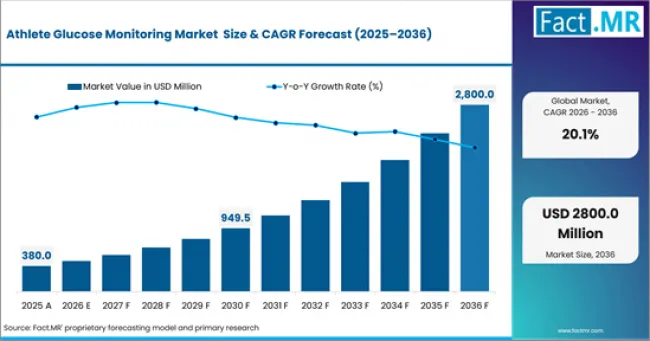
USD 450.0 million in 2026 to USD 2,800 million by 2036, at 20.1% CAGR.
- The athlete glucose monitoring market crossed a valuation of USD 380.0 million in 2025.
- Demand is expected to increase from USD 450.0 million in 2026 to USD 2,800 million by 2036.
- The market is forecast to record 20.1% CAGR during 2026 to 2036 as OTC glucose biosensors and sports nutrition platforms move into athlete routines.
What are the defining numbers behind athlete glucose monitoring growth?
USD 2.3 billion absolute opportunity by 2036, led by the United States and the United Kingdom.
- Demand Drivers in the Market
- Athletes need real-time feedback on fueling and training response.
- Coaches need glucose patterns to support nutrition planning.
- Fitness users need simple insights from sensor data.
- Platforms need recurring subscriptions built around sensors and coaching.
- Key Segments Analyzed
- By Product Type: Wearable Glucose Biosensors are expected to hold 40.0% share in 2026 because sensor access starts the user journey.
- By Sport Type: Endurance Sports lead because glucose swings are easier to connect with fueling and training duration. The share is projected at 38.0% in 2026.
- By Customer Type: Performance-Focused Athletes lead because they actively test nutrition and recovery routines. This customer group is likely to account for 43.0% share in 2026.
- By Delivery Model: App-Plus-Biosensor Subscriptions lead as users need sensors and interpretation together. The model is projected to hold 41.0% share in 2026.
- By End Use: Fueling and Nutrition Optimization is expected to hold 39.0% share in 2026 because athletes first use glucose data to adjust food timing.
- By Geography: The United States is projected to record 24.6% CAGR through 2036 as OTC CGM access and metabolic health apps expand.
- Analyst Opinion at Fact.MR
- Shambhu Nath Jha, Senior Analyst at Fact.MR, states, “Athlete glucose monitoring is shifting from curiosity to guided performance support. We see athletes asking how food, training and recovery affect their glucose response. Providers that combine accurate sensors with simple nutrition interpretation will gain stronger access to sports performance budgets.”
- Strategic Implications
- Sensor providers should package glucose data with clear athlete guidance.
- Sports nutrition brands can connect products with measurable glucose response.
- Coaches need education before using CGM data in training plans.
- Platforms must avoid overstated performance claims and explain limits clearly.
Athlete glucose monitoring uses wearable biosensors and apps to show how food and recovery affect glucose patterns. GSSI’s 2025 Sports Science Exchange article states that CGM can provide athletes without diabetes with insights into individual responses to dietary choices and recovery. [1] This places athlete glucose tools near sports analytics because teams are turning body data into practical training decisions.
OTC access is widening the category. Abbott’s Lingo biosensor tracks glucose 24/7 and is available without a prescription. [2] The wider blood glucose monitoring devices base gives athlete-focused products a proven sensor and app foundation.
The category is also moving beyond diabetes care into performance and wellness. App-based coaching can translate glucose curves into fueling cues. This connects with performance nutrition because athletes are using real-time data to adjust meal timing and training support.
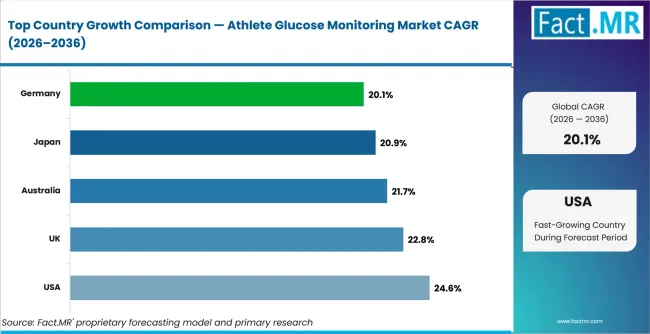
The United States is projected to record 24.6% CAGR through 2036 as OTC CGM access and metabolic health apps expand. The United Kingdom will gain from endurance sport use and private wellness adoption. The country is expected to post 22.8% CAGR through 2036. Australia is likely to record 21.7% CAGR as endurance, rugby and fitness communities adopt glucose tracking. Japan is forecast to advance at 20.9% CAGR as connected wellness and running culture support adoption. Germany is set to record 20.1% CAGR as sports nutrition users and performance clinics test glucose monitoring.
How does the athlete glucose monitoring market break down by segment?
Wearable Glucose Biosensors lead at 40.0%; Endurance Sports lead at 38.0%.
Which product type dominates?
Wearable Glucose Biosensors hold 40.0% share in 2026.
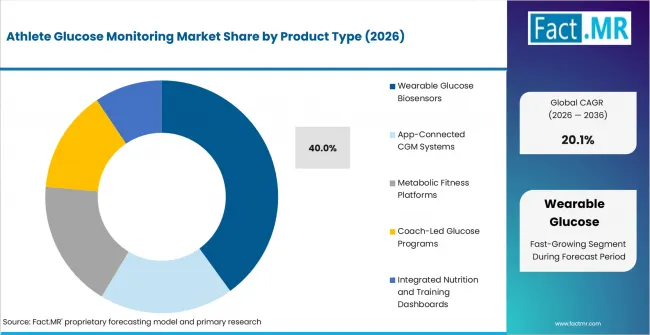
Wearable Glucose Biosensors are expected to hold 40.0% share in 2026 because sensor access starts the user journey. These devices capture glucose patterns across meals and recovery windows. Dexcom / Stelo states that OTC integrated CGM intended to continuously measure and display glucose values in adults aged 18 and older who are not on insulin. [3] The product type also sits near medical sensors because accuracy and wearability decide user trust.
Which sport type dominates?
Endurance Sports lead because glucose shifts are easier to connect with fueling.
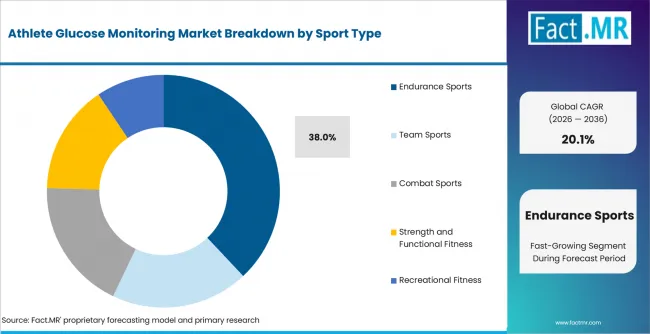
Endurance Sports lead because runners, cyclists and triathletes already track training load and nutrition timing. Long sessions make glucose trends easier to compare with meal timing and intensity. The sport type is projected to capture 38.0% share in 2026. Endurance adoption also supports sports nutrition because athletes use glucose feedback to adjust gels, drinks and recovery meals.
Which customer type dominates?
Performance-Focused Athletes lead because they actively test nutrition and recovery routines.
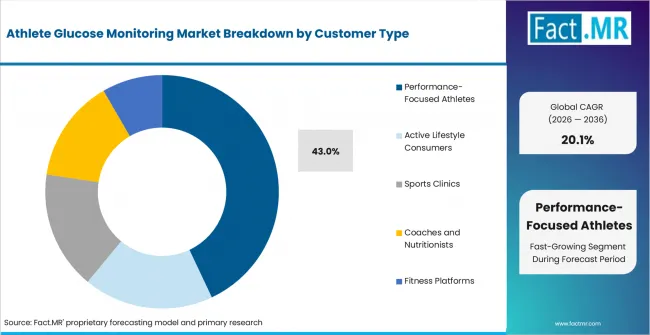
Performance-Focused Athletes lead because they are more willing to pay for sensor data that can guide training choices. These users often compare glucose trends with sleep and meal timing. This customer group is likely to account for 43.0% share in 2026. Adoption expands when insights are simple enough for amateur athletes to use without specialist interpretation.
Which delivery model dominates?
App-Plus-Biosensor Subscriptions lead because users need sensors and interpretation together.
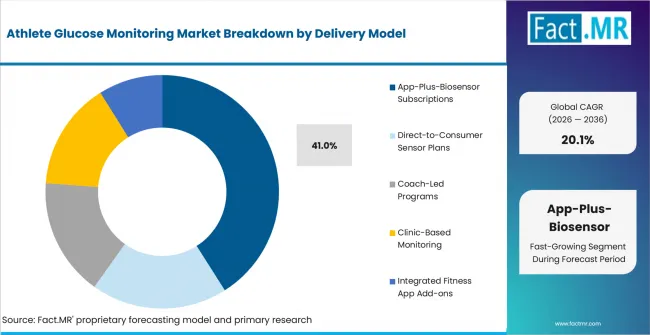
App-Plus-Biosensor Subscriptions lead because glucose readings alone can confuse users. Athletes need an app that connects sensor data with meals and recovery context. The model is projected to hold 41.0% share in 2026. Ultrahuman M1 positions itself as a metabolic fitness platform that helps users improve diet and exercise with glucose biomarkers and performance coaches. [4]
Which end use dominates?
Fueling and Nutrition Optimization holds 39.0% share in 2026.
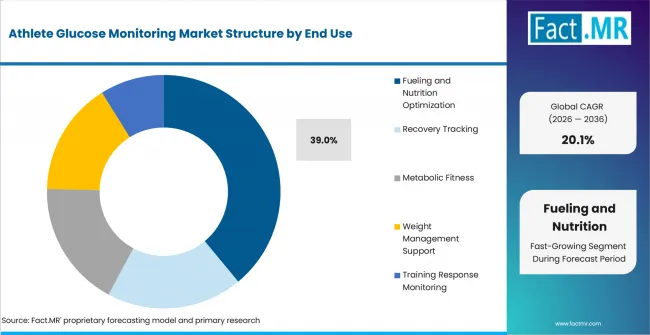
Fueling and Nutrition Optimization leads because athletes first use glucose data to adjust food timing before training. The end use is expected to hold 39.0% share in 2026. Users can identify personal responses to carbohydrate intake and workout intensity. Glucose dashboards can also connect with diabetes management software methods because both convert sensor streams into behavior guidance.
What is accelerating athlete glucose monitoring demand, and what is holding it back?
OTC sensor access, metabolic wellness apps and sports nutrition use drive demand; interpretation risk restrains adoption.

OTC sensor access is the main driver. More consumers can now use glucose biosensors without prescription barriers in selected markets. This expands the reachable base beyond diabetes management. Metabolic wellness apps add a second driver. FDA’s 2025 decision summary for the Signos Glucose Monitoring System states that the app receives data from an OTC iCGM and may help users understand how diet and exercise affect glucose excursions. [5] This supports app-led glucose interpretation for non-insulin users.
Sports nutrition use also supports the market. Athletes can compare glucose response with pre-workout meals and recovery intake. Brands may use this data to support personalized fueling programs, while avoiding medical claims.
The main restraint is interpretation risk. Glucose patterns in healthy athletes can be affected by stress and meal composition. Users may overreact to normal fluctuations. Providers must offer education and guardrails before athlete adoption can scale safely.
Where do the biggest athlete glucose monitoring opportunities sit?
Endurance fueling and coaching-led interpretation.
- Endurance Fueling: Athletes can use glucose data to test pre-training and long-session nutrition.
- Metabolic Fitness Subscriptions: Platforms can combine sensors with habit coaching and app insights.
- Coaching-Led Interpretation: Sports clinics can help athletes avoid over-reading normal glucose variation.
Which countries are scaling athlete glucose monitoring fastest?
United States 24.6%, United Kingdom 22.8%, Australia 21.7%, Japan 20.9%, Germany 20.1%.
Based on regional analysis, the athlete glucose monitoring market is segmented into North America, Western Europe, Asia Pacific, Latin America, and Middle East and Africa.
.webp)
| Country | CAGR |
|---|---|
| United States | 24.6% |
| United Kingdom | 22.8% |
| Australia | 21.7% |
| Japan | 20.9% |
| Germany | 20.1% |

What is powering the United States lead?
24.6% CAGR, driven by OTC CGM access and metabolic health apps.
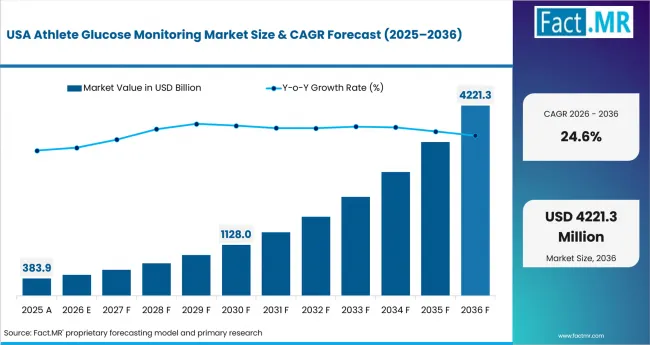
The United States is projected to record 24.6% CAGR through 2036 as OTC CGM access and metabolic health apps expand. The country has a large base of endurance athletes and fitness subscribers. Demand will focus on fueling insights, weight-management support and active lifestyle tracking. Subscription models will gain because sensors need recurring replacement. Growth will favor providers that offer clear app guidance and avoid confusing users with raw glucose charts.
How is the United Kingdom scaling athlete glucose monitoring demand?
22.8% CAGR, driven by endurance sport and private wellness adoption.
The United Kingdom has strong endurance sport and private wellness adoption. Running, cycling and triathlon users are likely to test glucose data for fueling and recovery insight. The country is expected to post 22.8% CAGR through 2036. Demand will focus on active adults and performance clinics. Growth will favor platforms that combine affordable sensors with sports nutrition education.
What underpins Australia’s growth?
21.7% CAGR, driven by endurance communities and outdoor fitness programs.
Australia is likely to record 21.7% CAGR through 2036 as endurance, rugby and fitness communities adopt glucose tracking. Athletes need practical feedback on hydration, food timing and recovery in varied training conditions. Fitness users are also adopting metabolic health tools. Demand will favor durable sensors and app guidance that supports outdoor training. Growth will expand through sports clinics and coaching programs.
What supports Japan’s outlook?
20.9% CAGR, driven by connected wellness and running culture.

Japan is forecast to advance at 20.9% CAGR through 2036 as connected wellness and running culture support adoption. Consumers are receptive to compact health devices and app-based feedback. Athletes may use glucose monitoring to refine meal timing and recovery routines. Demand will favor simple dashboards and local-language support. Growth will be strongest among urban runners and fitness communities.
How is Germany scaling athlete glucose monitoring?
20.1% CAGR, driven by sports nutrition users and performance clinics.
Germany is scaling through sports nutrition users and performance clinics testing glucose monitoring. Active consumers are already familiar with wearables and structured training plans. The country is set to record 20.1% CAGR by 2036 as glucose monitoring adds a nutrition feedback layer for endurance users. Providers will need careful education because performance claims are scrutinized. Growth will favor clinically responsible platforms that support sports nutrition interpretation.
Who leads the athlete glucose monitoring landscape?
Abbott Lingo and Ultrahuman lead through OTC biosensors and metabolic fitness positioning.

Athlete glucose monitoring systems are used by endurance athletes, performance clinics and fitness-focused consumers. Abbott Lingo provides an OTC glucose biosensor and app for wellness users. Dexcom / Stelo provides an OTC glucose biosensor for adults who are not on insulin. Ultrahuman M1 positions glucose data around metabolic fitness and exercise.
Levels helps users understand how diet and lifestyle affect glucose patterns and long-term metabolic health. [6] Signos supports glucose-based weight-management insights through an FDA-cleared app system. Nutrisense and similar coaching platforms support dietitian-led interpretation for users who need guidance. Competition through 2036 will depend on sensor access, app clarity and athlete education.
Providers that combine biosensor access with clear coaching will be better placed. App-led platforms can win fitness users. Sports clinics can win high-performance athletes. Sensor companies can win scale through OTC distribution and device trust.
Which companies are the key players?
Abbott Lingo, Dexcom / Stelo, Ultrahuman, Levels, Signos and Nutrisense.
- Abbott Lingo
- Dexcom / Stelo
- Ultrahuman
- Levels
- Signos
- Nutrisense
Bibliography
- [1] Riddell, M. C., Skroce, K., Turner, L. V., Zignoli, A., Zisser, H. C., & Hinkley, J. M. (2025, May). Continuous glucose monitoring use in athletes without diabetes. Gatorade Sports Science Institute.
- [2] Abbott. (2026). Lingo glucose biosensor and app. Lingo by Abbott.
- [3] Dexcom. (2026). Stelo glucose biosensor. Dexcom.
- [4] Ultrahuman. (2026). Ultrahuman M1: Real-time nutrition and fitness tracking. Ultrahuman.
- [5] U.S. Food and Drug Administration. (2025, March 21). 510(k) substantial equivalence determination decision summary: Signos Glucose Monitoring System. FDA.
- [6] Levels Health. (2026). Levels Health. Levels.
This Report Addresses
- Strategic intelligence on athlete glucose monitoring across product type, sport type and customer type.
- Segment analysis covering Wearable Glucose Biosensors, Endurance Sports, Performance-Focused Athletes, App-Plus-Biosensor Subscriptions and Fueling Optimization.
- Regional outlook covering the United States, United Kingdom, Australia, Japan and Germany.
- Competitive analysis of Abbott Lingo, Dexcom / Stelo, Ultrahuman, Levels, Signos and Nutrisense.
- Product assessment covering wearable biosensors, app-connected CGM systems, metabolic fitness platforms and coach-led programs.
- Sport-type assessment covering endurance sports, team sports, combat sports and functional fitness.
- Primary interviews, provider checks, official source review and athlete glucose monitoring validation support the forecast.
What does the athlete glucose monitoring market cover?
Wearable glucose biosensors and apps used by athletes to understand fueling and metabolic response.
The athlete glucose monitoring market covers continuous glucose sensors, mobile apps and coaching platforms used by athletes and active consumers. It includes OTC glucose biosensors, metabolic fitness dashboards, sports nutrition programs and coach-led interpretation services. The market connects with wireless health and fitness devices because glucose sensors rely on body-worn data capture and mobile feedback.
The market differs from clinical diabetes monitoring because the focus is performance, fueling and lifestyle insight. It also connects with smart fitness as active users adopt connected tools to personalize workouts and nutrition.
What is included in the scope?
Glucose sensors and athlete nutrition dashboards.
The scope includes wearable glucose biosensors used by athletes and fitness-focused consumers. It covers app-based glucose interpretation and coach dashboards. Some platforms also use wearable AI methods to convert sensor signals into personalized nudges.
The scope includes direct-to-consumer subscriptions and team performance pilots. It also covers integrations with wearable computing devices that combine glucose data with heart rate, sleep and activity signals.
What is excluded from the scope?
Diabetes-only clinical CGM programs without athlete or performance use.
The scope excludes prescribed diabetes CGM use unless the service is positioned for athlete performance or active lifestyle coaching. It excludes standard glucose meters without continuous tracking. It excludes generic nutrition apps with no glucose sensor input. It also excludes medical treatment decisions that should be handled by qualified healthcare professionals.
How was the analysis built?
100+ sources, 40+ company portfolios, 25+ countries, 20+ interviews.
- Primary Research:
- Primary research includes interviews with sports nutritionists and performance coaches. It includes input from metabolic health platforms and endurance athletes.
- Desk Research:
- Desk research reviews athlete CGM evidence and official product sources. It covers OTC biosensors and glucose coaching models.
- Market-Sizing and Forecasting:
- Forecasting uses active athlete populations, OTC sensor access and subscription conversion. Device pricing and coaching attachment support the market assessment.
- Data Validation and Update Cycle:
- Forecasts are validated through provider checks and sports nutrition feedback. Product launches and regulatory updates help confirm market direction.
What is the report’s scope and coverage?
| Attribute | Details |
|---|---|
| Quantitative Units | USD Million in 2026 to USD Million by 2036 at CAGR |
| Market Definition | Wearable glucose biosensors and apps used by athletes to understand fueling, training and recovery response |
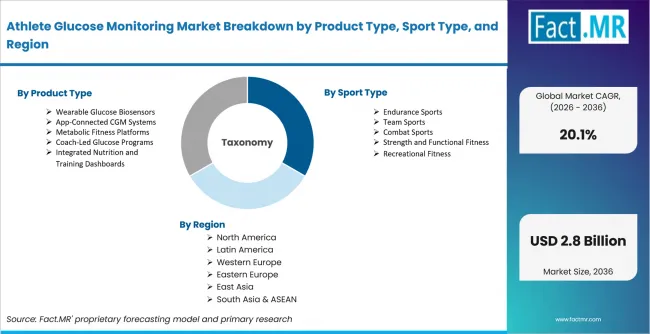
| Product Type | Wearable Glucose Biosensors, App-Connected CGM Systems, Metabolic Fitness Platforms, Coach-Led Glucose Programs, Integrated Nutrition and Training Dashboards |
| Sport Type | Endurance Sports, Team Sports, Combat Sports, Strength and Functional Fitness, Recreational Fitness |
| Customer Type | Performance-Focused Athletes, Active Lifestyle Consumers, Sports Clinics, Coaches and Nutritionists, Fitness Platforms |
| Delivery Model | App-Plus-Biosensor Subscriptions, Direct-to-Consumer Sensor Plans, Coach-Led Programs, Clinic-Based Monitoring, Integrated Fitness App Add-ons |
| End Use | Fueling and Nutrition Optimization, Recovery Tracking, Metabolic Fitness, Weight Management Support, Training Response Monitoring |
| Regions Covered | North America, Western Europe, Asia Pacific, Latin America, Middle East and Africa |
| Countries Covered | United States, United Kingdom, Australia, Japan, Germany |
| Key Companies Profiled | Abbott Lingo, Dexcom / Stelo, Ultrahuman, Levels, Signos and Nutrisense |
| Forecast Period | 2026 to 2036 |
| Approach | Hybrid top-down and bottom-up approach using athlete populations, active fitness subscribers, OTC CGM access, sensor replacement cycles and provider validation |
How is the market segmented?
-
By Product Type:
- Wearable Glucose Biosensors
- App-Connected CGM Systems
- Metabolic Fitness Platforms
- Coach-Led Glucose Programs
- Integrated Nutrition and Training Dashboards
-
By Sport Type:
- Endurance Sports
- Team Sports
- Combat Sports
- Strength and Functional Fitness
- Recreational Fitness
-
By Customer Type:
- Performance-Focused Athletes
- Active Lifestyle Consumers
- Sports Clinics
- Coaches and Nutritionists
- Fitness Platforms
-
By Delivery Model:
- App-Plus-Biosensor Subscriptions
- Direct-to-Consumer Sensor Plans
- Coach-Led Programs
- Clinic-Based Monitoring
- Integrated Fitness App Add-ons
-
By End Use:
- Fueling and Nutrition Optimization
- Recovery Tracking
- Metabolic Fitness
- Weight Management Support
- Training Response Monitoring
-
Region:
- North America
- United States
- Canada
- Europe
- United Kingdom
- Germany
- France
- Netherlands
- Spain
- Asia Pacific
- Australia
- Japan
- South Korea
- Singapore
- India
- Latin America
- Brazil
- Mexico
- Chile
- Middle East & Africa
- GCC Countries
- South Africa
- Israel
- North America
- Frequently Asked Questions -
Which product type leads the Athlete Glucose Monitoring Market?
Wearable Glucose Biosensors lead with 40.0% share in 2026 because sensor access starts the user journey.
Which country expands faster in the Athlete Glucose Monitoring Market?
The United States is projected to record 24.6% CAGR through 2036 as OTC CGM access and metabolic health apps expand.
How does the United Kingdom perform in the Athlete Glucose Monitoring Market?
The United Kingdom is expected to post 22.8% CAGR through 2036 as endurance sport and private wellness adoption increase.
How does Australia perform in the Athlete Glucose Monitoring Market?
Australia is likely to record 21.7% CAGR through 2036 as endurance, rugby and fitness communities adopt glucose tracking.
How does Japan perform in the Athlete Glucose Monitoring Market?
Japan is forecast to advance at 20.9% CAGR through 2036 as connected wellness and running culture support adoption.
How does Germany perform in the Athlete Glucose Monitoring Market?
Germany is set to record 20.1% CAGR through 2036 as sports nutrition users and performance clinics test glucose monitoring.
What is the primary driver in the Athlete Glucose Monitoring Market?
The primary driver is athlete interest in real-time fueling and training response data.
What is the main restraint in the Athlete Glucose Monitoring Market?
The main restraint is interpretation risk because healthy athletes may over-read normal glucose variation.
Why are endurance sports important in this market?
Endurance sports are important because long sessions make glucoe trends easier to connect with fueling and training intensity.
Table of Content
- Executive Summary
- Global Market Outlook
- Demand to side Trends
- Supply to side Trends
- Technology Roadmap Analysis
- Analysis and Recommendations
- Market Overview
- Market Coverage / Taxonomy
- Market Definition / Scope / Limitations
- Research Methodology
- Chapter Orientation
- Analytical Lens and Working Hypotheses
- Market Structure, Signals, and Trend Drivers
- Benchmarking and Cross-market Comparability
- Market Sizing, Forecasting, and Opportunity Mapping
- Research Design and Evidence Framework
- Desk Research Programme (Secondary Evidence)
- Company Annual and Sustainability Reports
- Peer-reviewed Journals and Academic Literature
- Corporate Websites, Product Literature, and Technical Notes
- Earnings Decks and Investor Briefings
- Statutory Filings and Regulatory Disclosures
- Technical White Papers and Standards Notes
- Trade Journals, Industry Magazines, and Analyst Briefs
- Conference Proceedings, Webinars, and Seminar Materials
- Government Statistics Portals and Public Data Releases
- Press Releases and Reputable Media Coverage
- Specialist Newsletters and Curated Briefings
- Sector Databases and Reference Repositories
- Fact.MR Internal Proprietary Databases and Historical Market Datasets
- Subscription Datasets and Paid Sources
- Social Channels, Communities, and Digital Listening Inputs
- Additional Desk Sources
- Expert Input and Fieldwork (Primary Evidence)
- Primary Modes
- Qualitative Interviews and Expert Elicitation
- Quantitative Surveys and Structured Data Capture
- Blended Approach
- Why Primary Evidence is Used
- Field Techniques
- Interviews
- Surveys
- Focus Groups
- Observational and In-context Research
- Social and Community Interactions
- Stakeholder Universe Engaged
- C-suite Leaders
- Board Members
- Presidents and Vice Presidents
- R&D and Innovation Heads
- Technical Specialists
- Domain Subject-matter Experts
- Scientists
- Physicians and Other Healthcare Professionals
- Governance, Ethics, and Data Stewardship
- Research Ethics
- Data Integrity and Handling
- Primary Modes
- Tooling, Models, and Reference Databases
- Desk Research Programme (Secondary Evidence)
- Data Engineering and Model Build
- Data Acquisition and Ingestion
- Cleaning, Normalisation, and Verification
- Synthesis, Triangulation, and Analysis
- Quality Assurance and Audit Trail
- Market Background
- Market Dynamics
- Drivers
- Restraints
- Opportunity
- Trends
- Scenario Forecast
- Demand in Optimistic Scenario
- Demand in Likely Scenario
- Demand in Conservative Scenario
- Opportunity Map Analysis
- Product Life Cycle Analysis
- Supply Chain Analysis
- Investment Feasibility Matrix
- Value Chain Analysis
- PESTLE and Porter’s Analysis
- Regulatory Landscape
- Regional Parent Market Outlook
- Production and Consumption Statistics
- Import and Export Statistics
- Market Dynamics
- Global Market Analysis 2021 to 2025 and Forecast, 2026 to 2036
- Historical Market Size Value (USD Million) Analysis, 2021 to 2025
- Current and Future Market Size Value (USD Million) Projections, 2026 to 2036
- Y to o to Y Growth Trend Analysis
- Absolute $ Opportunity Analysis
- Global Market Pricing Analysis 2021 to 2025 and Forecast 2026 to 2036
- Global Market Analysis 2021 to 2025 and Forecast 2026 to 2036, By Product Type
- Introduction / Key Findings
- Historical Market Size Value (USD Million) Analysis By Product Type , 2021 to 2025
- Current and Future Market Size Value (USD Million) Analysis and Forecast By Product Type , 2026 to 2036
- Wearable Glucose Biosensors
- App-Connected CGM Systems
- Metabolic Fitness Platforms
- Coach-Led Glucose Programs
- Integrated Nutrition and Training Dashboards
- Wearable Glucose Biosensors
- Y to o to Y Growth Trend Analysis By Product Type , 2021 to 2025
- Absolute $ Opportunity Analysis By Product Type , 2026 to 2036
- Global Market Analysis 2021 to 2025 and Forecast 2026 to 2036, By Sport Type
- Introduction / Key Findings
- Historical Market Size Value (USD Million) Analysis By Sport Type, 2021 to 2025
- Current and Future Market Size Value (USD Million) Analysis and Forecast By Sport Type, 2026 to 2036
- Endurance Sports
- Team Sports
- Combat Sports
- Strength and Functional Fitness
- Recreational Fitness
- Endurance Sports
- Y to o to Y Growth Trend Analysis By Sport Type, 2021 to 2025
- Absolute $ Opportunity Analysis By Sport Type, 2026 to 2036
- Global Market Analysis 2021 to 2025 and Forecast 2026 to 2036, By Customer Type
- Introduction / Key Findings
- Historical Market Size Value (USD Million) Analysis By Customer Type, 2021 to 2025
- Current and Future Market Size Value (USD Million) Analysis and Forecast By Customer Type, 2026 to 2036
- Performance-Focused Athletes
- Active Lifestyle Consumers
- Sports Clinics
- Coaches and Nutritionists
- Fitness Platforms
- Performance-Focused Athletes
- Y to o to Y Growth Trend Analysis By Customer Type, 2021 to 2025
- Absolute $ Opportunity Analysis By Customer Type, 2026 to 2036
- Global Market Analysis 2021 to 2025 and Forecast 2026 to 2036, By Delivery Model
- Introduction / Key Findings
- Historical Market Size Value (USD Million) Analysis By Delivery Model, 2021 to 2025
- Current and Future Market Size Value (USD Million) Analysis and Forecast By Delivery Model, 2026 to 2036
- App-Plus-Biosensor Subscriptions
- Direct-to-Consumer Sensor Plans
- Coach-Led Programs
- Clinic-Based Monitoring
- Integrated Fitness App Add-ons
- App-Plus-Biosensor Subscriptions
- Y to o to Y Growth Trend Analysis By Delivery Model, 2021 to 2025
- Absolute $ Opportunity Analysis By Delivery Model, 2026 to 2036
- Global Market Analysis 2021 to 2025 and Forecast 2026 to 2036, By End Use
- Introduction / Key Findings
- Historical Market Size Value (USD Million) Analysis By End Use, 2021 to 2025
- Current and Future Market Size Value (USD Million) Analysis and Forecast By End Use, 2026 to 2036
- Fueling and Nutrition Optimization
- Recovery Tracking
- Metabolic Fitness
- Weight Management Support
- Training Response Monitoring
- Fueling and Nutrition Optimization
- Y to o to Y Growth Trend Analysis By End Use, 2021 to 2025
- Absolute $ Opportunity Analysis By End Use, 2026 to 2036
- Global Market Analysis 2021 to 2025 and Forecast 2026 to 2036, By Region
- Introduction
- Historical Market Size Value (USD Million) Analysis By Region, 2021 to 2025
- Current Market Size Value (USD Million) Analysis and Forecast By Region, 2026 to 2036
- North America
- Latin America
- Western Europe
- Eastern Europe
- East Asia
- South Asia and Pacific
- Middle East & Africa
- Market Attractiveness Analysis By Region
- North America Market Analysis 2021 to 2025 and Forecast 2026 to 2036, By Country
- Historical Market Size Value (USD Million) Trend Analysis By Market Taxonomy, 2021 to 2025
- Market Size Value (USD Million) Forecast By Market Taxonomy, 2026 to 2036
- By Country
- USA
- Canada
- Mexico
- By Product Type
- By Sport Type
- By Customer Type
- By Delivery Model
- By End Use
- By Country
- Market Attractiveness Analysis
- By Country
- By Product Type
- By Sport Type
- By Customer Type
- By Delivery Model
- By End Use
- Key Takeaways
- Latin America Market Analysis 2021 to 2025 and Forecast 2026 to 2036, By Country
- Historical Market Size Value (USD Million) Trend Analysis By Market Taxonomy, 2021 to 2025
- Market Size Value (USD Million) Forecast By Market Taxonomy, 2026 to 2036
- By Country
- Brazil
- Chile
- Rest of Latin America
- By Product Type
- By Sport Type
- By Customer Type
- By Delivery Model
- By End Use
- By Country
- Market Attractiveness Analysis
- By Country
- By Product Type
- By Sport Type
- By Customer Type
- By Delivery Model
- By End Use
- Key Takeaways
- Western Europe Market Analysis 2021 to 2025 and Forecast 2026 to 2036, By Country
- Historical Market Size Value (USD Million) Trend Analysis By Market Taxonomy, 2021 to 2025
- Market Size Value (USD Million) Forecast By Market Taxonomy, 2026 to 2036
- By Country
- Germany
- UK
- Italy
- Spain
- France
- Nordic
- BENELUX
- Rest of Western Europe
- By Product Type
- By Sport Type
- By Customer Type
- By Delivery Model
- By End Use
- By Country
- Market Attractiveness Analysis
- By Country
- By Product Type
- By Sport Type
- By Customer Type
- By Delivery Model
- By End Use
- Key Takeaways
- Eastern Europe Market Analysis 2021 to 2025 and Forecast 2026 to 2036, By Country
- Historical Market Size Value (USD Million) Trend Analysis By Market Taxonomy, 2021 to 2025
- Market Size Value (USD Million) Forecast By Market Taxonomy, 2026 to 2036
- By Country
- Russia
- Poland
- Hungary
- Balkan & Baltic
- Rest of Eastern Europe
- By Product Type
- By Sport Type
- By Customer Type
- By Delivery Model
- By End Use
- By Country
- Market Attractiveness Analysis
- By Country
- By Product Type
- By Sport Type
- By Customer Type
- By Delivery Model
- By End Use
- Key Takeaways
- East Asia Market Analysis 2021 to 2025 and Forecast 2026 to 2036, By Country
- Historical Market Size Value (USD Million) Trend Analysis By Market Taxonomy, 2021 to 2025
- Market Size Value (USD Million) Forecast By Market Taxonomy, 2026 to 2036
- By Country
- China
- Japan
- South Korea
- By Product Type
- By Sport Type
- By Customer Type
- By Delivery Model
- By End Use
- By Country
- Market Attractiveness Analysis
- By Country
- By Product Type
- By Sport Type
- By Customer Type
- By Delivery Model
- By End Use
- Key Takeaways
- South Asia and Pacific Market Analysis 2021 to 2025 and Forecast 2026 to 2036, By Country
- Historical Market Size Value (USD Million) Trend Analysis By Market Taxonomy, 2021 to 2025
- Market Size Value (USD Million) Forecast By Market Taxonomy, 2026 to 2036
- By Country
- India
- ASEAN
- Australia & New Zealand
- Rest of South Asia and Pacific
- By Product Type
- By Sport Type
- By Customer Type
- By Delivery Model
- By End Use
- By Country
- Market Attractiveness Analysis
- By Country
- By Product Type
- By Sport Type
- By Customer Type
- By Delivery Model
- By End Use
- Key Takeaways
- Middle East & Africa Market Analysis 2021 to 2025 and Forecast 2026 to 2036, By Country
- Historical Market Size Value (USD Million) Trend Analysis By Market Taxonomy, 2021 to 2025
- Market Size Value (USD Million) Forecast By Market Taxonomy, 2026 to 2036
- By Country
- Kingdom of Saudi Arabia
- Other GCC Countries
- Turkiye
- South Africa
- Other African Union
- Rest of Middle East & Africa
- By Product Type
- By Sport Type
- By Customer Type
- By Delivery Model
- By End Use
- By Country
- Market Attractiveness Analysis
- By Country
- By Product Type
- By Sport Type
- By Customer Type
- By Delivery Model
- By End Use
- Key Takeaways
- Key Countries Market Analysis
- USA
- Pricing Analysis
- Market Share Analysis, 2025
- By Product Type
- By Sport Type
- By Customer Type
- By Delivery Model
- By End Use
- Canada
- Pricing Analysis
- Market Share Analysis, 2025
- By Product Type
- By Sport Type
- By Customer Type
- By Delivery Model
- By End Use
- Mexico
- Pricing Analysis
- Market Share Analysis, 2025
- By Product Type
- By Sport Type
- By Customer Type
- By Delivery Model
- By End Use
- Brazil
- Pricing Analysis
- Market Share Analysis, 2025
- By Product Type
- By Sport Type
- By Customer Type
- By Delivery Model
- By End Use
- Chile
- Pricing Analysis
- Market Share Analysis, 2025
- By Product Type
- By Sport Type
- By Customer Type
- By Delivery Model
- By End Use
- Germany
- Pricing Analysis
- Market Share Analysis, 2025
- By Product Type
- By Sport Type
- By Customer Type
- By Delivery Model
- By End Use
- UK
- Pricing Analysis
- Market Share Analysis, 2025
- By Product Type
- By Sport Type
- By Customer Type
- By Delivery Model
- By End Use
- Italy
- Pricing Analysis
- Market Share Analysis, 2025
- By Product Type
- By Sport Type
- By Customer Type
- By Delivery Model
- By End Use
- Spain
- Pricing Analysis
- Market Share Analysis, 2025
- By Product Type
- By Sport Type
- By Customer Type
- By Delivery Model
- By End Use
- France
- Pricing Analysis
- Market Share Analysis, 2025
- By Product Type
- By Sport Type
- By Customer Type
- By Delivery Model
- By End Use
- India
- Pricing Analysis
- Market Share Analysis, 2025
- By Product Type
- By Sport Type
- By Customer Type
- By Delivery Model
- By End Use
- ASEAN
- Pricing Analysis
- Market Share Analysis, 2025
- By Product Type
- By Sport Type
- By Customer Type
- By Delivery Model
- By End Use
- Australia & New Zealand
- Pricing Analysis
- Market Share Analysis, 2025
- By Product Type
- By Sport Type
- By Customer Type
- By Delivery Model
- By End Use
- China
- Pricing Analysis
- Market Share Analysis, 2025
- By Product Type
- By Sport Type
- By Customer Type
- By Delivery Model
- By End Use
- Japan
- Pricing Analysis
- Market Share Analysis, 2025
- By Product Type
- By Sport Type
- By Customer Type
- By Delivery Model
- By End Use
- South Korea
- Pricing Analysis
- Market Share Analysis, 2025
- By Product Type
- By Sport Type
- By Customer Type
- By Delivery Model
- By End Use
- Russia
- Pricing Analysis
- Market Share Analysis, 2025
- By Product Type
- By Sport Type
- By Customer Type
- By Delivery Model
- By End Use
- Poland
- Pricing Analysis
- Market Share Analysis, 2025
- By Product Type
- By Sport Type
- By Customer Type
- By Delivery Model
- By End Use
- Hungary
- Pricing Analysis
- Market Share Analysis, 2025
- By Product Type
- By Sport Type
- By Customer Type
- By Delivery Model
- By End Use
- Kingdom of Saudi Arabia
- Pricing Analysis
- Market Share Analysis, 2025
- By Product Type
- By Sport Type
- By Customer Type
- By Delivery Model
- By End Use
- Turkiye
- Pricing Analysis
- Market Share Analysis, 2025
- By Product Type
- By Sport Type
- By Customer Type
- By Delivery Model
- By End Use
- South Africa
- Pricing Analysis
- Market Share Analysis, 2025
- By Product Type
- By Sport Type
- By Customer Type
- By Delivery Model
- By End Use
- USA
- Market Structure Analysis
- Competition Dashboard
- Competition Benchmarking
- Market Share Analysis of Top Players
- By Regional
- By Product Type
- By Sport Type
- By Customer Type
- By Delivery Model
- By End Use
- Competition Analysis
- Competition Deep Dive
- Abbott Lingo
- Overview
- Product Portfolio
- Profitability by Market Segments (Product/Age /Sales Channel/Region)
- Sales Footprint
- Strategy Overview
- Marketing Strategy
- Product Strategy
- Channel Strategy
- Dexcom / Stelo
- Ultrahuman
- Levels
- Signos
- Nutrisense
- Abbott Lingo
- Competition Deep Dive
- Assumptions & Acronyms Used
List Of Table
- Table 1: Global Market Value (USD Million) Forecast by Region, 2021 to 2036
- Table 2: Global Market Value (USD Million) Forecast by Product Type , 2021 to 2036
- Table 3: Global Market Value (USD Million) Forecast by Sport Type, 2021 to 2036
- Table 4: Global Market Value (USD Million) Forecast by Customer Type, 2021 to 2036
- Table 5: Global Market Value (USD Million) Forecast by Delivery Model, 2021 to 2036
- Table 6: Global Market Value (USD Million) Forecast by End Use, 2021 to 2036
- Table 7: North America Market Value (USD Million) Forecast by Country, 2021 to 2036
- Table 8: North America Market Value (USD Million) Forecast by Product Type , 2021 to 2036
- Table 9: North America Market Value (USD Million) Forecast by Sport Type, 2021 to 2036
- Table 10: North America Market Value (USD Million) Forecast by Customer Type, 2021 to 2036
- Table 11: North America Market Value (USD Million) Forecast by Delivery Model, 2021 to 2036
- Table 12: North America Market Value (USD Million) Forecast by End Use, 2021 to 2036
- Table 13: Latin America Market Value (USD Million) Forecast by Country, 2021 to 2036
- Table 14: Latin America Market Value (USD Million) Forecast by Product Type , 2021 to 2036
- Table 15: Latin America Market Value (USD Million) Forecast by Sport Type, 2021 to 2036
- Table 16: Latin America Market Value (USD Million) Forecast by Customer Type, 2021 to 2036
- Table 17: Latin America Market Value (USD Million) Forecast by Delivery Model, 2021 to 2036
- Table 18: Latin America Market Value (USD Million) Forecast by End Use, 2021 to 2036
- Table 19: Western Europe Market Value (USD Million) Forecast by Country, 2021 to 2036
- Table 20: Western Europe Market Value (USD Million) Forecast by Product Type , 2021 to 2036
- Table 21: Western Europe Market Value (USD Million) Forecast by Sport Type, 2021 to 2036
- Table 22: Western Europe Market Value (USD Million) Forecast by Customer Type, 2021 to 2036
- Table 23: Western Europe Market Value (USD Million) Forecast by Delivery Model, 2021 to 2036
- Table 24: Western Europe Market Value (USD Million) Forecast by End Use, 2021 to 2036
- Table 25: Eastern Europe Market Value (USD Million) Forecast by Country, 2021 to 2036
- Table 26: Eastern Europe Market Value (USD Million) Forecast by Product Type , 2021 to 2036
- Table 27: Eastern Europe Market Value (USD Million) Forecast by Sport Type, 2021 to 2036
- Table 28: Eastern Europe Market Value (USD Million) Forecast by Customer Type, 2021 to 2036
- Table 29: Eastern Europe Market Value (USD Million) Forecast by Delivery Model, 2021 to 2036
- Table 30: Eastern Europe Market Value (USD Million) Forecast by End Use, 2021 to 2036
- Table 31: East Asia Market Value (USD Million) Forecast by Country, 2021 to 2036
- Table 32: East Asia Market Value (USD Million) Forecast by Product Type , 2021 to 2036
- Table 33: East Asia Market Value (USD Million) Forecast by Sport Type, 2021 to 2036
- Table 34: East Asia Market Value (USD Million) Forecast by Customer Type, 2021 to 2036
- Table 35: East Asia Market Value (USD Million) Forecast by Delivery Model, 2021 to 2036
- Table 36: East Asia Market Value (USD Million) Forecast by End Use, 2021 to 2036
- Table 37: South Asia and Pacific Market Value (USD Million) Forecast by Country, 2021 to 2036
- Table 38: South Asia and Pacific Market Value (USD Million) Forecast by Product Type , 2021 to 2036
- Table 39: South Asia and Pacific Market Value (USD Million) Forecast by Sport Type, 2021 to 2036
- Table 40: South Asia and Pacific Market Value (USD Million) Forecast by Customer Type, 2021 to 2036
- Table 41: South Asia and Pacific Market Value (USD Million) Forecast by Delivery Model, 2021 to 2036
- Table 42: South Asia and Pacific Market Value (USD Million) Forecast by End Use, 2021 to 2036
- Table 43: Middle East & Africa Market Value (USD Million) Forecast by Country, 2021 to 2036
- Table 44: Middle East & Africa Market Value (USD Million) Forecast by Product Type , 2021 to 2036
- Table 45: Middle East & Africa Market Value (USD Million) Forecast by Sport Type, 2021 to 2036
- Table 46: Middle East & Africa Market Value (USD Million) Forecast by Customer Type, 2021 to 2036
- Table 47: Middle East & Africa Market Value (USD Million) Forecast by Delivery Model, 2021 to 2036
- Table 48: Middle East & Africa Market Value (USD Million) Forecast by End Use, 2021 to 2036
List Of Figures
- Figure 1: Global Market Pricing Analysis
- Figure 2: Global Market Value (USD Million) Forecast 2021-2036
- Figure 3: Global Market Value Share and BPS Analysis by Product Type , 2026 and 2036
- Figure 4: Global Market Y-o-Y Growth Comparison by Product Type , 2026-2036
- Figure 5: Global Market Attractiveness Analysis by Product Type
- Figure 6: Global Market Value Share and BPS Analysis by Sport Type, 2026 and 2036
- Figure 7: Global Market Y-o-Y Growth Comparison by Sport Type, 2026-2036
- Figure 8: Global Market Attractiveness Analysis by Sport Type
- Figure 9: Global Market Value Share and BPS Analysis by Customer Type, 2026 and 2036
- Figure 10: Global Market Y-o-Y Growth Comparison by Customer Type, 2026-2036
- Figure 11: Global Market Attractiveness Analysis by Customer Type
- Figure 12: Global Market Value Share and BPS Analysis by Delivery Model, 2026 and 2036
- Figure 13: Global Market Y-o-Y Growth Comparison by Delivery Model, 2026-2036
- Figure 14: Global Market Attractiveness Analysis by Delivery Model
- Figure 15: Global Market Value Share and BPS Analysis by End Use, 2026 and 2036
- Figure 16: Global Market Y-o-Y Growth Comparison by End Use, 2026-2036
- Figure 17: Global Market Attractiveness Analysis by End Use
- Figure 18: Global Market Value (USD Million) Share and BPS Analysis by Region, 2026 and 2036
- Figure 19: Global Market Y-o-Y Growth Comparison by Region, 2026-2036
- Figure 20: Global Market Attractiveness Analysis by Region
- Figure 21: North America Market Incremental Dollar Opportunity, 2026-2036
- Figure 22: Latin America Market Incremental Dollar Opportunity, 2026-2036
- Figure 23: Western Europe Market Incremental Dollar Opportunity, 2026-2036
- Figure 24: Eastern Europe Market Incremental Dollar Opportunity, 2026-2036
- Figure 25: East Asia Market Incremental Dollar Opportunity, 2026-2036
- Figure 26: South Asia and Pacific Market Incremental Dollar Opportunity, 2026-2036
- Figure 27: Middle East & Africa Market Incremental Dollar Opportunity, 2026-2036
- Figure 28: North America Market Value Share and BPS Analysis by Country, 2026 and 2036
- Figure 29: North America Market Value Share and BPS Analysis by Product Type , 2026 and 2036
- Figure 30: North America Market Y-o-Y Growth Comparison by Product Type , 2026-2036
- Figure 31: North America Market Attractiveness Analysis by Product Type
- Figure 32: North America Market Value Share and BPS Analysis by Sport Type, 2026 and 2036
- Figure 33: North America Market Y-o-Y Growth Comparison by Sport Type, 2026-2036
- Figure 34: North America Market Attractiveness Analysis by Sport Type
- Figure 35: North America Market Value Share and BPS Analysis by Customer Type, 2026 and 2036
- Figure 36: North America Market Y-o-Y Growth Comparison by Customer Type, 2026-2036
- Figure 37: North America Market Attractiveness Analysis by Customer Type
- Figure 38: North America Market Value Share and BPS Analysis by Delivery Model, 2026 and 2036
- Figure 39: North America Market Y-o-Y Growth Comparison by Delivery Model, 2026-2036
- Figure 40: North America Market Attractiveness Analysis by Delivery Model
- Figure 41: North America Market Value Share and BPS Analysis by End Use, 2026 and 2036
- Figure 42: North America Market Y-o-Y Growth Comparison by End Use, 2026-2036
- Figure 43: North America Market Attractiveness Analysis by End Use
- Figure 44: Latin America Market Value Share and BPS Analysis by Country, 2026 and 2036
- Figure 45: Latin America Market Value Share and BPS Analysis by Product Type , 2026 and 2036
- Figure 46: Latin America Market Y-o-Y Growth Comparison by Product Type , 2026-2036
- Figure 47: Latin America Market Attractiveness Analysis by Product Type
- Figure 48: Latin America Market Value Share and BPS Analysis by Sport Type, 2026 and 2036
- Figure 49: Latin America Market Y-o-Y Growth Comparison by Sport Type, 2026-2036
- Figure 50: Latin America Market Attractiveness Analysis by Sport Type
- Figure 51: Latin America Market Value Share and BPS Analysis by Customer Type, 2026 and 2036
- Figure 52: Latin America Market Y-o-Y Growth Comparison by Customer Type, 2026-2036
- Figure 53: Latin America Market Attractiveness Analysis by Customer Type
- Figure 54: Latin America Market Value Share and BPS Analysis by Delivery Model, 2026 and 2036
- Figure 55: Latin America Market Y-o-Y Growth Comparison by Delivery Model, 2026-2036
- Figure 56: Latin America Market Attractiveness Analysis by Delivery Model
- Figure 57: Latin America Market Value Share and BPS Analysis by End Use, 2026 and 2036
- Figure 58: Latin America Market Y-o-Y Growth Comparison by End Use, 2026-2036
- Figure 59: Latin America Market Attractiveness Analysis by End Use
- Figure 60: Western Europe Market Value Share and BPS Analysis by Country, 2026 and 2036
- Figure 61: Western Europe Market Value Share and BPS Analysis by Product Type , 2026 and 2036
- Figure 62: Western Europe Market Y-o-Y Growth Comparison by Product Type , 2026-2036
- Figure 63: Western Europe Market Attractiveness Analysis by Product Type
- Figure 64: Western Europe Market Value Share and BPS Analysis by Sport Type, 2026 and 2036
- Figure 65: Western Europe Market Y-o-Y Growth Comparison by Sport Type, 2026-2036
- Figure 66: Western Europe Market Attractiveness Analysis by Sport Type
- Figure 67: Western Europe Market Value Share and BPS Analysis by Customer Type, 2026 and 2036
- Figure 68: Western Europe Market Y-o-Y Growth Comparison by Customer Type, 2026-2036
- Figure 69: Western Europe Market Attractiveness Analysis by Customer Type
- Figure 70: Western Europe Market Value Share and BPS Analysis by Delivery Model, 2026 and 2036
- Figure 71: Western Europe Market Y-o-Y Growth Comparison by Delivery Model, 2026-2036
- Figure 72: Western Europe Market Attractiveness Analysis by Delivery Model
- Figure 73: Western Europe Market Value Share and BPS Analysis by End Use, 2026 and 2036
- Figure 74: Western Europe Market Y-o-Y Growth Comparison by End Use, 2026-2036
- Figure 75: Western Europe Market Attractiveness Analysis by End Use
- Figure 76: Eastern Europe Market Value Share and BPS Analysis by Country, 2026 and 2036
- Figure 77: Eastern Europe Market Value Share and BPS Analysis by Product Type , 2026 and 2036
- Figure 78: Eastern Europe Market Y-o-Y Growth Comparison by Product Type , 2026-2036
- Figure 79: Eastern Europe Market Attractiveness Analysis by Product Type
- Figure 80: Eastern Europe Market Value Share and BPS Analysis by Sport Type, 2026 and 2036
- Figure 81: Eastern Europe Market Y-o-Y Growth Comparison by Sport Type, 2026-2036
- Figure 82: Eastern Europe Market Attractiveness Analysis by Sport Type
- Figure 83: Eastern Europe Market Value Share and BPS Analysis by Customer Type, 2026 and 2036
- Figure 84: Eastern Europe Market Y-o-Y Growth Comparison by Customer Type, 2026-2036
- Figure 85: Eastern Europe Market Attractiveness Analysis by Customer Type
- Figure 86: Eastern Europe Market Value Share and BPS Analysis by Delivery Model, 2026 and 2036
- Figure 87: Eastern Europe Market Y-o-Y Growth Comparison by Delivery Model, 2026-2036
- Figure 88: Eastern Europe Market Attractiveness Analysis by Delivery Model
- Figure 89: Eastern Europe Market Value Share and BPS Analysis by End Use, 2026 and 2036
- Figure 90: Eastern Europe Market Y-o-Y Growth Comparison by End Use, 2026-2036
- Figure 91: Eastern Europe Market Attractiveness Analysis by End Use
- Figure 92: East Asia Market Value Share and BPS Analysis by Country, 2026 and 2036
- Figure 93: East Asia Market Value Share and BPS Analysis by Product Type , 2026 and 2036
- Figure 94: East Asia Market Y-o-Y Growth Comparison by Product Type , 2026-2036
- Figure 95: East Asia Market Attractiveness Analysis by Product Type
- Figure 96: East Asia Market Value Share and BPS Analysis by Sport Type, 2026 and 2036
- Figure 97: East Asia Market Y-o-Y Growth Comparison by Sport Type, 2026-2036
- Figure 98: East Asia Market Attractiveness Analysis by Sport Type
- Figure 99: East Asia Market Value Share and BPS Analysis by Customer Type, 2026 and 2036
- Figure 100: East Asia Market Y-o-Y Growth Comparison by Customer Type, 2026-2036
- Figure 101: East Asia Market Attractiveness Analysis by Customer Type
- Figure 102: East Asia Market Value Share and BPS Analysis by Delivery Model, 2026 and 2036
- Figure 103: East Asia Market Y-o-Y Growth Comparison by Delivery Model, 2026-2036
- Figure 104: East Asia Market Attractiveness Analysis by Delivery Model
- Figure 105: East Asia Market Value Share and BPS Analysis by End Use, 2026 and 2036
- Figure 106: East Asia Market Y-o-Y Growth Comparison by End Use, 2026-2036
- Figure 107: East Asia Market Attractiveness Analysis by End Use
- Figure 108: South Asia and Pacific Market Value Share and BPS Analysis by Country, 2026 and 2036
- Figure 109: South Asia and Pacific Market Value Share and BPS Analysis by Product Type , 2026 and 2036
- Figure 110: South Asia and Pacific Market Y-o-Y Growth Comparison by Product Type , 2026-2036
- Figure 111: South Asia and Pacific Market Attractiveness Analysis by Product Type
- Figure 112: South Asia and Pacific Market Value Share and BPS Analysis by Sport Type, 2026 and 2036
- Figure 113: South Asia and Pacific Market Y-o-Y Growth Comparison by Sport Type, 2026-2036
- Figure 114: South Asia and Pacific Market Attractiveness Analysis by Sport Type
- Figure 115: South Asia and Pacific Market Value Share and BPS Analysis by Customer Type, 2026 and 2036
- Figure 116: South Asia and Pacific Market Y-o-Y Growth Comparison by Customer Type, 2026-2036
- Figure 117: South Asia and Pacific Market Attractiveness Analysis by Customer Type
- Figure 118: South Asia and Pacific Market Value Share and BPS Analysis by Delivery Model, 2026 and 2036
- Figure 119: South Asia and Pacific Market Y-o-Y Growth Comparison by Delivery Model, 2026-2036
- Figure 120: South Asia and Pacific Market Attractiveness Analysis by Delivery Model
- Figure 121: South Asia and Pacific Market Value Share and BPS Analysis by End Use, 2026 and 2036
- Figure 122: South Asia and Pacific Market Y-o-Y Growth Comparison by End Use, 2026-2036
- Figure 123: South Asia and Pacific Market Attractiveness Analysis by End Use
- Figure 124: Middle East & Africa Market Value Share and BPS Analysis by Country, 2026 and 2036
- Figure 125: Middle East & Africa Market Value Share and BPS Analysis by Product Type , 2026 and 2036
- Figure 126: Middle East & Africa Market Y-o-Y Growth Comparison by Product Type , 2026-2036
- Figure 127: Middle East & Africa Market Attractiveness Analysis by Product Type
- Figure 128: Middle East & Africa Market Value Share and BPS Analysis by Sport Type, 2026 and 2036
- Figure 129: Middle East & Africa Market Y-o-Y Growth Comparison by Sport Type, 2026-2036
- Figure 130: Middle East & Africa Market Attractiveness Analysis by Sport Type
- Figure 131: Middle East & Africa Market Value Share and BPS Analysis by Customer Type, 2026 and 2036
- Figure 132: Middle East & Africa Market Y-o-Y Growth Comparison by Customer Type, 2026-2036
- Figure 133: Middle East & Africa Market Attractiveness Analysis by Customer Type
- Figure 134: Middle East & Africa Market Value Share and BPS Analysis by Delivery Model, 2026 and 2036
- Figure 135: Middle East & Africa Market Y-o-Y Growth Comparison by Delivery Model, 2026-2036
- Figure 136: Middle East & Africa Market Attractiveness Analysis by Delivery Model
- Figure 137: Middle East & Africa Market Value Share and BPS Analysis by End Use, 2026 and 2036
- Figure 138: Middle East & Africa Market Y-o-Y Growth Comparison by End Use, 2026-2036
- Figure 139: Middle East & Africa Market Attractiveness Analysis by End Use
- Figure 140: Global Market - Tier Structure Analysis
- Figure 141: Global Market - Company Share Analysis