Automated Office Smart Shading Systems Market
Automated Office Smart Shading Systems Market Size and Share Forecast Outlook 2026 to 2036
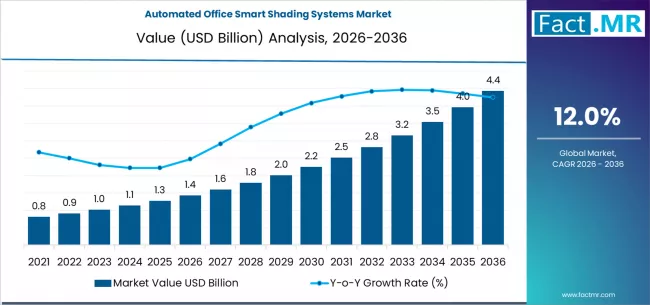
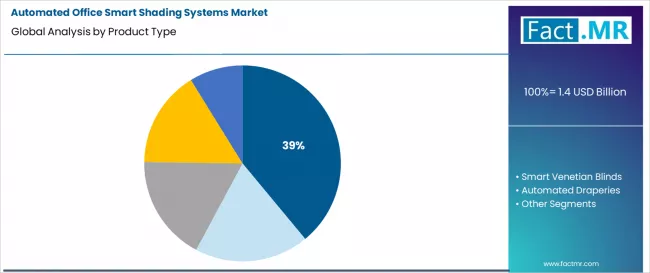
Automated office smart shading systems market is projected to grow from USD 1.4 billion in 2026 to USD 4.4 billion by 2036, at a CAGR of 12.0%. Motorized Roller Shades will dominate with a 39.0% market share, while iot-enabled control will lead the technology segment with a 36.0% share.
Automated Office Smart Shading Systems Market Forecast and Outlook 2026 to 2036
The global automated office smart shading systems market is projected to surge from USD 1.43 billion in 2026 to USD 4.43 billion by 2036, achieving a CAGR of 12.0%. This accelerated growth is driven by the confluence of smart building proliferation, stringent energy efficiency regulations, and a heightened focus on occupant wellness and productivity.
Key Takeaways from the Automated Office Smart Shading Systems Market
- Market Value for 2026: USD 1.43 Billion
- Market Value for 2036: USD 4.43 Billion
- Forecast CAGR (2026-2036): 12.0%
- Leading Product Type Segment (2026): Motorized Roller Shades (39%)
- Leading Technology Segment (2026): IoT-Enabled Control (36%)
- Leading End User Segment (2026): Commercial Offices (51%)
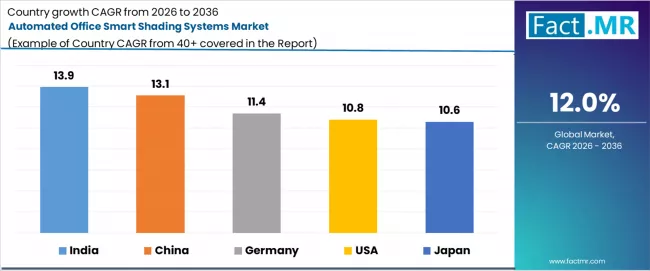
- Key Growth Countries: India (13.90% CAGR), China (13.10% CAGR), USA (10.80% CAGR), Germany (11.40% CAGR), Japan (10.60% CAGR)
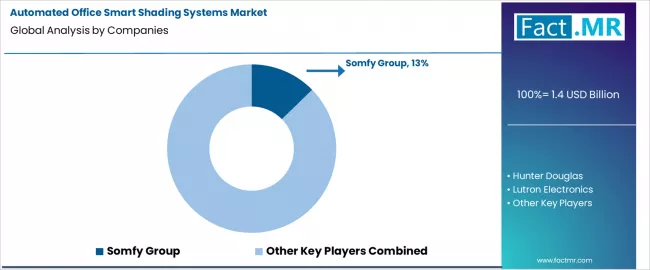
- Key Players in the Market: Somfy Group, Hunter Douglas, Lutron Electronics, Crestron Electronics, ABB Smart Building Systems, Others

Modern office design increasingly prioritizes dynamic, responsive environments where lighting and thermal management are automated to optimize comfort and reduce operational costs. The integration of motorized shades with IoT-based building management systems and AI-driven scheduling is transforming passive window coverings into active, data-responsive components of the intelligent office ecosystem.
Metric
| Metric | Value |
|---|---|
| Market Value (2026) | USD 1.43 Billion |
| Market Forecast Value (2036) | USD 4.43 Billion |
| Forecast CAGR (2026-2036) | 12.0% |
Category
| Category | Segments |
|---|---|
| Product Type | Motorized Roller Shades, Smart Venetian Blinds, Automated Draperies, Integrated Smart Film Systems, Others |
| Technology | IoT-Enabled Control, Sensor-Based Automation, AI-Driven Smart Scheduling, Voice & App Control Integration, Others |
| End User | Commercial Offices, Co-Working Spaces, Hospitality & Service Offices, Government & Public Buildings |
| Region | North America, Latin America, Western Europe, Eastern Europe, East Asia, South Asia & Pacific, MEA |
Segmental Analysis
By Product Type, Which Solution Offers the Best Balance of Function and Adoption?

Motorized roller shades lead the product segment with a 39% share. Their dominance is due to their versatility, relatively straightforward integration into various architectural styles, and cost-effectiveness for large-scale commercial deployments.
They provide effective glare control and privacy while serving as a reliable platform for integrating motorization and smart controls, making them the most widely adopted solution in the office segment.
By Technology, What Forms the Core of System Intelligence?

IoT-enabled control is the leading technology segment, holding a 36% share. This represents the foundational layer for smart shading, allowing individual shades or groups to be connected to a network for centralized management, remote access, and integration with broader building automation systems.
The ability to monitor status, control settings from cloud platforms, and receive maintenance alerts is essential for modern facility management, making IoT connectivity a prerequisite for advanced functionality.
By End User, Which Sector is the Primary Innovation Driver?

Commercial offices constitute the dominant end-user segment at 51%. This sector drives demand due to its large-scale need for energy savings, occupant comfort standardization, and alignment with green building certifications like LEED and WELL.
Corporate investments in smart workplace technology to enhance employee well-being and reduce HVAC load are the primary force behind product development and sophisticated system integration in this market.
What are the Principal Drivers, Challenges, and Trends in this Market?
The primary driver is the global push for net-zero carbon buildings, where automated shading is a critical tool for reducing solar heat gain and artificial lighting demand. A key restraint is the high initial cost and complexity of installing integrated systems in existing buildings, which can deter retrofits.
A significant opportunity lies in the proliferation of sensor data such as occupancy, sunlight, and temperature being leveraged by AI to create fully predictive and autonomous shading schedules that adapt to real-time use patterns. The dominant trend is the shift from standalone shading products to deeply embedded subsystems within holistic smart building platforms, enabling scenarios where shades, lighting, and HVAC operate in a synchronized, energy-optimized manner.
Analysis of the Automated Office Smart Shading Systems Market by Key Countries

| Country | CAGR (2026-2036) |
|---|---|
| India | 13.90% |
| China | 13.10% |
| USA | 10.80% |
| Germany | 11.40% |
| Japan | 10.60% |
How does the USA's Leadership in Smart Commercial Real Estate Fuel Growth?

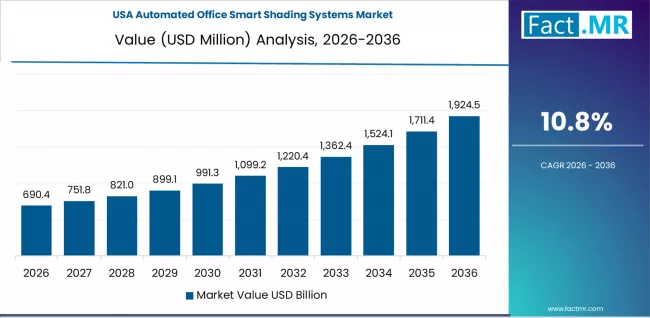
The USA's 10.80% CAGR is driven by its mature commercial real estate sector's rapid adoption of PropTech and smart building solutions. Demand is fueled by corporate sustainability goals, the prevalence of LEED-certified buildings, and the need for advanced facility management tools in large office portfolios, making integrated shading a standard component of high-end office fit-outs and renovations.
What drives China's Massive Scale in Smart Building Deployment?
China's 13.10% growth is propelled by unprecedented rates of commercial construction and national policies mandating green and intelligent building standards. The scale of new office tower developments, coupled with government-led smart city initiatives, creates a vast market for standardized, connected building systems, including automated shading, as a core element of modern infrastructure.
Why does Germany Exemplify the High-Efficiency European Market?
Germany's 11.40% CAGR reflects its stringent Energy Saving Ordinance building codes and leadership in engineering-driven building automation. Growth is driven by retrofits of existing building stock to meet efficiency targets and the integration of shading into sophisticated KNX or BACnet-based building management systems, with a premium on quality, reliability, and data privacy.
How is Japan's Focus on Precision and Comfort Shaping Adoption?
Japan's 10.60% growth is influenced by its advanced workplace management culture and dense urban office environment. There is strong demand for precise, reliable automation that maximizes natural light while eliminating glare on screens, contributes to seismic safety by securing window areas, and integrates seamlessly with other building services in space-constrained, high-rise developments.
What Underpins India's Exceptional Growth in Smart Infrastructure?
India's leading 13.90% CAGR is fueled by the explosive growth of Grade-A commercial office space and co-working ecosystems in metropolitan areas. Rapid urbanization, corporate mandates for healthier workplaces, and the adoption of green building norms like IGBC are driving large-scale deployments of smart building technologies, with automated shading seen as a key component for energy management and occupant appeal in new constructions.
Competitive Landscape of the Automated Office Smart Shading Systems Market

The competitive landscape features specialized shading manufacturers, luxury home automation providers expanding into commercial spaces, and industrial automation giants entering the smart building arena.
Competition centers on system reliability, the breadth and openness of integration protocols such as Matter, BACnet and KNX, the sophistication of cloud management software, and the ability to deliver comprehensive project design and support services. Success depends on forming alliances with architectural firms, building management system integrators, and glass/window manufacturers to be specified early in the construction or renovation process.
Key Players in the Automated Office Smart Shading Systems Market
- Somfy Group
- Hunter Douglas
- Lutron Electronics
- Crestron Electronics
- ABB Smart Building Systems
- Others
Scope of Report
| Items | Values |
|---|---|
| Quantitative Units | USD Billion |
| Product Type | Motorized Roller Shades, Smart Venetian Blinds, Automated Draperies, Integrated Smart Film Systems, Others |
| Technology | IoT-Enabled Control, Sensor-Based Automation, AI-Driven Smart Scheduling, Voice & App Control Integration, Others |
| End User | Commercial Offices, Co-Working Spaces, Hospitality & Service Offices, Government & Public Buildings |
| Key Countries | India, China, USA, Germany, Japan |
| Key Companies | Somfy Group, Hunter Douglas, Lutron Electronics, Crestron Electronics, ABB Smart Building Systems, Others |
| Additional Analysis | Energy saving potential and ROI analysis for automated shading systems; study of integration challenges with legacy building management systems; analysis of data privacy and cybersecurity in IoT-enabled shading; impact of dynamic glass (smart film) on traditional shade demand; review of wireless communication protocol wars (Zigbee, Z-Wave, Bluetooth Mesh) in commercial settings. |
Market by Segments
-
Product Type :
- Motorized Roller Shades
- Smart Venetian Blinds
- Automated Draperies
- Integrated Smart Film Systems
- Others
-
Technology :
- IoT-Enabled Control
- Sensor-Based Automation
- AI-Driven Smart Scheduling
- Voice & App Control Integration
- Others
-
End User :
- Commercial Offices
- Co-Working Spaces
- Hospitality & Service Offices
- Government & Public Buildings
-
Region :
-
North America
- USA
- Canada
-
Latin America
- Brazil
- Mexico
- Argentina
- Rest of Latin America
-
Western Europe
- Germany
- France
- Italy
- Spain
- UK
- BENELUX
- Rest of Western Europe
-
Eastern Europe
- Russia
- Poland
- Czech Republic
- Rest of Eastern Europe
-
East Asia
- China
- Japan
- South Korea
- Rest of East Asia
-
South Asia & Pacific
- India
- ASEAN
- Australia
- Rest of South Asia & Pacific
-
MEA
- GCC Countries
- South Africa
- Turkiye
- Rest of MEA
-
References
- American Society of Heating, Refrigerating and Air-Conditioning Engineers (ASHRAE). (2024). Standard 90.1-2024: Energy standard for buildings except low-rise residential buildings. ASHRAE.
- International WELL Building Institute (IWBI). (2024). WELL v2 feature L06: Visual lighting design. IWBI.
- Kensek, K. M. (2023). Automated shading systems in architecture: Design, integration, and performance. Routledge.
- Lee, E. S., & Selkowitz, S. E. (2023). The role of advanced fenestration systems in net-zero energy buildings. Lawrence Berkeley National Laboratory.
- Menzies, G. F., & Wherrett, J. R. (2023). Smart buildings: Technology, platforms, and the impact of IoT. Journal of Building Engineering.
- U.S. Green Building Council (USGBC). (2024). LEED v4.1 Building Design and Construction guide. USGBC.
Table of Content
- Executive Summary
- Global Market Outlook
- Demand to side Trends
- Supply to side Trends
- Technology Roadmap Analysis
- Analysis and Recommendations
- Market Overview
- Market Coverage / Taxonomy
- Market Definition / Scope / Limitations
- Market Background
- Market Dynamics
- Drivers
- Restraints
- Opportunity
- Trends
- Scenario Forecast
- Demand in Optimistic Scenario
- Demand in Likely Scenario
- Demand in Conservative Scenario
- Opportunity Map Analysis
- Product Life Cycle Analysis
- Supply Chain Analysis
- Investment Feasibility Matrix
- Value Chain Analysis
- PESTLE and Porter’s Analysis
- Regulatory Landscape
- Regional Parent Market Outlook
- Production and Consumption Statistics
- Import and Export Statistics
- Market Dynamics
- Global Market Analysis 2021 to 2025 and Forecast, 2026 to 2036
- Historical Market Size Value (USD Million) Analysis, 2021 to 2025
- Current and Future Market Size Value (USD Million) Projections, 2026 to 2036
- Y to o to Y Growth Trend Analysis
- Absolute $ Opportunity Analysis
- Global Market Pricing Analysis 2021 to 2025 and Forecast 2026 to 2036
- Global Market Analysis 2021 to 2025 and Forecast 2026 to 2036, By Product Type
- Introduction / Key Findings
- Historical Market Size Value (USD Million) Analysis By Product Type, 2021 to 2025
- Current and Future Market Size Value (USD Million) Analysis and Forecast By Product Type, 2026 to 2036
- Motorized Roller Shades
- Smart Venetian Blinds
- Automated Draperies
- Integrated Smart Film Systems
- Others
- Motorized Roller Shades
- Y to o to Y Growth Trend Analysis By Product Type, 2021 to 2025
- Absolute $ Opportunity Analysis By Product Type, 2026 to 2036
- Global Market Analysis 2021 to 2025 and Forecast 2026 to 2036, By Technology
- Introduction / Key Findings
- Historical Market Size Value (USD Million) Analysis By Technology, 2021 to 2025
- Current and Future Market Size Value (USD Million) Analysis and Forecast By Technology, 2026 to 2036
- IoT-Enabled Control
- Sensor-Based Automation
- AI-Driven Smart Scheduling
- Voice & App Control Integration
- Others
- IoT-Enabled Control
- Y to o to Y Growth Trend Analysis By Technology, 2021 to 2025
- Absolute $ Opportunity Analysis By Technology, 2026 to 2036
- Global Market Analysis 2021 to 2025 and Forecast 2026 to 2036, By End User
- Introduction / Key Findings
- Historical Market Size Value (USD Million) Analysis By End User, 2021 to 2025
- Current and Future Market Size Value (USD Million) Analysis and Forecast By End User, 2026 to 2036
- Commercial Offices
- Co-Working Spaces
- Hospitality & Service Offices
- Government & Public Buildings
- Commercial Offices
- Y to o to Y Growth Trend Analysis By End User, 2021 to 2025
- Absolute $ Opportunity Analysis By End User, 2026 to 2036
- Global Market Analysis 2021 to 2025 and Forecast 2026 to 2036, By Region
- Introduction
- Historical Market Size Value (USD Million) Analysis By Region, 2021 to 2025
- Current Market Size Value (USD Million) Analysis and Forecast By Region, 2026 to 2036
- North America
- Latin America
- Western Europe
- Eastern Europe
- East Asia
- South Asia and Pacific
- Middle East & Africa
- Market Attractiveness Analysis By Region
- North America Market Analysis 2021 to 2025 and Forecast 2026 to 2036, By Country
- Historical Market Size Value (USD Million) Trend Analysis By Market Taxonomy, 2021 to 2025
- Market Size Value (USD Million) Forecast By Market Taxonomy, 2026 to 2036
- By Country
- USA
- Canada
- Mexico
- By Product Type
- By Technology
- By End User
- By Country
- Market Attractiveness Analysis
- By Country
- By Product Type
- By Technology
- By End User
- Key Takeaways
- Latin America Market Analysis 2021 to 2025 and Forecast 2026 to 2036, By Country
- Historical Market Size Value (USD Million) Trend Analysis By Market Taxonomy, 2021 to 2025
- Market Size Value (USD Million) Forecast By Market Taxonomy, 2026 to 2036
- By Country
- Brazil
- Chile
- Rest of Latin America
- By Product Type
- By Technology
- By End User
- By Country
- Market Attractiveness Analysis
- By Country
- By Product Type
- By Technology
- By End User
- Key Takeaways
- Western Europe Market Analysis 2021 to 2025 and Forecast 2026 to 2036, By Country
- Historical Market Size Value (USD Million) Trend Analysis By Market Taxonomy, 2021 to 2025
- Market Size Value (USD Million) Forecast By Market Taxonomy, 2026 to 2036
- By Country
- Germany
- UK
- Italy
- Spain
- France
- Nordic
- BENELUX
- Rest of Western Europe
- By Product Type
- By Technology
- By End User
- By Country
- Market Attractiveness Analysis
- By Country
- By Product Type
- By Technology
- By End User
- Key Takeaways
- Eastern Europe Market Analysis 2021 to 2025 and Forecast 2026 to 2036, By Country
- Historical Market Size Value (USD Million) Trend Analysis By Market Taxonomy, 2021 to 2025
- Market Size Value (USD Million) Forecast By Market Taxonomy, 2026 to 2036
- By Country
- Russia
- Poland
- Hungary
- Balkan & Baltic
- Rest of Eastern Europe
- By Product Type
- By Technology
- By End User
- By Country
- Market Attractiveness Analysis
- By Country
- By Product Type
- By Technology
- By End User
- Key Takeaways
- East Asia Market Analysis 2021 to 2025 and Forecast 2026 to 2036, By Country
- Historical Market Size Value (USD Million) Trend Analysis By Market Taxonomy, 2021 to 2025
- Market Size Value (USD Million) Forecast By Market Taxonomy, 2026 to 2036
- By Country
- China
- Japan
- South Korea
- By Product Type
- By Technology
- By End User
- By Country
- Market Attractiveness Analysis
- By Country
- By Product Type
- By Technology
- By End User
- Key Takeaways
- South Asia and Pacific Market Analysis 2021 to 2025 and Forecast 2026 to 2036, By Country
- Historical Market Size Value (USD Million) Trend Analysis By Market Taxonomy, 2021 to 2025
- Market Size Value (USD Million) Forecast By Market Taxonomy, 2026 to 2036
- By Country
- India
- ASEAN
- Australia & New Zealand
- Rest of South Asia and Pacific
- By Product Type
- By Technology
- By End User
- By Country
- Market Attractiveness Analysis
- By Country
- By Product Type
- By Technology
- By End User
- Key Takeaways
- Middle East & Africa Market Analysis 2021 to 2025 and Forecast 2026 to 2036, By Country
- Historical Market Size Value (USD Million) Trend Analysis By Market Taxonomy, 2021 to 2025
- Market Size Value (USD Million) Forecast By Market Taxonomy, 2026 to 2036
- By Country
- Kingdom of Saudi Arabia
- Other GCC Countries
- Turkiye
- South Africa
- Other African Union
- Rest of Middle East & Africa
- By Product Type
- By Technology
- By End User
- By Country
- Market Attractiveness Analysis
- By Country
- By Product Type
- By Technology
- By End User
- Key Takeaways
- Key Countries Market Analysis
- USA
- Pricing Analysis
- Market Share Analysis, 2025
- By Product Type
- By Technology
- By End User
- Canada
- Pricing Analysis
- Market Share Analysis, 2025
- By Product Type
- By Technology
- By End User
- Mexico
- Pricing Analysis
- Market Share Analysis, 2025
- By Product Type
- By Technology
- By End User
- Brazil
- Pricing Analysis
- Market Share Analysis, 2025
- By Product Type
- By Technology
- By End User
- Chile
- Pricing Analysis
- Market Share Analysis, 2025
- By Product Type
- By Technology
- By End User
- Germany
- Pricing Analysis
- Market Share Analysis, 2025
- By Product Type
- By Technology
- By End User
- UK
- Pricing Analysis
- Market Share Analysis, 2025
- By Product Type
- By Technology
- By End User
- Italy
- Pricing Analysis
- Market Share Analysis, 2025
- By Product Type
- By Technology
- By End User
- Spain
- Pricing Analysis
- Market Share Analysis, 2025
- By Product Type
- By Technology
- By End User
- France
- Pricing Analysis
- Market Share Analysis, 2025
- By Product Type
- By Technology
- By End User
- India
- Pricing Analysis
- Market Share Analysis, 2025
- By Product Type
- By Technology
- By End User
- ASEAN
- Pricing Analysis
- Market Share Analysis, 2025
- By Product Type
- By Technology
- By End User
- Australia & New Zealand
- Pricing Analysis
- Market Share Analysis, 2025
- By Product Type
- By Technology
- By End User
- China
- Pricing Analysis
- Market Share Analysis, 2025
- By Product Type
- By Technology
- By End User
- Japan
- Pricing Analysis
- Market Share Analysis, 2025
- By Product Type
- By Technology
- By End User
- South Korea
- Pricing Analysis
- Market Share Analysis, 2025
- By Product Type
- By Technology
- By End User
- Russia
- Pricing Analysis
- Market Share Analysis, 2025
- By Product Type
- By Technology
- By End User
- Poland
- Pricing Analysis
- Market Share Analysis, 2025
- By Product Type
- By Technology
- By End User
- Hungary
- Pricing Analysis
- Market Share Analysis, 2025
- By Product Type
- By Technology
- By End User
- Kingdom of Saudi Arabia
- Pricing Analysis
- Market Share Analysis, 2025
- By Product Type
- By Technology
- By End User
- Turkiye
- Pricing Analysis
- Market Share Analysis, 2025
- By Product Type
- By Technology
- By End User
- South Africa
- Pricing Analysis
- Market Share Analysis, 2025
- By Product Type
- By Technology
- By End User
- USA
- Market Structure Analysis
- Competition Dashboard
- Competition Benchmarking
- Market Share Analysis of Top Players
- By Regional
- By Product Type
- By Technology
- By End User
- Competition Analysis
- Competition Deep Dive
- Somfy Group
- Overview
- Product Portfolio
- Profitability by Market Segments (Product/Age /Sales Channel/Region)
- Sales Footprint
- Strategy Overview
- Marketing Strategy
- Product Strategy
- Channel Strategy
- Hunter Douglas
- Lutron Electronics
- Crestron Electronics
- ABB Smart Building Systems
- Others
- Somfy Group
- Competition Deep Dive
- Assumptions & Acronyms Used
- Research Methodology
List Of Table
- Table 1: Global Market Value (USD Million) Forecast by Region, 2021 to 2036
- Table 2: Global Market Value (USD Million) Forecast by Product Type, 2021 to 2036
- Table 3: Global Market Value (USD Million) Forecast by Technology, 2021 to 2036
- Table 4: Global Market Value (USD Million) Forecast by End User, 2021 to 2036
- Table 5: North America Market Value (USD Million) Forecast by Country, 2021 to 2036
- Table 6: North America Market Value (USD Million) Forecast by Product Type, 2021 to 2036
- Table 7: North America Market Value (USD Million) Forecast by Technology, 2021 to 2036
- Table 8: North America Market Value (USD Million) Forecast by End User, 2021 to 2036
- Table 9: Latin America Market Value (USD Million) Forecast by Country, 2021 to 2036
- Table 10: Latin America Market Value (USD Million) Forecast by Product Type, 2021 to 2036
- Table 11: Latin America Market Value (USD Million) Forecast by Technology, 2021 to 2036
- Table 12: Latin America Market Value (USD Million) Forecast by End User, 2021 to 2036
- Table 13: Western Europe Market Value (USD Million) Forecast by Country, 2021 to 2036
- Table 14: Western Europe Market Value (USD Million) Forecast by Product Type, 2021 to 2036
- Table 15: Western Europe Market Value (USD Million) Forecast by Technology, 2021 to 2036
- Table 16: Western Europe Market Value (USD Million) Forecast by End User, 2021 to 2036
- Table 17: Eastern Europe Market Value (USD Million) Forecast by Country, 2021 to 2036
- Table 18: Eastern Europe Market Value (USD Million) Forecast by Product Type, 2021 to 2036
- Table 19: Eastern Europe Market Value (USD Million) Forecast by Technology, 2021 to 2036
- Table 20: Eastern Europe Market Value (USD Million) Forecast by End User, 2021 to 2036
- Table 21: East Asia Market Value (USD Million) Forecast by Country, 2021 to 2036
- Table 22: East Asia Market Value (USD Million) Forecast by Product Type, 2021 to 2036
- Table 23: East Asia Market Value (USD Million) Forecast by Technology, 2021 to 2036
- Table 24: East Asia Market Value (USD Million) Forecast by End User, 2021 to 2036
- Table 25: South Asia and Pacific Market Value (USD Million) Forecast by Country, 2021 to 2036
- Table 26: South Asia and Pacific Market Value (USD Million) Forecast by Product Type, 2021 to 2036
- Table 27: South Asia and Pacific Market Value (USD Million) Forecast by Technology, 2021 to 2036
- Table 28: South Asia and Pacific Market Value (USD Million) Forecast by End User, 2021 to 2036
- Table 29: Middle East & Africa Market Value (USD Million) Forecast by Country, 2021 to 2036
- Table 30: Middle East & Africa Market Value (USD Million) Forecast by Product Type, 2021 to 2036
- Table 31: Middle East & Africa Market Value (USD Million) Forecast by Technology, 2021 to 2036
- Table 32: Middle East & Africa Market Value (USD Million) Forecast by End User, 2021 to 2036
List Of Figures
- Figure 1: Global Market Pricing Analysis
- Figure 2: Global Market Value (USD Million) Forecast 2021 to 2036
- Figure 3: Global Market Value Share and BPS Analysis by Product Type, 2026 and 2036
- Figure 4: Global Market Y to o to Y Growth Comparison by Product Type, 2026 to 2036
- Figure 5: Global Market Attractiveness Analysis by Product Type
- Figure 6: Global Market Value Share and BPS Analysis by Technology, 2026 and 2036
- Figure 7: Global Market Y to o to Y Growth Comparison by Technology, 2026 to 2036
- Figure 8: Global Market Attractiveness Analysis by Technology
- Figure 9: Global Market Value Share and BPS Analysis by End User, 2026 and 2036
- Figure 10: Global Market Y to o to Y Growth Comparison by End User, 2026 to 2036
- Figure 11: Global Market Attractiveness Analysis by End User
- Figure 12: Global Market Value (USD Million) Share and BPS Analysis by Region, 2026 and 2036
- Figure 13: Global Market Y to o to Y Growth Comparison by Region, 2026 to 2036
- Figure 14: Global Market Attractiveness Analysis by Region
- Figure 15: North America Market Incremental Dollar Opportunity, 2026 to 2036
- Figure 16: Latin America Market Incremental Dollar Opportunity, 2026 to 2036
- Figure 17: Western Europe Market Incremental Dollar Opportunity, 2026 to 2036
- Figure 18: Eastern Europe Market Incremental Dollar Opportunity, 2026 to 2036
- Figure 19: East Asia Market Incremental Dollar Opportunity, 2026 to 2036
- Figure 20: South Asia and Pacific Market Incremental Dollar Opportunity, 2026 to 2036
- Figure 21: Middle East & Africa Market Incremental Dollar Opportunity, 2026 to 2036
- Figure 22: North America Market Value Share and BPS Analysis by Country, 2026 and 2036
- Figure 23: North America Market Value Share and BPS Analysis by Product Type, 2026 and 2036
- Figure 24: North America Market Y to o to Y Growth Comparison by Product Type, 2026 to 2036
- Figure 25: North America Market Attractiveness Analysis by Product Type
- Figure 26: North America Market Value Share and BPS Analysis by Technology, 2026 and 2036
- Figure 27: North America Market Y to o to Y Growth Comparison by Technology, 2026 to 2036
- Figure 28: North America Market Attractiveness Analysis by Technology
- Figure 29: North America Market Value Share and BPS Analysis by End User, 2026 and 2036
- Figure 30: North America Market Y to o to Y Growth Comparison by End User, 2026 to 2036
- Figure 31: North America Market Attractiveness Analysis by End User
- Figure 32: Latin America Market Value Share and BPS Analysis by Country, 2026 and 2036
- Figure 33: Latin America Market Value Share and BPS Analysis by Product Type, 2026 and 2036
- Figure 34: Latin America Market Y to o to Y Growth Comparison by Product Type, 2026 to 2036
- Figure 35: Latin America Market Attractiveness Analysis by Product Type
- Figure 36: Latin America Market Value Share and BPS Analysis by Technology, 2026 and 2036
- Figure 37: Latin America Market Y to o to Y Growth Comparison by Technology, 2026 to 2036
- Figure 38: Latin America Market Attractiveness Analysis by Technology
- Figure 39: Latin America Market Value Share and BPS Analysis by End User, 2026 and 2036
- Figure 40: Latin America Market Y to o to Y Growth Comparison by End User, 2026 to 2036
- Figure 41: Latin America Market Attractiveness Analysis by End User
- Figure 42: Western Europe Market Value Share and BPS Analysis by Country, 2026 and 2036
- Figure 43: Western Europe Market Value Share and BPS Analysis by Product Type, 2026 and 2036
- Figure 44: Western Europe Market Y to o to Y Growth Comparison by Product Type, 2026 to 2036
- Figure 45: Western Europe Market Attractiveness Analysis by Product Type
- Figure 46: Western Europe Market Value Share and BPS Analysis by Technology, 2026 and 2036
- Figure 47: Western Europe Market Y to o to Y Growth Comparison by Technology, 2026 to 2036
- Figure 48: Western Europe Market Attractiveness Analysis by Technology
- Figure 49: Western Europe Market Value Share and BPS Analysis by End User, 2026 and 2036
- Figure 50: Western Europe Market Y to o to Y Growth Comparison by End User, 2026 to 2036
- Figure 51: Western Europe Market Attractiveness Analysis by End User
- Figure 52: Eastern Europe Market Value Share and BPS Analysis by Country, 2026 and 2036
- Figure 53: Eastern Europe Market Value Share and BPS Analysis by Product Type, 2026 and 2036
- Figure 54: Eastern Europe Market Y to o to Y Growth Comparison by Product Type, 2026 to 2036
- Figure 55: Eastern Europe Market Attractiveness Analysis by Product Type
- Figure 56: Eastern Europe Market Value Share and BPS Analysis by Technology, 2026 and 2036
- Figure 57: Eastern Europe Market Y to o to Y Growth Comparison by Technology, 2026 to 2036
- Figure 58: Eastern Europe Market Attractiveness Analysis by Technology
- Figure 59: Eastern Europe Market Value Share and BPS Analysis by End User, 2026 and 2036
- Figure 60: Eastern Europe Market Y to o to Y Growth Comparison by End User, 2026 to 2036
- Figure 61: Eastern Europe Market Attractiveness Analysis by End User
- Figure 62: East Asia Market Value Share and BPS Analysis by Country, 2026 and 2036
- Figure 63: East Asia Market Value Share and BPS Analysis by Product Type, 2026 and 2036
- Figure 64: East Asia Market Y to o to Y Growth Comparison by Product Type, 2026 to 2036
- Figure 65: East Asia Market Attractiveness Analysis by Product Type
- Figure 66: East Asia Market Value Share and BPS Analysis by Technology, 2026 and 2036
- Figure 67: East Asia Market Y to o to Y Growth Comparison by Technology, 2026 to 2036
- Figure 68: East Asia Market Attractiveness Analysis by Technology
- Figure 69: East Asia Market Value Share and BPS Analysis by End User, 2026 and 2036
- Figure 70: East Asia Market Y to o to Y Growth Comparison by End User, 2026 to 2036
- Figure 71: East Asia Market Attractiveness Analysis by End User
- Figure 72: South Asia and Pacific Market Value Share and BPS Analysis by Country, 2026 and 2036
- Figure 73: South Asia and Pacific Market Value Share and BPS Analysis by Product Type, 2026 and 2036
- Figure 74: South Asia and Pacific Market Y to o to Y Growth Comparison by Product Type, 2026 to 2036
- Figure 75: South Asia and Pacific Market Attractiveness Analysis by Product Type
- Figure 76: South Asia and Pacific Market Value Share and BPS Analysis by Technology, 2026 and 2036
- Figure 77: South Asia and Pacific Market Y to o to Y Growth Comparison by Technology, 2026 to 2036
- Figure 78: South Asia and Pacific Market Attractiveness Analysis by Technology
- Figure 79: South Asia and Pacific Market Value Share and BPS Analysis by End User, 2026 and 2036
- Figure 80: South Asia and Pacific Market Y to o to Y Growth Comparison by End User, 2026 to 2036
- Figure 81: South Asia and Pacific Market Attractiveness Analysis by End User
- Figure 82: Middle East & Africa Market Value Share and BPS Analysis by Country, 2026 and 2036
- Figure 83: Middle East & Africa Market Value Share and BPS Analysis by Product Type, 2026 and 2036
- Figure 84: Middle East & Africa Market Y to o to Y Growth Comparison by Product Type, 2026 to 2036
- Figure 85: Middle East & Africa Market Attractiveness Analysis by Product Type
- Figure 86: Middle East & Africa Market Value Share and BPS Analysis by Technology, 2026 and 2036
- Figure 87: Middle East & Africa Market Y to o to Y Growth Comparison by Technology, 2026 to 2036
- Figure 88: Middle East & Africa Market Attractiveness Analysis by Technology
- Figure 89: Middle East & Africa Market Value Share and BPS Analysis by End User, 2026 and 2036
- Figure 90: Middle East & Africa Market Y to o to Y Growth Comparison by End User, 2026 to 2036
- Figure 91: Middle East & Africa Market Attractiveness Analysis by End User
- Figure 92: Global Market - Tier Structure Analysis
- Figure 93: Global Market - Company Share Analysis
- FAQs -
How big is the automated office smart shading systems market in 2026?
The global automated office smart shading systems market is estimated to be valued at USD 1.4 billion in 2026.
What will be the size of automated office smart shading systems market in 2036?
The market size for the automated office smart shading systems market is projected to reach USD 4.4 billion by 2036.
How much will be the automated office smart shading systems market growth between 2026 and 2036?
The automated office smart shading systems market is expected to grow at a 12.0% CAGR between 2026 and 2036.
What are the key product types in the automated office smart shading systems market?
The key product types in automated office smart shading systems market are motorized roller shades, smart venetian blinds, automated draperies, integrated smart film systems and others.
Which technology segment to contribute significant share in the automated office smart shading systems market in 2026?
In terms of technology, iot-enabled control segment to command 36.0% share in the automated office smart shading systems market in 2026.