- Base Value(2025): 25.5 Bn
- Estimated Value(2026): 28.7 Bn
- Forecast Value (2036): 93.2 Bn
- CAGR (2026 - 2036): 12.5%
Digital Signage System Market Forecast By Fact.MR
In 2025, the digital signage system market was valued at USD 25.5 billion. Based on Fact MR analysis, demand for digital signage systems is estimated to grow to USD 28.7 billion in 2026 and USD 93.2 billion by 2036. FMR projects a CAGR of 12.5% during the forecast period.
The absolute dollar growth from 2026 to 2036 is USD 64.5 billion. This growth is driven by the increasing adoption of digital signage in retail, transportation, healthcare, and corporate sectors to improve customer engagement and streamline communication. Rising demand for interactive and cloud-based signage solutions, along with advancements in display technologies, supports market expansion. However, challenges such as high initial investment and infrastructure complexity may affect growth in some regions.
China leads with a CAGR of 9.2%, driven by rapid urbanization and increasing demand in retail and commercial spaces. India follows with 8.9%, supported by growing adoption of interactive signage and corporate digital displays. The USA grows at 7.8%, fueled by strong demand in retail, transportation hubs, and corporate environments. Japan shows a CAGR of 7.1%, reflecting adoption of advanced display technologies in commercial and public spaces. Germany grows at 6.5%, driven by steady demand in corporate, retail, and transportation sectors.
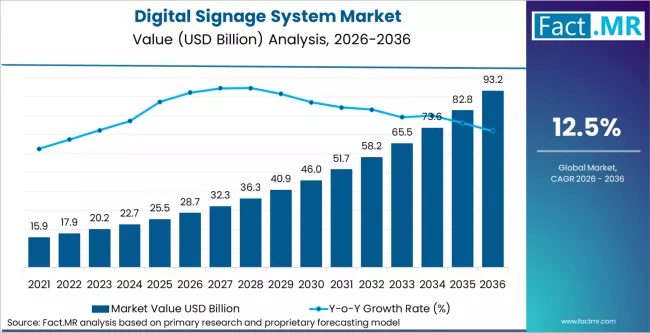
Digital Signage System Market Market Value Analysis | Source: Fact.MR
Digital Signage System Market
| Metric | Value |
|---|---|
| Estimated Value in (2026E) | USD 28.7 billion |
| Forecast Value in (2036F) | USD 93.2 billion |
| Forecast CAGR (2026 to 2036) | 12.5% |
Source: Fact.MR analysis. Updated Mar 10, 2026
Digital Signage System Market Definition
The digital signage system market involves the manufacture, deployment, and sale of integrated display solutions that deliver dynamic digital content (such as images, videos, and information) across screens and displays in commercial, retail, transportation, hospitality, and corporate environments.
Market Inclusions
This report covers global and regional market sizes for digital signage systems over a defined forecast period, including display types (LED, LCD, projection), system components (hardware, software, content management), application segments (retail, transportation hubs, corporate, hospitality), and deployment models (on‑premises, cloud‑based).
Market Exclusions
The scope excludes standalone consumer displays not integrated into managed digital signage networks, unrelated advertising media (print billboards, posters), and general IT infrastructure not specific to digital signage solutions.
Research Methodology
- Primary Research: Interviews were conducted with display manufacturers, system integrators, and end‑user technology buyers.
- Desk Research: Data was sourced from industry reports, technology publications, and trade association statistics.
- Market‑Sizing and Forecasting: A hybrid model combining top‑down digital display adoption forecasts with bottom‑up shipment and revenue data was used.
- Data Validation and Update Cycle: Findings were validated through expert review and aligned with recent production, deployment, and trade figures.
Summary of the Digital Signage System Market
- Market Definition
- The Digital Signage System Market involves the manufacture, deployment, and sale of integrated display solutions that deliver dynamic digital content (images, videos, and information) across screens in commercial, corporate, retail, transportation, and public environments. The market includes LCD, plasma, OLED, and LED displays, content management software, and scheduling solutions for indoor and outdoor applications.
- Demand Drivers
- Rising adoption of digital signage in retail, corporate, transportation, and healthcare sectors to enhance customer engagement.
- Increasing preference for interactive and cloud-based signage solutions.
- Advancements in display technologies improving visual quality, reliability, and energy efficiency.
- Expansion of commercial and corporate infrastructure, including airports, malls, and educational institutions.
- Demand for dynamic, programmable, and real-time content to replace static signage.
- Key Segments Analyzed
- Technology: LCD or Plasma (51% share in 2026), OLED, LED Display Technology.
- Software: Content Management Software, Distribution Software, Scheduling Software.
- Type: Indoor (63% share in 2026), Outdoor.
- Application: Corporate & Commercial Sector, Manufacturing, Educational Institutes, Government, Banking & Financial Institutes, Transportation, Retail & Wholesale, Media & Entertainment, Healthcare.
- Geography: North America, East Asia, South Asia, Europe; China leads at 9.2% CAGR, India 8.9%, USA 7.8%, Japan 7.1%, Germany 6.5%.
- Analyst Opinion at Fact MR
- Shambhu Nath Jha, Principal Consultant, Fact MR, opines, 'In this updated edition of the Digital Signage System Market report, industry participants will observe that value creation is shifting from conventional static displays toward dynamic, interactive, and networked signage solutions. Digital signage systems are no longer passive information tools but active enablers of customer engagement, brand visibility, and operational communication. Suppliers that invest in advanced display technologies, integrated software platforms, and cloud-based content management will capture margin expansion beyond basic screen installations. The convergence of high-quality visuals, interoperability, and real-time content management defines the competitive landscape through 2036.'
- Strategic Implications/Executive Takeaways
- Expand indoor digital signage offerings for retail, corporate, transportation, and educational applications.
- Integrate interactive and cloud-based software platforms for real-time content management.
- Target high-growth regions such as China, India, and USA with infrastructure and commercial deployment projects.
- Ensure interoperability, security, and compliance standards for software and networked systems.
- Offer turnkey solutions combining hardware, software, and installation services for seamless deployment.
- Focus on advanced display technologies to improve image quality, durability, and energy efficiency.
- Methodology
- Primary Research: Interviews with display manufacturers, system integrators, and end-user technology buyers.
- Desk Research: Data sourced from industry reports, technology publications, and trade association statistics.
- Market Sizing & Forecasting: Hybrid model combining top-down digital display adoption forecasts with bottom-up shipment and revenue data.
- Data Validation: Findings validated through expert review, deployment figures, and trade statistics; updated via proprietary Fact MR forecasting models.
Segmental Analysis
Digital Signage System Market Analysis by Type
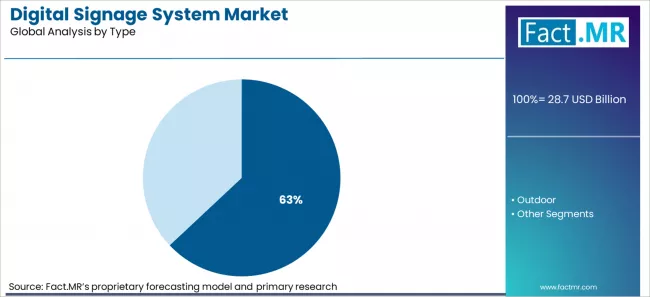
Digital Signage System Market Analysis By Type | Source: Fact.MR
Market Overview: Indoor digital signage systems are expected to capture 63% of the market share by 2026. These systems are widely deployed in retail stores, corporate offices, airports, and educational institutions to deliver targeted information, advertisements, and interactive content in controlled environments.
Demand Drivers:
- High Demand in Commercial and Retail Spaces: Indoor signage enhances customer engagement and brand visibility in high-traffic areas such as shopping malls and airports.
- Ease of Installation and Maintenance: Indoor systems are easier to install, operate, and maintain compared to outdoor solutions, contributing to their widespread adoption.
- Customizable and Interactive Content: Indoor signage allows businesses to update and display real-time content, promotional messages, and interactive experiences to attract and retain audiences.
Digital Signage System Market Analysis by Technology
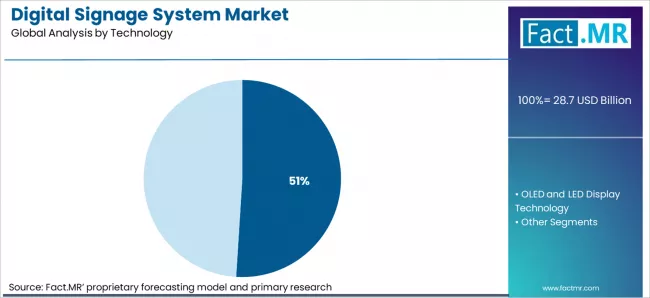
Digital Signage System Market Analysis By Technology | Source: Fact.MR
Market Overview: LCD or plasma display technology is projected to hold 51% of the market share by 2026. These technologies are widely used in digital signage for their high image quality, reliability, and cost-effectiveness in indoor applications.
Demand Drivers:
- High Visual Quality: LCD and plasma displays provide sharp images, bright colors, and wide viewing angles, making them ideal for indoor signage applications.
- Cost-Effective Solutions: These technologies are generally more affordable than OLED or advanced LED displays, supporting adoption across small- to medium-sized businesses.
- Widespread Availability and Support: The maturity of LCD and plasma display technology ensures a wide range of compatible screens, replacement parts, and technical support, driving market preference in indoor digital signage.
Digital Signage System Market Drivers, Restraints, and Opportunities
FMR analysts observe that the digital signage system market is a growth‑aligned, display‑technology segment driven by rising demand for dynamic visual communication across retail, corporate, hospitality, transportation hubs, and public venues. Historically, static printed signage dominated communication; as brands and organizations prioritized real‑time messaging, targeted advertising, and interactive customer engagement, structural demand emerged for digital displays that can be updated remotely, scheduled programmatically, and integrated with data feeds. The 2026 valuation reflects this shift, with adoption tied to broader digital transformation initiatives and customer experience strategies rather than legacy static displays.
While conventional static signage remains present in cost‑sensitive contexts, advanced digital signage solutions with high‑resolution displays, networked content management systems, and analytics integration are gaining share. These integrated systems often command higher pricing and recurring service revenues, contributing to net market value growth even as unit volumes grow in line with infrastructure investments. The market exists because organizations increasingly view digital signage as a strategic communication channel that enhances engagement and delivers measurable business outcomes.
- Customer Engagement Demand: Brands and venues adopt digital signage to replace static posters with dynamic, targeted visuals that improve interaction and influence purchasing behavior.
- Digital Standards & Integration: Demand for interoperable content management and analytics platforms pushes adoption of certified systems that meet defined performance and security criteria.
- Regional Deployment Trends: In North America and Asia‑Pacific, strong retail, transport, and corporate infrastructure drive higher uptake of advanced digital signage compared with regions with slower digital transformation.
Regional Analysis
The market analysis covers key global regions, including North America, East Asia, South Asia, and Europe. It is segmented geographically, with specific market dynamics for each region. The full report provides a detailed market attractiveness analysis.
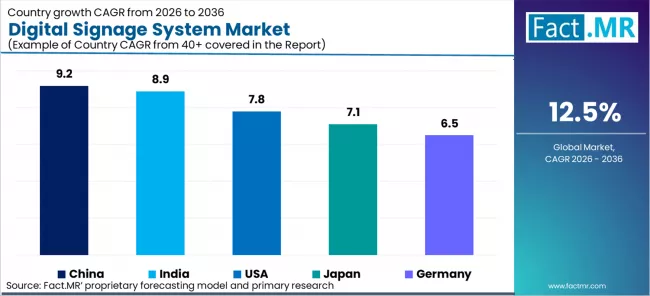
Digital Signage System Market Cagr Analysis By Country | Source: Fact.MR
| Country | CAGR (2026-2036) |
|---|---|
| USA | 7.8% |
| China | 9.2% |
| Germany | 6.5% |
| Japan | 7.1% |
| India | 8.9% |
Source: Fact.MR analysis. Updated Mar 10, 2026
Source: Fact MR (FMR) analysis, based on proprietary forecasting model and primary research
North America
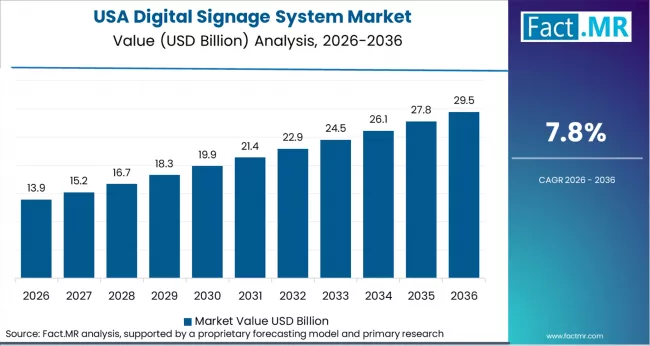
Digital Signage System Market Country Value Analysis | Source: Fact.MR
The USA is a major market, supported by increasing deployment in retail, corporate, and transportation sectors, along with adoption of interactive display solutions. Key players include Samsung Electronics, LG Electronics, and NEC Corporation.
- USA: Demand for digital signage systems in the USA is projected to rise at 7.8% CAGR through 2036. Growth is supported by federal infrastructure upgrades in airports and public transport (06-2025) and Samsung Electronics’ expansion of display solutions (09-2025).
East Asia
China and Japan are key markets, driven by retail modernization, corporate IT infrastructure, and rising use of interactive signage solutions.
- China: Demand for digital signage systems in China is projected to rise at 9.2% CAGR through 2036. Growth is supported by expansion of smart retail projects (03-2025) and NEC Corporation’s production and distribution increase (08-2025).
- Japan: Demand for digital signage systems in Japan is projected to rise at 7.1% CAGR through 2036. Growth is influenced by adoption of smart store technology (02-2025) and LG Electronics’ regional deployments (07-2025).
South Asia
India is a significant market, driven by rising adoption in retail, airports, and public spaces, along with growth in advertising technology.
- India: Demand for digital signage systems in India is projected to rise at 8.9% CAGR through 2036. Growth is supported by government smart city initiatives (05-2025) and Samsung Electronics’ regional expansions (09-2025).
Europe
Germany is a key market, supported by retail modernization, corporate installations, and public sector deployments.
- Germany: Demand for digital signage systems in Germany is projected to rise at 6.5% CAGR through 2036. Growth is influenced by federal smart infrastructure projects (04-2025) and LG Electronics’ regional facility expansions (08-2025).
Fact MR's analysis of the digital signage system market in North America, East Asia, South Asia, and Europe consists of country-wise assessments that include the USA, China, Germany, Japan, and India. Readers can find detailed trends, regulatory updates, and company-specific investments shaping market growth in these countries.
What is the Competitive Structure and Buyer Behavior in the Digital Signage System Market?
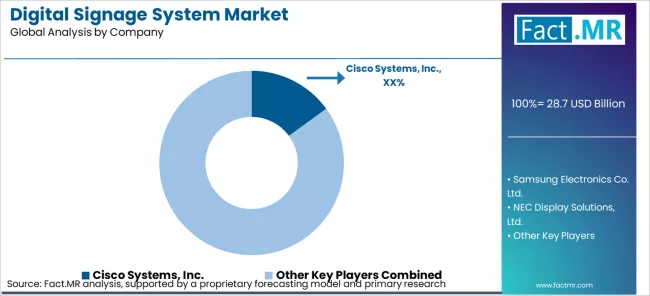
Digital Signage System Market Analysis By Company | Source: Fact.MR
The digital signage system market is moderately fragmented, with major technology and display firms such as Cisco Systems, Inc., Samsung Electronics Co. Ltd., NEC Display Solutions, Ltd., and Panasonic Corporation commanding meaningful share alongside specialised solution providers including BroadSign International, Inc., Smart Digital Signage Inc., Out Front Digital Communications, Israk Technology, Net Display Systems PADS, WinMate Communication Inc., and Visix, Inc. The primary competitive variables are display quality, system interoperability, software platform capability, ease of content management, and total cost of ownership for installation and maintenance. Companies with integrated hardware and software portfolios, strong channel networks, and global service infrastructures hold structural advantages because they can offer end‑to‑end solutions that simplify deployment and ongoing support across diverse environments.
Large enterprise customers, retail chains, transportation hubs, and venue operators wield significant buyer leverage by qualifying multiple suppliers, standardising technical specifications, and negotiating pricing and service agreements based on volume and performance commitments. To manage supplier dependency, these buyers often adopt multi‑vendor strategies and prioritise platforms that support open standards and flexible integration, which limits individual suppliers’ pricing power. As a result, competition centres on providing robust performance, seamless content management and integration, and reliable after‑sales support rather than on price alone.
Key Players of the Digital Signage System Market
- Cisco Systems, Inc.
- Samsung Electronics Co. Ltd.
- NEC Display Solutions, Ltd.
- Broad Sign International, Inc.
- Panasonic Corporation
- Smart Digital Signage Inc.
- Out Front Digital Communications
- Israk Technology
- Net Display Systems PADS
- WinMate Communication Inc.
- Visix, Inc.
Report Scope
| Metric | Value |
|---|---|
| Quantitative Units | USD 28.7 billion (2026) to USD 93.2 billion (2036), at a CAGR of 12.5% |
| Market Definition | The Digital Signage System Market includes display hardware, content management software, and scheduling solutions deployed across indoor and outdoor commercial, corporate, and public environments. |
| Technology | LCD or Plasma, OLED and LED Display Technology |
| Software | Content Management Software, Distribution, Scheduling Software |
| Type | Indoor, Outdoor |
| Application | Corporate and Commercial Sector, Manufacturing, Educational Institutes, Government, Banking and Financial Institutes, Transportation, Retail and Wholesale, Media and Entertainment, Healthcare |
| Regions Covered | North America, Latin America, Europe, East Asia, South Asia, Oceania, Middle East & Africa |
| Countries Covered | United States, Canada, Mexico, Brazil, Germany, France, United Kingdom, Italy, Spain, China, India, Japan, South Korea, Australia, and 15+ other countries |
| Key Companies Profiled | Cisco Systems, Inc., Samsung Electronics Co. Ltd., NEC Display Solutions, Ltd., Broad Sign International, Inc., Panasonic Corporation, Smart Digital Signage Inc., Out Front Digital Communications, Israk Technology, Net Display Systems PADS, WinMate Communication Inc., Visix, Inc. |
| Forecast Period | 2026 to 2036 |
| Approach | Hybrid top-down and bottom-up market modeling validated through interviews with display manufacturers, software providers, and end-users, supported by deployment and industry benchmarking data. |
Source: Fact.MR analysis. Updated Mar 10, 2026
Bibliographies
- International Telecommunication Union. (2023). Digital display technologies and smart communication infrastructure in connected environments. International Telecommunication Union.
- National Institute of Standards and Technology. (2024). Cybersecurity considerations for network-connected digital display systems. National Institute of Standards and Technology.
- International Organization for Standardization. (2023). Information technology and audiovisual equipment standards for digital display systems. International Organization for Standardization.
- World Economic Forum. (2024). Digital transformation of retail and public information systems through connected displays. World Economic Forum.
- Samsung Electronics Co., Ltd. (2024). Samsung annual report: Display technologies, digital signage solutions, and smart retail infrastructure. Samsung Electronics Co., Ltd.
- Cisco Systems, Inc. (2024). Cisco annual report: Networking infrastructure for digital media and connected enterprise environments. Cisco Systems, Inc.
- Panasonic Holdings Corporation. (2024). Panasonic integrated report: Visual systems, connected displays, and smart infrastructure solutions. Panasonic Holdings Corporation.
This report addresses
- Market intelligence enabling a detailed assessment of leading countries, technologies, and system types in the Digital Signage System Market globally.
- Market volume (revenue) estimates and 10-year revenue forecasts from 2026 to 2036, validated through hardware deployment data, software adoption metrics, and signage industry trends.
- Growth opportunity mapping across technologies (LCD/Plasma, OLED, LED), software solutions (Content Management, Distribution, Scheduling), system types (Indoor, Outdoor), applications (Corporate, Retail, Transportation, Healthcare, Education, Media & Entertainment, Banking), and regions.
- Segment and regional revenue forecasts by technology, software, type, application, and geography, covering 40+ countries.
- Competition strategy analysis focusing on display quality, system interoperability, content management, software platform functionality, and total cost of ownership, including major players Cisco Systems, Inc., Samsung Electronics Co. Ltd., NEC Display Solutions, Ltd., BroadSign International, Inc., and Panasonic Corporation.
- Product, technology, and regulatory tracking aligned with digital display standards, networked signage integration, and smart infrastructure initiatives across commercial, corporate, and public environments.
- Adoption dynamics emphasizing indoor digital signage, interactive displays, cloud-based content management, and analytics-enabled deployments.
- Report delivery in PDF, Excel, PowerPoint, and interactive dashboard formats for executive, operational, and strategic planning use.
Segmentation
Digital Signage System Market Key Segments
-
Technology
- LCD or Plasma
- OLED and LED Display Technology
-
Software
- Content Management Software
- Distribution
- Scheduling Software
-
Type
- Indoor
- Outdoor
-
Application
- Corporate and Commercial Sector
- Manufacturing
- Educational Institutes
- Government
- Banking and Financial Institutes
- Transportation
- Retail and Wholesale
- Media and Entertainment
- Healthcare
-
Region
- North America
- USA
- Canada
- Mexico
- Europe
- Germany
- UK
- France
- Italy
- Spain
- Nordic Countries
- BENELUX
- Rest of Europe
- Asia Pacific
- China
- Japan
- South Korea
- India
- Australia
- Rest of Asia Pacific
- Latin America
- Brazil
- Argentina
- Rest of Latin America
- Middle East and Africa
- Kingdom of Saudi Arabia
- United Arab Emirates
- South Africa
- Rest of Middle East and Africa
- Other Regions
- Oceania
- Central Asia
- Other Markets
- North America
Who worked on this report


Preview the report firsthand - request a free sample
Free SampleGet the brochure for pricing and purchase details
Download PDF