- Market Value (2025): USD 1.6 Bn
- Estimated Value (2026): USD 1.8 Bn
- Forecast Value (2036): USD 3.8 Bn
- CAGR (2026-2036): 8.1%
What is the Automated Snack Formers Market forecast to be worth by 2036?
USD 1.8 billion in 2026 to USD 3.8 billion by 2036 at an 8.1% CAGR.
- The Automated Snack Formers Market crossed a valuation of USD 1.6 billion in 2025.
- Demand is projected to increase from USD 1.8 billion in 2026 to USD 3.8 billion by 2036.
- The market is forecast to record 8.1% CAGR from 2026 to 2036 as snack manufacturers use forming to protect shape control and reduce changeover waste.
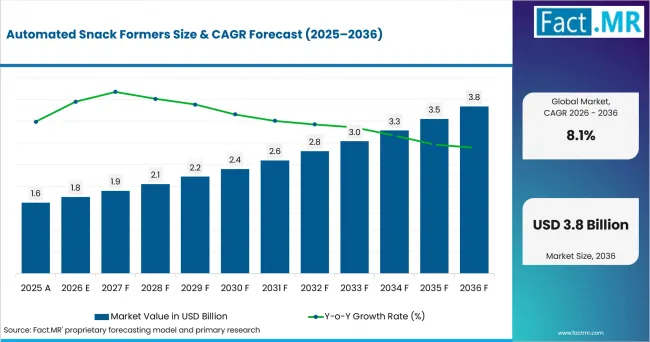
Automated Snack Formers Value Analysis | Source: Fact.MR
What are the defining numbers behind Automated Snack Formers Market growth?
An absolute opportunity of USD 2.1 billion is expected between 2026 and 2036.
- Demand Drivers in the Market
- Plant managers need repeatable forming accuracy as brands move from long cookie runs to more varied snack formats.
- Line engineers value recipe storage and PLC control because small product changes affect dough pressure and die fill.
- Food manufacturers face higher evidence demands around efficiency. The U.S. Census Bureau reported in September 2026 that Food Manufacturing (NAICS 311) generated USD 1,054.3 billion in 2024 shipments.
- Snack processors are linking forming with baking and inspection. USDA ERS reported in June 2026 that food-away-from-home spending reached USD 1.41 trillion in 2025.
- Key Segments Analyzed
- By Former Type: Rotary molder is expected to hold 29.0% share in 2026 because baked snack plants need repeatable shape release and weight control.
- By Snack Type: Baked snacks are projected to account for 27.0% share in 2026 as crackers and biscuits remain suited to automated forming.
- By Throughput: 1,001-2,500 kg/h is anticipated to capture 29.0% share in 2026 due to its fit with mid-scale plants and multi-SKU lines.
- By Automation Level: PLC recipe controlled is estimated to represent 34.0% share in 2026 owing to faster recall of product settings across planned changeovers.
- Analyst Opinion at Fact.MR
- Shambhu Nath Jha, Principal Consultant at Fact.MR, states, "Automated snack formers are becoming a control point between dough preparation and thermal processing. The market is expected to reward equipment that preserves product geometry while shortening changeover routines. Better-positioned suppliers combine tooling knowledge, servo control and sanitation support in one line package."
- Strategic Implications
- Equipment vendors should document weight control and product-release performance for doughs, bar masses and composite fillings.
- Automation teams should connect former data with oven and inspection systems to reduce avoidable setup losses during recipe changes.
- Aftermarket teams should build tooling libraries that help plants shift between seasonal products and core SKUs with fewer trials.
The USA is projected to post 9.1% CAGR through 2036 as high-volume food manufacturing keeps automated forming close to plant economics. Japan is expected to record 8.8% CAGR as convenience formats support compact and repeatable production. Germany is anticipated to advance at 8.4% CAGR due to food machinery depth and line retrofit needs. Italy is estimated to reach 7.3% CAGR through equipment clusters tied to bakery and snack production. The UK is forecast to record 6.0% CAGR as digitization support helps smaller processors evaluate automation upgrades.
How does the Automated Snack Formers Market break down by segment?
Rotary molder leads Former Type at 29.0%; PLC recipe controlled leads Automation Level at 34.0%.
Which Former Type dominates?
Rotary molder holds 29.0% share in 2026.
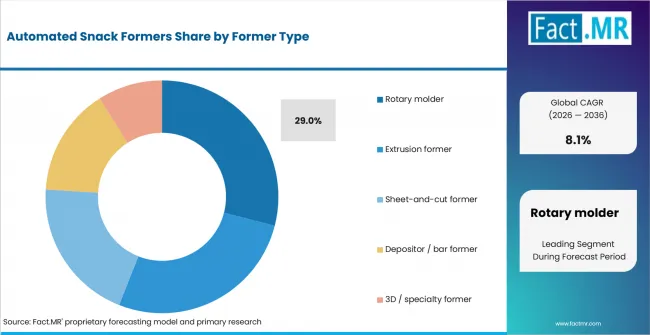
Automated Snack Formers Analysis By Former Type | Source: Fact.MR
Rotary molders hold a practical advantage in baked snack lines where dough release and cavity fill affect saleable output. They fit biscuit and cookie plants that run several shapes while keeping the downstream process stable.
Their advantage is clearest where operators need repeatable thickness and clean product release before baking. Tooling choice therefore affects pack appearance, oven loading and the amount of off-spec product removed after forming.
What leads the Snack Type segment?
Baked snacks account for 27.0% share in 2026.
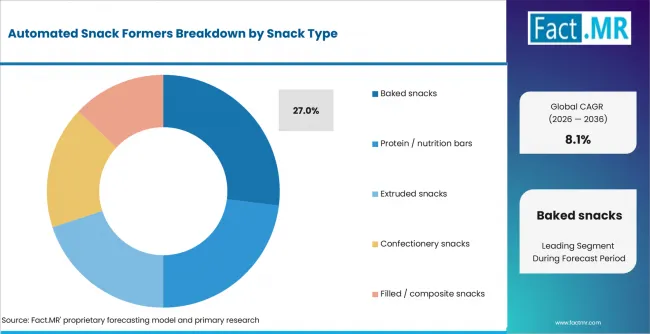
Automated Snack Formers Analysis By Snack Type | Source: Fact.MR
Baked snacks lead because crackers, biscuits and baked crisps depend on uniform dough handling before thermal processing. A forming error becomes visible after baking, so equipment selection starts before the oven.
Baked snack plants therefore judge a former by portion accuracy, gentle release and stable transfer to ovens. The segment remains suited to rotary and sheet-and-cut systems because product shape is visible in the final pack.
How does Throughput shape demand?
1,001-2,500 kg/h captures 18.0% share in 2026.
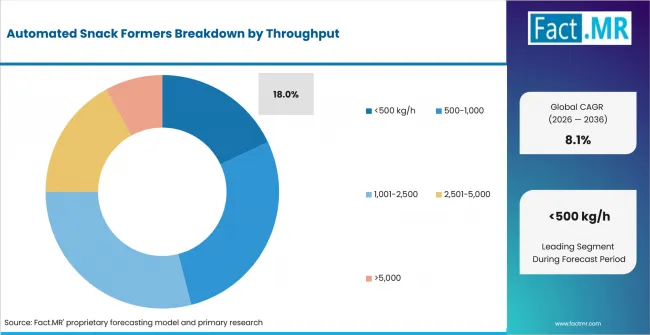
Automated Snack Formers Analysis By Throughput | Source: Fact.MR
The 1,001-2,500 kg/h band suits plants that need industrial output and frequent product adjustments. It is large enough for national snack distribution and flexible enough for shaped products that need recipe changeovers.
The same throughput band fits retrofit decisions. Plants can add a controlled former while keeping the complete heat-processing and packaging sequence for a later capital cycle.
What supports PLC recipe control within Automation Level?
PLC recipe controlled holds 34.0% share in 2026.
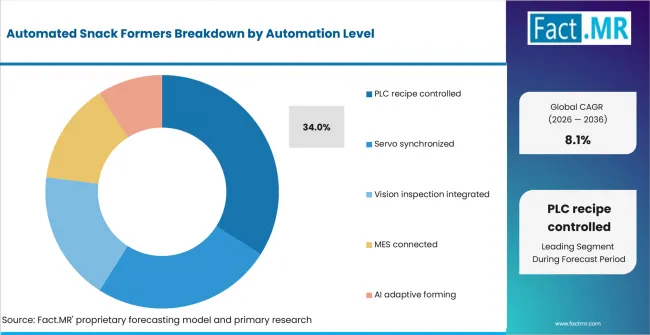
Automated Snack Formers Analysis By Automation Level | Source: Fact.MR
PLC recipe control leads because forming lines depend on repeatable settings for pressure, speed and weight. Recipe recall reduces trial runs when a plant switches from biscuits to filled bars or composite snacks.
Operators benefit when recipe settings travel with the product family. This makes training easier and helps quality teams compare forming conditions with inspection results after the run starts.
What is accelerating Automated Snack Formers Market adoption, and what is holding it back?
Demand is expected to rise through snack line automation, recipe variety and labor control. Adoption is constrained by capital cost, cleaning time and integration work.
Drivers Impact Analysis
| DRIVER | (~) % IMPACT ON CAGR | GEOGRAPHIC RELEVANCE | IMPACT TIMELINE |
|---|---|---|---|
| Recipe-controlled snack forming | +1.5% | Global | Short term (<= 2 years) |
| Growth in prepared and convenience food output | +1.3% | North America, Europe, East Asia | Medium term (2-4 years) |
| Labor and training pressure in food plants | +0.9% | USA, Germany, Japan | Medium term (2-4 years) |
| Integration with inspection and baking systems | +0.7% | Global | Long term (>= 4 years) |
Opportunity Impact Analysis
| OPPORTUNITY | (~) % IMPACT ON CAGR | GEOGRAPHIC RELEVANCE | IMPACT TIMELINE |
|---|---|---|---|
| Modular former upgrades for existing bakeries | +1.1% | North America, Europe | Short term (<= 2 years) |
| Servo synchronized forming for filled snacks | +0.9% | East Asia, Europe | Medium term (2-4 years) |
| Vision-linked forming adjustment | +0.7% | Global | Long term (>= 4 years) |
Restraints Impact Analysis
| RESTRAINT | (~) % IMPACT ON CAGR | GEOGRAPHIC RELEVANCE | IMPACT TIMELINE |
|---|---|---|---|
| High line-conversion cost | -0.6% | Global | Short term (<= 2 years) |
| Cleaning and allergen-changeover time | -0.5% | North America, Europe, Japan | Medium term (2-4 years) |
| Recipe validation across varied doughs | -0.4% | Global | Long term (>= 4 years) |
Which countries are scaling the Automated Snack Formers Market through 2036?
- The country comparison spans 3.1 percentage points and forms three practical growth bands across the forecast period.
- The USA remains 0.3 percentage point above Japan through food manufacturing scale and repeatable snack production.
- Japan remains 0.4 percentage point above Germany as convenience formats support compact automated forming.
- Germany remains 1.1 percentage points above Italy through machinery depth and line retrofit needs.
- Italy remains 1.3 percentage points above the UK through bakery machinery clusters and flexible production lines.
- The UK closes the displayed range as digitization support helps smaller food manufacturers evaluate automation upgrades.
Comparable CAGRs can create different entry conditions due to installed bakery assets, operator skills and the level of line integration. Full report coverage includes North America, Latin America, Western Europe, Eastern Europe, East Asia, South Asia & Pacific, Middle East & Africa.
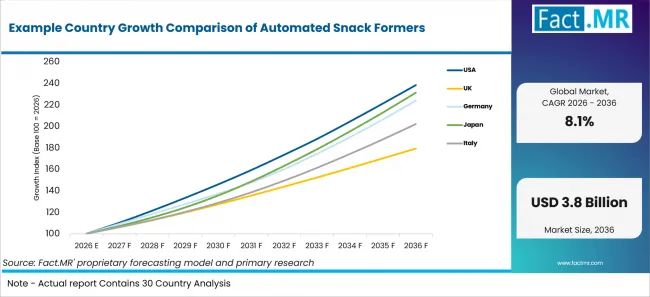
Example Country Growth Comparison Of Automated Snack Formers | Source: Fact.MR
| Country | CAGR |
|---|---|
| United States | 9.1% |
| Japan | 8.8% |
| Germany | 8.4% |
| Italy | 7.3% |
| United Kingdom | 6.0% |
What supports USA adoption?
9.1% CAGR, supported by food manufacturing scale and repeatable snack production.
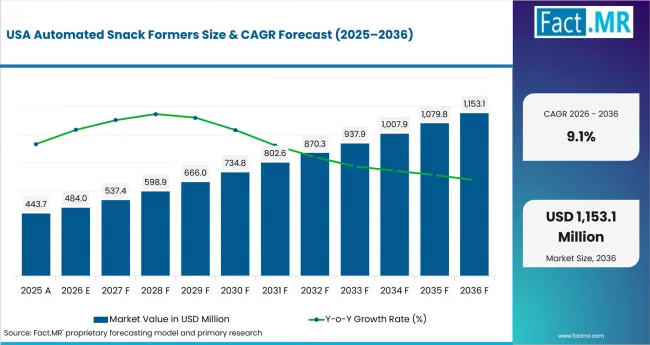
Automated Snack Formers Country Value Analysis | Source: Fact.MR
Large U.S. snack plants are expected to keep automated forming close to throughput and labor planning. The country has a broad base of cookie, cracker and bar production where rotary molders and PLC recipe control help protect weight and shape. Buyers are likely to favor systems that reduce setup trials and keep changeovers predictable across national product ranges.
How is Japan scaling demand?
8.8% CAGR, driven by convenience formats and domestic food processing output.
Japanese processors are expected to favor compact formers that handle smaller pieces, filled snacks and premium convenience formats. USDA FAS reported in April 2026 that Japan's food processing sector totaled USD 174 billion in 2025. That scale supports repeatable portioning in plants serving convenience retail and ready-to-eat channels.
What is supporting Germany’s adoption?
8.4% CAGR, supported by machinery depth and repeatable prepared-food output.
Germany is expected to benefit from its engineering base and installed bakery machinery network. Destatis reported in January 2026 that the country produced 1.7 million tonnes of ready meals in 2024. Snack producers are likely to use servo synchronized formers where repeated formats and export-quality presentation shape equipment selection.
How does Italy perform?
7.3% CAGR, led by food machinery clusters and flexible production lines.
Italian demand is anticipated to develop around bakery, confectionery and filled snack producers that need flexible equipment for smaller lots. Istat reported in June 2026 that Italy's agri-food sector generated EUR 89 billion in value added in 2025. Northern machinery clusters support shorter engineering loops between formers, packaging teams and plant integrators.
What supports the United Kingdom’s growth?
6.0% CAGR, backed by food manufacturing scale and SME digitization support.
UK growth is forecast to come from selective upgrades in food factories that need recipe memory and compact line integration. The Office for National Statistics reported in July 2026 that food represented 22.9% of total manufacturers' sales in 2025. Baked snack plants are likely to use rotary and sheet-and-cut formers to maintain consistency in smaller factory footprints.
Who leads the Automated Snack Formers Market?
Bühler is active through forming, moulding and puffing technologies for snacks, cereals, confectionery and bakery products. Its food-processing portfolio spans ingredient handling and forming through downstream processing and automated line control.
Baker Perkins, now part of Coperion Food, Health and Nutrition, remains relevant through biscuit, cookie, cracker and extrusion technologies. GEA competes through controlled food forming, including the MaxiFormer II drum former with automated product-weight reporting.
Reading Bakery Systems serves baked-snack applications through integrated processing systems, complete process lines and Science & Innovation Center support. Heat and Control announced the acquisition of Fabcon Food Systems in June 2025, adding snack-processing and handling capabilities to its broader food-equipment platform.
Rheon remains active in automated food forming and dough sheet systems for filled and shaped foods. Competition centers on tooling quality, sanitation access, recipe controls and the ability to integrate formers with ovens, conveyors and inspection equipment.
Which companies are the key providers?
Key companies include Bühler; Baker Perkins; GEA; Reading Bakery Systems; Heat and Control; and Rheon.
- Bühler
- Baker Perkins
- GEA
- Reading Bakery Systems
- Heat and Control
- Rheon
Bibliography
- GEA. (2025, March 17). GEA shows technology innovations for a better food future at IFFA.
- Heat and Control. (2025, June 2). Heat and Control announces acquisition of Fabcon Food Systems Ltd.
- Istat. (2026, June 12). Economic accounts for agriculture - Year 2025.
- Office for National Statistics. (2026, July 24). UK manufacturers' sales by product: 2025.
- Statistisches Bundesamt. (2026, January 14). Produktion von Fertiggerichten binnen fünf Jahren mengenmäßig um 25,6 % gestiegen.
- U.S. Bureau of Labor Statistics. (2025, July). Table B-6a. Employment of production and nonsupervisory employees on private nonfarm payrolls by industry sector, seasonally adjusted.
- U.S. Census Bureau. (2026, September 3). Census Bureau releases new Annual Integrated Economic Survey data.
- U.S. Department of Agriculture, Foreign Agricultural Service. (2026, April 1). Food processing ingredients annual (Report No. JA2026-0012).
- Zeballos, E., & Sinclair, W. (2026, June 11). Total U.S. food spending reached $2.51 trillion in 2025. U.S. Department of Agriculture, Economic Research Service.
This Report Answers
- The report explains where automated snack formers are used across former type, snack type, throughput and automation level.
- Segment analysis identifies the leading subsegments and the plant-level reasons processors prioritize them.
- Country analysis reviews the listed markets and the food manufacturing conditions that support automation demand.
- Competitive analysis reviews current providers across bakery forming, extrusion, drum forming, snack handling and complete production lines.
- Application analysis assesses how shape control, recipe memory and line integration influence equipment selection.
What does the Automated Snack Formers Market cover?
The Automated Snack Formers Market covers formers used in food processing and handling equipment where product shape and mass control affect line output. The assessment considers thermal links with food industry heat processing equipment because forming quality must hold through baking, frying or drying.
Coverage includes rotary moulding, extrusion forming, sheet-and-cut systems and depositors used in snacks, biscuits, bars and filled pieces. Adjacent wafer production lines are reviewed where forming and shape control overlap with snack operations.
What is included in the scope?
The scope includes complete formers, replacement tooling, recipe control upgrades and integrated stations used inside modular food processing lines. It includes formers connected with ingredient dosing systems and drying equipment where output balance affects heat-recovery baking lines and plant energy planning.
The scope covers PLC recipe control, servo synchronized operation, vision inspection integration and MES connectivity for snack plants using eco-efficient baking lines.
What is excluded from the scope?
The scope is outside stand-alone ovens, dryers and conveyor oven systems sold as separate heat-treatment assets. Retail snack brands, raw ingredients, flavoring systems and plastic-free snack packaging are outside scope when automated forming equipment is absent.
Consumer kitchen appliances, manual cutters and commercial 3D food printers fall outside scope unless they serve commercial snack forming. Downstream packaging automation solutions are included only where forming-line control directly connects with them.
How Was the Analysis Built?
The analysis draws on 120+ sources, 35+ company portfolios, 25+ countries, and more than 20 industry interviews.
- Primary Research: Interviews with manufacturers, equipment vendors, integrators and plant managers examine line layout, product changeover, sanitation needs and supplier selection.
- Desk Research: Desk research covers government statistics, company releases, public policy sources, industry associations and technical references.
- Market Sizing and Forecasting: Estimates combine historical performance, line investment indicators, snack production needs, segment shares and country-level growth.
- Data Validation and Update Cycle: Findings are checked against public data, company activity, product launches and shifts in commercial adoption.
What is the report’s scope and coverage?
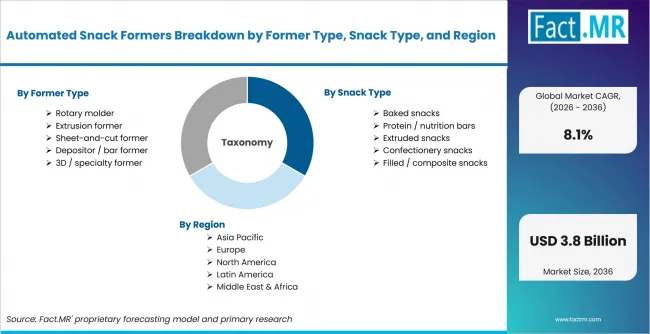
Automated Snack Formers Breakdown By Former Type, Snack Type, And Region | Source: Fact.MR
| Attribute | Details |
|---|---|
| Quantitative Units | USD billion |
| Market Definition | Automated equipment used to shape, mold, extrude, sheet, cut, deposit or form snack products before baking, frying, drying, cooling or packaging. |
| Former Type | Rotary molder; Extrusion former; Sheet-and-cut former; Depositor and bar former; 3D and specialty former |
| Snack Type | Baked snacks; Protein and nutrition bars; Extruded snacks; Confectionery snacks; Filled and composite snacks |
| Throughput | <500 kg/h; 500-1,000 kg/h; 1,001-2,500 kg/h; 2,501-5,000 kg/h; >5,000 kg/h |
| Automation Level | PLC recipe controlled; Servo synchronized; Vision inspection integrated; MES connected; AI adaptive forming |
| Regions Covered | North America; Latin America; Western Europe; Eastern Europe; East Asia; South Asia & Pacific; Middle East & Africa |
| Countries Covered | United States; United Kingdom; Germany; Japan; Italy |
| Key Companies Profiled | Bühler; Baker Perkins; GEA; Reading Bakery Systems; Heat and Control; Rheon |
| Forecast Period | 2026 to 2036 |
| Approach | Hybrid top-down and bottom-up approach using snack production lines, automation levels, former type mix, country adoption, company portfolio review and buyer interviews. |
How is the market segmented?
-
By Former Type
- Rotary molder
- Extrusion former
- Sheet-and-cut former
- Depositor and bar former
- 3D and specialty former
-
By Snack Type
- Baked snacks
- Protein and nutrition bars
- Extruded snacks
- Confectionery snacks
- Filled and composite snacks
-
By Throughput
- <500 kg/h
- 500-1,000 kg/h
- 1,001-2,500 kg/h
- 2,501-5,000 kg/h
- >5,000 kg/h
-
By Automation Level
- PLC recipe controlled
- Servo synchronized
- Vision inspection integrated
- MES connected
- AI adaptive forming
-
By Region
- North America
- Latin America
- Western Europe
- Eastern Europe
- East Asia
- South Asia & Pacific
- Middle East & Africa