
- Market Value (2025): USD 780.0 Mn
- Estimated Value (2026): USD 826.8 Mn
- Forecast Value (2036): USD 1537.5 Mn
- CAGR (2026-2036): 6.4%
Automatic Riveting Machine Market Forecast and Outlook 2026 to 2036
The global automatic riveting machine market was USD 780.0 million in 2025 and reached USD 826.8 million in 2026. The market is expected to reach USD 1,537.5 million by 2036, expanding at a CAGR of 6.4% during the 2026 to 2036 assessment period.
Automatic riveting is becoming more important as manufacturers seek faster and more consistent ways to join metal and mixed-material components. In July 2025, Spain-based AGME introduced an automatic riveting solution combining radial and orbital technologies with electric positioning axes and an automatic tool changer. Designed for automotive, appliance and capital goods production, the system highlights how manufacturers are adopting flexible riveting equipment to improve precision, shorten cycle times and reduce manual intervention.
- Automatic Riveting Machine Market Value (2025): USD 780.0 million
- Automatic Riveting Machine Market Value (2026): USD 826.8 million
- Automatic Riveting Machine Market Forecast Value (2036): USD 1,537.5 million
- Automatic Riveting Machine Market Forecast CAGR (2026–2036): 6.4%
- Leading Technology: Self-piercing riveting (32.6%)
- Key Market Participants: Atlas Copco, Stanley Black and Decker, Bollhoff, Durr (Brotje Automation) and Electroimpact
- Key Growth Countries: India, Mexico, China, United States and South Korea
Lightweight vehicle designs and the shift towards electric mobility are changing how automakers approach body assembly. In November 2026, ABB announced a supply of more than 1,700 industrial robots to BMW for its Neue Klasse production facilities in Germany and China. The robots will handle riveting, welding and assembly tasks, highlighting automakers' growing preference for flexible robotic production cells that maintain precision across new vehicle platforms.
Automatic Riveting Machine Market
| Metric | Value |
|---|---|
| Value in 2025 | USD 777.1 million |
| Value in 2026 | USD 826.8 million |
| Forecast Value in 2036 | USD 1,537.5 million |
| Forecast CAGR (2026 to 2036) | 6.4% |
Source: Fact.MR analysis. Updated Nov 27, 2026
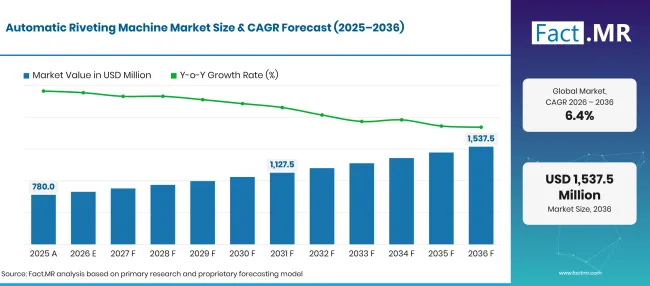
Automatic Riveting Machine Market Forecast Global | Source: Fact.MR
Category
| Category | Category Segments |
|---|---|
| Technology | Self-piercing riveting, Orbital and radial riveting, Automatic blind riveting, Automatic solid riveting, Impact and hydraulic riveting |
| Configuration | Robot-mounted, Bench-top, Production-line integrated, Gantry and multi-head |
| End Use | Automotive, Aerospace, Electrical and electronics, Appliances and white goods, Construction and HVAC |
| Rivet Material | Steel, Aluminium, Stainless steel, Copper and brass, Titanium and other |
| Region | India; Mexico; China; United States; South Korea |
Source: Fact.MR analysis. Updated Nov 27, 2026
Segmental Analysis
What makes self-piercing riveting the leading technology segment in the Automatic Riveting Machine Market?
Automatic Riveting Machine Market Breakdown Technology | Source: Fact.MR
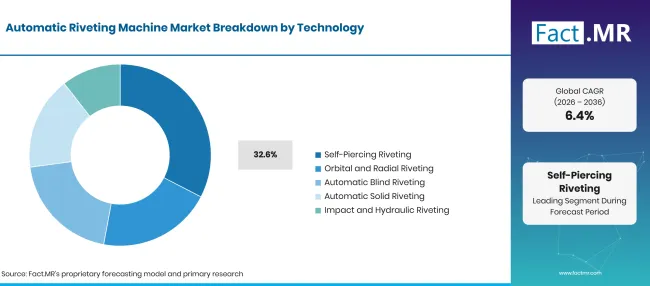
Self-piercing riveting leads the technology segment with a 32.6% revenue share in 2026, or USD 269.5 million. The process joins aluminium and mixed-material panels without pre-drilled holes, making it suitable for lightweight vehicle bodies where welding can be difficult. Strong joints, process repeatability and easier quality monitoring support its use in automotive and industrial assembly.
Orbital and radial riveting, automatic blind riveting, automatic solid riveting and impact and hydraulic riveting are also growing as manufacturers require joining options for different materials, joint strengths and production speeds. In July 2026, Atlas Copco introduced its Common Control Platform, which brings self-pierce riveting, flow-drill fastening, dispensing and vision technologies into one interface for automotive and electronics production.[atlascopco]
Which factors support robot-mounted as the largest configuration segment in the Automatic Riveting Machine Market?
Automatic Riveting Machine Market Breakdown Configuration | Source: Fact.MR
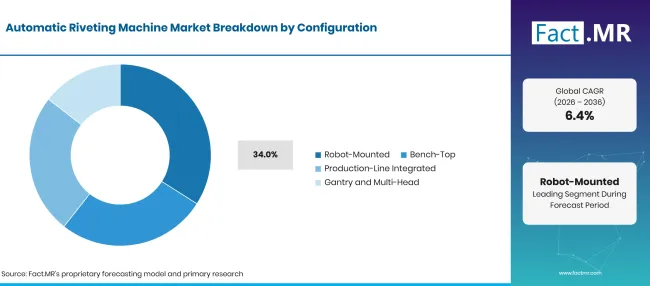
Robot-mounted systems lead the configuration segment with a 34.0% revenue share in 2026, or USD 281.1 million. These systems reach complex body shapes, operate around fixed joining stations and can be reprogrammed when manufacturers introduce new models. Automotive and aerospace lines favor them because they combine flexibility with consistent positioning.
Bench-top systems serve lower-volume and precision applications, while production-line integrated and gantry and multi-head systems support higher throughput. Interest in connected assembly is increasing: at Automate 2026, Atlas Copco featured automated self-pierce riveting for lightweight and mixed-material assemblies used in automotive and industrial manufacturing.[atlascopco]
What makes automotive the leading end use segment in the Automatic Riveting Machine Market?
Automatic Riveting Machine Market Breakdown End Use | Source: Fact.MR
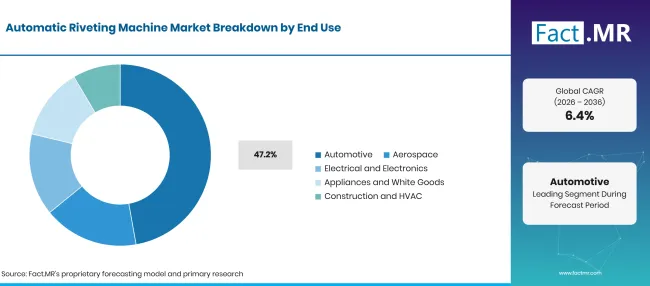
Automotive leads the end use segment with a 47.2% revenue share in 2026, or USD 390.2 million. Vehicle bodies and structures use large numbers of rivets at high production volumes, while the move toward aluminium-intensive and electric-vehicle designs is increasing the need for new joining lines. Aerospace follows, where high-value assemblies require controlled and traceable joining.
Electrical and electronics, appliances and white goods, and construction and HVAC applications are also expanding as manufacturers automate repetitive fastening tasks. Stanley Black & Decker reported that its Engineered Fastening segment recorded 6% sales growth in 2025, supported by strong demand from aerospace and automotive customers.[ir.stanleyblackanddecker]
Which factors support steel as the largest rivet material segment in the Automatic Riveting Machine Market?
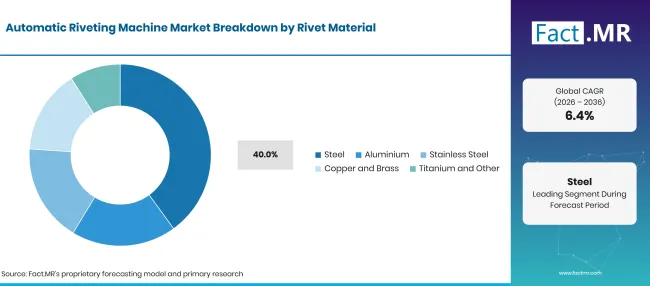
Automatic Riveting Machine Market Breakdown Rivet Material | Source: Fact.MR
Steel leads the rivet material segment with a 40.0% revenue share in 2026, or USD 330.7 million. Steel remains widely used across vehicles, appliances and industrial equipment because it offers strength, availability and established joining practices. Aluminium riveting is gaining ground as lightweighting becomes more common in transport and industrial products.
Stainless steel, copper and brass, and titanium and other materials are growing in applications that require corrosion resistance, electrical conductivity or high strength-to-weight performance. The mix of materials is encouraging equipment makers to develop riveting systems that can manage different fastener types and joint requirements.
Automatic Riveting Machine Market: Drivers, Restraints and Trends
Driver: Lightweight and Mixed-Material Vehicle Production:
Automotive manufacturers are using more aluminium, high-strength steel and mixed-material structures that cannot always be joined effectively by conventional welding. Self-piercing riveting creates strong joints in these materials without pre-drilling, which supports lighter vehicle bodies and electric-vehicle structures. Atlas Copco positions its Henrob self-pierce riveting systems for clean, high-strength joints in multi-material vehicle structures. This shift is increasing demand for automated riveting equipment that can deliver repeatable joints at production speed.
Restraint: High Equipment and Integration Costs:
Automatic riveting lines require substantial upfront spending on machines, robots, controls, tooling and installation. Integrating new equipment with existing conveyors, vision systems and factory software can add cost and delay deployment. Automotive investment cycles also create uncertainty, while adhesives, welding and flow-drill screw joining compete for some applications. For smaller manufacturers, these costs can make manual or semi-automated joining more practical than a fully automated riveting cell.
Trend: Process Monitoring and Traceability:
Manufacturers are adopting riveting systems with force-displacement monitoring, data logging and vision-based inspection to document joint quality. Atlas Copco’s Common Control Platform, introduced in July 2026, unifies self-pierce riveting, flow-drill fastening, dispensing and vision technologies through a web-based interface, reducing integration complexity and improving process transparency. This direction supports traceable production and helps manufacturers identify joining deviations before parts move further down them.
Trend: Electric-Vehicle Structures and Flexible Automation:
Battery enclosures, lightweight chassis structures and mixed-material body designs are adding riveting tasks across vehicle programs. At Automate 2026, Atlas Copco demonstrated automated self-pierce riveting for lightweight and mixed-material assemblies, reflecting demand for flexible joining automation. Future opportunities lie in modular riveting cells, connected quality data and equipment that can be redeployed as vehicle platforms and production volumes change.
Automatic Riveting Machine Market Analysis by Key Country
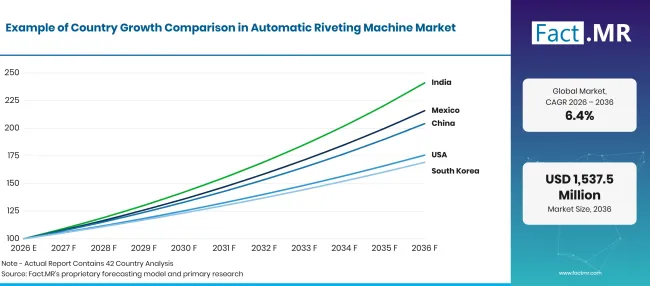
Automatic Riveting Machine Market Growth Index | Source: Fact.MR
| Country | CAGR (2026–2036) |
|---|---|
| India | 9.2% |
| Mexico | 8.0% |
| China | 7.4% |
| United States | 5.8% |
| South Korea | 5.4% |
Source: Fact.MR analysis. Updated Nov 27, 2026
Why is India the fastest-growing market for automatic riveting machines?
India is recording the strongest growth among the five countries, with demand expected to rise at a 9.2% CAGR through 2036. Expansion in vehicle and electronics manufacturing is creating a larger base for automated joining equipment, particularly as local producers add capacity for lightweight vehicle structures and precision assemblies.
Sales are also supported by investment in modern production lines that improve joint consistency and reduce manual handling. Robot-mounted and production-line integrated systems are gaining attention because they can be adapted across vehicle models and component variants. This combination of capacity expansion and automation upgrades is strengthening demand for automatic riveting machines.
What is shaping automatic riveting machines demand in Mexico?
Mexico is expected to record an 8.0% CAGR through 2036, above the global rate of 6.4%. Automotive assembly and supplier plants serving North American markets are expanding their use of automated joining equipment to meet volume, quality and traceability requirements.
Demand is being driven by vehicle-body production, lightweight-material adoption and the need to maintain consistent joints across high-volume lines. Robot-mounted systems are becoming more important as plants handle different models and body styles on shared production infrastructure. This makes Mexico an important market for flexible riveting automation.
How is demand for automatic riveting machines developing in China?
China is likely to record a 7.4% CAGR through 2036, above the global rate of 6.4%. Its large vehicle, appliance and electronics manufacturing base creates sustained demand for joining equipment, while local suppliers compete with international equipment providers on price, service and integration capability.
Growth is supported by line upgrades that improve output, reduce manual intervention and manage a wider range of materials. Manufacturers are also investing in systems that provide process data and repeatable joint quality. These requirements favor automated riveting solutions across automotive and industrial production.
What is driving automatic riveting machines demand in the United States?
Demand in the United States is expected to advance at a 5.8% CAGR through 2026 to 2036, below the global rate. A strong automotive and aerospace base continues to create demand for advanced joining systems, particularly where manufacturers need traceable quality records and flexible automation.
Stanley Black & Decker reported that its Engineered Fastening segment grew 6% in 2025, with organic revenue up 8% on strong aerospace and automotive demand. In August 2026, the company announced a USD 1 billion investment in the United States through 2028, with about half allocated to research and development and half to capital expenditure and manufacturing investment. These investments support demand for advanced fastening and automation technologies.
Why is growth slower for automatic riveting machines in South Korea?
South Korea is expected to expand at a 5.4% CAGR through 2036, the slowest among the five countries. Its mature automotive and electronics manufacturing base already uses high levels of automation, so incremental demand depends more on line upgrades, new vehicle programs and advanced quality-control requirements than on basic capacity additions.
Steady demand remains for robot-mounted and production-line integrated systems that improve repeatability and support connected manufacturing. As plants modernize joining processes and introduce more mixed-material structures, equipment suppliers can benefit from replacement and upgrade demand.
Competitive Landscape for Automatic Riveting Machine Market
The automatic riveting machine market is relatively concentrated. Atlas Copco, Stanley Black and Decker, Bollhoff, Durr (Brotje Automation) and Electroimpact together held about 61% of 2026 revenue, based on Fact.MR estimates. Competition centers on process capability, cycle time, robot integration, monitoring software and service coverage.
Industrial tool and fastening groups, automation integrators and aerospace-specialist builders compete across different riveting technologies. Atlas Copco’s Common Control Platform illustrates the direction of competition toward unified control of riveting, fastening, dispensing and vision systems. Dürr also expanded its automation position through its acquisition of BBS Automation, strengthening its offering across automated production systems
Recent Developments
- On July 1, 2026, Atlas Copco introduced its Common Control Platform, a unified hardware and software platform that brings self-pierce riveting, flow-drill fastening, dispensing and vision technologies into one interface for automotive and electronics production.
- On August 12, 2026, Stanley Black & Decker announced a USD 1 billion investment in the United States through 2028 to advance innovation, strengthen its manufacturing footprint and expand skilled-trades training.
- In 2025, Dürr acquired BBS Automation, expanding its automation business and adding capabilities across automated production systems.
- No qualifying 2025 or 2026 acquisition, partnership or product launch could be verified for Bollhoff from its official announcements.
- No qualifying 2025 or 2026 acquisition, partnership or product launch could be verified for Electroimpact from its official announcements.
Key Players in Automatic Riveting Machine Market
Key companies operating in the market include Atlas Copco, Stanley Black & Decker, Bollhoff, Dürr (Broetje Automation), and Electroimpact.
- Atlas Copco
- Stanley Black and Decker
- Bollhoff
- Durr (Brotje Automation)
- Electroimpact
Bibliography
- Atlas Copco. (2026, July 1). The Common Control Platform: Multiple joining technologies unified.
- Atlas Copco. (2026). Automate 2026.
- Atlas Copco. (n.d.). Automotive and tiers.
- Dürr Aktiengesellschaft. (n.d.). Dürr Group’s press releases, images and videos.
- Stanley Black & Decker. (2026, February 4). Stanley Black & Decker reports 4Q and full year 2025 results.
- Stanley Black & Decker. (2026, August 12). Stanley Black & Decker investing $1 billion in the U.S. to drive innovation, strengthen U.S. manufacturing footprint and expand the skilled trades workforce essential to building America’s infrastructure.
- U.S. Securities and Exchange Commission. (2026). Stanley Black & Decker 2025 annual report.
Segmentation
Scope of Report
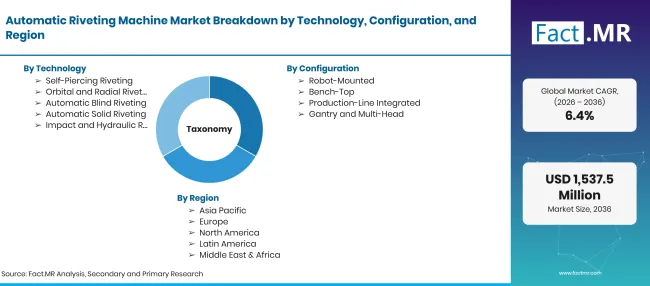
Automatic Riveting Machine Market Taxonomy | Source: Fact.MR
| Items | Values |
|---|---|
| Quantitative Units (2026) | USD 826.8 million |
| Technology | Self-piercing riveting, Orbital and radial riveting, Automatic blind riveting, Automatic solid riveting, Impact and hydraulic riveting |
| Configuration | Robot-mounted, Bench-top, Production-line integrated, Gantry and multi-head |
| End Use | Automotive, Aerospace, Electrical and electronics, Appliances and white goods, Construction and HVAC |
| Rivet Material | Steel, Aluminium, Stainless steel, Copper and brass, Titanium and other |
| Regions Covered | North America, Latin America, Europe, Asia Pacific, Middle East & Africa |
| Countries Covered | India, Mexico, China, United States, South Korea and other countries |
| Key Companies Profiled | Atlas Copco, Stanley Black and Decker, Bollhoff, Durr (Brotje Automation), Electroimpact |
| Additional Attributes | Dollar revenue in the Automatic Riveting Machine Market is segmented by technology, configuration, end use, rivet material and region. |
Source: Fact.MR analysis. Updated Nov 27, 2026
Automatic Riveting Machine Market by Segments
-
Technology
- Self-piercing riveting
- Orbital and radial riveting
- Automatic blind riveting
- Automatic solid riveting
- Impact and hydraulic riveting
-
Configuration
- Robot-mounted
- Bench-top
- Production-line integrated
- Gantry and multi-head
-
End Use
- Automotive
- Aerospace
- Electrical and electronics
- Appliances and white goods
- Construction and HVAC
-
Rivet Material
- Steel
- Aluminium
- Stainless steel
- Copper and brass
- Titanium and other
-
Region
- North America
- United States
- Canada
- Mexico
- Europe
- Germany
- United Kingdom
- France
- Italy
- Spain
- Rest of Europe
- Asia Pacific
- China
- India
- Japan
- South Korea
- Australia and New Zealand
- Rest of Asia Pacific
- Latin America
- Brazil
- Argentina
- Rest of Latin America
- Middle East & Africa
- GCC Countries
- South Africa
- Rest of Middle East & Africa
- North America
Table of Contents
Key Takeaways
- Market Size and CAGR
- Top Growth Driver
- Fastest Growing Segment
- Leading Region
- Key Companies
- Emerging Opportunities

