
- Market Value (2025): USD 780.0 Mn
- Estimated Value (2026): USD 822.9 Mn
- Forecast Value (2036): USD 1459.8 Mn
- CAGR (2026-2036): 5.9%
Inline Checkweighers Market Forecast and Outlook 2026 to 2036
The inline checkweigher market is anticipated to grow from USD 822.9 million in 2026 to USD 1,459.8 million by 2036, reflecting a CAGR of 5.9% over the ten-year period. Demand is supported by manufacturers' increasing focus on accurate package weights, automated inspection and reducing product giveaway across food, beverage and pharmaceutical production lines.
Demand for inline checkweighers is increasing as food, beverage and pharmaceutical manufacturers seek accurate package weights, lower product giveaway and automated inspection. Equipment suppliers are developing faster weighing systems with improved data connectivity and rejection controls. For example, in April 2026, Ishida Europe announced that it would launch its DACS-AS checkweigher range at Interpack 2026 in Düsseldorf, Germany, in May.
Key Takeaways from Inline Checkweighers Market
- Sales of inline checkweighers stood at USD 780.0 million in 2025
- Inline Checkweighers Market Value (2026): USD 822.9 million
- Inline Checkweighers Market Forecast Value (2036): USD 1,459.8 million
- Inline Checkweighers Market Forecast CAGR (2026-2036): 5.9%
- Leading Product Type: Belt checkweighers (46.0%)
- Key Market Participants: Mettler-Toledo, Minebea Intec, Ishida, Anritsu, Loma Systems
- Key Growth Countries: China, South Korea, United Kingdom, United States, France
In July 2026, the UK's Office for National Statistics reported that food manufacturing accounted for 22.9% of total manufacturers' product sales in 2025. This highlights the scale of food production activities requiring packaging, filling and quality control equipment. Food processors use inline checkweighers to monitor package weights, identify products outside specified tolerances and reduce excess filling. Equipment manufacturers are responding with systems that combine weight inspection, metal detection and production data monitoring.
Inline Checkweighers Market
| Metric | Value |
|---|---|
| Estimated Value in (2026) | USD 822.9 million |
| Forecast Value in (2036) | USD 1,459.8 million |
| Forecast CAGR (2026 to 2036) | 5.9% |
Source: Fact.MR analysis.
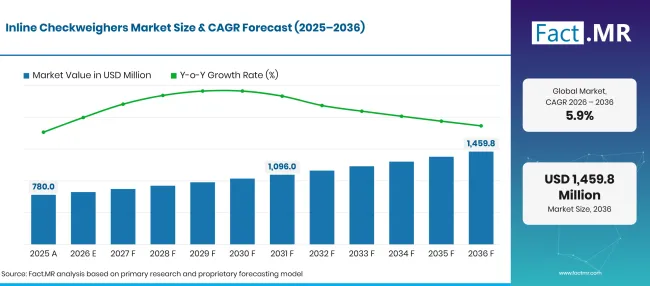
Inline Checkweighers Market Forecast Global | Source: Fact.MR
Category
| Category | Segments |
|---|---|
| Product Type | Belt checkweighers, High-speed and specialty checkweighers, Combination checkweigher and metal detector, Combination checkweigher and x-ray |
| Weighing Capacity | 1 to under 10 kg, Below 1 kg, 10 to under 50 kg, 50 kg and above |
| End Use | Food and beverage, Pharmaceuticals and healthcare, Logistics, parcel and E-commerce, Consumer goods and household products, Chemicals and agrochemicals |
| Reject Mechanism | Air-blast reject, Pusher arm reject, Drop-flap and belt-drop reject, Diverter and sweep reject, Alarm and stop-line only |
| Region | China; South Korea; United Kingdom; United States; France |
Source: Fact.MR analysis. Updated Nov 27, 2026
Segmental Analysis
What makes belt checkweighers the leading product type segment in the Inline Checkweighers Market?
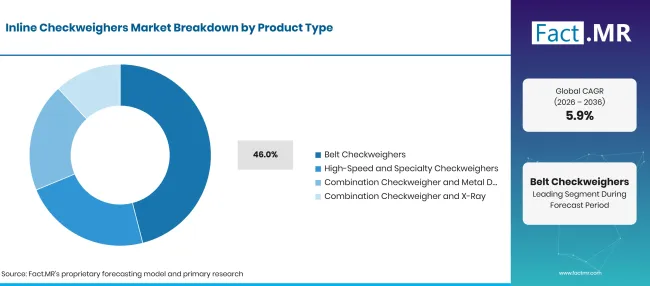
Inline Checkweighers Market Breakdown Product Type | Source: Fact.MR
Belt checkweighers account for 46.0% of market revenue in 2026, approximately USD 378.5 million. Their conveyor-based design allows packaged products to be weighed continuously without interrupting production. Mettler-Toledo offers dynamic checkweighing systems with different belt configurations and rejection options, supporting accurate weight inspection across food, pharmaceutical and consumer goods packaging lines.
Which factors support 1 to under 10 kg as the largest weighing capacity segment in the Inline Checkweighers Market?
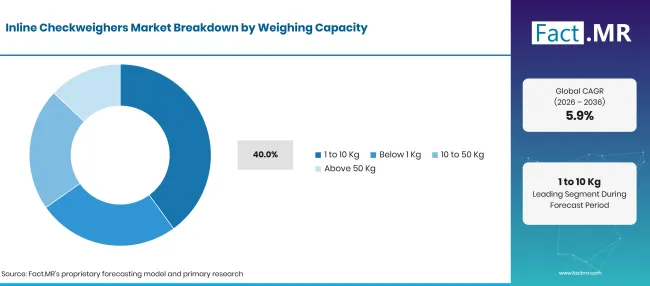
Inline Checkweighers Market Breakdown Weighing Capacity | Source: Fact.MR
Products weighing from 1 kg to under 10 kg represent 40.0% of inline checkweigher revenue in 2026, equivalent to approximately USD 329.2 million. This capacity range accommodates packaged foods, multipacks and selected consumer goods. Minebea Intec supplies dynamic checkweighers with different weighing capacities, allowing manufacturers to match equipment specifications with product weight and production requirements.
What makes food and beverage the leading end use segment in the Inline Checkweighers Market?
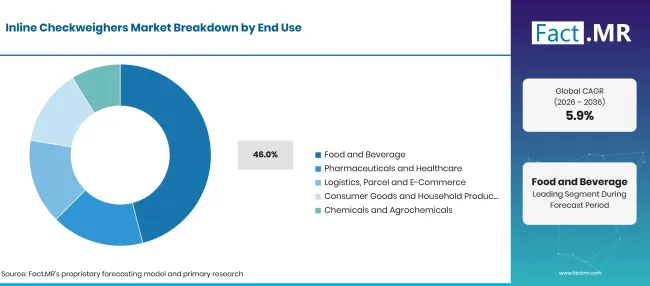
Inline Checkweighers Market Breakdown End Use | Source: Fact.MR
Food and beverage manufacturers contribute approximately USD 378.5 million in 2026, securing 46.0% of market revenue. Packaging lines use automated checkweighers to monitor product quantities and identify underfilled or overfilled packages. Ishida offers checkweighing systems for packaged and unpackaged foods, helping processors maintain weight consistency while reducing unnecessary product giveaway and packaging waste.
Which factors support air-blast reject as the largest reject mechanism segment in the Inline Checkweighers Market?
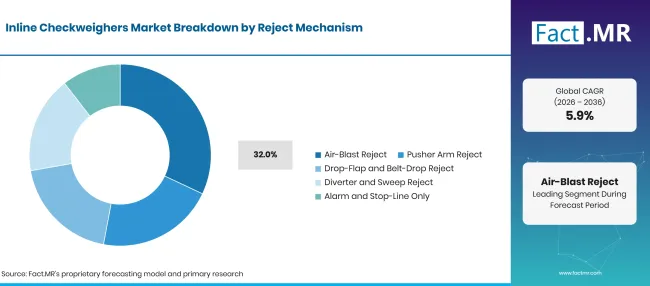
Inline Checkweighers Market Breakdown Reject Mechanism | Source: Fact.MR
Air-blast rejection systems generate approximately USD 263.3 million in 2026, representing 32.0% of market revenue. Compressed air removes suitable lightweight packages from conveyor lines without direct mechanical contact. Ishida offers air rejection options for lower-weight products, making this mechanism useful for packaged snacks, confectionery and other lightweight goods requiring rapid rejection after weighing.
Inline Checkweighers Market-Drivers, Restraints & Trends
Drivers
Accurate package weight control and the need to reduce product giveaway support purchases of inline checkweighers across food, pharmaceutical and consumer goods manufacturing. Automated systems identify packages outside specified weight limits, helping manufacturers maintain consistent filling operations and production quality.
Restraints
High initial investment costs can discourage smaller manufacturers from installing inline checkweighers. Equipment integration may require conveyor modifications, calibration and operator training. Long machine service lives also affect replacement frequency, while product handling requirements influence the selection of suitable weighing systems.
Trend
Combined Inspection Systems: Packaging manufacturers are adopting equipment that combines weight verification with contamination detection and label inspection. Mettler-Toledo offers integrated checkweighing systems with metal detection, X-ray or vision inspection capabilities. These configurations help manufacturers consolidate inspection functions while reducing production line space requirements.
Trend
Data Connectivity: Production teams are using connected checkweighers to examine weight variations, rejection patterns and equipment performance. Ishida's Sentinel 5.0 platform connects multiple inspection systems through a shared dashboard. Such capabilities support faster identification of filling inconsistencies and improved production monitoring across packaging lines.
Inline Checkweighers Market Analysis by Key Country
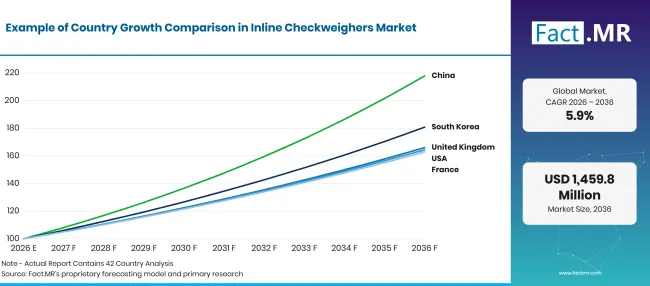
Inline Checkweighers Market Growth Index | Source: Fact.MR
| Country | CAGR (2026-2036) |
|---|---|
| China | 8.1% |
| South Korea | 6.1% |
| United Kingdom | 5.2% |
| United States | 5.1% |
| France | 5.0% |
Source: Fact.MR analysis.
Why is China the fastest-growing market for inline checkweighers?
Demand for inline checkweighers in China is anticipated to increase at an 8.1% CAGR through 2036.
Food processing expansion and automated packaging operations create opportunities for continuous weight inspection. In January 2026, China's National Bureau of Statistics reported that the value added of food processing from agricultural and sideline products, among industrial enterprises above the designated size, increased by 5.6% during 2025. Manufacturers handling packaged foods can use conveyor-based checkweighers to identify weight variations, limit excessive filling and maintain consistent package quantities across high-volume production lines.
What is shaping inline checkweighers demand in South Korea?
Food manufacturing provides an important application for inline checkweighers in South Korea, where sales are anticipated to rise at a 6.1% CAGR over the next decade.
In 2026, the Ministry of Food and Drug Safety reported that domestic food industry production reached approximately KRW 119.7 trillion in 2025, increasing by 4.3% from the previous year. Packaged food producers require consistent filling and inspection procedures. Checkweighers equipped with automatic rejection mechanisms can help identify packages outside specified weight limits before products reach distribution channels.
How is demand for inline checkweighers developing in the United Kingdom?
Sales of inline checkweighers in the United Kingdom are anticipated to expand at a 5.2% CAGR during the forecast period.
Package quantity control remains an important consideration for food manufacturers operating automated filling lines. The Office for National Statistics reported in July 2026 that food manufacturing represented 22.9% of total UK manufacturers' product sales during 2025. Producers can integrate checkweighers with existing conveyors to monitor package weights, investigate filling inconsistencies and maintain appropriate quantity-control records.
What is driving inline checkweighers demand in the United States?
Packaging accuracy and automated inspection requirements influence inline checkweigher purchases in the United States.
Sales are anticipated to grow at a 5.1% CAGR by 2036. The National Institute of Standards and Technology maintains Handbook 133, with a 2026 edition providing procedures, developed primarily for government weights and measures officials, for checking the net contents of packaged goods. Manufacturers use automatic weighing equipment to support internal quantity-control procedures. Food, pharmaceutical and consumer goods packaging facilities also consider rejection accuracy, production speed and equipment connectivity when upgrading inspection systems.
Why is growth slower for inline checkweighers in France?
Demand for inline checkweighers in France is anticipated to increase at a 5.0% CAGR over the forecast period.
Established food processing facilities require weighing equipment suited to their packaging formats and operating speeds. France's Ministry of Agriculture reported in its 2026 industry overview that approximately 70% of the country's agricultural production undergoes domestic food processing. Producers handling packaged foods and beverages can use checkweighers for quantity verification. Equipment purchases also depend on conveyor compatibility, calibration needs and available production space.
Competitive Landscape for Inline Checkweighers Market
Packaging line performance increasingly determines competition among inline checkweigher manufacturers. Mettler-Toledo supplies C-Series checkweighers and integrated systems combining weight inspection with metal detection, X-ray and vision technologies. Minebea Intec offers Essentus and Flexus equipment for different weighing capacities, while Loma Systems combines CW3 checkweighing with IQ4 metal detection.
In April 2026, Ishida Europe announced that it would launch its DACS-AS checkweigher range at Interpack 2026, emphasizing reliable weight inspection. Manufacturers distinguish their offerings through conveyor speed, weighing precision, hygienic construction and automatic rejection options. Integration with packaging equipment and production monitoring software also influences purchases, particularly among food processors seeking tighter filling control and reduced product giveaway.
Recent Developments
- In August 2026, Minebea Intec introduced the Essentus Advanced L checkweigher for food, pharmaceutical, and consumer goods manufacturers. The system checks products weighing up to 12 kilograms and provides simple digital controls. The model is initially available in Asia, India, the Middle East and Africa.
- In April 2026, Ishida Europe announced that it would launch its DACS-AS checkweigher range at Interpack in May 2026. The equipment checks package weights during production and helps food manufacturers meet legal weighing requirements and retailer standards.
Key Players in Inline Checkweighers Market
Key companies operating in the market include Mettler-Toledo, Minebea Intec, Ishida, Anritsu, and Loma Systems.
- Mettler-Toledo
- Minebea Intec
- Ishida
- Anritsu
- Loma Systems
Bibliography
- Ishida Europe. (2026, April 15). The full package: Ishida Europe to showcase new innovations tackling food manufacturing challenges at Interpack 2026.
- Loma Systems. (2026, January 29). Loma Systems to showcase advanced inspection solutions at CFIA 2026 in Rennes, France.
- McGuire, J., Sefcik, D., Minnich, L., Benham, E., Baucom, I., & Lippa, K. (2025). NIST Handbook 133: Checking the net contents of packaged goods (2026 ed.). National Institute of Standards and Technology.
- METTLER TOLEDO. (2026). C35 AdvancedLine checkweigher.
- Minebea Intec. (2026, August 19). Focus on product quality: The new checkweigher Essentus Advanced L.
- Minebea Intec. (2026). Dynamic checkweighers for maximum efficiency and safety.
- Ministère de l’Agriculture, de l’Agro-alimentaire et de la Souveraineté alimentaire. (2026). Panorama des industries agroalimentaires: Chiffres et indicateurs clés, édition 2026.
- Ministry of Food and Drug Safety, Republic of Korea. (2026, May 29). 2025 food industry production reaches KRW 119 trillion, up 4.3% year over year.
- National Bureau of Statistics of China. (2026, January 20). Industrial production operation in December 2025.
- Office for National Statistics. (2026, July 24). UK manufacturers’ sales by product: 2025.
Segmentation
Scope of Report
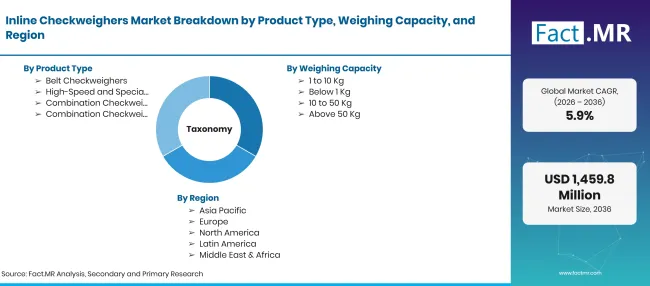
Inline Checkweighers Market Taxonomy | Source: Fact.MR
| Items | Values |
|---|---|
| Quantitative Units (2026) | USD 822.9 Million |
| Product Type | Belt checkweighers, High-speed and specialty checkweighers, Combination checkweigher and metal detector, Combination checkweigher and x-ray |
| Weighing Capacity | 1 to under 10 kg, Below 1 kg, 10 to under 50 kg, 50 kg and above |
| End Use | Food and beverage, Pharmaceuticals and healthcare, Logistics, parcel and E-commerce, Consumer goods and household products, Chemicals and agrochemicals |
| Reject Mechanism | Air-blast reject, Pusher arm reject, Drop-flap and belt-drop reject, Diverter and sweep reject, Alarm and stop-line only |
| Regions Covered | North America, Latin America, Europe, Asia Pacific, Middle East & Africa |
| Countries Covered | China, South Korea, United Kingdom, United States, France, and other countries |
| Key Companies Profiled | Mettler-Toledo, Minebea Intec, Ishida, Anritsu, Loma Systems |
| Additional Attributes | Dollar revenue in the Inline Checkweighers Market is segmented by product type, weighing capacity, end use and reject mechanism and region. |
Source: Fact.MR analysis. Updated Nov 27, 2026
Inline Checkweighers Market by Segments
-
Product Type
- Belt checkweighers
- High-speed and specialty checkweighers
- Combination checkweigher and metal detector
- Combination checkweigher and x-ray
-
Weighing Capacity
- 1 to under 10 kg
- Below 1 kg
- 10 to under 50 kg
- 50 kg and above
-
End Use
- Food and beverage
- Pharmaceuticals and healthcare
- Logistics, parcel and E-commerce
- Consumer goods and household products
- Chemicals and agrochemicals
-
Reject Mechanism
- Air-blast reject
- Pusher arm reject
- Drop-flap and belt-drop reject
- Diverter and sweep reject
- Alarm and stop-line only
-
Region:
- North America
- United States
- Canada
- Mexico
- Europe
- Germany
- United Kingdom
- France
- Italy
- Spain
- Rest of Europe
- Asia Pacific
- China
- India
- Japan
- South Korea
- Australia and New Zealand
- Rest of Asia Pacific
- Latin America
- Brazil
- Argentina
- Rest of Latin America
- Middle East & Africa
- GCC Countries
- South Africa
- Rest of Middle East & Africa
- North America
Table of Contents
Key Takeaways
- Market Size and CAGR
- Top Growth Driver
- Fastest Growing Segment
- Leading Region
- Key Companies
- Emerging Opportunities

