
- Market Value (2025): USD 880.0 Mn
- Estimated Value (2026): USD 924.0 Mn
- Forecast Value (2036): USD 1563.4 Mn
- CAGR (2026-2036): 5.4%
Servo-hydraulic Testing Machines Market Forecast and Outlook 2026 to 2036
The servo-hydraulic testing machine market is anticipated to expand from USD 924.0 million in 2026 to USD 1,563.4 million by 2036, registering a CAGR of 5.4% over the ten-year period.
Demand for servo-hydraulic testing machines is increasing as automotive, aerospace and materials manufacturers require accurate fatigue, durability and structural performance testing. Equipment suppliers are developing advanced control systems to improve testing precision and laboratory efficiency. For example, in August 2026, Instron launched its Labtronic EVO controller family for servo-hydraulic testing applications, offering modular configurations, simplified wiring and improved system management.
Key Takeaways from the Servo-hydraulic Testing Machines Market
- Sales of servo-hydraulic testing machines stood at USD 880.0 million in 2025
- Servo-hydraulic Testing Machines Market Value (2026): USD 924.0 million
- Servo-hydraulic Testing Machines Market Forecast Value (2036): USD 1563.4 million
- Servo-hydraulic Testing Machines Market Forecast CAGR (2026-2036): 5.4%
- Leading Test Type: Fatigue and dynamic testing (38.0%)
- Key Market Participants: MTS Systems, Instron, ZwickRoell, Shimadzu
- Key Growth Countries: India, China, South Korea, France, Germany
In January 2026, ZwickRoell reported that Getzner Werkstoffe was using its HA160 servo-hydraulic testing machine to conduct fatigue tests on elastomer materials used in vibration isolation applications. Manufacturers of automotive components, industrial machinery and engineered materials rely on repeated loading tests to evaluate product durability and mechanical performance. Testing equipment suppliers are responding with systems that offer controlled force application, adjustable loading frequencies and application-specific test configurations. Wider use of advanced fatigue testing methods could create additional opportunities for servo-hydraulic testing machines across Europe, East Asia and North America.
Servo-hydraulic Testing Machines Market
| Metric | Value |
|---|---|
| Estimated Value in (2026) | USD 924.0 million |
| Forecast Value in (2036) | USD 1563.4 million |
| Forecast CAGR (2026 to 2036) | 5.4% |
Source: Fact.MR analysis.
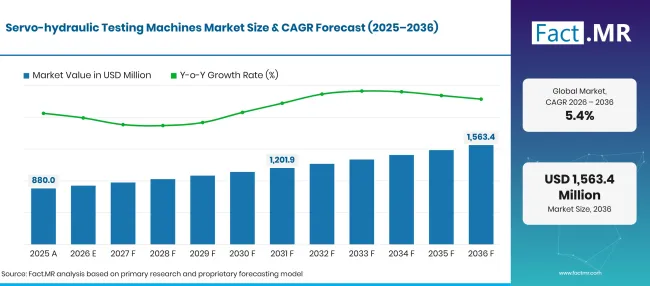
Servo Hydraulic Testing Machines Market Forecast Global | Source: Fact.MR
Category
| Category | Segments |
|---|---|
| Test Type | Fatigue and dynamic testing, Static tension and compression testing, Structural and component testing, Impact and high-rate testing |
| Load Capacity | 25 to 100 kN, Up to 25 kN, 100 to 500 kN, Above 500 kN |
| End Use | Automotive and transport, Aerospace and defence, Metals and materials research, Construction materials and civil engineering, Medical devices and biomechanics |
| Axis Configuration | Single-axis systems, Axial-torsional systems, Multi-axis systems, Custom reaction-frame systems |
| Key Countries | India; China; South Korea; France; Germany |
Source: Fact.MR analysis. Updated Nov 27, 2026
Segmental Analysis
What makes fatigue and dynamic testing the leading test type segment in the Servo-hydraulic Testing Machines Market?
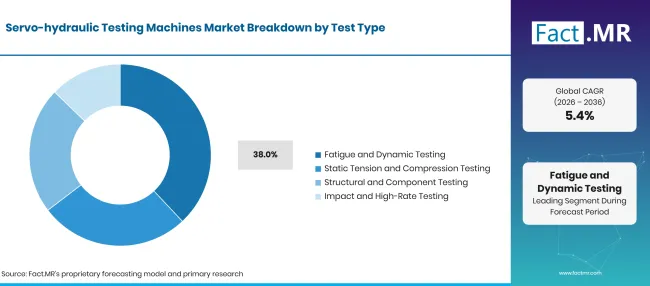
Servo Hydraulic Testing Machines Market Breakdown Test Type | Source: Fact.MR
Fatigue and dynamic testing accounts for 38.0% of market revenue in 2026, valued at approximately USD 351.1 million. Automotive, aerospace and materials laboratories use repeated loading cycles to examine component durability and fatigue resistance. Servo-hydraulic machines provide controlled force and displacement during testing, helping engineers evaluate material behavior under changing mechanical loads.
Which factors support 25 to 100 kN as the largest load capacity segment in the Servo-hydraulic Testing Machines Market?
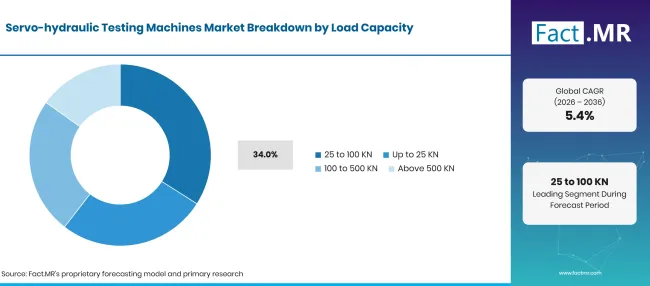
Servo Hydraulic Testing Machines Market Breakdown Load Capacity | Source: Fact.MR
The 25 to 100 kN load capacity segment represents 34.0% of market revenue in 2026, equivalent to approximately USD 314.2 million. This force range accommodates fatigue testing of engineered materials, automotive components and selected biomedical devices. ZwickRoell offers compact servo-hydraulic systems with 25, 50 and 100 kN force capacities for laboratory applications.
What makes automotive and transport the leading end use segment in the Servo-hydraulic Testing Machines Market?
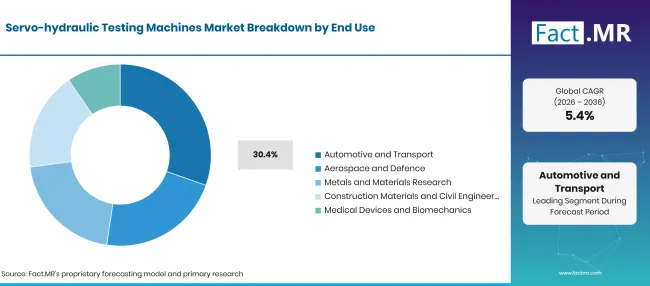
Servo Hydraulic Testing Machines Market Breakdown End Use | Source: Fact.MR
Automotive and transport applications contribute 30.4% of market revenue in 2026, reaching approximately USD 280.9 million. Vehicle manufacturers conduct durability tests on suspension components, chassis assemblies and mechanical joints to assess performance under repeated stress. Servo-hydraulic testing systems reproduce controlled loading conditions, supporting component validation and material selection during vehicle development.
Which factors support single-axis systems as the largest axis configuration segment in the Servo-hydraulic Testing Machines Market?
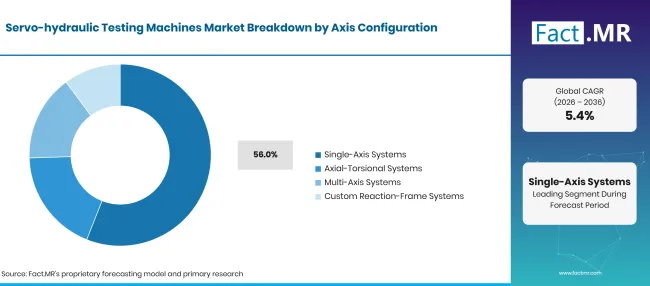
Servo Hydraulic Testing Machines Market Breakdown Axis Configuration | Source: Fact.MR
Single-axis systems hold 56.0% of market revenue in 2026, valued at approximately USD 517.4 million. Their ability to apply controlled tensile or compressive forces along one direction makes them suitable for standardized fatigue and mechanical testing. Laboratories can use interchangeable fixtures and adjustable loading conditions to examine different specimens without requiring complex multi-axis arrangements.
Servo-hydraulic Testing Machines Market- Drivers, Restraints & Trends
Drivers
Increasing fatigue and component durability testing supports demand for controlled loading systems. Automotive, aerospace and materials manufacturers use servo-hydraulic machines to evaluate mechanical performance under repeated stress. These systems reproduce controlled loading conditions, helping engineers assess fatigue life, structural integrity and component reliability during product development.
Restraints
High equipment costs and maintenance requirements influence laboratory investment decisions. Servo-hydraulic testing machines require hydraulic power units, specialized maintenance and suitable laboratory infrastructure. Equipment purchase costs, operating expenses and competition from electrodynamic testing systems can affect purchasing decisions, particularly among laboratories with limited budgets.
Trend
Application-specific actuation systems support diverse mechanical testing requirements. Laboratories increasingly evaluate hydraulic, electrodynamic and servo-electric systems according to force capacity, testing frequency and specimen characteristics. Instron offers configurable servo-hydraulic testing systems with different hydraulic power units, allowing users to match equipment capabilities with specific testing procedures.
Trend
Advanced fatigue testing equipment supports repeated loading and material durability evaluation. Servo-hydraulic load frames accommodate cyclic tension, compression and fatigue testing across different force ranges. ZwickRoell offers testing systems with high frame stiffness and controlled hydraulic actuation, supporting mechanical evaluation of automotive components, metals and engineered materials.
Servo-hydraulic Testing Machines Market Analysis by Key Country
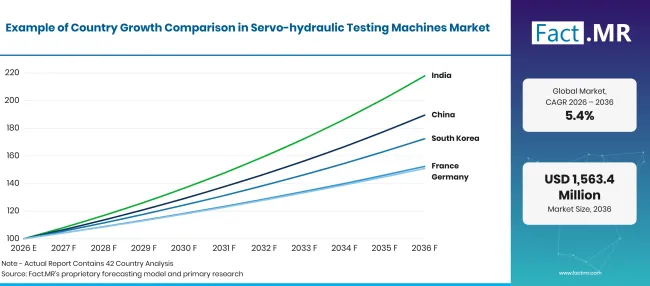
Servo Hydraulic Testing Machines Market Growth Index | Source: Fact.MR
| Country | CAGR (2026-2036) |
|---|---|
| India | 8.1% |
| China | 6.6% |
| South Korea | 5.6% |
| France | 4.3% |
| Germany | 4.2% |
Source: Fact.MR analysis.
Why is India the fastest-growing market for servo-hydraulic testing machines?
India's servo-hydraulic testing machines market is forecast to expand at a CAGR of 8.1% between 2026 and 2036.
Investment in automotive research, electric vehicle development and component certification is creating opportunities for mechanical testing equipment. In September 2026, the Ministry of Heavy Industries reported that the Global Automotive Research Centre was upgrading its testing infrastructure under the PM E-DRIVE scheme. Its facilities cover fatigue, vehicle safety and component evaluation. These developments could encourage automotive laboratories and component manufacturers to purchase advanced hydraulic testing systems for durability assessment.
How is demand for servo-hydraulic testing machines developing in China?
China's servo-hydraulic testing machines market is anticipated to register a 6.6% CAGR through 2036.
Large-scale vehicle manufacturing creates substantial requirements for material strength, fatigue resistance and structural component evaluation. According to the China Association of Automobile Manufacturers, domestic automobile production reached 34.531 million units in 2025, increasing 10.4% from 2024. Automotive suppliers use controlled mechanical loading to examine suspension assemblies, metal components and other engineered parts. Continued vehicle development and manufacturing activity could support purchases of servo-hydraulic testing equipment across China's automotive research and industrial testing facilities.
What is driving servo-hydraulic testing machines demand in South Korea?
South Korea's market for servo-hydraulic testing machines is set to grow at a CAGR of 5.6% during 2026 to 2036.
Automotive engineering and advanced vehicle development create requirements for accurate fatigue and durability evaluation. In 2026, the Ministry of Trade, Industry and Resources announced KRW 464.5 billion in investment support for the country's automotive industry. Research involving next-generation vehicles requires mechanical testing of structural materials, chassis components and assemblies. Such development programs could encourage testing laboratories to invest in specialized hydraulic loading systems and improved measurement equipment.
What is shaping servo-hydraulic testing machines demand in France?
France's servo-hydraulic testing machines market is forecast to grow at a CAGR of 4.3% through 2036.
Aerospace engineering provides important applications for high-force structural testing and repeated loading evaluations. The French Aerospace Industries Association reported that industry order intake reached EUR 88.6 billion in 2025, reflecting continued activity across civil aviation and defence programs. Aircraft manufacturers and component suppliers require fatigue testing to assess structural performance under changing loads. Investment in aerospace development and material qualification could sustain demand for specialized servo-hydraulic testing machines across French engineering laboratories.
Why is growth slower for servo-hydraulic testing machines in Germany?
Germany's servo-hydraulic testing machines market is projected to record a 4.2% CAGR between 2026 and 2036.
Established engineering laboratories and cautious industrial investment influence equipment replacement decisions. According to the German Machine Tool Builders' Association, domestic machine tool production declined 8% to EUR 13.6 billion in 2025. Manufacturers are increasingly focused on equipment servicing, modernization and operating efficiency. Testing laboratories may prioritize upgrading control electronics, hydraulic components and measurement systems before purchasing complete machines. Demand remains linked to automotive engineering, industrial materials evaluation and specialized mechanical testing applications.
Competitive Landscape for Servo-hydraulic Testing Machines Market
Competition in the servo-hydraulic testing machines market revolves around loading accuracy, fatigue testing capabilities, controller technology and flexibility across material testing applications. MTS Systems offers Landmark servo-hydraulic systems with FlexTest controllers for structural durability and fatigue evaluation, particularly in automotive engineering. Instron supplies hydraulic testing equipment with configurable force capacities and advanced control electronics. Its Labtronic EVO controller, introduced in August 2026, supports modular configurations and compatibility with existing testing infrastructure.
ZwickRoell differentiates its HA, HB and HC machine series through actuator positioning, frame stiffness and specialized fatigue testing software. Shimadzu serves materials laboratories with its EHF series for dynamic loading and endurance testing. Equipment suppliers also compete through calibration services, software upgrades, technical assistance and long-term maintenance arrangements, influencing purchasing decisions among research institutions and industrial testing facilities.
Recent Developments
- In July 2026, Shimadzu completed its USD 711 million acquisition of TESCAN, a Czech electron microscope manufacturer. The purchase expanded Shimadzu's material analysis business and added advanced imaging technology to its laboratory equipment portfolio.
- In April 2025, Shimadzu merged Alsachim and Biomaneo into Shimadzu Chemistry and Diagnostics in France. The merger brought laboratory reagents and diagnostic technologies together, helping the company improve product development and customer services.
Key Players in Servo-hydraulic Testing Machines Market
Key companies operating in the market include MTS Systems, Instron, ZwickRoell, and Shimadzu.
- MTS Systems
- Instron
- ZwickRoell
- Shimadzu
Bibliography
- German Aerospace Industries Association. (2026, May 11). 2025 results: The French aerospace industry remains strongly positioned for the future.
- German Machine Tool Builders’ Association. (2026, January 19). German machine tool industry focuses on diversification and technological leadership.
- Instron. (2026, August 28). Instron launches Labtronic EVO—a modular controller platform for servohydraulic testing systems.
- International Organization for Standardization. (2025). ISO 23296:2025—Metallic materials—Fatigue testing—Force controlled thermo-mechanical fatigue testing method.
- International Organization for Standardization. (2026). ISO 1099:2026—Metallic materials—Fatigue testing—Axial force-controlled method.
- Ministry of Heavy Industries, Government of India. (2026, September 28). GARC advances automotive testing under PM E-DRIVE.
- Ministry of Trade, Industry and Resources, Republic of Korea. (2026, February 5). Government to invest KRW 464.5 billion in the automotive industry in 2026.
- Shimadzu Corporation. (2025, April 3). Integration of two European group companies to strengthen analytical and measurement reagent business.
- Shimadzu Corporation. (2026, July 10). Shimadzu acquires Czech-based TESCAN as a wholly owned subsidiary.
- Shimadzu Corporation. (2025). Shimadzu analytical and measuring instruments 2025: Fatigue testing machines.
- ZwickRoell. (2026, January). Getzner Werkstoffe GmbH uses HA 160 to test vibration isolation.
Segmentation
Scope of Report
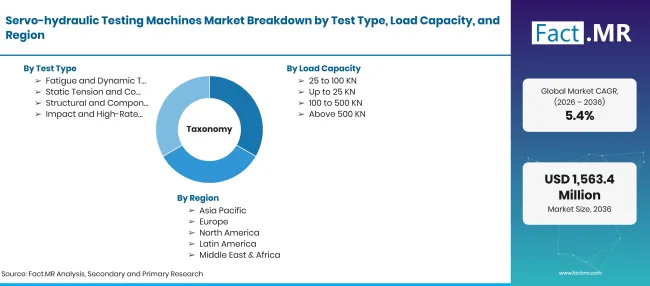
Servo Hydraulic Testing Machines Market Taxonomy | Source: Fact.MR
| Items | Values |
|---|---|
| Quantitative Units (2026) | USD 924.0 Million |
| Test Type | Fatigue and dynamic testing, Static tension and compression testing, Structural and component testing, Impact and high-rate testing |
| Load Capacity | 25 to 100 kN, Up to 25 kN, 100 to 500 kN, Above 500 kN |
| End Use | Automotive and transport, Aerospace and defence, Metals and materials research, Construction materials and civil engineering, Medical devices and biomechanics |
| Axis Configuration | Single-axis systems, Axial-torsional systems, Multi-axis systems, Custom reaction-frame systems |
| Regions Covered | North America, Latin America, Europe, Asia Pacific, Middle East & Africa |
| Countries Covered | India, China, South Korea, France, Germany, and other countries |
| Key Companies Profiled | MTS Systems, Instron, ZwickRoell, Shimadzu |
| Additional Attributes | Dollar revenue in the Servo-hydraulic Testing Machines Market is segmented by test type, load capacity, end use and axis configuration and region. |
Source: Fact.MR analysis. Updated Nov 27, 2026
Servo-hydraulic Testing Machines Market by Segments
-
Test Type
- Fatigue and dynamic testing
- Static tension and compression testing
- Structural and component testing
- Impact and high-rate testing
-
Load Capacity
- 25 to 100 kN
- Up to 25 kN
- 100 to 500 kN
- Above 500 kN
-
End Use
- Automotive and transport
- Aerospace and defence
- Metals and materials research
- Construction materials and civil engineering
- Medical devices and biomechanics
-
Axis Configuration
- Single-axis systems
- Axial-torsional systems
- Multi-axis systems
- Custom reaction-frame systems
-
Region:
- North America
- United States
- Canada
- Mexico
- Europe
- Germany
- United Kingdom
- France
- Italy
- Spain
- Rest of Europe
- Asia Pacific
- China
- India
- Japan
- South Korea
- Australia and New Zealand
- Rest of Asia Pacific
- Latin America
- Brazil
- Argentina
- Rest of Latin America
- Middle East & Africa
- GCC Countries
- South Africa
- Rest of Middle East & Africa
- North America
Table of Contents
Key Takeaways
- Market Size and CAGR
- Top Growth Driver
- Fastest Growing Segment
- Leading Region
- Key Companies
- Emerging Opportunities

