
- Market Value (2025): USD 740.0 Mn
- Estimated Value (2026): USD 806.6 Mn
- Forecast Value (2036): USD 1998.9 Mn
- CAGR (2026-2036): 9.5%
Flexible Ceramics Market Forecast and Outlook 2026 to 2036
According to the Fact.MR analysis, the flexible ceramic market crossed a valuation of USD 740.0 million in 2025 and is projected to grow from USD 806.6 million in 2026 to USD 1998.9 million by 2036. Demand for flexible ceramics is likely to grow at a CAGR of 9.5% over the forecast period.
Demand for flexible ceramics is rising as builders, industrial users and electronics makers look for ceramic surfaces and insulation that bend, cut and fit easily. Suppliers are offering soft ceramic cladding, fabrics, thin films and substrates, papers and felts, and thermal blankets based on alumina, silica, alumino-silicate and zirconia.
Key Takeaways from the Flexible Ceramics Market
- Flexible Ceramics Market Value (2025): USD 740.0 million
- Flexible Ceramics Market Value (2026): USD 806.6 million
- Flexible Ceramics Market Forecast Value (2036): USD 1998.9 million
- Flexible Ceramics Market Forecast CAGR (2026-2036): 9.5%
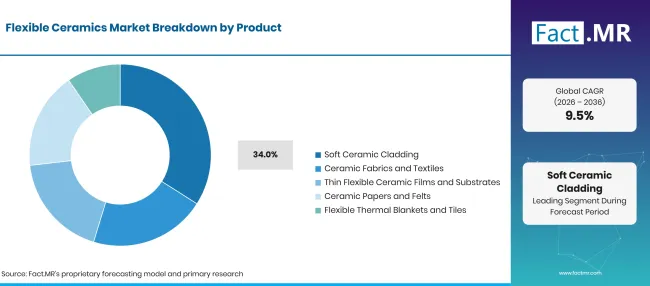
- Leading Product: Soft ceramic cladding (34.0%)
- Key Market Participants: Alkegen (Unifrax), Morgan Advanced Materials, 3M, Kyocera, Saint-Gobain
- Key Growth Countries: India, China, South Korea, United States, United Kingdom
Growth in building facades and interiors, high-temperature industrial insulation and battery and electronics uses is expected to support rapid growth, with construction remaining the largest user. Demand for advanced insulation materials is expected to accelerate as construction, industrial manufacturing and emerging technology applications expand. Building facades and interior insulation remain major consumption areas, supported by increasing requirements for thermal efficiency, fire resistance and energy conservation. According to the United Nations Environment Programme's Global Status Report for Buildings and Construction 2025–2026, global building floor area reached 273 billion square metres in 2024, increasing 1.7% year on year, while buildings accounted for 28% of global energy consumption. Additionally, growing battery manufacturing, electronics production and high-temperature industrial processing are creating opportunities for specialized insulation materials with superior thermal and electrical performance.
Flexible Ceramics Market
| Metric | Value |
|---|---|
| Estimated Value in (2026) | USD 806.6 million |
| Forecast Value in (2036) | USD 1998.9 million |
| Forecast CAGR (2026 to 2036) | 9.5% |
Source: Fact.MR analysis.
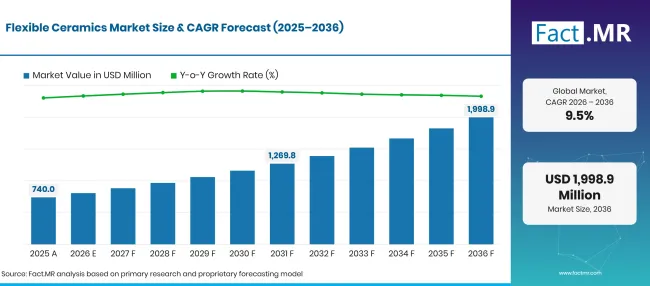
Flexible Ceramics Market Forecast Global | Source: Fact.MR
Category
| Category | Segments |
|---|---|
| Product | Soft ceramic cladding, Ceramic fabrics and textiles, Thin flexible ceramic films and substrates, Ceramic papers and felts, Flexible thermal blankets and tiles |
| Material | Alumina, Silica, Alumino-silicate, Modified clay and cement, Zirconia |
| Application | Building facades and interiors, Thermal insulation and furnaces, Electronics and energy storage, Aerospace and defence, Automotive |
| End User | Construction, Industrial manufacturing, Electronics and semiconductors, Aerospace and defence, Energy |
| Region | India; China; South Korea; United States; United Kingdom |
Source: Fact.MR analysis.
Segmental Analysis
What is driving sales of soft ceramic cladding in the Flexible Ceramics Market?
Flexible Ceramics Market Breakdown Product | Source: Fact.MR
Sales of soft ceramic cladding to capture 34.0% of market revenue in 2026, about USD 274.2 million, supported by demand for lightweight decorative surfaces across building facades and interior walls. The US Census Bureau reported that total construction spending reached an annualized rate of USD 2,186.1 billion in September 2026, with nonresidential construction accounting for USD 790.6 billion. This substantial construction activity creates opportunities for flexible surface materials that offer decorative finishes without the weight and installation requirements of conventional rigid tiles. Curved architectural surfaces and renovation projects further support interest in bendable ceramic cladding solutions.
Which material characteristics are strengthening alumina demand in flexible ceramics?
Flexible Ceramics Market Breakdown Material | Source: Fact.MR
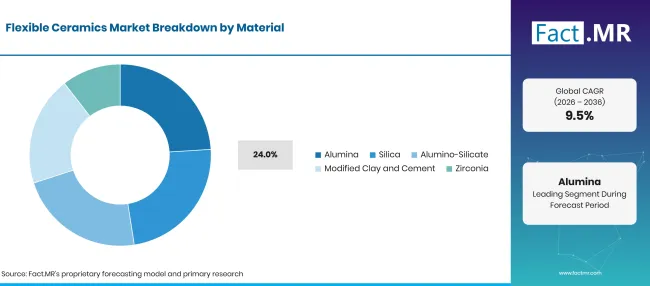
Demand for alumina-based flexible ceramics represents 24.0% of market revenue in 2026, about USD 193.6 million, reflecting alumina's thermal stability, mechanical strength and suitability for demanding industrial applications. According to the US Geological Survey's Mineral Commodity Summaries 2026, US alumina production reached an estimated 710,000 metric tonnes in 2025, compared with 700,000 tonnes in 2024. The report also estimates apparent alumina consumption at 2.5 million tonnes in 2025, compared with 1.9 million tonnes in 2024. Alumina's established industrial supply base and use in ceramics, refractories and electronics support its relevance as a material for flexible ceramic technologies.
How are building facade and interior projects influencing flexible ceramics adoption?
Flexible Ceramics Market Breakdown Application | Source: Fact.MR
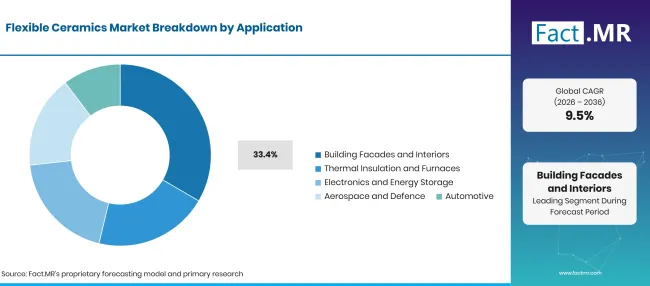
Adoption of flexible ceramics in building facades and interiors holds 33.4% of market revenue in 2026, about USD 269.4 million, as architects and developers seek lightweight materials for decorative walls, curved surfaces and renovation projects. India's Ministry of Statistics and Programme Implementation reported in April 2026 that about 98.54 lakh households had undertaken construction for their own use during the study's reference period. The same government study identified 10.27 lakh unincorporated construction agencies operating in the sector. This extensive construction activity creates potential opportunities for flexible ceramic sheets, particularly in interior finishing, decorative cladding and building improvement applications.
Which construction activities are supporting flexible ceramics sales among end users?
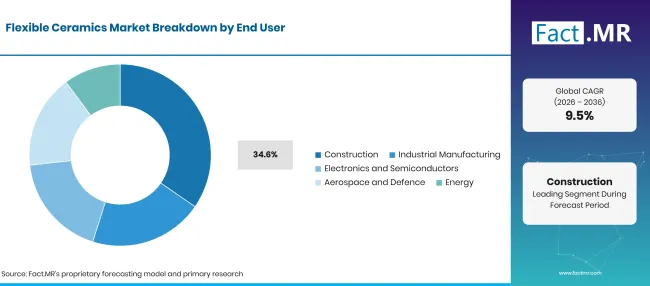
Flexible Ceramics Market Breakdown End User | Source: Fact.MR
Sales to the construction industry account for 34.6% of flexible ceramics market revenue in 2026, about USD 279.1 million, supported by requirements for lightweight cladding, heat-resistant surfaces and adaptable architectural materials. The US Census Bureau reported that nonresidential construction spending reached an annualized rate of USD 790.6 billion in September 2026, increasing 1.1% from August. Meanwhile, the Indian government allocated ₹12.22 lakh crore for infrastructure capital expenditure in the Union Budget 2026–27, highlighting continued investment in infrastructure development. These construction and infrastructure activities create opportunities for flexible ceramic materials across commercial buildings, industrial facilities and architectural installations.
Flexible Ceramics Market-Drivers, Restraints & Trends
Drivers: Growing Demand for Lightweight and Adaptable Ceramic Materials
Demand for flexible ceramics is gaining momentum as construction companies, electronics manufacturers and industrial users seek materials combining low weight, thermal resistance and design flexibility. In building applications, thinner ceramic finishes offer opportunities for curved surfaces, lightweight facades and renovation projects, while technical ceramic materials support applications requiring heat resistance and dimensional stability. India's Ministry of Statistics and Programme Implementation reported that construction activity grew 7.4% in FY 2025-26, while manufacturing expanded 7.6% year-on-year in September 2026. Additionally, the Annual Survey of Industries released in November 2026 recorded 9.28% growth in manufacturing corporate-sector gross value added, indicating expanding industrial activity.
Restraints: High Manufacturing Costs and Material Qualification Requirements
Sales of flexible ceramics can be constrained by relatively high manufacturing costs, limited commercial production capacity and lengthy qualification procedures. Specialized ceramic formulations, precision processing, thermal treatment and quality-control requirements can increase production expenses compared with conventional ceramic tiles and insulation materials. New materials also require performance validation for thermal stability, mechanical strength, durability and compatibility with existing construction or industrial systems. India's Bureau of Energy Efficiency published its 2024-25 industrial energy statistics in 2026, estimating annual energy consumption of 80 million tonnes of oil equivalent (Mtoe) for iron and steel and 34.15 Mtoe for cement. Such energy-intensive manufacturing environments highlight the importance of controlling processing costs, particularly when scaling specialized ceramic production.
Opportunity: Lightweight Ceramic Cladding for Building Facades
Lightweight ceramic cladding offers manufacturers an opportunity to address demand for modern facade systems, curved architectural surfaces and building renovation projects. Flexible ceramic finishes can provide an alternative to heavier conventional stone and tile installations where reduced structural loading and easier surface adaptation are important. India's Ministry of Statistics and Programme Implementation reported 7.4% growth in construction activity during FY 2025-26, supported by infrastructure development and continued building investment. The government's industrial and electronics manufacturing programmes also create opportunities for advanced ceramic components. In November 2026, the Ministry of Electronics and Information Technology approved specialty ceramic manufacturing under its Electronics Components Manufacturing Scheme, including an investment-linked project expected to strengthen domestic specialty ceramic production.
Trend: Increasing Use of Ceramic Fibers and Papers for High-Temperature Insulation
Adoption of ceramic fibers, flexible ceramic papers and related insulation materials is gaining attention among industrial operators seeking lightweight thermal protection and improved heat-management performance. These materials are relevant to furnaces, kilns, glass manufacturing, steel processing and other applications involving elevated operating temperatures. India's Bureau of Energy Efficiency estimated that iron and steel industries consumed 80 Mtoe of energy annually in FY 2024-25, while cement manufacturing accounted for another 34.15 Mtoe. The same government assessment identified 1.90 Mtoe of energy consumption in the glass industry. These substantial energy requirements reinforce the commercial importance of thermal management, insulation efficiency and reduced heat loss across energy-intensive industrial operations.
Flexible Ceramics Market Analysis by Key Country
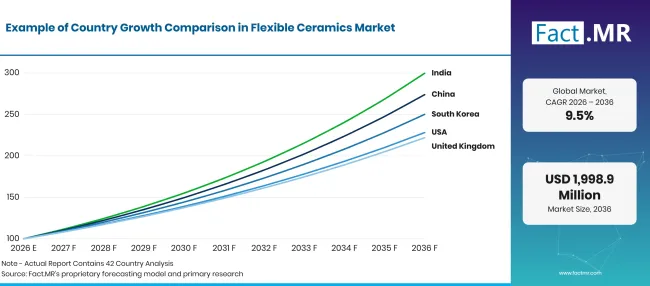
Flexible Ceramics Market Growth Index | Source: Fact.MR
| Country | CAGR (2026-2036) |
|---|---|
| India | 11.6% |
| China | 10.6% |
| South Korea | 9.6% |
| United States | 8.6% |
| United Kingdom | 8.3% |
Source: Fact.MR analysis.
What is accelerating flexible ceramics demand and sales in India?
Demand for flexible ceramics in India is projected to increase at an 11.6% CAGR through 2036, the fastest among the five profiled countries.
Expanding construction activity, industrial manufacturing and investment in electronics production are creating opportunities for lightweight ceramic finishes and advanced thermal materials. According to India's Ministry of Statistics and Programme Implementation, industrial production increased 6.7% year-on-year in September 2026, while manufacturing output grew 7.6%. Infrastructure and construction goods production also increased 7.2% during the month. These developments support potential demand for flexible ceramic cladding, technical ceramics and heat-resistant materials across expanding industrial and construction applications.
Which industrial developments are strengthening flexible ceramics sales in China?
Sales of flexible ceramics in China are forecast to grow at a 10.6% CAGR through 2036, exceeding the global rate of 9.5%.
The country's extensive manufacturing base, established ceramics industry and electronics production ecosystem support demand for advanced ceramic materials used in insulation, facades and industrial components. China's National Bureau of Statistics reported that manufacturing value added increased 5.9% year-on-year in the third quarter of 2026, while industrial value added grew 5.2%. However, construction value added declined 4.4% during the quarter, indicating uneven demand across end-use industries. Manufacturing expansion remains an important supporting factor for specialty ceramic suppliers.
How are semiconductor and battery investments influencing flexible ceramics adoption in South Korea?
Adoption of flexible ceramics in South Korea is projected to increase at a 9.6% CAGR through 2036, slightly exceeding the global rate of 9.5%.
Semiconductor fabrication, battery manufacturing and advanced display production are creating opportunities for ceramic materials used in thermal management, electrical insulation and precision industrial components. South Korea's Ministry of Trade, Industry and Resources reported that semiconductor exports reached USD 60.30 billion in September 2026, increasing 262.8% year-on-year. Total exports during January to September 2026 reached USD 814.5 billion. Strong semiconductor trade performance supports continued investment in advanced manufacturing and specialty ceramic materials.
What is sustaining flexible ceramics demand across the United States?
Demand for flexible ceramics in the United States is expected to expand at an 8.6% CAGR through 2036, below the global rate of 9.5%.
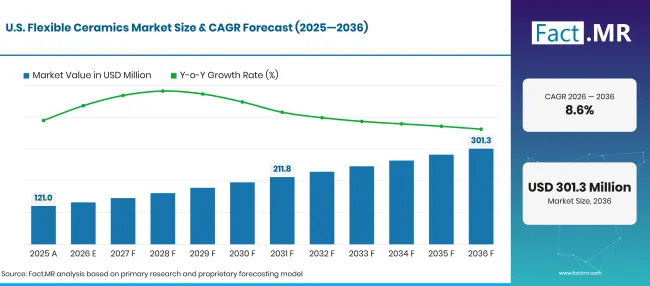
Flexible Ceramics Market Forecast Usa | Source: Fact.MR
Aerospace engineering, defence equipment, electronics manufacturing and energy-related research support purchases of advanced ceramics for thermal protection, insulation and specialized industrial components. According to the US Federal Reserve, industrial production increased 0.7% in September 2026, while manufacturing output advanced 0.3%. Production of defence and space equipment also increased 0.4%, and construction supplies recorded 1.0% growth. These developments indicate continued industrial requirements for materials offering thermal resistance, durability and lightweight performance.
Which factors are influencing flexible ceramics sales growth in the United Kingdom?
Sales of flexible ceramics in the United Kingdom are forecast to grow at an 8.3% CAGR through 2036, the slowest among the five profiled countries.
Aerospace engineering, defence manufacturing, electronics production and specialist industrial applications provide opportunities for advanced ceramic materials, although comparatively moderate construction activity limits some facade-related opportunities. According to the UK's Office for National Statistics, manufacturing output increased 0.9% in the third quarter of 2026, while computer, electronic and optical products manufacturing grew 4.6%. Construction output, however, declined 0.7% during the same quarter. Expanding electronics production and specialist manufacturing provide important support for future technical ceramic adoption.
Competitive Landscape for Flexible Ceramics Market
The flexible ceramic market is moderately concentrated, with Alkegen (Unifrax), Morgan Advanced Materials, 3M, Kyocera and Saint-Gobain together hold about 50% of 2026 revenue, based on Fact.MR estimates. Competition centers on material performance, thickness and flexibility, cost and qualification with end users. Advanced-ceramics groups lead, with fiber and insulation specialists and fast-growing Asian makers competing.
Recent Developments
- On September 3, 2026, Alkegen announced that the US Bankruptcy Court confirmed its Chapter 11 Plan of Reorganization, marking a significant development in its financial restructuring. The plan eliminates approximately USD 3.1 billion in debt and places the company under the ownership of institutional investors. Alkegen confirmed that it would continue operating its global manufacturing facilities and serving customers during the restructuring. The development is relevant to the flexible ceramics competitive landscape because Alkegen manufactures refractory ceramic fibers, polycrystalline wool, aerogel composites and micro-fine glass materials used in high-temperature insulation and industrial applications.
- On June 2, 2025, Morgan Advanced Materials announced the completion of its first real-time ceramic sintering research project, conducted with Diamond Light Source in the United Kingdom. The research used high-temperature X-ray diffraction to examine the behaviour of alumina ceramics during the sintering process. The investigation identified a previously unobserved material phase and provided additional understanding of firing-temperature limits. The findings are expected to help Morgan optimize ceramic manufacturing processes without compromising material performance.
- On August 24, 2026, 3M and BOE announced the opening of a joint research laboratory at the BOE Technology Innovation Center in China. The collaboration focuses on advanced display materials, including optical films, optically clear adhesives and structural adhesives. The research programme covers LCD, OLED and MLED technologies, with an emphasis on improving optical efficiency, foldable displays and ultra-narrow bezel processes. The companies intend to accelerate the development and commercialization of advanced material solutions through shared research facilities, testing resources and technical expertise.
- On April 27, 2026, Kyocera announced the commercialization of a new multilayer ceramic core substrate for advanced semiconductor packages, including xPUs and switch ASICs. The product uses the company's proprietary fine ceramic materials and is designed to provide greater rigidity, high-density wiring and reduced warpage in large semiconductor packages. The technology supports circuit miniaturization and higher-performance packaging requirements for AI data centres. Kyocera planned to showcase the new substrate at the Electronic Components and Technology Conference (ECTC) 2026 in Orlando, Florida. This is a direct advanced ceramic product development, although it targets semiconductor packaging rather than flexible ceramic cladding.
- On March 19, 2026, Kyocera announced progress in developing ceramic hermetic sealing technologies for liquid hydrogen applications. The development addresses the requirements of sealing systems used in demanding cryogenic environments. Ceramic materials are important in these applications because of their insulation, chemical stability and sealing characteristics. This development highlights Kyocera's continued focus on advanced ceramic engineering for next-generation energy infrastructure.
Key Players in Flexible Ceramics Market
Key companies operating in the market include Alkegen (Unifrax), Morgan Advanced Materials, 3M, Kyocera, and Saint-Gobain.
- Alkegen (Unifrax)
- Morgan Advanced Materials
- 3M
- Kyocera
- Saint-Gobain
Bibliography
- 3M. (2026). 3M and BOE launch joint laboratory to accelerate display technology innovation [Press release].
- Bureau of Energy Efficiency. (n.d.). Industry energy consumption statistics [PDF]. Government of India.
- Kyocera. (2026). Kyocera announces multilayer ceramic core substrate [Press release].
- Ministry of Statistics and Programme Implementation. (2026, October 28). Quick estimates of Index of Industrial Production and use based index for the month of September 2026 [PDF]. Government of India.
- Ministry of Statistics and Programme Implementation. (2026, November 3). Annual survey of industries 2024–25 [PDF]. Government of India.
- Ministry of Statistics and Programme Implementation. (2026). Press note on GDP estimates for Q4 2025–26 and provisional estimates for FY 2025–26 [PDF]. Government of India.
- Morgan Advanced Materials. (n.d.). Morgan conducts first real time ceramic sintering research [Press release].
- Press Information Bureau. (2026, November 4). Semicon 2.0 web application portal launched and approved applicants under ECMS announced. Government of India. o
- U.S. Census Bureau. (2026, November 2). Monthly construction spending: September 2026. U.S. Department
- U.S. Geological Survey. (2026, February 6). Mineral commodity summaries 2026 [PDF]. U.S. Department of the Interior.
- U.S. Geological Survey. (2026, February 6). Mineral commodity summaries 2026.
Segmentation
Scope of Report
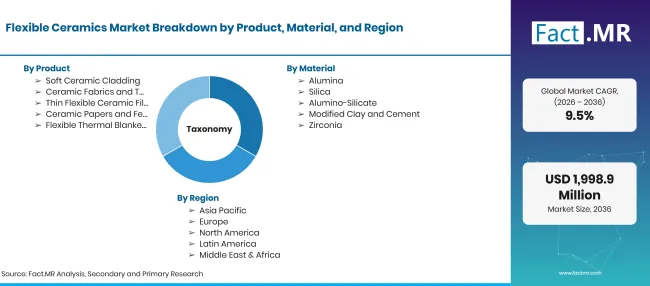
Flexible Ceramics Market Taxonomy | Source: Fact.MR
| Items | Values |
|---|---|
| Quantitative Units (2026) | USD 806.6 Million |
| Product | Soft ceramic cladding, Ceramic fabrics and textiles, Thin flexible ceramic films and substrates, Ceramic papers and felts, Flexible thermal blankets and tiles |
| Material | Alumina, Silica, Alumino-silicate, Modified clay and cement, Zirconia |
| Application | Building facades and interiors, Thermal insulation and furnaces, Electronics and energy storage, Aerospace and defence, Automotive |
| End User | Construction, Industrial manufacturing, Electronics and semiconductors, Aerospace and defence, Energy |
| Regions Covered | North America, Latin America, Europe, Asia Pacific, Middle East & Africa |
| Countries Covered | India, China, South Korea, United States, United Kingdom, and other countries |
| Key Companies Profiled | Alkegen (Unifrax), Morgan Advanced Materials, 3M, Kyocera, Saint-Gobain |
| Additional Attributes | Dollar revenue in the Flexible Ceramics Market is segmented by product, material, application and end user and region. |
Source: Fact.MR analysis.
Flexible Ceramics Market by Segments
-
Product
- Soft ceramic cladding
- Ceramic fabrics and textiles
- Thin flexible ceramic films and substrates
- Ceramic papers and felts
- Flexible thermal blankets and tiles
-
Material
- Alumina
- Silica
- Alumino-silicate
- Modified clay and cement
- Zirconia
-
Application
- Building facades and interiors
- Thermal insulation and furnaces
- Electronics and energy storage
- Aerospace and defence
- Automotive
-
End User
- Construction
- Industrial manufacturing
- Electronics and semiconductors
- Aerospace and defence
- Energy
-
Region:
- North America
- United States
- Canada
- Mexico
- Europe
- Germany
- United Kingdom
- France
- Italy
- Spain
- Rest of Europe
- Asia Pacific
- China
- India
- Japan
- South Korea
- Australia and New Zealand
- Rest of Asia Pacific
- Latin America
- Brazil
- Argentina
- Rest of Latin America
- Middle East & Africa
- GCC Countries
- South Africa
- Rest of Middle East & Africa
- North America
Table of Contents
Key Takeaways
- Market Size and CAGR
- Top Growth Driver
- Fastest Growing Segment
- Leading Region
- Key Companies
- Emerging Opportunities

