The Automotive Interior Polypropylene Laminates Market is analyzed across its key product, application and end-use segments, with regional trends and demand outlook, forecast 2026 to 2036.
By Fact.MR Automotive DeskLead analyst:
Shubham PatidarPublished :
Updated :
11 min read
Fact-checked under the Fact.MR editorial process
Automotive Interior Polypropylene Laminates Market Forecast and Outlook 2026 to 2036
The global market for automotive interior polypropylene laminates is projected to advance from USD 4.15 billion in 2026 to USD 10.12 billion by 2036, growing at a 9.2% CAGR, driven by the critical need to balance aesthetic sophistication, tactile quality, and cost efficiency in modern vehicle cabins. This market centers on the fusion of polypropylene substrates with decorative and functional surface layers, creating materials that deliver the perceived value of soft-touch surfaces, woodgrain, or metallic finishes without the weight and expense of traditional materials like leather or solid plastics.
Summary of Automotive Interior Polypropylene Laminates Market
Market Snapshot
Global automotive interior polypropylene laminates market revenue stood at USD 4.15 billion in 2026 and is forecast to reach USD 10.12 billion by 2036.
At a 9.2% CAGR from 2026 to 2036, this market is set to expand ~2.4x in value, adding USD 5.86 billion in absolute opportunity.
Growth is being driven by increasing demand for premium automotive interiors combined with cost-efficient materials, where polypropylene laminates offer a balance of aesthetics, durability, and affordability.
These laminates are evolving into multi-functional interior materials, enabling soft-touch finishes, decorative surfaces, and lightweight structural performance across vehicle cabins.
Demand and Growth Drivers
Rising consumer expectations for premium interior design and tactile quality across all vehicle segments is accelerating adoption.
Increasing pressure on OEMs to reduce vehicle weight and control bill-of-material costs, especially in electric vehicles, is driving the shift toward polypropylene laminates.
Growing use of lightweight polymer materials in automotive interiors is reinforcing demand for advanced laminate solutions.
Expansion of electric vehicle production and interior differentiation strategies is further supporting market growth.
Advancements in recycled polypropylene and bio-based laminate technologies are enabling sustainability-focused innovation.
Product and Segment View
PVC-based PP laminates hold 34% of laminate type share in 2026,emergingas the leading segment due to their flexibility, durability, and cost-performance balance.
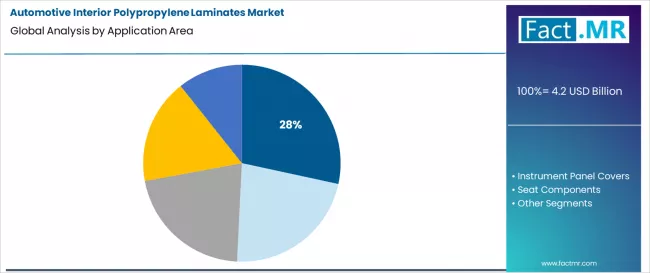
Door panels account for 28% of application share in 2026, positioning this as the dominant segment due to high wear exposure and design importance.
Passenger carsrepresent54% of vehicle type share in 2026, reflecting the large-scale adoption of premium interior materials in this segment.
These laminates are widely used across:
Door panels
Instrument panels
Pillars and trims
Seat backs and consoles
Geography and Competitive Outlook
Asia Pacific, North America, and Europe represent the key growth regions, supported by strong automotive manufacturing ecosystems.
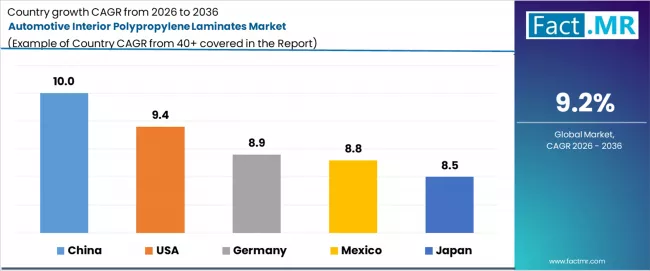
China (10.0% CAGR), United States (9.4%), Mexico (8.8%), Germany (8.9%), and Japan (8.5%) are key growth markets.
Market expansion is closely tied to automotive production trends, EV adoption, and increasing emphasis on interior differentiation.
Key companies active in this market include Adient plc, Lear Corporation,IntevaProducts, Faurecia, and Magna International.
Automotive Interior Polypropylene Laminates Market — At a Glance
Attribute
Details
Market Value 2026
USD 4.15 billion
Market Value 2036
USD 10.12 billion
Absolute Dollar Opportunity 2026-2036
USD 5.86 billion
Total Growth 2026-2036
141.2%
CAGR 2026-2036
9.2%
Growth Multiple
~2.4x
Key Demand Theme
Increasing demand for lightweight, cost-efficient, and premium-feel interior materials in automotive applications
Leading Segment by Laminate Type (2026)
PVC-Based PP Laminates
Segment Share (2026)
34%
Leading Segment by Application (2026)
Door Panels
Segment Share (2026)
28%
Leading Segment by Vehicle Type (2026)
Passenger Cars
Segment Share (2026)
54%
Key Growth Regions
Asia Pacific, North America, Europe
Country CAGRs
China 10.0%, USA 9.4%, Mexico 8.8%, Germany 8.9%, Japan 8.5%
Top Companies
Adient, Lear,Inteva, Faurecia, Magna
Segmentation by Laminate Type
PVC-Based PP Laminates, TPO Laminates, Others
Segmentation by Application
Door Panels, Instrument Panels, Pillars, Consoles, Others
Segmentation by Vehicle Type
Passenger Cars, Light Commercial Vehicles, Heavy Vehicles
Segmentation by Region
North America, Latin America, Western Europe, Eastern Europe, East Asia, South Asia & Pacific, MEA
Source: Fact.MR analysis. Updated Apr 2, 2026
Growth is propelled by rising consumer expectations for premium interiors across all vehicle segments and the concurrent OEM imperative to control bill-of-material costs, especially with the added cost pressure from vehicle electrification. PP laminates offer an optimal solution, providing excellent durability, scratch resistance, and design versatility for high-wear components like door panels and instrument panels. The evolution is marked by innovations in sustainable laminates using recycled PP content and bio-based vinyl layers. China's 10.00% CAGR underscores its role as the largest automotive production hub, where domestic suppliers are rapidly advancing laminate technologies to meet both local and global demand for value-engineered interior solutions. This market encapsulates the transformation of the cabin into a key brand differentiator, where material choice directly influences consumer perception and comfort.
North America, Latin America, Western Europe, Eastern Europe, East Asia, South Asia & Pacific, MEA
Source: Fact.MR analysis. Updated Apr 2, 2026
Segmental Analysis
By Laminate Type, Which Combination Dominates for Balance of Cost and Performance?
Automotive Interior Polypropylene Laminates Market Analysis By Laminate Type | Source: Fact.MR
PVC-based PP laminates lead the segment with a 34% share. This dominance is rooted in a decades-proven formula: a rigid, cost-effective polypropylene substrate bonded to a flexible polyvinyl chloride (PVC) skin.
This combination offers an unparalleled balance, providing designers with a vast array of colors, grains, and embossed textures in the PVC layer, while the PP backing ensures structural integrity, dimensional stability, and ease of thermoforming. The established supply chain and processing know-how for PVC/PP laminates make them the default choice for a wide range of interior applications, from mid-market to premium segments.
By Application Area, Which Component Drives High-Volume Material Consumption?
Automotive Interior Polypropylene Laminates Market Analysis By Application Area | Source: Fact.MR
Door panels represent the largest application area with a 28% share. As one of the largest and most visually prominent interior surfaces, door panels are a primary focus for enhancing cabin aesthetics and haptic feel.
They incorporate complex geometries for armrests, map pockets, and speaker grilles, making them ideal for laminate materials that can be deep-drawn without splitting or losing their finish. The high volume of door panels produced per vehicle makes this application the most significant driver for laminate innovation and volume consumption.
By Vehicle Type, Which Segment Prioritizes Interior Appeal Across its Portfolio?
Automotive Interior Polypropylene Laminates Market Analysis By Vehicle Type | Source: Fact.MR
Passenger cars hold the dominant share of 54%. This segment encompasses the broadest range of vehicles, from economy to luxury sedans and hatchbacks, all of which prioritize interior comfort and design as primary purchase considerations.
The use of PP laminates allows manufacturers to create visually appealing, durable interiors that meet specific brand and price-point targets. The intense competition within the passenger car segment to offer premium-feel cabins at accessible price points continues to be the most powerful force driving the adoption and refinement of laminate technologies.
What are the Drivers, Restraints, and Key Trends of the Automotive Interior Polypropylene Laminates Market?
The primary market driver is the intense competition among OEMs to deliver perceived interior quality and luxury as a key brand differentiator, especially as vehicle powertrains become homogenized with electrification. Consumers increasingly judge a vehicle's value by its cabin ambiance, making surface materials critical.
OEMs face relentless cost pressure, making expensive alternatives like genuine leather or painted soft plastics less viable for high-volume models. PP laminates solve this by offering a premium aesthetic at a fraction of the cost. Furthermore, the light weight of PP-based laminates contributes to overall vehicle weight reduction goals.
A significant market restraint is the growing environmental scrutiny of PVC due to concerns over chlorine content and end-of-life recyclability. This is pushing the industry toward alternative skin materials like TPO and PUR, which may have different processing characteristics or higher costs.
The capital intensity of lamination and thermoforming lines also poses a barrier. Achieving a truly luxury feel that matches higher-end materials remains a challenge for some laminate solutions, potentially limiting their penetration into the premium and luxury vehicle segments.
Key trends include the rapid development of sustainable laminates utilizing PCR polypropylene substrates and bio-based or phthalate-free vinyl alternatives. There is a strong trend towards skinless or mono-material solutions, such as all-PP laminates, designed for easier recycling.
The integration of functional elements into the laminate, such as embedded lighting, capacitive touch sensors, or even heating elements, is emerging. Furthermore, digital printing and laser-etching technologies are being adopted to create hyper-realistic, customizable surface finishes without the cost of traditional embossing rolls.
Analysis of the Automotive Interior Polypropylene Laminates Market by Key Countries
Automotive Interior Polypropylene Laminates Market Cagr Analysis By Country | Source: Fact.MR
Country
CAGR (2026-2036)
China
10.00%
USA
9.40%
Mexico
8.80%
Germany
8.90%
Japan
8.50%
Source: Fact.MR analysis. Updated Apr 2, 2026
How is China's Integrated Supply Chain and Focus on Tech-Luxury Interiors Driving Growth?
China's leading 10.00% CAGR is powered by its complete automotive ecosystem, where domestic laminate suppliers work in tight synergy with both local and joint-venture OEMs. Chinese brands are aggressively using interior design and technology to define a new tech-luxury identity, creating high-demand for innovative, cost-effective laminate solutions that incorporate unique textures, integrated digital displays, and ambient lighting. The scale and speed of the Chinese market allow for rapid iteration and adoption of new laminate aesthetics.
What is the Impact of the USA's Preference for Spacious Interiors and Durability?
Automotive Interior Polypropylene Laminates Market Country Value Analysis | Source: Fact.MR
The USA's 9.40% growth is influenced by the domestic preference for spacious vehicles like SUVs and trucks, which feature vast interior surface areas for door panels, dashboards, and consoles. American consumers prioritize durable, easy-to-clean interiors that can withstand family use, making robust, stain-resistant PP laminates a preferred choice.
The reshoring of some automotive production and the strong presence of tier-one interior suppliers create a localized hub for laminate development focused on North American tastes and durability standards.
Why is Mexico's Strategic Manufacturing Role for Export a Key Factor?
Mexico's significant 8.80% CAGR is directly tied to its role as a major export hub for vehicles destined for North and South America. The numerous manufacturing plants in Mexico require a steady, local supply of high-quality interior components to maintain lean logistics.
This has spurred the growth of a sophisticated tier-one and tier-two supplier base for interior trim, creating a concentrated and competitive market for PP laminate production that prioritizes cost-competitiveness, consistent quality, and just-in-time delivery for global platforms assembled locally.
How is Germany's Definition of Premium Interior Craftsmanship Shaping Demand?
Germany's 8.90% growth reflects its position at the apex of automotive interior craftsmanship. German OEMs utilize laminates not as a cost-saving measure, but as an engineered material to achieve specific, high-end aesthetic and haptic effects.
The demand is for laminates with ultra-fine grains, perfect color consistency, and exceptional dimensional stability that can integrate seamlessly with other premium materials like aluminum or genuine leather, supporting the holistic luxury experience expected in German premium vehicles.
What Role does Japan's Focus on Minimalism, Quality, and Material Innovation Play?
Japan's 8.50% growth is driven by its design philosophy of takumi, or artisan craftsmanship, applied to modern materials. Japanese interiors often emphasize minimalism, serenity, and tactile perfection.
This creates demand for PP laminates with exceptionally smooth, soft-touch surfaces, innovative matte finishes, and subtle, authentic-looking textures. Japanese material companies lead in developing new polymer alloys and coating technologies for laminates that reduce gloss, resist fingerprints, and create a sense of warmth and quality aligned with their design ethos.
Competitive Landscape of the Automotive Interior Polypropylene Laminates Market
Automotive Interior Polypropylene Laminates Market Analysis By Company | Source: Fact.MR
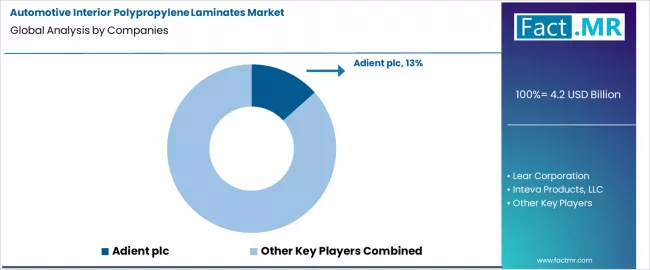
Global tier-one automotive interior suppliers who possess vertical integration capabilities, from material compounding and lamination to trim part manufacturing and assembly, dominate the competitive landscape.
Competition revolves around design partnership capabilities, the ability to co-develop and prototype new surface finishes directly with OEM stylists, and achieving global supply scale with regional manufacturing footprints. Success depends on mastering the complex supply chain of films, foils, substrates, and adhesives, and providing OEMs with a complete, validated component rather than just a raw material.
Key Players in the Automotive Interior Polypropylene Laminates Market
Adient plc
Lear Corporation
Inteva Products, LLC
Faurecia
Magna International
References
Brydson, J. A. (2022). Plastics materials (8th ed.). Butterworth-Heinemann.
Fakirov, S. (2023). Co-extrusion in automotive applications. Hanser Publications.
Harper, C. A. (2021). Handbook of plastics technologies: The complete guide to properties and performance. McGraw-Hill Education.
Hest, D., & Mewes, D. (2023). Surface design and finishing of plastics. Springer.Kutz, M. (Ed.). (2022). Applied plastics engineering handbook: Processing, materials, and applications (2nd ed.). William Andrew.
Miravete, A. (Ed.). (2021). 3D textile reinforcements in composite materials. Woodhead Publishing.
Osswald, T. A., & Hernández-Ortiz, J. P. (2022). Polymer processing: Modeling and simulation. Hanser Publishers.
Pfaendner, R. (2023). Recycling and sustainability of automotive materials. Royal Society of Chemistry.
Ulrich, H. (2022). Introduction to industrial polymers. Hanser Publishers.Wypych, G. (2021). Handbook of polymers (3rd ed.). ChemTec Publishing.
Adient plc, Lear Corporation, Inteva Products, LLC, Faurecia, Magna International
Additional Analysis
VOC (Volatile Organic Compound) and fogging analysis of laminate systems; long-term color fastness and UV resistance testing; haptic feel and acoustic dampening properties; comparative lifecycle assessment of PVC vs. non-PVC laminates; disassembly and recyclability studies of multi-material laminate components; cost-benefit analysis of in-house lamination vs. outsourced supply.
Source: Fact.MR analysis. Updated Apr 2, 2026
Market by Segments
Laminate Type :
PVC-Based PP Laminates
TPO/PP Laminates
ABS/PP Laminates
NBR/PP Laminates
Others
Application Area :
Door Panels
Instrument Panel Covers
Seat Components
Headliners
Others
Vehicle Type :
Passenger Cars
Commercial Vehicles
SUVs & Crossovers
Others
Region :
North America
USA
Canada
Latin America
Brazil
Argentina
Mexico
Rest of Latin America
Western Europe
Germany
UK
France
Spain
Italy
BENELUX
Rest of Western Europe
Eastern Europe
Russia
Poland
Czech Republic
Rest of Eastern Europe
East Asia
China
Japan
South Korea
Rest of East Asia
South Asia & Pacific
India
ASEAN
Australia
Rest of South Asia & Pacific
MEA
Saudi Arabia
UAE
Turkiye
Rest of MEA
Questions Answered
Frequently Asked Questions
How big is the automotive interior polypropylene laminates market in 2026?
The global automotive interior polypropylene laminates market is estimated to be valued at USD 4.2 billion in 2026.
What will be the size of automotive interior polypropylene laminates market in 2036?
The market size for the automotive interior polypropylene laminates market is projected to reach USD 10.0 billion by 2036.
How much will be the automotive interior polypropylene laminates market growth between 2026 and 2036?
The automotive interior polypropylene laminates market is expected to grow at a 9.2% CAGR between 2026 and 2036.
What are the key product types in the automotive interior polypropylene laminates market?
The key product types in automotive interior polypropylene laminates market are pvc‑based pp laminates, tpo/pp laminates, abs/pp laminates, nbr/pp laminates and others.
Which application area segment to contribute significant share in the automotive interior polypropylene laminates market in 2026?
In terms of application area, door panels segment to command 28.4% share in the automotive interior polypropylene laminates market in 2026.