- Market Value (2025): USD 491.3 Mn
- Estimated Value (2026): USD 543.5 Mn
- Forecast Value (2036): USD 1491.3 Mn
- CAGR (2026-2036): 10.6%
What is the Automotive Carbon Fiber Hood and Tailgate Market forecast to be worth by 2036?
USD 543.5 million in 2026 to USD 1491.3 million by 2036 at a 10.6% CAGR.
- As per Fact.MR analysis, the automotive carbon fiber hood and tailgate market reached USD 491.3 million in 2025.
- Demand will increase from USD 543.5 million in 2026 to USD 1491.3 million by 2036.
- The automotive carbon fiber hood and tailgate market will record a 10.6% CAGR from 2026 to 2036.
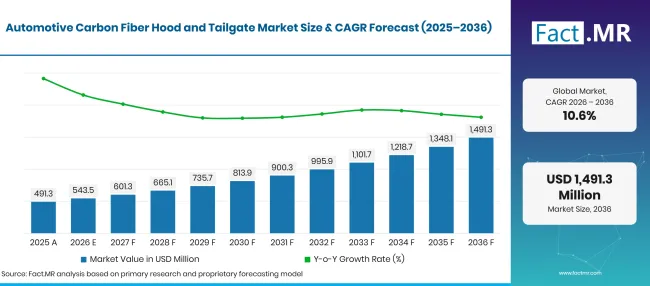
Factmr Automotive Carbon Fiber Hood And Tailgate Market Forecast Global | Source: Fact.MR
| Year | Basis | Market value (USD Million) |
|---|---|---|
| 2025 | Actual | 491.3 |
| 2026 | Estimate | 543.5 |
| 2036 | Forecast | 1491.3 |
| CAGR 2026 to 2036 | Forecast period | 10.6% |
Source: Fact.MR analysis. Updated Oct 14, 2026
What are the defining numbers behind Automotive Carbon Fiber Hood and Tailgate Market growth?
An absolute opportunity of USD 947.8 million will be created between 2026 and 2036.
- Demand Drivers in the Market
- Automakers are tightening their focus on mass reduction to improve energy efficiency and driving dynamics. With an exceptional strength-to-weight ratio, carbon fiber composites suit exterior panels where weight savings must coexist with structural rigidity.
- Owners of performance and luxury vehicles are gravitating toward carbon fiber for its distinctive weave and its link to motorsport engineering. Hoods and tailgates offer highly visible upgrade points that do not require a full body redesign.
- Refinements in resin transfer molding and press-based processing are enabling more efficient carbon fiber production. Tighter control over surface quality, cycle times, and material utilization will help suppliers meet automotive manufacturing standards.
- Automakers and aftermarket specialists are turning to distinctive exterior materials to set models and performance packages apart. Carbon fiber panels combine styling versatility with potential weight reduction, and this pairing will strengthen their role in specialized vehicle programs.
- Key Segments Analyzed
- By Vehicle Type: Passenger Cars are projected to command a 73.8% share in 2026, supported by demand for lightweight exterior components, premium styling, and performance-oriented vehicle customization.
- By Application: Aftermarket is set to dominate with a 78.2% share in 2026, reflecting interest in replacement, customization, and performance upgrades for existing vehicles.
- By Manufacturing Process: Resin Transfer Molding is poised to lead with a 48.3% share in 2026, supported by its suitability for producing shaped composite exterior parts with controlled surface quality.
- Analyst Opinion at Fact.MR
- Shambhu Nath Jha, Principal Consultant at Fact.MR, states, “Carbon fiber hoods and tailgates are moving from showpiece upgrades to engineered weight-reduction components. Automakers will favor suppliers that deliver consistent surface finish, shorter molding cycles, and scalable production across vehicle platforms. Players that pair advanced molding capability with cost-efficient output will gain the most from premium OEM programs and the aftermarket.”
- Strategic Implications
- Material suppliers are positioned to strengthen their market standing by improving carbon fiber utilization, surface consistency, and processing efficiency to meet automakers’ cost and quality requirements.
- Manufacturers should prioritize scalable molding technologies and repeatable production standards to improve the commercial feasibility of carbon fiber hoods and tailgates beyond limited-volume vehicle programs.
- Suppliers have the opportunity to broaden their product portfolios with vehicle-specific components, reliable fitment specifications, and durable finishes that address customization and replacement demand.
- Vehicle manufacturers are advised to evaluate carbon fiber components against conventional materials on weight reduction, total component cost, repairability, durability, and manufacturing cycle time rather than material performance alone.
Germany is set to lead the five listed countries with a 13.7% CAGR from 2026 to 2036, followed by the United Kingdom at 12.6%. Brazil and the United States are expected to advance at 11.7% and 11.2%, respectively, while Japan is projected to register the slowest growth at 8.2%.
How does the Automotive Carbon Fiber Hood and Tailgate Market break down by segment?
Passenger Cars will lead Vehicle Type at 73.8%; Aftermarket will lead Application at 78.2%; Resin Transfer Molding will lead Manufacturing Process at 48.3%.
Which Vehicle Type dominates?
Passenger Cars will account for 73.8% share in 2026.
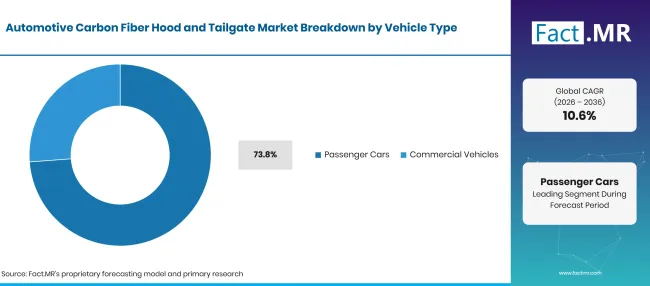
Factmr Automotive Carbon Fiber Hood And Tailgate Market Breakdown Vehicle Type | Source: Fact.MR
| Vehicle Type | Share (2026) |
|---|---|
| Passenger Cars (leading segment) | 73.8% |
| Commercial Vehicles | 26.2% |
| Total | 100.0% |
Source: Fact.MR analysis. Updated Oct 14, 2026
Passenger cars are on track to lead the segment as manufacturers and vehicle owners are increasingly seeking lighter exterior components that pair visual appeal with structural performance. Premium sedans, sports cars, and performance-oriented models will be natural fits for carbon fiber hoods and tailgates, particularly where distinctive appearance and weight reduction will justify higher component costs. Commercial vehicles are slated to add incremental demand wherever lightweighting, specialized body configurations, or performance needs are favoring advanced composites. Adoption, however, will hinge on payload economics, operating conditions, component durability, and the cost advantage over conventional materials.
How does the Application segment shape demand?
Aftermarket will account for 78.2% share in 2026.
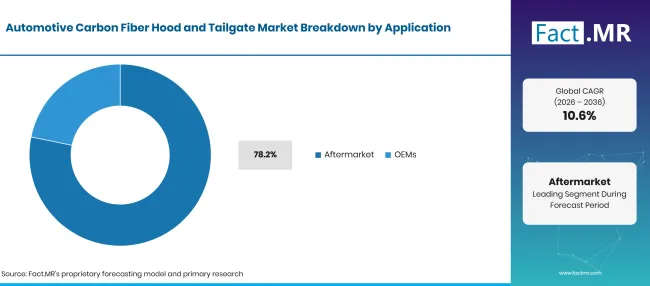
Factmr Automotive Carbon Fiber Hood And Tailgate Market Breakdown Application | Source: Fact.MR
| Application | Share (2026) |
|---|---|
| Aftermarket (leading segment) | 78.2% |
| OEMs | 21.8% |
| Total | 100.0% |
Source: Fact.MR analysis. Updated Oct 14, 2026
The aftermarket is positioned to lead as vehicle owners and customization businesses are turning to carbon fiber hoods and tailgates for styling upgrades, replacement needs, and performance-focused modifications. These components will deliver a visible change to a vehicle’s exterior, making them a natural fit for specialist tuning and customization channels. OEM demand is forecast to be shaped by automakers’ decisions on whether to bring carbon fiber components into factory-built vehicles. Original-equipment programs will require consistent quality, repeatable production, safety validation, and competitive component economics. The balance between aftermarket and OEM demand will therefore turn on the relative weight given to customization versus factory-installed lightweighting solutions.
What leads the Manufacturing Process segment?
Resin Transfer Molding will capture 48.3% share in 2026.

Factmr Automotive Carbon Fiber Hood And Tailgate Market Breakdown Manufacturing Process | Source: Fact.MR
| Manufacturing Process | Share (2026) |
|---|---|
| Resin Transfer Molding (leading segment) | 48.3% |
| Other segments combined (Compression Molding and Others) | 51.7% |
| Total | 100.0% |
Source: Fact.MR analysis. Updated Oct 14, 2026
Resin transfer molding is well placed to lead because the process is enabling the production of shaped composite components while helping manufacturers achieve consistent surface quality. Its fit with exterior panels, including hoods and roofs, will keep it relevant for applications that will call for controlled geometry and an automotive-grade finish. Compression molding is anticipated to serve applications where suitable composite materials and tooling are enabling repeatable component production. Process selection will depend on component design, resin system, production volume, cycle time, tooling investment, and finish requirements. Other manufacturing approaches will contribute where specific part geometries or production needs are favoring alternative methods.
What is accelerating Automotive Carbon Fiber Hood and Tailgate Market adoption, and what is holding it back?
Demand will benefit from vehicle lightweighting, premium customization, and improvements in composite manufacturing. However, high material and tooling costs, repair complexity, and the need for consistent production quality may constrain broader adoption.
Drivers Impact Analysis
| DRIVER | (~) % IMPACT ON CAGR | GEOGRAPHIC RELEVANCE | IMPACT TIMELINE |
|---|---|---|---|
| Automotive light-weighting initiatives to improve energy efficiency and vehicle performance | +2.0% | Global | Short term (<= 2 years) |
| Rising demand for premium vehicle personalization and customization | +1.6% | North America, Western Europe, East Asia | Medium term (2-4 years) |
| Advances in resin transfer molding and press-based processing technologies | +1.2% | Global | Medium term (2-4 years) |
| Growing emphasis on exterior design differentiation across vehicle models | +0.8% | Western Europe, North America, Latin America | Long term (>= 4 years) |
Source: Fact.MR analysis. Updated Oct 14, 2026
Opportunity Impact Analysis
| OPPORTUNITY | (~) % IMPACT ON CAGR | GEOGRAPHIC RELEVANCE | IMPACT TIMELINE |
|---|---|---|---|
| Scalable molding technologies extending carbon fiber use beyond limited-volume vehicle programs | +1.2% | Global | Medium term (2-4 years) |
| Vehicle-specific aftermarket portfolios with reliable fitment and durable finishes | +0.9% | North America, Western Europe | Long term (>= 4 years) |
| Wider OEM adoption in premium and performance vehicle platforms | +0.6% | Western Europe, East Asia | Medium term (2-4 years) |
| Expansion of specialist tuning and online customization channels | +0.4% | North America, Latin America | Short term (<= 2 years) |
Source: Fact.MR analysis. Updated Oct 14, 2026
Restraints Impact Analysis
| RESTRAINT | (~) % IMPACT ON CAGR | GEOGRAPHIC RELEVANCE | IMPACT TIMELINE |
|---|---|---|---|
| High component cost relative to conventional materials | -0.8% | Global | Short term (<= 2 years) |
| Surface-finish consistency and repairability requirements | -0.6% | Global | Medium term (2-4 years) |
| Cycle-time and production-scalability constraints across vehicle platforms | -0.4% | Global | Long term (>= 4 years |
Source: Fact.MR analysis. Updated Oct 14, 2026
Which countries are scaling the Automotive Carbon Fiber Hood and Tailgate Market through 2036?
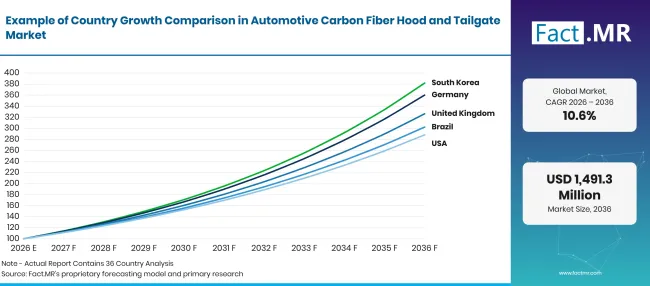
Factmr Automotive Carbon Fiber Hood And Tailgate Market Growth Index | Source: Fact.MR
| Country | CAGR (2026–2036) |
|---|---|
| Germany | 13.7% |
| United Kingdom | 12.6% |
| Brazil | 11.7% |
| United States | 11.2% |
| Japan | 8.2% |
Source: Fact.MR analysis. Updated Oct 14, 2026
What supports Germany adoption?
13.7% CAGR, supported by automotive manufacturing and advanced-material capabilities.
Germany's forecast indicates the strongest expansion in the country comparison. Its automotive manufacturing base and established advanced-materials capabilities provide a relevant context for carbon fiber component development. However, the specific contribution of domestic hood and tailgate demand, aftermarket sales, and OEM procurement requires separate verification before publication.
How is the United Kingdom scaling demand?
12.6% CAGR, led by specialist automotive engineering and performance-oriented vehicle applications.
The United Kingdom's forecast indicates substantial growth potential for carbon fiber hoods and tailgates. Demand may be supported by performance-oriented vehicles, specialist automotive engineering, and customization applications. The extent to which these factors contribute to the stated market growth requires country-specific market evidence.
What supports Brazil adoption?
11.7% CAGR, shaped by aftermarket customization and distinctive vehicle styling.
Brazil's forecast indicates an expanding opportunity for carbon fiber exterior components. Aftermarket customization and demand for distinctive vehicle styling may provide relevant avenues for growth. Wider adoption will depend on component affordability, import and distribution economics, vehicle compatibility, and access to qualified installation services.
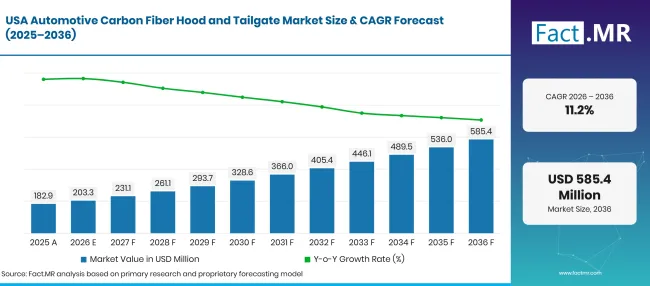
What supports United States adoption?
11.2% CAGR, driven by performance upgrades, lightweight components, and vehicle customization.
Factmr Automotive Carbon Fiber Hood And Tailgate Market Forecast Usa | Source: Fact.MR
The United States offers a relevant market context for aftermarket customization, performance upgrades, and lightweight automotive components. Carbon fiber hoods and tailgates can appeal to owners seeking a combination of distinctive styling and reduced component weight. Adoption will depend on vehicle-specific product availability, installation quality, pricing, and demand across premium and performance-oriented vehicle segments.
How is Japan developing demand?
8.2% CAGR, backed by lightweight vehicle engineering and composite-processing capabilities.
Japan's forecast indicates a more moderate pace of expansion relative to Germany, the United Kingdom, Brazil, and the United States. Opportunities may arise from lightweight vehicle engineering, premium vehicle applications, and advances in composite processing.
Who leads the Automotive Carbon Fiber Hood and Tailgate Market?
Competition falls into three groups. Carbon fiber and composite material producers compete on material performance, supply scale, and processing support. Toray Industries, Inc. supplies carbon fiber, fabrics, and prepregs for lightweight body panels, including hoods and roofs. SGL Carbon SE, Teijin Limited, Mitsubishi Chemical Group Corporation, Hexcel Corporation offer carbon fibers, prepregs, molding compounds, and resin systems.
Component specialists compete on design capability, tooling, and program readiness: Material consistency, resin transfer molding capability, surface finish, program qualification, and cost competitiveness will decide supplier selection through 2036.
Which companies are the key providers?
Key companies include Toray Industries, Inc.; SGL Carbon SE; Teijin Limited; Mitsubishi Chemical Group Corporation; Hexcel Corporation; Multimatic Inc.
- Toray Industries, Inc.
- SGL Carbon SE
- Teijin Limited
- Mitsubishi Chemical Group Corporation
- Hexcel Corporation
- Multimatic Inc.
Bibliography
- [1] Hexcel Corporation. (2025, February 17). Hexcel to celebrate JEC World 60th anniversary with new aerospace and automotive innovations.
- [2] Mitsubishi Chemical Group Corporation. (2025, February 25). Mitsubishi Chemical Group’s prepreg using plant-derived resin acquires International Sustainability and Carbon Certification ISCC PLUS—Contributing to the reduction of environmental impacts in areas ranging from sports and leisure to mobility and industrial applications.
- [3] Mitsubishi Chemical Group Corporation. (2025, May 9). Endorsement of the Carbon Fiber Association of Japan's position paper on the proposed amendments to the ELV Directive.
- [4] Multimatic Inc. (2025, January 31). Multimatic to showcase advanced “Art-to-Part” composite solutions at JEC World 2025.
- [5] SGL Carbon SE. (2025, May 13). SGL Carbon receives Q1 award from Ford Motor Company.
- [6] SGL Carbon SE. (2025, August 5). SGL Carbon manufactures prepregs made from natural fibers for use in motorsports.
- [7] Teijin Carbon Europe GmbH. (2025, March 3). Teijin Carbon introduces High Performance 36K Intermediate Modulus Carbon Fiber for Affordable Light Weighting.
This Report Answers
- The report examines the automotive carbon fiber hood and tailgate market by vehicle type, application, and manufacturing process.
- Segment analysis identifies passenger cars, aftermarket applications, and resin transfer molding as the leading categories based on the 2026 shares.
- Country analysis compares Germany, the United Kingdom, Brazil, the United States, and Japan by their growth rates through 2036.
- Competitive analysis reviews material suppliers, composite specialists, and automotive component manufacturers identified in the company list.
- Strategic analysis evaluates light-weighting requirements, production scalability, component economics, customization demand, and manufacturing constraints.
What does the Automotive Carbon Fiber Hood and Tailgate Market cover?
The Automotive Carbon Fiber Hood and Tailgate Market covers carbon fiber composite exterior components designed for automotive use. Hoods and tailgates made from carbon fiber-reinforced materials can reduce component weight while providing stiffness, durability, and design flexibility. Their suitability depends on component geometry, material selection, manufacturing process, and required surface finish.
The assessment includes passenger cars and commercial vehicles, along with aftermarket and original equipment manufacturer (OEM) applications. It also examines resin transfer molding, compression molding, and other manufacturing approaches relevant to the production of these components.
What is included in the scope?
The scope includes carbon fiber composite hoods and tailgates for automotive installation, whether through OEM programs or aftermarket channels. It covers components manufactured using the processes specified in the market data and considers their role in vehicle lightweighting, styling, customization, and performance applications.
The assessment also covers relevant material suppliers, composite processors, automotive component manufacturers, country-level growth forecasts, and the commercial factors influencing adoption.
What is excluded from the scope?
The scope excludes unrelated carbon fiber applications, including aerospace structures, sporting goods, wind energy components, and industrial products not used in automotive hoods or tailgates.
Carbon fiber chassis structures, interior trim, roofs, spoilers, and other body panels fall outside the defined component boundary unless specifically included in a hood or tailgate product offering. Conventional steel or aluminum hoods and tailgates are excluded from the carbon fiber component market value.
How Was the Analysis Built?
The analysis draws on 120+ sources, 35+ company portfolios, 25+ countries, and more than 20 industry interviews.
- Primary Research: Primary research includes discussions with manufacturers, service providers, technology developers, distributors, end users, and subject-matter experts. These conversations examine purchasing priorities, product adoption, operational challenges, approval requirements, competitive positioning, and the factors that influence wider market acceptance.
- Desk Research: Desk research covers government statistics, regulatory publications, company filings, trade data, technical studies, industry associations, standards, public policy, and other authoritative sources. Every source used in the analysis is documented in the bibliography.
- Market Sizing and Forecasting: Market estimates combine historical performance, demand indicators, pricing and volume trends, segment shares, company participation, country-level growth, adoption patterns, investment activity, and barriers to market expansion.
- Data Validation and Update Cycle: Findings are validated by comparing primary interviews with public data, company activity, regulatory changes, trade patterns, and industry developments. Regular updates review new product launches, capacity changes, partnerships, approvals, and shifts in commercial adoption.
Segmentation
What is the report’s scope and coverage?
Factmr Automotive Carbon Fiber Hood And Tailgate Market Taxonomy | Source: Fact.MR
| Attribute | Details |
|---|---|
| Quantitative Units | USD million; market value from USD 543.5 million in 2026 to USD 1,491.3 million by 2036 at a 10.6% CAGR |
| Market Definition | Carbon fiber composite hoods and tailgates used in automotive applications, including factory-fitted and aftermarket components |
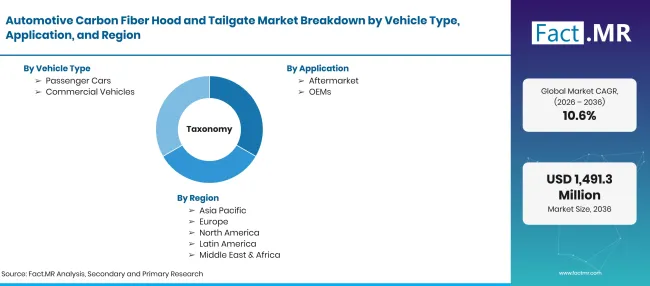
| Vehicle Type | Passenger Cars; Commercial Vehicles |
| Application | Aftermarket; OEMs |
| Manufacturing Process | Resin Transfer Molding; Compression Molding; Others |
| Regions Covered | North America; Latin America; Western Europe; Eastern Europe; East Asia; South Asia & Pacific; Middle East & Africa |
| Countries Covered | Germany; Brazil; United States; United Kingdom; Japan |
| Key Companies Profiled | Toray Industries, Inc.; SGL Carbon SE; Teijin Limited; Mitsubishi Chemical Group Corporation; Hexcel Corporation; Multimatic Inc. |
| Forecast Period | 2026 to 2036 |
| Approach | Market sizing and forecasting using the market values, CAGR, segment shares, country growth rates, manufacturing processes, application categories, and competitive landscape |
Source: Fact.MR analysis. Updated Oct 14, 2026
How is the market segmented?
-
By Vehicle Type
- Passenger Cars
- Commercial Vehicles
-
By Application
- Aftermarket
- OEMs
- Others
-
By Manufacturing Process
- Resin Transfer Molding
- Compression Molding
- Others
-
By Region
- North America
- Latin America
- Western Europe
- Eastern Europe
- East Asia
- South Asia & Pacific
- Middle East & Africa
Frequently Asked Questions
How big is the Automotive Carbon Fiber Hood and Tailgate Market in 2026?
What is the CAGR of the Automotive Carbon Fiber Hood and Tailgate Market from 2026 to 2036?
Which vehicle type leads the Automotive Carbon Fiber Hood and Tailgate Market?
Which application leads the Automotive Carbon Fiber Hood and Tailgate Market?
Which manufacturing process leads the Automotive Carbon Fiber Hood and Tailgate Market?
Which country will grow the most in the Automotive Carbon Fiber Hood and Tailgate Market?
Who are the main companies in the Automotive Carbon Fiber Hood and Tailgate Market?
Who worked on this report


Preview the report firsthand - request a free sample
Free SampleGet the brochure for pricing and purchase details
Download PDF