- Market Value (2025): USD 1.48 Bn
- Estimated Value (2026): USD 1.6 Bn
- Forecast Value (2036): USD 3.4 Bn
- CAGR (2026-2036): 7.9%
What is the Automotive Wind Tunnel Market forecast to be worth by 2036?
USD 1.6 billion in 2026 to USD 3.4 billion by 2036 at a 7.9% CAGR.
- According to Fact.MR analysis, the automotive wind tunnel market reached USD 1.48 billion in 2025.
- Worldwide revenue is forecast to increase from USD 1.6 billion in 2026 to USD 3.4 billion by 2036.
- Sales are forecast to register a 7.9% CAGR during 2026 to 2036 as manufacturers improve airflow testing during vehicle development.
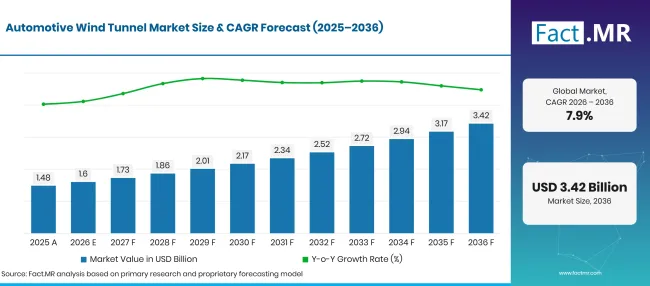
Factmr Automotive Wind Tunnel Market Forecast Global | Source: Fact.MR
| Year | Basis | Market Value (USD billion) |
|---|---|---|
| 2025 | Actual | 1.48 |
| 2026 | Estimate | 1.60 |
| 2036 | Forecast | 3.40 |
| CAGR 2026 to 2036 | Forecast period | 7.9% |
Source: Fact.MR analysis. Updated Oct 13, 2026
What are the defining numbers behind Automotive Wind Tunnel Market growth?
USD 1.8 billion in absolute chance between 2026 and 2036.
- Demand Drivers in the Market
- Automotive body engineers will use wind tunnels to compare air resistance under controlled conditions before finalizing exterior designs for production. Similar engineering work will also involve automotive simulation software.
- For electric vehicle teams, air resistance will become more important at higher speeds because the energy needed to move through the air will directly affect vehicle efficiency over a journey.
- This analysis considers consistent airflow measurement as a practical reason for investment in testing facilities. Engineers comparing different designs will need the same road and wheel conditions to determine whether a body change improves performance.
- Key Segments Analyzed
- By Type: Full-Scale Wind Tunnels lead with 58.3% share in 2026 because engineers can measure airflow around a complete vehicle.
- By Application: Passenger Vehicles represent 62.1% share in 2026 as model updates require aerodynamic and wind-noise checks.
- By Testing Type: Aerodynamics Testing holds 68.7% share in 2026 because exterior drag remains a core development measure.
- By End-User: Automotive Manufacturers represent 71.2% share in 2026 as vehicle brands direct testing plans around their product programs.
- Analyst Opinion at Fact.MR
- Shambhu Nath Jha, Principal Consultant at Fact.MR, states, “Buyers will place strong value on consistent measurements and available test time. A facility that delivers reliable results will support multiple stages of body design improvement during vehicle development.”
- Strategic Implications
- Tunnel operators will focus on consistent airflow measurements and clear test reports so engineering teams can compare design updates without repeating tests.
- Vehicle manufacturers will reserve tunnel time for decisions that depend on real airflow behavior, particularly around wheel areas and cooling systems.
- Equipment developers will balance measurement accuracy with the space and energy needed to run a full-scale facility.
- Independent engineering centers will offer flexible test schedules to support programs that do not justify building their own wind tunnel.
Germany is projected to record 9.4% CAGR during 2026 to 2036. Brazil follows at 8.6%, while the USA reaches 7.8%. The UK is forecast at 7.0%, and Japan at 6.2%.
How does the Automotive Wind Tunnel Market break down by segment?
Full-Scale Wind Tunnels lead Type at 58.3%; Passenger Vehicles lead Application at 62.1%; Aerodynamics Testing leads Testing Type at 68.7%; Automotive Manufacturers lead End-User at 71.2%.
Which Type leads automotive wind tunnel sales?
Full-Scale Wind Tunnels are projected to hold 58.3% share in 2026.
| Type | Share (2026) |
|---|---|
| Full-Scale Wind Tunnels (Leading segment) | 58.3% |
| Other segments combined | 41.7%* |
| Total | 100.0% |
Source: Fact.MR analysis. Updated Oct 13, 2026
A full-scale tunnel will allow engineers to study airflow around the entire vehicle under controlled conditions, including the effect of mirrors and underbody areas on drag. Model-scale tunnels will help teams compare different body designs before building full-size prototypes.
What leads the Application segment?
Passenger Vehicles are projected to account for 62.1% share in 2026.
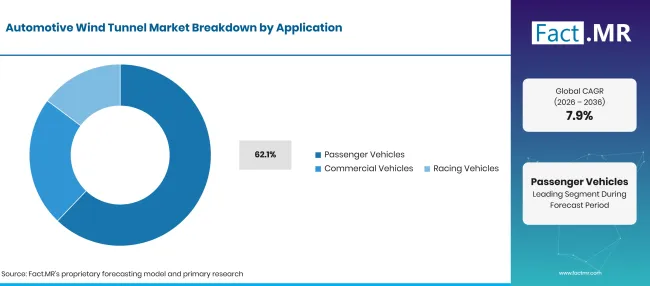
Factmr Automotive Wind Tunnel Market Breakdown Application | Source: Fact.MR
| Application | Share (2026) |
|---|---|
| Passenger Vehicles (Leading segment) | 62.1% |
| Other segments combined | 37.9%* |
| Total | 100.0% |
Source: Fact.MR analysis. Updated Oct 13, 2026
Passenger vehicle design teams will carry out airflow tests when updating body designs or developing new models. Commercial vehicle engineers will evaluate large front areas and cooling systems. Racing teams will use controlled testing to compare design changes aimed at improving track performance.
How does Testing Type shape the market?
Aerodynamics Testing is forecast to represent 68.7% share in 2026.
| Testing Type | Share (2026) |
|---|---|
| Aerodynamics Testing (Leading segment) | 68.7% |
| Other segments combined | 31.3%* |
| Total | 100.0% |
Source: Fact.MR analysis. Updated Oct 13, 2026
Aerodynamic testing will measure drag and lift at different speeds, while climatic testing will examine how vehicles perform under controlled weather conditions. Acoustic testing will provide additional insight into wind noise around the cabin. Each type of testing will require tools that match the measurement being carried out.
Which End-User group has the largest share?
Automotive Manufacturers are expected to represent 71.2% share in 2026.
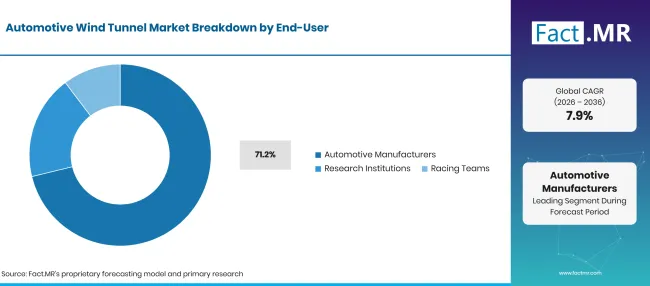
Factmr Automotive Wind Tunnel Market Breakdown End User | Source: Fact.MR
| End-User | Share (2026) |
|---|---|
| Automotive Manufacturers (Leading segment) | 71.2% |
| Other segments combined | 28.8%* |
| Total | 100.0% |
Source: Fact.MR analysis. Updated Oct 13, 2026
Automotive manufacturers will use wind tunnels during vehicle design and model updates. Having in-house access will help teams keep testing on schedule during vehicle development. Research institutions and racing teams will often use specialist facilities for specific testing requirements.
What is accelerating Automotive Wind Tunnel Market adoption, and what is holding it back?
Vehicle efficiency goals and testing needs will continue to support spending on wind tunnels. However, high facility costs and limited testing availability will continue to restrict expansion.
Drivers Impact Analysis
| DRIVER | (~) % IMPACT ON CAGR | GEOGRAPHIC RELEVANCE | IMPACT TIMELINE |
|---|---|---|---|
| Vehicle aerodynamic development | +1.2% | Germany, USA, Japan | Medium term (2–4 years) |
| Electric vehicle body design | +1.0% | Europe, North America | Medium term (2–4 years) |
| Vehicle noise and cooling checks | +0.8% | Global | Short term (<= 2 years) |
| Model redesign cycles | +0.6% | Global | Medium term (2–4 years) |
| Outside testing contracts | +0.4% | UK, Brazil | Long term (>= 4 years) |
Source: Fact.MR analysis. Updated Oct 13, 2026
Opportunity Impact Analysis
| OPPORTUNITY | (~) % IMPACT ON CAGR | GEOGRAPHIC RELEVANCE | IMPACT TIMELINE |
|---|---|---|---|
| Rolling-road upgrades | +0.8% | Germany, Japan | Medium term (2–4 years) |
| Testing services for new EV bodies | +0.7% | USA, UK | Medium term (2–4 years) |
| Integrated noise measurement | +0.5% | Europe | Long term (>= 4 years) |
| Specialist model-scale testing | +0.4% | Global | Short term (<= 2 years) |
Source: Fact.MR analysis. Updated Oct 13, 2026
Restraints Impact Analysis
| RESTRAINT | (~) % IMPACT ON CAGR | GEOGRAPHIC RELEVANCE | IMPACT TIMELINE |
|---|---|---|---|
| Large facility investment | -0.9% | Global | Long term (>= 4 years) |
| Power and operating expense | -0.7% | Global | Medium term (2–4 years) |
| Simulation substitution for early tests | -0.5% | Global | Medium term (2–4 years) |
| Specialist personnel requirements | -0.4% | Global | Short term (<= 2 years) |
Source: Fact.MR analysis. Updated Oct 13, 2026
Which countries are scaling the Automotive Wind Tunnel Market through 2036?
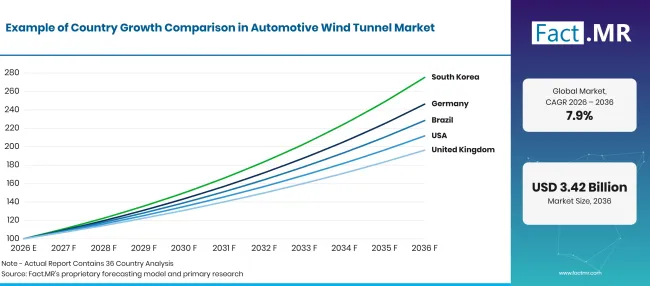
Factmr Automotive Wind Tunnel Market Growth Index | Source: Fact.MR
| Country | CAGR (2026–2036) |
|---|---|
| Germany | 9.4% |
| Brazil | 8.6% |
| USA | 7.8% |
| UK | 7.0% |
| Japan | 6.2% |
Source: Fact.MR analysis. Updated Oct 13, 2026
How is Germany developing automotive wind tunnel adoption?
9.4% CAGR, supported by established automotive engineering and physical vehicle testing.
Germany’s vehicle development centers will continue to use full-scale wind tunnels to test body designs, drag, and wind noise. The Federal Statistical Office reported 2.86 million new passenger-car registrations in 2025 [2]. Regular model updates and ongoing electric vehicle development will continue to support repeat testing across established engineering facilities.
How is Brazil developing automotive wind tunnel adoption?
8.6% CAGR, driven by local vehicle development and specialist testing services.
Brazilian engineering teams will use model-scale and external testing facilities to compare airflow before moving ahead with full-size prototypes. IBGE reported that industrial production increased 1.8% in January 2026 [3]. Local testing providers will benefit as manufacturers look for aerodynamic support without taking on the full cost of building and operating their own facilities.
How is the United States developing automotive wind tunnel adoption?
7.8% CAGR, supported by vehicle-efficiency analysis and broad engineering activity.
U.S. manufacturers will use wind tunnels to study drag, airflow around wheels, and airflow underneath vehicles while improving new designs. The Environmental Protection Agency reported average fuel economy of 27.2 miles per gallon for model-year 2024 vehicles [1]. Physical testing will continue to play an important role alongside simulation when manufacturers need reliable measurements before final design approval.
How is the United Kingdom developing automotive wind tunnel adoption?
7.0% CAGR, shaped by specialist engineering services and electric-vehicle development.
UK manufacturers and specialist engineering groups will use aerodynamic testing for passenger vehicles, performance models, and electric vehicle programs. The Department for Transport recorded 2,617,000 first vehicle registrations in 2025 [4]. Independent operators will support manufacturers that need focused wind-tunnel testing without the cost of maintaining their own full-scale facilities.
How is Japan developing automotive wind tunnel adoption?
6.2% CAGR, supported by mature vehicle engineering and careful use of specialist testing capacity.
Japanese automakers will use controlled airflow testing to compare drag and wind noise before finalizing vehicle designs. The Ministry of Economy, Trade and Industry identified transport equipment as one of the contributors to a planned production increase for January 2026 [5]. Established development teams will combine model-scale testing with full-vehicle validation to improve new body designs more efficiently.
Who competes in the Automotive Wind Tunnel Market?
Competition will continue to include tunnel engineering specialists and companies that operate vehicle testing facilities. Aerolab designs wind tunnels, while FKFS and HORIBA MIRA provide specialized vehicle testing services.
Pininfarina will remain involved in vehicle design activities. Mitsubishi Heavy Industries has experience in wind tunnel engineering, while DNW operates aerodynamic research facilities. These organizations will continue to serve different roles across the testing value chain.
Which companies are the key providers?
Key companies include Aerolab; Mitsubishi Heavy Industries; FKFS; DNW; HORIBA MIRA; MAHLE GmbH; and Pininfarina.
- Aerolab
- Mitsubishi Heavy Industries
- FKFS
- DNW
- HORIBA MIRA
- MAHLE GmbH
- Pininfarina
What is the report’s scope and coverage?
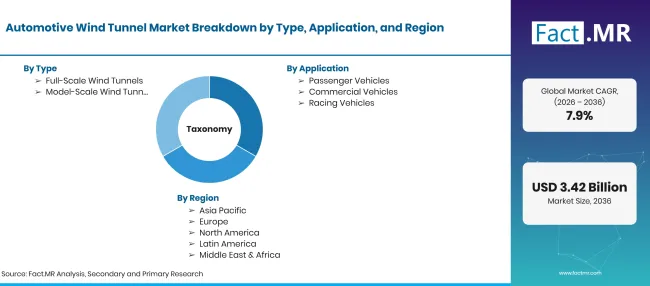
Factmr Automotive Wind Tunnel Market Taxonomy | Source: Fact.MR
| Attribute | Details |
|---|---|
| Quantitative units | USD billion |
| Definition | Wind tunnel facilities and associated systems used to measure airflow and related vehicle performance during automotive design and validation |
| Type | Full-Scale Wind Tunnels; Model-Scale Wind Tunnels |
| Application | Passenger Vehicles; Commercial Vehicles; Racing Vehicles |
| Testing Type | Aerodynamics Testing; Climatic Testing; Acoustic Testing |
| End-User | Automotive Manufacturers; Research Institutions; Racing Teams |
| Regions Covered | North America; Latin America; Western Europe; Eastern Europe; East Asia; South Asia & Pacific; Middle East & Africa |
| Countries Covered | Germany; Brazil; USA; UK; Japan |
| Companies Covered | Aerolab; Mitsubishi Heavy Industries; FKFS; DNW; HORIBA MIRA; MAHLE GmbH; Pininfarina |
| Forecast Period | 2026 to 2036 |
| Approach | Vehicle engineering activity, test facility capacity, application mix, and country outlook analysis |
Source: Fact.MR analysis. Updated Oct 13, 2026
Bibliography
- [1] U.S. Environmental Protection Agency. (2026, February). 2025 EPA Automotive Trends Report: Fuel economy and technology since 1975—Executive summary.
- [2] Statistisches Bundesamt (Destatis). (2026, March 23). Neuzulassungen von Kraftfahrzeugen in Deutschland [New registrations of motor vehicles in Germany].
- [3] Instituto Brasileiro de Geografia e Estatística. (2026, March 6). Produção industrial avança 1,8% em janeiro [Industrial production rises 1.8% in January].
- [4] Department for Transport. (2026, April 29). Vehicle licensing statistics, United Kingdom: 2025.
- [5] Ministry of Economy, Trade and Industry. (2026, January 30). Indices of Industrial Production: Preliminary Report for December 2025.
- [6] Office for National Statistics. (2026, October 8). UK new vehicle registrations and production [Data set].
This Report Answers
- How revenue develops from 2026 to 2036 under the defined wind tunnel market scope.
- Which facility type and vehicle application accounts for the main projected spending.
- Where aerodynamic measurement differs from climatic and acoustic testing.
- How the country growth outlook compares across Germany, Brazil, USA, UK, and Japan.
- Which organizations design tunnels, provide test services, or use facilities in vehicle development
What does the Automotive Wind Tunnel Market cover?
The assessment covers equipment and testing facilities that create controlled airflow around automotive vehicles or scale models. It includes test systems used for aerodynamic measurements and related vehicle development work.
What is included in the scope?
Full-scale vehicle tunnels and model-scale automotive installations are included, together with measurement setups used during test programs.
Work performed for passenger vehicles and racing teams remains inside the coverage when the tests concern vehicle airflow.
What is excluded from the scope?
The assessment excludes ordinary production plant ventilation and unrelated aircraft-only wind tunnels. It also separates purely digital simulation software from physical wind tunnel equipment and facility operation.
How Was the Analysis Built?
The analysis draws on 120+ sources, 35+ company portfolios, 25+ countries, and more than 20 industry interviews.
- Primary Research: Primary research includes discussions with manufacturers, service providers, technology developers, distributors, end users, and subject-matter experts. These conversations examine purchasing priorities, product adoption, operational challenges, approval requirements, competitive positioning, and the factors that influence wider market acceptance.
- Desk Research: Desk research covers government statistics, regulatory publications, company filings, trade data, technical studies, industry associations, standards, public policy, and other authoritative sources. Every source used in the analysis is documented in the bibliography.
- Market Sizing and Forecasting: Market estimates combine historical performance, demand indicators, pricing and volume trends, segment shares, company participation, country-level growth, adoption patterns, investment activity, and barriers to market expansion.
- Data Validation and Update Cycle: Findings are validated by comparing primary interviews with public data, company activity, regulatory changes, trade patterns, and industry developments. Regular updates review new product launches, capacity changes, partnerships, approvals, and shifts in commercial adoption.
Segmentation
How is the market segmented?
-
By Type:
- Full-Scale Wind Tunnels
- Model-Scale Wind Tunnels
-
By Application:
- Passenger Vehicles
- Commercial Vehicles
- Racing Vehicles
-
By Testing Type:
- Aerodynamics Testing
- Climatic Testing
- Acoustic Testing
-
By End-User:
- Automotive Manufacturers
- Research Institutions
- Racing Teams
-
By Region:
- North America
- Latin America
- Western Europe
- Eastern Europe
- East Asia
- South Asia & Pacific
- Middle East & Africa
Frequently Asked Questions
How big is the Automotive Wind Tunnel Market in 2026?
What is the CAGR of the Automotive Wind Tunnel Market from 2026 to 2036?
Which type leads the Automotive Wind Tunnel Market?
Which application leads the Automotive Wind Tunnel Market?
Who are the leading companies in the Automotive Wind Tunnel Market?
Who worked on this report


Preview the report firsthand - request a free sample
Free SampleGet the brochure for pricing and purchase details
Download PDF