- Market Value (2025): USD 28.8 Bn
- Estimated Value (2026): USD 30.7 Bn
- Forecast Value (2036): USD 58.6 Bn
- CAGR (2026-2036): 6.7%
What is the Automotive Carbon Fiber Composites Market forecast to be worth by 2036?
USD 30.7 billion in 2026 to USD 58.6 billion by 2036 at 6.7% CAGR.
- The Automotive Carbon Fiber Composites Market surpassed a value of USD 28.8 billion in 2025.
- Demand is projected to increase from USD 30.7 billion in 2026 to USD 58.6 billion by 2036.
- The market is forecast to record 6.7% CAGR from 2026 to 2036 as selected body and battery programs qualify carbon fiber parts for production use.
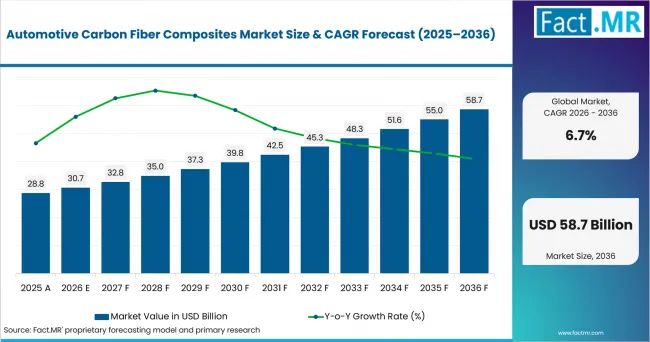
Automotive Carbon Fiber Composites Market Value Analysis | Source: Fact.MR
What are the defining numbers behind Automotive Carbon Fiber Composites Market growth?
USD 27.9 billion absolute opportunity by 2036.
- Demand Drivers in the Market
- Body and chassis teams need lower mass without losing stiffness or crash-load control in mixed-material vehicle structures.
- Electric vehicle programs need lighter body and battery-related parts since battery packs add mass to range and braking calculations.
- Premium and racing vehicle makers value carbon fiber where stiffness and visible material quality justify specialized design work.
- Key Segments Analyzed
- By Composite Product: Structural Carbon Fiber Components are expected to hold 38% share in 2026 because chassis components and body panels turn stiffness into vehicle value.
- By Vehicle Application: Body Structure is projected to account for 36% share in 2026 owing to crash structures and roof systems.
- By Vehicle Category: Passenger Cars are anticipated to capture 59% share in 2026 since sedans and sport utility vehicles provide the broadest premium and electric base.
- By End User: Automotive Original Equipment Manufacturers are estimated to represent 66% share in 2026 as vehicle makers control architecture and crash approval.
- By Manufacturing Technology: Resin Transfer Molding is forecast to account for 39% share in 2026 through closed-mold structural production.
- Analyst Opinion at Fact.MR
- Shambhu Nath Jha, Principal Consultant at Fact.MR, states, “Automotive carbon fiber composite purchasing is becoming a manufacturing-system decision. Programs are expected to scale only when companies prove cycle time and crash behavior. They must prove joining quality and repair strategy in the same approval plan.”
- Strategic Implications
- Automotive original equipment manufacturers gain better program clarity by comparing system mass with expected production volume before replacing metal structures with carbon fiber composites.
- Material companies and molders can reduce release risk by qualifying the full process window before production begins.
- Tier 1 manufacturers benefit from defining load paths and sealing requirements before finalizing tooling plans for battery enclosures.
China leads at 7.6% CAGR. The USA follows at 7.2%. Germany reaches 6.9% and Japan records 6.5%. South Korea posts 6.2%. India reaches 5.9% and Mexico closes at 5.6%.
How does the Automotive Carbon Fiber Composites Market break down by segment?
Structural Carbon Fiber Components lead Composite Product at 38% share in 2026. Body Structure leads Vehicle Application at 36% share.
Which Composite Product dominates?
Structural Carbon Fiber Components hold 38% share in 2026.
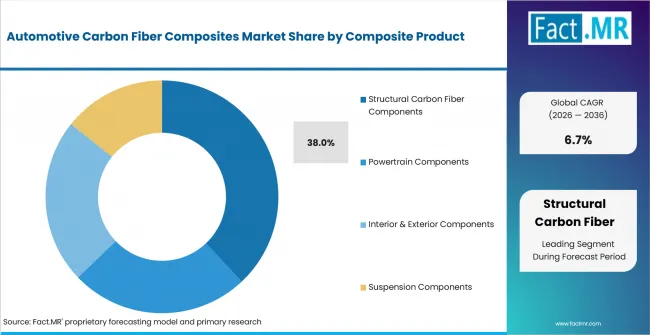
Automotive Carbon Fiber Composites Market Analysis By Composite Product | Source: Fact.MR
Chassis components and body panels lead because they turn carbon fiber properties into stiffness and crash performance. Powertrain Components follow through battery enclosures and drive shafts. Interior and exterior uses remain selective. Suspension uses follow where duty cycles justify cost.
What leads the Vehicle Application segment?
Body Structure accounts for 36% share in 2026.
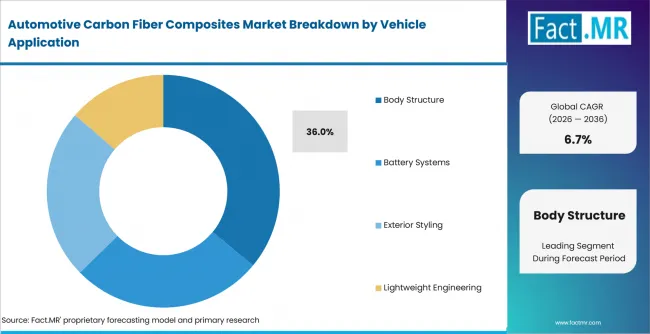
Automotive Carbon Fiber Composites Market Analysis By Vehicle Application | Source: Fact.MR
Crash structures and roof systems are defined early in vehicle architecture. Material approval therefore affects load transfer and service planning. Battery Systems follow where electric platforms require enclosures and support structures. Exterior Styling overlaps with automotive carbon thermoplastic where molded appearance parts need faster forming.
Why do Passenger Cars lead Vehicle Category demand?
Passenger Cars hold 59% share in 2026.
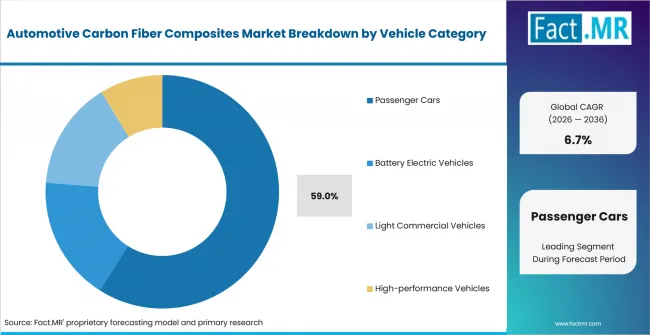
Automotive Carbon Fiber Composites Market Analysis By Vehicle Category | Source: Fact.MR
Sedans and sport utility vehicles provide the widest platform base for carbon fiber composite parts. Premium and electric versions give suppliers more entry points. Specialized parts support automotive lightweight material choices in high-value programs.
Which End User accounts for the largest share?
Automotive Original Equipment Manufacturers lead with 66% share in 2026.
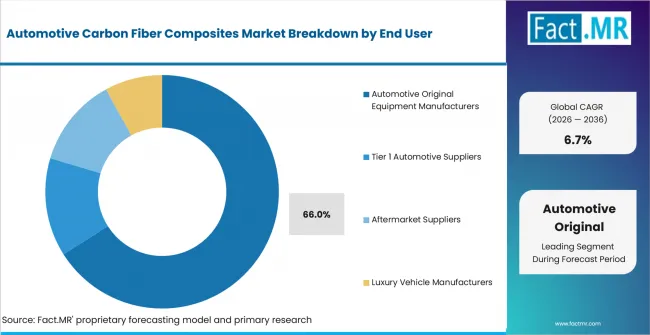
Automotive Carbon Fiber Composites Market Analysis By End User | Source: Fact.MR
Automakers approve architecture and crash models before any structural material enters a vehicle platform. They control tooling release and repair documentation. Tier 1 manufacturers then convert approved materials into components.
Which Manufacturing Technology leads?
Resin Transfer Molding holds 39% share in 2026.
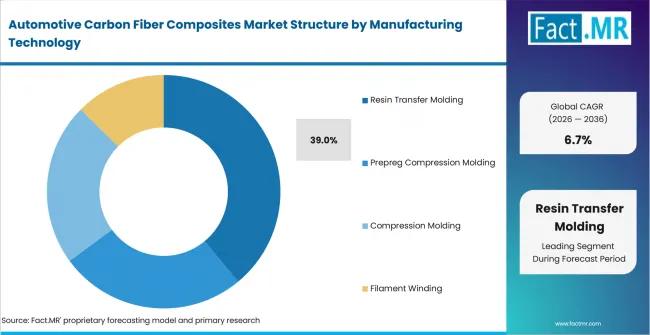
Automotive Carbon Fiber Composites Market Analysis By Manufacturing Technology | Source: Fact.MR
High-pressure and low-pressure RTM place dry preforms into a closed mold before resin impregnation. The route fits structural work when preform quality and cure control are repeatable. Automation support decides whether the process moves beyond low-volume parts.
What is accelerating Automotive Carbon Fiber Composites Market adoption, and what is holding it back?
Vehicle lightweighting and electric platform mass support adoption. Premium vehicle programs create higher-value applications. Material cost and cycle time slow wider use. Joining and inspection create further release work. Repair and recycling requirements create further constraints.
Drivers Impact Analysis
| DRIVER | (~) % IMPACT ON CAGR | GEOGRAPHIC RELEVANCE | IMPACT TIMELINE |
|---|---|---|---|
| Vehicle lightweighting programs | +1.7% | China, USA, Europe | Short term (<= 2 years) |
| Electric platform mass | +1.5% | China, USA, Germany, South Korea | Short term (<= 2 years) |
| Premium and performance vehicles | +1.1% | Germany, Japan, USA | Medium term (2-4 years) |
| Faster molding cycles | +0.9% | Established composite hubs | Medium term (2-4 years) |
| Early engineering co-development | +0.7% | Automotive manufacturing centers | Long term (>= 4 years) |
Source: Fact.MR analysis. Updated Aug 6, 2026
- Vehicle lightweighting: Carbon fiber is expected to earn program space where lower mass improves range or handling without shifting cost to repair work.
- Electric platform redesign: Battery enclosures and roof systems are anticipated to give carbon fiber a clearer role when engineers start from new load cases.
- Premium and performance programs: High-value models continue to support CFRP parts where finish quality and stiffness carry customer value.
Opportunity Impact Analysis
| OPPORTUNITY | (~) % IMPACT ON CAGR | GEOGRAPHIC RELEVANCE | IMPACT TIMELINE |
|---|---|---|---|
| Battery enclosures and supports | +1.2% | China, USA, Germany, South Korea | Short term (<= 2 years) |
| High-pressure RTM and fast-cure systems | +0.9% | Europe, Japan, USA, China | Medium term (2-4 years) |
| Reclaimed fiber routes | +0.6% | USA, Europe, Japan | Medium term (2-4 years) |
| Localized molding near assembly | +0.5% | Mexico, India, China, USA | Long term (>= 4 years) |
Source: Fact.MR analysis. Updated Aug 6, 2026
- Battery and structural integration: The primary opportunity is concentrated in parts that combine mass reduction with stiffness and impact resistance.
- Faster and more circular processing: Thermoplastic systems and reclaimed fiber routes are expected to target parts where duty cycles fit their retained properties.
- Localized production: Near-plant preforming and molding are likely to shorten response time when launch teams face surface or dimensional issues.
Restraints Impact Analysis
| RESTRAINT | (~) % IMPACT ON CAGR | GEOGRAPHIC RELEVANCE | IMPACT TIMELINE |
|---|---|---|---|
| Material and intermediate cost | -1.3% | Global | Short term (<= 2 years) |
| Cycle time and yield | -1.0% | High-volume hubs | Short term (<= 2 years) |
| Joining and repair validation | -0.8% | Structural composite programs | Medium term (2-4 years) |
| Recycling and substitute materials | -0.6% | Europe, USA, Japan | Long term (>= 4 years) |
Source: Fact.MR analysis. Updated Aug 6, 2026
- Cost and production-rate exposure: Vehicle programs must pay for material and tooling. Molding and bonding raise the conversion burden. Inspection and finishing raise cost. Scrap control creates an additional cost layer.
- Qualification and service burden: Teams must approve impact damage limits and repair rules before structural carbon fiber parts enter wider use.
- Alternative-material pressure: Aluminum and magnesium compete with natural-fiber composites and advanced steels where carbon fiber cannot prove system value.
Which countries are scaling Automotive Carbon Fiber Composites Market fastest?
- The country comparison spans 2.0 percentage points and forms three practical growth bands across the forecast period.
- China remains 0.4 percentage point above the USA through electric vehicle scale and rapid platform renewal.
- The USA remains 0.3 percentage point above Germany as premium vehicle programs support selective adoption.
- Germany remains 0.4 percentage point above Japan through premium engineering and mixed-material body experience.
- Japan remains 0.3 percentage point above South Korea through carbon fiber expertise and production discipline.
- South Korea remains 0.3 percentage point above India through export vehicle production and advanced-material capability.
- India remains 0.3 percentage point above Mexico as vehicle manufacturing scale builds early capability.
Comparable CAGRs can create different entry conditions because vehicle mix and engineering depth vary by country. Full report coverage includes North America and Latin America. Europe and East Asia complete the regional view with South Asia and Pacific and Middle East and Africa.
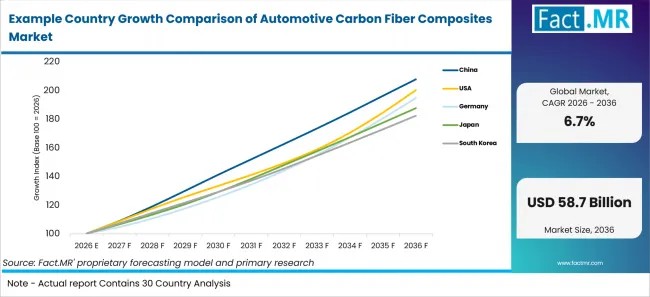
Example Country Growth Comparison Of Automotive Carbon Fiber Composites Market | Source: Fact.MR
| Country | CAGR (2026-2036) |
|---|---|
| China | 7.6% |
| USA | 7.2% |
| Germany | 6.9% |
| Japan | 6.5% |
| South Korea | 6.2% |
| India | 5.9% |
| Mexico | 5.6% |
Source: Fact.MR analysis. Updated Aug 6, 2026
What is driving China’s growth through 2036?
7.6% CAGR, driven by electric vehicle scale and local composite capability.
China’s electric vehicle programs review part weight during platform planning. This gives carbon fiber companies a clearer chance to qualify body and battery-related parts before tooling decisions are fixed.
How is the USA scaling demand?
7.2% CAGR, supported by electric and premium vehicle programs.
Premium cars and pickup trucks give the USA several selective routes for carbon fiber. Motorsport programs and electric platforms create further entry points. Adoption remains practical only where repair cost and production yield are controlled.
What supports Germany’s outlook?
6.9% CAGR, shaped by premium vehicle engineering and export exposure.
Germany’s premium engineering base gives carbon fiber a practical role in body and performance programs. Companies must prove automated production and surface quality before wider vehicle release.
How is Japan developing Automotive Carbon Fiber Composites demand?
6.5% CAGR, supported by domestic carbon fiber expertise and precision manufacturing.
Japanese material companies and automakers place heavy weight on repeatable production. Demand is expected to grow where fiber and resin knowledge supports reliable body and shaft applications.
What is shaping South Korea’s growth?
6.2% CAGR, owing to export vehicle production and electric mobility.
South Korea’s export vehicle base gives composite companies a practical path into selected programs. Battery and electronics capability support cross-functional lightweighting work. Steel and chemical experience improves local process depth.
How is India building Automotive Carbon Fiber Composites capability?
5.9% CAGR, driven by vehicle manufacturing scale and localization policy.
India’s adoption path is expected to remain selective during the forecast period. Early use is most likely in high-value body parts and battery components. Racing and specialty vehicles offer smaller entry points.
What shapes Mexico’s outlook?
5.6% CAGR, supported by North American vehicle integration and export assembly.
Mexico’s role in North American assembly gives local molders a chance to serve nearby programs. Material cost keeps demand focused on premium and electric parts. Appearance-critical and performance parts remain practical entry points.
Who leads the Automotive Carbon Fiber Composites Market?
SGL Carbon and Toray Industries hold prominent positions through automotive-grade carbon fiber materials, while Teijin and Hexcel add structural composite expertise.
Syensqo and Mitsubishi Chemical strengthen resin and intermediate-material capabilities. HS Hyosung Advanced Materials and DowAksa expand fiber supply. Mubea Carbo Tech and Cevotec broaden the field through lightweight component engineering, automated fiber placement and production support for body, battery and performance vehicle programs globally.
Which companies are the key providers?
Key companies include SGL Carbon SE; Toray Industries, Inc.; Teijin Limited; Hexcel Corporation; Syensqo SA; Mitsubishi Chemical Group Corporation; HS Hyosung Advanced Materials Corporation; DowAksa Advanced Composites Holdings B.V.; Mubea Carbo Tech GmbH; Cevotec GmbH.
- SGL Carbon SE
- Toray Industries, Inc.
- Teijin Limited
- Hexcel Corporation
- Syensqo SA
- Mitsubishi Chemical Group Corporation
- HS Hyosung Advanced Materials Corporation
- DowAksa Advanced Composites Holdings B.V.
- Mubea Carbo Tech GmbH
- Cevotec GmbH
Bibliography
- Pacific Northwest National Laboratory. (2025, January 16). Wholly sustainable, cost-effective carbon fiber-nylon compounds: CRADA 592 final report. U.S. Department of Energy.
- U.S. Department of Energy. (2025, January 17). Funding notice: Fiscal year 2025 Vehicle Technologies Office program-wide notice of funding opportunity.
- International Energy Agency. (2025, May 14). Global EV outlook 2025: Expanding sales in diverse markets.
This Report Answers
- The report provides strategic intelligence on Automotive Carbon Fiber Composites Market choices across Composite Product and Vehicle Application.
- Segment analysis covers Structural Carbon Fiber Components and Body Structure as the stated share leaders within the 2026 market.
- Vehicle and customer analysis evaluates Passenger Cars and Automotive Original Equipment Manufacturers through the largest listed 2026 shares.
- Country outlook evaluates China and the USA alongside Germany and Japan. South Korea and India appear with Mexico to complete the growth comparison.
- Technology assessment covers Resin Transfer Molding and Prepreg Compression Molding. Compression Molding and Filament Winding complete the process view with qualification needs.
What does the Automotive Carbon Fiber Composites Market cover?
Carbon fiber reinforced composite materials and automotive components are used in body and battery programs. Powertrain and suspension programs are included. Interior and exterior programs are covered through lightweight-engineering work.
The market covers carbon fiber reinforced thermoset and thermoplastic materials. It covers intermediate forms and preforms. Molded parts and qualified assemblies are included when they are tied to automotive components. Body panels and battery enclosures are covered. Shafts and seats are included. Leaf springs and control arms remain within scope.
What is included in the scope?
The scope includes continuous and woven carbon fiber composite forms when sold into defined automotive parts. Chopped and sheet-molding forms are included. Thermoplastic carbon fiber forms remain inside the scope. It covers Resin Transfer Molding and Prepreg Compression Molding. Compression Molding and Filament Winding are included. Automated fiber placement and robotic fiber layup remain within scope.
What is excluded from the scope?
The scope excludes non-automotive carbon fiber and finished vehicle revenue. Glass-fiber-only parts remain outside the market. Stand-alone equipment or chemical revenue is excluded. Resins and coatings are included only when they directly support a qualifying automotive carbon fiber composite component.
How Was the Analysis Built?
The analysis draws on 120+ sources, 35+ company portfolios, 25+ countries, and more than 20 industry interviews.
- Primary Research: Primary research includes discussions with manufacturers, service providers, technology developers, distributors, end users, procurement teams, and subject-matter experts. These conversations examine purchasing priorities, product adoption, operational challenges, approval requirements, competitive positioning, and the factors that influence wider market acceptance.
- Desk Research: Desk research covers government statistics, regulatory publications, company filings, trade data, technical studies, industry associations, standards, public policy, and other authoritative sources. Every source used in the analysis is documented in the bibliography.
- Market Sizing and Forecasting: Market estimates combine historical performance, demand indicators, pricing and volume trends, segment shares, company participation, country-level growth, adoption patterns, investment activity, and barriers to market expansion.
- Data Validation and Update Cycle: Findings are validated by comparing primary interviews with public data, company activity, regulatory changes, trade patterns, and industry developments. Regular updates review new product launches, capacity changes, partnerships, approvals, procurement trends, and shifts in commercial adoption.
Segmentation
What is the report’s scope and coverage?
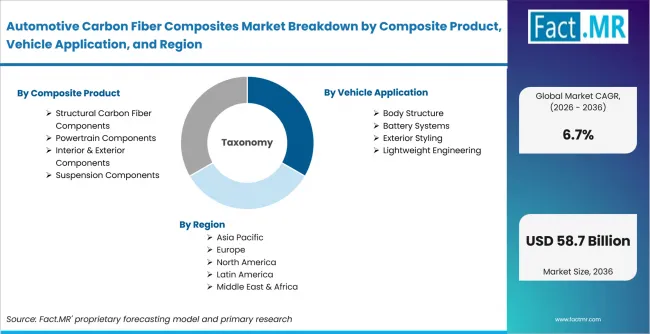
Automotive Carbon Fiber Composites Market Breakdown By Composite Product, Vehicle Application, And Region | Source: Fact.MR
| Attribute | Details |
|---|---|
| Quantitative Units | USD billion |
| Market Definition | Carbon fiber reinforced thermoset and thermoplastic materials used in qualified vehicle programs where weight reduction, stiffness, crash performance, inspection, and repair planning determine use |
| Composite Product | Structural Carbon Fiber Components; Powertrain Components; Interior & Exterior Components; Suspension Components |
| Vehicle Application | Body Structure; Battery Systems; Exterior Styling; Lightweight Engineering |
| Vehicle Category | Passenger Cars; Battery Electric Vehicles; Light Commercial Vehicles; High-performance Vehicles |
| End User | Automotive Original Equipment Manufacturers; Tier 1 Automotive Suppliers; Aftermarket Suppliers; Luxury Vehicle Manufacturers |
| Manufacturing Technology | Resin Transfer Molding; Prepreg Compression Molding; Compression Molding; Filament Winding |
| Regions Covered | North America; Latin America; Europe; East Asia; South Asia and Pacific; Middle East and Africa |
| Countries Covered | China; USA; Germany; Japan; South Korea; India; Mexico |
| Key Companies Profiled | SGL Carbon SE; Toray Industries, Inc.; Teijin Limited; Hexcel Corporation; Syensqo SA; Mitsubishi Chemical Group Corporation; HS Hyosung Advanced Materials Corporation; DowAksa Advanced Composites Holdings B.V.; Mubea Carbo Tech GmbH; Cevotec GmbH |
| Forecast Period | 2026 to 2036 |
| Approach | Hybrid top-down and bottom-up approach using vehicle production requirements; carbon fiber attachment assumptions; body and battery programs; composite-product qualification; OEM purchasing behavior; molding technology review; country adoption patterns and company portfolio review |
Source: Fact.MR analysis. Updated Aug 6, 2026
How is the market segmented?
-
By Composite Product:
- Structural Carbon Fiber Components
- Chassis Components
- Body Panels
- Powertrain Components
- Battery Enclosures
- Drive Shafts
- Interior & Exterior Components
- Instrument Panels
- Seat Structures
- Suspension Components
- Leaf Springs
- Control Arms
- Structural Carbon Fiber Components
-
By Vehicle Application:
- Body Structure
- Crash Structures
- Roof Systems
- Battery Systems
- Electric Powertrain
- Motor Housings
- Exterior Styling
- Aerodynamic Components
- Door Modules
- Lightweight Engineering
- Weight Reduction
- Fuel Efficiency Improvement
- Body Structure
-
By Vehicle Category:
- Passenger Cars
- Sedans
- Sport Utility Vehicles
- Battery Electric Vehicles
- Hybrid Electric Vehicles
- Plug-in Hybrid Vehicles
- Light Commercial Vehicles
- Delivery Vans
- Pick-up Trucks
- High-performance Vehicles
- Sports Cars
- Racing Vehicles
- Passenger Cars
-
By End User:
- Automotive Original Equipment Manufacturers
- Global Automotive Manufacturers
- Electric Vehicle Manufacturers
- Tier 1 Automotive Suppliers
- Component Manufacturers
- Motorsport Manufacturers
- Aftermarket Suppliers
- Custom Vehicle Builders
- Performance Vehicle Manufacturers
- Luxury Vehicle Manufacturers
- Supercar Manufacturers
- Motorsport Teams
- Automotive Original Equipment Manufacturers
-
By Manufacturing Technology:
- Resin Transfer Molding
- High-pressure RTM
- Low-pressure RTM
- Prepreg Compression Molding
- Fast-cure Prepreg Technology
- Autoclave Processing
- Compression Molding
- High-speed Compression Molding
- Thermoplastic Molding
- Filament Winding
- Automated Fiber Placement
- Robotic Fiber Layup
- Resin Transfer Molding
-
By Region:
- North America
- Latin America
- Europe
- East Asia
- South Asia and Oceania
- Middle East and Africa
Frequently Asked Questions
How big is the automotive carbon fiber composites market in 2026?
What is the CAGR of the automotive carbon fiber composites market from 2026 to 2036?
Which composite product leads the automotive carbon fiber composites market?
Which end-user segment leads the automotive carbon fiber composites market?
Who are the leading companies in the automotive carbon fiber composites market?
Who worked on this report


Preview the report firsthand - request a free sample
Free SampleGet the brochure for pricing and purchase details
Download PDF