- Market Value (2025): USD 1.97 Bn
- Estimated Value (2026): USD 2.12 Bn
- Forecast Value (2036): USD 4.49 Bn
- CAGR (2026-2036): 7.8%
What is the Automotive DC Power Relays Market forecast to be worth by 2036?
USD 2.1 billion in 2026 to USD 4.5 billion by 2036, at a 7.8% CAGR.
- According to Fact.MR analysis, the automotive DC power relays market reached USD 1.97 billion in 2025.
- Sales are projected to move from USD 2.12 billion in 2026 to USD 4.49 billion by 2036.
- The market is forecast to record a 7.8% CAGR from 2026 to 2036 as vehicle manufacturers specify switching devices for conventional electrical loads and electrified platforms.
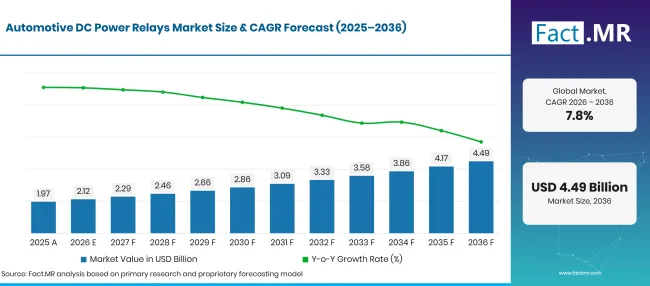
Factmr Automotive Dc Power Relays Market Forecast Global | Source: Fact.MR
| Year | Basis | Market Value (USD billion) |
|---|---|---|
| 2025 | Historical | 1.97 |
| 2026 | Estimate | 2.12 |
| 2036 | Forecast | 4.49 |
| CAGR 2026 to 2036 | Forecast period | 7.8% |
Source: Fact.MR analysis. Updated Oct 15, 2026
What are the defining numbers behind Automotive DC Power Relays Market growth?
USD 2.4 billion absolute opportunity between 2026 and 2036, centered on electromechanical relays and OEM vehicle programs.
- Demand Drivers in the Market
- Vehicle electrical engineers use DC power relays to connect higher-current loads without routing those currents through dashboard switches. Contact resistance and switching life shape device approval for recurring vehicle functions.
- Passenger vehicle manufacturers need switching parts that work across large production runs. The U.S. Environmental Protection Agency reported that battery-electric vehicles represented 7% of new U.S. light-duty vehicle production in model year 2024 in its February 2026 analysis [1].
- Commercial vehicle equipment teams rely on relays for auxiliary electrical functions that operate under heavier duty cycles. Fleet service costs rise when a low-cost switching part causes repeated workshop visits.
- Electrified vehicle designers compare relays by the voltage they control and the voltage applied to the relay coil. Separating those specifications helps prevent a low-voltage control relay from being mistaken for a traction-battery contactor.
- Key Segments Analyzed
- By Type: Electromechanical Relays will hold 62.3% share in 2026, reflecting familiar switching designs and vehicle-grade product ranges.
- By Application: Passenger Vehicles will account for 43.2% share in 2026 because original vehicle installations create steady component volumes.
- By Voltage Range: Low Voltage (12-48V) will account for 51.4% share in 2026, covering common control and accessory circuits.
- By End-User: Original Equipment Manufacturers (OEMs) will hold 72.1% share in 2026, shaped by supplier nomination before vehicle production.
- Analyst Opinion at Fact.MR
- Shambhu Nath Jha, Principal Consultant at Fact.MR, states, “Automotive DC power relay suppliers need to demonstrate dependable switching performance across the electrical loads and operating conditions found in modern vehicles. Carmakers assess contact durability, voltage handling, thermal behavior, and repeated switching before approving a relay for production use.”
- Strategic Implications
- Automotive engineers should specify load current and switching frequency separately, since the same rated voltage does not guarantee equal contact life across circuits.
- Relay manufacturers are expected to offer clearer test records for running temperature and load interruption as designs move into newer electrical layouts.
- Component sellers should retain accurate interchange information for older vehicle relay formats because service channels need dependable replacements.
- Vehicle platform teams benefit from aligning relay dimensions and electrical ratings early, which reduces rework during control-box and harness validation.
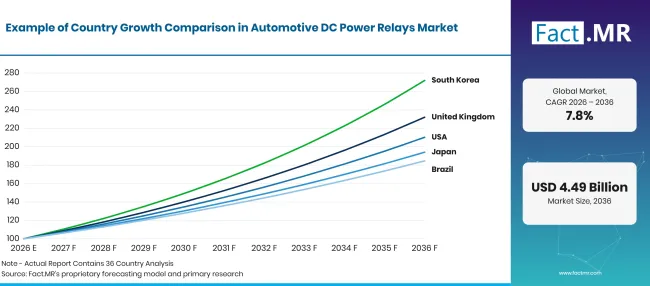
The United Kingdom has the highest stated country CAGR at 8.8%, followed by the United States at 7.7%. Japan records 6.9%, Brazil follows at 6.3%, and Germany posts 6.0%. These differences reflect separate vehicle production mixes and electrical-system buying requirements.
How does the Automotive DC Power Relays Market break down by segment?
Electromechanical Relays 62.3%; Passenger Vehicles 43.2%; Low Voltage (12-48V) 51.4%; OEMs 72.1% in 2026.
Which Type dominates?
Electromechanical Relays holds 62.3% share in 2026.
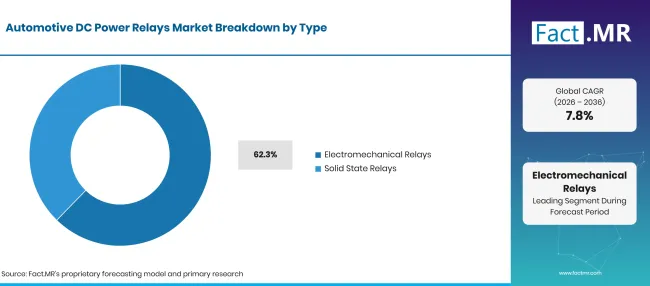
Factmr Automotive Dc Power Relays Market Breakdown Type | Source: Fact.MR
| Type dominates | Share (2026) |
|---|---|
| Electromechanical Relays (Leading segment) | 62.3% |
| Other segments combined | 37.7% |
| Total | 100.0% |
Source: Fact.MR analysis. Updated Oct 15, 2026
Electromechanical relays remain useful when vehicle manufacturers want a physical contact gap and a well-understood service history. Their coils and contacts have clear design limits that engineers can test against automotive duty cycles. Solid-state relays remove mechanical contact wear and serve applications that place greater value on frequent switching. Their heat output and leakage current require a different design review.
What leads the Application?
Passenger Vehicles holds 43.2% share in 2026.
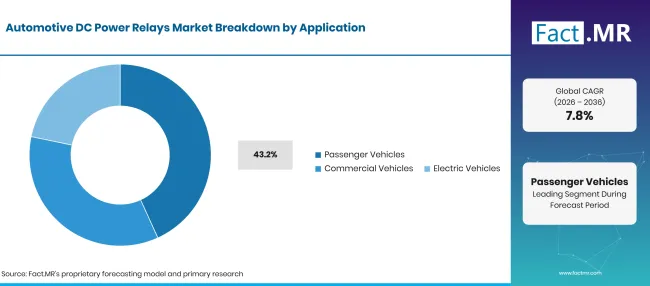
Factmr Automotive Dc Power Relays Market Breakdown Application | Source: Fact.MR
| Application | Share (2026) |
|---|---|
| Passenger Vehicles (Leading segment) | 43.2% |
| Other segments combined | 56.8% |
| Total | 100.0% |
Source: Fact.MR analysis. Updated Oct 15, 2026
Passenger car manufacturers place power relays in control assemblies supporting accessory loads and selected power distribution functions. The relay choice depends on current draw and expected switching frequency within the model platform. Commercial vehicles face other service periods and electrical accessory loads, so higher endurance may carry greater weight in qualification. Electric vehicles also require dedicated battery isolation contactors where system voltage and fault current exceed typical body-electronics requirements.
How does Voltage Range shape purchasing?
Low Voltage (12-48V) holds 51.4% share in 2026.
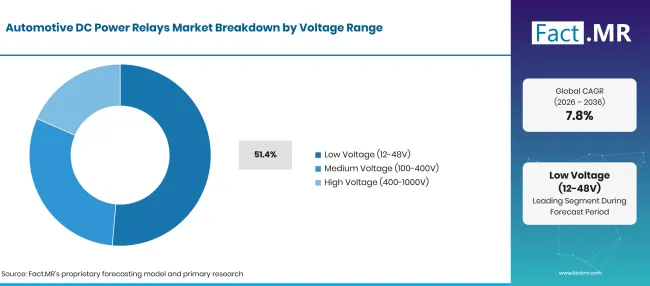
Factmr Automotive Dc Power Relays Market Breakdown Voltage Range | Source: Fact.MR
| Voltage Range | Share (2026) |
|---|---|
| Low Voltage (12-48V) (Leading segment) | 51.4% |
| Other segments combined | 48.6% |
| Total | 100.0% |
Source: Fact.MR analysis. Updated Oct 15, 2026
Low-voltage relays are used for common vehicle electrical systems and some 48 V setups, providing compact and reliable switching. The 100-400 V range is for different circuit needs with proper contact spacing. The 400-1000 V range handles high-voltage tasks requiring strong fault protection and insulation. Voltage class depends on the circuit and should be checked in product datasheets.
Which End-User?
Original Equipment Manufacturers (OEMs) holds 72.1% share in 2026.
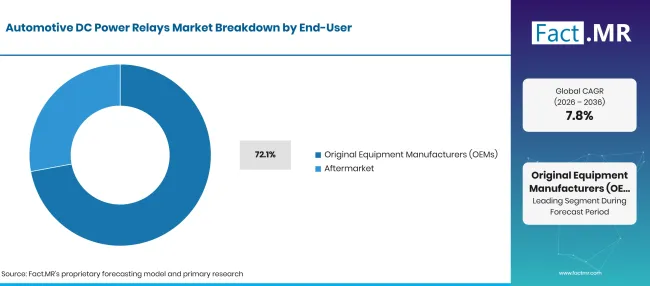
Factmr Automotive Dc Power Relays Market Breakdown End User | Source: Fact.MR
| End-User | Share (2026) |
|---|---|
| Original Equipment Manufacturers (OEMs) (Leading segment) | 72.1% |
| Other segments combined | 27.9% |
| Total | 100.0% |
Source: Fact.MR analysis. Updated Oct 15, 2026
Original equipment manufacturers normally approve relays during vehicle program design. They assess contact endurance and packaging because later component changes affect validation work. Aftermarket customers instead focus on reliable replacement supply and correct fit with the vehicle’s existing circuit. Clear part numbering helps workshops avoid fitting a visually similar relay with an unsuitable load rating. The difference matters commercially because OEM sales depend on multi-year platform awards, while replacement sales follow the age and service needs of vehicles already running.
What is accelerating Automotive DC Power Relays Market adoption, and what is holding it back?
Vehicle circuit expansion supports purchases, while contact qualification and cost pressure slow changes to approved parts.
Drivers Impact Analysis
| DRIVER | (~) % IMPACT ON CAGR | GEOGRAPHIC RELEVANCE | IMPACT TIMELINE |
|---|---|---|---|
| Vehicle electrical content | +1.1% | Global | Medium term (2–4 years) |
| OEM platform renewal | +0.9% | USA, Germany, Japan | Medium term (2–4 years) |
| Accessory load switching | +0.8% | Global | Short term (≤ 2 years) |
| Electrified vehicle circuits | +0.7% | UK, USA | Long term (≥ 4 years) |
| Commercial fleet equipment | +0.5% | Brazil, USA | Medium term (2–4 years) |
Source: Fact.MR analysis. Updated Oct 15, 2026
Opportunity Impact Analysis
| OPPORTUNITY | (~) % IMPACT ON CAGR | GEOGRAPHIC RELEVANCE | IMPACT TIMELINE |
|---|---|---|---|
| Compact relay designs | +0.8% | Japan, Germany | Medium term (2–4 years) |
| 48 V circuit protection | +0.6% | Europe, USA | Long term (≥ 4 years) |
| OEM supplier localization | +0.5% | Brazil, USA | Medium term (2–4 years) |
| Replacement part traceability | +0.4% | Global | Short term (≤ 2 years) |
Source: Fact.MR analysis. Updated Oct 15, 2026
Restraints Impact Analysis
| RESTRAINT | (~) % IMPACT ON CAGR | GEOGRAPHIC RELEVANCE | IMPACT TIMELINE |
|---|---|---|---|
| Contact wear and arcing | -0.8% | Global | Short term (≤ 2 years) |
| Qualification time | -0.6% | Germany, Japan | Medium term (2–4 years) |
| Price pressure | -0.5% | Brazil, USA | Medium term (2–4 years) |
| Solid-state substitution | -0.4% | Global | Long term (≥ 4 years) |
Source: Fact.MR analysis. Updated Oct 15, 2026
Which countries are scaling the Automotive DC Power Relays Market through 2036?
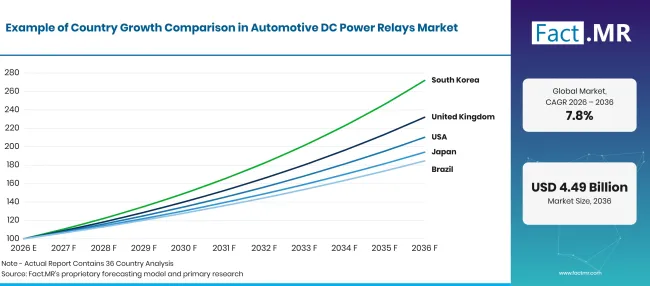
Factmr Automotive Dc Power Relays Market Growth Index | Source: Fact.MR
| Country | CAGR (2026–2036) |
|---|---|
| United Kingdom | 8.8% |
| United States | 7.7% |
| Japan | 6.9% |
| Brazil | 6.3% |
| Germany | 6.0% |
Source: Fact.MR analysis. Updated Oct 15, 2026
What supports automotive DC relay sales in the United Kingdom?
8.8% CAGR, driven by zero-emission vehicle registrations, domestic assembly, and replacement demand.
UK vehicle manufacturers and service networks require automotive DC relays for body power distribution, auxiliary circuits, and electric vehicle isolation functions. The Department for Transport reported 528,000 first registrations of zero-emission vehicles in 2025 [2], while SMMT reported 717,371 cars produced during the year [3]. Suppliers therefore need dependable contact performance, suitable current ratings, and steady replacement availability across changing vehicle platforms.
Why does the United States support continued relay purchasing?
7.7% CAGR, shaped by large vehicle production volumes, rising electrical content, and a broad service network.
Factmr Automotive Dc Power Relays Market Growth Index 1 | Source: Fact.MR
U.S. automakers use relays across passenger cars, light trucks, and other vehicle electrical systems, while repair channels depend on accurate fitment information. The Federal Reserve reported an annualized average of 10.16 million motor vehicle assemblies in 2025 [5]. Engineers also test contact life and heat performance before approval, making reliable switching behavior and clear part identification important for both production and aftermarket sales.
How is Japan shaping automotive DC relay design?
6.9% CAGR, influenced by compact packaging, established electrical engineering, and vehicle quality requirements.
Japanese relay suppliers focus on compact housings, controlled production, and dependable switching performance across body and high-voltage vehicle circuits. The Japan Automobile Manufacturers Association reported 3,345,023 vehicles produced by Japanese manufacturers in the United States during fiscal 2025 [6]. Global production programs therefore favor relay designs that can maintain consistent specifications across different assembly locations and vehicle platforms.
How are Brazilian vehicle programs influencing relay sales?
6.3% CAGR, supported by domestic vehicle production and aftermarket servicing.
Brazilian assembly plants and repair networks create steady requirements for relays used in passenger and commercial vehicle electrical systems. ANFAVEA reported 2.644 million vehicles produced in Brazil during 2025 [4]. Local suppliers benefit when they can maintain approved designs through model changes, while repair workshops depend on correct contact ratings and connector fit to match relays with existing vehicle electrical layouts.
What shapes the automotive DC relay outlook in Germany?
6.0% CAGR, linked to high-volume vehicle production, export activity, and detailed component validation.
German vehicle manufacturers require clear test records for contact life and electrical performance before approving relays for production. The German Automotive Industry Association reported 4.15 million passenger cars produced domestically in 2025 [7], while Destatis recorded about 1.5 million new-car exports from January to May 2025 [8]. Export-oriented vehicle programs therefore place strong emphasis on consistent relay specifications, repeatable testing, and reliable long-term supply.
Who leads the Automotive DC Power Relays Market?
TE Connectivity and Panasonic supply automotive switching products, while specialist offerings span other vehicle component groups.
TE Connectivity offers automotive relays and contactors for different power requirements. also supplies DC contactors and mechanical relays designed for specific vehicle applications. Vehicle manufacturers look at performance ratings and testing results before approving either product. Products that look similar are not always interchangeable because they may serve different electrical functions.
has a long history in automotive relay production, although changes in business ownership have affected part of its relay operations. and supply vehicle electrical components, but suitability depends on the exact relay specification. has a relay legacy as well, but current product responsibilities vary across its business structure.
As a result, it is more useful to compare specific relay and contactor product families rather than assume that every large electronics supplier offers the same types of products.
Which companies are the key providers?
Key companies include TE Connectivity; Panasonic Corporation; Aratas Corporation; FCL Components Limited; FORVIA HELLA; and Denso Corporation.
- TE Connectivity
- Panasonic Corporation
- Aratas Corporation
- FCL Components Limited
- FORVIA HELLA
- Denso Corporation
Bibliography
- [1] U.S. Environmental Protection Agency. (2026, February). 2025 EPA Automotive Trends Report: Fuel economy and technology since 1975.
- [2] Department for Transport. (2026, April 29). Vehicle licensing statistics: 2025.
- [3] Society of Motor Manufacturers and Traders. (2026, February 20). SMMT Motor Industry Facts 2026.
- [4] Associação Nacional dos Fabricantes de Veículos Automotores. (2026, January 15). Produção e venda de autoveículos crescem em 2025 e Anfavea projeta nova alta em 2026.
- [5] Board of Governors of the Federal Reserve System. (2026, September 18). Industrial Production and Capacity Utilization: Table 3. Motor Vehicle Assemblies.
- [6] Japan Automobile Manufacturers Association. (2026). Overseas production statistics: Fiscal 2025.
- [7] Verband der Automobilindustrie. (2026, January 5). Passenger car production in 2025 slightly above previous year's level.
- [8] Statistisches Bundesamt (Destatis). (2025, July 18). Exports of new passenger cars in the first five months of 2025 up 1.1% year on year.
This Report Answers
- The analysis examines how relay contact performance affects selection for vehicle power distribution.
- Segment comparison explains the position of electromechanical relays within vehicle electrical switching.
- Application discussion separates passenger vehicles from commercial and electric vehicle relay requirements.
- The voltage analysis distinguishes auxiliary switching duties from higher-voltage battery isolation.
- Country outlooks review local vehicle activity in Germany, Brazil, the United States, the United Kingdom and Japan.
- The competitive discussion evaluates automotive relay relevance without assigning company market shares.
What does the Automotive DC Power Relays Market cover?
The market covers DC electrical switching relays installed in vehicles to control current delivered to an electrical load. It includes electromechanical and solid-state types used within the defined voltage categories. Related Fact.MR coverage of automotive relay products addresses a broader combination of vehicle switching devices.
What is included in the scope?
Included sales concern individual automotive power relays and useful vehicle contactors sold for approved circuit applications. OEM installation is covered alongside aftermarket sales of replacement relays. Electrical classification follows the switched-circuit duty and should be read with the manufacturer’s load and interruption ratings. Control coil voltage alone is insufficient for placing a part in a switched-voltage category.
What is excluded from the scope?
Industrial-only power relays and building electrical contactors fall outside vehicle applications. Complete vehicle control units and wire harnesses are also excluded when their value is counted as a finished assembly instead of an individual relay. Charging-station relays fitted outside the vehicle are separate products unless expressly included in the specified automotive component boundary.
How Was the Analysis Built?
The analysis draws on 120+ sources, 35+ company portfolios, 25+ countries, and more than 20 industry interviews.
- Primary Research: Primary research includes discussions with manufacturers, service providers, technology developers, distributors, end users, and subject-matter experts. These conversations examine purchasing priorities, product adoption, operational challenges, approval requirements, competitive positioning, and the factors that influence wider market acceptance.
- Desk Research: Desk research covers government statistics, regulatory publications, company filings, trade data, technical studies, industry associations, standards, public policy, and other authoritative sources. Every source used in the analysis is documented in the bibliography.
- Market Sizing and Forecasting: Market estimates combine historical performance, demand indicators, pricing and volume trends, segment shares, company participation, country-level growth, adoption patterns, investment activity, and barriers to market expansion.
- Data Validation and Update Cycle: Findings are validated by comparing primary interviews with public data, company activity, regulatory changes, trade patterns, and industry developments. Regular updates review new product launches, capacity changes, partnerships, approvals, and shifts in commercial adoption.
Segmentation
What is the report’s scope and coverage?
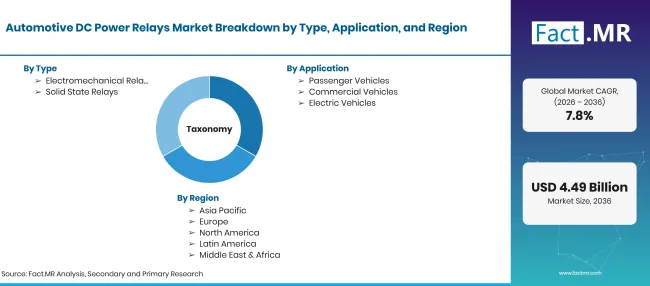
Factmr Automotive Dc Power Relays Market Taxonomy | Source: Fact.MR
| Attribute | Details |
|---|---|
| Quantitative Units | USD billion in 2026 to USD billion by 2036 at CAGR |
| Market Definition | Automotive direct-current electromechanical and solid-state power relays for switching vehicle electrical loads. |
| Type | Electromechanical Relays; Solid State Relays |
| Application | Passenger Vehicles; Commercial Vehicles; Electric Vehicles |
| Voltage Range | Low Voltage (12-48V); Medium Voltage (100-400V); High Voltage (400-1000V) |
| End-User | Original Equipment Manufacturers (OEMs); Aftermarket |
| Countries Covered | Germany; Brazil; United States; United Kingdom; Japan |
| Forecast Period | 2026 to 2036 |
| Companies Profiled | TE Connectivity; Panasonic; Aratas Corporation; FCL Components Limited; FORVIA HELLA; DENSO |
| Approach | Relay application analysis, electrical-rating assessment and official vehicle-production context |
Source: Fact.MR analysis. Updated Oct 15, 2026
How is the market segmented?
-
By Type
- Electromechanical Relays
- Solid State Relays
-
By Application
- Passenger Vehicles
- Commercial Vehicles
- Electric Vehicles
-
By Voltage Range
- Low Voltage (12-48V)
- Medium Voltage (100-400V)
- High Voltage (400-1000V)
-
By End-User
- Original Equipment Manufacturers (OEMs)
- Aftermarket
-
By Region
- North America
- Latin America
- Western Europe
- Eastern Europe
- East Asia
- South Asia & Pacific
- Middle East & Africa
Frequently Asked Questions
How big is the Automotive DC Power Relays Market in 2026?
What is the CAGR of the Automotive DC Power Relays Market from 2026 to 2036?
Which type leads the Automotive DC Power Relays Market?
Which application leads the Automotive DC Power Relays Market?
Who are the leading companies in the Automotive DC Power Relays Market?
Who worked on this report


Preview the report firsthand - request a free sample
Free SampleGet the brochure for pricing and purchase details
Download PDF