- Market Value (2025): USD 18.7 Bn
- Estimated Value (2026): USD 20.2 Bn
- Forecast Value (2036): USD 42.7 Bn
- CAGR (2026-2036): 7.8%
What is the Automotive Electronic Throttle Control System Market forecast to be worth by 2036?
USD 20.2 billion in 2026 to USD 42.7 billion by 2036 at a 7.8% CAGR.
- As per Fact.MR analysis, the automotive electronic throttle control system market was valued at USD 18.7 billion in 2025.
- Revenue is projected to increase from USD 20.2 billion in 2026 to USD 42.7 billion by 2036.
- The 7.8% CAGR reflects integration of electronic accelerator inputs and electronically controlled engine air management across vehicle platforms.
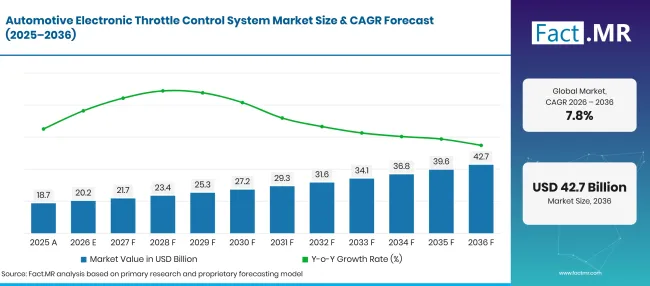
Automotive Electronic Throttle Control System Market Forecast Global | Source: Fact.MR
| Year | Basis | Market Value (USD billion) |
|---|---|---|
| 2025 | Actual | 18.7 |
| 2026 | Estimate | 20.2 |
| 2036 | Forecast | 42.7 |
| CAGR 2026 to 2036 | Forecast period | 7.8% |
Source: Fact.MR analysis. Updated Nov 3, 2026
What are the defining numbers behind Automotive Electronic Throttle Control System Market growth?
The forecast represents USD 22.5 billion in additional market value between 2026 and 2036.
- Demand Drivers in the Market
- Engine control engineers rely on throttle angle accuracy to balance driver requests and engine operating conditions. Electronic control lets the engine computer calculate throttle movement from sensor inputs rather than a mechanical cable.
- Automakers need a repeatable response across related engine variants. In January 2026, VDA reported that German plants assembled 4.15 million passenger cars during 2025 [1].
- Hybrid powertrains retain engine-air controls when a combustion engine remains part of the drive system. In January 2026, the European Automobile Manufacturers’ Association recorded 3,733,325 EU hybrid-electric passenger-car registrations during 2025 [2].
- Key Segments Analyzed
- By Vehicle Type: Passenger Cars account for 58.4% of 2026 sales as high-volume vehicle platforms use electronically managed engine air intake.
- By Component: Throttle Body represents 42.1% of 2026 value and combines an air passage with an electronically operated throttle plate.
- By Technology: Electronic systems capture 81.2% of 2026 sales, reflecting electronically interpreted accelerator requests.
- By Sales Channel: OEM supply accounts for 82.4% of 2026 value because assemblies are specified during vehicle engineering.
- Analyst Opinion at Fact.MR
- Shambhu Nath Jha, Principal Consultant at Fact.MR, states, “Electronic throttle suppliers compete on actuator accuracy, sensor feedback and compatibility with engine software. Manufacturers test assemblies across changing engine loads and fault conditions before approving them for production. Engine-air throttle bodies used in combustion vehicles are distinct from accelerator-input hardware used in fully electric vehicles.”
- Strategic Implications
- Throttle body manufacturers can focus on actuator endurance and accurate throttle-position feedback during vehicle-platform qualification.
- Automakers need to distinguish engine-air throttle content from accelerator input modules when reviewing electrified vehicle bills of material.
- Aftermarket distributors benefit from matching replacement components with the original calibration and connector requirements for each engine variant.
- Component design teams can document fault response and sensor agreement before releasing a revised control assembly.
Germany is projected to record 9.0% CAGR through 2036 as vehicle electronics programs reshape component requirements. Brazil follows at 8.2% amid local vehicle manufacturing and replacement demand. The USA is forecast at 7.4% while the UK reaches 6.6%. Japan is anticipated to expand at 5.9% as established component makers serve multiple powertrain platforms.
How does the Automotive Electronic Throttle Control System Market break down by segment?
Passenger Cars 58.4%; Throttle Body 42.1%; Electronic 81.2%; OEM 82.4%.
Which Vehicle Type leads?
Passenger Cars accounts for 58.4% of 2026 value.
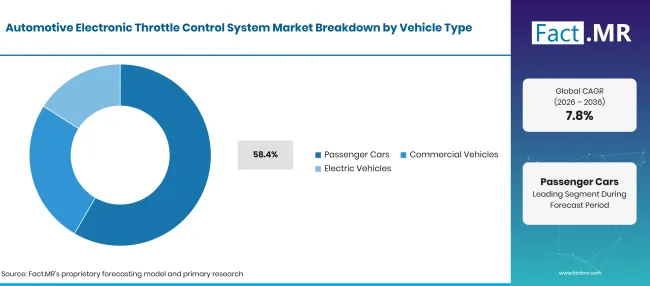
Automotive Electronic Throttle Control System Market Breakdown Vehicle Type | Source: Fact.MR
| Vehicle Type | Share (2026) |
|---|---|
| Passenger Cars (Leading segment) | 58.4% |
| Other segments combined | 41.6% |
| Total | 100.0% |
Source: Fact.MR analysis. Updated Nov 3, 2026
Passenger cars represent high unit volumes and use electronic accelerator control across a wide range of combustion and hybrid engines. Commercial vehicles often demand durable assemblies suited to sustained operating cycles. Electric vehicles use electronic accelerator inputs, although pure battery-electric propulsion does not require an internal-combustion throttle body. Global electric-car sales exceeded 20 million units in 2025 according to the International Energy Agency [3].
What leads the Component segment?
Throttle Body leads with 42.1% of 2026 value.
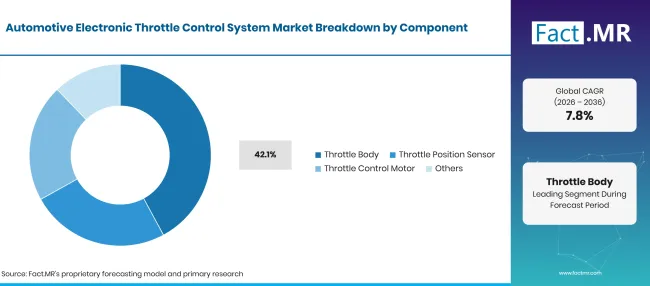
Automotive Electronic Throttle Control System Market Breakdown Component | Source: Fact.MR
| Component | Share (2026) |
|---|---|
| Throttle Body (Leading segment) | 42.1% |
| Other segments combined | 57.9% |
| Total | 100.0% |
Source: Fact.MR analysis. Updated Nov 3, 2026
A throttle body contains the valve that regulates the air entering a combustion engine. Its motor follows commands from the engine controller, while a position sensor reports the actual valve setting. Replacement parts must match the bore size, electrical connector and vehicle calibration.
How does Technology shape demand?
Electronic represents 81.2% of 2026 value.
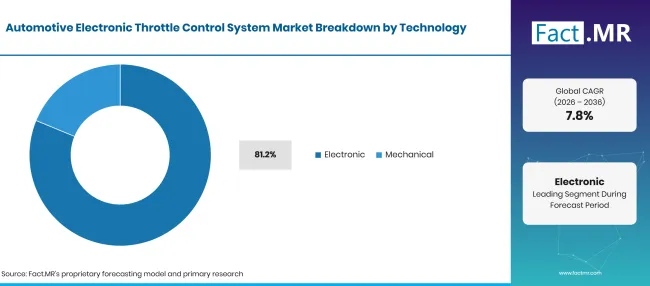
Automotive Electronic Throttle Control System Market Breakdown Technology | Source: Fact.MR
| Technology | Share (2026) |
|---|---|
| Electronic (Leading segment) | 81.2% |
| Other segments combined | 18.8% |
| Total | 100.0% |
Source: Fact.MR analysis. Updated Nov 3, 2026
An electronic throttle system turns accelerator-pedal movement into signals that tell the controller how far to open the throttle plate. This allows manufacturers to calibrate engine response and monitor faults through vehicle diagnostics. Older fleets may still contain mechanical cable arrangements, which have different repair requirements.
Which Sales Channel accounts for the most sales?
OEM captures 82.4% of 2026 value.
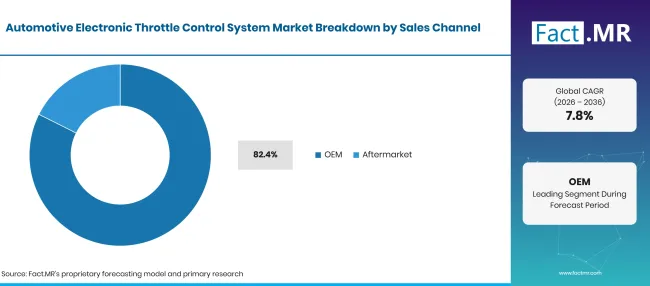
Automotive Electronic Throttle Control System Market Breakdown Sales Channel | Source: Fact.MR
| Sales Channel | Share (2026) |
|---|---|
| OEM (Leading segment) | 82.4% |
| Other segments combined | 17.6% |
| Total | 100.0% |
Source: Fact.MR analysis. Updated Nov 3, 2026
Original equipment manufacturers purchase throttle assemblies to match vehicle software and operating conditions. Early design selection often determines sensor interfaces and component packaging for the lifetime of an engine program. The aftermarket serves vehicles after the factory warranty period and during normal repair cycles. Independent service demand depends on fleet age and local access to compatible parts.
What is accelerating Automotive Electronic Throttle Control System Market adoption, and what is holding it back?
Engine-management requirements support demand, while calibration work and replacement costs influence purchasing.
Drivers Impact Analysis
| DRIVER | (~) % IMPACT ON CAGR | GEOGRAPHIC RELEVANCE | IMPACT TIMELINE |
|---|---|---|---|
| Electronic engine-management integration | +1.5% | Global | Medium term |
| Passenger car platform refreshes | +1.1% | Europe; East Asia | Medium term |
| Hybrid powertrain production | +0.8% | Europe; Japan | Long term |
| Diagnostics and position feedback | +0.6% | North America; Europe | Short term |
| Replacement demand for aging fleets | +0.4% | Global | Long term |
Source: Fact.MR analysis. Updated Nov 3, 2026
Opportunity Impact Analysis
| OPPORTUNIT | (~) % IMPACT ON CAGR | GEOGRAPHIC RELEVANCE | IMPACT TIMELINE |
|---|---|---|---|
| Integrated actuator and sensor assemblies | +0.8% | Europe; Asia | Medium term |
| Service parts for aging engine platforms | +0.6% | Americas | Short term |
| Control calibration for hybrid engines | +0.5% | Europe; Japan | Medium term |
| Platform-level component standardization | +0.4% | Global | Long term |
Source: Fact.MR analysis. Updated Nov 3, 2026
Restraints Impact Analysis
| RESTRAINT | (~) % IMPACT ON CAGR | GEOGRAPHIC RELEVANCE | IMPACT TIMELINE |
|---|---|---|---|
| Pure battery-electric powertrains lack engine throttles | -0.7% | Global | Long term |
| Calibration and qualification expense | -0.5% | Global | Medium term |
| Warranty liability from electronic faults | -0.4% | North America; Europe | Short term |
| Price pressure on replacement parts | -0.3% | Global | Medium term |
Source: Fact.MR analysis. Updated Nov 3, 2026
Which countries are scaling the Automotive Electronic Throttle Control System Market through 2036?
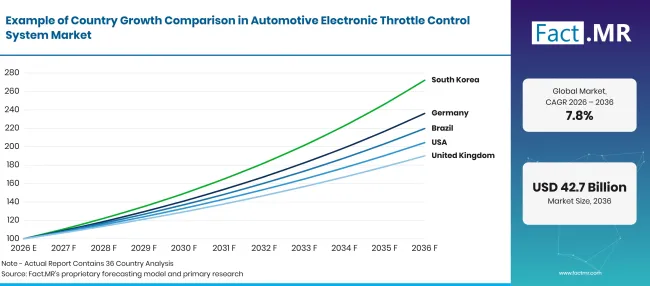
Automotive Electronic Throttle Control System Market Growth Index | Source: Fact.MR
| Country | CAGR (2026 to 2036) |
|---|---|
| Germany | 9.0% |
| Brazil | 8.2% |
| USA | 7.4% |
| UK | 6.6% |
| Japan | 5.9% |
Source: Fact.MR analysis. Updated Nov 3, 2026
What supports Germany adoption?
9.0% CAGR, tied to Germany’s shift toward electrified vehicle platforms and continued throttle demand in combustion engines.
German throttle-system programs depend on the engineering specifications used across major vehicle platforms. Engine platforms that retain combustion power continue to require calibrated throttle bodies and reliable position feedback.
What supports Brazil adoption?
8.2% CAGR, supported by Brazil’s vehicle production base and replacement demand across established fleets.
Brazilian vehicle assembly provides factory orders for electronic throttle components on combustion and hybrid engine lines. In January 2026, ANFAVEA reported production of 2.644 million motor vehicles during 2025 [5]. Local manufacturers need components compatible with the engines built for domestic use. Service companies also support established vehicle fleets, where accurate part identification is central to reliable replacement work.
What supports USA adoption?
7.4% CAGR, linked to large-scale U.S. vehicle production and stable throttle-control requirements across gasoline and hybrid models.
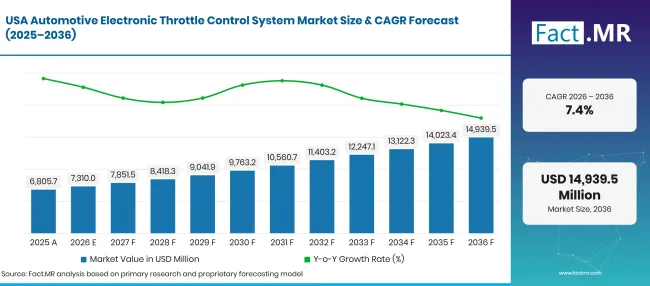
Automotive Electronic Throttle Control System Market Forecast Usa | Source: Fact.MR
United States automakers assess engine-air controls against the needs of gasoline and hybrid platforms. The VDA worldwide production series for 2025 records 9,995,789 passenger cars assembled in the United States [4]. Original-equipment contracts rely on stable response and position feedback across model variants.
What supports UK adoption?
6.6% CAGR, driven by UK vehicle manufacturing and the need for correctly matched electronic throttle components.
United Kingdom engine and vehicle production creates demand for sensors and air-control components on combustion-equipped platforms. In January 2026, SMMT reported 717,371 passenger cars manufactured in the UK during 2025 [6]. Engineers must align replacement and original equipment specifications with the engine fitted to each model. Workshop support also depends on clearly identified electronic throttle parts and calibration guidance.
What supports Japan adoption?
5.9% CAGR, shaped by Japan’s vehicle production base and strict component requirements across domestic engine platforms.
Japanese automakers emphasize repeatable valve motion and dependable feedback across engine families. The VDA international production series records 7,207,127 passenger cars manufactured in Japan during 2025. Throttle suppliers working on domestic engine platforms must meet manufacturer-specific electrical and mechanical requirements.
Who leads the Automotive Electronic Throttle Control System Market?
Company comparisons turn on the specific hardware available for engine-air control. Robert Bosch GmbH describes an electronic throttle valve operated by the engine control unit with angle-sensor feedback [7].
DENSO Corporation and Aisan Industry Co., Ltd. have engine-management and intake-component portfolios. Mikuni Corporation and Rheinmetall Pierburg are associated with air-management hardware. Astemo, Marelli and FORVIA HELLA contribute automotive electronic control or related components. The commercial distinction is whether a supplier supports the engine throttle itself or a connected electronics function.
Which companies are the key providers?
Key companies include Robert Bosch GmbH; DENSO Corporation; Astemo, Ltd.; Marelli; FORVIA HELLA; Aisan Industry Co., Ltd.; Mikuni Corporation; Rheinmetall AG (Pierburg).
- Robert Bosch GmbH
- DENSO Corporation
- Astemo, Ltd.
- Marelli
- FORVIA HELLA
- Aisan Industry Co., Ltd.
- Mikuni Corporation
- Rheinmetall AG (Pierburg)
Bibliography
- [1] German Association of the Automotive Industry. (2026, January 5). Passenger car production in 2025 slightly above previous year’s level.
- [2] European Automobile Manufacturers’ Association. (2026, January 27). New car registrations: +1.8% in 2025; battery-electric 17.4% market share.
- [3] International Energy Agency. (2026, May 20). Global EV Outlook 2026: Executive summary.
- [4] German Association of the Automotive Industry. (n.d.). Automobile production.
- [5] Associação Nacional dos Fabricantes de Veículos Automotores. (2026, January 15). Produção e venda de autoveículos crescem em 2025 e Anfavea projeta nova alta em 2026.
- [6] Society of Motor Manufacturers and Traders. (2026, January 29). Tough year for auto but new models and Industrial Strategy can deliver growth.
- [7] Bosch Mobility. (n.d.). Electronic throttle valve.
This Report Answers
- How passenger-car production influences factory throttle-unit demand and component qualification.
- Where electronic throttle bodies differ from accelerator input hardware on electric platforms.
- What sensor feedback and fault response mean for vehicle service and warranty exposure.
- How OEM orders differ from aftermarket sales and replacement cycles.
- Why the five covered countries have different forecast growth rates.
- Which named manufacturers participate in automotive engine-control and related air-management portfolios.
What does the Automotive Electronic Throttle Control System Market cover?
An electronic throttle system turns accelerator-pedal movement into signals that tell the controller how far to open the throttle plate. This allows manufacturers to calibrate engine response and monitor faults through vehicle diagnostics. Older fleets may still contain mechanical cable arrangements, which have different repair requirements. Electronic designs also need durable connectors and resistance to electrical interference, making correct part identification essential.
What is included in the scope?
Factory supply of suitable electronic throttle hardware is included alongside replacement sales through the aftermarket. Passenger and commercial combustion-engine vehicles form the central installed applications. Hybrid vehicles are included where an internal-combustion engine needs a throttle assembly. Electronic accelerator inputs on battery-electric vehicles are discussed only as an adjacent control function, with careful separation from engine throttle hardware.
What is excluded from the scope?
Mechanical engine linkages outside the specified electronically controlled equipment boundary are excluded from electronic-system sales. Standalone traction inverters and battery-control hardware are excluded. Battery-electric vehicles without a combustion engine are not treated as purchasers of intake-air throttle bodies. Generic vehicle sensors with no accelerator or throttle-control function are also outside the component definition.
How Was the Analysis Built?
The analysis draws on 120+ sources, 35+ company portfolios, 25+ countries, and more than 20 industry interviews.
- Primary Research: Primary research includes discussions with manufacturers, service providers, technology developers, distributors, end users, and subject-matter experts. These conversations examine purchasing priorities, product adoption, operational challenges, approval requirements, competitive positioning, and the factors that influence wider market acceptance.
- Desk Research: Desk research covers government statistics, regulatory publications, company filings, trade data, technical studies, industry associations, standards, public policy, and other authoritative sources. Every source used in the analysis is documented in the bibliography.
- Market Sizing and Forecasting: Market estimates combine historical performance, demand indicators, pricing and volume trends, segment shares, company participation, country-level growth, adoption patterns, investment activity, and barriers to market expansion.
- Data Validation and Update Cycle: Findings are validated by comparing primary interviews with public data, company activity, regulatory changes, trade patterns, and industry developments. Regular updates review new product launches, capacity changes, partnerships, approvals, and shifts in commercial adoption.
Segmentation
What is the report’s scope and coverage?
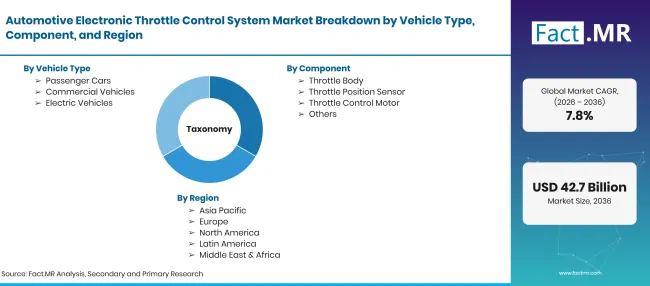
Automotive Electronic Throttle Control System Market Taxonomy | Source: Fact.MR
| Attribute | Details |
|---|---|
| Quantitative Units | USD billion |
| Market Definition | Electronic control of accelerator request and combustion-engine throttle airflow, including associated actuators and sensing functions. |
| Vehicle Type | Passenger Cars; Commercial Vehicles; Electric Vehicles |
| Component | Throttle Body; Throttle Position Sensor; Throttle Control Motor; Others |
| Technology | Electronic; Mechanical |
| Sales Channel | OEM; Aftermarket |
| Countries Covered | Germany; Brazil; USA; UK; Japan |
| Companies Profiled | Robert Bosch GmbH; DENSO Corporation; Astemo, Ltd.; Marelli; FORVIA HELLA; Aisan Industry Co., Ltd.; Mikuni Corporation; Rheinmetall AG (Pierburg). |
| Forecast Period | 2026 to 2036 |
| Approach | Platform-component mapping, production context, technology content assessment and aftermarket demand review |
Source: Fact.MR analysis. Updated Nov 3, 2026
How is the market segmented?
-
By Vehicle Type
- Passenger Cars
- Commercial Vehicles
- Electric Vehicles
-
By Component
- Throttle Body
- Throttle Position Sensor
- Throttle Control Motor
- Others
-
By Technology
- Electronic
- Mechanical
-
By Sales Channel
- OEM
- Aftermarket
-
By Region
- North America
- Latin America
- Western Europe
- Eastern Europe
- East Asia
- South Asia & Pacific
- Middle East & Africa
Frequently Asked Questions
How big is the automotive electronic throttle control system market in 2026?
What is the market CAGR through 2036?
Which vehicle type accounts for the most sales?
Which component leads?
Who are the main companies in the automotive electronic throttle control system market?
Who worked on this report


Preview the report firsthand - request a free sample
Free SampleGet the brochure for pricing and purchase details
Download PDF