- Market Value (2025): USD 6.23 Bn
- Estimated Value (2026): USD 6.65 Bn
- Forecast Value (2036): USD 12.7 Bn
- CAGR (2026-2036): 6.7%
What is the Automotive Protection Films Market forecast to be worth by 2036?
USD 6.7 billion in 2026 to USD 12.7 billion by 2036 at a 6.7% CAGR.
- As per Fact.MR analysis, the automotive protection films market was valued at USD 6.23 billion in 2025.
- Demand will grow from USD 6.65 billion in 2026 to USD 12.7 billion by 2036.
- Fact.MR forecasts a 6.7% CAGR from 2026 to 2036, supported by demand for vehicle surface protection and growing interest in preserving exterior finishes.
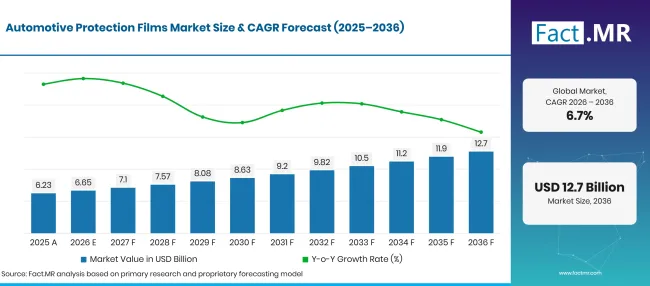
Factmr Automotive Protection Films Market Forecast Global | Source: Fact.MR
| Year | Basis | Market Value (USD billion) |
|---|---|---|
| 2025 | Actual | 6.23 |
| 2026 | Estimate | 6.65 |
| 2036 | Forecast | 12.7 |
| CAGR 2026 to 2036 | Forecast period | 6.7% |
Source: Fact.MR analysis. Updated Oct 15, 2026
What are the defining numbers behind Automotive Protection Films Market growth?
USD 6.0 billion absolute opportunity between 2026 and 2036.
- Demand Drivers in the Market
- Vehicle owners increasingly seek protective films to reduce visible paint damage from road debris, scratches and everyday wear. Paint protection films can help preserve the appearance of vehicle surfaces and support resale value when correctly selected and maintained.
- Premium vehicle ownership and demand for exterior customization create opportunities for manufacturers offering transparent, colored and specialty protection films. According to the Society of Indian Automobile Manufacturers (SIAM), India recorded 1,273,811 domestic passenger vehicle sales during April–June 2026, representing year-over-year growth of approximately 25.9% and utility vehicles accounted for approximately 68%. [1]. [1]
- Aftermarket distribution supports demand from existing vehicle owners who want to protect their vehicles after purchase. According to the Automotive Component Manufacturers Association of India (ACMA), India's domestic automotive aftermarket grew by 9% to ₹1.85 lakh crore in FY2025–26. [2]. [2]
- Original equipment manufacturers and automotive suppliers can incorporate protective film solutions into vehicle delivery or accessory programs. According to ACMA, automotive component supplies to original equipment manufacturers (OEMs) in India increased by 16.3% to ₹6.52 lakh crore in FY2025–26. [2][3]
- Key Segments Analyzed
- By Product Type: Thermoplastic Polyurethane (TPU) leads with a 48.2% share, reflecting its role in flexible, durable surface protection films.
- By Application: Exterior applications account for 64.7% of the market, supported by demand to protect painted body panels and other exposed vehicle surfaces.
- By Vehicle Type: Passenger cars hold a 71.3% share, reflecting the importance of personal vehicle appearance and paint preservation.
- By Distribution Channel: Aftermarket will capture 62.8% of the market, highlighting the role of independent installers, detailing centers and automotive accessory retailers.
- Analyst Opinion at Fact.MR
- Shambhu Nath Jha, Principal Consultant at Fact.MR, states, “Automotive protection film manufacturers are positioned to benefit from continued interest in vehicle appearance and surface preservation. Competition will depend on film durability, clarity, resistance to yellowing, ease of installation and the quality of after-sales support. Manufacturers and distributors that clearly explain product performance, coverage and maintenance requirements can help buyers distinguish between protection film options.”
- Strategic Implications
- Manufacturers need to prioritize consistent film quality, optical clarity, durability and product performance under varied weather and driving conditions.
- Aftermarket distributors can strengthen relationships with professional installers by providing clear guidance on product selection, coverage and maintenance.
- Installation businesses can improve service quality through technician training, proper surface preparation and precise application techniques to reduce defects and enhance customer satisfaction.
- OEMs and automotive suppliers can evaluate opportunities to offer protective films as factory-approved accessories or dealer-installed options.
- Market participants need to communicate realistic product benefits and clearly differentiate paint protection films from conventional decorative wraps and other surface coatings.
Germany is set to record an 8.0% CAGR through 2036. Brazil is projected to post an 8.7% CAGR, followed by the USA at 6.3%. The UK is estimated to advance at 5.8%, while Japan is forecast to grow at 6.7%.
How does the Automotive Protection Films Market break down by segment?
Fact.MR finds that Thermoplastic Polyurethane as the leading Product Type at 48.2%, Exterior as the leading Application at 64.7%, Passenger Cars as the leading Vehicle Type at 71.3%, and Aftermarket as the leading Distribution Channel at 62.8%.
Which Product Type dominates?
Thermoplastic Polyurethane is set to hold 48.2% share in 2026.
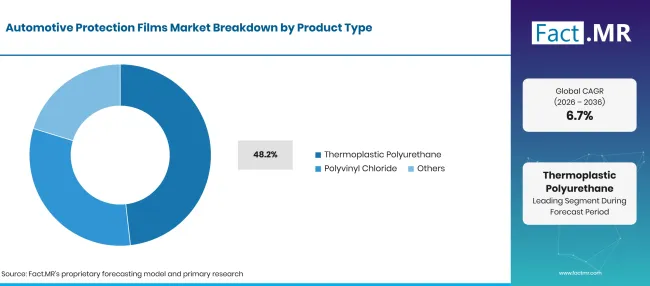
Factmr Automotive Protection Films Market Breakdown Product Type | Source: Fact.MR
| Product Type | Share (2026) |
|---|---|
| Thermoplastic Polyurethane (Leading segment) | 48.2% |
| Other segments combined | 51.8%* |
| Total | 100.0% |
Source: Fact.MR analysis. Updated Oct 15, 2026
Thermoplastic polyurethane is widely used in paint protection films because it combines flexibility with impact resistance and surface protection properties. Film performance varies by formulation, thickness, coating technology and installation quality. Polyvinyl chloride and other materials address different requirements, including cost, decorative finishes and specialized applications.
How does Application shape demand?
Exterior applications are set to account for 64.7% of the market.
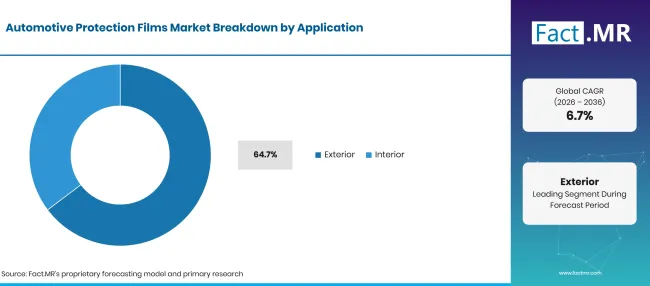
Factmr Automotive Protection Films Market Breakdown Application | Source: Fact.MR
| Application | Share (2026) |
|---|---|
| Exterior (Leading segment) | 64.7% |
| Other segments combined | 35.3%* |
| Total | 100.0% |
Source: Fact.MR analysis. Updated Oct 15, 2026
Exterior films protect exposed vehicle surfaces against everyday wear, minor scratches and road debris. Demand is supported by owners seeking to preserve paint condition and vehicle appearance. Interior protection applications address selected cabin surfaces that may be vulnerable to abrasion and routine use, although product requirements differ from those of exterior films. In August 2026, Avery Dennison launched its Supreme Defense Gloss Lite paint protection film, a 7.5-mil clear film featuring self-healing and hydrophobic properties and a seven-year warranty. Designed for daily-use vehicles, leased vehicles and commercial fleets, the product demonstrates industry efforts to offer protective films that combine durability, ease of installation and affordability [3]. [6]
Which Vehicle Type leads the market?
Passenger cars are set to hold a 71.3% share of the market.
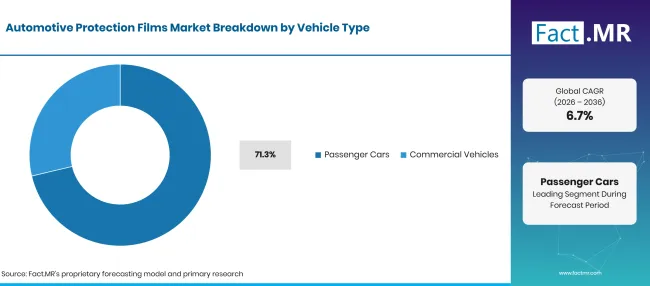
Factmr Automotive Protection Films Market Breakdown Vehicle Type | Source: Fact.MR
| Vehicle Type | Share (2026) |
|---|---|
| Passenger Cars (Leading segment) | 71.3% |
| Other segments combined | 28.7%* |
| Total | 100.0% |
Source: Fact.MR analysis. Updated Oct 15, 2026
Passenger cars account for the majority of demand in this segment. Private owners may choose protection films to maintain paint quality, improve the durability of high-contact areas and preserve the appearance of their vehicles. Commercial vehicle operators may also consider protective films, particularly where reducing visible wear supports fleet presentation and maintenance objectives. In April 2026, according to the International Organization of Motor Vehicle Manufacturers (OICA), as reported in its 2025 global vehicle sales statistics, worldwide motor vehicle sales reached approximately 99.8 million units in 2025, an increase of 4.7% from 2024. This global motor vehicle market represents a potential customer segment for paint protection film manufacturers targeting private vehicle owners seeking to protect exterior paintwork, reduce visible scratches and preserve vehicle appearance [4].[4]
How does Distribution Channel influence demand?
The aftermarket is set to account for 62.8% of the market.
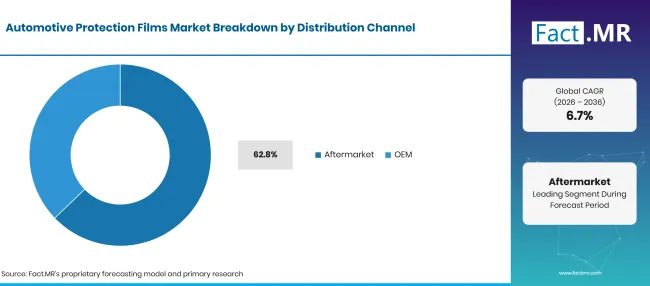
Factmr Automotive Protection Films Market Breakdown Distribution Channel | Source: Fact.MR
| Distribution Channel | Share (2026) |
|---|---|
| Aftermarket (Leading segment) | 62.8% |
| Other segments combined | 37.2%* |
| Total | 100.0% |
Source: Fact.MR analysis. Updated Oct 15, 2026
The aftermarket benefits from demand among existing vehicle owners who choose protection films after purchasing their vehicles. Professional installers and automotive detailing centers help customers select films based on vehicle use, budget and desired coverage. OEM distribution offers a different route through factory fitment, approved accessories and dealer-installed packages, allowing protection to be included earlier in the vehicle ownership process.
What is accelerating Automotive Protection Films Market adoption, and what is holding it back?
Vehicle surface protection boosts demand, but high costs and limited consumer awareness slow adoption.
Drivers Impact Analysis
| DRIVER | (~) % IMPACT ON CAGR | GEOGRAPHIC RELEVANCE | IMPACT TIMELINE |
|---|---|---|---|
| Rising demand for paint protection films | +1.0% | Europe, Americas | Medium term (2–4 years) |
| Growing consumer awareness of vehicle surface protection | +0.9% | Global | Short term (≤ 2 years) |
| Increasing premium vehicle ownership | +0.7% | Global | Medium term (2–4 years) |
| Expansion of aftermarket installation networks | +0.5% | Global | Short term (≤ 2 years) |
| OEM integration of protective film solutions | +0.4% | Global | Long term (≥ 4 years) |
Source: Fact.MR analysis. Updated Oct 15, 2026
Opportunity Impact Analysis
| OPPORTUNITY | (~) % IMPACT ON CAGR | GEOGRAPHIC RELEVANCE | IMPACT TIMELINE |
|---|---|---|---|
| Advanced self-healing paint protection films | +0.8% | Global | Medium term (2–4 years) |
| Growing demand for premium vehicle customization | +0.6% | Europe, Asia | Medium term (2–4 years) |
| OEM integration of factory-installed protection films | +0.5% | Americas, Asia | Long term (≥ 4 years) |
| Improved film performance and transparent product labeling | +0.4% | Global | Short term (≤ 2 years) |
Source: Fact.MR analysis. Updated Oct 15, 2026
Restraints Impact Analysis
| RESTRAINT | (~) % IMPACT ON CAGR | GEOGRAPHIC RELEVANCE | IMPACT TIMELINE |
|---|---|---|---|
| High upfront cost of paint protection films | -0.8% | Global | Short term (≤ 2 years) |
| Limited consumer awareness of long-term benefits | -0.6% | Global | Medium term (2–4 years) |
| Installation quality inconsistencies and risk of film defects | -0.5% | Global | Short term (≤ 2 years) |
| Uneven availability of skilled installers and authorized distribution networks | -0.4% | Global | Medium term (2–4 years) |
Source: Fact.MR analysis. Updated Oct 15, 2026
Which countries are scaling the Automotive Protection Films Market through 2036?
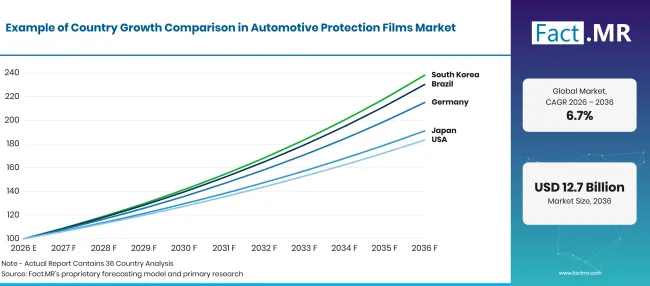
Factmr Automotive Protection Films Market Growth Index | Source: Fact.MR
| Country | CAGR (2026-2036) |
|---|---|
| Germany | 8.0% |
| Brazil | 8.7% |
| USA | 6.3% |
| UK | 5.8% |
| Japan | 6.7% |
Source: Fact.MR analysis. Updated Oct 15, 2026
What supports Germany adoption?
8.0% CAGR, supported by premium vehicle ownership, automotive manufacturing capabilities and demand for paint protection.
Germany’s established automotive industry and premium vehicle segment create opportunities for automotive protection films, particularly paint protection films designed to preserve exterior finishes. Demand is supported by interest in maintaining vehicle appearance and resale value, while professional installation networks help customers access specialized film products.
Adoption also depends on product durability, optical clarity and installation quality under varied driving and weather conditions. In January 2026, the German Association of the Automotive Industry (VDA) reported that domestic passenger car production reached 4.15 million units in 2025, up 2% year over year [5]. [7]
How is Brazil developing automotive protection film adoption?
8.7% CAGR, driven by vehicle appearance protection, aftermarket demand and expanding customization opportunities.
Brazil’s automotive protection films market is supported by demand for exterior paint protection, particularly in the aftermarket, where vehicle owners can choose films based on budget, durability and intended use. Paint protection films can help protect exposed surfaces from stone chips, scratches and environmental contaminants.
Broader adoption depends on affordability, consumer awareness and the availability of trained installers across regional markets. In January 2026, the Brazilian Association of Motor Vehicle Manufacturers (ANFAVEA) reported that Brazil produced 2.644 million motor vehicles in 2025, an increase of 3.5% over 2024 [6]. [8]
What supports United States adoption?
6.3% CAGR, supported by established aftermarket channels, premium vehicle care and demand for durable surface protection.
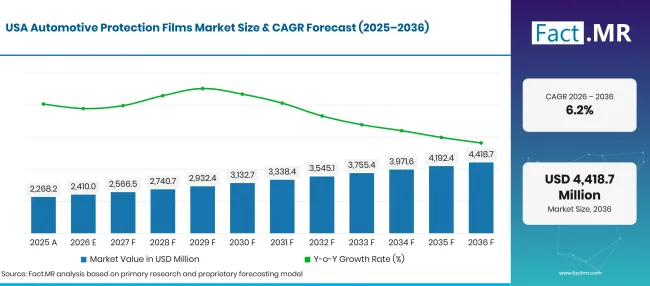
Factmr Automotive Protection Films Market Forecast Usa | Source: Fact.MR
The U.S. market benefits from a developed automotive aftermarket and consumer interest in maintaining vehicle appearance and value. Paint protection films are used on vulnerable exterior areas, including hoods, bumpers, mirrors and fenders, while specialized installers support product selection and application. Demand is also influenced by film performance, warranty coverage, installation costs and competition from ceramic coatings and conventional vehicle wraps.
How is the United Kingdom building adoption?
5.8% CAGR, shaped by aftermarket installation services, vehicle appearance maintenance and demand for exterior protection.
The UK market is supported by vehicle owners seeking to preserve paintwork against road debris, scratches and environmental exposure. Professional installation businesses and automotive detailing providers help introduce protection films to consumers, particularly owners of premium and performance vehicles. Adoption depends on product affordability, installer expertise and the ability of films to maintain optical clarity and adhesion under changing weather conditions. In April 2026, The Society of Motor Manufacturers and Traders (SMMT) reported that 42.55 million vehicles were on UK roads in 2025, including 36.68 million cars [7]. [5]
What supports Japan adoption?
6.7% CAGR, supported by vehicle finish preservation, precision-oriented installation and demand for high-quality automotive accessories.
Japan’s automotive protection films market is shaped by consumer interest in vehicle appearance, quality and long-term maintenance. Paint protection films offer a solution for preserving exterior finishes, particularly on premium vehicles and frequently exposed body panels. Opportunities also exist for OEM-approved accessories and dealer-installed options. Market development depends on consistent film quality, precise application, durability and compatibility with different vehicle surfaces. In April 2026, the Japan Automobile Manufacturers Association (JAMA) reported that 71.9% of surveyed Japanese households owned a passenger car, while 30.5% of car-owning households owned more than one [6].[8][9]
Who leads the Automotive Protection Films Market?
The Automotive Protection Films Market includes manufacturers and suppliers specializing in paint protection films, surface protection technologies and automotive films. Key companies profiled include 3M, XPEL, Inc., Avery Dennison Corporation, Eastman Chemical Company (LLumar) and STEK Automotive.
These companies participate in different parts of the automotive film value chain, including film development, manufacturing, distribution and installer support. Product differentiation depends on optical clarity, scratch resistance, durability, self-healing performance, adhesive technology and ease of installation. Brand portfolios and product specifications should be evaluated separately because not every company offers the same film materials or product categories.
Commercial competition also depends on the strength of installer networks, product availability, warranty coverage and customer confidence. Manufacturers need consistent product quality, distributors need dependable supply and technical guidance, and installation businesses need trained technicians to achieve reliable results.
Which companies are the key providers?
Key companies include 3M, XPEL, Inc., Avery Dennison Corporation, Eastman Chemical Company (LLumar) and STEK Automotive.
- 3M
- XPEL, Inc.
- Avery Dennison Corporation
- Eastman Chemical Company (LLumar)
- Profilm Advanced Materials
- STEK Automotive
- KDX (Kangde Xin)
Bibliography
- [1] Automotive Component Manufacturers Association of India. (2026). Automotive component industry performance: FY2025–26.
- [2] Avery Dennison. (2026, August 26). Avery Dennison® expands wet-apply paint protection film portfolio with 7-year clear film option at a smarter price point.
- [3] Singh, M. Y. (2026, June 2). PPFs could become an OEM dealership offering in 3 years: Nippon Paint's Jenender Anand. Autocar Professional.
- [4] International Organization of Motor Vehicle Manufacturers. (2026, April 23). Auto industry growth shifted east in 2025 amid global repositioning.
- [5] Society of Motor Manufacturers and Traders. (2026, April 24). One in 22 vehicles now zero emission as UK fleet reaches record high.
- [6] Society of Indian Automobile Manufacturers. (2026, July 15). Auto Industry Sales Performance of June 2026 and Q1 (April–June 2026).
- [7] Verband der Automobilindustrie. (2026, January 5). Passenger car production in 2025 slightly above previous year's level.
- [8] Associação Nacional dos Fabricantes de Veículos Automotores. (2026, January 15). Produção e venda de autoveículos crescem em 2025 e Anfavea projeta nova alta em 2026.
- [9] International Organization of Motor Vehicle Manufacturers. (2026, May 6). Passenger cars—Production—2025.
This Report Answers
- The report describes how automotive protection films are used to protect vehicle surfaces from scratches, stone chips and environmental damage.
- Segment analysis compares the specified product types, applications, vehicle types and distribution channels alongside their 2026 shares.
- Country analysis discusses Germany, Brazil, USA, UK and Japan alongside relevant automotive industry statistics.
- The competitive overview profiles 3M, XPEL, Inc., Avery Dennison Corporation, Eastman Chemical Company and STEK Automotive.
- Application analysis distinguishes exterior and interior protection, highlighting demand for paint protection, vehicle appearance preservation and surface durability.
What does the Automotive Protection Films Market cover?
The market covers protective film products intended to protect vehicle surfaces from scratches, stone chips and environmental damage. It tracks use across passenger cars and commercial vehicles. Product coverage follows the specified material categories, while application coverage separates exterior protection from interior protection. Purchasing decisions depend on vehicle type, desired protection level, film durability, optical clarity and installation requirements.
What is included in the scope?
Included products contain protective films sold for automotive surface protection. The value boundary covers products used for exterior protection, interior protection and other stated automotive surface applications. The segmentation also covers thermoplastic polyurethane (TPU), polyvinyl chloride (PVC) and other identified film materials, along with passenger cars and commercial vehicles.
What is excluded from the scope?
The analysis excludes automotive films used solely for decorative wrapping without a protective-film function. Conventional window tinting films and architectural films are outside the defined automotive protection films revenue boundary unless specifically classified within the stated product scope. Ceramic coatings, waxes and other liquid surface treatments are also excluded. Sales of installation equipment and unrelated automotive accessories are excluded.
How Was the Analysis Built?
The analysis combines automotive industry statistics, company product information, market segmentation and forecasting assumptions. Primary research inputs and the scope of source coverage require confirmation against the underlying research records.
- Primary Research: Primary research includes discussions with manufacturers, service providers, technology developers, distributors, end users, and subject-matter experts. These conversations examine purchasing priorities, product adoption, operational challenges, approval requirements, competitive positioning, and the factors that influence wider market acceptance.
- Desk Research: Desk research covers government statistics, regulatory publications, company filings, trade data, technical studies, industry associations, standards, public policy, and other authoritative sources. The bibliography records the selected official sources cited in the report.
- Market Sizing and Forecasting: Market estimates combine historical performance, demand indicators, pricing and volume trends, segment shares, company participation, country-level growth, adoption patterns, investment activity, and barriers to market expansion.
- Data Validation and Update Cycle: Findings are validated by comparing primary interviews with public data, company activity, regulatory changes, trade patterns, and industry developments. Regular updates review new product launches, capacity changes, partnerships, approvals, and shifts in commercial adoption.
Segmentation
What is the report’s scope and coverage?
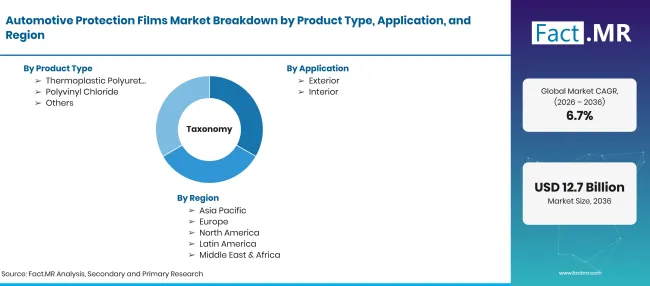
Factmr Automotive Protection Films Market Taxonomy | Source: Fact.MR
| Attribute | Details |
|---|---|
| Quantitative Units | USD billion: 2026 valuation, 2036 forecast and CAGR |
| Market Definition | Automotive protection films are specialized protective film products applied to vehicle surfaces to prevent scratches, stone chips, environmental damage and everyday wear while preserving exterior appearance and paint quality. |
| Product Type | Thermoplastic Polyurethane; Polyvinyl Chloride; Others |
| Application | Exterior; Interior |
| Vehicle Type | Passenger Cars; Commercial Vehicles |
| Distribution Channel | Aftermarket; OEM |
| Regions Covered | North America; Latin America; Western Europe; Eastern Europe; East Asia; South Asia & Pacific; Middle East & Africa |
| Countries Covered | Germany; Brazil; USA; UK; Japan |
| Companies Profiled | 3M, XPEL, Inc., Avery Dennison Corporation, Eastman Chemical Company (LLumar), STEK Automotive. |
| Forecast Period | 2026 to 2036 |
| Approach | Market segmentation and scenario-based analysis supported by automotive industry statistics and company product information |
Source: Fact.MR analysis. Updated Oct 15, 2026
How is the market segmented?
-
By Product Type
- Thermoplastic Polyurethane
- Polyvinyl Chloride
- Others
-
By Application
- Exterior
- Interior
-
By Vehicle Type
- Passenger Cars
- Commercial Vehicles
-
By Distribution Channel
- Aftermarket
- OEM
-
By Region
- North America
- Latin America
- Western Europe
- Eastern Europe
- East Asia
- South Asia & Pacific
- Middle East & Africa
Frequently Asked Questions
How big is the automotive protection films market in 2026?
What is the CAGR from 2026 to 2036?
Which product type has the largest stated share?
Which application leads?
Which companies are covered?
Who worked on this report


Preview the report firsthand - request a free sample
Free SampleGet the brochure for pricing and purchase details
Download PDF