- Market Value (2025): USD 17.2 Bn
- Estimated Value (2026): USD 18.9 Bn
- Forecast Value (2036): USD 49.0 Bn
- CAGR (2026-2036): 10.0%
What is the Automotive Semiconductors for Power Control Market forecast to be worth by 2036?
USD 18.9 billion in 2026 to USD 49.0 billion by 2036, at a 10.0% CAGR.
- Fact.MR estimates the automotive semiconductors for power control market was valued at USD 17.2 billion in 2025.
- Sales are projected to rise from USD 18.9 billion in 2026 to USD 49.0 billion by 2036.
- The market is forecast to post a 10.0% CAGR during 2026 to 2036 as automakers increase electronic control content in engine systems and vehicle electrical networks.
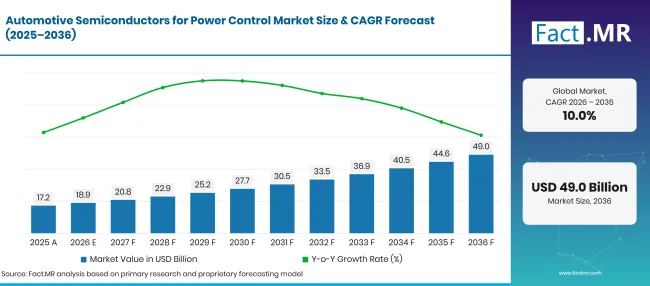
Automotive Semiconductors For Power Control Market Forecast Global | Source: Fact.MR
| Year | Basis | Market Value (USD billion) |
|---|---|---|
| 2025 | Actual | 17.3 |
| 2026 | Estimate | 19.0 |
| 2036 | Forecast | 49.0 |
| CAGR 2026 to 2036 | Forecast period | 10.0% |
Source: Fact.MR analysis. Updated Oct 22, 2026
What are the defining numbers behind Automotive Semiconductors for Power Control Market growth?
USD 30.0 billion absolute opportunity from 2026 to 2036, centered on microcontrollers, passenger vehicles and OEM supply.
- Demand Drivers in the Market
- Vehicle powertrain engineers need microcontrollers that can coordinate engine and transmission responses with precise timing. Platform-wide chip qualification makes proven software support and stable parts supply central to each sourcing decision.
- A synthetic research hypothesis for automotive power-control semiconductors places thermal performance and software compatibility among the questions for OEM engineering interviews.
- Electric vehicle designers use power transistors to control the flow of electricity across converters and switching circuits. Infineon introduced automotive-capable CoolSiC 750 V G2 MOSFETs in April 2025 for uses including on-board chargers and DC-DC converters [1]. These products show how power-device selection is changing with vehicle electrical design.
- OEM electronics teams are preparing for wider control-unit integration as software-defined vehicle designs develop. NXP introduced its S32K5 automotive microcontroller family in March 2025 to support zonal and electrification architectures [2]. Chip suppliers increasingly need to offer tools for software integration alongside the hardware.
- Automotive component selection will place sustained weight on heat control and fault handling. A failure in electrical power management can interrupt vehicle functions, so engineering teams review a chip’s operating limits alongside its software support.
- Key Segments Analyzed
- By Component: Microcontrollers hold 32.5% share in 2026 as vehicle control units execute real-time power management instructions.
- By Vehicle Type: Passenger Vehicles account for 58.9% share in 2026 because automakers fit electronic controllers across high-volume model ranges.
- By Application: Engine Management represents 31.2% share in 2026 as combustion and hybrid engines continue using semiconductor-based timing and load control.
- By End-User: OEMs capture 82.7% share in 2026 through direct component qualification and sourcing for new vehicle platforms.
- Analyst Opinion at Fact.MR
- Shambhu Nath Jha, Principal Consultant at Fact.MR, states, “The main commercial test for a power-control chip is whether an automaker can use it reliably across the intended vehicle program. Semiconductor suppliers are expected to compete on predictable switching performance and software integration as electrified designs spread.”
- Strategic Implications
- Semiconductor suppliers are expected to invest in power-device packages that limit heat during repeated switching. Infineon introduced CoolSiC JFET technology for solid-state power distribution in May 2025 [3].
- Chip designers need early reviews with automakers to confirm how new parts behave within existing control units. A similar pin layout may ease installation, but switching response and software behavior still need careful checks during qualification.
- Vehicle manufacturers are anticipated to compare software development tools alongside electrical performance before choosing control chips. For engine and transmission functions, reliable diagnostics can save time during integration and later fault tracing.
- Tier-1 electronics suppliers are expected to favor semiconductor vendors with stable delivery plans for long vehicle programs. Earlier checks on software support and component life cycles can reduce redesign work after a control unit enters production.
Japan is forecast to record 12.0% CAGR through 2036, followed by the United Kingdom at 10.9%. Germany advances at 9.9% and the United States at 9.0%. Brazil records 7.9%, reflecting a different balance of domestic vehicle assembly and electronics sourcing.
How does the Automotive Semiconductors for Power Control Market break down by segment?
Microcontrollers 32.5%; Passenger Vehicles 58.9%; Engine Management 31.2%; OEMs 82.7% in 2026.
Which Component leads vehicle power control?
Microcontrollers account for 32.5% share in 2026.
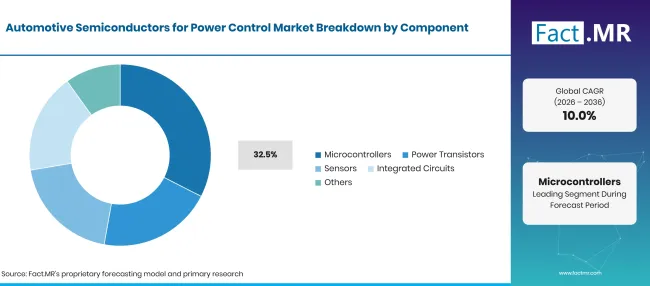
Automotive Semiconductors For Power Control Market Breakdown Component | Source: Fact.MR
| Component | Share (2026) |
|---|---|
| Microcontrollers (Leading segment) | 32.5% |
| Other segments combined | 67.5% |
| Total | 100.0% |
Source: Fact.MR analysis. Updated Oct 22, 2026
Microcontrollers are projected to hold the main component share because they execute control instructions within vehicle electronic systems. Engine controllers need timed processing that coordinates fuel delivery and electrical signals. Power transistors perform switching tasks in vehicle power circuits, while sensors provide operating information used by controllers. Integrated circuits combine control and supporting functions where the application calls for smaller electronic assemblies. compatibility with automotive software tools can influence which chip family enters a production program.
What leads the Vehicle Type segment?
Passenger Vehicles represent 58.9% share in 2026.
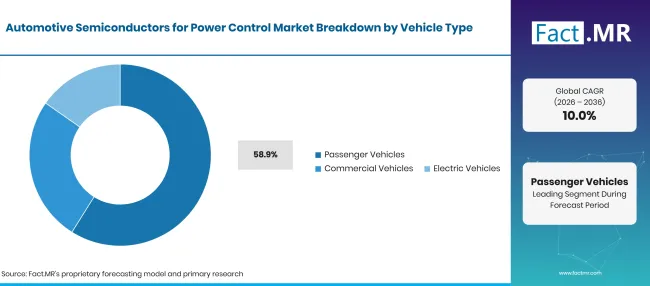
Automotive Semiconductors For Power Control Market Breakdown Vehicle Type 1 | Source: Fact.MR
| Vehicle Type | Share (2026) |
|---|---|
| Passenger Vehicles (Leading segment) | 58.9% |
| Other segments combined | 41.1% |
| Total | 100.0% |
Source: Fact.MR analysis. Updated Oct 22, 2026
Passenger vehicles are expected to account for the main vehicle-type share as manufacturers install power-control electronics across higher-volume model programs. Commercial vehicles use related chips in engine and transmission controllers designed for long operating hours. Electric vehicles introduce additional power switching requirements in onboard conversion and distribution circuits. Engineering teams assess semiconductor parts around each platform’s voltage and thermal limits before agreeing on a final design. platform reuse across vehicle models can support repeat component orders.
How does Application shape component purchases?
Engine Management leads with 31.2% share in 2026.
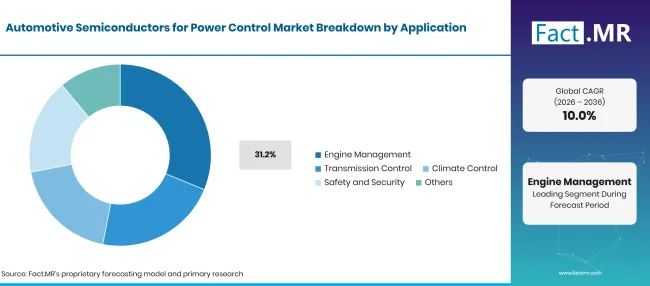
Automotive Semiconductors For Power Control Market Breakdown Application | Source: Fact.MR
| Application | Share (2026) |
|---|---|
| Engine Management (Leading segment) | 31.2% |
| Other segments combined | 68.8% |
| Total | 100.0% |
Source: Fact.MR analysis. Updated Oct 22, 2026
Engine Management is expected to account for the main application share because combustion and hybrid vehicles rely on control electronics to coordinate engine operation. Transmission Control requires accurate timing for electronic shifting functions. Climate Control uses switching and monitoring circuits to manage motors and other electrical loads. Safety and Security systems need components that respond consistently during fault events. the role of each circuit guides how automakers assess its semiconductor specifications.
Which End-User accounts for the main sales channel?
OEMs hold 82.7% share in 2026.
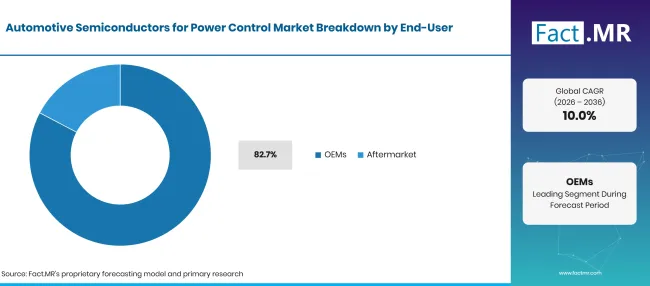
Automotive Semiconductors For Power Control Market Breakdown End User | Source: Fact.MR
| End-User | Share (2026) |
| OEMs (Leading segment) | 82.7% |
| Other segments combined | 17.3% |
| Total | 100.0% |
Source: Fact.MR analysis. Updated Oct 22, 2026
OEMs are forecast to hold the main end-user share because automotive semiconductors generally enter vehicles as part of approved electronic systems. Automakers and their direct suppliers review chip specifications early in the design cycle. The aftermarket supports replacement controllers and related electronic modules once vehicles are in service. Replacement demand depends on access to compatible parts and the exact electrical requirements of each model.
What is accelerating Automotive Semiconductors for Power Control Market adoption, and what is holding it back?
Electrified electrical systems and broader electronic control functions support semiconductor sales. Qualification time and heat-management limits can delay changes to production designs.
Drivers Impact Analysis
| DRIVER | (~) % IMPACT ON CAGR | GEOGRAPHIC RELEVANCE | IMPACT TIMELINE |
|---|---|---|---|
| Automotive electrification | +1.0% | Europe, East Asia | Medium term (2–4 years) |
| Controller integration | +0.8% | Global | Medium term (2–4 years) |
| Engine-control renewal | +0.7% | Global | Short term (<= 2 years) |
| Power switching efficiency | +0.5% | East Asia, North America | Long term (>= 4 years) |
| Vehicle production | +0.4% | Global | Medium term (2–4 years) |
Source: Fact.MR analysis. Updated Oct 22, 2026
Opportunity Impact Analysis
| OPPORTUNITY | (~) % IMPACT ON CAGR | GEOGRAPHIC RELEVANCE | IMPACT TIMELINE |
|---|---|---|---|
| Zonal electronics | +0.8% | Europe, Japan | Medium term (2–4 years) |
| Compact power switching | +0.6% | Global | Medium term (2–4 years) |
| Platform standardization | +0.5% | North America, Europe | Long term (>= 4 years) |
| Vehicle repair support | +0.4% | Global | Short term (<= 2 years) |
Source: Fact.MR analysis. Updated Oct 22, 2026
Restraints Impact Analysis
| RESTRAINT | (~) % IMPACT ON CAGR | GEOGRAPHIC RELEVANCE | IMPACT TIMELINE |
|---|---|---|---|
| Qualification lead time | -0.8% | Global | Medium term (2–4 years) |
| Thermal design limits | -0.6% | Global | Medium term (2–4 years) |
| Chip supply concentration | -0.5% | Global | Short term (<= 2 years) |
| Vehicle program cost | -0.4% | Brazil, Europe | Long term (>= 4 years) |
Source: Fact.MR analysis. Updated Oct 22, 2026
Which countries are scaling the Automotive Semiconductors for Power Control Market through 2036?
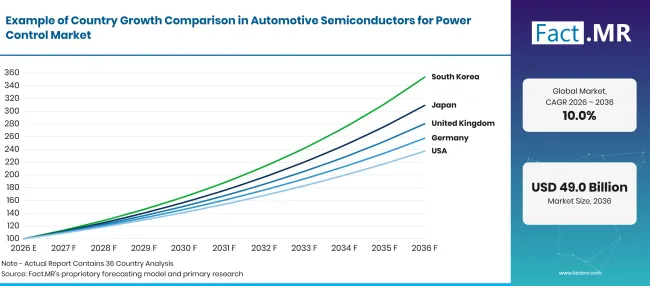
Automotive Semiconductors For Power Control Market Growth Index | Source: Fact.MR
| Country | CAGR (2026–2036) |
|---|---|
| Japan | 12.0% |
| United Kingdom | 10.9% |
| Germany | 9.9% |
| United States | 9.0% |
| Brazil | 7.9% |
Source: Fact.MR analysis. Updated Oct 22, 2026
Why is Japan expanding automotive power-control chip use?
12.0% CAGR, linked to hybrid-system engineering and semiconductor design capacity.
Japanese automakers combine hybrid powertrain expertise with a domestic base of semiconductor designers. Control electronics manage switching and operating feedback across electrified systems. Japan is forecast to record a 12.0% CAGR through 2036. Supplier selection is expected to emphasize consistent vehicle-grade performance and dependable software support during long model programs.
What is behind United Kingdom growth in power-control chips?
10.9% CAGR, shaped by electrified model introductions and platform qualification.
UK-based vehicle engineering programs create sales opportunities for semiconductor components used in electrified platforms. The Department for Transport published its 2025 vehicle licensing statistics in April 2026 [4]. Automakers are expected to evaluate chip performance against each vehicle’s electrical layout before approving new parts.
How is Germany shaping automotive semiconductor demand?
9.9% CAGR, associated with automotive exports and EV power electronics.
German automakers connect local vehicle engineering with export-oriented production programs. In July 2025, Destatis reported around 1.5 million new passenger cars exported during January to May 2025 [5]. Semiconductor makers serving this market are expected to focus on reliable switching performance and software compatibility across model platforms.
What supports the United States power-control outlook?
9.0% CAGR, reflecting controller integration and automotive engineering programs.
U.S. vehicle manufacturers work with semiconductor vendors on engine control and electrified power systems. the United States is projected to post a 9.0% CAGR during 2026 to 2036. Power transistors and microcontrollers are likely to be assessed on switching limits and fault response in addition to unit cost. Production programs favor components with a dependable path through automotive qualification.
Why is Brazil building its vehicle power-electronics base?
7.9% CAGR, linked to domestic assembly and control-system sourcing.
Brazil’s power-control semiconductor sales are connected with domestic vehicle assembly and electronic modules fitted to locally sold models. In January 2026, ANFAVEA reported on Brazilian vehicle production and sales during 2025 [6]. Domestic vehicle programs are expected to continue assessing component cost alongside electrical durability and replacement availability.
Who leads the Automotive Semiconductors for Power Control Market?
Infineon Technologies supplies semiconductor power-switching components used in automotive electrical systems. NXP Semiconductors develops microcontrollers suited to vehicle control architectures, while Texas Instruments offers automotive power management and analog components. STMicroelectronics provides microcontrollers and power devices for vehicle applications. the commercial differences between these providers are expected to depend on qualification support and the fit between each device and its intended control circuit.
Renesas Electronics offers automotive microcontrollers, while ROHM supplies power semiconductor devices. onsemi provides automotive power devices used in electrified systems, and Analog Devices develops relevant measurement and power management parts. Toshiba participates through semiconductor devices for automotive electronics, while Bosch contributes automotive semiconductor capabilities. product selection is expected to center on technical approval and manufacturing continuity across the vehicle program.
Which companies are the key providers?
Key companies include Infineon Technologies AG; NXP Semiconductors N.V.; Texas Instruments Incorporated; STMicroelectronics N.V.; Renesas Electronics Corporation; onsemi; Robert Bosch GmbH; Analog Devices Inc.; Toshiba Corporation; and ROHM Co. Ltd.
- Infineon Technologies AG
- NXP Semiconductors N.V.
- Texas Instruments Incorporated
- STMicroelectronics N.V.
- Renesas Electronics Corporation
- Onsemi
- Robert Bosch GmbH
- Analog Devices Inc.
- Toshiba Corporation
Bibliography
- [1] Infineon Technologies AG. (2025, April 29). Infineon launches CoolSiC™ MOSFET 750 V G2 with ultra-low RDS(on) for automotive and industrial power electronics.
- [2] NXP Semiconductors. (2025, March 11). New S32K5 microcontroller family advances zonal SDV architectures and extends the NXP CoreRide platform.
- [3] Infineon Technologies AG. (2025, May 5). Infineon introduces new CoolSiC™ JFET technology for smarter and faster solid-state power distribution.
- [4] Department for Transport. (2026, April 29). Vehicle licensing statistics: 2025.
- [5] Statistisches Bundesamt (Destatis). (2025, July 18). Exports of new passenger cars in the first five months of 2025 up 1.1% year on year.
- [6] Associação Nacional dos Fabricantes de Veículos Automotores. (2026, January 15). Produção e venda de autoveículos crescem em 2025 e Anfavea projeta nova alta em 2026.
This Report Answers
- The report examines microcontrollers and power transistors used in automotive electronic power control, including the technical requirements behind semiconductor selection.
- Vehicle-type analysis compares passenger vehicles with commercial and electric vehicles and explains why total assembly programs shape component orders.
- Country analysis covers Japan, the United Kingdom, Germany, the United States and Brazil, with attention to local manufacturing and electrified vehicle programs.
- Competitive analysis compares semiconductor suppliers by power switching devices, microcontrollers, control functions and the technical support needed for vehicle qualification.
- The report distinguishes OEM semiconductor sourcing from the aftermarket supply of control modules and related replacement electronics.
What does the Automotive Semiconductors for Power Control Market cover?
The market covers semiconductor components used to regulate electrical power and control related functions inside vehicles. It includes microcontrollers, power transistors and sensors alongside integrated circuits and other supporting components.
This coverage is narrower than the wider automotive semiconductor market, which also includes chips used mainly for information processing or communication.
WHat is included in the scope?
The scope includes automotive-grade semiconductors used in engine management and transmission control.
It also covers chips serving climate control and specified safety or security functions when their role is to regulate vehicle electrical power. Sales are assessed across passenger vehicles, commercial vehicles and electric vehicles. OEM component orders form the main route to new-vehicle production, while the aftermarket covers relevant replacement demand.
What is excluded from the scope?
The scope excludes general-purpose semiconductor sales that do not reach automotive power-control functions.
Complete traction inverter assemblies and vehicle battery packs are outside the component-level boundary except for the value of power-control chips included in them. Standalone software services, chip-manufacturing machinery and unrelated infotainment processors are also excluded.
How Was the Analysis Built?
The analysis draws on 120+ sources, 35+ company portfolios, 25+ countries, and more than 20 industry interviews.
- Primary Research: Primary research includes discussions with manufacturers, service providers, technology developers, distributors, end users, and subject-matter experts. These conversations examine purchasing priorities, product adoption, operational challenges, approval requirements, competitive positioning, and the factors that influence wider market acceptance.
- Desk Research: Desk research covers government statistics, regulatory publications, company filings, trade data, technical studies, industry associations, standards, public policy, and other authoritative sources. Every source used in the analysis is documented in the bibliography.
- Market Sizing and Forecasting: Market estimates combine historical performance, demand indicators, pricing and volume trends, segment shares, company participation, country-level growth, adoption patterns, investment activity, and barriers to market expansion.
- Data Validation and Update Cycle: Findings are validated by comparing primary interviews with public data, company activity, regulatory changes, trade patterns, and industry developments. Regular updates review new product launches, capacity changes, partnerships, approvals, and shifts in commercial adoption.
Segmentation
What is the report’s scope and coverage?
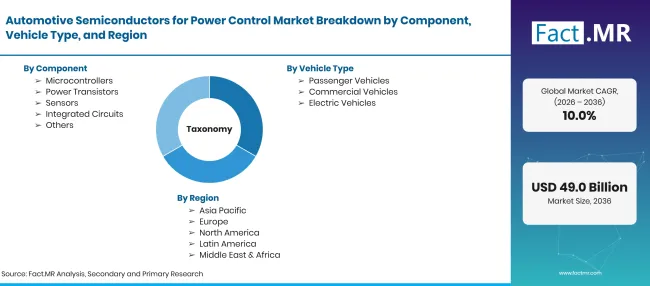
Automotive Semiconductors For Power Control Market Taxonomy | Source: Fact.MR
| Attribute | Details |
|---|---|
| Quantitative Units | USD billion in 2026 to USD billion by 2036 at CAGR |
| Market Definition | Automotive semiconductor devices used for vehicle electrical power control and related switching or control functions. |
| Component | Microcontrollers; Power Transistors; Sensors; Integrated Circuits; Others |
| Vehicle Type | Passenger Vehicles; Commercial Vehicles; Electric Vehicles |
| Application | Engine Management; Transmission Control; Climate Control; Safety and Security; Others |
| End-User | OEMs; Aftermarket |
| Regions Covered | North America; Latin America; Western Europe; Eastern Europe; East Asia; South Asia & Pacific; Middle East & Africa |
| Countries Covered | Germany; Brazil; United States; United Kingdom; Japan |
| Companies Profiled | Infineon Technologies AG; NXP Semiconductors N.V.; Texas Instruments Incorporated; STMicroelectronics N.V.; Renesas Electronics Corporation; onsemi; Robert Bosch GmbH; Analog Devices Inc.; Toshiba Corporation; and ROHM Co. Ltd. |
| Forecast Period | 2026 to 2036 |
| Approach | Vehicle-platform semiconductor application analysis, official vehicle statistics and original company disclosures |
Source: Fact.MR analysis. Updated Oct 22, 2026
How is the market segmented?
-
By Component
- Microcontrollers
- Power Transistors
- Sensors
- Integrated Circuits; Others
-
By Vehicle Type
- Passenger Vehicles
- Commercial Vehicles
- Electric Vehicles
-
By Application
- Engine Management
- Transmission Control
- Climate Control
- Safety and Security; Others
-
By End-User
- OEMs
- Aftermarket
-
By Region
- North America
- Latin America
- Western Europe
- Eastern Europe
- East Asia
- South Asia & Pacific
- Middle East & Africa
Frequently Asked Questions
How big is the automotive semiconductors for power control market in 2026?
What is the CAGR from 2026 to 2036?
Which component leads?
Which application leads?
Which companies participate in automotive power-control semiconductors?
Who worked on this report


Preview the report firsthand - request a free sample
Free SampleGet the brochure for pricing and purchase details
Download PDF