- Base Value(2025): 72.3 Bn
- Estimated Value(2026): 77.2 Bn
- Forecast Value (2036): 149.0 Bn
- CAGR (2026 - 2036): 6.8%
Automotive Semiconductor Market Forecast and Outlook By Fact.Mr
In 2025, the automotive semiconductor market was valued at USD 72.3 billion. Based on Fact.MR analysis, demand is estimated to grow to USD 77.2 billion in 2026 and USD 149.0 billion by 2036. FACT.MR projects a CAGR of 6.8% during the forecast period.
Between 2026-2036, the market is projected to generate an absolute dollar opportunity of USD 71.8 billion over the forecast period. Growth is structural rather than cyclical, supported by rising semiconductor content per vehicle. Electrification, ADAS adoption, and vehicle connectivity are driving demand. However, supply chain constraints, chip fabrication capacity limits, and pricing pressure in entry-level vehicles restrict faster expansion.
Country growth reflects EV adoption rates, automotive production scale, and semiconductor ecosystem maturity. India leads at 10.8% CAGR driven by EV manufacturing expansion and government incentives. China follows at 10.4% supported by domestic EV production and semiconductor localisation policies. The United States records 9.9% through advanced vehicle technology adoption and strong OEM investments. Japan posts 9.5% with steady hybrid vehicle production and sensor innovation. Germany and Australia grow at 9.0% and 8.9% respectively, representing mature markets with replacement-driven demand constrained by slower vehicle production growth.
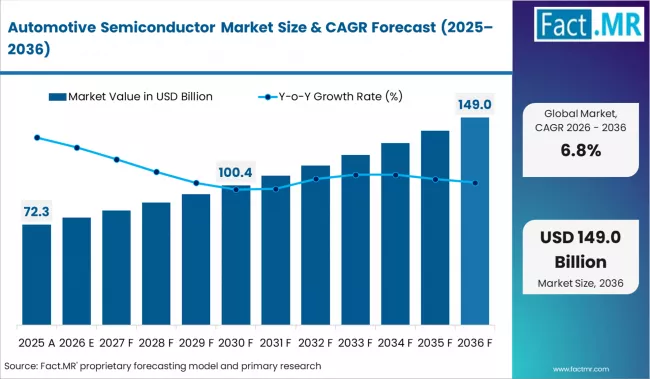
Automotive Semiconductor Market Market Value Analysis | Source: Fact.MR
| Metric | Value |
|---|---|
| Estimated Value in 2026 | USD 77.2 billion |
| Forecast Value in 2036 | USD 149.0 billion |
| Forecast CAGR (2026 to 2036) | 6.8% |
Automotive Semiconductor Market Definition
The automotive semiconductor market includes integrated circuits and discrete semiconductor components used in vehicles for control, sensing, processing, and communication functions. These components enable critical automotive systems such as powertrain control, safety systems, infotainment, and vehicle connectivity.
Market Inclusions
Covers global and regional market forecasts from 2026 to 2036 by component type, vehicle type, and application. Includes processors, memory, sensors, analog ICs, and discrete devices used across passenger and commercial vehicles. Also includes semiconductor demand across EV, hybrid, and ICE vehicle architectures.
Market Exclusions
Excludes non-automotive semiconductor applications such as consumer electronics and industrial chips. Also excludes software platforms, automotive electronics hardware systems, and semiconductor manufacturing equipment. Focus is strictly on semiconductor components used within automotive systems.
Research Methodology
- Primary Research
- Interviews with automotive OEM engineers, semiconductor suppliers, EV platform developers, and automotive electronics procurement managers.
- Desk Research
- Sources include company filings from Intel, NXP, NVIDIA, and TSMC, EV production data, government EV policy reports, and semiconductor industry publications.
- Market Sizing and Forecasting
- Hybrid model using semiconductor content per vehicle, global vehicle production data, and pricing trends across component categories.
- Data Validation and Update Cycle
- Validated through company revenues, OEM sourcing data, and expert interviews across automotive and semiconductor industries.
Summary of Automotive Semiconductor Market
- Market Definition
- Automotive semiconductors are electronic components used to enable vehicle control, safety, connectivity, and electrification systems.
- Demand Drivers
- EV adoption is increasing semiconductor content per vehicle significantly.
- ADAS and autonomous driving technologies require high-performance chips and sensors.
- Connected vehicle platforms are expanding demand for processors and memory devices.
- Key Segments Analyzed
- By Component: Logic ICs lead with about 33% share in 2026 due to processing requirements.
- By Vehicle Type: Passenger vehicles dominate with about 70% share due to high production volumes.
- By Application: Safety and infotainment segments drive the highest semiconductor consumption.
- Analyst Opinion at Fact.MR
- Shambhu Nath Jha notes the report highlights EV-driven semiconductor demand, ADAS growth opportunities, and supply chain transformation strategies.
- Strategic Implications
- Companies should invest in EV-focused semiconductor design and production capacity.
- Vendors should expand partnerships with automotive OEMs for integrated chip solutions.
- Manufacturers targeting Asia Pacific should align with regional EV and semiconductor policies.
- Methodology
- Market sizing uses semiconductor content per vehicle and OEM production data.
- Company financials and EV adoption data supported demand analysis.
- Forecasts include ADAS penetration, EV growth, and supply chain trends.
Segmental Analysis
Automotive Semiconductor Market Analysis by Component
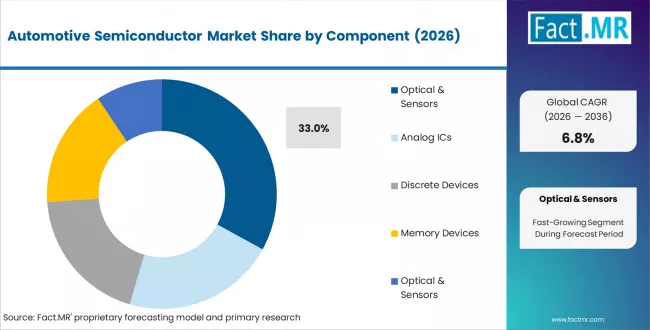
Automotive Semiconductor Market Analysis By Component | Source: Fact.MR
FACT.MR estimates logic ICs will hold about 33% share in 2026. These components are critical for processing large volumes of real-time vehicle data, enabling ADAS, infotainment, and central vehicle control systems. Their ability to support high-speed computing and integration across multiple vehicle functions gives them a structural advantage over discrete components.
- NVIDIA Automotive Platform Expansion: NVIDIA expanded its DRIVE platform in 2025, enabling advanced autonomous driving processors and AI-based vehicle computing systems used by multiple global OEMs. This expansion strengthens demand for high-performance logic ICs in next-generation vehicles. [1]
- TSMC Automotive Chip Investment: TSMC increased automotive semiconductor production capacity in 2024 to meet rising EV and ADAS demand. The company prioritised automotive-grade chips, ensuring reliability and scalability for long-term OEM contracts. [2]
- Sensor Integration Trend: Automotive sensor demand increased significantly in 2024 due to widespread ADAS adoption. Integration of sensors with processing chips is increasing reliance on logic ICs to manage data fusion and real-time decision-making in vehicles. [3]
Automotive Semiconductor Market Analysis by Vehicle Type
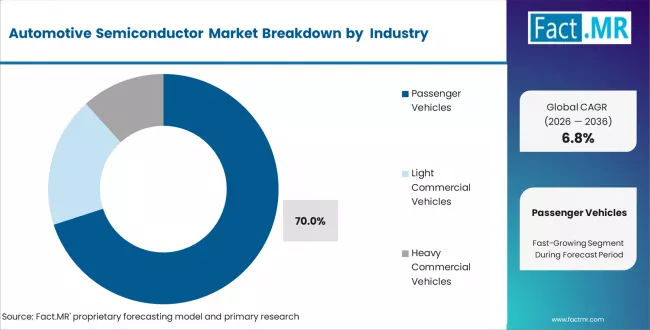
Automotive Semiconductor Market Analysis By Vehicle Type | Source: Fact.MR
FACT.MR estimates passenger vehicles will account for about 70% share in 2026. High global production volumes, combined with increasing electronic content per vehicle, drive dominance. Passenger vehicles are rapidly adopting EV platforms, connectivity features, and advanced safety systems, all of which significantly increase semiconductor usage.
- Tesla EV Production Growth: Tesla expanded EV production capacity in 2024, increasing semiconductor demand per vehicle due to high integration of computing systems, battery management chips, and autonomous driving hardware. [4]
- Toyota Hybrid Expansion: Toyota increased hybrid vehicle output in 2024, sustaining steady semiconductor consumption through powertrain control systems, sensors, and onboard electronics used in hybrid architectures. [5]
- Global EV Adoption Trend: EV sales growth globally is increasing semiconductor demand across passenger vehicles. Each EV requires significantly more chips than ICE vehicles, particularly for battery, power electronics, and connectivity systems. [6]
Drivers, Restraints, and Opportunities
FACT.MR analysts observe that the automotive semiconductor market has transitioned from low-value control components to high-value computing and sensing systems. Growth is now closely linked to vehicle electrification, autonomous driving development, and digital vehicle architecture transformation.
The market is shifting toward integrated, high-performance semiconductor platforms. Traditional discrete components are facing pricing pressure due to commoditisation, while advanced processors, sensors, and AI chips command premium pricing. This shift is increasing overall market value even as global vehicle production growth remains moderate.
- EV Electrification Growth: Government EV policies and OEM electrification strategies are significantly increasing semiconductor demand per vehicle. EVs require advanced power electronics, battery management systems, and onboard computing, resulting in higher chip content compared to ICE vehicles.
- ADAS Regulation Expansion: Safety regulations mandating ADAS features such as automatic emergency braking and lane-keeping assistance are increasing demand for sensors, processors, and connectivity chips. These systems rely heavily on semiconductor integration for real-time performance.
- Supply Chain Localisation: Countries are investing in domestic semiconductor manufacturing to reduce supply chain risks. Initiatives in the USA, Europe, and Asia are encouraging local chip production, reshaping global supply dynamics and reducing dependence on limited manufacturing hubs.
Regional Analysis
The automotive semiconductor market is analysed across North America, Europe, Asia Pacific, Latin America, and Middle East and Africa, covering 40+ country-level demand shaped by EV adoption rates, automotive production scale, semiconductor manufacturing capacity, and government policies supporting vehicle electrification and chip localisation. The full report offers market attractiveness analysis based on semiconductor content per vehicle, OEM production outlook, and regional policy support.
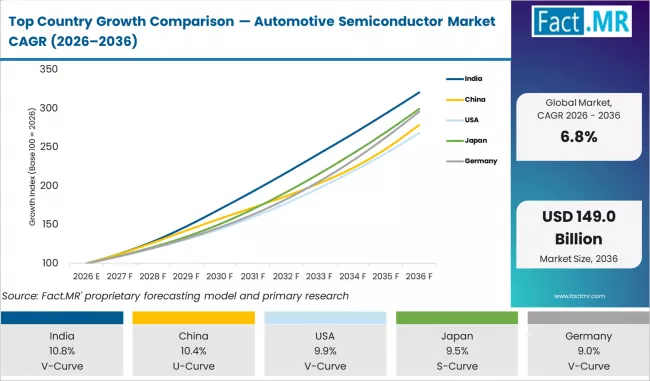
Top Country Growth Comparison Automotive Semiconductor Market Cagr 2026 2036 | Source: Fact.MR
| Country | CAGR (2026 to 2036) |
|---|---|
| India | 10.8% |
| China | 10.4% |
| USA | 9.9% |
| Japan | 9.5% |
| Germany | 9.0% |
| Australia | 8.9% |
Source: Fact.MR (FACT.MR) analysis, based on proprietary forecasting model and primary research
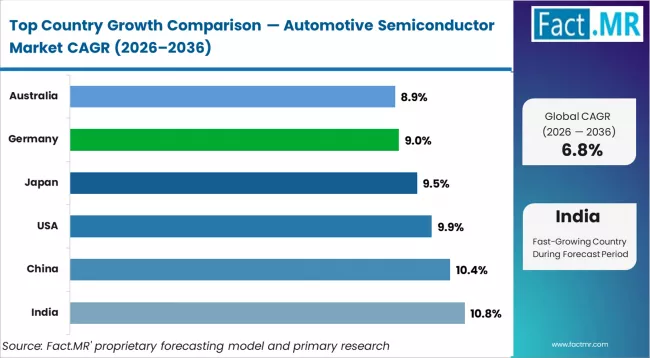
Automotive Semiconductor Market Cagr Analysis By Country | Source: Fact.MR
Asia Pacific Automotive Semiconductor Market Analysis
Asia Pacific is the fastest-growing region, driven by large-scale vehicle production and strong EV adoption. China and India lead demand growth, while Japan contributes through advanced automotive electronics innovation. Global semiconductor companies compete with domestic players across the region.
- India: India is witnessing strong growth at a CAGR of 10.8% through 2036. Government EV incentives and semiconductor manufacturing policies are accelerating adoption. Domestic OEMs are increasing EV production capacity, raising semiconductor demand per vehicle. Electronics manufacturing clusters are also expanding. Policy support is aligning with localisation of semiconductor supply chains.
- China: China is expanding steadily with a CAGR of 10.4% through 2036. Strong EV production and government-backed semiconductor localisation programmes are driving demand. Domestic OEMs are increasing semiconductor consumption across EV platforms. Large-scale investment under national industrial policies supports growth. Domestic chip manufacturers are strengthening mid-market supply while global vendors serve premium segments.
- Japan: Demand for automotive semiconductors in Japan is projected to rise at 9.5% CAGR through 2036. Growth is supported by strong hybrid vehicle production and advanced sensor innovation. Japanese OEMs such as Toyota and Honda are increasing semiconductor usage in electrified and safety systems. The country’s focus on reliability and high-quality automotive electronics continues to drive steady demand.
FACT.MR's Asia Pacific analysis includes India, China, Japan, South Korea, Australia and New Zealand, and ASEAN. It covers EV adoption trends, semiconductor localisation, and regional forecasts.
North America Automotive Semiconductor Market Analysis
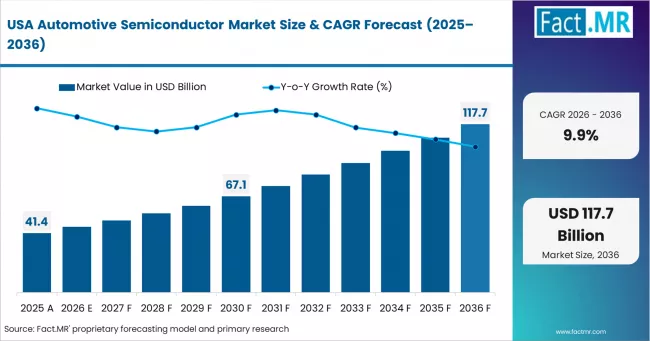
Automotive Semiconductor Market Country Value Analysis | Source: Fact.MR
North America is a high-value market driven by advanced automotive technologies and strong EV investments. The region benefits from semiconductor innovation and large-scale OEM investments in next-generation vehicle platforms.
- USA: The United States shows steady growth at a CAGR of 9.9% through 2036. EV adoption and autonomous driving development are increasing semiconductor demand. Government initiatives supporting domestic chip manufacturing are strengthening supply chains. Major semiconductor companies are headquartered in the region. OEM investments in connected and software-defined vehicles are accelerating demand.
FACT.MR's North America analysis includes the United States, Canada, and Mexico. It provides insights on EV demand, semiconductor investments, and adoption trends.
Europe Automotive Semiconductor Market Analysis
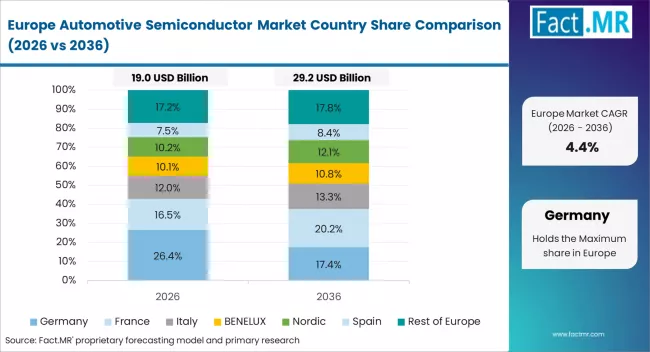
Automotive Semiconductor Market Europe Country Market Share Analysis 2026 & 2036 | Source: Fact.MR
Europe is a regulation-driven market where emission norms and EV transition policies drive semiconductor demand. Automotive OEMs are increasing investment in electrification and advanced electronics systems.
- Germany: Germany remains a key market with a CAGR of 9.0% through 2036. Strong automotive OEM presence is driving semiconductor demand. EV transition and digital vehicle architectures are increasing chip usage. Government policies support automotive innovation. The country remains a hub for automotive engineering and electronics.
- Australia: Australia is growing at a CAGR of 8.9% through 2036. Demand is supported by increasing EV adoption and government sustainability initiatives. Automotive imports with higher semiconductor content are driving demand. Mining and industrial sectors are also adopting advanced vehicle technologies. Market growth is steady but limited by smaller production volumes.
FACT.MR's Europe analysis includes Germany, France, the UK, Italy, Spain, Nordic countries, and BENELUX. It covers regulatory impact, EV adoption trends, and regional forecasts.
Competitive Aligners for Market Players
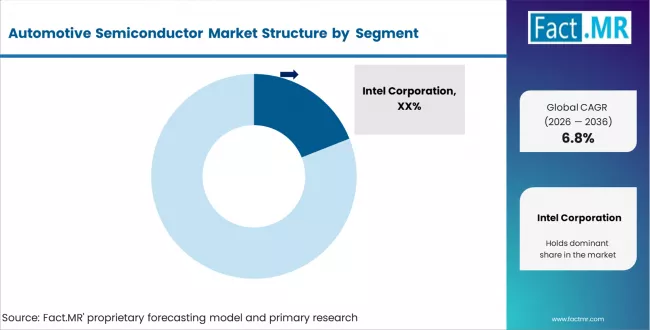
Automotive Semiconductor Market Analysis By Company | Source: Fact.MR
The automotive semiconductor market is shaped by a mix of large global chipmakers and specialised automotive-focused suppliers. A handful of companies account for a significant share of total revenue, especially in high-value segments such as processors, sensors, and power electronics. Firms like NXP Semiconductors, Infineon, NVIDIA, and Texas Instruments have built strong positions through long-term relationships with automotive OEMs and Tier-1 suppliers.
Some companies focus on design and innovation, while others dominate manufacturing. TSMC plays a critical role as a foundry partner, producing chips for multiple automotive semiconductor firms. NVIDIA and Qualcomm are gaining ground in advanced driver assistance and in-vehicle computing, where performance and software integration matter more than cost alone.
Automotive customers tend to work with multiple semiconductor suppliers to reduce risk. However, once a chip is designed into a vehicle platform, switching suppliers becomes difficult due to validation requirements and system compatibility. This gives established vendors steady repeat business over the vehicle lifecycle.
Competition is no longer based only on pricing. Reliability, long product life cycles, and compliance with automotive safety standards are key decision factors. As vehicles become more software-driven, companies that can offer integrated hardware and software solutions are gaining an edge over those selling standalone components.
Key Players
- Intel Corporation
- Samsung Semiconductors
- NXP Semiconductors
- NVIDIA Corporation
- Broadcom Inc.
- Texas Instruments Inc.
- Taiwan Semiconductor Manufacturing Co. Ltd.
- Qualcomm Inc.
- Micron Technology Inc.
- ASE Technology Holding Co. Ltd.
Bibliography
[1] NVIDIA Corporation. NVIDIA DRIVE Platform Overview and Automotive Updates. January 2025.
[2] Taiwan Semiconductor Manufacturing Company (TSMC). Annual Report 2024: Automotive Semiconductor Capacity Expansion and Advanced Node Production. April 2025.
[3] Semiconductor Industry Association (SIA). State of the U.S. Semiconductor Industry Report 2025. February 2025.
[4] Tesla Inc. Form 10-K Annual Report 2024: Production Capacity and EV Technology Integration. February 2025. [5] Toyota Motor Corporation. Annual Report 2024: Hybrid and Electrification Strategy Update.
[5] Toyota Motor Corporation. Annual Report 2024: Hybrid and Electrification Strategy Update. March 2025.
[6] International Energy Agency (IEA). Global EV Outlook 2025: Trends in Electric Vehicle Adoption and Semiconductor Demand. April 2025.
This Report Addresses
- Strategic intelligence on EV adoption trends, ADAS integration, and semiconductor demand shifts across global automotive markets.
- Market forecast from USD 77.2 billion in 2026 to USD 149.0 billion by 2036 at 6.8% CAGR.
- Growth opportunities across EV power electronics, autonomous driving chips, and connected vehicle platforms.
- Country-level outlook including India (10.8%), China (10.4%), USA (9.9%), Japan (9.5%), Germany (9.0%), and Australia (8.9%).
- Competitive analysis of Intel, NVIDIA, NXP, TSMC, Qualcomm, and other key players.
- Technology tracking covering AI chips, ADAS processors, and automotive-grade semiconductors.
- Regulatory and policy impact analysis including EV mandates and semiconductor localisation initiatives.
- Report delivery includes PDF, Excel datasets, and dashboard insights supported by company filings and industry data.
Segmentation
Scope of Report
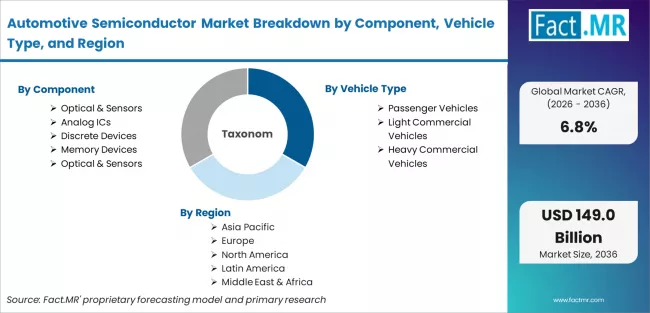
Automotive Semiconductor Market Breakdown By Component Vehicle Type And Region | Source: Fact.MR
| Attribute | Details |
|---|---|
| Quantitative Units | USD 77.2 billion (2026) to USD 149.0 billion (2036), at a CAGR of 6.8% |
| Market Definition | Semiconductor components used in vehicles for processing, sensing, power management, and communication across safety, infotainment, and powertrain systems in modern automotive architectures. |
| Component Segmentation | Micro Components (Processors), Memory Devices, Logic ICs, Optical & Sensors, Analog ICs, Discrete Devices |
| Vehicle Type Segmentation | Passenger Vehicles, Light Commercial Vehicles, Heavy Commercial Vehicles |
| Application Segmentation | Body, Safety, Telematics & Infotainment, Powertrain, Chassis |
| Regions Covered | North America, Europe, Asia Pacific, Latin America, Middle East and Africa |
| Countries Covered | USA, Canada, Mexico, UK, Germany, France, Italy, Spain, Nordic, BENELUX, Japan, South Korea, China, India, ASEAN, Australia and New Zealand, Brazil, Argentina, Chile, KSA, GCC, Turkey, South Africa, Rest of MEA |
| Key Companies Profiled | Intel Corporation, Samsung Semiconductors, NXP Semiconductors, NVIDIA Corporation, Broadcom Inc., Texas Instruments Inc., Taiwan Semiconductor Manufacturing Co. Ltd., Qualcomm Inc., Micron Technology Inc., ASE Technology Holding Co. Ltd. |
| Forecast Period | 2026 to 2036 |
| Approach | Hybrid top-down and bottom-up model using semiconductor content per vehicle, global vehicle production data, EV adoption rates, pricing benchmarks across component categories, and primary interviews with automotive OEMs and semiconductor suppliers. |
Automotive Semiconductor Market by Segments
-
By Component:
- Micro Components (Processors)
- Memory Devices
- Logic ICs
- Optical & Sensors
- Analog ICs
- Discrete Devices
-
By Vehicle Type:
- Passenger Vehicles
- Light Commercial Vehicles
- Heavy Commercial Vehicles
-
By Application:
- Body
- Safety
- Telematics & Infotainment
- Powertrain
- Chassis
-
By Region:
-
North America
- United States
- Canada
- Mexico
-
Latin America
- Brazil
- Mexico
- Argentina
- Chile
- Rest of Latin America
-
Western Europe
- Germany
- United Kingdom
- France
- Italy
- Spain
- Nordic Countries
- BENELUX
- Rest of Western Europe
-
Eastern Europe
- Russia
- Poland
- Hungary
- Balkan and Baltic
- Rest of Eastern Europe
-
East Asia
- China
- Japan
- South Korea
-
South Asia and Pacific
- India
- ASEAN
- Australia and New Zealand
- Rest of South Asia and Pacific
-
Middle East and Africa
- Kingdom of Saudi Arabia
- Other GCC Countries
- Turkey
- South Africa
- Rest of Middle East and Africa
-
Frequently Asked Questions
How large is the automotive semiconductor market in 2025?
What will the market size be in 2026?
What is the projected market size by 2036?
What is the expected CAGR of the market?
Which component segment leads the market?
Which vehicle type dominates semiconductor demand?
What is the main growth driver for this market?
How does ADAS impact semiconductor demand?
Which region is growing the fastest?
Why are semiconductors critical in modern vehicles?
What is a key challenge in the market?
Who are the key players in the automotive semiconductor market?
Who worked on this report


Preview the report firsthand - request a free sample
Free SampleGet the brochure for pricing and purchase details
Download PDF