Emission Control Additives for Marine Fuels Market

Emission Control Additives for Marine Fuels Market Size and Share Forecast Outlook 2026 to 2036

Emission control additives for marine fuels market is projected to grow from USD 0.6 billion in 2026 to USD 1.3 billion by 2036, at a CAGR of 7.7%. Sulfur Reduction Additives will dominate with a 30.0% market share, while cargo & container ships will lead the vessel type segment with a 32.0% share.

Emission Control Additives for Marine Fuels Market Forecast and Outlook 2026 to 2036

The global market for emission control additives in marine fuels is poised for steady growth, driven by stringent international regulations and the maritime industry's transition towards cleaner operations. Projected to expand from USD 0.64 billion in 2026 to USD 1.34 billion by 2036, the market is expected to rise at a 7.7% CAGR.

Key Takeaways from the Emission Control Additives for Marine Fuels Market

  • Market Value for 2026: USD 0.64 Billion
  • Market Value for 2036: USD 1.34 Billion
  • Forecast CAGR (2026-2036): 7.7%
  • Leading Additive Type Share (2026): Sulfur Reduction Additives (30%)
  • Leading Vessel Type Share (2026): Cargo & Container Ships (32%)
  • Leading Fuel Type Share (2026): Very Low Sulfur Fuel Oil (VLSFO) (34%)
  • Key Players in the Market: Innospec, BASF SE, Chevron Oronite, Afton Chemical, Lubrizol
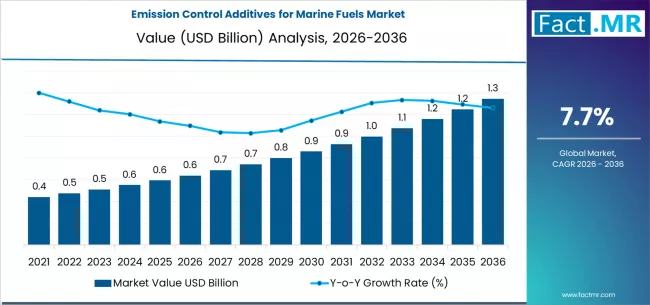
Emission Control Additives For Marine Fuels Market Market Value Analysis

Sulfur reduction additives represent the leading product type, capturing a 30% market share. Cargo and container ships constitute the dominant vessel type, accounting for 32% of demand. Very Low Sulfur Fuel Oil (VLSFO) is the primary fuel type utilizing these additives, holding a 34% share, as the global fleet complies with the IMO 2020 sulfur cap.

Growth is attriibuted to the International Maritime Organization's (IMO) progressively stricter regulations targeting SOx, NOx, and particulate matter emissions. Additives provide a critical and flexible compliance tool, enhancing fuel performance and reducing harmful emissions without requiring immediate, capital-intensive engine or exhaust system modifications. They play a vital role in ensuring fuel stability, improving combustion efficiency, and protecting engine components while meeting environmental mandates.

The market's evolution focuses on developing multifunctional additives that address multiple emission challenges simultaneously, such as reducing sulfur, improving cetane, and controlling soot. Innovations aim to ensure compatibility with a diverse range of emerging fuel blends, including biofuels and LNG, while optimizing cost-effectiveness for ship operators navigating a complex regulatory landscape.

Metric

Metric Value
Market Value (2026) USD 0.64 Billion
Market Forecast Value (2036) USD 1.34 Billion
Forecast CAGR (2026-2036) 7.7%

Category

Category Segments
Additive Type Sulfur Reduction Additives, Combustion Improvers, Cetane & Lubricity Enhancers, Ash & Soot Control Agents, Other Marine Fuel Emission Additives
Vessel Type Cargo & Container Ships, Tankers (Oil, LNG, Chemical), Passenger & Cruise Ships, Offshore Support Vessels, Naval & Special-Purpose Vessels
Fuel Type Very Low Sulfur Fuel Oil (VLSFO), Marine Gas Oil (MGO), Heavy Fuel Oil (HFO) with Additives, LNG & Hybrid Marine Fuels, Biofuels & Others
Region North America, Latin America, Western Europe, Eastern Europe, East Asia, South Asia & Pacific, MEA

Segmental Analysis

By Additive Type, Which Segment is Most Critical for Compliance?
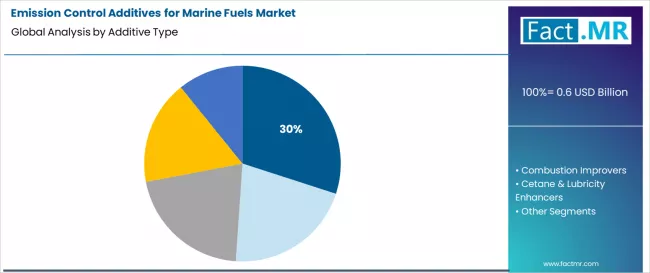
Emission Control Additives For Marine Fuels Market Analysis By Additive Type

Sulfur reduction additives lead the market with a 30% share. Their prominence is directly linked to the enforcement of the IMO's global 0.50% sulfur cap. While many vessels use inherently low-sulfur fuels, these additives remain essential for treating marginal fuels, ensuring compliance through onboard sulfur reduction processes, and cleaning fuel systems during the transition between different fuel grades. They provide a vital safety net and operational flexibility, securing their role as a foundational compliance tool for a significant portion of the global fleet.

By Vessel Type, Which Segment is the Largest Consumer?
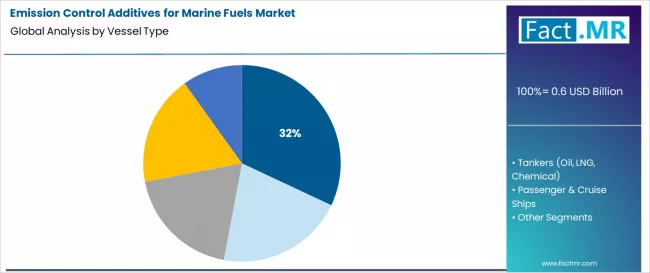
Emission Control Additives For Marine Fuels Market Analysis By Vessel Type

Cargo and container ships represent the largest vessel segment, accounting for a 32% share. These vessels form the backbone of global trade, consuming massive quantities of fuel on long-distance routes across multiple Emission Control Areas.

Their operational scale and the imperative to maintain strict schedule reliability make fuel quality and compliance non-negotiable. This drives consistent, high-volume demand for additives that ensure engine performance, prevent fuel-related issues, and guarantee adherence to varying regional emission standards.

By Fuel Type, Which Fuel Drives Additive Formulation?
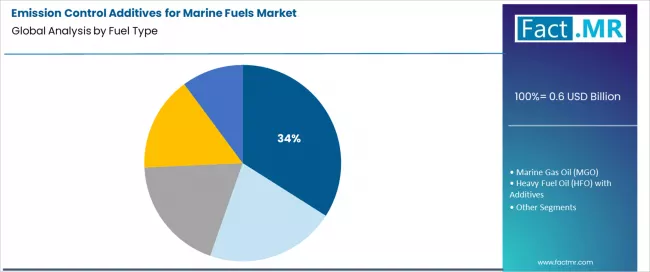
Emission Control Additives For Marine Fuels Market Analysis By Fuel Type

Very low sulfur fuel oil is the leading fuel type for additives, holding a 34% share. Since its introduction to meet the IMO 2020 cap, VLSFO has become the dominant marine fuel. However, its variable composition and stability challenges necessitate specific additive packages.

Additives are crucial for enhancing VLSFO's combustion characteristics, improving lubricity to protect engine fuel pumps, preventing sludge formation, and ensuring overall storage and handling stability, making them integral to its safe and efficient use.

What are the Drivers, Restraints, and Key Trends of the Emission Control Additives for Marine Fuels Market?

The primary market driver is the robust regulatory framework established by the IMO, including the global sulfur cap and upcoming measures like the Carbon Intensity Indicator (CII). These regulations compel ship owners to seek every available efficiency gain and emission reduction solution. The inherent variability and potential instability of modern compliant fuel blends like VLSFO create a technical necessity for additive treatment to ensure operational reliability and protect expensive engine assets, turning additives from an option into a standard operating procedure.

A significant market restraint is the cost sensitivity of the shipping industry, especially during periods of low freight rates. Additives represent an additional operational expenditure that owners may seek to minimize. Compatibility issues between different additive chemistries and fuel blends can pose risks, requiring careful selection and testing. Furthermore, the increasing adoption of alternative compliance methods, such as exhaust gas cleaning systems (scrubbers) or a switch to LNG, can potentially reduce additive demand in specific vessel segments.

Key trends include the development of multi-functional additive packages that combine sulfur handling, combustion improvement, and detergency in a single product to simplify logistics and dosing. There is a growing focus on additives for hybrid and biofuel blends as the industry explores decarbonization pathways. The market is also moving toward digitally-enabled additive management, where dosing is optimized via real-time data from engine performance monitors and fuel quality sensors, ensuring precise treatment and maximizing return on investment.

Analysis of the Emission Control Additives for Marine Fuels Market by Key Countries
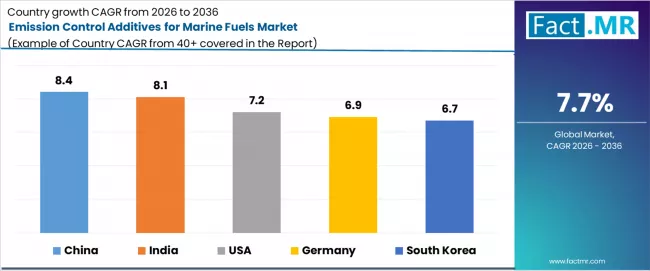
Emission Control Additives For Marine Fuels Market Cagr Analysis By Country

Country CAGR (2026-2036)
China 8.40%
India 8.10%
USA 7.20%
Germany 6.90%
South Korea 6.70%

How does China’s Dominance in Global Trade and Shipbuilding Influence the Market?

China’s leading CAGR of 8.40% is fueled by its position as the world's largest exporter and a top shipbuilding nation. Its vast fleet of coastal and international vessels requires immense volumes of compliant fuel and associated additives.

Domestic enforcement of IMO regulations and national green shipping initiatives further stimulate demand. China's growing capability to produce specialty fuel additives domestically also positions it as both a major consumer and a rising supplier in the global market.

What is the Impact of India’s Expanding Port Infrastructure and Coastal Shipping?

India’s 8.10% growth is driven by significant investments in port modernization and a national push to enhance the role of coastal shipping. Stricter enforcement of emission standards in major ports and coastal Emission Control Areas mandates the use of cleaner fuels and effective additives.

The expansion of India's own merchant fleet and refinery output geared towards VLSFO production creates a concurrent rise in domestic demand for performance-enhancing and emission-reducing additive treatments.

How do the USA’s Stringent ECA Regulations and Bunker Networks Shape Demand?
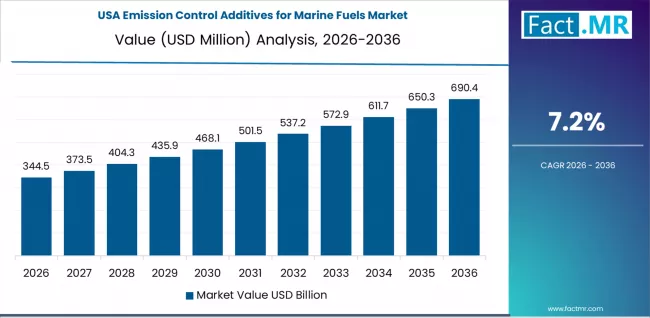
Emission Control Additives For Marine Fuels Market Country Value Analysis

The USA’s 7.20% CAGR is underpinned by its extensive coastal Emission Control Areas, which enforce a 0.10% sulfur limit. The major bunkering hubs in the Gulf and on the East Coast serve a large volume of compliant vessels.

The need for additives to ensure the stability and performance of ultra-low-sulfur fuels like MGO and VLSFO within these ECAs is critical. The market is characterized by demand for high-quality, reliable additive suites from major suppliers to mitigate operational risks for ship operators.

Why is Germany a Key Market for High-Performance Additive Formulations?

Germany’s 6.90% growth reflects its leadership in marine engineering and chemical manufacturing. German engine manufacturers and shipping companies operating high-value vessels demand technically advanced additive formulations that guarantee peak engine performance and longevity.

The market focuses on premium, R&D-intensive additives that offer demonstrable benefits in emission reduction and engine protection, aligning with the country's reputation for precision engineering and environmental technology.

What Role does South Korea’s Shipbuilding and Refining Sector Play?

South Korea’s 6.70% growth is anchored in its status as a global shipbuilding leader and a sophisticated refiner. The close link between its shipyards, marine engine producers, and petrochemical companies fosters early integration and testing of new additive technologies.

South Korean refiners producing specialized marine fuels often develop or partner on tailored additive packages, creating an integrated supply chain and driving demand for additives suited to next-generation vessels and fuels built domestically.

Competitive Landscape of the Emission Control Additives for Marine Fuels Market
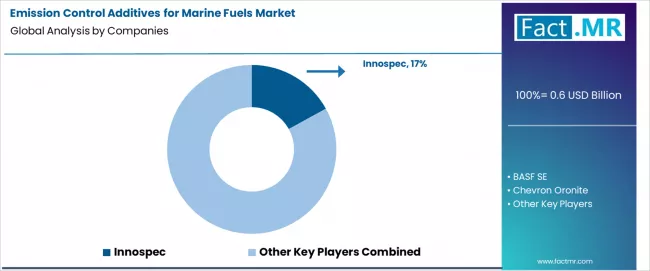
Emission Control Additives For Marine Fuels Market Analysis By Company

Specialized global fuel and lubricant additive companies with deep expertise in hydrocarbon chemistry dominate the competitive landscape. Leaders like Innospec, BASF, and Lubrizol compete on the strength of their proprietary additive componentry, extensive field-testing networks, and technical service support to bunker suppliers and fleet operators.

Competition centers on formulating products that address the latest fuel quality challenges, providing comprehensive compatibility data, and offering global supply chain reliability. A key differentiator is the ability to deliver customized additive solutions and dosing recommendations for specific fleets, fuel blends, and operational profiles.

Key Players in the Emission Control Additives for Marine Fuels Market

  • Innospec
  • BASF SE
  • Chevron Oronite
  • Afton Chemical
  • Lubrizol

Scope of Report

Items Values
Quantitative Units USD Billion
Additive Type Sulfur Reduction, Combustion Improvers, Cetane/Lubricity Enhancers, Ash/Soot Control, Other Additives
Vessel Type Cargo/Container Ships, Tankers, Passenger Ships, Offshore Vessels, Naval Vessels
Fuel Type VLSFO, MGO, HFO with Additives, LNG/Hybrid Fuels, Biofuels
Key Countries China, India, USA, Germany, South Korea
Key Companies Innospec, BASF SE, Chevron Oronite, Afton Chemical, Lubrizol
Additional Analysis Analysis of additive interaction with catalyst-based after-treatment systems; impact on fuel stability and incompatibility; cold flow properties in extreme climates; emissions testing and verification; total cost of ownership models for additive use vs. alternative compliance; regulatory analysis of future IMO targets.

Market by Segments

  • Additive Type :

    • Sulfur Reduction Additives
    • Combustion Improvers
    • Cetane & Lubricity Enhancers
    • Ash & Soot Control Agents
    • Other Marine Fuel Emission Additives
  • Vessel Type :

    • Cargo & Container Ships
    • Tankers (Oil, LNG, Chemical)
    • Passenger & Cruise Ships
    • Offshore Support Vessels
    • Naval & Special-Purpose Vessels
  • Fuel Type :

    • Very Low Sulfur Fuel Oil (VLSFO)
    • Marine Gas Oil (MGO)
    • Heavy Fuel Oil (HFO) with Additives
    • LNG & Hybrid Marine Fuels
    • Biofuels & Others
  • Region :

    • North America

      • USA
      • Canada
    • Latin America

      • Brazil
      • Mexico
      • Argentina
      • Rest of Latin America
    • Western Europe

      • Germany
      • UK
      • France
      • Spain
      • Italy
      • BENELUX
      • Rest of Western Europe
    • Eastern Europe

      • Russia
      • Poland
      • Czech Republic
      • Rest of Eastern Europe
    • East Asia

      • China
      • Japan
      • South Korea
      • Rest of East Asia
    • South Asia & Pacific

      • India
      • ASEAN
      • Australia
      • Rest of South Asia & Pacific
    • MEA

      • Saudi Arabia
      • UAE
      • Turkiye
      • Rest of MEA

Table of Content

  1. Executive Summary
    • Global Market Outlook
    • Demand to side Trends
    • Supply to side Trends
    • Technology Roadmap Analysis
    • Analysis and Recommendations
  2. Market Overview
    • Market Coverage / Taxonomy
    • Market Definition / Scope / Limitations
  3. Market Background
    • Market Dynamics
      • Drivers
      • Restraints
      • Opportunity
      • Trends
    • Scenario Forecast
      • Demand in Optimistic Scenario
      • Demand in Likely Scenario
      • Demand in Conservative Scenario
    • Opportunity Map Analysis
    • Product Life Cycle Analysis
    • Supply Chain Analysis
    • Investment Feasibility Matrix
    • Value Chain Analysis
    • PESTLE and Porter’s Analysis
    • Regulatory Landscape
    • Regional Parent Market Outlook
    • Production and Consumption Statistics
    • Import and Export Statistics
  4. Global Market Analysis 2021 to 2025 and Forecast, 2026 to 2036
    • Historical Market Size Value (USD Million) Analysis, 2021 to 2025
    • Current and Future Market Size Value (USD Million) Projections, 2026 to 2036
      • Y to o to Y Growth Trend Analysis
      • Absolute $ Opportunity Analysis
  5. Global Market Pricing Analysis 2021 to 2025 and Forecast 2026 to 2036
  6. Global Market Analysis 2021 to 2025 and Forecast 2026 to 2036, By Additive Type
    • Introduction / Key Findings
    • Historical Market Size Value (USD Million) Analysis By Additive Type, 2021 to 2025
    • Current and Future Market Size Value (USD Million) Analysis and Forecast By Additive Type, 2026 to 2036
      • Sulfur Reduction Additives
      • Combustion Improvers
      • Cetane & Lubricity Enhancers
      • Ash & Soot Control Agents
      • Other Marine Fuel Emission Additives
    • Y to o to Y Growth Trend Analysis By Additive Type, 2021 to 2025
    • Absolute $ Opportunity Analysis By Additive Type, 2026 to 2036
  7. Global Market Analysis 2021 to 2025 and Forecast 2026 to 2036, By Vessel Type
    • Introduction / Key Findings
    • Historical Market Size Value (USD Million) Analysis By Vessel Type, 2021 to 2025
    • Current and Future Market Size Value (USD Million) Analysis and Forecast By Vessel Type, 2026 to 2036
      • Cargo & Container Ships
      • Tankers (Oil, LNG, Chemical)
      • Passenger & Cruise Ships
      • Offshore Support Vessels
      • Naval & Special-Purpose Vessels
    • Y to o to Y Growth Trend Analysis By Vessel Type, 2021 to 2025
    • Absolute $ Opportunity Analysis By Vessel Type, 2026 to 2036
  8. Global Market Analysis 2021 to 2025 and Forecast 2026 to 2036, By Fuel Type
    • Introduction / Key Findings
    • Historical Market Size Value (USD Million) Analysis By Fuel Type, 2021 to 2025
    • Current and Future Market Size Value (USD Million) Analysis and Forecast By Fuel Type, 2026 to 2036
      • Very Low Sulfur Fuel Oil (VLSFO)
      • Marine Gas Oil (MGO)
      • Heavy Fuel Oil (HFO) with Additives
      • LNG & Hybrid Marine Fuels
      • Biofuels & Others
    • Y to o to Y Growth Trend Analysis By Fuel Type, 2021 to 2025
    • Absolute $ Opportunity Analysis By Fuel Type, 2026 to 2036
  9. Global Market Analysis 2021 to 2025 and Forecast 2026 to 2036, By Region
    • Introduction
    • Historical Market Size Value (USD Million) Analysis By Region, 2021 to 2025
    • Current Market Size Value (USD Million) Analysis and Forecast By Region, 2026 to 2036
      • North America
      • Latin America
      • Western Europe
      • Eastern Europe
      • East Asia
      • South Asia and Pacific
      • Middle East & Africa
    • Market Attractiveness Analysis By Region
  10. North America Market Analysis 2021 to 2025 and Forecast 2026 to 2036, By Country
    • Historical Market Size Value (USD Million) Trend Analysis By Market Taxonomy, 2021 to 2025
    • Market Size Value (USD Million) Forecast By Market Taxonomy, 2026 to 2036
      • By Country
        • USA
        • Canada
        • Mexico
      • By Additive Type
      • By Vessel Type
      • By Fuel Type
    • Market Attractiveness Analysis
      • By Country
      • By Additive Type
      • By Vessel Type
      • By Fuel Type
    • Key Takeaways
  11. Latin America Market Analysis 2021 to 2025 and Forecast 2026 to 2036, By Country
    • Historical Market Size Value (USD Million) Trend Analysis By Market Taxonomy, 2021 to 2025
    • Market Size Value (USD Million) Forecast By Market Taxonomy, 2026 to 2036
      • By Country
        • Brazil
        • Chile
        • Rest of Latin America
      • By Additive Type
      • By Vessel Type
      • By Fuel Type
    • Market Attractiveness Analysis
      • By Country
      • By Additive Type
      • By Vessel Type
      • By Fuel Type
    • Key Takeaways
  12. Western Europe Market Analysis 2021 to 2025 and Forecast 2026 to 2036, By Country
    • Historical Market Size Value (USD Million) Trend Analysis By Market Taxonomy, 2021 to 2025
    • Market Size Value (USD Million) Forecast By Market Taxonomy, 2026 to 2036
      • By Country
        • Germany
        • UK
        • Italy
        • Spain
        • France
        • Nordic
        • BENELUX
        • Rest of Western Europe
      • By Additive Type
      • By Vessel Type
      • By Fuel Type
    • Market Attractiveness Analysis
      • By Country
      • By Additive Type
      • By Vessel Type
      • By Fuel Type
    • Key Takeaways
  13. Eastern Europe Market Analysis 2021 to 2025 and Forecast 2026 to 2036, By Country
    • Historical Market Size Value (USD Million) Trend Analysis By Market Taxonomy, 2021 to 2025
    • Market Size Value (USD Million) Forecast By Market Taxonomy, 2026 to 2036
      • By Country
        • Russia
        • Poland
        • Hungary
        • Balkan & Baltic
        • Rest of Eastern Europe
      • By Additive Type
      • By Vessel Type
      • By Fuel Type
    • Market Attractiveness Analysis
      • By Country
      • By Additive Type
      • By Vessel Type
      • By Fuel Type
    • Key Takeaways
  14. East Asia Market Analysis 2021 to 2025 and Forecast 2026 to 2036, By Country
    • Historical Market Size Value (USD Million) Trend Analysis By Market Taxonomy, 2021 to 2025
    • Market Size Value (USD Million) Forecast By Market Taxonomy, 2026 to 2036
      • By Country
        • China
        • Japan
        • South Korea
      • By Additive Type
      • By Vessel Type
      • By Fuel Type
    • Market Attractiveness Analysis
      • By Country
      • By Additive Type
      • By Vessel Type
      • By Fuel Type
    • Key Takeaways
  15. South Asia and Pacific Market Analysis 2021 to 2025 and Forecast 2026 to 2036, By Country
    • Historical Market Size Value (USD Million) Trend Analysis By Market Taxonomy, 2021 to 2025
    • Market Size Value (USD Million) Forecast By Market Taxonomy, 2026 to 2036
      • By Country
        • India
        • ASEAN
        • Australia & New Zealand
        • Rest of South Asia and Pacific
      • By Additive Type
      • By Vessel Type
      • By Fuel Type
    • Market Attractiveness Analysis
      • By Country
      • By Additive Type
      • By Vessel Type
      • By Fuel Type
    • Key Takeaways
  16. Middle East & Africa Market Analysis 2021 to 2025 and Forecast 2026 to 2036, By Country
    • Historical Market Size Value (USD Million) Trend Analysis By Market Taxonomy, 2021 to 2025
    • Market Size Value (USD Million) Forecast By Market Taxonomy, 2026 to 2036
      • By Country
        • Kingdom of Saudi Arabia
        • Other GCC Countries
        • Turkiye
        • South Africa
        • Other African Union
        • Rest of Middle East & Africa
      • By Additive Type
      • By Vessel Type
      • By Fuel Type
    • Market Attractiveness Analysis
      • By Country
      • By Additive Type
      • By Vessel Type
      • By Fuel Type
    • Key Takeaways
  17. Key Countries Market Analysis
    • USA
      • Pricing Analysis
      • Market Share Analysis, 2025
        • By Additive Type
        • By Vessel Type
        • By Fuel Type
    • Canada
      • Pricing Analysis
      • Market Share Analysis, 2025
        • By Additive Type
        • By Vessel Type
        • By Fuel Type
    • Mexico
      • Pricing Analysis
      • Market Share Analysis, 2025
        • By Additive Type
        • By Vessel Type
        • By Fuel Type
    • Brazil
      • Pricing Analysis
      • Market Share Analysis, 2025
        • By Additive Type
        • By Vessel Type
        • By Fuel Type
    • Chile
      • Pricing Analysis
      • Market Share Analysis, 2025
        • By Additive Type
        • By Vessel Type
        • By Fuel Type
    • Germany
      • Pricing Analysis
      • Market Share Analysis, 2025
        • By Additive Type
        • By Vessel Type
        • By Fuel Type
    • UK
      • Pricing Analysis
      • Market Share Analysis, 2025
        • By Additive Type
        • By Vessel Type
        • By Fuel Type
    • Italy
      • Pricing Analysis
      • Market Share Analysis, 2025
        • By Additive Type
        • By Vessel Type
        • By Fuel Type
    • Spain
      • Pricing Analysis
      • Market Share Analysis, 2025
        • By Additive Type
        • By Vessel Type
        • By Fuel Type
    • France
      • Pricing Analysis
      • Market Share Analysis, 2025
        • By Additive Type
        • By Vessel Type
        • By Fuel Type
    • India
      • Pricing Analysis
      • Market Share Analysis, 2025
        • By Additive Type
        • By Vessel Type
        • By Fuel Type
    • ASEAN
      • Pricing Analysis
      • Market Share Analysis, 2025
        • By Additive Type
        • By Vessel Type
        • By Fuel Type
    • Australia & New Zealand
      • Pricing Analysis
      • Market Share Analysis, 2025
        • By Additive Type
        • By Vessel Type
        • By Fuel Type
    • China
      • Pricing Analysis
      • Market Share Analysis, 2025
        • By Additive Type
        • By Vessel Type
        • By Fuel Type
    • Japan
      • Pricing Analysis
      • Market Share Analysis, 2025
        • By Additive Type
        • By Vessel Type
        • By Fuel Type
    • South Korea
      • Pricing Analysis
      • Market Share Analysis, 2025
        • By Additive Type
        • By Vessel Type
        • By Fuel Type
    • Russia
      • Pricing Analysis
      • Market Share Analysis, 2025
        • By Additive Type
        • By Vessel Type
        • By Fuel Type
    • Poland
      • Pricing Analysis
      • Market Share Analysis, 2025
        • By Additive Type
        • By Vessel Type
        • By Fuel Type
    • Hungary
      • Pricing Analysis
      • Market Share Analysis, 2025
        • By Additive Type
        • By Vessel Type
        • By Fuel Type
    • Kingdom of Saudi Arabia
      • Pricing Analysis
      • Market Share Analysis, 2025
        • By Additive Type
        • By Vessel Type
        • By Fuel Type
    • Turkiye
      • Pricing Analysis
      • Market Share Analysis, 2025
        • By Additive Type
        • By Vessel Type
        • By Fuel Type
    • South Africa
      • Pricing Analysis
      • Market Share Analysis, 2025
        • By Additive Type
        • By Vessel Type
        • By Fuel Type
  18. Market Structure Analysis
    • Competition Dashboard
    • Competition Benchmarking
    • Market Share Analysis of Top Players
      • By Regional
      • By Additive Type
      • By Vessel Type
      • By Fuel Type
  19. Competition Analysis
    • Competition Deep Dive
      • Innospec
        • Overview
        • Product Portfolio
        • Profitability by Market Segments (Product/Age /Sales Channel/Region)
        • Sales Footprint
        • Strategy Overview
          • Marketing Strategy
          • Product Strategy
          • Channel Strategy
      • BASF SE
      • Chevron Oronite
      • Afton Chemical
      • Lubrizol
  20. Assumptions & Acronyms Used
  21. Research Methodology

List Of Table

  • Table 1: Global Market Value (USD Million) Forecast by Region, 2021 to 2036
  • Table 2: Global Market Value (USD Million) Forecast by Additive Type, 2021 to 2036
  • Table 3: Global Market Value (USD Million) Forecast by Vessel Type, 2021 to 2036
  • Table 4: Global Market Value (USD Million) Forecast by Fuel Type, 2021 to 2036
  • Table 5: North America Market Value (USD Million) Forecast by Country, 2021 to 2036
  • Table 6: North America Market Value (USD Million) Forecast by Additive Type, 2021 to 2036
  • Table 7: North America Market Value (USD Million) Forecast by Vessel Type, 2021 to 2036
  • Table 8: North America Market Value (USD Million) Forecast by Fuel Type, 2021 to 2036
  • Table 9: Latin America Market Value (USD Million) Forecast by Country, 2021 to 2036
  • Table 10: Latin America Market Value (USD Million) Forecast by Additive Type, 2021 to 2036
  • Table 11: Latin America Market Value (USD Million) Forecast by Vessel Type, 2021 to 2036
  • Table 12: Latin America Market Value (USD Million) Forecast by Fuel Type, 2021 to 2036
  • Table 13: Western Europe Market Value (USD Million) Forecast by Country, 2021 to 2036
  • Table 14: Western Europe Market Value (USD Million) Forecast by Additive Type, 2021 to 2036
  • Table 15: Western Europe Market Value (USD Million) Forecast by Vessel Type, 2021 to 2036
  • Table 16: Western Europe Market Value (USD Million) Forecast by Fuel Type, 2021 to 2036
  • Table 17: Eastern Europe Market Value (USD Million) Forecast by Country, 2021 to 2036
  • Table 18: Eastern Europe Market Value (USD Million) Forecast by Additive Type, 2021 to 2036
  • Table 19: Eastern Europe Market Value (USD Million) Forecast by Vessel Type, 2021 to 2036
  • Table 20: Eastern Europe Market Value (USD Million) Forecast by Fuel Type, 2021 to 2036
  • Table 21: East Asia Market Value (USD Million) Forecast by Country, 2021 to 2036
  • Table 22: East Asia Market Value (USD Million) Forecast by Additive Type, 2021 to 2036
  • Table 23: East Asia Market Value (USD Million) Forecast by Vessel Type, 2021 to 2036
  • Table 24: East Asia Market Value (USD Million) Forecast by Fuel Type, 2021 to 2036
  • Table 25: South Asia and Pacific Market Value (USD Million) Forecast by Country, 2021 to 2036
  • Table 26: South Asia and Pacific Market Value (USD Million) Forecast by Additive Type, 2021 to 2036
  • Table 27: South Asia and Pacific Market Value (USD Million) Forecast by Vessel Type, 2021 to 2036
  • Table 28: South Asia and Pacific Market Value (USD Million) Forecast by Fuel Type, 2021 to 2036
  • Table 29: Middle East & Africa Market Value (USD Million) Forecast by Country, 2021 to 2036
  • Table 30: Middle East & Africa Market Value (USD Million) Forecast by Additive Type, 2021 to 2036
  • Table 31: Middle East & Africa Market Value (USD Million) Forecast by Vessel Type, 2021 to 2036
  • Table 32: Middle East & Africa Market Value (USD Million) Forecast by Fuel Type, 2021 to 2036

List Of Figures

  • Figure 1: Global Market Pricing Analysis
  • Figure 2: Global Market Value (USD Million) Forecast 2021 to 2036
  • Figure 3: Global Market Value Share and BPS Analysis by Additive Type, 2026 and 2036
  • Figure 4: Global Market Y to o to Y Growth Comparison by Additive Type, 2026 to 2036
  • Figure 5: Global Market Attractiveness Analysis by Additive Type
  • Figure 6: Global Market Value Share and BPS Analysis by Vessel Type, 2026 and 2036
  • Figure 7: Global Market Y to o to Y Growth Comparison by Vessel Type, 2026 to 2036
  • Figure 8: Global Market Attractiveness Analysis by Vessel Type
  • Figure 9: Global Market Value Share and BPS Analysis by Fuel Type, 2026 and 2036
  • Figure 10: Global Market Y to o to Y Growth Comparison by Fuel Type, 2026 to 2036
  • Figure 11: Global Market Attractiveness Analysis by Fuel Type
  • Figure 12: Global Market Value (USD Million) Share and BPS Analysis by Region, 2026 and 2036
  • Figure 13: Global Market Y to o to Y Growth Comparison by Region, 2026 to 2036
  • Figure 14: Global Market Attractiveness Analysis by Region
  • Figure 15: North America Market Incremental Dollar Opportunity, 2026 to 2036
  • Figure 16: Latin America Market Incremental Dollar Opportunity, 2026 to 2036
  • Figure 17: Western Europe Market Incremental Dollar Opportunity, 2026 to 2036
  • Figure 18: Eastern Europe Market Incremental Dollar Opportunity, 2026 to 2036
  • Figure 19: East Asia Market Incremental Dollar Opportunity, 2026 to 2036
  • Figure 20: South Asia and Pacific Market Incremental Dollar Opportunity, 2026 to 2036
  • Figure 21: Middle East & Africa Market Incremental Dollar Opportunity, 2026 to 2036
  • Figure 22: North America Market Value Share and BPS Analysis by Country, 2026 and 2036
  • Figure 23: North America Market Value Share and BPS Analysis by Additive Type, 2026 and 2036
  • Figure 24: North America Market Y to o to Y Growth Comparison by Additive Type, 2026 to 2036
  • Figure 25: North America Market Attractiveness Analysis by Additive Type
  • Figure 26: North America Market Value Share and BPS Analysis by Vessel Type, 2026 and 2036
  • Figure 27: North America Market Y to o to Y Growth Comparison by Vessel Type, 2026 to 2036
  • Figure 28: North America Market Attractiveness Analysis by Vessel Type
  • Figure 29: North America Market Value Share and BPS Analysis by Fuel Type, 2026 and 2036
  • Figure 30: North America Market Y to o to Y Growth Comparison by Fuel Type, 2026 to 2036
  • Figure 31: North America Market Attractiveness Analysis by Fuel Type
  • Figure 32: Latin America Market Value Share and BPS Analysis by Country, 2026 and 2036
  • Figure 33: Latin America Market Value Share and BPS Analysis by Additive Type, 2026 and 2036
  • Figure 34: Latin America Market Y to o to Y Growth Comparison by Additive Type, 2026 to 2036
  • Figure 35: Latin America Market Attractiveness Analysis by Additive Type
  • Figure 36: Latin America Market Value Share and BPS Analysis by Vessel Type, 2026 and 2036
  • Figure 37: Latin America Market Y to o to Y Growth Comparison by Vessel Type, 2026 to 2036
  • Figure 38: Latin America Market Attractiveness Analysis by Vessel Type
  • Figure 39: Latin America Market Value Share and BPS Analysis by Fuel Type, 2026 and 2036
  • Figure 40: Latin America Market Y to o to Y Growth Comparison by Fuel Type, 2026 to 2036
  • Figure 41: Latin America Market Attractiveness Analysis by Fuel Type
  • Figure 42: Western Europe Market Value Share and BPS Analysis by Country, 2026 and 2036
  • Figure 43: Western Europe Market Value Share and BPS Analysis by Additive Type, 2026 and 2036
  • Figure 44: Western Europe Market Y to o to Y Growth Comparison by Additive Type, 2026 to 2036
  • Figure 45: Western Europe Market Attractiveness Analysis by Additive Type
  • Figure 46: Western Europe Market Value Share and BPS Analysis by Vessel Type, 2026 and 2036
  • Figure 47: Western Europe Market Y to o to Y Growth Comparison by Vessel Type, 2026 to 2036
  • Figure 48: Western Europe Market Attractiveness Analysis by Vessel Type
  • Figure 49: Western Europe Market Value Share and BPS Analysis by Fuel Type, 2026 and 2036
  • Figure 50: Western Europe Market Y to o to Y Growth Comparison by Fuel Type, 2026 to 2036
  • Figure 51: Western Europe Market Attractiveness Analysis by Fuel Type
  • Figure 52: Eastern Europe Market Value Share and BPS Analysis by Country, 2026 and 2036
  • Figure 53: Eastern Europe Market Value Share and BPS Analysis by Additive Type, 2026 and 2036
  • Figure 54: Eastern Europe Market Y to o to Y Growth Comparison by Additive Type, 2026 to 2036
  • Figure 55: Eastern Europe Market Attractiveness Analysis by Additive Type
  • Figure 56: Eastern Europe Market Value Share and BPS Analysis by Vessel Type, 2026 and 2036
  • Figure 57: Eastern Europe Market Y to o to Y Growth Comparison by Vessel Type, 2026 to 2036
  • Figure 58: Eastern Europe Market Attractiveness Analysis by Vessel Type
  • Figure 59: Eastern Europe Market Value Share and BPS Analysis by Fuel Type, 2026 and 2036
  • Figure 60: Eastern Europe Market Y to o to Y Growth Comparison by Fuel Type, 2026 to 2036
  • Figure 61: Eastern Europe Market Attractiveness Analysis by Fuel Type
  • Figure 62: East Asia Market Value Share and BPS Analysis by Country, 2026 and 2036
  • Figure 63: East Asia Market Value Share and BPS Analysis by Additive Type, 2026 and 2036
  • Figure 64: East Asia Market Y to o to Y Growth Comparison by Additive Type, 2026 to 2036
  • Figure 65: East Asia Market Attractiveness Analysis by Additive Type
  • Figure 66: East Asia Market Value Share and BPS Analysis by Vessel Type, 2026 and 2036
  • Figure 67: East Asia Market Y to o to Y Growth Comparison by Vessel Type, 2026 to 2036
  • Figure 68: East Asia Market Attractiveness Analysis by Vessel Type
  • Figure 69: East Asia Market Value Share and BPS Analysis by Fuel Type, 2026 and 2036
  • Figure 70: East Asia Market Y to o to Y Growth Comparison by Fuel Type, 2026 to 2036
  • Figure 71: East Asia Market Attractiveness Analysis by Fuel Type
  • Figure 72: South Asia and Pacific Market Value Share and BPS Analysis by Country, 2026 and 2036
  • Figure 73: South Asia and Pacific Market Value Share and BPS Analysis by Additive Type, 2026 and 2036
  • Figure 74: South Asia and Pacific Market Y to o to Y Growth Comparison by Additive Type, 2026 to 2036
  • Figure 75: South Asia and Pacific Market Attractiveness Analysis by Additive Type
  • Figure 76: South Asia and Pacific Market Value Share and BPS Analysis by Vessel Type, 2026 and 2036
  • Figure 77: South Asia and Pacific Market Y to o to Y Growth Comparison by Vessel Type, 2026 to 2036
  • Figure 78: South Asia and Pacific Market Attractiveness Analysis by Vessel Type
  • Figure 79: South Asia and Pacific Market Value Share and BPS Analysis by Fuel Type, 2026 and 2036
  • Figure 80: South Asia and Pacific Market Y to o to Y Growth Comparison by Fuel Type, 2026 to 2036
  • Figure 81: South Asia and Pacific Market Attractiveness Analysis by Fuel Type
  • Figure 82: Middle East & Africa Market Value Share and BPS Analysis by Country, 2026 and 2036
  • Figure 83: Middle East & Africa Market Value Share and BPS Analysis by Additive Type, 2026 and 2036
  • Figure 84: Middle East & Africa Market Y to o to Y Growth Comparison by Additive Type, 2026 to 2036
  • Figure 85: Middle East & Africa Market Attractiveness Analysis by Additive Type
  • Figure 86: Middle East & Africa Market Value Share and BPS Analysis by Vessel Type, 2026 and 2036
  • Figure 87: Middle East & Africa Market Y to o to Y Growth Comparison by Vessel Type, 2026 to 2036
  • Figure 88: Middle East & Africa Market Attractiveness Analysis by Vessel Type
  • Figure 89: Middle East & Africa Market Value Share and BPS Analysis by Fuel Type, 2026 and 2036
  • Figure 90: Middle East & Africa Market Y to o to Y Growth Comparison by Fuel Type, 2026 to 2036
  • Figure 91: Middle East & Africa Market Attractiveness Analysis by Fuel Type
  • Figure 92: Global Market - Tier Structure Analysis
  • Figure 93: Global Market - Company Share Analysis

- FAQs -

How big is the emission control additives for marine fuels market in 2026?

The global emission control additives for marine fuels market is estimated to be valued at USD 0.6 billion in 2026.

What will be the size of emission control additives for marine fuels market in 2036?

The market size for the emission control additives for marine fuels market is projected to reach USD 1.3 billion by 2036.

How much will be the emission control additives for marine fuels market growth between 2026 and 2036?

The emission control additives for marine fuels market is expected to grow at a 7.7% CAGR between 2026 and 2036.

What are the key product types in the emission control additives for marine fuels market?

The key product types in emission control additives for marine fuels market are sulfur reduction additives, combustion improvers, cetane & lubricity enhancers, ash & soot control agents and other marine fuel emission additives.

Which vessel type segment to contribute significant share in the emission control additives for marine fuels market in 2026?

In terms of vessel type, cargo & container ships segment to command 32.0% share in the emission control additives for marine fuels market in 2026.

Emission Control Additives for Marine Fuels Market