- Market Value (2025): USD 2.01 Bn
- Estimated Value (2026): USD 2.12 Bn
- Forecast Value (2036): USD 3.55 Bn
- CAGR (2026-2036): 5.3%
What is the Baby Bath Soap Market forecast to be worth by 2036?
USD 2.12 billion in 2026 to USD 3.55 billion by 2036 at a 5.3% CAGR.
- As per Fact.MR analysis, the baby bath soap market reached USD 2.01 billion in 2025.
- Sales are projected to rise from USD 2.12 billion in 2026 to USD 3.55 billion by 2036.
- The baby bath soap market is forecast to record a 5.3% CAGR between 2026 and 2036.
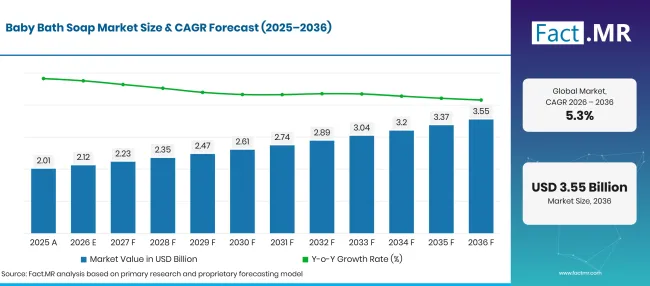
Factmr Baby Bath Soap Market Forecast Global | Source: Fact.MR
| Year | Basis | Market value (USD billion) |
|---|---|---|
| 2025 | Actual | 2.01 |
| 2026 | Estimate | 2.12 |
| 2036 | Forecast | 3.55 |
| CAGR 2026 to 2036 | Forecast period | 5.3% |
Source: Fact.MR analysis. Updated Oct 13, 2026
What are the defining numbers behind 3.83.8 growth?
USD 1.5 billion in absolute chance between 2026 and 2036.
- Demand Drivers in the Market
- Parents often choose baby bath soap for regular bathing because it is gentle on the skin and comes with clear age recommendations. The American Academy of Pediatrics noted in July 2025 that gentle washing is suitable for newborn care [1].
- Pharmacies and supermarkets make it easy for families to buy another soap bar during their regular shopping trips. Product labels help caregivers check age suitability and ingredient information before choosing between medicated and everyday-use products.
- Families dealing with dry or sensitive skin often look at fragrance information before trying a new soap. Manufacturers that clearly explain how a product should be used can build trust without presenting a regular cleansing soap as a medical treatment.
- Key Segments Analyzed
- By Products: Non-Medicated baby bath soap holds 63.4% share in 2026 because it serves routine cleansing needs in households with infants and young children.
- By Distribution Channel: Offline stores represent 68.8% share in 2026 as parents compare packs in person and replenish often used products during household shopping.
- Analyst Opinion at Fact.MR
- Shambhu Nath Jha, Principal Consultant at Fact.MR, states, “Baby bath soap will remain a product that families buy regularly, where familiar formulas and clear instructions help shape purchase decisions. When a product works well as part of a child’s bathing routine, parents will have a practical reason to continue buying the same soap.”
- Strategic Implications
- Manufacturers can keep baby bath soap labels simple and easy to understand. Clear product information will help parents compare different soaps without confusing everyday products with treatment-based products.
- Retailers may place baby soap alongside other bathing essentials so caregivers can compare options during their regular shopping trips. England and Wales recorded 585,396 births in 2025, as reported by the Office for National Statistics in May 2026 [7].
- Distributors will need to maintain availability of popular pack sizes because frequent product substitutions can reduce customer loyalty.
Brazil is forecast to record 6.1% CAGR through 2036 as routine bathing products remain accessible across everyday retail channels. Japan follows at 5.3% as product feel and ease of rinsing influence choice. The United States is forecast at 4.7%, while the United Kingdom is projected at 4.2%. Germany is expected to record 3.7% as retailers balance value and product suitability.
How does the Baby Bath Soap Market break down by segment?
Non-Medicated leads Products at 63.4%; Offline leads Distribution Channel at 68.8%.
Which Products segment accounts for the larger share?
Non-Medicated baby bath soap leads with 63.4% share in 2026.
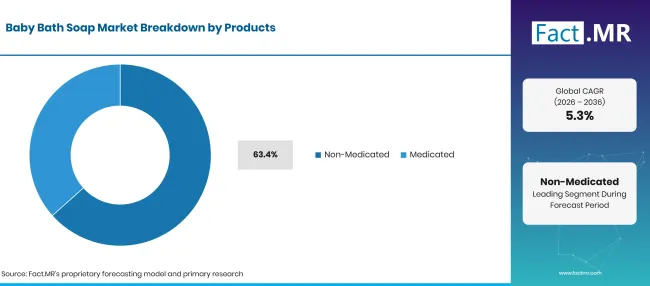
Factmr Baby Bath Soap Market Breakdown Products | Source: Fact.MR
Products Segment
| Product type | Share (2026) |
|---|---|
| Non-Medicated (Leading segment) | 63.4% |
| Other segments combined | 36.6% |
| Total | 100.0% |
Source: Fact.MR analysis. Updated Oct 13, 2026
Non-medicated baby bath soap accounts for 63.4% of product sales in 2026. Caregivers will continue to use regular cleansing soap for everyday bathing and often compare ingredients and skin comfort before buying again. Brands can help parents identify baby-specific formulas by clearly explaining the recommended age group and intended use. These simple details will remain helpful when families make routine purchases.
What leads the Distribution Channel segment?
Offline distribution accounts for 68.8% share in 2026.
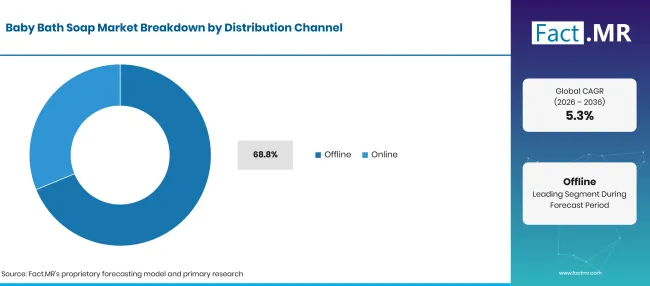
Factmr Baby Bath Soap Market Breakdown Distribution Channel | Source: Fact.MR
Distribution Channel Segment
| Distribution channel | Share (2026) |
|---|---|
| Offline (Leading segment) | 68.8% |
| Other segments combined | 31.2%* |
| Total | 100.0% |
Source: Fact.MR analysis. Updated Oct 13, 2026
Offline shops hold 68.8% of baby bath soap sales in 2026. Supermarkets and pharmacies allow families to check packaging while buying everyday baby care items. Parents can compare pack sizes and product details directly at the shelf, while retailers can place baby soap alongside other infant bathing products. Easy and convenient restocking will continue to be a key advantage for physical stores.
What is accelerating Baby Bath Soap Market adoption, and what is holding it back?
Regular bathing habits and easy access to stores will continue to support baby bath soap sales. At the same time, changes in newborn birth rates and the growing availability of other cleansing products will continue to influence future purchasing decisions.
Drivers Impact Analysis
| DRIVER | (~) % IMPACT ON CAGR | GEOGRAPHIC RELEVANCE | IMPACT TIMELINE |
|---|---|---|---|
| Routine baby cleansing | +1.0% | Global | Short term (<= 2 years) |
| Preference for mild labels | +0.8% | Europe, North America | Medium term (2–4 years) |
| Shelf access and repeat purchases | +0.7% | Global | Short term (<= 2 years) |
| Convenient pack sizes | +0.5% | Latin America, Asia | Medium term (2–4 years) |
| Parent guidance on gentle care | +0.4% | Global | Long term (>= 4 years) |
Source: Fact.MR analysis. Updated Oct 13, 2026
Opportunity Impact Analysis
| OPPORTUNITY | (~) % IMPACT ON CAGR | GEOGRAPHIC RELEVANCE | IMPACT TIMELINE |
|---|---|---|---|
| Clear ingredient labeling | +0.8% | Europe, North America | Short term (<= 2 years) |
| Targeted offline assortment | +0.6% | Global | Medium term (2–4 years) |
| Convenient online repeat orders | +0.5% | Global | Medium term (2–4 years) |
| Accessible small packs | +0.4% | Brazil, Asia | Long term (>= 4 years) |
Source: Fact.MR analysis. Updated Oct 13, 2026
Restraints Impact Analysis
| RESTRAINT | (~) % IMPACT ON CAGR | GEOGRAPHIC RELEVANCE | IMPACT TIMELINE |
|---|---|---|---|
| Lower birth counts | -0.8% | Germany, USA, UK, Japan | Long term (>= 4 years) |
| Competition from liquid washes | -0.6% | Global | Medium term (2–4 years) |
| Price sensitivity | -0.5% | Global | Short term (<= 2 years) |
| Claims and ingredient compliance | -0.4% | Europe, Brazil | Medium term (2–4 years) |
Source: Fact.MR analysis. Updated Oct 13, 2026
Which countries are scaling the Baby Bath Soap Market through 2036?
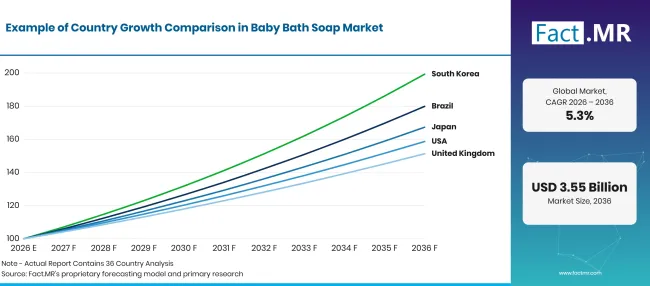
Factmr Baby Bath Soap Market Growth Index | Source: Fact.MR
| Country | CAGR (2026–2036) |
|---|---|
| Brazil | 6.1% |
| Japan | 5.3% |
| USA | 4.7% |
| UK | 4.2% |
| Germany | 3.7% |
Source: Fact.MR analysis. Updated Oct 13, 2026
What supports Brazil’s baby bath soap outlook?
6.1% CAGR, linked to everyday cleansing and accessible store formats.
Brazilian parents will often buy baby bath soap from local stores and pharmacies, where smaller pack sizes can fit everyday household budgets. In April 2025, Anvisa updated the submission process for cosmetic products that do not require registration, giving manufacturers a clear process for eligible formulas [4]. Its January 2025 consultations on cosmetic ingredient restrictions also influenced how brands review cleansing products [5]. Clear age guidance and simple usage information on the label will make it easier for families to compare soap bars and liquid washes.
How is Japan shaping baby soap purchases?
5.3% CAGR, supported by careful product selection and repeat care routines.
Baby-care retailers in Japan will give parents the chance to compare soap bars and liquid baby washes before choosing a product they trust. Clear product descriptions and easy-to-follow instructions will help caregivers choose a soap that fits their daily bathing routine, while liquid washes will remain a common alternative.
What is supporting demand in the United States?
4.7% CAGR, shaped by familiar brands and channel competition.
American families often purchase baby bath soap during regular visits to supermarkets and pharmacies, while online stores make repeat ordering more convenient. The Centers for Disease Control and Prevention reported a provisional 3,606,400 births in 2025 in its April 2026 vital statistics release [2]. This newborn population is expected to support demand from families buying baby cleansing products for the first time. When comparing soap bars and liquid washes, parents typically consider ease of use, familiar ingredients, and product price.
How is the United Kingdom developing sales?
4.2% CAGR, linked to grocery retail and careful labeling.
In the United Kingdom, parents can find baby cleansing products easily in grocery stores and pharmacies alongside other infant-care items. The Office for National Statistics reported 585,396 live births in England and Wales during 2025 in its May 2026 release [6]. Families with a new baby create opportunities for first-time purchases, while existing users drive repeat sales. Clear ingredient information makes it easier for shoppers to compare baby bath soap with other cleansing products, and pack size can influence the cost of a regular purchase.
What supports Germany’s market position?
3.7% CAGR, shaped by established retailers and newborn trends.
German drugstores give families a familiar place to compare baby bath soap options and pack prices. The Federal Statistical Office reported 654,241 births in Germany during 2025 in its July 2026 published figures [3]. Its July 2026 release also recorded a total fertility rate of 1.32 children per woman for 2025 [8]. Retailers use newborn population trends when planning product ranges, while familiar brands and clear instructions drive repeat purchases despite competition from liquid bathing products.
Who competes in the Baby Bath Soap Market?
Competition includes dedicated baby-care brands as well as larger personal-care companies. Chicco and Pigeon offer baby-care products, while Sebapharma and Himalaya Wellness provide cleansing products for parents seeking clear product information. Retailers review product suitability and product availability before adding more soap options to their shelves.
Johnson’s baby products are part of Kenvue following the separation of the consumer health business from Johnson & Johnson. Product portfolios need evaluation at the individual product level, as broader skincare or baby-care offerings do not necessarily indicate baby bath soap sales.
Which companies are the key providers?
Key companies include Earth Mama Organics; Galderma Laboratories L.P.; Himalaya Wellness Company; Kenvue Inc.; Pigeon; PZ Cussons; Sebapharma; and Unilever.
- Earth Mama Organics
- Galderma Laboratories L.P.
- Himalaya Wellness Company
- Kenvue Inc.
- Pigeon
- PZ Cussons
- Sebapharma
- Unilever
Bibliography
- [1] American Academy of Pediatrics. (2025, July 6). Bathing your baby. HealthyChildren.org.
- [2] Centers for Disease Control and Prevention. (2026, April 9). U.S. births down 1% in 2025.
- [3] Statistisches Bundesamt (Destatis). (2026, July 1). Total fertility rate drops to 1.32 children per woman in 2025.
- [4] Agência Nacional de Vigilância Sanitária. (2025, April 7). Peticionamento de cosméticos isentos de registro deve ser feito exclusivamente pelo Solicita/Datavisa.
- [5] Agência Nacional de Vigilância Sanitária. (2025, January 7). Aberta CP sobre listas de substâncias restritas e proibidas em produtos de higiene, perfumes e cosméticos.
- [6] Office for National Statistics. (2026, May 27). Births in England and Wales: 2025.
- [7] Statistisches Bundesamt (Destatis). (n.d.). Births.
- [8] Ministry of Health, Labour and Welfare. (2026, February 26). [Vital statistics preliminary report: December 2025].
This Report Answers
- The report compares everyday and medicated baby bath soap purchasing conditions.
- Segment analysis discusses why non-medicated soap and offline shopping account for the stated shares.
- Country outlooks examine demographic and retail conditions across the five forecast markets.
- Competitive analysis distinguishes dedicated baby soap sellers from broader infant-care portfolios.
- Channel analysis considers supermarket purchases alongside planned online repeat orders
What does the Baby Bath Soap Market cover?
The market covers soap formulations marketed specifically for bathing babies and young children. The assessment tracks retail sales of non-medicated products and applicable medicated products across the two distribution channels.
What is included in the scope?
The scope includes bars and soap-form baby cleansers intended for infant bathing, whether sold individually or as multipacks.
Offline retail includes supermarkets and pharmacies, while online retail includes brand and marketplace orders.
What is excluded from the scope?
Adult cleansing bars and generic household soaps are outside the market.
Baby shampoo and liquid body washes that are not sold as soap are also outside this boundary. The market excludes creams, diapers, wipes and medical treatment products that are not baby bath soap.
How Was the Analysis Built?
The analysis draws on 120+ sources, 35+ company portfolios, 25+ countries, and more than 20 industry interviews.
- Primary Research: Primary research includes discussions with manufacturers, service providers, technology developers, distributors, end users, and subject-matter experts. These conversations examine purchasing priorities, product adoption, operational challenges, approval requirements, competitive positioning, and the factors that influence wider market acceptance.
- Desk Research: Desk research covers government statistics, regulatory publications, company filings, trade data, technical studies, industry associations, standards, public policy, and other authoritative sources. Every source used in the analysis is documented in the bibliography.
- Market Sizing and Forecasting: Market estimates combine historical performance, demand indicators, pricing and volume trends, segment shares, company participation, country-level growth, adoption patterns, investment activity, and barriers to market expansion.
- Data Validation and Update Cycle: Findings are validated by comparing primary interviews with public data, company activity, regulatory changes, trade patterns, and industry developments. Regular updates review new product launches, capacity changes, partnerships, approvals, and shifts in commercial adoption.
Segmentation
What is the report’s scope and coverage?
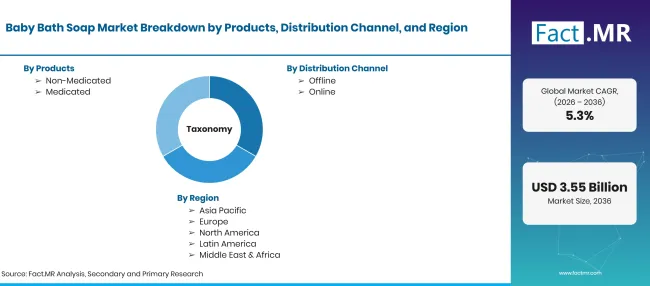
Factmr Baby Bath Soap Market Taxonomy | Source: Fact.MR
| Attribute | Details |
|---|---|
| Quantitative Units | USD billion |
| Market Definition | Bath soap formulated and marketed for babies and young children; routine cleansing and eligible medicated soap formats |
| Products | Non-Medicated; Medicated |
| Distribution Channel | Offline; Online |
| Regions Covered | North America; Latin America; Western Europe; Eastern Europe; East Asia; South Asia & Pacific; Middle East & Africa |
| Countries Covered | Brazil; Japan; USA; UK; Germany |
| Companies Profiled | Chicco; Earth Mama Organics; Galderma; Himalaya; Kenvue Inc.; Pigeon; PZ Cussons; Sebapharma; Unilever |
| Forecast Period | 2026 to 2036 |
| Approach | Market sizing considers baby-care households, bathing frequency, unit pricing, soap formats, retail distribution and country forecasts. |
Source: Fact.MR analysis. Updated Oct 13, 2026
How is the market segmented?
-
By Products:
- Non-Medicated
- Medicated
-
By Distribution Channel:
- Offline
- Online
-
By Region:
- North America
- Latin America
- Western Europe
- Eastern Europe
- East Asia
- South Asia & Pacific
- Middle East & Africa
Frequently Asked Questions
How big is the baby bath soap market in 2026?
What CAGR is forecast for baby bath soap?
Which products segment leads?
Which distribution channel leads?
Who are the main companies in the baby bath soap market?
Who worked on this report


Preview the report firsthand - request a free sample
Free SampleGet the brochure for pricing and purchase details
Download PDF