- Market Value (2025): USD 11.2 Bn
- Estimated Value (2026): USD 11.8 Bn
- Forecast Value (2036): USD 19.8 Bn
- CAGR (2026-2036): 5.3%
What is the Baby Training Pants Market forecast to be worth by 2036?
USD 11.8 billion in 2026 to USD 19.8 billion by 2036 at 5.3% CAGR.
- The baby training pants market reached USD 11.2 billion in 2025 as parents, retailers, diaper brands and childcare buyers increased spending where potty-training purchases move through repeat household replenishment, fit needs and channel availability.
- Demand is projected to increase from USD 11.8 billion in 2026 to USD 19.8 billion by 2036.
- The market is forecast to record 5.3% CAGR from 2026 to 2036.
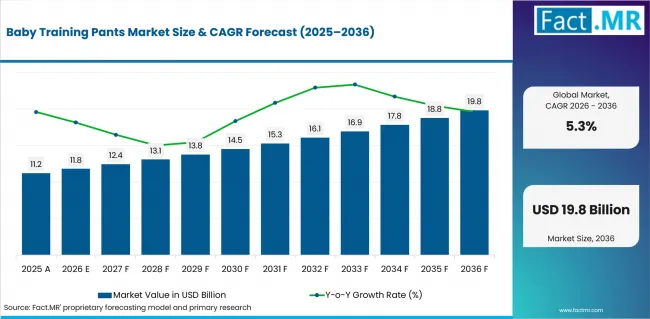
Baby Training Pants Market Value Analysis | Source: Fact.MR
What are the defining numbers behind Baby Training Pants Market growth?
USD 8.0 billion absolute opportunity is expected by 2036.
- Demand Drivers in the Market
- Disposable training pants remain the volume base because parents use them as a bridge between diapers and underwear. Pull-up design, leak protection and brand familiarity keep the format close to routine diaper buying.
- Large (L) sizes gain share as toilet training often extends across toddler and preschool ages. Buyers need a secure fit for active children without moving too early into underwear-only routines.
- Supermarkets and hypermarkets keep strong placement because parents can compare pack size, absorbency claims and price while buying other household staples.
- Household demand leads because most training decisions are made at home. Daycare purchases add volume, but parents still drive the core replacement cycle.
- Key Segments Analyzed
- By Product Type: Disposable Training Pants are expected to hold 57.0% share in 2026 because the format fits daily potty-training routines and gives parents a familiar disposable option during accidents.
- By Size: Large (L) is expected to hold 39.0% share in 2026 because the size range covers many children during the heaviest training period.
- By Distribution Channel: Supermarkets & Hypermarkets are expected to hold 29.7% share in 2026 because parents can compare brands, pack counts and price promotions in one trip.
- By End User: Households are expected to hold 40.2% share in 2026 because most purchases are made for home use even when daycare centers influence brand choice.
- By Absorbency Type: Regular Absorbency is expected to hold 40.5% share in 2026 because regular absorbency covers daytime accidents without the bulk of overnight products.
- Analyst Opinion at Fact.MR
- Shambhu Nath Jha, Sr. Consultant at Fact.MR, states, "Parents are not buying a category label; they are buying fewer accidents, easier changes and a product that feels close enough to underwear. Brands that explain fit, absorbency and skin comfort clearly have a better chance of staying in the repeat basket."
- Strategic Implications
- Brands should keep the product story close to training routines: pull-up ease, child comfort, leak protection and clear size guidance.
- Retailers can improve conversion by grouping daytime, overnight and value-pack options so parents can trade up without searching across the aisle.
- Suppliers should treat private label as a real constraint. Differentiation has to show up in fit, softness, absorbency proof and reliable shelf availability.
- South Korea is projected at 5.7%; USA is projected at 6.9%; Canada is projected at 5.3%; Germany is projected at 5.1%; Australia is projected at 4.9%; UK is projected at 4.8%; Japan is projected at 4.7% during 2026 to 2036. Country analysis is shaped by potty-training habits, retail concentration and brand trust.
How does the Baby Training Pants Market break down by segment?
Disposable Training Pants leads Product Type at 57.0% share in 2026, while Large (L) leads Size at 39.0% share.
Why does Disposable Training Pants lead Product Type?
Disposable Training Pants is expected to account for 57.0% share in 2026.
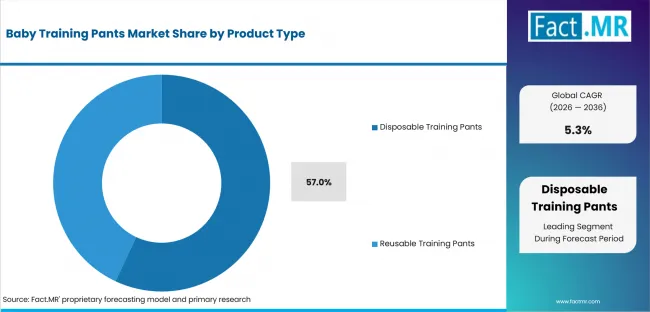
Baby Training Pants Market Analysis By Product Type | Source: Fact.MR
Disposable Training Pants lead the product type segment because the format fits daily potty-training routines and gives parents a familiar disposable option during accidents.
Why does Large (L) lead Size?
Large (L) is expected to account for 39.0% share in 2026.
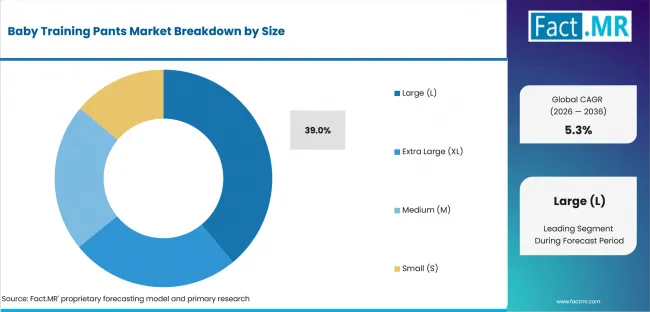
Baby Training Pants Market Analysis By Size | Source: Fact.MR
Large (L) leads the size segment because the size range covers many children during the heaviest training period.
Why does Supermarkets & Hypermarkets lead Distribution Channel?
Supermarkets & Hypermarkets is expected to account for 29.7% share in 2026.
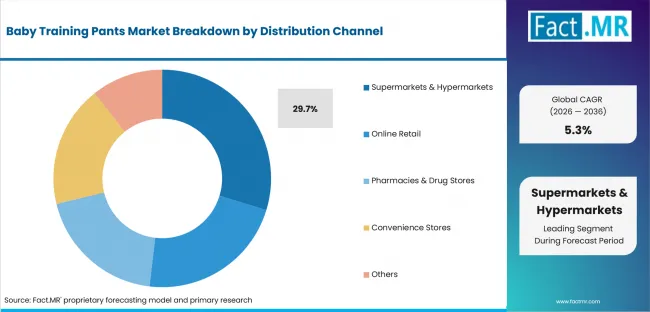
Baby Training Pants Market Analysis By Distribution Channel | Source: Fact.MR
Supermarkets & Hypermarkets lead the distribution channel segment because parents can compare brands, pack counts and price promotions in one trip.
Why does Households lead End User?
Households is expected to account for 40.2% share in 2026.
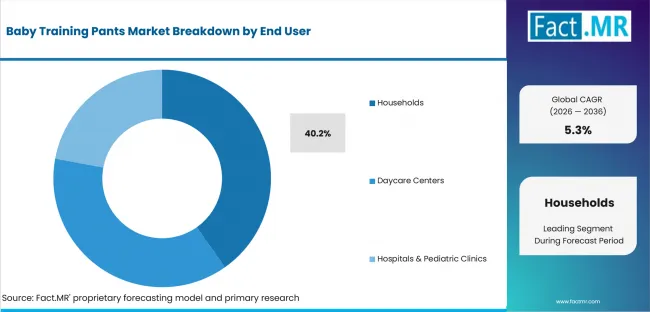
Baby Training Pants Market Analysis By End User | Source: Fact.MR
Households lead the end user segment because most purchases are made for home use even when daycare centers influence brand choice.
Why does Regular Absorbency lead Absorbency Type?
Regular Absorbency is expected to account for 40.5% share in 2026.
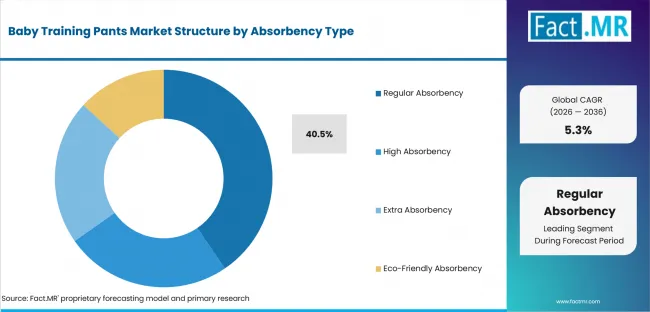
Baby Training Pants Market Analysis By Absorbency Type | Source: Fact.MR
Regular Absorbency leads the absorbency type segment because regular absorbency covers daytime accidents without the bulk of overnight products.
What is accelerating Baby Training Pants Market adoption, and what is holding it back?
Demand is expected to be supported by disposable training routines, larger toddler sizes and modern retail availability. Growth is held back by private-label price pressure and the slow transition from diapers to underwear in some households.
| DRIVER | QUALITATIVE RELEVANCE | GEOGRAPHIC RELEVANCE | IMPACT TIMELINE |
|---|---|---|---|
| Disposable training pants | High | South Korea | Short term (<=2 years) |
| Large (L) fit needs | High | USA | Short term (<=2 years) |
| Retail pack visibility | Moderate | Canada | Medium term (2-4 years) |
| Household routines | Selective | Germany | Medium term (2-4 years) |
Source: Fact.MR analysis. Updated Jul 29, 2026
- Disposable training pants: The format lets parents manage accidents without returning fully to diapers. That makes repeat purchase easier during the uncertain middle stage of toilet training.
- Large (L) fit needs: Children in active training need a product that stays in place while still being easy to pull down. Better fit guidance reduces trial-and-error buying.
- Retail pack visibility: Supermarkets and hypermarkets help shoppers compare pack size, absorbency and price promotions quickly.
- Household routines: Home use sets the refill cycle, even when daycare centers influence product expectations.
Opportunity Impact Analysis
| OPPORTUNITY | QUALITATIVE RELEVANCE | GEOGRAPHIC RELEVANCE | IMPACT TIMELINE |
|---|---|---|---|
| Better fit and size labeling | High | South Korea | Medium term (2-4 years) |
| Daytime and overnight bundles | Moderate | USA | Medium term (2-4 years) |
| Retailer and brand partnerships | Selective | Canada | Medium term (2-4 years) |
Source: Fact.MR analysis. Updated Jul 29, 2026
- Better fit and size labeling can reduce confusion between diapers, training pants and underwear-style products.
- Daytime and overnight bundles can help parents buy for different training situations without switching brands.
- Retailer and brand partnerships can use shelf education to explain absorbency levels and training-stage fit.
Restraints Impact Analysis
| RESTRAINT | QUALITATIVE RELEVANCE | GEOGRAPHIC RELEVANCE | IMPACT TIMELINE |
|---|---|---|---|
| Private-label competition pressures branded products when shoppers see little difference in absorbency or fit | High | South Korea | Short term (<=2 years) |
| Price sensitivity | Moderate | USA | Medium term (2-4 years) |
| Delayed toilet-training conversion | Selective | Canada | Medium term (2-4 years) |
Source: Fact.MR analysis. Updated Jul 29, 2026
- Private-label competition pressures branded products when shoppers see little difference in absorbency or fit.
- Price sensitivity rises because training pants are used alongside diapers during part of the transition.
- Conversion slows when parents delay toilet training or move directly from diapers to underwear.
Which countries are scaling Baby Training Pants Market fastest?
The global CAGR is 5.3%. Country rates show how potty-training habits, retail concentration and brand trust change the adoption route by market.
- South Korea records the highest listed CAGR at 5.7% from 2026 to 2036.
- USA and Canada also sit close to the upper end of the comparison where local demand conditions are stronger.
- Germany, Australia, UK, and Japan grow more steadily as buyers weigh cost, availability and adoption risk.
The full regional view covers North America, Latin America, Europe, East Asia, South Asia and Oceania, and the Middle East and Africa.
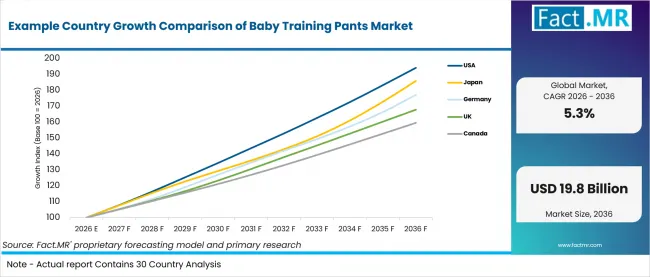
Example Country Growth Comparison Of Baby Training Pants Market | Source: Fact.MR
| COUNTRY | CAGR, 2026 to 2036 |
|---|---|
| South Korea | 5.7% |
| USA | 6.9% |
| Canada | 5.3% |
| Germany | 5.1% |
| Australia | 4.9% |
| UK | 4.8% |
| Japan | 4.7% |
Source: Fact.MR analysis. Updated Jul 29, 2026
What is shaping South Korea's outlook through 2036?
South Korea is projected at 5.7% CAGR during 2026 to 2036, above the global 5.3% trajectory. premium baby-care shoppers, strong modern retail and high brand awareness support faster adoption.
What is shaping USA's outlook through 2036?
USA is projected at 6.9% CAGR during 2026 to 2036, above the global 5.3% trajectory. large retail chains, online replenishment and established diaper-brand loyalty support repeat purchasing.
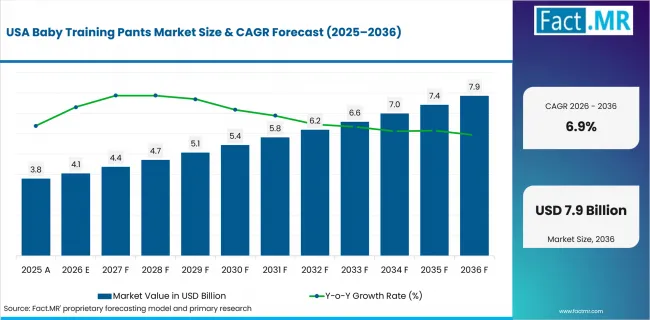
Baby Training Pants Market Country Value Analysis | Source: Fact.MR
What is shaping Canada's outlook through 2036?
Canada is projected at 5.3% CAGR during 2026 to 2036, in line with the global 5.3% trajectory. demand follows household replenishment and retailer availability across provinces.
What is shaping Germany's outlook through 2036?
Germany is projected at 5.1% CAGR during 2026 to 2036, below the global 5.3% trajectory. buyers compare skin comfort, fit and value before switching from diapers or underwear-style alternatives.
What is shaping Australia's outlook through 2036?
Australia is projected at 4.9% CAGR during 2026 to 2036, below the global 5.3% trajectory. growth reflects supermarket access and parent preference for practical training products.
What is shaping UK's outlook through 2036?
UK is projected at 4.8% CAGR during 2026 to 2036, below the global 5.3% trajectory. retail promotions and private-label competition shape uptake across household buyers.
What is shaping Japan's outlook through 2036?
Japan is projected at 4.7% CAGR during 2026 to 2036, below the global 5.3% trajectory. quality expectations and compact pack choices influence repeat purchases.
Who leads the Baby Training Pants Market?
Procter & Gamble and Kimberly-Clark Corporation are among the visible providers in the baby training pants market. Unicharm Corporation and Essity AB are also among the key players.
Procter & Gamble markets Pampers training underwear, while Kimberly-Clark markets Pull-Ups. Competition is shaped by fit, absorbency, softness, skin comfort, pack economics and retail availability.
Through 2036, competitive gains are expected to come from clearer positioning around Disposable Training Pants and stronger execution in the highest-growth country markets.
Which companies are active in the Baby Training Pants Market?
Key companies include Procter & Gamble; Kimberly-Clark Corporation; Unicharm Corporation; Essity AB; Ontex Group; Attindas Hygiene Partners; Hengan International Group; First Quality Enterprises.
- Procter & Gamble
- Kimberly-Clark Corporation
- Unicharm Corporation
- Essity AB
- Ontex Group
- Attindas Hygiene Partners
- Hengan International Group
- First Quality Enterprises
Bibliography
- American Academy of Pediatrics: The Right Age to Potty Train.
- U.S. Consumer Product Safety Commission: Diapers.
- Attindas: Company History.
This Report Addresses
- The report evaluates the Baby Training Pants Market through Product Type and Size choices that define the 2026 market structure.
- Segment analysis covers Disposable Training Pants and Large (L) as the leading 2026 positions.
- Country outlook compares the listed markets by CAGR and explains how potty-training habits, retail concentration and brand trust shape local demand.
- Competitive analysis profiles the named providers and evaluates competition around fit, absorbency, softness, skin comfort, pack economics and retail availability.
What does the Baby Training Pants Market cover?
The Baby Training Pants Market covers disposable and reusable training pants used during toilet training, including daytime and overnight formats, size ranges, absorbency levels, household use and daycare-linked demand.
The market boundary is tied to paid products, services and channels that directly support this use case. Adjacent spending is included only when it is part of the same purchase or operating decision.
What is included in the scope?
The scope includes product type, size, distribution channel, end user, absorbency type and regional demand for training pants sold for toilet-training use.
Coverage also includes adjacent segment options when they are purchased for the same defined market use.
What is excluded from the scope?
The scope excludes diapers, baby wipes, general baby apparel and unrelated hygiene products that are not sold as toilet-training pants.
How Was the Analysis Built?
The analysis combines primary research with desk research focused on the baby training pants market, its segment structure and country-level demand.
- Primary Research: Interviews and validation discussions test buyer priorities, adoption barriers, pricing logic and operating requirements.
- Desk Research: The assessment reviews company disclosures, public datasets, regulatory material, technical literature and industry records relevant to the market.
- Market Sizing and Forecasting: Estimates combine top-down and bottom-up checks across demand signals, segment shares, country activity, company participation and adoption constraints.
Segmentation
What is the report's scope and coverage?
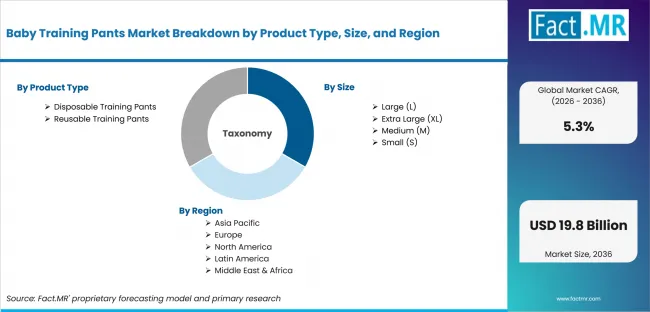
Baby Training Pants Market Breakdown By Product Type, Size, And Region | Source: Fact.MR
| Attribute | Details |
|---|---|
| Quantitative Units | USD 11.8 billion in 2026 to USD 19.8 billion by 2036 at 5.3% CAGR |
| Market Definition | The Baby Training Pants Market covers disposable and reusable training pants designed for toilet training, including daytime and overnight products sold across household and childcare channels. |
| Product Type | Disposable Training Pants; Daytime Training Pants; Overnight Training Pants; Reusable Training Pants; Cotton Training Pants; Waterproof Training Pants |
| Size | Large (L); 9-14 kg; 10-15 kg; Extra Large (XL); 12-17 kg; 13-18 kg; Medium (M); 7-12 kg; 8-13 kg; Small (S); 4-8 kg; 5-9 kg |
| Distribution Channel | Supermarkets & Hypermarkets; Hypermarkets; Supermarkets; Online Retail; E-commerce Platforms; Brand Websites; Pharmacies & Drug Stores; Chain Pharmacies; Independent Pharmacies; Convenience Stores; Urban Convenience Stores; Local Retail Stores; Others; Baby Specialty Stores; Wholesale Clubs |
| End User | Households; Residential Consumers; Working Parents; Daycare Centers; Private Daycare Centers; Public Childcare Centers; Hospitals & Pediatric Clinics; Maternity Hospitals; Pediatric Healthcare Facilities |
| Absorbency Type | Regular Absorbency; Daytime Protection; Light Wetness Protection; High Absorbency; Overnight Protection; Heavy Wetness Protection; Extra Absorbency; Premium Protection; Extended Wear; Eco-Friendly Absorbency; Biodegradable Core; Plant-Based Materials |
| Regions Covered | North America; Latin America; Europe; East Asia; South Asia and Oceania; Middle East and Africa |
| Countries Covered | South Korea; USA; Canada; Germany; Australia; UK; Japan |
| Key Companies Profiled | Procter & Gamble; Kimberly-Clark Corporation; Unicharm Corporation; Essity AB; Ontex Group; Attindas Hygiene Partners; Hengan International Group; First Quality Enterprises |
| Forecast Period | 2026 to 2036 |
| Approach | Hybrid top-down and bottom-up assessment using demand indicators, segment mix, country growth, company participation and public evidence relevant to the category. |
Source: Fact.MR analysis. Updated Jul 29, 2026
How is the market segmented?
-
By Product Type:
- Disposable Training Pants
- Daytime Training Pants
- Overnight Training Pants
- Reusable Training Pants
- Cotton Training Pants
- Waterproof Training Pants
-
By Size:
- Large (L)
- 9-14 kg
- 10-15 kg
- Extra Large (XL)
- 12-17 kg
- 13-18 kg
- Medium (M)
- 7-12 kg
- 8-13 kg
- Small (S)
- 4-8 kg
- 5-9 kg
-
By Distribution Channel:
- Supermarkets & Hypermarkets
- Hypermarkets
- Supermarkets
- Online Retail
- E-commerce Platforms
- Brand Websites
- Pharmacies & Drug Stores
- Chain Pharmacies
- Independent Pharmacies
- Convenience Stores
- Urban Convenience Stores
- Local Retail Stores
- Others
- Baby Specialty Stores
- Wholesale Clubs
-
By End User:
- Households
- Residential Consumers
- Working Parents
- Daycare Centers
- Private Daycare Centers
- Public Childcare Centers
- Hospitals & Pediatric Clinics
- Maternity Hospitals
- Pediatric Healthcare Facilities
-
By Absorbency Type:
- Regular Absorbency
- Daytime Protection
- Light Wetness Protection
- High Absorbency
- Overnight Protection
- Heavy Wetness Protection
- Extra Absorbency
- Premium Protection
- Extended Wear
- Eco-Friendly Absorbency
- Biodegradable Core
- Plant-Based Materials
-
By Region:
- North America
- Latin America
- Europe
- East Asia
- South Asia and Oceania
- Middle East and Africa
Frequently Asked Questions
Which Product Type leads the Baby Training Pants Market?
Which Size leads the Baby Training Pants Market?
Which Distribution Channel leads the Baby Training Pants Market?
Which End User leads the Baby Training Pants Market?
Which Absorbency Type leads the Baby Training Pants Market?
How does South Korea perform in the Baby Training Pants Market?
How does USA perform in the Baby Training Pants Market?
How does Canada perform in the Baby Training Pants Market?
What is the primary driver in the Baby Training Pants Market?
What is the main restraint in the Baby Training Pants Market?
Who worked on this report


Preview the report firsthand - request a free sample
Free SampleGet the brochure for pricing and purchase details
Download PDF