- Market Value (2025): USD 532.8 Mn
- Estimated Value (2026): USD 550.8 Mn
- Forecast Value (2036): USD 767.7 Mn
- CAGR (2026-2036): 3.4%
What is the Baked Food & Cereals Market forecast to be worth by 2036?
USD 550.8 billion in 2026 to USD 767.7 billion by 2036 at a 3.4% CAGR.
- As per Fact.MR analysis, the baked food & cereals market reached USD 532.8 billion in 2025.
- Demand is projected to increase from USD 550.8 billion in 2026 to USD 767.7 billion by 2036.
- The market is forecast to record a 3.4% CAGR from 2026 to 2036.
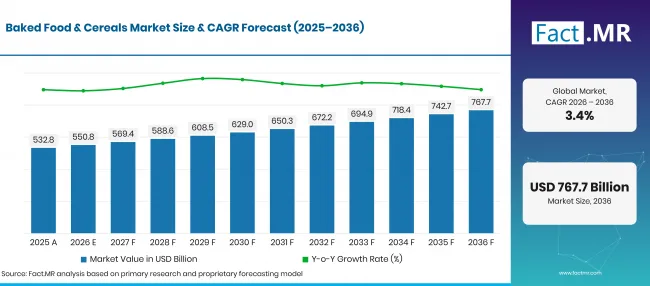
Baked Food And Cereals Market Forecast Global | Source: Fact.MR
What are the defining numbers behind Baked Food & Cereals Market growth?
According to Fact.MR analysis, an absolute opportunity of USD 216.9 billion is projected between 2026 and 2036.
- Demand Drivers in the Market
- Households regularly buy bread and cereals because they are easy to store, prepare, and use for breakfast and other daily meals.
- Packaged baked foods are widely available in stores, while online grocery shopping gives households another easy way to buy these products regularly or stock them for later use.
- Food companies are offering more whole-grain and gluten-free bakery products for shoppers looking for different grains and more fiber in familiar foods.
- Grain supply also affects the availability of bakery and cereal products. In January 2026, the USDA National Agricultural Statistics Service reported that U.S. wheat production reached 1.98 billion bushels in 2025 [20]. This large wheat supply gives bakery and cereal producers a steady source of raw material.
- Key Segments Analyzed
- By Product Type: Bread is projected to hold 38.2% share in 2026, supported by frequent household use and broad availability across packaged and fresh formats.
- By Sales Channel: Supermarkets/Hypermarkets are anticipated to account for 52.3% share in 2026 because they combine routine grocery traffic with wide bakery and cereal assortments.
- By Ingredient Type: Conventional products are estimated to represent 54.8% share in 2026 owing to broad mass-market availability and price coverage across mainstream product lines.
- Analyst Opinion at Fact.MR
- Shambhu Nath Jha of Fact.MR is Principal Consultant and states: “Baked foods and cereals are part of everyday meals, so sales depend on regular purchases. The market is expected to grow as brands offer clearer nutrition choices while keeping products tasty and affordable. Suppliers that provide good-quality grains and keep products widely available in stores are better placed to serve different countries.”
- Strategic Implications
- As per Fact.MR analysis, manufacturers can keep regular bread and cereal products familiar while offering whole-grain and organic bakery products for shoppers looking for these choices.
- Retailers can plan shelf space based on how often products are bought. Bread requires frequent restocking, while packaged cereals can stay on shelves longer. Destatis reported that Germany’s consumer price index for food and non-alcoholic drinks reached 136.5 in December 2025, with 2020 equal to 100 [2].
- Brands can offer pack sizes and prices that suit regular household budgets rather than depending only on premium products for sales growth.
- Ingredient planning depends on grain supply and changing costs because flour and cereal prices directly affect product prices. In September 2026, Conab estimated Brazil’s 2025/26 grain production at 361.7 million tonnes [6].
According to Fact.MR analysis, Germany is projected at 4.4% CAGR through 2036. Brazil follows at 4.0%; the USA at 3.6%; the UK at 3.2%; and Japan at 2.9%. Grain supply and retail reach create different growth conditions across the five countries.
How does the Baked Food & Cereals Market break down by segment?
Bread leads Product Type at 38.2%; Supermarkets/Hypermarkets lead Sales Channel at 52.3%; Conventional leads Ingredient Type at 54.8%.
Which Product Type dominates?
Bread is projected to hold 38.2% share in 2026.
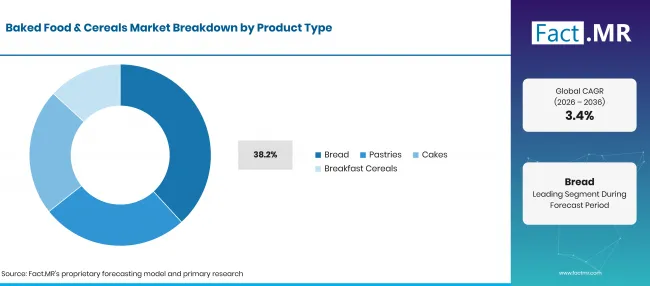
Baked Food And Cereals Market Breakdown Product Type | Source: Fact.MR
Bread remains a regular part of household meals, supporting its 38.2% share in 2026. Pastries and cakes are mainly bought as treats, while breakfast cereals are popular for quick morning meals. In April 2026, the USDA Economic Research Service reported that cereal and bakery product prices increased by an average of 1.0% in 2025 [8].
What leads the Sales Channel segment?
Supermarkets/Hypermarkets are anticipated to account for 52.3% share in 2026.
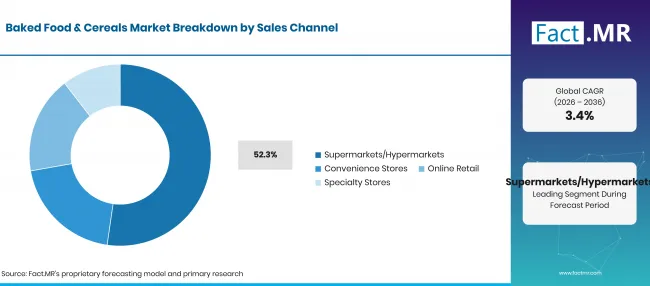
Baked Food And Cereals Market Breakdown Sales Channel | Source: Fact.MR
Supermarkets and hypermarkets are anticipated to lead because shoppers can buy a wide range of bakery and cereal products in one trip. Convenience stores are useful for smaller purchases, while online stores make regular ordering easier. In January 2026, the Office for National Statistics reported that UK retail sales volumes increased by 1.3% in 2025 [11].
How does Ingredient Type shape demand?
Conventional products are estimated to represent 54.8% share in 2026.
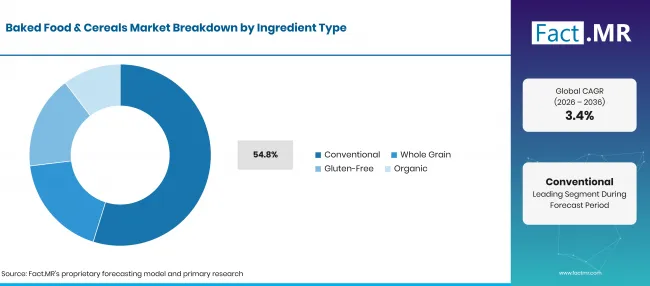
Baked Food And Cereals Market Breakdown Ingredient Type | Source: Fact.MR
Conventional ingredients are estimated to keep the largest share because they are used in products across different price ranges. Whole-grain, gluten-free, and organic products give shoppers more choices based on their nutrition preferences. In January 2026, Japan’s Statistics Bureau reported that food prices increased by 6.8% in 2025 [14].
What is accelerating Baked Food & Cereals Market adoption, and what is holding it back?
Regular household use supports demand, while higher grain and food prices can slow sales.
Drivers Impact Analysis
| DRIVER | (~) % IMPACT ON CAGR | GEOGRAPHIC RELEVANCE | IMPACT TIMELINE |
|---|---|---|---|
| Routine bread and cereal purchases | +0.9% | Global | Short term (<= 2 years) |
| Supermarket reach and grocery availability | +0.7% | Global | Short term (<= 2 years) |
| Whole-grain and dietary-specific product expansion | +0.6% | North America, Western Europe, East Asia | Medium term (2-4 years) |
| Large grain production base | +0.5% | Europe, Latin America, North America | Medium term (2-4 years) |
| Online grocery and repeat ordering | +0.3% | North America, Western Europe, East Asia | Long term (>= 4 years) |
Opportunity Impact Analysis
| OPPORTUNITY | (~) % IMPACT ON CAGR | GEOGRAPHIC RELEVANCE | IMPACT TIMELINE |
|---|---|---|---|
| Whole-grain product reformulation | +0.6% | Global | Medium term (2-4 years) |
| Convenient breakfast and snack formats | +0.5% | North America, East Asia | Short term (<= 2 years) |
| Organic and gluten-free range expansion | +0.4% | Western Europe, North America | Medium term (2-4 years) |
| Online assortment expansion | +0.3% | Global | Long term (>= 4 years) |
Restraints Impact Analysis
| RESTRAINT | (~) % IMPACT ON CAGR | GEOGRAPHIC RELEVANCE | IMPACT TIMELINE |
|---|---|---|---|
| Food and ingredient price pressure | -0.6% | Global | Short term (<= 2 years) |
| Lower bread purchases in some mature markets | -0.4% | Western Europe | Medium term (2-4 years) |
| Private-label price competition | -0.3% | North America, Western Europe | Medium term (2-4 years) |
| Weather-linked grain supply variation | -0.3% | Global | Long term (>= 4 years) |
Which countries are scaling the Baked Food & Cereals Market through 2036?
- Germany keeps a 0.4-point lead over Brazil as grain availability supports baked-food production and established retail channels keep products visible.
- Brazil follows at 4.0% as a large cereal crop base supports raw-material availability and retail sales continue expanding.
- The United States holds a 0.4-point lead over the United Kingdom, helped by high total food spending and broad supermarket coverage.
- The United Kingdom remains supported by frequent bread purchases even as household volumes have softened over time.
- Japan closes the group at 2.9%, where household food spending remains high but food inflation increases pressure on product mix and pricing.
Comparable CAGRs create different entry conditions because grain supply and spending vary by country. Retail reach and product preferences add further differences. Coverage spans seven global regions.
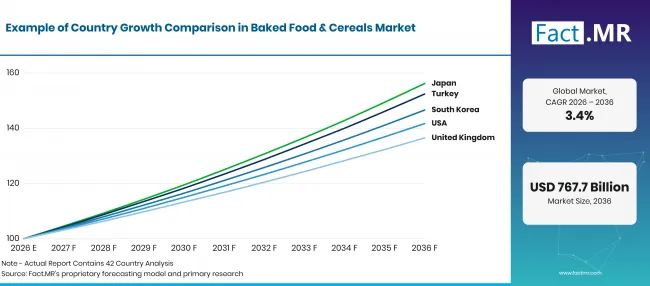
Factmr Baked Food And Cereals Market Growth Index | Source: Fact.MR
| Country | CAGR (2026-2036) |
|---|---|
| Germany | 4.4% |
| Brazil | 4.0% |
| USA | 3.6% |
| UK | 3.2% |
| Japan | 2.9% |
What supports Germany adoption?
4.4% CAGR, supported by grain availability and established grocery demand.
Germany has a large grain supply and a well-established network of bakeries and grocery stores. In January 2026, the German Federal Statistical Office reported that farms harvested 45 million tonnes of grain in 2025, up 16% from 2024 [1]. In February 2026, Deutsche Bundesbank reported that Germany’s average inflation rate was 2.3% in 2025 [3].
How is Brazil scaling demand?
4.0% CAGR, supported by cereal output and an expanding retail base.
Brazil has a large crop supply and growing access to packaged foods through modern retail stores. In January 2026, IBGE reported that the harvest of cereals, legumes, and oilseeds reached 346.1 million tonnes in 2025, up 18.2% from 2024 [4]. In February 2026, IBGE reported that retail sales increased by 1.6% in 2025 [5].
What supports the United States outlook?
3.6% CAGR, supported by high food spending and wide retail distribution.
The United States has a large grocery market, with households regularly spending on food for home use. In June 2026, the USDA Economic Research Service reported that total U.S. food spending reached USD 2.51 trillion in 2025, including USD 1.10 trillion for food consumed at home [7]. In September 2026, the U.S. Census Bureau reported that food and beverage stores generated USD 982.2 billion in revenue in 2024 [9].
What is supporting the United Kingdom’s adoption?
3.2% CAGR, supported by regular bread purchases and supermarket reach.
Bread is a regular household purchase in the United Kingdom, and supermarkets make packaged bakery and cereal products widely available. In September 2026, Defra reported that household bread purchases averaged 439 grams per person per week in FYE 2025 [10]. In January 2026, Defra reported that the UK wheat harvest reached 12 million tonnes in 2025, up 7.3% from 2024 [12]. Regular bread purchases support repeat sales, while wheat supply and ingredient costs affect product prices.
How does Japan perform?
2.9% CAGR, shaped by household food spending and product choice.
Japan has strong demand for convenient packaged foods that are easy to buy and use. In February 2026, the Statistics Bureau reported that average monthly household spending reached JPY 314,001 in 2025, up 4.6% from the previous year [13]. In October 2026, Japan’s Ministry of Agriculture, Forestry and Fisheries reported that the 2025 wheat harvest reached 1.031 million tonnes [15]. Bread and cereal brands compete by offering suitable pack sizes, easy-to-use products, and different ingredient choices while keeping prices in mind.
Who leads the Baked Food & Cereals Market?
Competition includes large cereal brands, bakery companies, and packaged food companies. General Mills, Mars, Incorporated, including former Kellanova cereal brands, and Nestlé offer breakfast cereals and other grain-based foods. Grupo Bimbo has a strong presence in bread and bakery products, with a wide range of packaged baked foods.
PepsiCo and Mondelēz International offer cereals, biscuits, and grain-based snacks. Kraft Heinz, The Campbell’s Company, and Conagra Brands also sell packaged foods that include baked and cereal products. Associated British Foods operates in bakery and grain-based foods.
Companies compete through familiar products, wide store availability, convenient pack options, ingredient choices, and price. They are also adding more whole-grain, gluten-free, and organic products while keeping regular bread and cereal products widely available.
Which companies are the key providers?
Key companies include General Mills; Mars, Incorporated (including former Kellanova cereal brands); Grupo Bimbo; Nestlé; PepsiCo; Mondelēz International; Kraft Heinz; The Campbell’s Company; Conagra Brands; and Associated British Foods.
- General Mills
- Mars, Incorporated (including former Kellanova cereal brands)
- Grupo Bimbo
- Nestlé
- PepsiCo
- Mondelēz International
- Kraft Heinz
- The Campbell’s Company
- Conagra Brands
- Associated British Foods
Bibliography
- [1] Federal Statistical Office of Germany (Destatis). (2026). 2025 grain and potato harvest: 45 million tons of grain and 14 million tons of potatoes.
- [2] Federal Statistical Office of Germany (Destatis). (2026, September 10). Consumer price index – overall index and by 12 divisions.
- [3] Deutsche Bundesbank. (2026, February 19). The German economy: Monthly Report – February 2026.
- [4] Brazilian Institute of Geography and Statistics (IBGE). (2026, January 15). In December, IBGE forecasts harvest of 346.1 million tonnes for 2025, 339.8 million tonnes for 2026.
- [5] Brazilian Institute of Geography and Statistics (IBGE). (2026, February 13). Retail sales close 2025 with rise of 1.6%.
- [6] Companhia Nacional de Abastecimento (Conab). (2026, September 15). Conab estima produção de 361,7 milhões de toneladas de grãos na safra 2025/26 [Conab estimates grain production of 361.7 million tonnes in the 2025/26 harvest].
- [7] Zeballos, E., & Sinclair, W. (2026, June 11). Total U.S. food spending reached $2.51 trillion in 2025. U.S. Department of Agriculture, Economic Research Service.
- [8] Sinclair, W., & Stewart, H. (2026, April 30). U.S. food-at-home prices increased 2.3 percent in 2025, compared with 2024. U.S. Department of Agriculture, Economic Research Service.
- [9] U.S. Census Bureau. (2026, September 3). Census Bureau releases new Annual Integrated Economic Survey data.
- [10] Department for Environment, Food & Rural Affairs. (2026, September 18). Family Food FYE 2025.
- [11] Office for National Statistics. (2026, January 23). Retail sales, Great Britain: December 2025.
- [12] Department for Environment, Food & Rural Affairs. (2026, January 20). Cereal and oilseed production in the United Kingdom 2025.
- [13] Statistics Bureau of Japan. (2026, February 6). 2025 yearly average. Family Income and Expenditure Survey.
- [14] Statistics Bureau of Japan. (2026, January 23). Japan 2025. Consumer Price Index.
- [15] Ministry of Agriculture, Forestry and Fisheries of Japan. (2026, October 1). 農林水産基本データ [Basic data on agriculture, forestry and fisheries].
This Report Addresses
- The report explains how baked foods and cereals are sold by product type and sales channel alongside ingredient type.
- Segment analysis identifies the leading subsegment within each supplied dimension and explains the operating factors behind its 2026 share.
- Country analysis compares Germany; Brazil; the USA; the UK; and Japan through grain supply and retail activity alongside household spending and price pressure.
- Competitive analysis reviews the supplied companies against current branded cereal and bakery activity alongside snack and grain-based food activity.
- Channel analysis assesses how supermarkets and convenience stores work alongside online retail and specialty stores to shape product availability and repeat buying.
What does the Baked Food & Cereals Market cover?
The Baked Food & Cereals Market covers bread; pastries; cakes; breakfast cereals; and other baked or grain-based foods sold through retail and foodservice channels. Bread mix trends provide adjacent context for standardized bread formats without changing this market boundary.
The assessment tracks packaged and fresh products across supermarkets and convenience stores alongside online retail and specialty stores. Rolled oats provide adjacent context for cereal-based breakfast formats while this assessment remains focused on finished baked foods and cereals.
What is included in the scope?
The scope includes products made with wheat; oats; corn; rice; and other cereal ingredients when sold as bread; pastries; cakes; breakfast cereals; or related baked formats. Flour categories provide upstream context where grain choice affects finished products.
Retail-ready mixes are included only when they directly support the defined baked-food boundary. Bakery enzymes may be reviewed as an adjacent input category, while standalone ingredient revenue remains outside this market.
What is excluded from the scope?
The scope excludes raw grain and industrial flour alongside non-baked confectionery and savory snacks outside the defined product boundary. Restaurant meals are excluded unless tied directly to a defined baked-food product.
Pet food and animal feed fall outside the revenue boundary alongside alcoholic grain beverages and baking equipment. Standalone ingredient revenue is also excluded.
How Was the Analysis Built?
The analysis draws on 120+ sources, 35+ company portfolios, 25+ countries, and more than 20 industry interviews.
- Primary Research: Primary research includes discussions with manufacturers, service providers, technology developers, distributors, end users, and subject-matter experts. These conversations examine purchasing priorities, product adoption, operational challenges, approval requirements, competitive positioning, and the factors that influence wider market acceptance.
- Desk Research: Desk research covers government statistics, regulatory publications, company filings, trade data, technical studies, industry associations, standards, public policy, and other authoritative sources. Every source used in the analysis is documented in the bibliography.
- Market Sizing and Forecasting: Market estimates combine historical performance, demand indicators, pricing and volume trends, segment shares, company participation, country-level growth, adoption patterns, investment activity, and barriers to market expansion.
- Data Validation and Update Cycle: Findings are validated by comparing primary interviews with public data, company activity, regulatory changes, trade patterns, and industry developments. Regular updates review new product launches, capacity changes, partnerships, approvals, and shifts in commercial adoption.
What is the report’s scope and coverage?
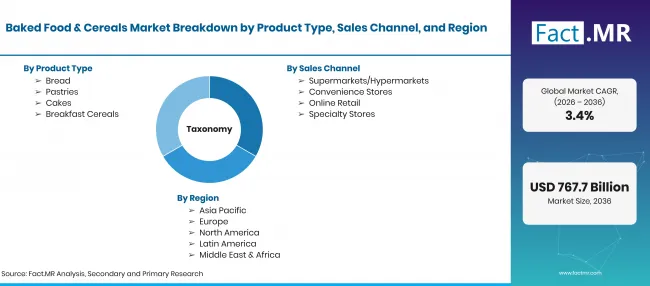
Baked Food And Cereals Market Taxonomy | Source: Fact.MR
| Attribute | Details |
|---|---|
| Quantitative Units | USD billion |
| Market Definition | Baked foods and cereal products sold for household and foodservice consumption, including bread, pastries, cakes, breakfast cereals, and other grain-based baked formats. |
| Product Type | Bread; Pastries; Cakes; Breakfast Cereals; Others |
| Sales Channel | Supermarkets/Hypermarkets; Convenience Stores; Online Retail; Specialty Stores; Others |
| Ingredient Type | Conventional; Whole Grain; Gluten-Free; Organic; Others |
| Regions Covered | North America; Latin America; Western Europe; Eastern Europe; East Asia; South Asia & Pacific; Middle East & Africa |
| Countries Covered | Germany; Brazil; USA; UK; Japan |
| Key Companies Profiled | General Mills; Mars, Incorporated; Grupo Bimbo; Nestlé; PepsiCo; Mondelēz International; Kraft Heinz; The Campbell’s Company; Conagra Brands; Associated British Foods |
| Forecast Period | 2026 to 2036 |
| Approach | Hybrid top-down and bottom-up approach using category spending, grain availability, retail-channel activity, segment shares, country growth, and company portfolio review. |
How is the market segmented?
-
By Product Type:
- Bread
- Pastries
- Cakes
- Breakfast Cereals
- Others
-
By Sales Channel:
- Supermarkets/Hypermarkets
- Convenience Stores
- Online Retail
- Specialty Stores
- Others
-
By Ingredient Type:
- Conventional
- Whole Grain
- Gluten-Free
- Organic
- Others
-
By Region:
- North America
- Latin America
- Western Europe
- Eastern Europe
- East Asia
- South Asia & Pacific
- Middle East & Africa