- Base Value(2025): 1.8 Bn
- Estimated Value(2026): 1.9 Bn
- Forecast Value (2036): 4.2 Bn
- CAGR (2026 - 2036): 8.2%
Teff Grain for Gluten-Free Baked Goods Market Forecast and Outlook By FACT.MR
In 2025, the teff grain for gluten-free baked goods market was valued at USD 1.8 billion. Based on Fact.MR analysis, demand for teff grain for gluten-free baked goods is estimated to grow to USD 1.9 billion in 2026 and USD 4.2 billion by 2036. FACT.MR projects a CAGR of 8.2% during the forecast period.
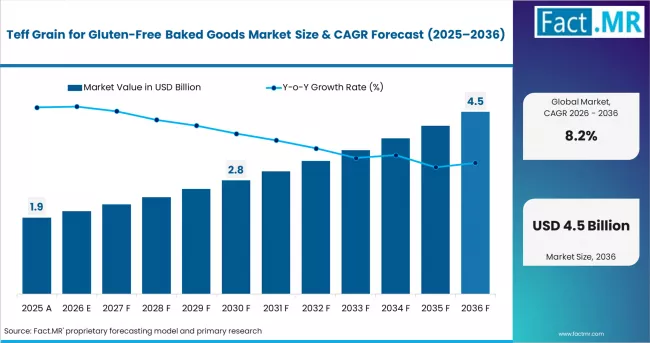
Teff Grain For Gluten Free Baked Goods Market Value Analysis | Source: Fact.MR
Summary of Teff Grain for Gluten-Free Baked Goods Market
- Market Definition
- The market covers teff grain and derived flour and whole grain products a naturally gluten-free ancient grain from Ethiopia supplied to food manufacturers, artisan bakeries, and retail consumers as a functional bakery ingredient globally.
- Demand Drivers
- Rising celiac disease diagnosis rates in North America and Europe are driving systematic substitution of wheat flour with nutritionally superior gluten-free alternatives in commercial bakery formulations.
- Bob's Red Mill and The Teff Company are expanding teff flour distribution into mainstream grocery and online channels in the U.S., with new teff cereal and snack line launches in February 2026 broadening application beyond baking.
- India and Mexico are developing domestic teff production programmes to reduce import dependency on Ethiopia and serve growing local demand from health food retailers and gluten-free bakery manufacturers.
- Key Segments Analyzed
- By Product Type: Teff flour leads with 42% share in 2026, as it is the primary input for gluten-free baking and the most commercially established product format among food manufacturers and home bakers.
- By Application: Food & beverages leads with 67% share in 2026, with bakery as the dominant sub-segment including bread, muffins, and pancakes. Nutraceuticals is the fastest-growing application segment.
- By Distribution Channel: Supermarkets/hypermarkets lead with 39% share in 2026. Online retail is the fastest-growing channel, driven by direct-to-consumer teff product discovery and subscription purchasing.
- By Geography: India leads at 10.9% CAGR through expanding domestic production. North America anchors absolute revenue through mature gluten-free retail infrastructure.
- Analyst Opinion at FACT.MR
- Shambhu Nath Jha, Principal Consultant at Fact.MR, opines, 'CXOs in gluten-free food ingredients will find teff at an inflection point between niche health food status and mainstream bakery ingredient adoption, with companies building multi-format product lines and domestic supply chain diversification achieving premium pricing and distribution advantages in the fastest-growing markets of India, Mexico, and China.'
- Strategic Implications
- Invest in domestic teff cultivation partnerships in India, Mexico, and Canada to build supply chain resilience against Ethiopia-dependent import volatility and qualify for local-origin labelling that supports premium pricing in health food retail.
- Develop teff flour product lines specifically documented for gluten-free baking performance including binding ratios, moisture absorption data, and blending recommendations to reduce adoption barriers for commercial bakery customers reformulating existing recipes.
- Expand online retail distribution with subscription and bundle formats targeting the fastest-growing channel, as teff's niche status makes e-commerce a critical access pathway for building consumer trial ahead of mainstream grocery ranging.
- Methodology
- Market sizing based on teff grain production volumes, flour pricing by origin and grade, validated against FAO production data and retail gluten-free market benchmarks from 2024 to 2025.
- FDA gluten-free labelling regulations, FSSAI standards, EU gluten-free food regulations, and teff commodity trade statistics supported demand and country analysis.
- Forecasts incorporate celiac disease prevalence trends, online retail penetration data, and expert interviews with gluten-free bakery ingredient buyers and retail category managers.
| Metric | Value |
|---|---|
| Estimated Value in 2026 | USD 1.9 billion |
| Forecast Value in 2036 | USD 4.2 billion |
| Forecast CAGR (2026 to 2036) | 8.2% |
Source: Fact.MR analysis. Updated Apr 20, 2026
The market is expected to generate USD 2.3 billion in incremental revenue between 2026 and 2036, reflecting strong and structurally supported growth. Expanding celiac disease diagnosis rates in North America and Europe, rising demand for protein-dense and iron-rich ancient grain alternatives, and growing online retail penetration are anchoring demand growth. However, supply constraints tied to Ethiopia's near-monopoly on teff cultivation, climate-driven harvest variability, and teff flour's premium price over rice and almond flour alternatives moderate faster volume expansion in price-sensitive retail segments.
Country-level growth reflects celiac prevalence, health food retail depth, and domestic teff production investment. India leads at 10.9% CAGR through 2036, emerging as both a producer and consumer of teff for niche health markets with FSSAI-compliant gluten-free food expansion. Mexico follows at 9.7% through high growth in gluten-free bakery demand and local teff production diversification efforts targeting domestic food service channels. China records 9.3% through rising urban interest in functional ancient grains for wellness diets, with e-commerce channels driving teff flour and ready-to-eat product adoption. Canada records 8.5% through strong demand for premium, nutrient-dense gluten-free alternatives in organised health food retail and food service. The United States records 7.4% through mature gluten-free market infrastructure and continued product diversification in bread, pancakes, and snack segments, constrained by intense competition from established rice and almond flour alternatives in mainstream grocery.
Segmental Analysis
Teff Grain for Gluten-Free Baked Goods Market Analysis by Product Type
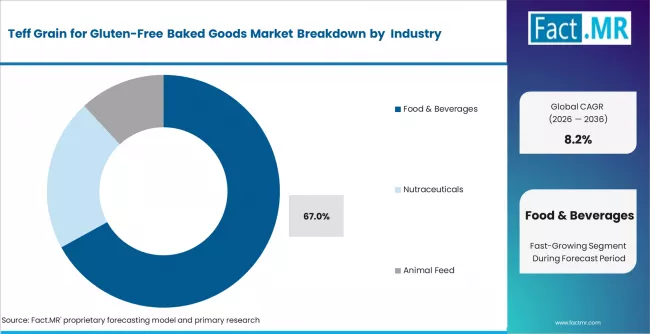
Teff Grain For Gluten Free Baked Goods Market Analysis By Application | Source: Fact.MR
Based on FACT.MR’s report, teff flour holds 42% share in 2026. It is the main commercial format. It integrates easily into bakery formulations. It works with existing equipment. Certified production meets FDA and EU gluten-free standards. It provides a nutrient-dense and safe alternative for gluten-sensitive consumers.
- Bob’s Red Mill Expansion: Bob's Red Mill launched new cereal and snack lines in February 2026. The focus is on health-conscious consumers. Production remains in dedicated gluten-free facilities. R5 ELISA testing ensures compliance. [3]
- Whole Grain Teff Technology: Research in Nutrients (November 2024) confirms teff’s high calcium content. It also highlights resistant starch and amino acid balance. This supports use in functional foods and nutraceuticals. [4]
- Ready-to-Eat Product Trend: In January 2026, new teff-based ready-to-eat products were launched. These target convenience and health segments. They expand usage beyond home baking. Adoption is increasing in foodservice and packaged foods. [3]
Teff Grain for Gluten-Free Baked Goods Market Analysis by Application
Based on FACT.MR’s analysis, food and beverage holds 67% share in 2026. Bakery is the leading sub-segment. Teff flour offers heat stability and binding properties. It replaces wheat flour in gluten-free recipes. Its moisture retention improves texture. Application research supports commercial use.
- King Arthur Application Development: King Arthur Baking Company documented substitution methods. 25% substitution works well in pancakes. 25–50% works in muffins and scones. This guidance supports bakery adoption. [5]
- Nutraceutical Segment Growth: Nutraceutical use is growing fastest. Teff supports calcium, iron, and glycaemic benefits. The Teff Company promotes use for athletes and health-focused consumers. [6]
- Online Retail Distribution Trend: Online retail is expanding rapidly. Anthony's Goods and Millets Place BV serve premium consumers. Direct channels support higher pricing. They bypass mainstream retail limitations. [3]
Drivers, Restraints, and Opportunities
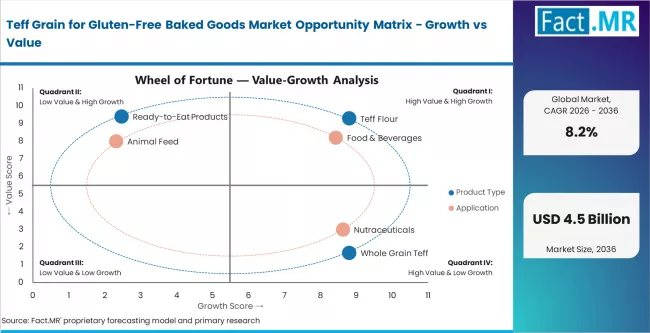
Teff Grain For Gluten Free Baked Goods Market Opportunity Matrix Growth Vs Value | Source: Fact.MR
FACT.MR analysts observe that teff has evolved from a niche Ethiopian staple into a global gluten-free baking ingredient. Growth is driven by teff’s high iron, calcium, and protein content. It outperforms rice flour and other gluten-free alternatives. This supports premium positioning among health-conscious and celiac consumers in North America and Europe.
Commodity teff faces competition from rice, almond, and quinoa flour. Price premiums of 30–80% over rice flour limit mass adoption but support higher margins in premium segments. Bob's Red Mill and The Teff Company maintain premium positioning through quality and certification.
- FDA Gluten-Free Labelling Standard: FDA enforces a 20 ppm gluten-free threshold. Teff producers must certify compliance. Bob's Red Mill uses dedicated facilities and R5 ELISA testing. This meets strict FDA standards. Certification is essential for bakery procurement. [1]
- India Domestic Production and FSSAI Expansion: India introduced gluten-free regulations in 2024. The 20 ppm standard aligns with global norms. Domestic cultivation is expanding in Karnataka and Andhra Pradesh. This reduces reliance on Ethiopia imports. It supports a localized supply model. [2]
- Online Retail and Direct-to-Consumer Growth: Online retail is the fastest-growing channel. E-commerce supports niche product discovery. Whole Grain Enterprises expanded distribution in 2025. Bob's Red Mill launched new teff products in 2026. This includes cereals and snacks. It expands beyond flour into new formats. [3]
Regional Analysis
The teff grain for gluten-free baked goods market is assessed across South Asia and Pacific, Latin America, East Asia, North America, and Europe, covering 40+ countries with distinct demand profiles shaped by celiac disease prevalence, gluten-free food regulation maturity, domestic teff production capacity, and health food retail infrastructure depth. The full report provides market attractiveness analysis by region and country.
.webp "Top Country Growth Comparison Teff Grain For Gluten Free Baked Goods Market Cagr (2026 2036)")
Top Country Growth Comparison Teff Grain For Gluten Free Baked Goods Market Cagr (2026 2036) | Source: Fact.MR
| Country | CAGR (2026 to 2036) |
|---|---|
| India | 10.9% |
| Mexico | 9.7% |
| China | 9.3% |
| Canada | 8.5% |
| United States | 7.4% |
Source: Fact.MR analysis. Updated Apr 20, 2026
Source: Fact.MR (FACT.MR) analysis, based on proprietary forecasting model and primary research
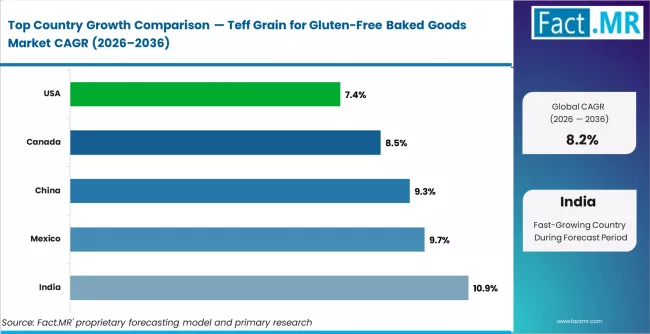
Teff Grain For Gluten Free Baked Goods Market Cagr Analysis By Country | Source: Fact.MR
Asia Pacific Teff Grain for Gluten-Free Baked Goods Market Analysis
Asia Pacific shows the highest expansion pace. India plays a dual role as producer and consumer. Domestic cultivation and FSSAI regulations support adoption. This creates a distinct model compared to import-driven markets.
- India: Market advances at 10.9% CAGR through 2036. FSSAI introduced gluten-free rules in 2024 with a 20 ppm limit. This builds a clear compliance framework. Cultivation in Karnataka and Andhra Pradesh is increasing. It reduces reliance on Ethiopia imports. Urban retail and e-commerce are expanding demand. Teff is entering diets alongside quinoa and millets.
- China: Momentum continues at 9.3% CAGR through 2036. Urban consumers are shifting toward ancient grains. E-commerce platforms drive access and awareness. Updated dietary guidelines support whole grain intake. Food manufacturers are launching premium teff bakery products. Product availability is rising in health food categories. [8]
FACT.MR’s analysis covers India, ASEAN, Australia, China, New Zealand, and Rest of Asia Pacific. Readers can find regulatory data, cultivation updates, and retail trends.
Latin America Teff Grain for Gluten-Free Baked Goods Market Analysis
Latin America represents a rising opportunity. Mexico is at the forefront. Expansion is supported by gluten-free bakery demand and local sourcing efforts.
- Mexico: Market progresses at 9.7% CAGR through 2036. COFEPRIS updated gluten labelling in 2024. The 20 ppm standard increases demand for certified ingredients. Bakery producers are diversifying into gluten-free lines. Local cultivation is being explored to reduce import costs. Urban retail and foodservice channels are increasing teff-based offerings. Shelf visibility is improving in premium stores.
FACT.MR’s analysis covers Mexico, Brazil, Argentina, Chile, and Rest of Latin America. Readers can find regulatory updates, production trends, and bakery expansion data.
North America Teff Grain for Gluten-Free Baked Goods Market Analysis
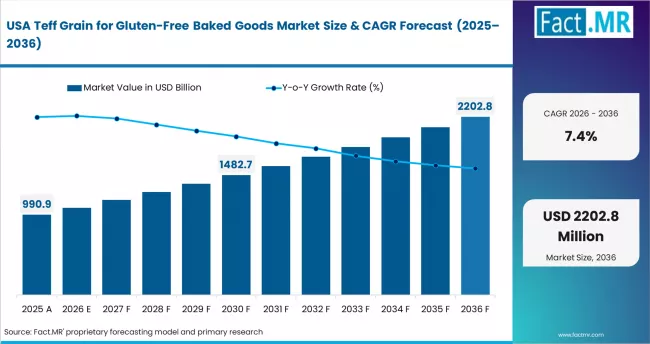
Teff Grain For Gluten Free Baked Goods Market Country Value Analysis | Source: Fact.MR
North America holds the largest revenue base. Demand is supported by a mature gluten-free market and premium retail channels. Bob's Red Mill, The Teff Company, and King Arthur Baking Company lead supply and application development.
- Canada: Market expands at 8.5% CAGR through 2036. Health Canada maintains a 20 ppm gluten-free standard. This aligns with global norms. Premium retail demand remains strong. Imports from U.S. suppliers support supply. Consumers prefer nutrient-rich ancient grains. Teff maintains a premium position.
- United States: Market develops at 7.4% CAGR through 2036. FDA gluten-free rules and USDA organic pathways support adoption. Bob's Red Mill expanded its product range in 2026. Distribution partnerships increased in 2025. Teff is entering new food categories beyond bakery. Price competition from rice and almond flour limits broader penetration.
FACT.MR’s analysis covers United States, Canada, and Mexico. Readers can find labelling data, market dynamics, and product launch insights
Competitive Aligners for Market Players
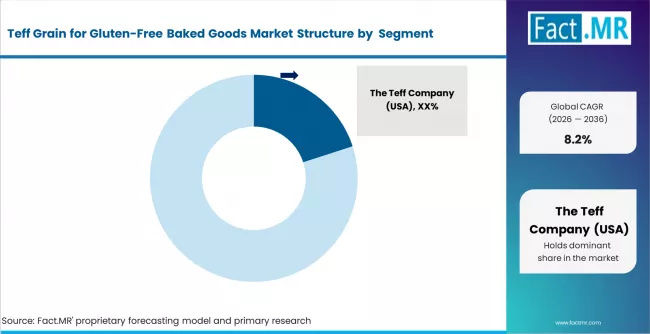
Teff Grain For Gluten Free Baked Goods Market Analysis By Company | Source: Fact.MR
The teff grain for gluten-free baked goods market remains highly fragmented, with no single company holding a dominant global position. Competition is primarily influenced by access to reliable sourcing, especially from Ethiopia, which produces the majority of global teff supply, along with the ability to meet strict gluten-free and clean-label certification standards. In this market, compliance and product quality are more important than scale. Certifications such as gluten-free facility validation, non-GMO verification, and organic labelling are critical for suppliers aiming to secure contracts with premium food manufacturers in the United States and Europe.
Bob's Red Mill has established a strong position through its dedicated gluten-free facility in Oregon. The company uses R5 ELISA testing across all production batches to ensure compliance with both U.S. and EU standards. This high level of quality assurance builds trust with commercial bakery customers and supports long-term supply agreements. The Teff Company, also known as Maskal Teff, has taken a different approach by developing domestic cultivation across the western United States, reducing reliance on imported grain and improving supply stability. Food manufacturers and gluten-free bakery brands typically adopt dual sourcing strategies and require ongoing certification validation. Once a supplier is approved, switching becomes complex due to re-testing, reformulation, and labelling updates. This creates durable supplier relationships. As a result, certified producers maintain premium pricing and stable margins, while non-certified or lower-cost suppliers face significant barriers to entry.
Key Players
- The Teff Company (USA)
- Bob's Red Mill Natural Foods (USA)
- Mama Fresh Injera PLC (Ethiopia)
- King Arthur Baking Company (USA)
- Tobia Teff (UK)
- Millets Place BV (Netherlands)
- Anthony's Goods
This Report Addresses
- Strategic insights on teff grain demand across gluten-free bakery, nutraceutical applications, online retail channel growth, domestic production development, and celiac-driven health food market expansion.
- Market forecast from USD 1.9 billion in 2026 to USD 4.2 billion by 2036. CAGR of 8.2%.
- Growth opportunity mapping across India FSSAI gluten-free regulatory expansion, Mexico domestic teff production development, China e-commerce wellness grain adoption, Canada premium health food retail demand, and U.S. multi-format product line expansion.
- Segment analysis by product type (flour, whole grain, ready-to-eat), application (food & beverages, nutraceuticals, animal feed), and distribution channel (supermarkets, online retail, specialty stores).
- Regional outlook covering South Asia and Pacific production and regulatory formalisation, Latin America domestic cultivation diversification, East Asia e-commerce wellness market, and North America certified gluten-free supply chain dynamics.
- Competitive analysis of Bob's Red Mill, The Teff Company, King Arthur Baking Company, Tobia Teff, Millets Place BV, and Mama Fresh Injera covering gluten-free certification status, facility capabilities, and distribution channel positioning.
- Technology and supply chain tracking including domestic teff cultivation advances outside Ethiopia, gluten-free facility R5 ELISA testing protocols, teff flour substitution ratio optimisation for commercial bakery, and ready-to-eat product format innovation.
- Report available in PDF, Excel, and presentation formats. Supported by primary research, FAO production data, FDA and FSSAI regulatory standards, and producer disclosures from 2024 to 2026.
Bibliography
- [1] Bob's Red Mill Natural Foods. Whole Grain Teff and Teff Flour Product Pages: Dedicated Gluten-Free Facility Processing with R5 ELISA Testing Protocol Meeting FDA 20 ppm Gluten-Free Standard. 2024. bobsredmill.com/product/teff-flour
- [2] Food Safety and Standards Authority of India. Food Safety and Standards (Gluten-Free Foods) Regulations: 20 ppm Gluten Threshold Standard for Indian Market Gluten-Free Food Labelling Including Teff and Other Certified Gluten-Free Grain Ingredients. 2024. fssai.gov.in
- [3] DataM Intelligence / OpenPR. Teff Products Market 2026: Key Developments Including Bob's Red Mill New Teff Cereal and Snack Lines (February 2026), Whole Grain Enterprises Retail Partnership (December 2025), and Ready-to-Eat Product Launches (January 2026). March 2026. openpr.com/news/4439401/teff-products-market-2026-gluten-free-foods-nutritional
- [4] Cappelli A. et al. Unlocking the Potential of Teff for Sustainable, Gluten-Free Diets and Unravelling Its Production Challenges to Address Global Food and Nutrition Security: A Review. Nutrients. November 2024. pmc.ncbi.nlm.nih.gov/articles/PMC11545792
- [5] King Arthur Baking Company. Food Science Application Development: Teff Flour Substitution Protocols for Commercial and Home Bakers Including 25% Substitution in Pancakes, Scones, and Muffins with Texture and Flavour Performance Data. 2024. kingarthurbaking.com
- [6] The Teff Company (Maskal Teff). Nutraceutical Positioning and Athlete Nutrition Platform for Teff Grain: High Calcium, Iron, and Amino Acid Profile Supporting Sports Nutrition and Celiac Nutritional Deficiency Applications. 2024. teffco.com
- [7] COFEPRIS (Federal Commission for Protection against Sanitary Risk), Mexico. Gluten-Free Food Labelling Standard Update: 20 ppm Threshold Alignment with Codex Alimentarius Standards for Mexican Market Certified Gluten-Free Food Products Including Imported and Domestic Ingredient Specifications. 2024. cofepris.gob.mx
- [8] National Health Commission of China. Dietary Guidelines for Chinese Residents: Updated Whole Grain and Dietary Fiber Consumption Recommendations Supporting Functional Grain Adoption Including Ancient Grain Alternatives for Urban Health-Conscious Consumer Segments. 2023. nhc.gov.cn
Teff Grain for Gluten-Free Baked Goods Market Definition
The teff grain for gluten-free baked goods market covers production and supply of teff grain and derived products such as flour and whole grain. These are used as gluten-free baking ingredients by food manufacturers and bakeries. Teff is naturally gluten-free and rich in protein, iron, calcium, and fiber, making it a premium ingredient in baked goods.
Teff Grain for Gluten-Free Baked Goods Market Inclusions
Includes global and regional forecasts from 2026 to 2036 by product type, application, and distribution channel. Covers teff flour, whole grain, and ready-to-eat formats across food, nutraceutical, and feed applications.
Teff Grain for Gluten-Free Baked Goods Market Exclusions
Excludes non-gluten-free grains and conventional wheat flour. Omits unprocessed teff for grazing and finished baked goods where teff is a minor ingredient. Focus remains on teff as a core gluten-free baking input.
Teff Grain for Gluten-Free Baked Goods Market Research Methodology
-
Primary Research
-
Interviews with teff grain importers, gluten-free bakery procurement managers, food ingredient buyers, and retail category managers. Covers the U.S., Canada, India, Mexico, and China.
-
-
Desk Research
-
Uses FAO teff production data, FSSAI gluten-free food standards, FDA gluten-free labelling regulations, EU gluten-free regulation updates, and producer disclosures from 2024–2025.
-
-
Market Sizing and Forecasting
-
Based on teff grain production volumes, flour pricing by origin and grade, and gluten-free bakery market demand benchmarks. Hybrid top-down and bottom-up model.
-
-
Data Validation and Update Cycle
-
Validated using producer capacity data, teff commodity trade statistics, and retail gluten-free market benchmarks. Cross-checked with expert interviews. Updated regularly.
-
Segmentation
Scope of Report
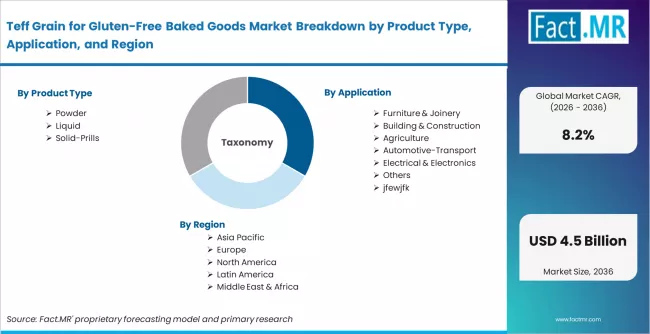
Teff Grain For Gluten Free Baked Goods Market Breakdown By Product Type, Application, And Region | Source: Fact.MR
| Attribute | Details |
|---|---|
| Quantitative Units | USD 1.9 billion (2026) to USD 4.2 billion (2036), at a CAGR of 8.2% |
| Market Definition | Teff grain and derived products teff flour, whole grain teff, and ready-to-eat formats produced from Eragrostis tef and supplied as a naturally gluten-free baking ingredient to food manufacturers, bakeries, and consumers for use in bread, muffins, pancakes, and other baked goods globally. |
| Product Type Segmentation | Teff Flour, Whole Grain Teff, Ready-to-Eat Products |
| Application Segmentation | Food & Beverages, Nutraceuticals, Animal Feed |
| Distribution Channel Segmentation | Supermarkets/Hypermarkets, Online Retail, Specialty Stores |
| Application Coverage | Gluten-free commercial bakery ingredient specification, celiac-compliant home baking, nutraceutical mineral and protein enrichment, functional food iron fortification, and animal feed supplementation. |
| Regions Covered | North America, Latin America, Europe, East Asia, South Asia and Pacific, Middle East and Africa |
| Countries Covered | USA, Canada, Mexico, Germany, UK, France, Italy, Spain, Nordic, BENELUX, China, Japan, South Korea, India, ASEAN, Australia and New Zealand, Brazil, Argentina, Chile, Saudi Arabia, GCC, Turkey, South Africa, Rest of MEA |
| Key Companies Profiled | The Teff Company (USA), Bob's Red Mill Natural Foods (USA), Mama Fresh Injera PLC (Ethiopia), King Arthur Baking Company (USA), Tobia Teff (UK), Millets Place BV (Netherlands), Anthony's Goods |
| Forecast Period | 2026 to 2036 |
| Approach | Hybrid top-down and bottom-up model using teff grain production volumes by product type, average selling prices by grade and origin, gluten-free bakery market demand benchmarks, retail channel adoption data, and primary interviews with gluten-free ingredient buyers and health food retail category managers. |
Source: Fact.MR analysis. Updated Apr 20, 2026
Teff Grain for Gluten-Free Baked Goods Market by Segments
-
By Product Type:
- Teff Flour
- Whole Grain Teff
- Ready-to-Eat Products
-
By Application:
- Food & Beverages
- Nutraceuticals
- Animal Feed
-
By Distribution Channel:
- Supermarkets/Hypermarkets
- Online Retail
- Specialty Stores
-
By Region:
- North America
- United States
- Canada
- Mexico
- Latin America
- Brazil
- Mexico
- Argentina
- Chile
- Rest of Latin America
- Western Europe
- Germany
- United Kingdom
- France
- Italy
- Spain
- Nordic Countries
- BENELUX
- Rest of Western Europe
- Eastern Europe
- Russia
- Poland
- Hungary
- Balkan and Baltic
- Rest of Eastern Europe
- East Asia
- China
- Japan
- South Korea
- South Asia and Pacific
- India
- ASEAN
- Australia and New Zealand
- Rest of South Asia and Pacific
- Middle East and Africa
- Kingdom of Saudi Arabia
- Other GCC Countries
- Turkey
- South Africa
- Rest of Middle East and Africa
- North America
Frequently Asked Questions
How large is the teff grain for gluten-free baked goods market in 2025?
What will the market size be in 2026?
What is the projected market size by 2036?
What is the expected CAGR of the teff grain for gluten-free baked goods market?
What is the absolute dollar opportunity in this market?
Which product type segment leads the market?
Which application segment holds the largest share?
Which distribution channel is growing fastest?
Which country shows the fastest growth?
Who worked on this report


Preview the report firsthand - request a free sample
Free SampleGet the brochure for pricing and purchase details
Download PDF