- Market Value (2025): USD 1.1 Bn
- Estimated Value (2026): USD 1.2 Bn
- Forecast Value (2036): USD 2.9 Bn
- CAGR (2026-2036): 8.9%
What is the Food Ingredient Encapsulation Systems Market forecast to be worth by 2036?
USD 2.9 Billion by 2036 at 8.9% CAGR.
- The Food Ingredient Encapsulation Systems Market reached USD 1.1 Billion in 2025.
- Demand is projected to increase from USD 1.2 Billion in 2026 to USD 2.9 Billion by 2036.
- The market is forecast to record an 8.9% CAGR from 2026 to 2036.
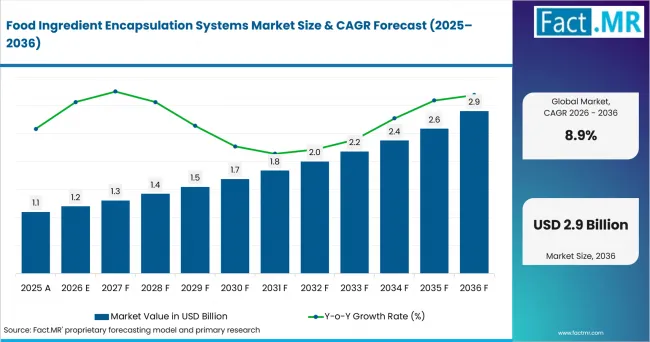
Food Ingredient Encapsulation Systems Market Value Analysis | Source: Fact.MR
What are the defining numbers behind Food Ingredient Encapsulation Systems Market growth?
An absolute opportunity of USD 1,682 million is expected between 2026 and 2036.
- Demand Drivers in the Market
- Encapsulation protects volatile flavours and aromas from oxygen, moisture and processing losses while supporting release at the intended point of use.
- Spray drying gives food manufacturers a scalable route for converting dispersed or emulsified actives into stable powders that can be stored and dosed more easily.
- Functional beverages require dispersible delivery of flavours, vitamins, minerals and lipid-based ingredients while preserving taste and stability through shelf life.
- Bakery and confectionery formulations use encapsulation to separate reactive ingredients and manage flavour release during mixing, baking or consumption.
- Probiotics, oils and other sensitive cores create demand for shell systems that can protect activity until the ingredient reaches the target food matrix or release condition.
- Key Segments Analyzed
- By Technology: Spray drying is projected to account for 37.0% share in 2026 because the process combines scale, powder handling and broad compatibility with food-grade carrier systems.
- By Core Material: Flavours & aromas are expected to represent 30.0% share in 2026 as volatile compounds benefit directly from protection against oxygen, moisture and premature loss.
- By Shell Material: Carbohydrate-based systems are forecast to hold 41.0% share in 2026 because starches, maltodextrins and related carriers fit common food processes and spray-drying workflows.
- By Application: Functional beverages are projected to capture 29.0% share in 2026 as formulators need stable and dispersible delivery of flavours and functional ingredients in liquid products.
- Analyst Opinion at Fact.MR
- Shambhu Nath Jha, Principal Consultant at Fact.MR, states, "Encapsulation is bought as a formulation system, not as a stand-alone coating step. Buyers have to match the core ingredient with the shell, process temperature, storage conditions and required release point. Spray drying remains practical because it is scalable, but suppliers still need to prove retention, dispersibility and release in the finished food. The commercial advantage will come from systems that reduce reformulation work while protecting flavour or nutrient performance through processing and shelf life."
- Strategic Implications
- Suppliers should document retention, release and stability under the actual thermal and storage conditions used by customers.
- Food manufacturers should screen core-shell compatibility before scale-up because the same carrier can behave differently across flavours, vitamins, probiotics and oils.
- Carbohydrate-based carrier systems should be positioned around processability, dispersibility and label requirements rather than carrier chemistry alone.
- Technical support should be concentrated around functional beverages, bakery and confectionery, dairy and dietary supplements because each application imposes a different release and stability requirement.
- Suppliers with more than one delivery technology can route heat-sensitive or high-value cores away from standard spray drying when another process provides a better stability profile.
How does the Food Ingredient Encapsulation Systems Market break down by segment?
The market is segmented by Technology, Core Material, Shell Material and Application.
Why does Spray Drying lead Technology?
Spray drying is projected to account for a 37.0% share in 2026.
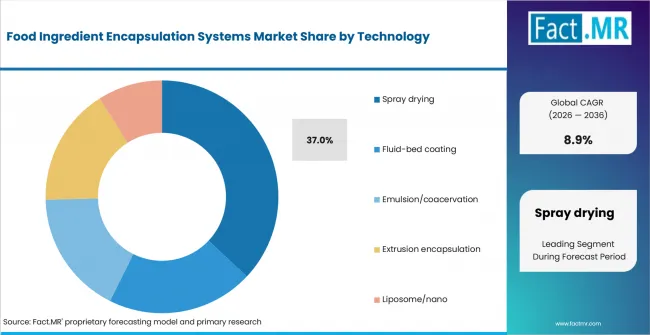
Food Ingredient Encapsulation Systems Market Analysis By Technology | Source: Fact.MR
Spray drying leads because it converts liquid feed systems into stable powders in a continuous process that can be scaled for commercial food manufacturing. The technology is widely suited to flavour systems, vitamins and other ingredients that can be dispersed or emulsified before drying.
The commercial value comes from powder handling, dosing and storage as much as from encapsulation itself. Heat exposure remains a formulation constraint, so inlet and outlet temperatures, carrier choice and residence time have to be matched to the sensitivity of the core material.
Why do Flavours & Aromas lead Core Material?
Flavours & aromas are projected to account for a 30.0% share in 2026.
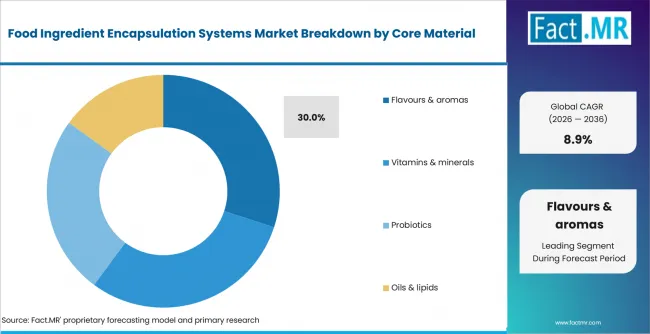
Food Ingredient Encapsulation Systems Market Analysis By Core Material | Source: Fact.MR
Flavours and aromas lead because many of their most valuable components are volatile and can degrade or evaporate before the finished product is consumed. Encapsulation helps reduce premature loss and separates sensitive compounds from oxygen, moisture or reactive ingredients.
Release behavior also matters. A flavour system may need to remain protected through storage and processing, then release during hydration, heating or consumption. This gives encapsulation a direct role in sensory consistency.
Why do Carbohydrate-based Systems lead Shell Material?
Carbohydrate-based systems are projected to account for a 41.0% share in 2026.
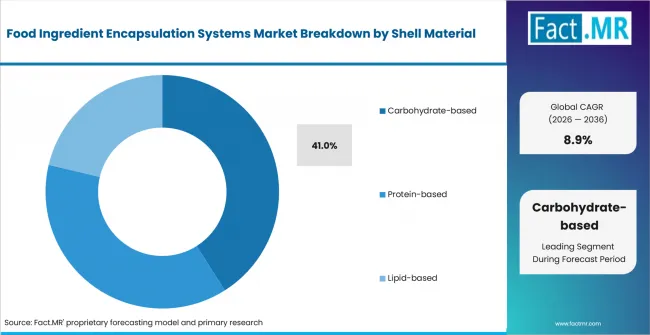
Food Ingredient Encapsulation Systems Market Analysis By Shell Material | Source: Fact.MR
Carbohydrate-based shells lead because starches, maltodextrins and related food-grade carriers can provide film formation, solubility and powder characteristics that suit common encapsulation processes. Their compatibility with spray drying supports use across flavours and selected functional ingredients.
Carrier selection still depends on the core and release target. Formulators balance solids loading, viscosity, oxidation protection and label expectations before fixing the shell system for commercial production.
Why do Functional Beverages lead Application?
Functional beverages are projected to account for a 29.0% share in 2026.
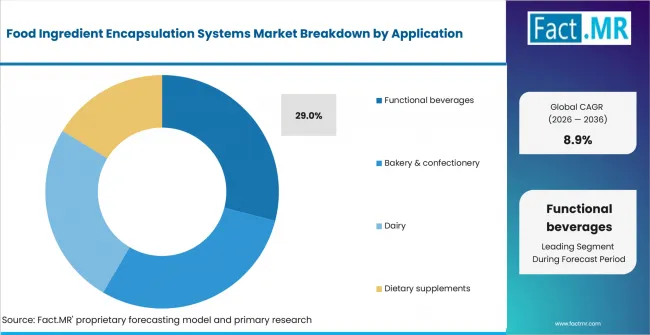
Food Ingredient Encapsulation Systems Market Analysis By Application | Source: Fact.MR
Functional beverages lead because liquid products expose flavours and functional ingredients to water, oxygen, light and storage time while consumers still expect consistent taste and appearance. Encapsulation can improve dispersibility or protect sensitive actives until the beverage is prepared or consumed.
The application also brings several core materials together in one formulation. Flavours, vitamins, minerals and lipid-based components may require different stabilization approaches, which creates demand for application-specific delivery systems.
What is accelerating Food Ingredient Encapsulation Systems Market adoption, and what is holding it back?
Drivers Impact Analysis
| Driver | (~) % Impact on CAGR | Geographic Relevance | Impact Timeline |
|---|---|---|---|
| Stability protection for volatile and oxidation-sensitive ingredients | +1.5% | Global | Near to medium term |
| Scalable powder conversion through spray drying | +1.2% | USA and Europe | Near to medium term |
| Functional beverage and fortified-food formulation | +1.0% | USA, Europe and Japan | Medium term |
| Controlled release and taste management | +0.9% | Global | Medium term |
Source: Fact.MR analysis. Updated Aug 14, 2026
Opportunity Impact Analysis
| Opportunity | (~) % Impact on CAGR | Geographic Relevance | Impact Timeline |
|---|---|---|---|
| Protection of probiotic and lipid-based actives | +0.8% | USA, Europe and Japan | Medium term |
| Application-specific controlled release beyond standard spray drying | +0.7% | Global | Medium to long term |
| Carrier systems for vitamin and mineral fortification | +0.6% | Europe and Japan | Medium term |
Source: Fact.MR analysis. Updated Aug 14, 2026
Restraints Impact Analysis
| Restraint | (~) % Impact on CAGR | Geographic Relevance | Impact Timeline |
|---|---|---|---|
| Thermal stress for sensitive cores during drying | -0.9% | Global | Near term |
| Core-shell compatibility and release variability | -0.8% | Global | Near to medium term |
| Cost and scale-up complexity in liposome and nano systems | -0.6% | Global | Medium term |
Source: Fact.MR analysis. Updated Aug 14, 2026
Which countries are scaling the Food Ingredient Encapsulation Systems Market through 2036?
- United States: A broad food and beverage processing base creates repeated use cases for encapsulated flavours and functional ingredients across beverage, bakery, dairy and nutrition applications.
- Germany: Food manufacturers and ingredient suppliers operate within a large European manufacturing base where process consistency and ingredient documentation shape supplier qualification.
- Japan: Functional-food and nutrition labeling requirements make stability, ingredient identity and delivery performance important when suppliers position encapsulated vitamins and other functional ingredients.
- Italy: Supplier investment in encapsulation capacity supports local formulation work and application support for flavour and functional-ingredient systems.
- France: Food and beverage manufacturers use encapsulated ingredients where product stability and controlled flavour or nutrient delivery have to fit European food rules and industrial processing requirements.
- Spain: A sizable food-manufacturing and export base supports demand for scalable ingredient systems that can be applied across beverages, bakery, confectionery and supplements.
Country CAGR (2026-2036)
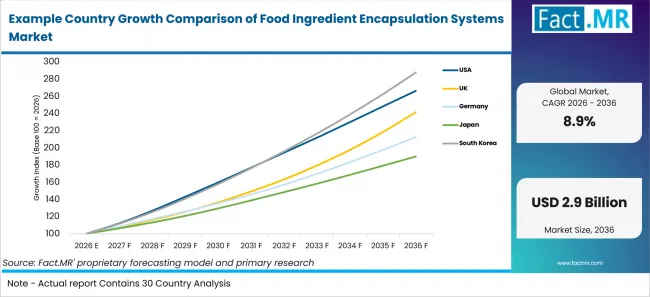
Example Country Growth Comparison Of Food Ingredient Encapsulation Systems Market | Source: Fact.MR
| Country | 2026 Share | CAGR (2026-2036) |
|---|---|---|
| United States | 29.0% | 10.99% |
| Germany | 17.0% | 8.49% |
| Japan | 15.0% | 8.09% |
| Italy | 16.0% | 8.79% |
| France | 12.0% | 9.50% |
| Spain | 11.0% | 10.42% |
Source: Fact.MR analysis. Updated Aug 14, 2026
What is driving United States's growth through 2036?
United States is forecast to expand at a 10.99% CAGR from 2026 to 2036 and accounts for 29.0% of demand among the listed country markets in 2026.
USDA Economic Research Service data show a large domestic food and beverage manufacturing base with tens of thousands of processing establishments. That industrial scale gives encapsulation suppliers a broad qualification base across flavours, nutrition ingredients and beverage systems. Functional beverages and fortified foods add demand where stability and dispersibility must be maintained during distribution and shelf life.
What is driving Germany's growth through 2036?
Germany is forecast to expand at an 8.49% CAGR from 2026 to 2036 and accounts for 17.0% of demand among the listed country markets in 2026.
Germany operates inside the European Union food and drink manufacturing system, where ingredient suppliers serve industrial bakery, beverage, dairy and nutrition customers under common food-safety and labeling rules. Encapsulation demand is tied to repeatable processing and documented ingredient performance, especially when sensitive cores must retain functionality through heating or storage.
What is driving Japan's growth through 2036?
Japan is forecast to expand at an 8.09% CAGR from 2026 to 2036 and accounts for 15.0% of demand among the listed country markets in 2026.
Japan has structured rules for nutrition and health-related food labeling. That increases the importance of ingredient identity, stability and documented function when vitamins and other active ingredients are incorporated into commercial foods. Encapsulation suppliers can add value by improving protection and release without changing the intended sensory profile.
What is driving Italy's growth through 2036?
Italy is forecast to expand at an 8.79% CAGR from 2026 to 2036 and accounts for 16.0% of demand among the listed country markets in 2026.
Italy has direct evidence of supplier investment in food encapsulation capability. DSM-Firmenich announced a new Parma facility designed around a proprietary encapsulation process and functional blends, with operations scheduled to begin in 2027. The investment points to continued regional demand for technical formulation support and specialized delivery systems.
What is driving France's growth through 2036?
France is forecast to expand at a 9.50% CAGR from 2026 to 2036 and accounts for 12.0% of demand among the listed country markets in 2026.
France participates in the European food and drink manufacturing base and applies EU rules governing permitted vitamin and mineral sources. Encapsulation demand therefore depends on both technical performance and ingredient compliance. Suppliers that can document stability, release and application fit are better positioned for repeat use in fortified foods and beverages.
What is driving Spain's growth through 2036?
Spain is forecast to expand at a 10.42% CAGR from 2026 to 2036 and accounts for 11.0% of demand among the listed country markets in 2026.
Spain combines food manufacturing with strong beverage, bakery and confectionery activity serving domestic and export channels. Encapsulation systems support this production base when formulators need shelf-stable powders, protected flavour systems or functional ingredients that can be dosed consistently at industrial scale.
Who leads the Food Ingredient Encapsulation Systems Market?
Balchem Corporation is positioned around dedicated food microencapsulation and controlled-release systems. Its food applications emphasize protection, stability, handling and release of active ingredients.
Ingredion Incorporated competes through encapsulants and emulsifiers designed to protect active components from temperature and oxygen. DSM-Firmenich AG combines flavour delivery with protection and release systems, including technologies beyond conventional spray drying.
BASF SE supplies nutrition ingredients and has publicly demonstrated microencapsulation for food applications. Kerry Group plc combines spray-drying capability with flavour encapsulation in its manufacturing network. Sensient Technologies Corporation participates through custom flavour and flavouring systems across beverage, bakery, dairy and confectionery applications. Its positioning is broader than the dedicated encapsulation platforms offered by some other listed suppliers.
Competition is shaped by the ability to match core sensitivity with shell chemistry and processing conditions. Buyers assess retention, dispersibility, taste impact, release behavior and shelf stability before a system moves into repeat production. Application support is important because a delivery system that works in a dry mix may behave differently in a beverage or heat-processed food.
Which companies are the key providers?
Key companies include Balchem Corporation; Ingredion Incorporated; DSM-Firmenich AG; BASF SE; Kerry Group plc; and Sensient Technologies Corporation.
- Balchem Corporation
- Ingredion Incorporated
- DSM-Firmenich AG
- BASF SE
- Kerry Group plc
- Sensient Technologies Corporation
Bibliography
- Balchem Corporation. (2026). Microencapsulation for Food.
- Ingredion Incorporated. (2026). Encapsulants & Emulsifiers.
- DSM-Firmenich AG. (2026). Delivery Systems, Taste, Texture & Health.
- DSM-Firmenich AG. (2025). New encapsulation and functional blends facility in Parma, Italy.
- BASF SE. (2024). Food Ingredients China 2024: nutrition and aroma ingredients portfolio, including microencapsulation demonstrations.
- Kerry Group plc. (2026). Manufacturing: Excellence in Production.
- Sensient Technologies Corporation. (2026). Sensient Flavors.
- U.S. Department of Agriculture, Economic Research Service. (2025). Food and Beverage Manufacturing.
- FoodDrinkEurope. (2026). Data & Trends of the European Food and Drink Industry 2026.
- European Commission. (2026). Addition of Vitamins and Minerals.
- European Commission. (2026). Food Supplements.
- Consumer Affairs Agency, Government of Japan. (2026). Food Labelling.
- Peer-reviewed food encapsulation literature covering protection, controlled release and delivery of bioactive compounds.
This Report Answers
- The report examines demand across Technology, Core Material, Shell Material and Application.
- Segment analysis explains why spray drying, flavours & aromas, carbohydrate-based shells and functional beverages lead their respective categories in 2026.
- Country analysis compares the supplied 2026 shares and growth rates for the United States, Germany, Japan, Italy, France and Spain through 2036.
- Competitive analysis reviews the listed companies and their publicly supported encapsulation or food-ingredient capabilities.
- The analysis considers core sensitivity, shell compatibility, release behavior, process scale-up and application fit that influence purchasing decisions.
What does the Food Ingredient Encapsulation Systems Market cover?
The market covers food-grade ingredient delivery systems designed to protect a core material, stabilize it during processing or storage, or control when and how it is released in a finished food or beverage. The covered technology set includes spray drying, fluid-bed coating, emulsion or coacervation, extrusion encapsulation and liposome or nano systems.
The assessment follows the stated segmentation by Technology, Core Material, Shell Material and Application. Revenue is counted where the commercial product or formulation is supplied primarily as an encapsulated food ingredient or food-grade delivery system.
What is included in the scope?
The scope includes Spray drying, Fluid-bed coating, Emulsion/coacervation, Extrusion encapsulation and Liposome/nano technologies. It covers Flavours & aromas, Vitamins & minerals, Probiotics, Oils & lipids as core materials, with Carbohydrate-based, Protein-based and Lipid-based shell systems.
Demand is assessed across Functional beverages, Bakery & confectionery, Dairy and Dietary supplements. Commercial ingredient systems are included when encapsulation is a defining function used to protect, stabilize, mask, disperse or control release of the core material.
What is excluded from the scope?
Unencapsulated base flavours, vitamins, minerals, probiotics and oils are excluded when they are sold without an encapsulation or controlled-delivery function. Standalone spray dryers, coating equipment and process machinery are outside ingredient-system revenue.
Pharmaceutical-only delivery systems, packaging microcapsules and animal-feed-only encapsulation products are outside the market unless the same food-grade commercial system is sold into the human-food applications listed in the scope.
How Was the Analysis Built?
The analysis combines product scope, segment demand, country outlook and supplier coverage.
- Primary Research: Interviews focus on food formulators, ingredient suppliers, product developers and procurement or technical teams that qualify encapsulated ingredients for commercial formulations.
- Desk Research: The review covers peer-reviewed food encapsulation research, government food-manufacturing data, regulatory guidance and official supplier product literature.
- Market Sizing and Forecasting: Estimates combine technology mix, application demand, core-material usage, shell and process economics, country growth and realized food-ingredient pricing.
- Data Validation and Update Cycle: Company names and current capabilities are checked against official sources. Market values, segment shares, country projections and arithmetic are cross-checked for internal consistency before publication.
Segmentation
What is the report's scope and coverage?
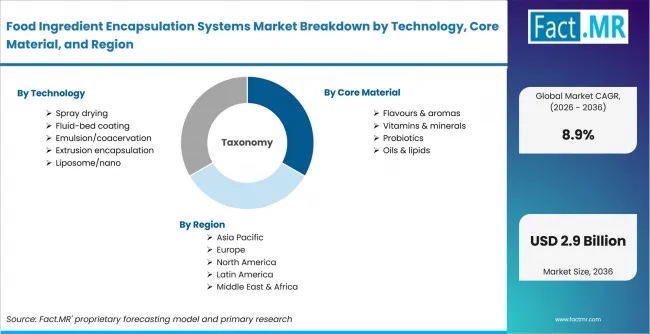
Food Ingredient Encapsulation Systems Market Breakdown By Technology, Core Material, And Region | Source: Fact.MR
| Attribute | Details |
|---|---|
| Quantitative Units | USD Million |
| Market Definition | Food-grade encapsulation systems that protect, stabilize or control the release of flavours, nutrients, probiotics, oils and other active food ingredients. |
| Segments Covered | Technology; Core Material; Shell Material; Application |
| Regions Covered | North America; Latin America; Europe; East Asia; South Asia and Oceania; Middle East and Africa |
| Countries Covered | United States; Germany; Japan; Italy; France; Spain |
| Key Companies Profiled | Balchem Corporation; Ingredion Incorporated; DSM-Firmenich AG; BASF SE; Kerry Group plc; Sensient Technologies Corporation |
| Forecast Period | 2026 to 2036 |
| Base Year | 2025 |
| Market Value, 2026 | USD 1,250 million |
| Market Value, 2036 | USD 2,932 million |
| CAGR, 2026-2036 | 8.9% |
| Absolute Opportunity | USD 1,682 million |
| Approach | Combines application demand, technology mix, core-material use, shell economics, supplier capabilities, country growth and realized food-ingredient pricing. |
Source: Fact.MR analysis. Updated Aug 14, 2026
How is the market segmented?
-
By Technology
- Spray drying
- Fluid-bed coating
- Emulsion/coacervation
- Extrusion encapsulation
- Liposome/nano
-
By Core Material
- Flavours & aromas
- Vitamins & minerals
- Probiotics
- Oils & lipids
-
By Shell Material
- Carbohydrate-based
- Protein-based
- Lipid-based
-
By Application
- Functional beverages
- Bakery & confectionery
- Dairy
- Dietary supplements
-
By Region
- North America
- Latin America
- Western Europe
- Eastern Europe
- East Asia
- South Asia and Pacific
- Middle East & Africa
Frequently Asked Questions
What is the Food Ingredient Encapsulation Systems Market value in 2026?
At what CAGR is the market projected to grow?
What is the projected market value by 2036?
Which Technology category leads the market?
Which Core Material category leads the market?
Which Shell Material category leads the market?
Which Application category leads the market?
Which listed country records the strongest CAGR?
What is the primary driver in this market?
What is the main restraint?
Which companies are assessed?
Who worked on this report


Preview the report firsthand - request a free sample
Free SampleGet the brochure for pricing and purchase details
Download PDF