Bamboo Fiber Trays Market
Bamboo Fiber Trays Market Size and Share Forecast Outlook 2026 to 2036
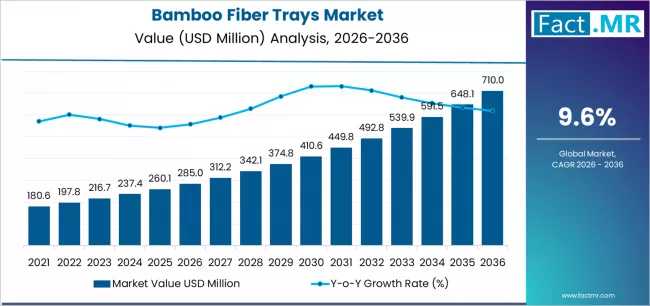
The bamboo fiber trays market is projected to grow from USD 285.0 million in 2026 to USD 710.0 million by 2036, at a CAGR of 9.6%. Ready Meals & Retail will dominate with a 45.0% market share, while clamshell trays will lead the packaging format/type segment with a 50.0% share.
Bamboo Fiber Trays Market Forecast and Outlook 2026 to 2036
The global bamboo fiber trays market is valued at USD 285.0 million in 2026. The market is forecast to reach USD 710.0 million by 2036, an increase of USD 425.0 million. This represents total growth of 149.1%, expanding at a compound annual growth rate (CAGR) of 9.6% between 2026 and 2036.
Key Takeaways from the Bamboo Fiber Trays Market Report
- Market Value (2026): USD 285.0 Million
- Market Forecast Value (2036): USD 710.0 Million
- Market Forecast CAGR: 9.6%
- Leading End-Use: Ready Meals & Retail (45.0%)
- Key Growth Regions: Asia Pacific, North America, Europe
- Key Players: Huhtamaki Oyj (Asia operations), Duni Group, Stora Enso Oyj, Uflex Limited (conversion), Toppan Inc.

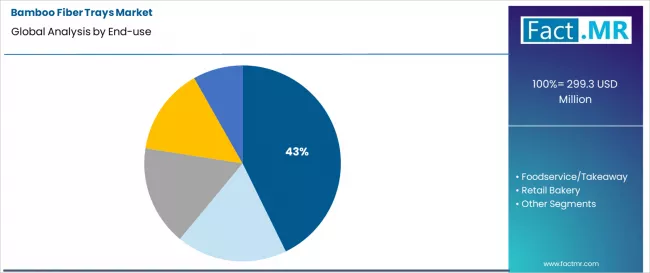
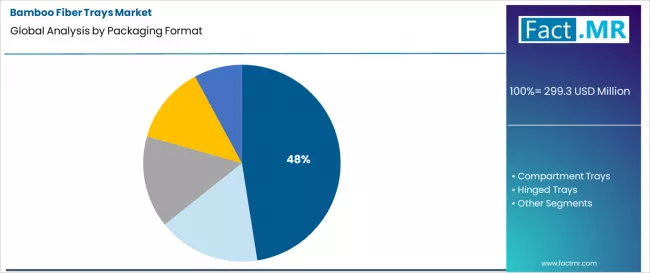
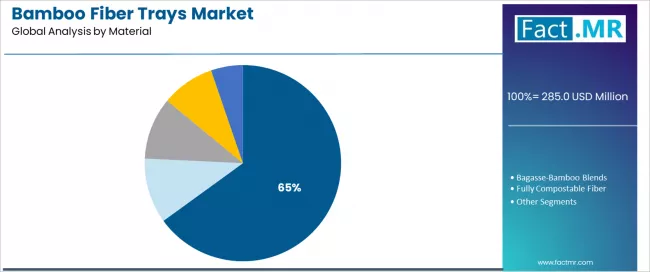
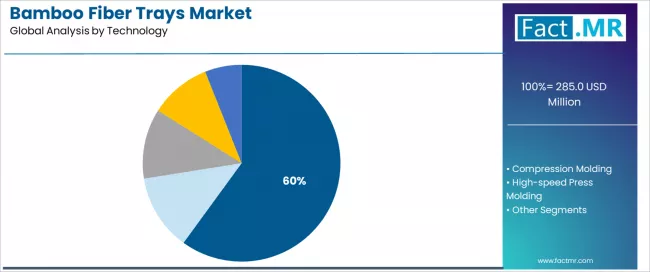
Segmentation data shows a market built for food contact and convenience. By end-use, the ready meals and retail sector commands a leading 45.0% share in 2026. Clamshell trays dominate the packaging format segment with a 50.0% share. Pure bamboo pulp or fiber holds a dominant 65.0% material share, while molded pulp thermoforming is the primary technology with a 60.0% share. This configuration highlights a targeted replacement of plastic and molded fiber trays in food presentation and protection.
A significant macro trend is the pursuit of packaging materials with inherent functional benefits beyond basic sustainability. Bamboo offers natural antimicrobial properties and a high strength-to-weight ratio, making it particularly suitable for preserving fresh food and supporting moist or oily ready meals without leaking or sagging. This performance advantage provides a tangible quality story for brands, moving beyond the environmental claim to include product protection and food safety.
The scalability of bamboo as a feedstock is shaping investment and supply chain development. Unlike some annual crops, bamboo is a perennial grass that regenerates quickly without replanting and can thrive on marginal land. This reliable and rapid renewability appeals to large-scale manufacturers seeking a stable, high-volume fiber supply to meet growing demand from the foodservice and retail sectors. The establishment of dedicated bamboo pulp sources is creating a new, vertically integrated supply chain for sustainable packaging.
Bamboo Fiber Trays Market
| Metric | Value |
|---|---|
| Estimated Value in (2026E) | USD 285.0 million |
| Forecast Value in (2036F) | USD 710.0 million |
| Forecast CAGR (2026 to 2036) | 9.6% |
Category
| Category | Segment |
|---|---|
| End-use/Application | Ready Meals & Retail, Foodservice/Takeaway, Retail Bakery, Catering & Events, Others |
| Packaging Format/Type | Clamshell Trays, Compartment Trays, Hinged Trays, Sleeved Trays, Others |
| Material | Bamboo Pulp/Fiber, Bagasse-Bamboo Blends, Fully Compostable Fiber, Local Bamboo Blends, Others |
| Technology | Molded Pulp Thermoforming, Compression Molding, High-speed Press Molding, Wet Molding, Others |
| Region | North America, Europe, Asia Pacific, Latin America, MEA |
Segment Analysis
How is the Ready Meals Sector Leveraging Bamboo for Leak-Resistant Performance?
The ready meals and retail segment holds a 45.0% market share in 2026. This leadership is driven by the need for a tray that can withstand microwave heating, contain sauces, and present food attractively while being fully compostable. Bamboo fiber’s natural strength and oil resistance make it ideal for this challenging application.
Development focuses on creating trays with precise dimensional stability to prevent warping during freezing and reheating cycles. The tray’s performance must equal that of plastic or aluminum to gain acceptance from large meal manufacturers and retailers, turning its functional resilience into a key selling point alongside its compostability.
What Makes Clamshell Trays the Universal Format for Food-to-Go Applications?
Clamshell trays lead the packaging format segment with a 50.0% share. Their dominance stems from versatility and consumer familiarity. The format works for salads, sandwiches, bakery items, and hot meals, providing excellent product visibility and secure closure. For bamboo, the challenge and focus are on producing a consistently smooth hinge that withstands repeated opening and closing without cracking.
The widespread existing use of plastic clamshells across retail and foodservice makes this format a priority for substitution, as a successful bamboo version can directly replace a significant volume of plastic packaging with minimal change to packing operations.
Why is Pure Bamboo Fiber Becoming the Material Benchmark for Strength and Purity?

Pure bamboo pulp or fiber accounts for a dominant 65.0% material share. Its position is secured by consumer perception of bamboo as a clean, strong, and natural material. Using a high percentage of pure bamboo fiber allows for clear marketing claims of a “bamboo-based” product, which carries more weight than a blended material.
Pure bamboo fiber provides excellent rigidity and a desirable, light-colored natural finish. Development focuses on optimizing pulping processes to maximize fiber length and strength while maintaining the material’s compostability and ensuring a consistent supply of high-quality feedstock.
Is Molded Pulp Thermoforming Enabling High-Volume Production of Complex Shapes?

Molded pulp thermoforming technology commands a 60.0% share. This process is critical for producing the detailed, consistent shapes required for compartmentalized food trays at commercial scale. Thermoforming allows for precise control over wall thickness and the creation of intricate features like stacking ribs and locking lids.
For bamboo fiber, the technology must be adapted to handle its specific drainage and heating characteristics during forming. The dominance of this method underscores the market's move beyond simple pressed trays to sophisticated, functional designs that compete directly with injection-molded plastic, enabling bamboo to enter mainstream food packaging lines.
What are the Drivers, Restraints, and Key Trends of the Bamboo Fiber Trays Market?
Market growth is propelled by bans on single-use plastic foodware, consumer preference for naturally derived packaging, and strong demand from the foodservice industry for sustainable takeaway solutions. The excellent visual and tactile appeal of bamboo trays is a key brand driver. Higher production costs compared to conventional molded fiber or plastic, and potential supply chain complexities for consistent bamboo pulp, serve as key restraints.
Performance under extreme microwave heat or with very greasy foods can also be a technical challenge. Development concentrates on creating high-barrier, water-resistant coatings derived from natural sources to expand application range. Another focus is on blending bamboo with other agricultural fibers like bagasse to optimize cost and performance for specific regional markets.
Analysis of the Bamboo Fiber Trays Market by Key Countries
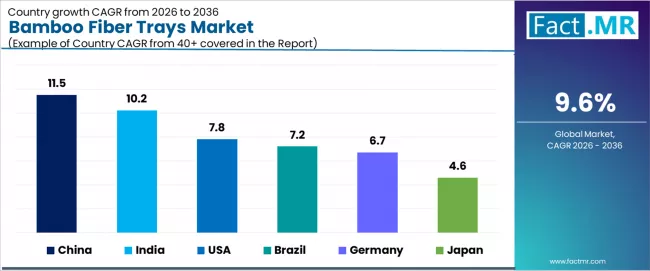
| Country | CAGR (2026-2036) |
|---|---|
| China | 11.5% |
| USA | 7.8% |
| Germany | 6.7% |
| India | 10.2% |
| Brazil | 7.2% |
| Japan | 4.6% |
How is China’s Domestic Bamboo Supply and Manufacturing Scale Defining Leadership?
China’s market grows at an 11.5% CAGR, leveraging its vast bamboo resources and integrated manufacturing ecosystem. As the global leader in bamboo cultivation and processing, it has a built-in advantage in raw material cost and availability.
Growth is fueled by domestic policy promoting green packaging and the massive scale of the country’s food delivery and ready-to-eat sectors. Development focuses on fully automated, high-speed production lines that can meet immense domestic demand and serve as an export hub for bamboo-based packaging, setting global benchmarks for production efficiency.
- Vertical integration from bamboo forest to finished tray is becoming more common, ensuring quality control and supply chain resilience.
- Government support for the “bamboo as a substitute for plastic” initiative is driving standardization and investment in the sector.
Are USA’s Market Dynamics Driven by Premium Food Retail and Regulatory Pressures?

USA’s market expands at a 7.8% CAGR, shaped by legislation against polystyrene and plastic food containers in numerous states and cities. Growth is strong in premium grocery chains, meal kit services, and fast-casual restaurants seeking an upscale, sustainable presentation.
Development focuses on achieving a premium, smooth finish that appeals to American consumers and on creating tray designs that integrate seamlessly with existing cold chain and delivery logistics for partners like grocery delivery services.
- The need for trays that are certified for both home and industrial composting is critical for acceptance in different municipal systems.
- Partnerships between bamboo tray converters and national food brands are key to driving volume adoption beyond niche applications.
How does Germany’s Market Prioritize Certified Compostability in a Strict Waste System?
Germany’s market advances at a 6.7% CAGR, where any alternative must have certified compostability to fit within the Bio-waste (Biogut) collection system. Bamboo trays must disintegrate completely within specified timeframes in industrial facilities.
Growth is steady in the foodservice sector for events, canteens, and high-end takeaway that values the natural aesthetic. The market favors pure material compositions with clear documentation and avoids blends or coatings that might hinder compostability.
- There is high demand for trays that carry respected certifications like DIN CERTCO or the “Keimling” (seedling) logo.
- Development focuses on enhancing the grease resistance of trays using inherently resistant bamboo fiber blends rather than synthetic coatings.
Can India’s Growth Tap into Local Bamboo and a Booming Food Delivery Economy?
India demonstrates strong growth at a 10.2% CAGR, powered by its own bamboo resources and the explosive expansion of online food delivery and cloud kitchens. The price-sensitive market drives innovation towards affordable trays made from local bamboo varieties or blends with wheat straw. Growth focuses on functionality for India’s diverse cuisine, requiring trays that can handle gravies, fried foods, and high moisture content without failing.
- The rise of organized retail and packaged fresh food is creating new demand for branded, sustainable bakery and snack trays.
- Local manufacturing using decentralized, smaller-scale bamboo processing models is emerging to serve regional markets efficiently.
How is Brazil’s Market Leveraging its Biodiversity for Unique Fiber Blends?
Brazil’s market is set to grow at a 7.2% CAGR, with an opportunity to innovate using its abundant bamboo species alongside other local fibers like bagasse. This allows for the creation of composite trays optimized for local climate conditions and food types. Growth is notable in the catering and event segment, where sustainable disposable tableware is in high demand. The market favors solutions that highlight their natural, local origin as part of their appeal.
- Research into blends of bamboo with other native fibers aims to improve performance for specific applications, like trays for moist fruits or grilled meats.
- The export of agricultural products is creating a parallel demand for sustainable primary packaging made from local materials.
How does Aesthetic Perfection and Functional Precision Influence Bamboo Fiber Trays Demand in Japan?
Japan’s market grows at a 4.6% CAGR, where adoption requires trays that meet exceptional standards of cleanliness, precise shape, and minimalist aesthetics. Bamboo trays for retail bento boxes, premium fruits, and confectionery must have a flawless, consistent finish.
The market values ultra-thin yet strong constructions that reduce material use and align with a cultural aversion to waste. Development focuses on achieving a very fine, smooth surface texture that appeals to Japanese consumers and functions perfectly on high-speed automated packing lines.
- There is significant value in trays designed for specific, iconic convenience store items, ensuring perfect fit and portion presentation.
- Innovation targets lightweight yet rigid constructions that maintain integrity during transport in crowded urban delivery networks.
Competitive Landscape of the Bamboo Fiber Trays Market
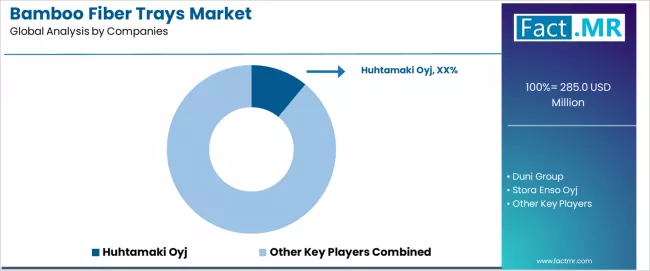
The competitive landscape includes global fiber packaging leaders, specialty molded pulp companies, and regional players with access to bamboo feedstocks. Competition centers on proprietary pulping and molding technologies that enhance production speed and finish quality, and on securing reliable, cost-competitive bamboo fiber supply chains.
Key players differentiate through advanced tray designs that offer better functionality, such as improved leak resistance or microwaveability, and through possessing crucial compostability certifications for key markets. Success requires deep expertise in working with natural fiber variability and building strong relationships with both bamboo suppliers and high-volume foodservice or retail brand owners. Companies that can offer a complete solution, from custom design to certified composability testing, are building a distinct advantage.
Key Players in the Bamboo Fiber Trays Market
- Huhtamaki Oyj
- Duni Group
- Stora Enso Oyj
- Uflex Limited
- Toppan Inc.
Scope of the Report
| Items | Values |
|---|---|
| Quantitative Units (2026) | USD 285.0 Million |
| End-use/Application | Ready Meals & Retail, Foodservice/Takeaway, Retail Bakery, Catering & Events, Others |
| Packaging Format/Type | Clamshell Trays, Compartment Trays, Hinged Trays, Sleeved Trays, Others |
| Material | Bamboo Pulp/Fiber, Bagasse-Bamboo Blends, Fully Compostable Fiber, Local Bamboo Blends, Others |
| Technology | Molded Pulp Thermoforming, Compression Molding, High-speed Press Molding, Wet Molding, Others |
| Regions Covered | North America, Europe, Asia Pacific, Latin America, MEA |
| Key Companies Profiled | Huhtamaki Oyj, Duni Group, Stora Enso Oyj, Uflex Limited, Toppan Inc. |
Bamboo Fiber Trays Market by Segments
-
End-use/Application :
- Ready Meals & Retail
- Foodservice / Takeaway
- Retail Bakery
- Catering & Events
- Others
-
Packaging Format/Type :
- Clamshell Trays
- Compartment Trays
- Hinged Trays
- Sleeved Trays
- Others
-
Material :
- Bamboo Pulp/Fiber
- Bagasse-Bamboo Blends
- Fully Compostable Fiber
- Local Bamboo Blends
- Others
-
Technology :
- Molded Pulp Thermoforming
- Compression Molding
- High-speed Press Molding
- Wet Molding
- Others
-
Region :
-
North America
- USA
- Canada
- Mexico
-
Europe
- Germany
- UK
- France
- Italy
- Spain
- Rest of Europe
-
Asia Pacific
- China
- India
- Japan
- South Korea
- Australia
- Rest of Asia Pacific
-
Latin America
- Brazil
- Argentina
- Rest of Latin America
-
MEA
- Saudi Arabia
- UAE
- South Africa
- Rest of MEA
-
Table of Content
- Executive Summary
- Global Market Outlook
- Demand to side Trends
- Supply to side Trends
- Technology Roadmap Analysis
- Analysis and Recommendations
- Market Overview
- Market Coverage / Taxonomy
- Market Definition / Scope / Limitations
- Market Background
- Market Dynamics
- Drivers
- Restraints
- Opportunity
- Trends
- Scenario Forecast
- Demand in Optimistic Scenario
- Demand in Likely Scenario
- Demand in Conservative Scenario
- Opportunity Map Analysis
- Product Life Cycle Analysis
- Supply Chain Analysis
- Investment Feasibility Matrix
- Value Chain Analysis
- PESTLE and Porter’s Analysis
- Regulatory Landscape
- Regional Parent Market Outlook
- Production and Consumption Statistics
- Import and Export Statistics
- Market Dynamics
- Global Market Analysis 2021 to 2025 and Forecast, 2026 to 2036
- Historical Market Size Value (USD Million) Analysis, 2021 to 2025
- Current and Future Market Size Value (USD Million) Projections, 2026 to 2036
- Y to o to Y Growth Trend Analysis
- Absolute $ Opportunity Analysis
- Global Market Pricing Analysis 2021 to 2025 and Forecast 2026 to 2036
- Global Market Analysis 2021 to 2025 and Forecast 2026 to 2036, By End-use/Application
- Introduction / Key Findings
- Historical Market Size Value (USD Million) Analysis By End-use/Application, 2021 to 2025
- Current and Future Market Size Value (USD Million) Analysis and Forecast By End-use/Application, 2026 to 2036
- Ready Meals & Retail
- Foodservice / Takeaway
- Retail Bakery
- Catering & Events
- Others
- Y to o to Y Growth Trend Analysis By End-use/Application, 2021 to 2025
- Absolute $ Opportunity Analysis By End-use/Application, 2026 to 2036
- Global Market Analysis 2021 to 2025 and Forecast 2026 to 2036, By Packaging Format/Type
- Introduction / Key Findings
- Historical Market Size Value (USD Million) Analysis By Packaging Format/Type, 2021 to 2025
- Current and Future Market Size Value (USD Million) Analysis and Forecast By Packaging Format/Type, 2026 to 2036
- Clamshell Trays
- Compartment Trays
- Hinged Trays
- Sleeved Trays
- Others
- Y to o to Y Growth Trend Analysis By Packaging Format/Type, 2021 to 2025
- Absolute $ Opportunity Analysis By Packaging Format/Type, 2026 to 2036
- Global Market Analysis 2021 to 2025 and Forecast 2026 to 2036, By Material
- Introduction / Key Findings
- Historical Market Size Value (USD Million) Analysis By Material, 2021 to 2025
- Current and Future Market Size Value (USD Million) Analysis and Forecast By Material, 2026 to 2036
- Bamboo Pulp / Fiber
- Bagasse-Bamboo Blends
- Fully Compostable Fiber
- Local Bamboo Blends
- Others
- Y to o to Y Growth Trend Analysis By Material, 2021 to 2025
- Absolute $ Opportunity Analysis By Material, 2026 to 2036
- Global Market Analysis 2021 to 2025 and Forecast 2026 to 2036, By Technology
- Introduction / Key Findings
- Historical Market Size Value (USD Million) Analysis By Technology, 2021 to 2025
- Current and Future Market Size Value (USD Million) Analysis and Forecast By Technology, 2026 to 2036
- Molded Pulp Thermoforming
- Compression Molding
- High-speed Press Molding
- Wet Molding
- Others
- Y to o to Y Growth Trend Analysis By Technology, 2021 to 2025
- Absolute $ Opportunity Analysis By Technology, 2026 to 2036
- Global Market Analysis 2021 to 2025 and Forecast 2026 to 2036, By Region
- Introduction
- Historical Market Size Value (USD Million) Analysis By Region, 2021 to 2025
- Current Market Size Value (USD Million) Analysis and Forecast By Region, 2026 to 2036
- North America
- Latin America
- Western Europe
- Eastern Europe
- East Asia
- South Asia and Pacific
- Middle East & Africa
- Market Attractiveness Analysis By Region
- North America Market Analysis 2021 to 2025 and Forecast 2026 to 2036, By Country
- Historical Market Size Value (USD Million) Trend Analysis By Market Taxonomy, 2021 to 2025
- Market Size Value (USD Million) Forecast By Market Taxonomy, 2026 to 2036
- By Country
- USA
- Canada
- Mexico
- By End-use/Application
- By Packaging Format/Type
- By Material
- By Technology
- By Country
- Market Attractiveness Analysis
- By Country
- By End-use/Application
- By Packaging Format/Type
- By Material
- By Technology
- Key Takeaways
- Latin America Market Analysis 2021 to 2025 and Forecast 2026 to 2036, By Country
- Historical Market Size Value (USD Million) Trend Analysis By Market Taxonomy, 2021 to 2025
- Market Size Value (USD Million) Forecast By Market Taxonomy, 2026 to 2036
- By Country
- Brazil
- Chile
- Rest of Latin America
- By End-use/Application
- By Packaging Format/Type
- By Material
- By Technology
- By Country
- Market Attractiveness Analysis
- By Country
- By End-use/Application
- By Packaging Format/Type
- By Material
- By Technology
- Key Takeaways
- Western Europe Market Analysis 2021 to 2025 and Forecast 2026 to 2036, By Country
- Historical Market Size Value (USD Million) Trend Analysis By Market Taxonomy, 2021 to 2025
- Market Size Value (USD Million) Forecast By Market Taxonomy, 2026 to 2036
- By Country
- Germany
- UK
- Italy
- Spain
- France
- Nordic
- BENELUX
- Rest of Western Europe
- By End-use/Application
- By Packaging Format/Type
- By Material
- By Technology
- By Country
- Market Attractiveness Analysis
- By Country
- By End-use/Application
- By Packaging Format/Type
- By Material
- By Technology
- Key Takeaways
- Eastern Europe Market Analysis 2021 to 2025 and Forecast 2026 to 2036, By Country
- Historical Market Size Value (USD Million) Trend Analysis By Market Taxonomy, 2021 to 2025
- Market Size Value (USD Million) Forecast By Market Taxonomy, 2026 to 2036
- By Country
- Russia
- Poland
- Hungary
- Balkan & Baltic
- Rest of Eastern Europe
- By End-use/Application
- By Packaging Format/Type
- By Material
- By Technology
- By Country
- Market Attractiveness Analysis
- By Country
- By End-use/Application
- By Packaging Format/Type
- By Material
- By Technology
- Key Takeaways
- East Asia Market Analysis 2021 to 2025 and Forecast 2026 to 2036, By Country
- Historical Market Size Value (USD Million) Trend Analysis By Market Taxonomy, 2021 to 2025
- Market Size Value (USD Million) Forecast By Market Taxonomy, 2026 to 2036
- By Country
- China
- Japan
- South Korea
- By End-use/Application
- By Packaging Format/Type
- By Material
- By Technology
- By Country
- Market Attractiveness Analysis
- By Country
- By End-use/Application
- By Packaging Format/Type
- By Material
- By Technology
- Key Takeaways
- South Asia and Pacific Market Analysis 2021 to 2025 and Forecast 2026 to 2036, By Country
- Historical Market Size Value (USD Million) Trend Analysis By Market Taxonomy, 2021 to 2025
- Market Size Value (USD Million) Forecast By Market Taxonomy, 2026 to 2036
- By Country
- India
- ASEAN
- Australia & New Zealand
- Rest of South Asia and Pacific
- By End-use/Application
- By Packaging Format/Type
- By Material
- By Technology
- By Country
- Market Attractiveness Analysis
- By Country
- By End-use/Application
- By Packaging Format/Type
- By Material
- By Technology
- Key Takeaways
- Middle East & Africa Market Analysis 2021 to 2025 and Forecast 2026 to 2036, By Country
- Historical Market Size Value (USD Million) Trend Analysis By Market Taxonomy, 2021 to 2025
- Market Size Value (USD Million) Forecast By Market Taxonomy, 2026 to 2036
- By Country
- Kingdom of Saudi Arabia
- Other GCC Countries
- Turkiye
- South Africa
- Other African Union
- Rest of Middle East & Africa
- By End-use/Application
- By Packaging Format/Type
- By Material
- By Technology
- By Country
- Market Attractiveness Analysis
- By Country
- By End-use/Application
- By Packaging Format/Type
- By Material
- By Technology
- Key Takeaways
- Key Countries Market Analysis
- USA
- Pricing Analysis
- Market Share Analysis, 2025
- By End-use/Application
- By Packaging Format/Type
- By Material
- By Technology
- Canada
- Pricing Analysis
- Market Share Analysis, 2025
- By End-use/Application
- By Packaging Format/Type
- By Material
- By Technology
- Mexico
- Pricing Analysis
- Market Share Analysis, 2025
- By End-use/Application
- By Packaging Format/Type
- By Material
- By Technology
- Brazil
- Pricing Analysis
- Market Share Analysis, 2025
- By End-use/Application
- By Packaging Format/Type
- By Material
- By Technology
- Chile
- Pricing Analysis
- Market Share Analysis, 2025
- By End-use/Application
- By Packaging Format/Type
- By Material
- By Technology
- Germany
- Pricing Analysis
- Market Share Analysis, 2025
- By End-use/Application
- By Packaging Format/Type
- By Material
- By Technology
- UK
- Pricing Analysis
- Market Share Analysis, 2025
- By End-use/Application
- By Packaging Format/Type
- By Material
- By Technology
- Italy
- Pricing Analysis
- Market Share Analysis, 2025
- By End-use/Application
- By Packaging Format/Type
- By Material
- By Technology
- Spain
- Pricing Analysis
- Market Share Analysis, 2025
- By End-use/Application
- By Packaging Format/Type
- By Material
- By Technology
- France
- Pricing Analysis
- Market Share Analysis, 2025
- By End-use/Application
- By Packaging Format/Type
- By Material
- By Technology
- India
- Pricing Analysis
- Market Share Analysis, 2025
- By End-use/Application
- By Packaging Format/Type
- By Material
- By Technology
- ASEAN
- Pricing Analysis
- Market Share Analysis, 2025
- By End-use/Application
- By Packaging Format/Type
- By Material
- By Technology
- Australia & New Zealand
- Pricing Analysis
- Market Share Analysis, 2025
- By End-use/Application
- By Packaging Format/Type
- By Material
- By Technology
- China
- Pricing Analysis
- Market Share Analysis, 2025
- By End-use/Application
- By Packaging Format/Type
- By Material
- By Technology
- Japan
- Pricing Analysis
- Market Share Analysis, 2025
- By End-use/Application
- By Packaging Format/Type
- By Material
- By Technology
- South Korea
- Pricing Analysis
- Market Share Analysis, 2025
- By End-use/Application
- By Packaging Format/Type
- By Material
- By Technology
- Russia
- Pricing Analysis
- Market Share Analysis, 2025
- By End-use/Application
- By Packaging Format/Type
- By Material
- By Technology
- Poland
- Pricing Analysis
- Market Share Analysis, 2025
- By End-use/Application
- By Packaging Format/Type
- By Material
- By Technology
- Hungary
- Pricing Analysis
- Market Share Analysis, 2025
- By End-use/Application
- By Packaging Format/Type
- By Material
- By Technology
- Kingdom of Saudi Arabia
- Pricing Analysis
- Market Share Analysis, 2025
- By End-use/Application
- By Packaging Format/Type
- By Material
- By Technology
- Turkiye
- Pricing Analysis
- Market Share Analysis, 2025
- By End-use/Application
- By Packaging Format/Type
- By Material
- By Technology
- South Africa
- Pricing Analysis
- Market Share Analysis, 2025
- By End-use/Application
- By Packaging Format/Type
- By Material
- By Technology
- USA
- Market Structure Analysis
- Competition Dashboard
- Competition Benchmarking
- Market Share Analysis of Top Players
- By Regional
- By End-use/Application
- By Packaging Format/Type
- By Material
- By Technology
- Competition Analysis
- Competition Deep Dive
- Huhtamaki Oyj
- Overview
- Product Portfolio
- Profitability by Market Segments (Product/Age /Sales Channel/Region)
- Sales Footprint
- Strategy Overview
- Marketing Strategy
- Product Strategy
- Channel Strategy
- Duni Group
- Stora Enso Oyj
- Uflex Limited
- Toppan Inc.
- Huhtamaki Oyj
- Competition Deep Dive
- Assumptions & Acronyms Used
- Research Methodology
List Of Table
- Table 1: Global Market Value (USD Million) Forecast by Region, 2021 to 2036
- Table 2: Global Market Value (USD Million) Forecast by End-use/Application, 2021 to 2036
- Table 3: Global Market Value (USD Million) Forecast by Packaging Format/Type, 2021 to 2036
- Table 4: Global Market Value (USD Million) Forecast by Material, 2021 to 2036
- Table 5: Global Market Value (USD Million) Forecast by Technology, 2021 to 2036
- Table 6: North America Market Value (USD Million) Forecast by Country, 2021 to 2036
- Table 7: North America Market Value (USD Million) Forecast by End-use/Application, 2021 to 2036
- Table 8: North America Market Value (USD Million) Forecast by Packaging Format/Type, 2021 to 2036
- Table 9: North America Market Value (USD Million) Forecast by Material, 2021 to 2036
- Table 10: North America Market Value (USD Million) Forecast by Technology, 2021 to 2036
- Table 11: Latin America Market Value (USD Million) Forecast by Country, 2021 to 2036
- Table 12: Latin America Market Value (USD Million) Forecast by End-use/Application, 2021 to 2036
- Table 13: Latin America Market Value (USD Million) Forecast by Packaging Format/Type, 2021 to 2036
- Table 14: Latin America Market Value (USD Million) Forecast by Material, 2021 to 2036
- Table 15: Latin America Market Value (USD Million) Forecast by Technology, 2021 to 2036
- Table 16: Western Europe Market Value (USD Million) Forecast by Country, 2021 to 2036
- Table 17: Western Europe Market Value (USD Million) Forecast by End-use/Application, 2021 to 2036
- Table 18: Western Europe Market Value (USD Million) Forecast by Packaging Format/Type, 2021 to 2036
- Table 19: Western Europe Market Value (USD Million) Forecast by Material, 2021 to 2036
- Table 20: Western Europe Market Value (USD Million) Forecast by Technology, 2021 to 2036
- Table 21: Eastern Europe Market Value (USD Million) Forecast by Country, 2021 to 2036
- Table 22: Eastern Europe Market Value (USD Million) Forecast by End-use/Application, 2021 to 2036
- Table 23: Eastern Europe Market Value (USD Million) Forecast by Packaging Format/Type, 2021 to 2036
- Table 24: Eastern Europe Market Value (USD Million) Forecast by Material, 2021 to 2036
- Table 25: Eastern Europe Market Value (USD Million) Forecast by Technology, 2021 to 2036
- Table 26: East Asia Market Value (USD Million) Forecast by Country, 2021 to 2036
- Table 27: East Asia Market Value (USD Million) Forecast by End-use/Application, 2021 to 2036
- Table 28: East Asia Market Value (USD Million) Forecast by Packaging Format/Type, 2021 to 2036
- Table 29: East Asia Market Value (USD Million) Forecast by Material, 2021 to 2036
- Table 30: East Asia Market Value (USD Million) Forecast by Technology, 2021 to 2036
- Table 31: South Asia and Pacific Market Value (USD Million) Forecast by Country, 2021 to 2036
- Table 32: South Asia and Pacific Market Value (USD Million) Forecast by End-use/Application, 2021 to 2036
- Table 33: South Asia and Pacific Market Value (USD Million) Forecast by Packaging Format/Type, 2021 to 2036
- Table 34: South Asia and Pacific Market Value (USD Million) Forecast by Material, 2021 to 2036
- Table 35: South Asia and Pacific Market Value (USD Million) Forecast by Technology, 2021 to 2036
- Table 36: Middle East & Africa Market Value (USD Million) Forecast by Country, 2021 to 2036
- Table 37: Middle East & Africa Market Value (USD Million) Forecast by End-use/Application, 2021 to 2036
- Table 38: Middle East & Africa Market Value (USD Million) Forecast by Packaging Format/Type, 2021 to 2036
- Table 39: Middle East & Africa Market Value (USD Million) Forecast by Material, 2021 to 2036
- Table 40: Middle East & Africa Market Value (USD Million) Forecast by Technology, 2021 to 2036
List Of Figures
- Figure 1: Global Market Pricing Analysis
- Figure 2: Global Market Value (USD Million) Forecast 2021 to 2036
- Figure 3: Global Market Value Share and BPS Analysis by End-use/Application, 2026 and 2036
- Figure 4: Global Market Y to o to Y Growth Comparison by End-use/Application, 2026 to 2036
- Figure 5: Global Market Attractiveness Analysis by End-use/Application
- Figure 6: Global Market Value Share and BPS Analysis by Packaging Format/Type, 2026 and 2036
- Figure 7: Global Market Y to o to Y Growth Comparison by Packaging Format/Type, 2026 to 2036
- Figure 8: Global Market Attractiveness Analysis by Packaging Format/Type
- Figure 9: Global Market Value Share and BPS Analysis by Material, 2026 and 2036
- Figure 10: Global Market Y to o to Y Growth Comparison by Material, 2026 to 2036
- Figure 11: Global Market Attractiveness Analysis by Material
- Figure 12: Global Market Value Share and BPS Analysis by Technology, 2026 and 2036
- Figure 13: Global Market Y to o to Y Growth Comparison by Technology, 2026 to 2036
- Figure 14: Global Market Attractiveness Analysis by Technology
- Figure 15: Global Market Value (USD Million) Share and BPS Analysis by Region, 2026 and 2036
- Figure 16: Global Market Y to o to Y Growth Comparison by Region, 2026 to 2036
- Figure 17: Global Market Attractiveness Analysis by Region
- Figure 18: North America Market Incremental Dollar Opportunity, 2026 to 2036
- Figure 19: Latin America Market Incremental Dollar Opportunity, 2026 to 2036
- Figure 20: Western Europe Market Incremental Dollar Opportunity, 2026 to 2036
- Figure 21: Eastern Europe Market Incremental Dollar Opportunity, 2026 to 2036
- Figure 22: East Asia Market Incremental Dollar Opportunity, 2026 to 2036
- Figure 23: South Asia and Pacific Market Incremental Dollar Opportunity, 2026 to 2036
- Figure 24: Middle East & Africa Market Incremental Dollar Opportunity, 2026 to 2036
- Figure 25: North America Market Value Share and BPS Analysis by Country, 2026 and 2036
- Figure 26: North America Market Value Share and BPS Analysis by End-use/Application, 2026 and 2036
- Figure 27: North America Market Y to o to Y Growth Comparison by End-use/Application, 2026 to 2036
- Figure 28: North America Market Attractiveness Analysis by End-use/Application
- Figure 29: North America Market Value Share and BPS Analysis by Packaging Format/Type, 2026 and 2036
- Figure 30: North America Market Y to o to Y Growth Comparison by Packaging Format/Type, 2026 to 2036
- Figure 31: North America Market Attractiveness Analysis by Packaging Format/Type
- Figure 32: North America Market Value Share and BPS Analysis by Material, 2026 and 2036
- Figure 33: North America Market Y to o to Y Growth Comparison by Material, 2026 to 2036
- Figure 34: North America Market Attractiveness Analysis by Material
- Figure 35: North America Market Value Share and BPS Analysis by Technology, 2026 and 2036
- Figure 36: North America Market Y to o to Y Growth Comparison by Technology, 2026 to 2036
- Figure 37: North America Market Attractiveness Analysis by Technology
- Figure 38: Latin America Market Value Share and BPS Analysis by Country, 2026 and 2036
- Figure 39: Latin America Market Value Share and BPS Analysis by End-use/Application, 2026 and 2036
- Figure 40: Latin America Market Y to o to Y Growth Comparison by End-use/Application, 2026 to 2036
- Figure 41: Latin America Market Attractiveness Analysis by End-use/Application
- Figure 42: Latin America Market Value Share and BPS Analysis by Packaging Format/Type, 2026 and 2036
- Figure 43: Latin America Market Y to o to Y Growth Comparison by Packaging Format/Type, 2026 to 2036
- Figure 44: Latin America Market Attractiveness Analysis by Packaging Format/Type
- Figure 45: Latin America Market Value Share and BPS Analysis by Material, 2026 and 2036
- Figure 46: Latin America Market Y to o to Y Growth Comparison by Material, 2026 to 2036
- Figure 47: Latin America Market Attractiveness Analysis by Material
- Figure 48: Latin America Market Value Share and BPS Analysis by Technology, 2026 and 2036
- Figure 49: Latin America Market Y to o to Y Growth Comparison by Technology, 2026 to 2036
- Figure 50: Latin America Market Attractiveness Analysis by Technology
- Figure 51: Western Europe Market Value Share and BPS Analysis by Country, 2026 and 2036
- Figure 52: Western Europe Market Value Share and BPS Analysis by End-use/Application, 2026 and 2036
- Figure 53: Western Europe Market Y to o to Y Growth Comparison by End-use/Application, 2026 to 2036
- Figure 54: Western Europe Market Attractiveness Analysis by End-use/Application
- Figure 55: Western Europe Market Value Share and BPS Analysis by Packaging Format/Type, 2026 and 2036
- Figure 56: Western Europe Market Y to o to Y Growth Comparison by Packaging Format/Type, 2026 to 2036
- Figure 57: Western Europe Market Attractiveness Analysis by Packaging Format/Type
- Figure 58: Western Europe Market Value Share and BPS Analysis by Material, 2026 and 2036
- Figure 59: Western Europe Market Y to o to Y Growth Comparison by Material, 2026 to 2036
- Figure 60: Western Europe Market Attractiveness Analysis by Material
- Figure 61: Western Europe Market Value Share and BPS Analysis by Technology, 2026 and 2036
- Figure 62: Western Europe Market Y to o to Y Growth Comparison by Technology, 2026 to 2036
- Figure 63: Western Europe Market Attractiveness Analysis by Technology
- Figure 64: Eastern Europe Market Value Share and BPS Analysis by Country, 2026 and 2036
- Figure 65: Eastern Europe Market Value Share and BPS Analysis by End-use/Application, 2026 and 2036
- Figure 66: Eastern Europe Market Y to o to Y Growth Comparison by End-use/Application, 2026 to 2036
- Figure 67: Eastern Europe Market Attractiveness Analysis by End-use/Application
- Figure 68: Eastern Europe Market Value Share and BPS Analysis by Packaging Format/Type, 2026 and 2036
- Figure 69: Eastern Europe Market Y to o to Y Growth Comparison by Packaging Format/Type, 2026 to 2036
- Figure 70: Eastern Europe Market Attractiveness Analysis by Packaging Format/Type
- Figure 71: Eastern Europe Market Value Share and BPS Analysis by Material, 2026 and 2036
- Figure 72: Eastern Europe Market Y to o to Y Growth Comparison by Material, 2026 to 2036
- Figure 73: Eastern Europe Market Attractiveness Analysis by Material
- Figure 74: Eastern Europe Market Value Share and BPS Analysis by Technology, 2026 and 2036
- Figure 75: Eastern Europe Market Y to o to Y Growth Comparison by Technology, 2026 to 2036
- Figure 76: Eastern Europe Market Attractiveness Analysis by Technology
- Figure 77: East Asia Market Value Share and BPS Analysis by Country, 2026 and 2036
- Figure 78: East Asia Market Value Share and BPS Analysis by End-use/Application, 2026 and 2036
- Figure 79: East Asia Market Y to o to Y Growth Comparison by End-use/Application, 2026 to 2036
- Figure 80: East Asia Market Attractiveness Analysis by End-use/Application
- Figure 81: East Asia Market Value Share and BPS Analysis by Packaging Format/Type, 2026 and 2036
- Figure 82: East Asia Market Y to o to Y Growth Comparison by Packaging Format/Type, 2026 to 2036
- Figure 83: East Asia Market Attractiveness Analysis by Packaging Format/Type
- Figure 84: East Asia Market Value Share and BPS Analysis by Material, 2026 and 2036
- Figure 85: East Asia Market Y to o to Y Growth Comparison by Material, 2026 to 2036
- Figure 86: East Asia Market Attractiveness Analysis by Material
- Figure 87: East Asia Market Value Share and BPS Analysis by Technology, 2026 and 2036
- Figure 88: East Asia Market Y to o to Y Growth Comparison by Technology, 2026 to 2036
- Figure 89: East Asia Market Attractiveness Analysis by Technology
- Figure 90: South Asia and Pacific Market Value Share and BPS Analysis by Country, 2026 and 2036
- Figure 91: South Asia and Pacific Market Value Share and BPS Analysis by End-use/Application, 2026 and 2036
- Figure 92: South Asia and Pacific Market Y to o to Y Growth Comparison by End-use/Application, 2026 to 2036
- Figure 93: South Asia and Pacific Market Attractiveness Analysis by End-use/Application
- Figure 94: South Asia and Pacific Market Value Share and BPS Analysis by Packaging Format/Type, 2026 and 2036
- Figure 95: South Asia and Pacific Market Y to o to Y Growth Comparison by Packaging Format/Type, 2026 to 2036
- Figure 96: South Asia and Pacific Market Attractiveness Analysis by Packaging Format/Type
- Figure 97: South Asia and Pacific Market Value Share and BPS Analysis by Material, 2026 and 2036
- Figure 98: South Asia and Pacific Market Y to o to Y Growth Comparison by Material, 2026 to 2036
- Figure 99: South Asia and Pacific Market Attractiveness Analysis by Material
- Figure 100: South Asia and Pacific Market Value Share and BPS Analysis by Technology, 2026 and 2036
- Figure 101: South Asia and Pacific Market Y to o to Y Growth Comparison by Technology, 2026 to 2036
- Figure 102: South Asia and Pacific Market Attractiveness Analysis by Technology
- Figure 103: Middle East & Africa Market Value Share and BPS Analysis by Country, 2026 and 2036
- Figure 104: Middle East & Africa Market Value Share and BPS Analysis by End-use/Application, 2026 and 2036
- Figure 105: Middle East & Africa Market Y to o to Y Growth Comparison by End-use/Application, 2026 to 2036
- Figure 106: Middle East & Africa Market Attractiveness Analysis by End-use/Application
- Figure 107: Middle East & Africa Market Value Share and BPS Analysis by Packaging Format/Type, 2026 and 2036
- Figure 108: Middle East & Africa Market Y to o to Y Growth Comparison by Packaging Format/Type, 2026 to 2036
- Figure 109: Middle East & Africa Market Attractiveness Analysis by Packaging Format/Type
- Figure 110: Middle East & Africa Market Value Share and BPS Analysis by Material, 2026 and 2036
- Figure 111: Middle East & Africa Market Y to o to Y Growth Comparison by Material, 2026 to 2036
- Figure 112: Middle East & Africa Market Attractiveness Analysis by Material
- Figure 113: Middle East & Africa Market Value Share and BPS Analysis by Technology, 2026 and 2036
- Figure 114: Middle East & Africa Market Y to o to Y Growth Comparison by Technology, 2026 to 2036
- Figure 115: Middle East & Africa Market Attractiveness Analysis by Technology
- Figure 116: Global Market - Tier Structure Analysis
- Figure 117: Global Market - Company Share Analysis
- FAQs -
How big is the bamboo fiber trays market in 2026?
The global bamboo fiber trays market is estimated to be valued at USD 285.0 million in 2026.
What will be the size of bamboo fiber trays market in 2036?
The market size for the bamboo fiber trays market is projected to reach USD 710.0 million by 2036.
How much will be the bamboo fiber trays market growth between 2026 and 2036?
The bamboo fiber trays market is expected to grow at a 9.6% CAGR between 2026 and 2036.
What are the key product types in the bamboo fiber trays market?
The key product types in bamboo fiber trays market are ready meals & retail, foodservice / takeaway, retail bakery, catering & events and others.
Which packaging format/type segment to contribute significant share in the bamboo fiber trays market in 2026?
In terms of packaging format/type, clamshell trays segment to command 50.0% share in the bamboo fiber trays market in 2026.