- Market Value (2025): USD 1.22 Bn
- Estimated Value (2026): USD 1.27 Bn
- Forecast Value (2036): USD 1.87 Bn
- CAGR (2026-2036): 3.9%
What is the Barium Salt Market forecast to be worth by 2036?
USD 1.3 billion in 2026 to USD 1.9 billion by 2036 at a 3.9% CAGR.
- The barium salt market closed 2025 at USD 1.22 billion, with coatings, glass, ceramics and vehicle components taking most of the volume.
- Revenue will move from USD 1.27 billion in 2026 to USD 1.87 billion by 2036, as electronic grades and specialty fillers gain weight in the product mix.
- A 3.9% CAGR reflects a mature industrial base in which value growth will come from higher-purity grades more than from added tonnage.
| Year | Basis | Market Value (USD billion) |
|---|---|---|
| 2025 | Actual | 1.22 |
| 2026 | Estimate | 1.3 |
| 2036 | Forecast | 1.9 |
| CAGR 2026 to 2036 | Forecast period | 3.9% |
Source: Fact.MR analysis. Updated Nov 12, 2026
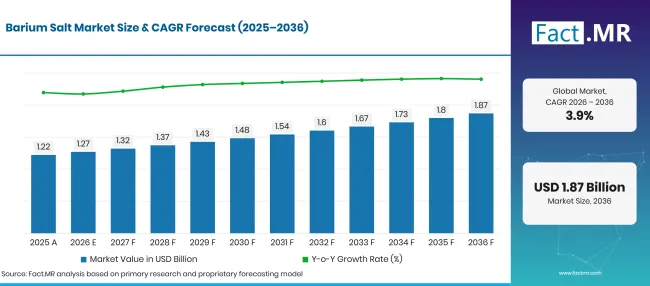
Barium Salt Market Forecast Global | Source: Fact.MR
What are the defining numbers behind Barium Salt Market growth?
The 2026 to 2036 period will add USD 0.6 billion in new value, concentrated in coating fillers and high-purity carbonate for capacitors.
- Demand Drivers in the Market
- Barite is the mineral feed for most barium chemicals, and world output came to about 108.7 million tonnes in 2025, according to the U.S. Geological Survey. Outside drilling fluids, the same survey lists paints, plastics, rubber and brake pads among its filler uses. Converting this ore into refined salts is where chemical producers add value.
- Coating and ink formulators keep buying precipitated barium sulfate because it lifts gloss, density and heat resistance. Sakai Chemical’s October 2025 integrated report describes flake and spherical barium sulfate shaped by its powder processing technology. Grades of this kind let paint makers cut pigment loadings without losing finish quality.
- Vehicle assembly sets the pace for coatings, rubber parts and friction materials that carry barium fillers. Germany built 4,151,800 passenger cars in 2025, a rise of 2% on 2024. Even modest output gains in large producing countries hold demand for automotive filler grades steady.
- Capacitor makers need high-purity barium carbonate as the starting point for barium titanate. Demand for these dielectric parts is rising with AI servers, vehicle electrification and smaller devices, which favors suppliers able to certify trace impurity levels.
- Key Segments Analyzed
- By Product Type: Barium Chloride will hold 28.5% share in 2026 because chemical plants use it as the main feed for other barium compounds.
- By Application: Paints and Coatings will account for 32.1% of 2026 value, as formulators use barium sulfate to raise brightness and film density.
- By End-User Industry: Automotive will take 29.3% in 2026, since vehicle coatings, rubber parts and brake pads all draw on barium fillers.
- Analyst Opinion at Fact.MR
- Shambhu Nath Jha, Principal Consultant at Fact.MR, states, “Barium salts look like a commodity on paper, yet the margin now lies in purity certificates and particle control. A plant able to switch a line from industrial carbonate to capacitor grade will keep its customers through the next electronics cycle. Coating and brake pad buyers will keep tonnage stable, but the growth in value will come from electronics.”
- Strategic Implications
- Manufacturers should invest in classification and washing steps that let one plant switch between industrial and electronic grades of barium carbonate.
- Distributors should hold local stock of chloride and sulfate grades with full safety and REACH documentation, since smaller coating plants buy in short cycles.
- Coating and brake pad buyers should qualify a second barium sulfate source with matched particle size, so that a plant outage does not halt production.
- Investors should look at producers with low-carbon reduction projects, as energy use in kiln processing will weigh on cost and customer audits.
Germany will grow at 5.1%, ahead of every other covered country, because its automotive and coatings plants are close to an established European barium carbonate producer. The United States follows at 4.5%, a gap of 0.6 points that reflects a broad filler market with heavy reliance on imported barite. Japan’s 3.8% trails by a wider 0.7 points, as capacitor materials add value while domestic coatings stay flat. Brazil, at 3.5%, is only 0.3 points behind Japan thanks to rising vehicle output. The United Kingdom closes the range at 3.1%, where weaker vehicle production in 2025 leaves construction coatings as the steadier outlet.
How does the Barium Salt Market break down by segment?
Barium Chloride will lead Product Type at 28.5%; Paints and Coatings will head Application at 32.1%; Automotive will hold End-User Industry at 29.3% in 2026.
Which Product Type leads?
Barium Chloride holds 28.5% of 2026 sales.
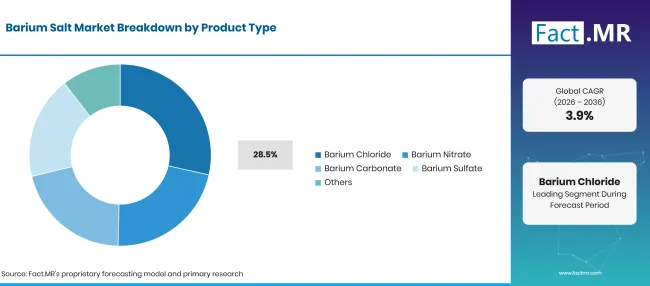
Barium Salt Market Breakdown Product Type | Source: Fact.MR
| Product Type | Share (2026) |
|---|---|
| Barium Chloride (Leading segment) | 28.5% |
| Other segments combined | 71.5%* |
| Total | 100.0% |
Source: Fact.MR analysis. Updated Nov 12, 2026
Chemical producers dissolve barium chloride to precipitate sulfate, carbonate and other compounds, so much of its tonnage never reaches an end user in its own form. Buyers choose between dihydrate crystal and anhydrous grades according to water tolerance in their process. Electronics grade chloride, offered by Guizhou Redstar among others, also feeds specialty precipitation lines where sodium and iron limits are tight. Barium carbonate serves glass, ceramic glazes, bricks and capacitor powders, and its high-purity grades carry the strongest price premium. Barium sulfate covers fillers and pigments, while barium nitrate goes into optical glass and pyrotechnics. Readers tracking the ore side of the chain can follow the barytes supply outlook for feedstock trends.
What supports Paints and Coatings within Application?
Paints and Coatings take 32.1% of 2026 revenue.
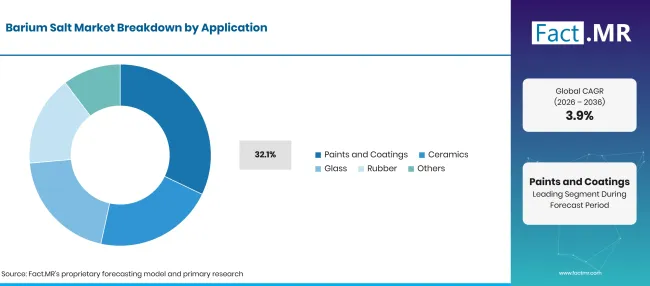
Barium Salt Market Breakdown Application | Source: Fact.MR
| Application | Share (2026) |
|---|---|
| Paints and Coatings (Leading segment) | 32.1% |
| Other segments combined | 67.9%* |
| Total | 100.0% |
Source: Fact.MR analysis. Updated Nov 12, 2026
Formulators of industrial and automotive paints value barium sulfate for its chemical inertness and high density. Fine grades below one micron help with gloss and surface smoothness, while coarser precipitated grades act as low-cost extenders. Sakai Chemical noted in May 2025 that price increases on barium products for paints and inks lifted profit, which shows how coating buyers accept value pricing for consistent quality. Ceramics and glass absorb barium carbonate as a flux and as a way to raise refractive index in optical glass. Rubber compounders use sulfate for weight and abrasion resistance. Cheaper white fillers compete in some uses, and the calcium carbonate filler segment sets a price ceiling for less demanding paints.
How does End-User Industry shape demand?
Automotive accounts for 29.3% of 2026 value.
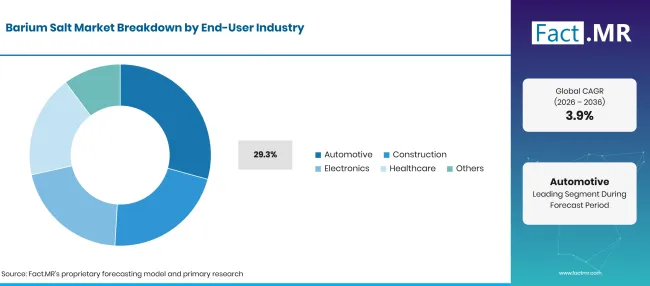
Barium Salt Market Breakdown End User Industry | Source: Fact.MR
| End-User Industry | Share (2026) |
|---|---|
| Automotive (Leading segment) | 29.3% |
| Other segments combined | 70.7%* |
| Total | 100.0% |
Source: Fact.MR analysis. Updated Nov 12, 2026
Vehicle plants consume barium salts indirectly through primers, topcoats, rubber seals, plastic trim and brake pads. A full year of German automotive production ended 1.7% below 2024, according to the federal statistics office, while all of German industry slipped 1.1%. That mix shows why filler suppliers watch vehicle output closely even when car counts hold up. Construction buys barium sulfate in paints and in radiation-shielding concrete, while electronics takes carbonate for dielectric and electroceramic components. Healthcare remains a smaller outlet built on pharmacopoeia-grade sulfate for X-ray contrast media. Other industries include pyrotechnics, catalysts and water treatment.
What is accelerating Barium Salt Market adoption, and what is holding it back?
Steady demand from coatings and vehicle parts gives producers a reliable tonnage base. Growth in capacitors for AI servers and electric vehicles pulls high-purity carbonate into a premium tier. On the other side, energy-heavy kiln processing raises compliance costs in China and Europe, and calcium carbonate or talc can replace barium sulfate in cheaper paints. Contrast media volumes are also softening as some hospitals shift to endoscopy.
Drivers Impact Analysis
| DRIVER | (~) % IMPACT ON CAGR | GEOGRAPHIC RELEVANCE | IMPACT TIMELINE |
|---|---|---|---|
| Functional filler demand in industrial and automotive coatings | +0.9% | Global | Medium term (2-4 years) |
| Glass and ceramic glaze production needs | +0.8% | East Asia, Western Europe | Medium term (2-4 years) |
| Vehicle component and brake pad output | +0.7% | Global | Medium term (2-4 years) |
| Chemical intermediate use of barium chloride | +0.5% | East Asia, North America | Short term (<=2 years) |
| High-purity grades for capacitor dielectrics | +0.4% | East Asia | Long term (>=4 years) |
Source: Fact.MR analysis. Updated Nov 12, 2026
Opportunity Impact Analysis
| OPPORTUNITY | (~) % IMPACT ON CAGR | GEOGRAPHIC RELEVANCE | IMPACT TIMELINE |
|---|---|---|---|
| Capacitor-grade barium carbonate for AI server components | +0.7% | Japan, East Asia | Long term (>=4 years) |
| Fine and shaped barium sulfate for premium coatings and cosmetics | +0.6% | Western Europe, East Asia | Medium term (2-4 years) |
| Custom particle size and purity programs | +0.5% | Global | Medium term (2-4 years) |
| Low-carbon barium carbonate for audited supply chains | +0.4% | Western Europe, North America | Long term (>=4 years) |
Source: Fact.MR analysis. Updated Nov 12, 2026
Restraints Impact Analysis
| RESTRAINT | (~) % IMPACT ON CAGR | GEOGRAPHIC RELEVANCE | IMPACT TIMELINE |
|---|---|---|---|
| Barite feedstock and energy cost swings | -0.7% | Global | Short term (<=2 years) |
| Emission and waste compliance for kiln processing | -0.6% | East Asia, Western Europe | Medium term (2-4 years) |
| Substitution by calcium carbonate and talc in low-cost paints | -0.4% | Global | Medium term (2-4 years) |
| Cyclical demand from vehicle and building markets | -0.3% | Global | Medium term (2-4 years) |
Source: Fact.MR analysis. Updated Nov 12, 2026
Which countries are scaling the Barium Salt Market through 2036?
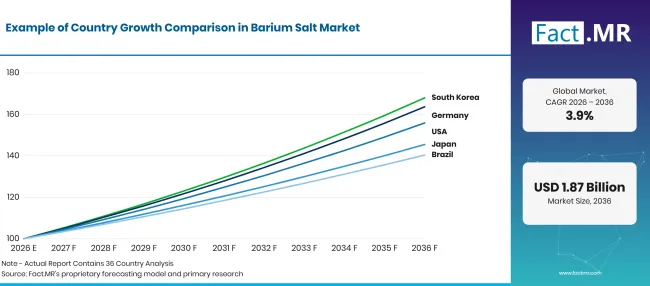
Barium Salt Market Growth Index | Source: Fact.MR
| Country | CAGR (2026 to 2036) |
|---|---|
| Germany | 5.1% |
| United States | 4.5% |
| Japan | 3.8% |
| Brazil | 3.5% |
| United Kingdom | 3.1% |
Source: Fact.MR analysis. Updated Nov 12, 2026
What supports barium salt adoption in Germany?
5.1% CAGR, supported by vehicle coatings demand and an established domestic barium carbonate base.
German carmakers and their paint suppliers form a dense cluster of filler buyers close to Rhine valley chemical plants. Passenger car exports came to 3,174,900 units in 2025, level with the year before, according to the automotive association VDA. Kandelium runs barium and strontium carbonate production at Bad Hönningen, and its May 2025 sustainability report describes trials of biochar and hydrogen as substitutes for petroleum coke in reduction. Local supply shortens lead times for German coaters and glass plants.
What is supporting United States adoption?
4.5% CAGR, backed by a broad filler market and large vehicle output.
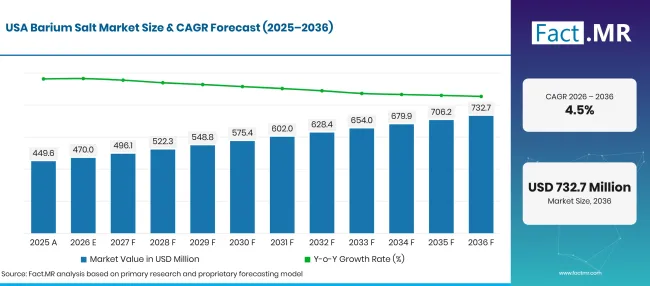
Barium Salt Market Forecast Usa | Source: Fact.MR
The United States assembled 10.24 million motor vehicles in 2025, according to the world automakers’ body OICA. Total construction spending came to USD 2,164.4 billion in 2025, down 1.4% from 2024, which still leaves a large base for architectural paints. More than 90% of barite sold in the country goes into drilling fluids, so chemical converters rely on imported ore and refined salts. Buyers here weigh reliable import logistics as heavily as grade quality.
How is Japan developing demand?
3.8% CAGR, driven by capacitor materials more than by coatings.
Japan produced 8.41 million vehicles in 2025, the OICA review shows, which keeps automotive paint demand in place. The sharper story lies in electronics. In August 2026, Nippon Chemical Industrial announced added barium titanate capacity at its Koriyama plant, lifting supply for AI server capacitors about 1.5 times, including the high-purity barium carbonate used as raw material. Such investments tie Japanese carbonate demand to the dielectric material supply chain.
What supports Brazil’s growth?
3.5% CAGR, helped by higher vehicle output and local paint production.
Brazil produced 2.644 million vehicles in 2025, up 3.5% on 2024, according to the vehicle makers’ association Anfavea. Domestic registrations rose 2.1% to 2.690 million units in the same year. Those gains support coatings, tires and brake pads that use barium sulfate. Most refined barium salts arrive by import, so landed cost and port lead times shape purchasing decisions.
How is the United Kingdom performing?
3.1% CAGR, reflecting softer vehicle output and steadier construction paint use.
SMMT data show the United Kingdom built 764,715 cars and commercial vehicles in 2025, a drop of 15.5% on 2024. Construction output in Great Britain rose 1.8% across 2025, the fifth straight year of annual growth, according to the Office for National Statistics. Architectural and protective coatings therefore carry more of local barium sulfate demand while vehicle plants rebuild volume.
Who leads the Barium Salt Market?
Competition splits into three groups. Japanese specialists, Sakai Chemical Industry and Nippon Chemical Industrial, compete on purity, particle engineering and long qualification ties with capacitor and coating customers.
Sakai’s October 2025 integrated report sets out a push to grow its dielectric materials business in high-end and mid-range capacitor markets. Nippon Chemical Industrial’s 2026 capacity addition links its carbonate output directly to AI server demand. In Europe, Kandelium serves glass, ceramics and ferrite buyers who need short supply routes and lower embedded carbon, a position it is reinforcing through its coke substitution program. A third group of Chinese producers, including Shandong Xinke Environmental Chemical, Yingfengyuan Industrial Group and Guizhou Redstar, competes on scale and cost in chloride, nitrate, carbonate and sulfate. Over the forecast period, the contest will hinge on who can certify capacitor-grade purity at volume while holding down energy and emission costs.
Which companies are the key providers?
Key companies in the Barium Salt Market include Sakai Chemical Industry, Nippon Chemical Industrial, Kandelium, Shandong Xinke Environmental Chemical, Yingfengyuan Industrial Group and Guizhou Redstar.
- Sakai Chemical Industry Co., Ltd.
- Nippon Chemical Industrial Co., Ltd.
- Kandelium GmbH
- Shandong Xinke Environmental Chemical Co., Ltd.
- Yingfengyuan Industrial Group Limited
- Guizhou Redstar Co., Ltd.
Bibliography
- Associação Nacional dos Fabricantes de Veículos Automotores. (2026, January 15). Produção e venda de autoveículos crescem em 2025 e Anfavea projeta nova alta em 2026
- Federal Statistical Office of Germany. (2026, February 6). Production in December 2025: -1.9% on the previous month
- German Association of the Automotive Industry. (2026, January 5). Passenger car production in 2025 slightly above previous year’s level
- International Organization of Motor Vehicle Manufacturers. (2026, April 23). Auto industry growth shifted east in 2025 amid global repositioning
- Kandelium. (2025, May). Tradition meets transformation: Our path to a sustainable company
- Nippon Chemical Industrial Co., Ltd. (2026, August 18). Expansion of barium titanate production capacity
- Office for National Statistics. (2026, February 12). Construction output in Great Britain: December 2025, new orders and Construction Output Price Indices, October to December 2025
- Sakai Chemical Industry Co., Ltd. (2025, May 27). Financial Results Presentation for the Fiscal Year Ended March 31, 2025
- Sakai Chemical Industry Co., Ltd. (2025, October). Sakai Chemical Group Integrated Report 2025
- Society of Motor Manufacturers and Traders. (2026, January 29). Tough year for Auto but new models and Industrial Strategy can deliver growth
- U.S. Census Bureau. (2026, February 27). Monthly Construction Spending, December 2025
- U.S. Geological Survey. (2026, February). Mineral Commodity Summaries 2026: Barite
This Report Answers
- How much value barium salts will add between 2026 and 2036, and which grades will capture it.
- Why barium chloride holds the top product position even though much of it is converted inside chemical plants.
- Where paints and coatings buyers draw the line between barium sulfate and cheaper white fillers.
- What capacitor and AI server demand means for high-purity barium carbonate suppliers.
- How Germany, the United States, Japan, Brazil and the United Kingdom differ in growth and buying patterns.
- Which producer groups compete on purity, on location and on cost.
What does the Barium Salt Market cover?
This study values refined barium compounds at the point of first sale by producers to industrial buyers. Coverage spans barium chloride, nitrate, carbonate and sulfate, along with hydroxide and smaller specialty salts grouped under others.
Value is measured in USD billion at producer prices. Demand is traced through paints and coatings, ceramics, glass and rubber, and then through automotive, construction, electronics and healthcare buyers.
What is included in the scope?
Industrial and high-purity grades of barium carbonate sold to glass, ceramic and capacitor powder makers.
Precipitated and fine barium sulfate used in paints, inks, plastics, rubber and brake pads, including grades close to opacifying pigment ingredients.
Barium chloride and barium nitrate sold as intermediates, glass additives and pyrotechnic ingredients.
Pharmacopoeia-grade barium sulfate sold to contrast media and medical device producers.
What is excluded from the scope?
Crude and ground barite sold for drilling fluids or as unrefined filler.
Strontium compounds made on shared lines, which are tracked in the strontium compounds study.
Finished paints, glass, capacitors and brake pads made by downstream buyers.
Non-barium white fillers such as calcium carbonate, talc and titanium dioxide.
How Was the Analysis Built?
The analysis draws on 120+ sources, 35+ company portfolios, 25+ countries, and more than 20 industry interviews.
- Primary Research: Primary research includes discussions with manufacturers, service providers, technology developers, distributors, end users, and subject-matter experts. These conversations examine purchasing priorities, product adoption, operational challenges, approval requirements, competitive positioning, and the factors that influence wider market acceptance.
- Desk Research: Desk research covers government statistics, regulatory publications, company filings, trade data, technical studies, industry associations, standards, public policy, and other authoritative sources. Every source used in the analysis is documented in the bibliography.
- Market Sizing and Forecasting: Market estimates combine historical performance, demand indicators, pricing and volume trends, segment shares, company participation, country-level growth, adoption patterns, investment activity, and barriers to market expansion.
- Data Validation and Update Cycle: Findings are validated by comparing primary interviews with public data, company activity, regulatory changes, trade patterns, and industry developments. Regular updates review new product launches, capacity changes, partnerships, approvals, and shifts in commercial adoption.
Segmentation
What is the report’s scope and coverage?
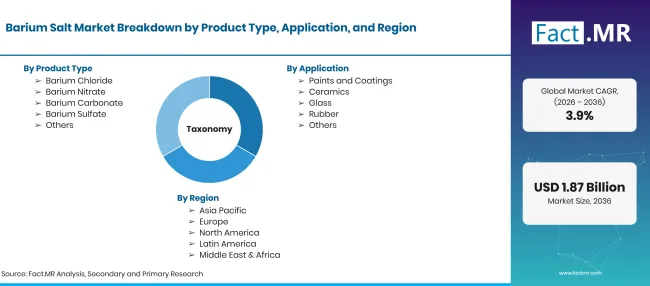
Barium Salt Market Taxonomy 1 | Source: Fact.MR
| Attribute | Details |
|---|---|
| Quantitative Units | USD billion in 2026 to USD billion by 2036 at CAGR |
| Market Definition | Refined inorganic barium compounds sold as chemical intermediates, fillers, pigments and functional raw materials for industrial and specialty uses. |
| Product Type | Barium Chloride; Barium Nitrate; Barium Carbonate; Barium Sulfate; Others |
| Application | Paints and Coatings; Ceramics; Glass; Rubber; Others |
| End-User Industry | Automotive; Construction; Electronics; Healthcare; Others |
| Regions Covered | North America; Latin America; Western Europe; Eastern Europe; East Asia; South Asia & Pacific; Middle East & Africa |
| Countries Covered | Germany; United States; Japan; Brazil; United Kingdom |
| Companies Profiled | Sakai Chemical Industry; Nippon Chemical Industrial; Kandelium; Shandong Xinke Environmental Chemical; Yingfengyuan Industrial Group; Guizhou Redstar |
| Forecast Period | 2026 to 2036 |
| Approach | Grade-level demand mapping across coatings, glass, ceramics, rubber and electronics, cross-checked with vehicle, construction and barite supply statistics. |
Source: Fact.MR analysis. Updated Nov 12, 2026
How is the market segmented?
-
By Product Type
- Barium Chloride
- Barium Nitrate
- Barium Carbonate
- Barium Sulfate
- Others
-
By Application
- Paints and Coatings
- Ceramics
- Glass
- Rubber
- Others
-
By End-User Industry
- Automotive
- Construction
- Electronics
- Healthcare
- Others
-
By Region
- North America
- Latin America
- Western Europe
- Eastern Europe
- East Asia
- South Asia & Pacific
- Middle East & Africa
Frequently Asked Questions
How large is the barium salt market in 2026?
What growth rate will the barium salt market record?
Which product type leads?
Which application leads?
Which end-user industry leads?
Which country will grow quickest?
Who are the main companies?
What holds the market back?
Who worked on this report


Preview the report firsthand - request a free sample
Free SampleGet the brochure for pricing and purchase details
Download PDF