- Market Value (2025): USD 892.5 Mn
- Estimated Value (2026): USD 933.6 Mn
- Forecast Value (2036): USD 1463.7 Mn
- CAGR (2026-2036): 4.6%
What is the Baseball Helmets Market forecast to be worth by 2036?
USD 933.6 million in 2026 to USD 1463.7 million by 2036 at a 4.6% CAGR.
- The Baseball Helmets Market was valued at USD 892.5 million in 2025.
- Baseball helmet sales increase from USD 933.6 million in 2026 to USD 1463.7 million by 2036, covering batting helmets and position-specific protective headgear.
- The 4.6% CAGR from 2026 to 2036 reflects demand from youth leagues, amateur teams and professional equipment users.
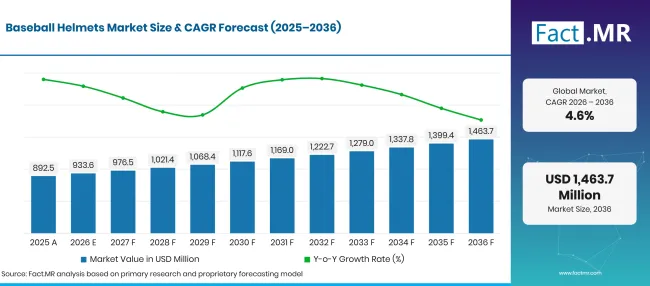
Baseball Helmets Market Forecast Global | Source: Fact.MR
| Year | Basis | Market Value (USD million) |
|---|---|---|
| 2025 | Actual | 892.5 |
| 2026 | Estimate | 933.6 |
| 2036 | Forecast | 1463.7 |
| CAGR 2026 to 2036 | Forecast period | 4.6% |
Source: Fact.MR analysis. Updated Nov 5, 2026
What are the defining numbers behind Baseball Helmets Market growth?
Between 2026 and 2036, baseball helmet sales will add USD 530.1 million, with youth players, batting helmets and recurring team replacement purchases forming important sources of demand.
- Demand Drivers in the Market
- Catchers need head and face protection designed for repeated defensive play, so their equipment is assessed separately from a standard batting helmet. A NOCSAE catcher-helmet specification modified in February 2025 became effective in August 2025 [2].
- Sporting goods stores help families and club managers compare helmets through in-person fitting. A correct head measurement, secure padding and a compatible faceguard are more useful buying criteria than appearance alone, especially when a player is moving into a different size.
- Specialty stores remain useful for trying on baseball helmets before purchase. Store staff can compare head circumference and shell fit while showing players compatible face protection.
- Key Segments Analyzed
- By Product Type: Batting Helmets account for 54.2% of 2026 value as most rostered hitters require head protection at the plate.
- By Material: Polycarbonate represents 38.7% of 2026 value, offering a molded shell option in performance-oriented batting headgear.
- By End-User: Youth players capture 45.0% of 2026 sales through team purchases and parent-funded individual replacements.
- By Distribution Channel: Specialty Sports Stores lead with 42.8% of 2026 revenue as fit advice and product comparison remain important.
- Analyst Opinion at Fact.MR
- Shambhu Nath Jha, Principal Consultant at Fact.MR, states, “Baseball helmet purchasing depends on fit, replacement timing and position-specific protection rather than appearance alone. Teams and families need clear sizing guidance, compatible faceguards and dependable access to approved models before the playing season begins.”
- Strategic Implications
- Helmet manufacturers can publish clear measurement guides and identify compatible guards for each model, helping families and teams select suitable protection with fewer fitting errors.
- Youth league managers need to inspect shells and padding before each season so replacement needs are identified early enough to source the correct sizes.
- Specialty retailers benefit from planning inventory around registration periods and team equipment checks, with enough youth sizes available for in-person fitting.
- Distributors can separate batting and catcher helmets clearly in product listings so club staff can match protective equipment to the correct playing position.
Germany is projected to record 5.3% CAGR through 2036, reflecting established baseball clubs and specialist equipment supply. Brazil follows at 4.8%, where organized youth tournaments contribute to purchasing needs. The United States records 4.4% as school and community participation supports replacement sales. The United Kingdom follows at 3.9%, while Japan posts 3.5% amid mature baseball participation and established equipment practices.
How does the Baseball Helmets Market break down by segment?
Batting Helmets hold 54.2%; Polycarbonate 38.7%; Youth 45.0%; Specialty Sports Stores 42.8% in 2026.
Which Product Type dominates?
Batting Helmets account for 54.2% of 2026 value.
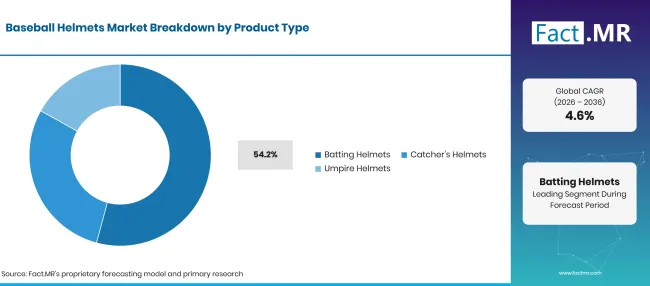
Baseball Helmets Market Breakdown Product Type | Source: Fact.MR
| Product Type | Share (2026) |
|---|---|
| Batting Helmets (Leading segment) | 54.2% |
| Other segments combined | 45.8% |
| Total | 100.0% |
Source: Fact.MR analysis. Updated Nov 5, 2026
Batting helmets are used by players during turns at the plate. Teams often hold shared sizes while families purchase a helmet for individual fit. Catcher’s helmets meet a different need through integrated face protection and specialized construction.
What leads the Material segment?
Polycarbonate leads with 38.7% of 2026 value.
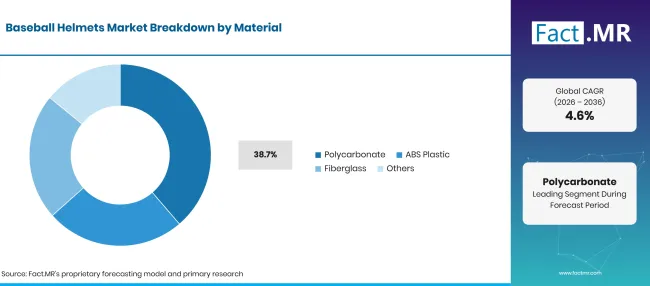
Baseball Helmets Market Breakdown Material | Source: Fact.MR
| Material | Share (2026) |
|---|---|
| Polycarbonate (Leading segment) | 38.7% |
| Other segments combined | 61.3% |
| Total | 100.0% |
Source: Fact.MR analysis. Updated Nov 5, 2026
Polycarbonate supports consistent molded helmet-shell shapes and established manufacturing processes. ABS plastic offers another shell option, while fiberglass appears in more specialized construction. Protective performance depends on the finished helmet design and appropriate testing. Material selection matters to buyers because clubs evaluate the complete protective product.
How does End-User shape demand?
Youth captures 45.0% of 2026 value.
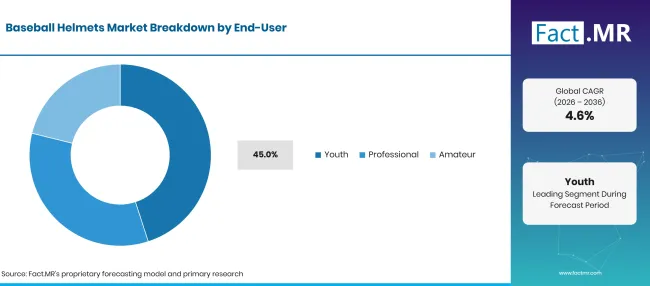
Baseball Helmets Market Breakdown End User | Source: Fact.MR
| End-User | Share (2026) |
|---|---|
| Youth (Leading segment) | 45.0% |
| Other segments combined | 55.0% |
| Total | 100.0% |
Source: Fact.MR analysis. Updated Nov 5, 2026
Youth baseball creates helmet purchases as players change sizes or join organized teams. Parents consider comfort and fit alongside helmet markings required by their league. A school equipment manager may compare personal ownership with shared inventory.
Which Distribution Channel holds the largest share?
Specialty Sports Stores represent 42.8% of 2026 value.
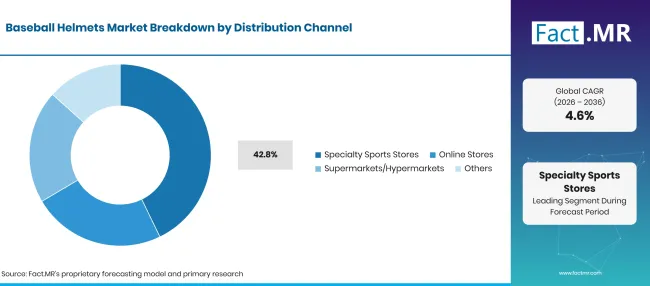
Baseball Helmets Market Breakdown Distribution Channel | Source: Fact.MR
| Distribution Channel | Share (2026) |
|---|---|
| Specialty Sports Stores (Leading segment) | 42.8% |
| Other segments combined | 57.2% |
| Total | 100.0% |
Source: Fact.MR analysis. Updated Nov 5, 2026
Specialty sports stores offer a setting where players can check fit before purchasing a baseball helmet. Staff can explain model-specific faceguard compatibility and help coaches assemble sets of common sizes. Online stores are convenient for repeat purchases once the product and size are known.
What is accelerating Baseball Helmets Market adoption, and what is holding it back?
Youth-team demand and routine equipment inspections support helmet purchases. Team budgets, fitting requirements and the time needed to obtain approved replacements influence when clubs place orders.
Drivers Impact Analysis
| DRIVER | (~) % IMPACT ON CAGR | GEOGRAPHIC RELEVANCE | IMPACT TIMELINE |
|---|---|---|---|
| Youth league purchases | +1.1% | North America, Japan | Short term |
| Replacement and safety inspections | +0.9% | North America, Europe | Short term |
| Player-specific fit and guards | +0.7% | Global | Medium term |
| Catcher headgear specialization | +0.6% | Global | Medium term |
| Organized club competition | +0.4% | Europe, Latin America | Long term |
Source: Fact.MR analysis. Updated Nov 5, 2026
Opportunity Impact Analysis
| OPPORTUNITY | (~) % IMPACT ON CAGR | GEOGRAPHIC RELEVANCE | IMPACT TIMELINE |
|---|---|---|---|
| Correct-fit youth collections | +0.6% | North America, Europe | Medium term |
| Compatible faceguard upgrades | +0.5% | Global | Medium term |
| Team ordering and restocking | +0.4% | North America, Japan | Short term |
| Club-level online retail | +0.3% | Global | Long term |
Source: Fact.MR analysis. Updated Nov 5, 2026
Restraints Impact Analysis
| RESTRAINT | (~) % IMPACT ON CAGR | GEOGRAPHIC RELEVANCE | IMPACT TIMELINE |
|---|---|---|---|
| Price sensitivity for team orders | -0.6% | Global | Short term |
| Sizing and online return friction | -0.5% | Global | Short term |
| Certification and testing expense | -0.4% | North America, Europe | Medium term |
| Small league scale in some countries | -0.3% | Europe, Latin America | Long term |
Source: Fact.MR analysis. Updated Nov 5, 2026
Which countries are scaling the Baseball Helmets Market through 2036?
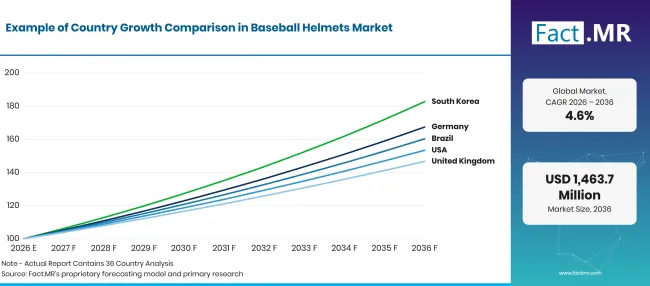
Baseball Helmets Market Growth Index | Source: Fact.MR
| Country | CAGR (2026 to 2036) |
|---|---|
| Germany | 5.3% |
| Brazil | 4.8% |
| USA | 4.4% |
| UK | 3.9% |
| Japan | 3.5% |
Source: Fact.MR analysis. Updated Nov 5, 2026
What supports Germany’s baseball helmet purchases?
5.3% CAGR, linked to club competition and specialist equipment demand.
Germany’s organized baseball clubs buy batting helmets for hitters and separate protection for catchers. The WBSC Europe 2025 competition schedule included German clubs in the European Champions Cup [6]. Competition schedules help teams plan equipment checks and arrange suitable sizes before travel.
How is Brazil developing baseball helmet demand?
4.8% CAGR, connected to organized youth and adult competition.
Brazil differs from larger baseball markets because demand is concentrated around regional competitions, youth development programs and specialist club purchases rather than a broad nationwide player base. Import availability also has a stronger influence on product choice, while clubs must balance limited equipment budgets with seasonal replacement needs and player sizing.
What supports USA baseball helmet replacement demand?
4.4% CAGR, tied to school teams and recurring helmet checks.
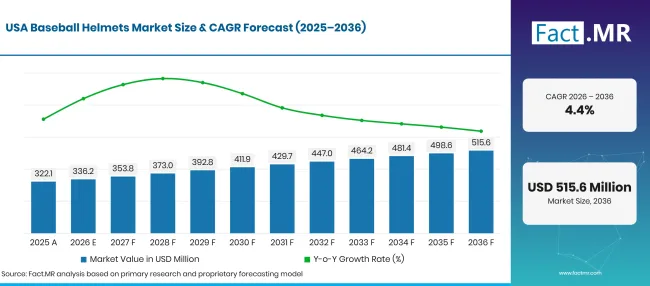
Baseball Helmets Market Forecast Usa | Source: Fact.MR
High school teams form a sizable customer group for baseball helmets in the United States. The NFHS recorded 472,598 boys' high school baseball participants for 2024–25 in its September 2025 release [1]. Coaches review helmet condition and roster sizes ahead of the next competition period.
How does the UK baseball helmet market develop?
3.9% CAGR, reflecting targeted club and youth activities.
British baseball clubs buy protective equipment around planned league schedules and player registrations. BaseballSoftballUK announced a five-team National Baseball League for 2025 in April that year [3]. UK Sport's October 2026 funding schedule included a GBP 700,000 award for baseball and softball under the Los Angeles 2028 New Sport category [4]. This is high-performance sport funding rather than a direct measure of club helmet purchases.
How is Japan maintaining baseball helmet demand?
3.5% CAGR, linked to established competitive playing standards.
Japan’s established baseball culture supports specialist equipment orders for schools and clubs. The World Baseball Softball Confederation announced in September 2025 that the U-18 Baseball World Cup would be held in Okinawa with 12 teams [5]. Competition expectations encourage regular fitting and inventory reviews.
Who leads the Baseball Helmets Market?
Competition in baseball head protection centers on correct fit and the range of approved helmet models. Rawlings and Easton offer batting helmets, while EvoShield supplies protective baseball equipment.
Mizuno and Marucci serve baseball customers through branded headgear lines. All-Star has a clear role in catcher protection. Company positioning depends on verified products and dependable retail supply rather than unsupported claims of sales leadership.
Which companies are the key providers?
Companies and brands profiled include Rawlings; Easton Diamond Sports; EvoShield; Mizuno; All-Star; and Marucci.
- Rawlings
- Easton Diamond Sports
- EvoShield
- Mizuno
- All-Star
- Marucci
Bibliography
- [1] National Federation of State High School Associations. (2025, September 9). Participation in high school sports hits record high with sizable increase in 2024-25.
- [2] National Operating Committee on Standards for Athletic Equipment. (2025, February). Standard performance specification for newly manufactured baseball/softball catcher’s helmets with faceguard (ND024–24m25).
- [3] BaseballSoftballUK. (2025, April 2). Watch the entire 2025 BBF NBL season on BSUK-TV – FREE!
- [4] UK Sport. (2026, October). Current funding awards.
- [5] World Baseball Softball Confederation. (2025, September 2). Worldwide TV coverage for the WBSC U-18 Baseball World Cup 2025.
- [6] World Baseball Softball Confederation Europe. (2025, February 1). WBSC Europe Baseball Competitions 2025: Information to national federations by the WBSC Europe Baseball Commission.
This Report Answers
- The report explains how batting, catcher and umpire helmets differ in required coverage and buying patterns.
- Material analysis compares polycarbonate with ABS plastic and fiberglass without treating shell material as a complete safety rating.
- End-user analysis examines youth purchasing alongside professional and amateur equipment replacement.
- Country analysis reviews differences in club organization and access to baseball helmet specialists.
- Competitive analysis focuses on helmet and catcher equipment products supported by manufacturer information.
What does the Baseball Helmets Market cover?
The market covers protective helmets intended for baseball batting, catching and officiating use. Value is assessed for helmet products sold through retail and organized sporting equipment channels. Batting helmets used by individuals and clubs form the central category. Catcher headgear includes helmet systems designed for face protection as part of a complete assembly. The wider category is discussed alongside baseball equipment in related product analysis.
What is included in the scope?
The scope includes new batting helmets and catcher helmets sold for baseball use.
It also includes umpire protective headgear within the defined product category. Purchases are tracked across youth, professional and amateur users. Distribution covers specialist sporting goods stores and online retailers, together with other relevant retail outlets. The wider category is discussed alongside sport protection equipment in related product analysis.
What is excluded from the scope?
Revenue covers baseball batting helmets and protective headgear for catchers and umpires.
The boundary excludes bats, gloves, balls, separate chest protectors and leg guards. Equipment designed solely for cycling or other sports belongs outside the baseball helmet category.
How Was the Analysis Built?
The analysis draws on 120+ sources, 35+ company portfolios, 25+ countries, and more than 20 industry interviews.
- Primary Research: Primary research includes discussions with manufacturers, service providers, technology developers, distributors, end users, and subject-matter experts. These conversations examine purchasing priorities, product adoption, operational challenges, approval requirements, competitive positioning, and the factors that influence wider market acceptance.
- Desk Research: Desk research covers government statistics, regulatory publications, company filings, trade data, technical studies, industry associations, standards, public policy, and other authoritative sources. Every source used in the analysis is documented in the bibliography.
- Market Sizing and Forecasting: Market estimates combine historical performance, demand indicators, pricing and volume trends, segment shares, company participation, country-level growth, adoption patterns, investment activity, and barriers to market expansion.
- Data Validation and Update Cycle: Findings are validated by comparing primary interviews with public data, company activity, regulatory changes, trade patterns, and industry developments. Regular updates review new product launches, capacity changes, partnerships, approvals, and shifts in commercial adoption.
Segmentation
What is the report’s scope and coverage?
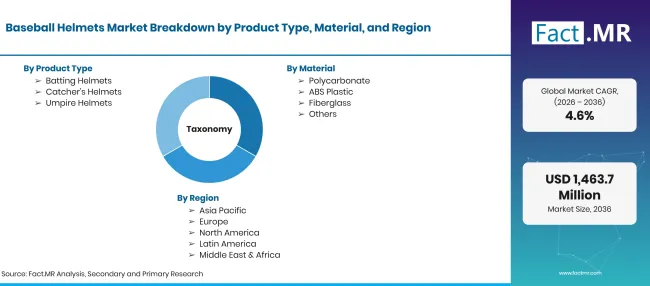
Baseball Helmets Market Taxonomy | Source: Fact.MR
| Attribute | Details |
|---|---|
| Quantitative Units | USD million |
| Market Definition | Baseball batting, catcher and umpire protective helmets sold to players, teams and distributors. |
| Product Type | Batting Helmets; Catcher’s Helmets; Umpire Helmets |
| Material | Polycarbonate; ABS Plastic; Fiberglass; Others |
| End-User | Youth; Professional; Amateur |
| Distribution Channel | Specialty Sports Stores; Online Stores; Supermarkets/Hypermarkets; Others |
| Regions Covered | North America; Latin America; Western Europe; Eastern Europe; East Asia; South Asia & Pacific; Middle East & Africa |
| Countries Covered | Germany; Brazil; USA; UK; Japan |
| Companies Profiled | Rawlings; Easton Diamond Sports; EvoShield; Mizuno; All-Star; Marucci |
| Forecast Period | 2026 to 2036 |
| Approach | Product-level helmet category analysis, participation evidence, certification rules, and channel review |
Source: Fact.MR analysis. Updated Nov 5, 2026
How is the market segmented?
-
By Product Type
- Batting Helmets
- Catcher’s Helmets
- Umpire Helmets
-
By Material
- Polycarbonate
- ABS Plastic
- Fiberglass
- Others
-
By End-User
- Youth
- Professional
- Amateur
-
By Distribution Channel
- Specialty Sports Stores
- Online Stores
- Supermarkets/Hypermarkets
- Others
-
By Region
- North America
- Latin America
- Western Europe
- Eastern Europe
- East Asia
- South Asia & Pacific
- Middle East & Africa
Frequently Asked Questions
How big is the baseball helmets market in 2026?
What is the CAGR of the baseball helmets market from 2026 to 2036?
Which product type accounts for the largest market share?
Which material holds the largest share?
Which end-user group accounts for the largest share?
Which companies are profiled in the market?
Who worked on this report


Preview the report firsthand - request a free sample
Free SampleGet the brochure for pricing and purchase details
Download PDF