- Base Value(2025): 127.2 Mn
- Forecast Value (2035): 225.7 Mn
- CAGR (2035): 6.8%
Aero Helmets Market Outlook 2025 to 2035
The global aero helmets market is expected to reach USD 225.7 million by 2035, up from USD 127.2 million in 2025. During the forecast period 2025 to 2035, the industry is projected to expand at a CAGR of 5.9%.
The market behind aero helmets is associated with the increased popularity of cycling rides, triathlons, and professional racing, where aerodynamic and performance are critical. Raising awareness about the safety of the rider, lightweight materials, and other technologies of ventilation increase comfort and alleviate fatigue. Smart integration as impact sensors, connectivity, and others are also another source of demand. The increasing fitness patterns, commuting and competitive sports cycling are driving ownership across the professional, amateur and recreational cycling divisions.
Quick Stats for Aero Helmets Market
- Industry Value (2025): USD 127.2 million
- Projected Value (2035): USD 225.7 million
- Forecast CAGR (2025 to 2035): 5.9%
- Leading Segment (2025): Aero Road Helmets (40.2% Market Share)
- Fastest Growing Country (2025-2035): China (7.9% CAGR)
- Top Key Players: PuttView, Foresight Sports, TruGolf, Callaway Golf, Golf VX, vGolf, and Tempo Golf Club
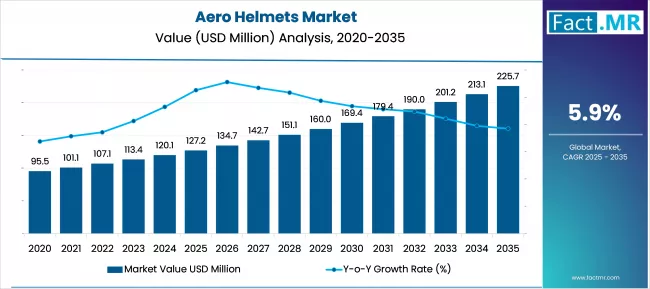
Aero Helmets Market Market Value Analysis | Source: Fact.MR
What are the drivers of the Aero Helmets Market?
Aero helmets industry is growing as the companies target on improving the performance, safety and comfort of cyclists by developing superior aerodynamic designs and lightweight technologies. The rise in interest in competitive cycling, triathlons and recreational riding, as well as the development in awareness on head protection, stimulates growth.
New features like built-in smart sensors, the vent system, and connectivity offer real-time performance information, impact information, and efficiency during a ride. The latter trends towards increased fitness and outdoor sport, commuting to work in cities and the need for technologically enhanced sports equipment further contribute to the adoption. Also, the tailored designs, ergonomic fittings, and training applications based on data are still contributing to expansion of the global markets.
What are the regional trends of the Aero Helmets Market?
The aero helmets market exhibits different growth rates in the regions which is catalyzed by the culture of cycling, sports infrastructures and adoption of technology.
The demand of high-performance, aerodynamic, and smart-connected helmets is highest in North America among the professional and recreational bikers. In Western
Europe, the focus is on light and environmentally friendly and safety-compliant designs that follow rigid laws.
In Asia Pacific, such countries as China, Japan, and India are quickly implementing high-quality aero helmets because of rising rates of cycling events, urban commuting and competition sports academies.
Latin America has moderate growth with the desire to recreational cycling as well as Middle East and Africa are targeting the safety and performance type of helmets to advance cycling programs and infrastructure development.
What are the challenges and restraining factors of the Aero Helmets Market?
The aero helmets market is associated with a number of challenges that can limit the growth. The ease of entry enables small players to manufacture low quality helmets that impact the trust of the consumers and their level of safety. Amateur cyclists may be discouraged by high prices of the more advanced aero helmets and the price of smart features or maintenance.
Disproportional adoption is caused by the differences in cycling infrastructure, rider skills, and safety benefit awareness. Global safety, environmental and quality standards are very strict and have to be followed by the manufacturers. Other limitations are the disjointed supply chains, poor interoperability of smart helmet functions, absence of technical expertise among consumers, and poor after sales services in the developing world.
Country-Wise Insights
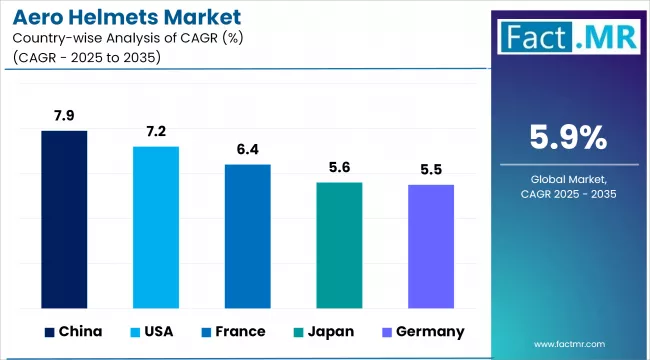
Aero Helmets Market Cagr Analysis By Country | Source: Fact.MR
High demand in United States for smart, aerodynamic helmets
U.S. enjoys overwhelming presence in the Aero Helmets market because many professional and triathlon cyclists, and recreational riders focus on safety and performance. Fully developed cycling structures, competition cycling, and urban commuting patterns trigger the need of using high-tech aerodynamic helmets.
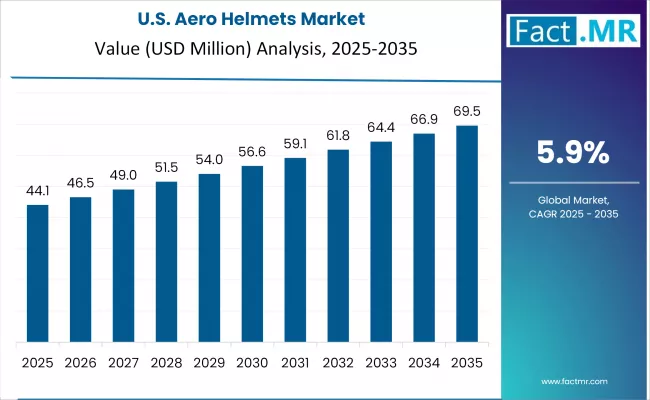
Aero Helmets Market Country Value Analysis | Source: Fact.MR
The integration of smart sensors, impact sensors, and connection capabilities in helmets is gaining popularity among the technological riders. The distribution channels are actively developed, and new designs in accordance with comfort and ventilation and safety are introduced by major international and domestic manufacturers.
The U.S. presents a significant growth option in the world due to an increase in fitness consciousness, involvement in endurance activities and a high consumption power.
Strong safety regulations in Germany drive high-quality helmet adoption
In Europe, Germany is a major market in terms of aero helmet and this is backed by a high cycling culture, safety laws, and technological production abilities. Bike riding contests, urban commuting, and recreational cycling are some of the activities that have led to high demand of lightweight, aerodynamic, and impact-resistant helmets.
German consumers value quality, adherence to the EU standards of safety, and green materials. Intelligent functions of smart helmets: tracking performance, control of ventilation, and the possibility of connection become increasingly common.
Well-established distribution networks, cycling clubs and professional training programs are beneficial to the market. The high level of safety awareness, continuous innovation and the position of the country in the European cycling market keeps Germany strong.
Rapid growth in Japan fueled by tech-savvy cyclists
The market of Aero Helmets in Japan is increasing at high rates, which is due to the increased popularity of cycling sport, triathlon and urban commuting. Helmets, which are aerodynamically designed, have optimized ventilation and in-built smart features, are being taken by professional and amateur cyclists in large numbers. Market growth is facilitated by cycling academies, recreational clubs, and sports programs of the city.
Safety, comfort, and performance data monitoring are appreciated by consumers, which motivates manufacturers to develop connected helmets, lightweight materials, and ergonomic design. The high technological uptake in Japan, the structured distribution channels and government efforts in encouraging cycling infrastructure enhance the growth of the market. Growing enthusiasm towards fitness, endurance sporting activities and leisurely cycling is driving the demand in the country.
Category-Wise Analysis
Lightweight, aerodynamic helmets enhance performance for competitive cyclists
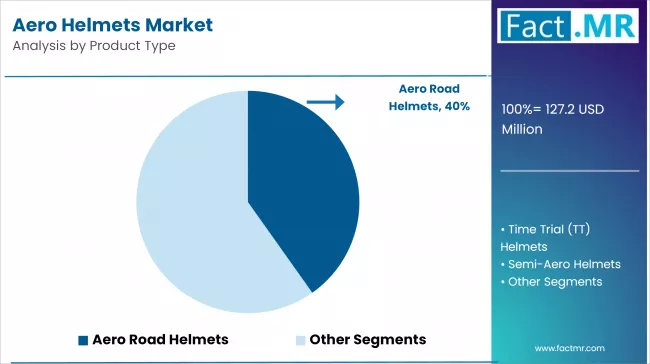
Aero Helmets Market Analysis By Product Type | Source: Fact.MR
Aero road helmets are made with the purposes of competitive bikers and triathletes in effort to get aerodynamic efficiency, lightweight building, and ventilation to decrease drag and enhance execution. They have been popular with professional racing, endurance cycling and recreational road cycling.
To make it more comfortable and safer, manufacturers use the airflow channels for optimization, impact-resistant material and adjustable fits. The cycling competitions, triathlons, and increasing awareness of performance improvement drive the demand. Connectivity and smart sensors that enable real-time performance tracking also increase uptake. Aero road helmets are a high-end product focusing on high performance-based riders around the world.
Durable, affordable helmets suitable for recreational and semi-professional riders
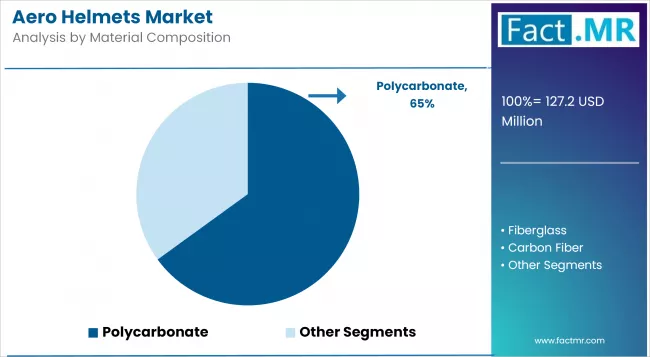
Aero Helmets Market Analysis By Material Composition | Source: Fact.MR
Fiberglass helmets are also a compromise between safety, durability and affordability, which has rendered them popular among the recreational and semi-professional cyclists. The material has adequate impact resistance, yet it is lightweight and it makes the long-distance ride comfortable. Fiberglass helmets have a tendency to have ventilation systems, aerodynamic designs and ergonomic fits as they work better.
They are adopted by those cyclists who want high-quality protection at a premium price and not carbon fiber. These helmets are also provided in many outlets across speciality shops and online platforms and due to their durability and reliability they are practical in everyday commuting, fitness riding and amateur racing to ensure a continuous demand in major markets.
Convenient e-commerce channels boost global helmet sales adoption
The online retailers can be viewed as an important distribution channel of aero helmets providing a great variety of brand names, designs, and intelligent elements at a convenient level with a competitive price. Product comparison, customer opinion, and personal recommendations can be done in detail through e-commerce sites which enhance consumer confidence and purchase rates.
The segment also enjoys the advantage of a global presence, good logistics, and easy access to newer innovations such as connected helmets, smart sensors and aerodynamic designs. Younger and more tech-friendly cyclists are moving towards online sales, which is more convenient, has more options, and is brought to the home. The online retailer segment is further being reinforced by growth in the digital adoption and e-commerce penetration.
Competitive Analysis
Key players in the Aero Helmets Market include Giro, Specialized, Kask, POC Sports, Abus, MET, Oakley Velo Mach, Trek Ballista MIPS, and HJC
The aero helmets market is very competitive and its major players are differentiated by technological advancement, aerodynamic effectiveness and safety of use. The most successful companies, including Specialized, Giro, Oakley, Kask, and Trek aim at high-tech materials, intelligent sensors, optimization of the ventilation, and shock absorbing. Good R&D facilitates better performance monitoring, light designs, and incorporation of connectivity features to be used real-time riding data.
Sports partnerships with professional cycling teams, sports academies and distributors increase market coverage. The supply of material of high quality, ergonomic designs, new safety elements, and trusted after sales services assists the brands in keeping the consumer confidence. This requires continuous innovation and compliance with international safety standards as the primary factors to competitive sustainability.
Recent Development
- In October 2024, Rudy Project released an aerodynamic cycling helmet named The Wing which was the result of a wind tunnel and extensive computational fluid dynamics research with Swiss Side. The helmet is light in in-mold construction and geometry profile that suits a number of rider positions, which makes it comfortable as well as effective in several forms of cycling.
- In March 2024, Giro introduced the Aerohead II MIPS a time trial helmet, which was being designed together with professional cyclist Jonas Vingegaard. It has an oversized Zeiss visor that improves aerodynamic and visibility, and an MIPS Air Node liner that contributes to better rotational impact protection. The first application in competition was the Tirreno-Adriatico and is to be introduced on a global consumer basis in Spring 2026.
Fact.MR has provided detailed information about the price points of key manufacturers of Aero Helmets Market positioned across regions, sales growth, production capacity, and speculative technological expansion, in the recently published report.
Methodology and Industry Tracking Approach
The Aero Helmets Market survey was carried out by the Fact.MR 2025 company contacting 6,200 people in 20 countries among which the number of respondents is at least 120. The two-thirds of the end-users were professional cyclists, triathletes, recreational riders, and cycling clubs, with the others being industry experts like helmet manufacturers, sports technologists, and safety analysts.
The data collection of helmet adoption, aerodynamic performance, and material preference, smart features, price, and market potential were conducted between September 2024 and August 2025. More than 130 secondary sources and analytical techniques, such as regression analysis, trend projection and scenario modelling, were used to come up with detailed market forecasts, segment understanding and regional trends.
With Fact.MR monitoring consumer behavior, product efficacy, industry trends, and market opportunities since 2018, this report is becoming an authoritative source of information that stakeholders can rely on.
Segmentation
Segmentation of Aero Helmets Market
-
By Product Type :
- Time Trial (TT) Helmets
- Aero Road Helmets
- Semi-Aero Helmets
-
By Material Composition :
- Polycarbonate
- Fiberglass
- Carbon Fiber
-
By Distribution Channels :
- Online Retailers
- Specialty Bike Shops
- Sporting Goods Stores
-
By End User :
- Professional Athletes
- Amateur Cyclists
- Commuters
-
By Region :
- North America
- Latin America
- Western Europe
- Eastern Europe
- East Asia
- South Asia & Pacific
- Middle East & Africa
Frequently Asked Questions
What was the global Aero Helmets Market Size Reported by Fact.MR for 2025?
Who are the major players operating in the Aero Helmets Market?
What is the estimated valuation of the Aero Helmets Market in 2035?
What value CAGR did the Aero Helmets Market Exhibit Over the Last Five Years?
Who worked on this report


Preview the report firsthand - request a free sample
Free SampleGet the brochure for pricing and purchase details
Download PDF