- Market Value (2025): USD 11.21 Bn
- Estimated Value (2026): USD 12.2 Bn
- Forecast Value (2036): USD 27.3 Bn
- CAGR (2026-2036): 8.4%
What is the Battery for Inverters Market forecast to be worth by 2036?
USD 12.2 billion in 2026 to USD 27.3 billion by 2036 at an 8.4% CAGR.
- Demand for batteries for inverters was worth USD 11.21 billion in 2025, with replacement of worn tubular units in homes and small shops accounting for a steady part of that spend.
- Revenue will expand from USD 12.2 billion in 2026 to USD 27.3 billion by 2036 as new inverter installations and solar-linked backup systems add to the replacement base.
- An 8.4% CAGR for 2026 to 2036 reflects two engines working at once: recurring lead-acid replacement and a growing switch to lithium-ion packs in new homes and offices.
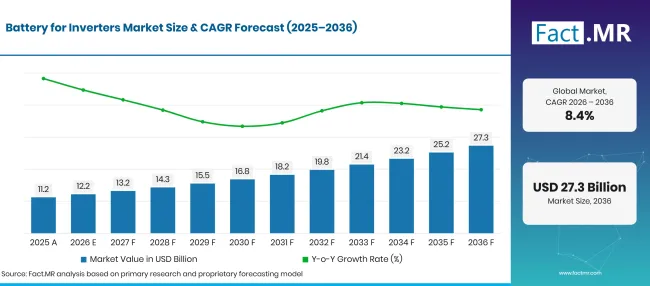
Battery For Inverters Market Forecast Global | Source: Fact.MR
| Year | Basis | Market Value (USD billion) |
|---|---|---|
| 2025 | Actual | 11.2 |
| 2026 | Estimate | 12.2 |
| 2036 | Forecast | 27.3 |
| CAGR 2026 to 2036 | Forecast period | 8.4% |
Source: Fact.MR analysis. Updated Nov 5, 2026
What are the defining numbers behind Battery for Inverters Market growth?
The 2026 to 2036 period will add USD 15.2 billion in new value, with lead-acid replacement and lithium-ion upgrades in residential systems carrying most of the gain.
- Demand Drivers in the Market
- Longer grid outages are turning backup batteries into a planned purchase. U.S. customers averaged about 11 hours without power in 2024, nearly twice the level of a decade earlier, with major storms accounting for 80% of those hours [1].
- Weak local grids keep demand recurring in island and emerging markets. Customers in Puerto Rico averaged 36 hours of interruptions in 2025 even before major events were counted, a rise of 19% on 2024 [2].
- Rooftop solar is pulling batteries into hybrid inverter systems. Households that add panels increasingly want stored energy for evening use and outage cover, which lifts the average battery capacity sold per home.
- Commercial sites need continuity for billing counters, cold storage and network equipment. Shops, clinics and small offices therefore size inverter batteries to keep critical loads running through peak-hour cuts.
- Ageing tubular batteries create a predictable replacement cycle. Units in hot climates and with frequent deep discharges wear out sooner, which keeps dealer counters busy between new installations.
- Key Segments Analyzed
- By Battery Type: Lead Acid will hold 54.2% share in 2026, since tubular designs give households a low entry price and a dealer network that can replace them quickly.
- By Application: Residential will account for 42.1% of 2026 value, as homes depend on inverter batteries to keep lights, routers and refrigerators running during cuts.
- By Power Rating: 1-10 kVA will capture 41.7% in 2026, given that this band matches the load of a typical home or small shop without the cost of larger systems.
- By Sales Channel: Dealers will command 47.5% of 2026 sales, owing to their role in fitting, testing and swapping batteries on site.
- Analyst Opinion at Fact.MR
- Shambhu Nath Jha, Principal Consultant at Fact.MR, states, “Buyers of inverter batteries used to compare price per ampere-hour and little else. Outage length and solar pairing now shape the decision. Lead-acid will keep the replacement market because dealers can stock and swap it within a day. Lithium-ion will gain the new installations where recharge speed and battery management count for more than the upfront price.”
- Strategic Implications
- Battery manufacturers should publish tested cycle life at realistic discharge depths, because buyers now compare total cost over the life of the unit and not only the sticker price.
- Inverter makers should certify compatibility with both tubular lead-acid and lithium-ion packs, so dealers can upgrade customers without changing the whole system.
- Dealers and distributors should build battery testing, exchange and take-back services into each sale, given that replacement buyers return to the outlet that serviced their first unit.
- Investors should track lithium-ion cell localisation and national storage rules, since both will shift cost and demand between chemistries over the forecast period.
Japan will post the quickest expansion at 11.0%, as national battery policy and solar growth push homes and facilities toward stored power. Brazil follows at 10.5% after new storage law created incentives for battery systems. Germany will grow at 10.0% on a fast-growing storage fleet, and the United States at 9.6% reflects storm-driven outages alongside utility storage build-out. The United Kingdom closes the group at 7.2%, where a reliable grid limits pure backup demand and growth leans on home energy upgrades.
How does the Battery for Inverters Market break down by segment?
Lead Acid will lead Battery Type at 54.2%; Residential will head Application at 42.1%; 1-10 kVA will top Power Rating at 41.7%; Dealers will head Sales Channel at 47.5% in 2026.
Which Battery Type leads?
Lead Acid represents 54.2% of 2026 sales.
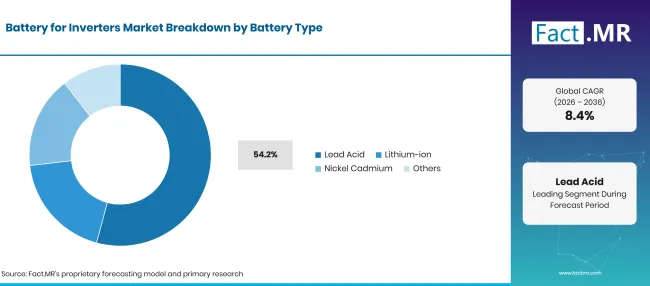
Battery For Inverters Market Breakdown Battery Type | Source: Fact.MR
| Battery Type | Share (2026) |
|---|---|
| Lead Acid (Leading segment) | 54.2% |
| Other segments combined | 45.8%* |
| Total | 100.0% |
Source: Fact.MR analysis. Updated Nov 5, 2026
Price-sensitive households still choose tubular lead-acid units for their low upfront cost and wide fit with existing inverters. These batteries tolerate repeated charging in areas with daily cuts, and local dealers can top up, test and replace them without special tools. Buyers comparing chemistries can review lead acid battery trends for the wider demand picture. Lithium-ion packs are gaining in new installations through compact wall-mounted designs and faster recharge. Japan’s revised battery strategy of June 2026 targets a domestic manufacturing base of 150 GWh per year from 2030 and notes growing storage needs in data centres, medical facilities and disaster prevention [3]. Cell supply trends in the lithium-ion battery sector will shape pricing for these packs, while nickel cadmium and other chemistries serve niche industrial roles.
What supports Residential within Application?
Residential takes 42.1% of 2026 revenue.
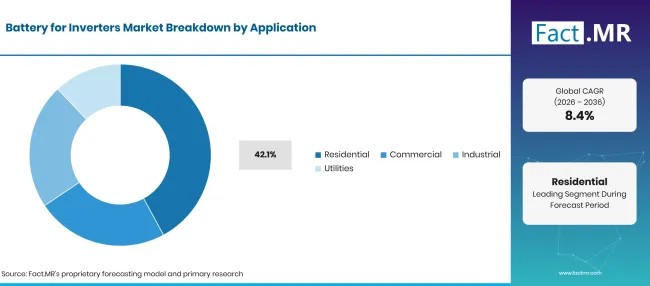
Battery For Inverters Market Breakdown Application | Source: Fact.MR
| Application | Share (2026) |
|---|---|
| Residential (Leading segment) | 42.1% |
| Other segments combined | 57.9%* |
| Total | 100.0% |
Source: Fact.MR analysis. Updated Nov 5, 2026
Homes rely on inverter batteries for the loads that cannot wait: lighting, fans, phone charging and internet routers. Commercial and industrial users often have generators or larger UPS systems as an alternative, so households carry the widest base of inverter battery buyers. Replacement of worn units adds a second, steady stream of home purchases. Home energy upgrades are adding a solar-linked layer to residential demand. The UK’s July 2026 flexibility roadmap states that the Warm Homes Plan aims to upgrade up to 5 million homes with solar panels, batteries and heat pumps [4]. This trend overlaps with the residential energy storage segment, where hybrid inverters handle both solar charging and backup.
What leads the Power Rating segment?
The 1-10 kVA band holds 41.7% of 2026 demand.
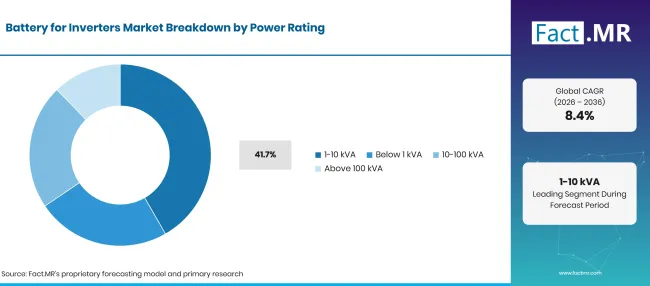
Battery For Inverters Market Breakdown Power Rating | Source: Fact.MR
| Power Rating | Share (2026) |
|---|---|
| 1-10 kVA (Leading segment) | 41.7% |
| Other segments combined | 58.3%* |
| Total | 100.0% |
Source: Fact.MR analysis. Updated Nov 5, 2026
Typical home and small shop loads fall within this band, covering several appliances, lights and a refrigerator at once. Systems below 1 kVA suit only basic lighting, while units above 10 kVA serve factories, hospitals and telecom sites with heavier loads. Battery banks in the 1-10 kVA range increasingly include monitoring and charge control. Integrated battery management systems help lithium-ion packs report state of charge to the inverter, which reduces deep discharge and extends service life.
How does Sales Channel shape demand?
Dealers channel 47.5% of 2026 revenue.
| Sales Channel | Share (2026) |
|---|---|
| Dealers (Leading segment) | 47.5% |
| Other segments combined | 52.5%* |
| Total | 100.0% |
Source: Fact.MR analysis. Updated Nov 5, 2026
Inverter batteries are heavy, need correct sizing and usually arrive with installation, so buyers turn to a local dealer who can test the old unit and fit the new one the same day. Exchange offers on spent lead-acid batteries also bring repeat customers back to the same counter. Online stores help buyers compare warranties and capacities before purchase, though many still finish the sale through a fitter. Direct sales serve commercial and industrial buyers that order larger battery banks under service contracts.
What is accelerating Battery for Inverters Market adoption, and what is holding it back?
Longer outages, rooftop solar and more home appliances are lifting the need for stored backup power. High upfront prices for lithium-ion packs slow the switch in price-sensitive homes. Capacity loss over repeated cycles and stricter rules on collecting spent batteries add cost for buyers and sellers.
Drivers Impact Analysis
| DRIVER | (~) % IMPACT ON CAGR | GEOGRAPHIC RELEVANCE | IMPACT TIMELINE |
|---|---|---|---|
| DRIVER | (~) % IMPACT ON CAGR | GEOGRAPHIC RELEVANCE | IMPACT TIMELINE |
| Longer and more frequent power cuts pushing households to keep backup supply at home | +2.6% | Global | Short term (<=2 years) |
| More homes installing inverters as household electrification spreads | +1.8% | South Asia & Pacific, Latin America, Western Europe | Medium term (2-4 years) |
| Shops, offices and clinics needing uninterrupted electricity | +1.2% | Global | Medium term (2-4 years) |
| Shift toward lithium-ion batteries in compact backup units | +0.8% | East Asia, North America, Western Europe | Long term (>=4 years) |
| Ageing lead-acid inverter batteries reaching end of life and needing replacement | +0.5% | Global | Short term (<=2 years) |
Source: Fact.MR analysis. Updated Nov 5, 2026
Opportunity Impact Analysis
| OPPORTUNITY | (~) % IMPACT ON CAGR | GEOGRAPHIC RELEVANCE | IMPACT TIMELINE |
|---|---|---|---|
| OPPORTUNITY | (~) % IMPACT ON CAGR | GEOGRAPHIC RELEVANCE | IMPACT TIMELINE |
| Longer-life tubular lead-acid batteries with more efficient charging | +0.9% | South Asia & Pacific, Latin America | Medium term (2-4 years) |
| Lithium-ion inverter batteries entering home backup installations | +0.7% | Global | Long term (>=4 years) |
| Inverter and battery sold as one system with built-in battery management | +0.5% | North America, Western Europe, East Asia | Medium term (2-4 years) |
| Solar and inverter battery setups becoming a common hybrid choice | +0.3% | Global | Long term (>=4 years) |
Source: Fact.MR analysis. Updated Nov 5, 2026
Restraints Impact Analysis
| RESTRAINT | (~) % IMPACT ON CAGR | GEOGRAPHIC RELEVANCE | IMPACT TIMELINE |
|---|---|---|---|
| RESTRAINT | (~) % IMPACT ON CAGR | GEOGRAPHIC RELEVANCE | IMPACT TIMELINE |
| High upfront price of lithium-ion inverter batteries | -0.4% | Global | Short term (<=2 years) |
| Capacity loss over repeated cycles leading to costly replacements | -0.3% | Global | Medium term (2-4 years) |
| Few trained technicians and thin after-sales support in remote areas | -0.2% | Emerging markets | Long term (>=4 years) |
| Collection, recycling and disposal rules for spent batteries | -0.1% | Global | Medium term (2-4 years) |
Source: Fact.MR analysis. Updated Nov 5, 2026
Which countries are scaling the Battery for Inverters Market through 2036?
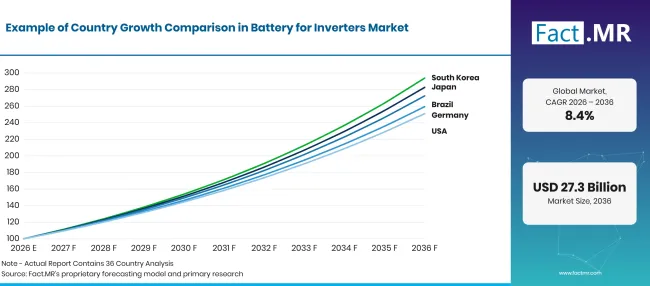
Battery For Inverters Market Growth Index | Source: Fact.MR
| Country | CAGR (2026 to 2036) |
|---|---|
| Japan | 11.0% |
| Brazil | 10.5% |
| Germany | 10.0% |
| United States | 9.6% |
| United Kingdom | 7.2% |
Source: Fact.MR analysis. Updated Nov 5, 2026
What supports adoption in Japan?
11.0% CAGR, driven by national battery policy and a rising share of solar power.
Japan is pairing industrial battery policy with a larger solar fleet. The Agency for Natural Resources and Energy projects solar at 23% to 29% of the FY2040 power mix, up from 9.8% in FY2023, and plans storage battery development to balance that output [5]. The revised battery strategy also links new storage demand to data centres and disaster prevention [3]. Homes and facilities facing earthquakes and typhoons will add batteries that keep essential circuits live.
How is Brazil developing demand?
10.5% CAGR, backed by a new legal framework for battery storage.
Brazil’s Law No. 15,269 of 24 November 2025 sets guidelines for regulating electricity storage and creates a tax incentive for battery systems, capped at BRL 1 billion a year from 2026 to 2030 [6]. Solar power led the country’s capacity additions in 2025 with 2,815.84 MW, and ANEEL expects 9.1 GW of total new capacity in 2026 [7]. Distributed solar homes and businesses are a natural market for hybrid inverter batteries.
What supports adoption in Germany?
10.0% CAGR, reflecting fast growth in connected battery storage.
Germany’s storage base is growing well beyond home units. The Federal Network Agency counted 921 operational battery storage facilities at medium voltage and above in 2024, with about 3.2 GWh of storage capacity [8]. Network operators also received 9,710 connection applications for such systems that year [8]. Households with solar panels are adding batteries to raise self-consumption, which brings inverter-linked storage into everyday homes.
What is shaping the United States’ adoption?
9.6% CAGR, as storm outages and storage build-out raise interest in backup power.
Battery capacity is spreading across the U.S. power system. The Energy Information Administration reported 43.6 GW of operating battery storage at the end of 2025, and operators added 8.3 GW in the first half of 2026 [9]. Hurricane-prone states in the South and East see the most demand for home backup, where long outages make inverter batteries and integrated home systems a practical purchase.
How does the United Kingdom perform?
7.2% CAGR, helped by home energy upgrades and a growing storage fleet.
The UK grid is reliable, so demand leans on solar homes and flexibility services more than on pure backup. Grid-scale battery storage capacity reached 7.5 GW in 2025, with a record 2.3 GW energised during the year [4]. Home batteries paired with solar and hybrid inverters will grow as households seek to shift cheap off-peak power into evening use.
Who leads the Battery for Inverters Market?
Competition splits into three groups with different strengths. Exide Industries, Luminous Power Technologies and Amara Raja Energy & Mobility serve the high-volume tubular lead-acid trade. Dealer reach and fast replacement win sales in that group. Luminous showcased inverters and long-lasting batteries in Odisha in April 2026 and is developing a new energy storage plant at Angul [10].
EnerSys and GS Yuasa supply stationary and UPS batteries for commercial and industrial backup, where reliability testing counts most. GS Yuasa announced in August 2026 a 2 GWh per year plant in Ibaraki for domestically produced stationary storage systems [11]. EnerSys reported in October 2026 that a U.S. rental UPS provider chose its lithium-based DataSafe Noir system for mobile event power [12]. LG Energy Solution and Tesla compete in lithium-ion home batteries linked to solar and hybrid inverters. Suppliers able to prove cycle life, pair packs with battery management and keep service vans close to customers will win the buyers who switch chemistries through 2036.
Which companies are the key providers?
Key companies in the Battery for Inverters Market include Exide Industries, Luminous Power Technologies, Amara Raja Energy & Mobility, EnerSys, GS Yuasa, LG Energy Solution and Tesla.
- Exide Industries
- Luminous Power Technologies
- Amara Raja Energy & Mobility
- EnerSys
- GS Yuasa
- LG Energy Solution
- Tesla
Bibliography
- [1] U.S. Energy Information Administration. (2025, December 1). Hurricanes in 2024 led to the most hours without power in the United States in 10 years.
- [2]U.S. Energy Information Administration. (2026, August 10). Duration of power outages in Puerto Rico not caused by major events increased 19% in 2025.
- [3] Ministry of Economy, Trade and Industry. (2026, June 2). "Battery Industry Strategy" Revised as the "Battery and Power Industry Strategy".
- [4] Department for Energy Security and Net Zero. (2026, July 13). Clean flexibility roadmap: July 2026 update (accessible webpage).
- [5] Agency for Natural Resources and Energy. (2026, January 9). A Closer Look at the 7th Strategic Energy Plan Aiming to Substantially Expand Renewable Energy.
- [6] Câmara dos Deputados. (2025, November 24). Lei nº 15.269, de 24 de novembro de 2025.
- [7] Agência Gov. (2026, January 13). ANEEL prevê crescimento de 9,1 GW na matriz elétrica brasileira em 2026.
- [8] Bundesnetzagentur. (2025, November 12). Bundesnetzagentur publishes figures on connection applications and approvals for battery storage for 2024.
- [9] U.S. Energy Information Administration. (2026, August 7). Battery storage capacity averaged 70% growth over the last three years.
- [10] Luminous Power Technologies. (2026, April 8). Luminous Bets Big on Odisha with Investments in Solar and Energy Storage Manufacturing.
- [11] GS Yuasa Corporation. (2026, August 31). GS Yuasa to Establish a Manufacturing Plant in Ibaraki Prefecture for Next-Generation, Domestically Produced Stationary Energy Storage Systems.
- [12] EnerSys. (2026, October 22). EnerSys DataSafe Noir Energy Storage System Selected by UPS Rental Provider for Mobile Event Power Application.
This Report Answers
- How revenue divides between lead-acid, lithium-ion, nickel cadmium and other chemistries.
- Why households form the main application base and which appliance loads drive their purchase.
- What makes the 1-10 kVA band the standard choice for homes and small shops.
- How dealers, online stores and direct sales differ in their role for inverter battery sales and replacement.
- Which of the five profiled countries will grow quickest and what storage policy lies behind each rate.
- Where cycle life, battery management and service coverage will separate the competing supplier groups.
What does the Battery for Inverters Market cover?
This market tracks batteries sold for use with inverters that store energy and release it as backup power when grid supply fails or falls short. Lead-acid, lithium-ion, nickel cadmium and other chemistries form the product base.
Value is measured at the battery level across four applications, four power rating bands and three sales channels. Battery packs sold inside an integrated inverter system are counted for their battery value only.
What is included in the scope?
Tubular lead-acid and sealed maintenance-free batteries marketed for inverter backup.
Lithium-ion packs built for compatible inverters, including solar battery units used with hybrid inverters.
Emerging chemistries such as sodium-ion battery packs once offered for inverter backup.
Battery management components sold as part of a qualifying inverter battery system.
What is excluded from the scope?
Automotive starter batteries and electric vehicle traction batteries.
Grid storage projects that do not serve an inverter-based backup application.
Standalone inverters, solar panels, generators and electrical distribution equipment.
Battery recycling services and independent maintenance charges.
How Was the Analysis Built?
The analysis draws on 120+ sources, 35+ company portfolios, 25+ countries, and more than 20 industry interviews.
- Primary Research: Primary research includes discussions with manufacturers, service providers, technology developers, distributors, end users, and subject-matter experts. These conversations examine purchasing priorities, product adoption, operational challenges, approval requirements, competitive positioning, and the factors that influence wider market acceptance.
- Desk Research: Desk research covers government statistics, regulatory publications, company filings, trade data, technical studies, industry associations, standards, public policy, and other authoritative sources. Every source used in the analysis is documented in the bibliography.
- Market Sizing and Forecasting: Market estimates combine historical performance, demand indicators, pricing and volume trends, segment shares, company participation, country-level growth, adoption patterns, investment activity, and barriers to market expansion.
- Data Validation and Update Cycle: Findings are validated by comparing primary interviews with public data, company activity, regulatory changes, trade patterns, and industry developments. Regular updates review new product launches, capacity changes, partnerships, approvals, and shifts in commercial adoption.
Segmentation
What is the report’s scope and coverage?
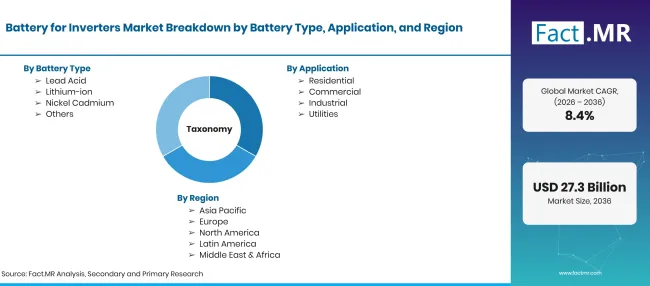
Battery For Inverters Market Taxonomy | Source: Fact.MR
| Attribute | Details |
|---|---|
| Quantitative Units | USD billion |
| Market Definition | Batteries used with inverter systems to store electrical energy and supply backup power during grid interruptions or periods of inadequate supply. |
| Battery Type | Lead Acid; Lithium-ion; Nickel Cadmium; Others |
| Application | Residential; Commercial; Industrial; Utilities |
| Power Rating | Below 1 kVA; 1-10 kVA; 10-100 kVA; Above 100 kVA |
| Sales Channel | Dealers; Online; Direct Sales |
| Regions Covered | North America; Latin America; Western Europe; Eastern Europe; East Asia; South Asia & Pacific; Middle East & Africa |
| Countries Covered | Japan; Brazil; Germany; United States; United Kingdom |
| Companies Profiled | Exide Industries; Luminous Power Technologies; Amara Raja Energy & Mobility; EnerSys; GS Yuasa; LG Energy Solution; Tesla |
| Forecast Period | 2026 to 2036 |
| Approach | Hybrid top-down and bottom-up model built on inverter installations by country, battery chemistry mix, power rating distribution, application demand and sales channel review. |
Source: Fact.MR analysis. Updated Nov 5, 2026
How is the market segmented?
-
By Battery Type
- Lead Acid
- Lithium-ion
- Nickel Cadmium
- Others
-
By Application
- Residential
- Commercial
- Industrial
- Utilities
-
By Power Rating
- Below 1 kVA
- 1-10 kVA
- 10-100 kVA
- Above 100 kVA
-
By Sales Channel
- Dealers
- Online
- Direct Sales
-
By Region
- North America
- Latin America
- Western Europe
- Eastern Europe
- East Asia
- South Asia & Pacific
- Middle East & Africa
Frequently Asked Questions
How large is the battery for inverters market in 2026?
What growth rate will the battery for inverters market record?
Which battery type leads?
Which application leads?
Which power rating leads?
Which sales channel leads?
Which country will grow quickest?
Who are the main companies?
What holds the market back?
Who worked on this report


Preview the report firsthand - request a free sample
Free SampleGet the brochure for pricing and purchase details
Download PDF