- Market Value (2025): USD 543.9 Mn
- Estimated Value (2026): USD 600.0 Mn
- Forecast Value (2036): USD 1600.0 Mn
- CAGR (2026-2036): 10.3%
What is the Battery Slurry Dispersants Market forecast to be worth by 2036?
USD 600.0 million in 2026 to USD 1,600.0 million by 2036 at 10.3% CAGR.
- The Battery Slurry Dispersants Market crossed USD 543.9 million in 2025 as electrode manufacturers widened additive qualification.
- Demand is projected to increase from USD 600.0 million in 2026 to USD 1,600.0 million by 2036.
- The market is forecast to record a 10.3% CAGR through 2036 as approved slurry additives enter repeat cell production.
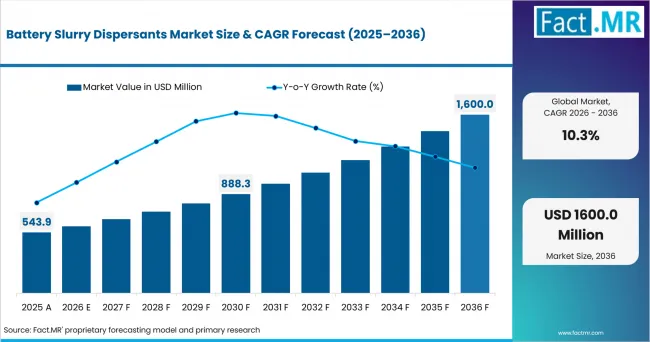
Battery Slurry Dispersants Market Market Value Analysis | Source: Fact.MR
What are the defining numbers behind Battery Slurry Dispersants Market growth?
USD 1,000.0 million absolute opportunity by 2036 led by Cell Manufacturers and NMP-Based systems alongside Anode Slurry.
- Demand Drivers in the Market
- Cell producers are also looking for lower-viscosity slurries that move more easily through coating lines without forcing them to reduce active material content.
- For silicon anodes, controlling particle clumping during mixing is especially important because poor dispersion can quickly lead to inconsistent performance.
- Coating lines also need the slurry to spread evenly across metal current collector so the finished electrode has uniform coverage and fewer defects.
- Key Segments Analyzed
- By Electrode Type: Anode Slurry is likely to lead with a 33.0% share in 2026, reflecting its broad use in lithium-ion battery production and the need for reliable coating behavior.
- By Additive Type: Polymeric Dispersants are expected to make up 31.0% of the market in 2026 because they help keep particles evenly distributed and reduce slurry instability during processing.
- By Solvent System: NMP-Based formulations are set to account for 36.0% share in 2026, supported by their compatibility with commonly used cathode materials and their long-standing role in commercial cell production.
- By Application: EV Cells are projected to hold 32.0% share in 2026 as electric vehicle output rises and battery makers continue to expand manufacturing capacity.
- By End User: Cell Manufacturers are expected to represent 42.0% share in 2026, as many producers prepare slurry in-house and increase electrode output across large-scale battery plants.
- Analyst Opinion at Fact.MR
- Shambhu Nath Jha, Senior Analyst at Fact.MR, states, “battery slurry dispersants are becoming production-enabling additives that can affect viscosity and coating uniformity. Commercial adoption will favor additive manufacturers that provide chemistry-specific formulation guidance.”
- Strategic Implications
- Additive manufacturers need to provide viscosity data across the full range of shear conditions encountered during mixing and coating.
- Electrode developers should check whether the slurry remains evenly dispersed after extended storage, rather than relying only on results recorded immediately after preparation.
- Before switching from an approved additive, cell manufacturers should run coating trials and compare defect rates under the same production conditions.
- Application teams also need to confirm that each additive works properly with the selected binder and conductive carbon system.
- In China, stronger local technical support will be important as demand grows at a 13.9% CAGR and customers require faster help with formulation and production issues.
Battery electrode manufacturing is placing greater emphasis on slurry stability to improve coating quality and cell performance. BASF SE expanded its battery materials portfolio to support advanced lithium-ion battery production.
China is expected to record a 13.9% CAGR through 2036 driven by large-scale lithium-ion battery production and expanding gigafactory capacity. India is projected to post a 12.9% CAGR supported by domestic cell manufacturing projects and government-backed battery production initiatives. Germany is anticipated to advance at an 11.9% CAGR owing to advanced automotive battery development and high-precision electrode manufacturing. Brazil is estimated to record a 10.8% CAGR attributable to growing battery assembly activities and expanding energy storage investments. The United States is forecast to post a 9.8% CAGR reinforced by domestic gigafactory expansion and continued investment in advanced battery manufacturing.
How does the Battery Slurry Dispersants Market break down by segment?
Cell Manufacturers lead end user segment at 42% while NMP-Based systems lead solvent segment at 36% market share.
What supports Electrode Type adoption?
Anode Slurry holds 33% share in 2026.
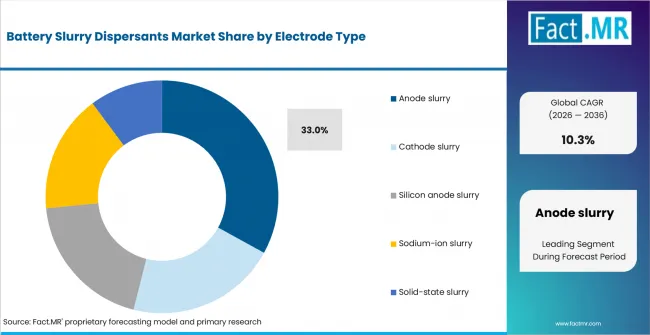
Battery Slurry Dispersants Market Analysis By Electrode Type | Source: Fact.MR
Anode Slurry leads the market because graphite remains the dominant anode material in lithium-ion battery production. Cathode Slurry requires effective dispersion to keep metal oxide particles and conductive carbon evenly distributed. In March 2025, BASF SE expanded U.S. production of its Licity® anode binders to strengthen regional supply for lithium-ion battery manufacturers. The expansion also enables global availability of the Licity portfolio and supports growing demand for battery materials.
Which Additive Type dominates?
Polymeric Dispersant holds 31% share in 2026.
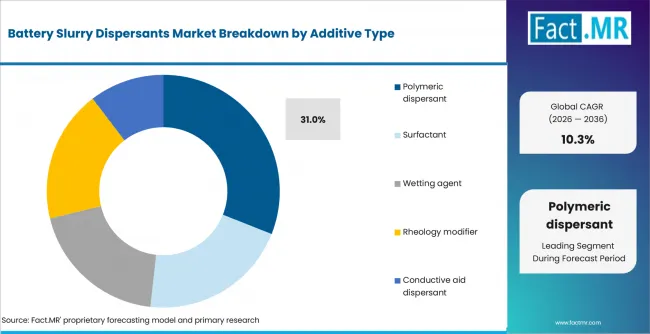
Battery Slurry Dispersants Market Analysis By Additive Type | Source: Fact.MR
Polymeric Dispersants account for the largest share as they keep active material particles evenly dispersed throughout slurry preparation. Surfactants improve wetting by lowering surface tension during mixing. Wetting Agents promote better contact between the slurry and the current collector for more uniform coatings.
What leads the Solvent System segment?
NMP-Based holds 36% share in 2026.
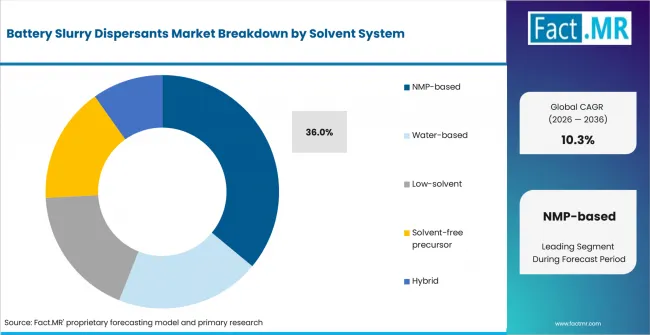
Battery Slurry Dispersants Market Analysis By Solvent System | Source: Fact.MR
NMP-Based systems lead the market as they continue to support established cathode manufacturing processes across commercial battery production. Water-Based systems offer an alternative where lower solvent recovery requirements are a priority. Low-Solvent formulations help reduce drying demand while increasing solid loading. In April 2024, Arkema introduced its INCELLION™ waterborne acrylic solutions for battery electrodes and highlighted materials that support dry-process and solid-state battery manufacturing.
How does Application shape demand?
EV Cells hold 32% share in 2026.
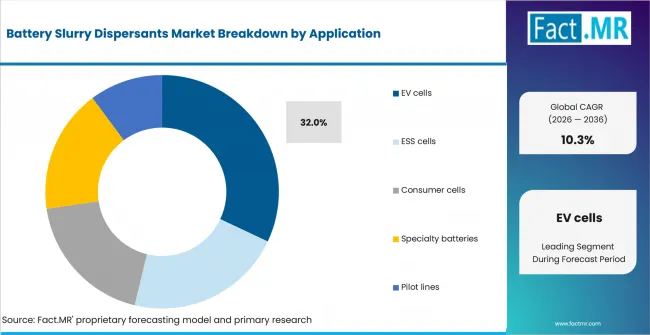
Battery Slurry Dispersants Market Analysis By Application | Source: Fact.MR
EV Cells lead the market as electric vehicle production continues to increase battery manufacturing volumes across major regions. ESS Cells place greater emphasis on long-term electrode stability to support extended operating life. Consumer Cells require fast coating and efficient processing across compact battery formats. In June 2024, BASF showcased battery processing additives that improve slurry preparation and coating efficiency while supporting higher solid-content electrode formulations.
Where is End User demand strongest?
Cell Manufacturers hold 42% share in 2026.
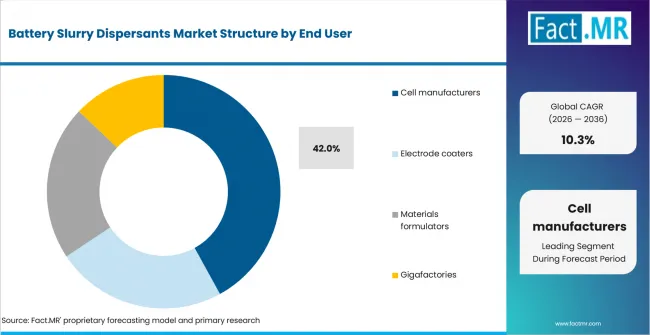
Battery Slurry Dispersants Market Analysis By End User | Source: Fact.MR
Cell Manufacturers account for the largest share as they conduct electrode formulation approval and material qualification before production begins. Electrode Coaters prepare finished coated foils that move directly into cell assembly. In December 2025, BYK stated that effective additive selection is critical for processing LFP, NCM, NCA, graphite, and silicon electrode slurries during battery production scale-up.
What is accelerating Battery Slurry Dispersants Market adoption and what is holding it back?
Higher electrode loading is anticipated to accelerate adoption while formulation sensitivity restrains replacement.
Drivers Impact Analysis
| DRIVER | (~) % IMPACT ON CAGR | GEOGRAPHIC RELEVANCE | IMPACT TIMELINE |
|---|---|---|---|
| Higher slurry solid content | +0.8% | China and Europe | Medium term |
| Silicon anode development | +0.7% | Asia Pacific and North America | Medium term |
| Large-scale electrode coating | +0.6% | Global gigafactories | Short term |
| Water-based cathode processing | +0.5% | Europe and Asia Pacific | Long term |
| Regional application laboratories | +0.4% | Global battery centers | Medium term |
Source: Fact.MR analysis. Updated Jul 14, 2026
- Higher slurry solid content: Greater solid loading can reduce drying demand. Slurry viscosity rises as solvent content falls. Dispersants help retain workable flow.
- Silicon anode development: Silicon particles can aggregate during processing. Their volume change also affects electrode structure. Specialized dispersants improve particle distribution.
- Large-scale coating: Gigafactories use larger slurry batches and wider coating lines. Small formulation variation can affect large production volumes. Stable additives reduce process inconsistency.
- Water-based cathodes: Water-based processing can reduce NMP use. New binders and dispersants are required for cathode materials. Corrosion and moisture sensitivity remain technical concerns.
- Application laboratories: Battery formulations differ across active material systems. Local testing helps reproduce customer mixing conditions. Technical support can shorten qualification work.
Opportunity Impact Analysis
| OPPORTUNITY | (~) % IMPACT ON CAGR | GEOGRAPHIC RELEVANCE | IMPACT TIMELINE |
|---|---|---|---|
| Additives for water-based cathodes | +0.5% | Europe and China | Long term |
| Carbon dispersion packages | +0.4% | Global | Short term |
| High-solid slurry additives | +0.4% | Global gigafactories | Medium term |
| Sodium-ion electrode additives | +0.3% | China and India | Long term |
Source: Fact.MR analysis. Updated Jul 14, 2026
- Silicon-rich anodes: Higher silicon content can increase battery capacity. Silicon also creates difficult dispersion and swelling problems. Tailored polymers can improve slurry stability.
- Water-based cathodes: Battery plants seek lower solvent use. Water-compatible additives can support this transition. Products must avoid metal corrosion and coating defects.
- Carbon packages: Conductive carbon strongly affects slurry viscosity. Dedicated packages can improve carbon distribution. Lower carbon dosage can increase active material content.
- High-solid slurries: Greater solid content can improve plant productivity. Mixing and pumping become more difficult. Advanced dispersants can preserve coating behavior.
- Sodium-ion additives: Sodium-ion production is moving toward commercial scale. New active materials require separate formulation work. Early additive qualification can create long-term customer positions.
Restraints Impact Analysis
| RESTRAINT | (~) % IMPACT ON CAGR | GEOGRAPHIC RELEVANCE | IMPACT TIMELINE |
|---|---|---|---|
| Electrochemical compatibility requirements | -0.5% | Global | Medium term |
| Lengthy cell qualification | -0.4% | Global battery plants | Medium term |
| Sensitivity to additive dosage | -0.3% | Electrode coating centers | Short term |
| Binder compatibility limits | -0.3% | Global | Short term |
| Process differences across cell chemistries | -0.2% | Global | Long term |
Source: Fact.MR analysis. Updated Jul 14, 2026
- Electrochemical compatibility: Additives remain inside the final electrode. Unwanted reactions can reduce cell life. Manufacturers require long cycling tests.
- Lengthy qualification: Slurry improvements do not guarantee finished cell gains. Customers test coating and cell performance. Approval can extend across several development stages.
- Dosage sensitivity: Small additive changes can alter viscosity. Excess material may reduce adhesion or conductivity. Accurate dosing equipment is required.
- Binder compatibility: Dispersants interact with polymer binders. Poor compatibility can create separation or coating defects. Each binder system needs separate testing.
- Chemistry variation: LFP and NCM surfaces behave differently. Graphite and silicon also need different dispersion strategies. One additive may not suit every electrode.
Which countries are scaling Battery Slurry Dispersants Market fastest?
China 13.9%, India 12.9%, Germany 11.9%, Brazil 10.8%, United States 9.8%.
Regional analysis covers North America and Europe. Coverage also includes Asia Pacific and Central and South America. The Middle East and Africa complete the geographic view.
.webp "Top Country Growth Comparison Battery Slurry Dispersants Market Cagr (2026 2036)")
Top Country Growth Comparison Battery Slurry Dispersants Market Cagr (2026 2036) | Source: Fact.MR
| COUNTRY | CAGR |
|---|---|
| China | 13.9% |
| India | 12.9% |
| Germany | 11.9% |
| Brazil | 10.8% |
| United States | 9.8% |
Source: Fact.MR analysis. Updated Jul 14, 2026
What underpins China’s growth?
13.9% CAGR driven by battery cell production and electrode manufacturing.
China continues to expand battery manufacturing through large investments in cell production and electrode processing. This manufacturing scale creates steady demand for advanced slurry additives while giving suppliers opportunities to support local formulation work. Production teams are also adopting new battery chemistries, increasing the need for dispersants that deliver consistent performance across different electrode systems.
What is driving India’s growth through 2036?
12.9% CAGR supported by cell manufacturing investment and electrode localization.
Battery manufacturing in India is gaining momentum as new gigafactories move toward commercial production. Domestic cell projects are creating demand for electrode processing materials while encouraging suppliers to establish local technical support. Cost remains an important consideration, yet manufacturers continue to prioritize coating consistency and reliable slurry performance.
How is Germany scaling demand?
11.9% CAGR supported by battery research and automotive cell development.
Germany has strong battery engineering and chemical manufacturing capabilities. European projects are evaluating lower-solvent electrode processing. Demand is anticipated to advance at an 11.9% CAGR. Additive manufacturers can support pilot and commercial coating lines. German customers require detailed process documentation. Electrochemical compatibility data will influence final approval. Water-based cathode development can create new demand. Silicon-rich anode programs provide another technical route.
What supports the Brazil outlook?
10.8% CAGR driven by regional battery production and industrial electrification.
Brazil has an established vehicle manufacturing sector. Energy storage and electric transport create new cell demand. The market is estimated to register a 10.8% CAGR. Most specialty dispersants may enter through imports during early development. Regional formulation laboratories can support smaller production batches. Local distribution must maintain storage conditions. Brazilian manufacturers may focus on LFP chemistry. This route creates demand for conductive carbon dispersion support.
How is the United States developing demand?
9.8% CAGR supported by domestic battery plants and advanced electrode programs.
The United States is expanding cell and battery material production. New factories require additives for large-scale slurry mixing. The market is forecast to post a 9.8% CAGR through 2036. Local technical laboratories can reduce development time. Silicon anode investment creates specialized formulation needs. Dry electrode research may alter future additive demand.
Who leads the Battery Slurry Dispersants Market?
BYK and Evonik lead through battery-specific wetting and dispersing technologies. BASF and Lubrizol strengthen competition through polymer and specialty additive expertise.
BYK provides additives for cathode and anode slurry preparation. Its battery portfolio addresses active material wetting and particle distribution. Technical seminars also support formulation knowledge. Evonik offers TEGO Surten E process additives for lithium-ion batteries. Its portfolio includes dispersants and wetting agents. P84 polyimide provides binder and dispersant functions.
BASF supplies dispersing and wetting agents for electrode manufacturing. The company also provides Licity battery binders. Its additive products target coating quality and higher slurry solid content. Lubrizol brings polymer dispersant expertise across industrial formulations. Croda contributes surfactant and specialty chemical capabilities. Ashland offers rheology and polymer technologies for complex slurry systems. Competitive positioning through 2036 will reflect electrochemical compatibility and viscosity control. Regional technical support will also affect customer qualification.
Which companies are the key providers?
BYK and Evonik are key providers. BASF and Lubrizol are also profiled. Croda and Ashland complete the company set.
- BYK-Chemie GmbH
- Evonik Industries AG
- BASF SE
- The Lubrizol Corporation
- Ashland Inc.
Bibliography
- . BASF showcases innovative battery recycling and battery materials solutions at The Battery Show Europe 2024.BASF. (2024, June)
- BASF. (2025, March). BASF expands U.S. production capabilities for Licity® anode binders.
- BYK. (2025, December 2). Power up! The role of active materials in electrode slurries [Webinar].
- Arkema. (2024, April 24). Arkema to showcase unique set of technologies for battery solutions at China International Battery Fair (CIBF) 2024.
This Report Addresses
- The report provides strategic intelligence across Electrode Type and Additive Type.
- Segment analysis identifies Cell Manufacturers and NMP-Based systems as major categories.
- Regional assessment examines China and India alongside Germany.
- Brazil and the United States complete the country comparison.
- Competitive analysis profiles BYK and Evonik alongside BASF.
- Process analysis covers viscosity control and particle dispersion.
What does the Battery Slurry Dispersants Market cover?
Polymeric dispersants and wetting agents used within electrode slurries.
The Battery Slurry Dispersants Market covers additives used during battery electrode preparation. These products control particle distribution and slurry flow.
The market differs from general industrial dispersants because battery performance drives the purchase. Products without an electrode-processing function are outside the boundary.
What is included in the scope?
Dispersants used across cathode and anode slurry systems.
The scope includes Polymeric Dispersants and Surfactants. Wetting Agents and Rheology Modifiers are also covered.
NMP-Based and Water-Based processing are included. Low-Solvent and Hybrid systems are covered when additives provide slurry stabilization.
Included revenue covers qualified additives and formulation packages. Application support related to viscosity and coating is reflected within competitive positioning.
What is excluded from the scope?
General-purpose dispersants without battery applications are outside the scope.
The scope excludes electrolyte additives and active electrode materials. Complete binder systems are excluded when no dispersing function is present.
Mixing equipment and coating machinery are not counted. Solvents are also outside the market boundary.
How was the analysis built?
120+ sources and 40+ manufacturer product ranges were reviewed. The assessment also covered 25+ countries and 20+ interviews.
- Primary Research
- Primary research includes discussions with additive manufacturers and electrode engineers. It covers cell producers involved in slurry qualification.
- Input from coating specialists supports commercial assessment. Interviews examine viscosity and particle stability requirements.
- Desk Research
- Desk research reviews official company technical documents. Government battery programs support regional assessment.
- Product data sheets inform additive comparisons. Company announcements identify current electrode processing developments.
- Market-Sizing and Forecasting
- Forecasting uses cell production and electrode coating output. Models consider additive dosage within each slurry batch.
- Segment shares support market allocation. Country forecasts reflect battery manufacturing investment.
- Data Validation and Update Cycle
- Forecasts are tested through industry interviews. Regional estimates are compared with cell production activity.
- Product developments support periodic forecast revisions. Manufacturing expansions also inform competitive analysis.
Segmentation
What is the report’s scope and coverage?
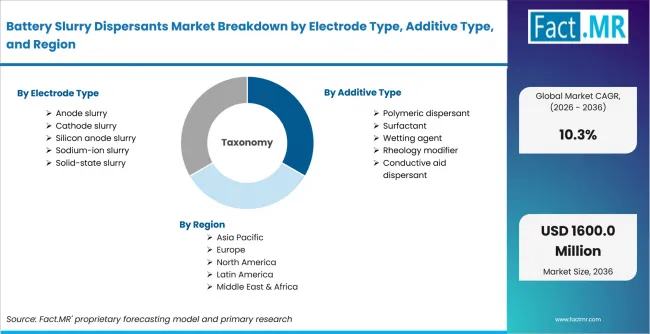
Battery Slurry Dispersants Market Breakdown By Electrode Type, Additive Type, And Region | Source: Fact.MR
| Attribute | Details |
|---|---|
| Quantitative Units | USD Million in 2026 to USD Million by 2036 at CAGR |
| Market Definition | Dispersants and wetting additives used to stabilize active material slurries for electrode coating |
| Electrode Type | Cathode Slurry, Anode Slurry, Silicon Anode Slurry, Sodium-Ion Slurry, Solid-State Slurry |
| Additive Type | Polymeric Dispersant, Surfactant, Wetting Agent, Rheology Modifier, Conductive Aid Dispersant |
| Solvent System | NMP-Based, Water-Based, Low-Solvent, Solvent-Free Precursor, Hybrid |
| Application | EV Cells, ESS Cells, Consumer Cells, Specialty Batteries, Pilot Lines |
| End User | Cell Manufacturers, Electrode Coaters, Materials Formulators, Gigafactories |
| Regions Covered | North America, Europe, Asia Pacific, Central and South America, Middle East and Africa |
| Countries Covered | China, India, Germany, Brazil, United States |
| Key Companies Profiled | BYK-Chemie, Evonik, BASF, Lubrizol, Croda, Ashland |
| Forecast Period | 2026 to 2036 |
| Approach | Hybrid assessment using electrode output and additive adoption alongside formulation qualification |
Source: Fact.MR analysis. Updated Jul 14, 2026
How is the market segmented?
-
By Electrode Type
- Cathode Slurry
- Anode Slurry
- Silicon Anode Slurry
- Sodium-Ion Slurry
- Solid-State Slurry
-
By Additive Type
- Polymeric Dispersant
- Surfactant
- Wetting Agent
- Rheology Modifier
- Conductive Aid Dispersant
-
By Solvent System
- NMP-Based
- Water-Based
- Low-Solvent
- Solvent-Free Precursor
- Hybrid
-
By Application
- EV Cells
- ESS Cells
- Consumer Cells
- Specialty Batteries
- Pilot Lines
-
By End User
- Cell Manufacturers
- Electrode Coaters
- Materials Formulators
- Gigafactories
-
By Region
- North America
- United States
- Canada
- Europe
- Germany
- United Kingdom
- France
- Italy
- Spain
- Asia Pacific
- China
- India
- Japan
- South Korea
- Australia
- Central and South America
- Brazil
- Argentina
- Mexico
- Chile
- Middle East and Africa
- UAE
- Saudi Arabia
- South Africa
- North America
Frequently Asked Questions
Which Electrode Type leads the Battery Slurry Dispersants Market?
Which Additive Type leads the Battery Slurry Dispersants Market?
Which Solvent System leads the Battery Slurry Dispersants Market?
Which Application leads the Battery Slurry Dispersants Market?
Which End User leads the Battery Slurry Dispersants Market?
Which country records the highest CAGR in the Battery Slurry Dispersants Market?
How does India perform in the Battery Slurry Dispersants Market?
How does Germany perform in the Battery Slurry Dispersants Market?
What is the primary driver in the Battery Slurry Dispersants Market?
What is the main restraint in the Battery Slurry Dispersants Market?
Who worked on this report


Preview the report firsthand - request a free sample
Free SampleGet the brochure for pricing and purchase details
Download PDF