- Market Value (2025): USD 253.2 Mn
- Estimated Value (2026): USD 295 Mn
- Forecast Value (2036): USD 1358.6 Mn
- CAGR (2026-2036): 16.5%
What is the battery ground power units market forecast to be worth by 2036?
USD 295 million in 2026 to USD 1,358.6 million by 2036, at 16.5% CAGR.
- The battery ground power units market surpassed a valuation of USD 253.2 million in 2025. Demand is expected to increase from USD 295 million in 2026 to USD 1,358.6 million by 2036.
- The market is forecast to record 16.5% CAGR from 2026 to 2036 as airports replace diesel GPUs with battery-powered units and charging-ready ground power systems.
- Battery GPUs also support airport operation workflows when cleaner aircraft power improves gate turnaround planning.
- ITW GSE reported in 2024 that dnata added 14 electric GPUs at Dubai International Airport, replacing diesel-powered equipment and reducing fuel consumption. [1]
- This supports the market boundary because battery GPUs are moving from niche use to operational fleet deployment. Battery ground power planning also connects with air start unit replacement cycles when airports modernize aircraft support equipment around lower-emission ramp operations.
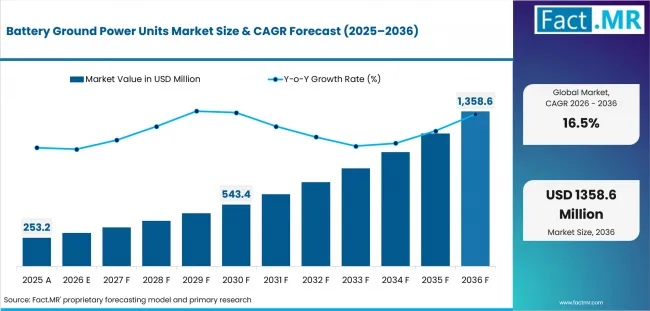
Battery Ground Power Units Market Market Value Analysis | Source: Fact.MR
What are the defining numbers behind battery ground power units market growth?
USD 1,063.6 million absolute opportunity by 2036, led by lithium-ion GPUs, mobile towable units and narrowbody gate power.
- Demand Drivers in the Market
- Airports need low-emission ground power that reduces diesel use at gates and stands.
- Airlines need stable aircraft power that cuts APU use during turnaround.
- Ground handlers need mobile GPUs that fit shift patterns without long idle time.
- MRO facilities need quiet aircraft power for hangar and apron checks.
- Key Segments Analyzed
- By Battery Chemistry: Lithium-ion is expected to hold 46.0% share in 2026 because it supports higher energy density and repeat use.
- By Mobility: Mobile towable GPUs lead because they fit mixed gate and remote stand operations. The segment is projected to capture 38.0% share in 2026.
- By Power Output: Combination AC/DC units are likely to account for 34.0% share in 2026 because airports need flexible aircraft coverage.
- By Application: Narrowbody gates are expected to hold 36.0% share in 2026 because single-aisle aircraft create high GPU utilization.
- By Buyer Type: Ground handlers are projected to record 35.0% share in 2026 because they operate the GPU fleet daily.
- Analyst Opinion at Fact.MR
- Shambhu Nath Jha, Senior Analyst at Fact.MR, states, “Battery ground power units are becoming a practical decarbonization tool for airports. The market will grow where suppliers prove runtime, aircraft compatibility and charging support under real ramp conditions. Products that reduce diesel use without slowing turnaround will gain the strongest buyer confidence.”
- Strategic Implications
- GPU suppliers should prove battery runtime across gate, stand and hangar use cases.
- Airports should align battery GPU adoption with airside charging capacity.
- Ground handlers should compare diesel replacement using real shift duty cycles.
- MRO facilities should prioritize quieter battery GPUs for indoor and night operations.
The United States is projected to record 17.8% CAGR through 2036 as large airports and FBOs replace diesel GPUs. Japan is expected to post 17.1% CAGR through 2036 as lithium-ion eGPU use expands from early airline deployments. Germany is likely to record 16.6% CAGR as airports and ground handlers upgrade electric GSE fleets. UAE is forecast to advance at 16.1% CAGR as Dubai-style fleet electrification supports large hub adoption. India is set to record 15.4% CAGR as new airport projects and remote stand operations require cleaner mobile power.
How does the battery ground power units market break down by segment?
Lithium-ion leads at 46.0%; mobile towable GPUs lead at 38.0%.
Which battery chemistry dominates?
Lithium-ion capture 46.0% share in 2026.
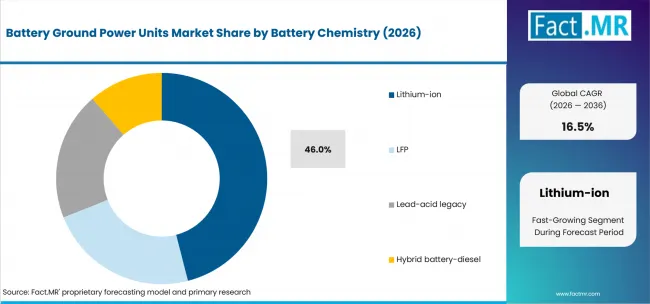
Battery Ground Power Units Market Analysis By Battery Chemistry | Source: Fact.MR
Lithium-ion is expected to hold 46.0% share in 2026 because it supports stronger energy density, faster recharge potential and repeat aircraft servicing. LFP follows as airports seek safer chemistry and longer cycle life. Lead-acid legacy units remain in smaller aviation and business-jet applications. Hybrid battery-diesel systems are used where operators want range assurance during transition. Japan Airlines introduced a lithium-ion battery-powered eGPU at Matsuyama Airport in 2024 and stated that the unit can support a Boeing 737-800 turnaround for about 14 flights on a full charge. [2]
Which mobility type dominates?
Mobile towable GPUs hold 38.0% share in 2026.
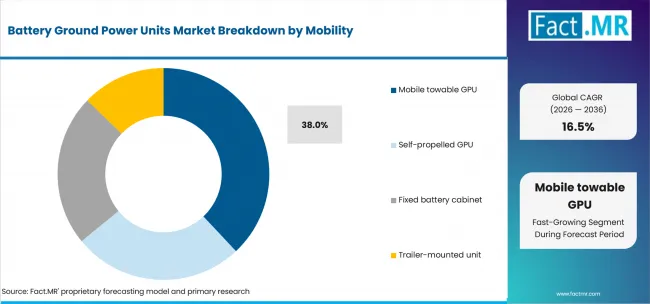
Battery Ground Power Units Market Analysis By Mobility | Source: Fact.MR
Mobile towable GPUs lead because airports need flexible units that can move between gates, hangars and remote stands. The mobility segment is projected to capture 38.0% share in 2026 as ground handlers replace diesel carts with towable battery units. Self-propelled GPUs follow where operators want easier movement without tugs. Fixed battery cabinets fit high-use gates with stable aircraft mix. Trailer-mounted units support larger battery capacity and MRO demand. TLD states that POWER-409 is a zero-emission battery-powered 400Hz GPU designed for remote aircraft positions and hangars. [3]
Which power output dominates?
Combination AC/DC units account for 34.0% share in 2026.
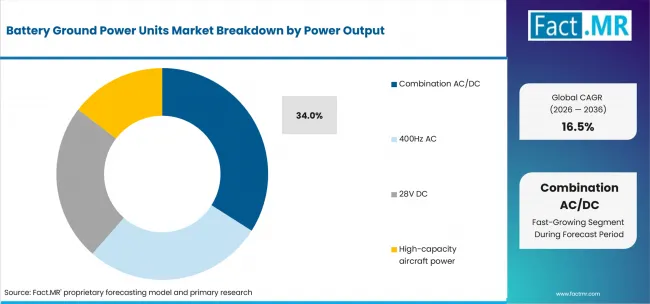
Battery Ground Power Units Market Analysis By Power Output | Source: Fact.MR
Combination AC/DC units lead because airports need one platform that can support more aircraft types. The power-output segment is likely to account for 34.0% share in 2026 as operators choose flexible GPUs for mixed fleets. 28V DC units are important for business aviation and regional aircraft. 400Hz AC units support commercial aircraft at gates and MRO areas. High-capacity aircraft power grows where narrowbody and widebody service needs increase. Cleaner aircraft power also supports sequencing with belt loaders once the aircraft is connected safely.
Which application dominates?
Narrowbody gates lead with 36.0% share in 2026.
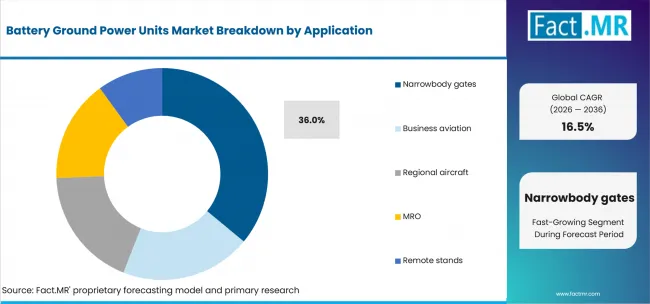
Battery Ground Power Units Market Analysis By Application | Source: Fact.MR
Narrowbody gates lead because single-aisle aircraft generate frequent turnaround cycles and high ground power use. The application segment is expected to hold 36.0% share in 2026 as airports deploy battery GPUs at high-rotation stands. Regional aircraft follow where 28V DC units are common. Business aviation uses compact battery carts at FBOs. MRO uses quiet power during maintenance checks. Remote stands are important where fixed 400Hz infrastructure is limited. Powervamp describes its Coolspool 28V DC battery ramp carts as an environmentally friendly alternative to traditional diesel GPUs. [4]
Which buyer type dominates?
Ground handlers hold 35.0% share in 2026.
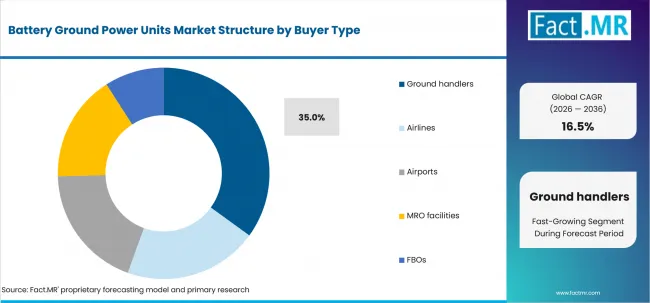
Battery Ground Power Units Market Analysis By Buyer Type | Source: Fact.MR
Ground handlers lead because they operate GPU fleets across gates, remote stands and aircraft maintenance areas. The buyer-type segment is projected to record 35.0% share in 2026 as handlers replace diesel units with battery GPUs. Airports influence charging infrastructure and airside safety rules. Airlines support adoption when cleaner power reduces APU use. MRO facilities require quiet and stable power. FBOs adopt compact units for business aviation. IATA stated in 2025 that electrifying GSE can cut emissions per turnaround and has issued guidance covering battery management and infrastructure readiness. [5]
What is accelerating Battery Ground Power Units Market adoption, and what is holding it back?
GSE electrification and APU reduction drive it; charging limits and battery replacement cost restrain it.
Drivers Impact Analysis
| DRIVER | (~) % IMPACT ON CAGR | GEOGRAPHIC RELEVANCE | IMPACT TIMELINE |
|---|---|---|---|
| Airport decarbonization shifting GPUs away from diesel engines | +1.9% | United States, Japan, Germany, UAE | Short term (≤ 2 years) |
| Narrowbody gate utilization increasing need for cleaner aircraft power | +1.5% | Large hubs and regional airports | Medium term (2–4 years) |
| Battery runtime improving mobile GPU usability at remote stands | +1.3% | North America, Europe, East Asia | Medium term (2–4 years) |
| Ground handling sustainability programs supporting fleet conversion | +1.1% | Global, strongest in large hub airports | Short term (≤ 2 years) |
| FBO and MRO demand growing for low-noise aircraft power | +0.8% | United States, Europe, Japan | Long term (≥ 4 years) |
Source: Fact.MR analysis. Updated Jul 6, 2026
Airport decarbonization
Airport decarbonization is the strongest driver because diesel GPUs create local emissions and noise near aircraft stands. Battery GPUs provide clean point-of-use power for parked aircraft. This driver is strongest where airports already electrify broader GSE fleets. It also supports cleaner workflows around aircraft tugs when ramp fleets are modernized together.
Narrowbody gate utilization
Narrowbody gate utilization supports demand because single-aisle aircraft create frequent ground power cycles. Battery GPUs can serve repeated turnarounds when charging access and runtime are planned well. This makes high-use domestic gates early deployment targets. Airlines support adoption when APU use can be reduced.
Battery runtime
Battery runtime improvements support mobile GPU use at remote stands. Longer runtime reduces anxiety over mid-shift charging. Better battery management also protects service life. This driver will be important where fixed gate power is unavailable.
Ground handling sustainability
Ground handling sustainability programs increase purchase interest because handlers need practical ways to reduce fleet emissions. Battery GPUs are easier to deploy than some heavier electric equipment because their use case is clear. Charging planning still matters. Airport charging expansion can also support aircraft tow tractors when multiple GSE categories electrify together.
FBO and MRO demand
FBO and MRO demand grows because operators need quiet power for business jets, hangars and overnight maintenance. Battery GPUs reduce noise and fumes in sensitive areas. They can also improve working conditions for technicians. This driver favors compact 28V DC units and combination AC/DC platforms.
Opportunity Impact Analysis
| OPPORTUNITY | (~) % IMPACT ON CAGR | GEOGRAPHIC RELEVANCE | IMPACT TIMELINE |
|---|---|---|---|
| LFP batteries for longer cycle life and safer ramp operations | +1.2% | United States, Europe, Japan, India | Medium term (2–4 years) |
| Fixed battery cabinets for high-use narrowbody gates | +1.0% | Large hubs globally | Medium term (2–4 years) |
| Trailer-mounted high-capacity units for MRO and remote stands | +0.9% | United States, Germany, UAE, China | Short term (≤ 2 years) |
| Fleet conversion bundles combining GPU, charger and service support | +0.7% | Large hub airports and ground handlers | Long term (≥ 4 years) |
Source: Fact.MR analysis. Updated Jul 6, 2026
LFP batteries
LFP batteries create opportunity because airports value cycle life and thermal stability. This chemistry can suit high-use ramp equipment where safety and predictable charging matter. Suppliers can position LFP units for ground handlers that run long shifts. Battery monitoring will be critical to prove durability.
Fixed battery cabinets
Fixed battery cabinets create opportunity at high-use gates where mobile units are not always efficient. A cabinet can provide aircraft power close to the stand while reducing equipment movement. This helps terminals with predictable narrowbody schedules. Fixed battery systems also fit gate upgrades linked with airfield ground lighting programs when airports modernize airside power infrastructure together.
Trailer-mounted high-capacity units
Trailer-mounted high-capacity units create opportunity for MRO, widebody servicing and remote stands. Larger battery packs can support longer service windows. They also allow airports to deploy power where fixed infrastructure is limited. The strongest near-term opportunity sits in maintenance areas and flexible stand operations.
Fleet conversion bundles
Fleet conversion bundles can combine battery GPUs, chargers, battery monitoring and service support. This helps ground handlers move beyond one-off purchases. Bundles also simplify operator training and maintenance planning. They can include charger placement studies and shift-based TCO models.
Restraints Impact Analysis
| RESTRAINT | (~) % IMPACT ON CAGR | GEOGRAPHIC RELEVANCE | IMPACT TIMELINE |
|---|---|---|---|
| Charging infrastructure limits at gates and remote stands | -1.6% | Global | Short term (≤ 2 years) |
| Battery replacement cost affecting lifecycle economics | -1.3% | Global, strongest in high-use fleets | Medium term (2–4 years) |
| Runtime limits under peak power and heavy turnaround schedules | -1.1% | Large hubs and remote stand airports | Medium term (2–4 years) |
| Weight and handling constraints for high-capacity battery units | -0.8% | MRO, remote stand and FBO operations | Long term (≥ 4 years) |
Source: Fact.MR analysis. Updated Jul 6, 2026
Charging infrastructure
Charging infrastructure is the main restraint because battery GPUs need reliable airside charging access. Remote stands may lack suitable power supply. Large fleets can also create charging congestion between shifts. Airport electrical planning must come before full fleet conversion.
Battery replacement cost
Battery replacement cost affects lifecycle economics. Ground handlers need clarity on pack life, warranty terms and second-life options. High-use GPUs may cycle batteries quickly. Suppliers must show cost per turnaround, not only purchase price.
Runtime limits
Runtime limits can slow adoption in high-intensity operations. Battery GPUs must handle peak load and repeated aircraft connections. Poor planning can leave units unavailable during the next turn. Larger packs and charging rotation plans reduce the issue.
Weight and handling
Weight and handling constraints matter as battery capacity increases. Larger units may be harder to tow in tight ramp spaces. Self-propelled designs can help but raise cost. Airports must balance capacity with maneuverability.
Which countries are scaling battery ground power units fastest?
United States 17.8%; Japan 17.1%; Germany 16.6%; UAE 16.1%; India 15.4%.
Based on regional analysis, the battery ground power units market is segmented into North America, Western Europe, East Asia, South Asia, Latin America, and Middle East and Africa.
| Country | CAGR |
|---|---|
| United States | 17.8% |
| Japan | 17.1% |
| Germany | 16.6% |
| UAE | 16.1% |
| India | 15.4% |
Source: Fact.MR analysis. Updated Jul 6, 2026
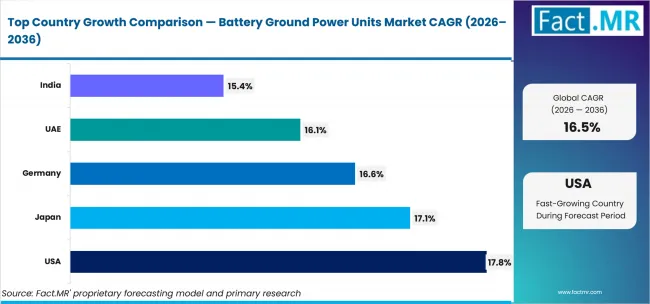
Battery Ground Power Units Market Cagr Analysis By Country | Source: Fact.MR
What is powering the United States lead?
17.8% CAGR, driven by FBO adoption and large hub GSE electrification.
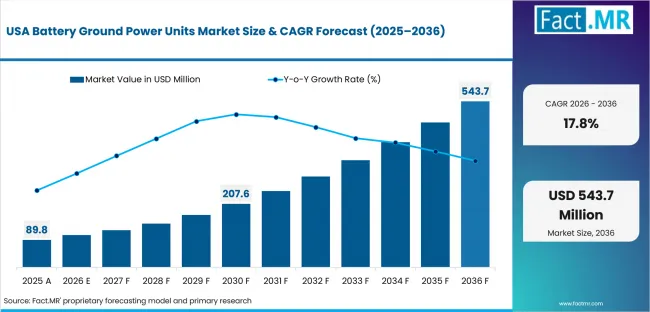
Battery Ground Power Units Market Country Value Analysis | Source: Fact.MR
The United States is projected to record 17.8% CAGR from 2026 to 2036 as airports, airlines and FBOs replace diesel GPUs with battery-powered units. Growth will favor mobile towable GPUs, compact 28V DC systems and high-capacity AC/DC units. Battery GPU adoption can also coordinate with aircraft refueler movement where ramp teams plan safer equipment sequencing.
How is Japan scaling battery GPU demand?
17.1% CAGR, driven by lithium-ion eGPU deployment and airline-led sustainability programs.
Japan is expected to post 17.1% CAGR through 2036 as airlines and airports test battery GPUs in live turnaround operations. Demand will focus on lithium-ion units, narrowbody aircraft and compact airport operations. Early evidence from airline deployment will help shape wider buyer confidence.
What supports Germany’s outlook?
16.6% CAGR, supported by airport decarbonization and ground handler fleet conversion.
Germany is likely to record 16.6% CAGR by 2036 as airports align ground power upgrades with broader airside electrification. Demand will focus on mobile towable GPUs and fixed battery cabinets at high-use stands. Supplier selection will depend on charging integration and service support.
What underpins UAE growth?
16.1% CAGR, backed by Dubai-style electric GPU fleet deployment.
UAE is forecast to advance at 16.1% CAGR from 2026 to 2036 as large hubs and ground handlers use electric GPUs to cut diesel use at aircraft stands. Growth will favor high-capacity units for narrowbody and widebody support. Harsh climate performance will be a key purchase criterion.
How is India scaling battery GPU adoption?
15.4% CAGR, driven by new airport projects and remote stand power needs.
India is set to record 15.4% CAGR through 2036 as airport expansion and terminal modernization increase demand for cleaner ground power. Remote stands and regional airports will create strong demand for mobile towable GPUs. Growth will favor durable units with simple charging and mixed aircraft compatibility.
Who leads the battery ground power units market?
ITW GSE and TLD lead battery eGPU coverage, while Powervamp and Guinault strengthen portable and aircraft-power portfolios.
Battery ground power units are supplied by GPU specialists and aviation power companies. ITW GSE is central through the 7400 eGPU and airline deployment evidence. TLD is relevant through POWER-409 and lithium-ion battery GPU platforms. Powervamp is important through 28V DC battery ramp carts and portable aviation power systems.
Guinault supports the GPU supplier set through aircraft ground power systems across civil and military aviation. Oshkosh AeroTech is the current pathway for former JBT AeroTech ground power brands, including Jetpower point-of-use systems.
Competition through 2036 will be shaped by runtime, charging speed, power quality, battery safety and service support. Ground handler fleet planning can also connect with ground support equipment tires replacement cycles when airports convert older diesel GSE fleets toward electric platforms.
Which companies are the key providers?
ITW GSE and TLD are key providers. Guinault and Powervamp are also profiled. Oshkosh AeroTech completes the company set.
- ITW GSE
- Guinault
- Powervamp
- Oshkosh AeroTech
- TLD
Bibliography
- dnata. (2024, October 10). dnata adds 14 electric ground power units (GPUs) to Dubai fleet. dnata.
- Japan Airlines. (2024, May 17). Introduction of the first lithium-ion battery-powered ground power unit at Matsuyama Airport. Japan Airlines.
- TLD. (2026). POWER-409. TLD.
- Powervamp. (2026). Ground power units (GPU) - aircraft GPU. Powervamp.
- International Air Transport Association. (2025, May 13). Ground handling priorities: Safety, baggage, global standardization and sustainability. International Air Transport Association.
This Report Addresses
- Strategic intelligence on battery ground power units across battery chemistry and mobility.
- Segment analysis covering Lithium-ion and Mobile Towable GPUs.
- Regional outlook covering the United States, Japan, Germany, UAE and India.
- Competitive analysis of ITW GSE, Guinault, Powervamp, Oshkosh AeroTech, TLD.
- Technology assessment covering lithium-ion, LFP, 28V DC, 400Hz AC and combination AC/DC power.
- Use case assessment covering regional aircraft, business aviation, narrowbody gates, MRO and remote stands.
- TCO screening compares battery GPUs with diesel GPUs and fixed electrical ground power.
- Primary interviews, provider checks and official source review support the forecast.
What does the battery ground power units market cover?
Battery-powered GPUs that supply aircraft electrical power at gates, stands and maintenance areas.
The battery ground power units market covers lithium-ion, LFP, lead-acid legacy and hybrid battery-diesel systems. Mobility coverage includes mobile towable GPUs, self-propelled GPUs, fixed battery cabinets and trailer-mounted units.
The market differs from broad GPU coverage because battery storage is central to the product. It excludes diesel-only GPUs and fixed grid power without onboard battery storage.
What is included in the scope?
Battery GPU hardware and aircraft power output systems.
The scope includes 28V DC and high-capacity aircraft power units. Application coverage includes regional aircraft, business aviation, narrowbody gates, MRO and remote stands.
Buyer-type coverage includes airports, airlines, ground handlers, MRO facilities and FBOs. Battery GPUs can also operate near passenger boarding bridge systems when aircraft power and bridge readiness are coordinated at contact gates.
What is excluded from the scope?
Diesel-only GPUs and fixed electrical infrastructure without battery storage are outside the scope.
The scope excludes conventional diesel GPUs, hydrogen fuel-cell GPUs and general industrial power carts outside aviation. It also excludes airport charging stations unless they are sold as part of a battery GPU ecosystem.
How was the analysis built?
100+ sources, 40+ company portfolios, 25+ countries, 20+ interviews.
- Primary Research: Primary research includes interviews with airport sustainability teams, GSE fleet managers and airline ground operations teams. It includes input from GPU manufacturers, battery suppliers, FBO operators and MRO facilities.
- Desk Research: Desk research reviews official eGPU deployments, battery GPU product pages, ground handling sustainability guidance, airport electrification programs and charging infrastructure updates.
- Market-Sizing and Forecasting: Forecasting uses GPU fleet replacement cycles, remote stand power demand, battery chemistry mix, airport charging readiness and diesel-to-electric conversion rates.
- Data Validation and Update Cycle: Forecasts are validated through provider checks and technical interviews. Battery runtime, aircraft power compatibility and TCO versus diesel GPUs help confirm market direction.
Segmentation
What is the report’s scope and coverage?
| Attribute | Details |
|---|---|
| Quantitative Units | USD Million in 2026 to USD Million by 2036 at CAGR |
| Market Definition | Battery-powered GPUs that supply aircraft electrical power at gates, stands and maintenance areas |
| Battery Chemistry | Lithium-ion; LFP; lead-acid legacy; hybrid battery-diesel |
| Mobility | Mobile towable GPU; self-propelled GPU; fixed battery cabinet; trailer-mounted unit |
| Power Output | 28V DC; 400Hz AC; combination AC/DC; high-capacity aircraft power |
| Application | Regional aircraft; business aviation; narrowbody gates; MRO; remote stands |
| Buyer Type | Airports; airlines; ground handlers; MRO facilities; FBOs |
| Regions Covered | North America; Western Europe; East Asia; South Asia; Latin America; Middle East and Africa |
| Countries Covered | United States; Japan; Germany; UAE; India |
| Key Companies Profiled | ITW GSE; Guinault; Powervamp; Oshkosh AeroTech; TLD |
| Forecast Period | 2026 to 2036 |
| Approach | Hybrid top-down and bottom-up approach using GPU fleet replacement, eGPU deployment evidence, charging readiness, battery chemistry mix and provider validation |
Source: Fact.MR analysis. Updated Jul 6, 2026
How is the market segmented?
-
By Battery Chemistry:
- Lithium-ion
- LFP
- Lead-acid legacy
- Hybrid battery-diesel
-
By Mobility:
- Mobile towable GPU
- Self-propelled GPU
- Fixed battery cabinet
- Trailer-mounted unit
-
By Power Output:
- 28V DC
- 400Hz AC
- Combination AC/DC
- High-capacity aircraft power
-
By Application:
- Regional aircraft
- Business aviation
- Narrowbody gates
- MRO
- Remote stands
-
By Buyer Type:
- Airports
- Airlines
- Ground handlers
- MRO facilities
- FBOs
-
Region:
- North America
- United States
- Canada
- Western Europe
- Germany
- United Kingdom
- France
- Netherlands
- Spain
- East Asia
- Japan
- China
- South Korea
- South Asia & Pacific
- India
- Singapore
- Thailand
- Latin America
- Brazil
- Mexico
- Chile
- Middle East & Africa
- UAE
- Saudi Arabia
- South Africa
- North America
Frequently Asked Questions
Which battery chemistry leads the Battery Ground Power Units Market?
Which mobility type leads the Battery Ground Power Units Market?
Which power output leads the Battery Ground Power Units Market?
Which application leads the Battery Ground Power Units Market?
Which buyer type leads the Battery Ground Power Units Market?
Which country expands fastest in the Battery Ground Power Units Market?
How does Japan perform in the Battery Ground Power Units Market?
How does Germany perform in the Battery Ground Power Units Market?
How does UAE perform in the Battery Ground Power Units Market?
How does India perform in the Battery Ground Power Units Market?
What is the primary driver in the Battery Ground Power Units Market?
What is the main restraint in the Battery Ground Power Units Market?
Why are lithium-ion GPUs important?
Why do ground handlers dominate demand?
Who worked on this report


Preview the report firsthand - request a free sample
Free SampleGet the brochure for pricing and purchase details
Download PDF