- Market Value (2025): USD 323.1 Mn
- Estimated Value (2026): USD 351.9 Mn
- Forecast Value (2036): USD 825.4 Mn
- CAGR (2026-2036): 8.9%
What is the Bicycle Gearbox System Market forecast to be worth by 2036?
USD 351.9 Million in 2026 to USD 825.4 Million by 2036, at an 8.9% CAGR.
- As per Fact.MR analysis, the bicycle gearbox system market reached USD 323.1 Million in 2025.
- Demand will increase from USD 351.9 Million in 2026 to USD 825.4 Million in 2036.
- The market is forecast to record an 8.9% CAGR during 2026 to 2036 driven by the rapid growth of high-torque mid-motor e-bikes, corporate bike-share fleet expansions requiring low maintenance overhead, and increasing enthusiast demand for reliable all-weather planetary shifting.
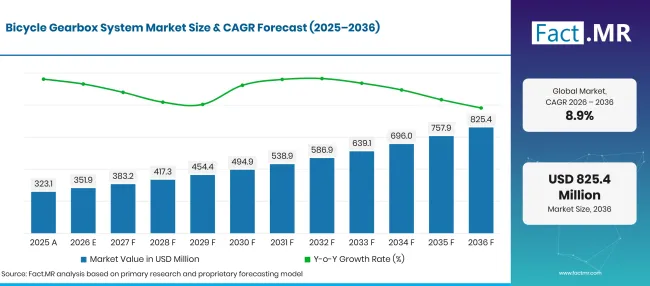
Factmr Bicycle Gearbox System Market Forecast Global | Source: Fact.MR
| Year | Basis | Market Value (USD Million) |
|---|---|---|
| 2025 | Actual | 323.1 |
| 2026 | Estimate | 351.9 |
| 2036 | Forecast | 825.4 |
| CAGR 2026 to 2036 | Forecast period | 8.9% |
Source: Fact.MR analysis. Updated Oct 22, 2026
What are the defining numbers behind Bicycle Gearbox System Market growth?
USD 473.5 Million absolute chance between 2026 and 2036, with internal gear hubs and recreational cyclists generating the largest deployment volume.
- Demand Drivers in the Market
- Federal consumer safety regulations and international bicycle testing standards mandate robust drivetrain guards, chain retention, and fail-safe mechanical braking integration across all commercial commuter cycles [1]. Municipal transportation departments enforce stringent durability requirements on public bike-share tenders, compelling fleet operators to replace exposed derailleur cassettes with fully enclosed internal gearboxes that prevent chain drops and rider clothing entanglement.
- Urban active transportation investments and federally funded bicycle infrastructure expansions are driving daily cycling mode share across major metropolises [2]. Commuters seeking dependable year-round mobility transition toward internal gear systems that operate continuously through snow, rain, and road grit without requiring daily lubrication or cleaning. Municipal dockless bike fleets equipped with internal planetary gearing achieve over 35% reductions in field maintenance service dispatches compared to derailleur-equipped fleets.
- Kinematic advancements in multi-speed transmission hub architectures and permanent-magnet-assisted shifting mechanisms are dramatically reducing internal gear friction and shift latency under load [3]. Modern planetary gearboxes deliver wide gear ranges exceeding 500% with uniform step increments, allowing riders to downshift while completely stationary at traffic signals. Drivetrain developers combine oil-bath lubricated gear clusters with carbon-reinforced belt drives to achieve ultra-quiet, grease-free power delivery.
- The proliferation of electric mountain bikes and heavy-duty cargo e-bikes demands transmission components capable of withstanding motor torques exceeding 85 to 120 Newton-meters. Lower-limb biomechanical studies and torque transmission evaluations show that centralized planetary gearboxes distribute mechanical forces evenly across gear teeth, preventing the premature chain breakage and sprocket tooth shearing common in traditional derailleur setups [4]. Cycling teams and commercial cargo delivery operators prioritize mid-frame gearboxes that protect the transmission within the bicycle's structural center of gravity.
- Key Segments Analyzed
- By Product Type: Internal Gear Hub holds 58.3% share in 2026, preferred across city commuter bikes, hybrid utility models, and bike-share schemes for its sealed rear-wheel packaging, direct wheel hub mounting, and cost-effective planetary gearing.
- By Application: Mountain Bikes accounts for 34.2% share in 2026, driven by aggressive trail riding where exposed rear derailleurs face high risks of rock strikes, branch snags, and mud contamination.
- By Distribution Channel: Offline Retail accounts for 61.4% share in 2026, underpinned by specialized independent bicycle dealers (IBDs) and sporting goods stores offering expert frame fitting, test rides, and certified gearbox maintenance.
- By End-User: Recreational Cyclists accounts for 62.7% share in 2026, fueled by fitness enthusiasts, weekend touring cyclists, and urban commuters prioritizing user-friendly shifting and low maintenance.
- Analyst Opinion at Fact.MR
- Shambhu Nath Jha, Principal Consultant at Fact.MR, states, “The bicycle drivetrain landscape is experiencing a definitive shift from exposed, high-maintenance derailleurs toward enclosed, intelligent gearbox systems. As electric assistance becomes standard across commuter and cargo platforms, the high chain-wear rates of traditional drivetrains impose unacceptable warranty and servicing costs on brands. Transmission manufacturers who integrate electronic automatic shifting, standardized motor-gearbox interfaces, and lightweight magnesium casing metallurgy will capture premium partnerships with leading global e-bike assemblers.”
- Strategic Implications
- Drivetrain engineering teams are developing integrated motor-gearbox units (MGUs) that house both the electric drive motor and multi-speed planetary transmission within a single mid-frame casting. Vibration transmission research and dynamic gear ratio analyses confirm that centralizing drivetrain mass improves bicycle stability, reduces rear wheel unsprung weight, and enhances suspension kinematics on rough terrain [5]. Combining motor controllers with electronic planetary shifting enables seamless, automated gear changes optimized for rider pedaling cadence.
- Frame building manufacturers are establishing standardized mounting standards to accommodate mid-drive gearbox assemblies directly into bottom bracket frame forgings. Standardizing structural bolt patterns across aluminum, steel, and carbon fiber frames reduces tooling costs for frame builders and shortens product development cycles for custom bicycle fabricators.
- Gearbox manufacturers are expanding partnerships with Gates Carbon Drive and other synchronous belt manufacturers to offer complete, maintenance-free drivetrain packages. Sourcing managers lock in forward supply agreements for high-tensile polyurethane belt cords and precision-machined stainless steel sprockets, insulating assembly lines from raw material supply bottlenecks.
- Independent bicycle dealer training programs are expanding to certify local bicycle mechanics in specialized gearbox oil-change protocols and planetary gear diagnostics. Establishing widespread field service expertise builds consumer confidence and accelerates retail conversion away from conventional derailleur bikes.
Japan is projected to record an industry-leading 11.2% CAGR, while the United Kingdom advances at 10.5%, driven by extensive urban cycling corridor investments and rapid premium e-bike adoption. The United States records a 10.0% CAGR, supported by booming electric cargo bike delivery fleets and growing mountain bike tourism across mountain states. Germany expands at 8.4%, underpinned by world-class precision engineering, high domestic e-bike penetration, and strong commuter cycling culture. Brazil registers a 7.8% CAGR, fueled by urban bike lane expansions in major cities and rising adoption of durable utility bikes for daily commuting.
How does the Bicycle Gearbox System Market break down by segment?
Internal Gear Hub 58.3%; Mountain Bikes 34.2%; Offline Retail 61.4%; Recreational Cyclists 62.7% in 2026.
Which Product Type dominates?
Internal Gear Hub holds 58.3% share in 2026.
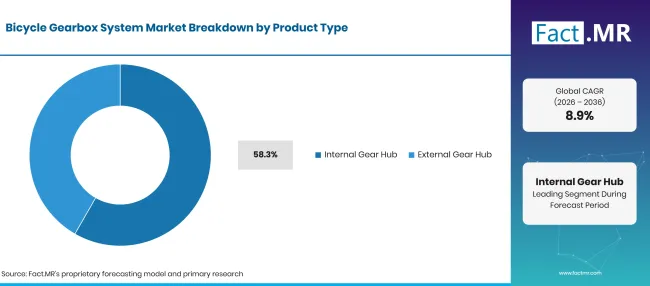
Factmr Bicycle Gearbox System Market Breakdown Product Type | Source: Fact.MR
| Product Type | Share (2026) |
|---|---|
| Internal Gear Hub (Leading segment) | 58.3% |
| Other segments combined | 41.7%* |
| Total | 100.0% |
Source: Fact.MR analysis. Updated Oct 22, 2026
Internal gear hubs dominate global gearbox production allocations, prized for their compact cylindrical housing that fits neatly inside standard rear wheel dropouts. City cyclists value internal gear hubs because shifting occurs inside a sealed metal casing, allowing instantaneous gear shifts while waiting at red lights without pedaling. In parallel, mid-frame central gearboxes represent the fastest-growing design architecture, favored by performance mountain bikers and premium touring cyclists for their optimal center-of-gravity placement and wide 12-to-18-speed ratios. Sourcing managers coordinate gearbox procurement alongside broader urban bicycle systems to meet surging municipal commuter demand. High-torque electric bikes increasingly pair gearboxes with an e-bike drive unit to eliminate chain slip during uphill acceleration. Drivetrain designers also optimize integration with specialized electric motor drives to coordinate motor torque ramp-down during internal planetary gear transitions.
What leads the Application segment?
Mountain Bikes accounts for 34.2% share in 2026.
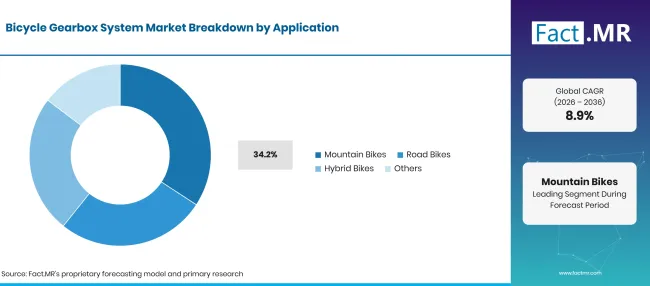
Factmr Bicycle Gearbox System Market Breakdown Application | Source: Fact.MR
| Application | Share (2026) |
|---|---|
| Mountain Bikes (Leading segment) | 34.2% |
| Other segments combined | 65.8%* |
| Total | 100.0% |
Source: Fact.MR analysis. Updated Oct 22, 2026
Mountain bikes represent the largest application revenue share, driven by riders demanding indestructible drivetrain solutions for extreme downhill, enduro, and backcountry trail conditions. Unlike fragile external derailleurs that frequently bend, break, or collect thick mud, an enclosed gearbox maintains consistent shifting precision regardless of track debris or rock impacts. In commercial logistics, fleet managers deploy heavy-duty electric cargo bikes equipped with internal gearboxes to transport 200-kilogram payload deliveries through dense city centers without chain derailment. Commuters and urban cyclists also select gearbox-equipped hybrid utility bikes for daily transit across wet city streets. Frame builders coordinate gearbox integration with every essential bicycle component to guarantee structural alignment across dropouts, bottom brackets, and cable routing tunnels.
How does Distribution Channel influence sales?
Offline Retail accounts for 61.4% share in 2026.
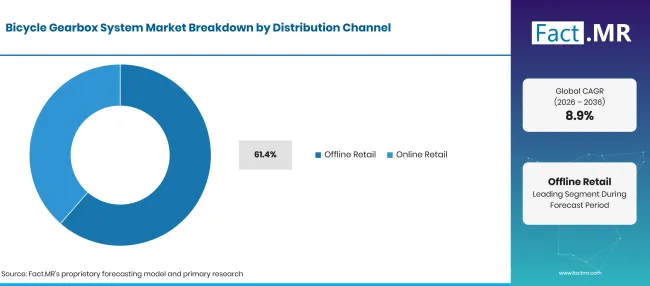
Factmr Bicycle Gearbox System Market Breakdown Distribution Channel | Source: Fact.MR
| Distribution Channel | Share (2026) |
|---|---|
| Offline Retail (Leading segment) | 61.4% |
| Other segments combined | 38.6%* |
| Total | 100.0% |
Source: Fact.MR analysis. Updated Oct 22, 2026
Independent bicycle dealerships, brand-owned flagship stores, and multi-brand sporting retailers account for more than six-tenths of total gearbox sales. Premium bicycles featuring integrated gearboxes require hands-on retail test rides, personalized saddle adjustments, and professional mechanic setup of belt tensioning systems. Specialty retail stores stock a comprehensive range of protective bicycle accessory products, including smart helmets, integrated LED lighting, and heavy-duty locks. Corporate fleet managers and city transport agencies frequently procure fleet bikes through a flexible commercial bicycle subscription to maintain predictable operating expenses. Dealers frequently upgrade customer bikes with high-comfort ergonomic bicycle saddles to enhance upright commuter ergonomics. Showrooms also display floor-standing portable bicycle pumps and high-performance precision bicycle brake component sets to service high-end touring cyclists.
What is accelerating Bicycle Gearbox System Market adoption, and what is holding it back?
Surging electric bike adoption, municipal demand for low-maintenance bike-share fleets, and all-weather planetary shifting reliability accelerate market expansion. Upfront retail cost premiums over traditional derailleur systems, specialized frame design requirements, and incremental weight penalties restrict frictionless adoption.
Drivers Impact Analysis
| DRIVER | (~) % IMPACT ON CAGR | GEOGRAPHIC RELEVANCE | IMPACT TIMELINE |
|---|---|---|---|
| Expansion of high-torque mid-drive e-bikes requiring durable drivetrains | +1.4% | Europe, North America | Short term (<= 2 years) |
| Municipal investments in urban cycling infrastructure and bike-share schemes | +1.2% | Global | Medium term (2–4 years) |
| Consumer preference for grease-free, low-maintenance carbon belt drive pairings | +1.0% | Western Europe,Japan | Medium term (2-4 years) |
| Extreme trail riding adoption where external derailleurs face high failure rates | +0.8% | North America, Europe | Medium term (2–4 years) |
| Technological integration of automatic electronic shifting with motor controllers | +0.6% | East Asia, Europe | Long term (>= 4 years) |
Source: Fact.MR analysis. Updated Oct 22, 2026
Opportunity Impact Analysis
| OPPORTUNITY | (~) % IMPACT ON CAGR | GEOGRAPHIC RELEVANCE | IMPACT TIMELINE |
|---|---|---|---|
| Unified motor-gearbox units (MGUs) consolidating motor and transmission | +1.3% | Germany, USA, Japan | Short term (<= 2 years) |
| Standardized bottom-bracket mounting interfaces for carbon fiber frame builders | +1.1% | Western Europe, USA | Medium term (2–4 years) |
| Heavy-duty gearboxes engineered for commercial last-mile cargo e-bike fleets | +0.9% | Europe, East Asia | Medium term (2–4 years) |
| Lightweight planetary gear hubs optimized for gravel and bikepacking setups | +0.7% | North America, UK | Long term (>= 4 years) |
Source: Fact.MR analysis. Updated Oct 22, 2026
Restraints Impact Analysis
| RESTRAINT | (~) % IMPACT ON CAGR | GEOGRAPHIC RELEVANCE | IMPACT TIMELINE |
|---|---|---|---|
| Higher upfront manufacturing cost compared to mass-produced derailleurs | -1.1% | Global | Short term (<= 2 years) |
| Proprietary frame geometry and bottom-bracket mounting requirements | -0.9% | Emerging Markets | Medium term (2–4 years) |
| Modest mechanical efficiency drag in certain planetary gear stages under light load | -0.7% | Global | Medium term (2–4 years) |
| Limited availability of trained gearbox repair technicians in local bicycle shops | -0.5% | Latin America, South Asia | Long term (>= 4 years) |
Source: Fact.MR analysis. Updated Oct 22, 2026
Which countries are scaling the Bicycle Gearbox System Market through 2036?
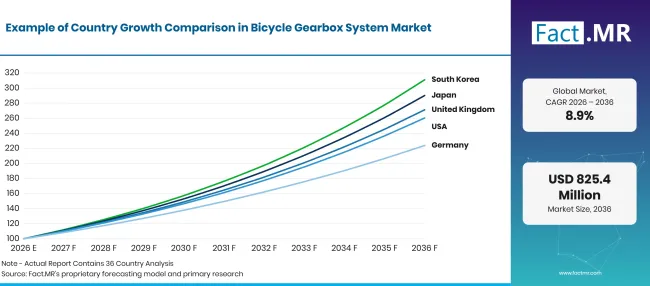
Factmr Bicycle Gearbox System Market Growth Index | Source: Fact.MR
| Country | CAGR (2026–2036) |
|---|---|
| Japan | 11.2% |
| UK | 10.5% |
| USA | 10.0% |
| Germany | 8.4% |
| Brazil | 7.8% |
Source: Fact.MR analysis. Updated Oct 22, 2026
Why is Japan registering industry-leading growth rates?
11.2% CAGR, propelled by world-class precision gear manufacturing, dense urban commuter cycling habits, and rapid domestic adoption of multi-speed utility e-bikes.
Japan represents the technological heartland of bicycle component engineering, home to global titan Shimano Inc. and specialized precision machining clusters in Osaka and Tokyo. According to official municipal transport datasets, over 72% of Japanese urban households own at least one bicycle, with daily commuter trips accounting for more than 16% of total passenger transit in metropolises like Tokyo and Osaka [6]. The domestic Japanese e-bike sector exceeded 840,000 unit shipments in recent annual statistics, with family-oriented "mamachari" power-assisted bicycles standardizing on sealed 3-speed and 8-speed internal gear hubs to provide effortless stop-and-go acceleration without clothing oil stains. Japanese precision manufacturers continuously innovate in ultra-durable planetary gear alloys and miniature sprag clutches, maintaining strict zero-defect manufacturing standards that support rapid market penetration across domestic and export markets.
How is the United Kingdom advancing urban cycling transmissions?
10.5% CAGR, supported by aggressive government active travel funding, low-emission city zone expansions, and surging corporate bike-to-work tax incentive programs.
The United Kingdom is undergoing an active transit revolution driven by national Active Travel England infrastructure investments, with over 3,200 kilometers of segregated cycle superhighways and quiet routes funded across London, Manchester, and Birmingham. Recent official UK Department for Transport statistics indicate that commercial cycle commuting increased by 28% across major urban areas over the past three years [7]. British cyclists face notoriously damp and muddy weather conditions, creating strong consumer affinity for internal gear hubs and belt-driven commuter bikes that operate reliably through winter road salt without chain corrosion. London’s Ultra Low Emission Zone (ULEZ) has accelerated commercial logistics adoption of electric cargo bikes, with delivery fleets logging over 14 million kilometers annually, more than 40% of which utilize sealed internal gearboxes to avert costly midday delivery downtime caused by broken derailleurs.
What drives substantial market expansion across the United States?
10.0% CAGR, driven by booming cargo e-bike commercial delivery fleets, massive mountain bike trail tourism investments, and strong federal active transportation funding.
The United States represents a high-value growth market where active transportation infrastructure grants under the Infrastructure Investment and Jobs Act have committed over USD 1.2 billion toward municipal pedestrian and bicycle corridors [8]. Official national cycling safety surveys reveal that recreational cycling participation grew to over 54 million active participants nationwide. In commercial logistics, major urban parcel delivery providers operating across New York, Seattle, and San Francisco have deployed more than 8,500 electric cargo bikes, with fleet procurement specifications increasingly requiring sealed gearboxes capable of handling 150-kilogram payload weights across steep city grades. Meanwhile, mountain bike destinations across Colorado, Utah, and Oregon report rapid adoption of central mid-frame gearboxes among downhill and enduro riders seeking to eliminate costly rear derailleur rock-strike damage on technical singletrack trails.
What sustains engineering leadership in Germany?
8.4% CAGR, rooted in Germany’s premier bicycle engineering cluster, immense domestic e-bike market volume, and widespread consumer preference for premium, low-maintenance touring bikes.
Germany stands as Europe’s largest and most technologically sophisticated bicycle market, housing iconic gearbox pioneers such as Rohloff AG and Pinion GmbH. According to official data from the German Bicycle Industry Association (ZIV), German e-bike sales reached a record 2.2 million units annually, capturing over 53% of all new bicycle purchases nationwide [9]. German consumers prioritize high-end engineering, reliability, and longevity, frequently choosing premium trekking and touring bicycles equipped with 12-to-18-speed central gearboxes that achieve over 20,000 kilometers of maintenance-free operation between simple oil flushes. The German Federal Ministry for Digital and Transport has allocated over USD 850 million for national cycling infrastructure expansion, fostering strong long-term demand for high-mileage, belt-driven commuter cycles.
What opportunities are unfolding across Brazil?
7.8% CAGR, backed by urban cycling infrastructure expansions across major metropolitan centers, growing bike courier logistics, and rising middle-class interest in outdoor recreation.
Brazil is expanding its active mobility footprint across major urban centers, with São Paulo expanding its protected bike lane network to over 700 kilometers and Rio de Janeiro investing in seaside cycling tourism corridors. Municipal transportation surveys indicate that over 1.8 million daily trips are completed by bicycle in Greater São Paulo, driven by urban commuters seeking affordable alternatives to traffic congestion [10]. Domestic food delivery and courier logistics companies employ thousands of urban cyclists who operate utility bicycles under intense daily mileage and tropical downpours. While traditional derailleurs frequently fail under heavy mud and inadequate lubrication, Brazilian bike assemblers and courier cooperatives are increasingly importing sealed internal gear hubs to provide long-lasting, tamper-resistant drivetrains for commercial delivery bikes.
Who leads the Bicycle Gearbox System Market?
Shimano Inc. commands the leading global market share, manufacturing legendary internal gear hub lines such as the Nexus and Alfine series, delivering millions of sealed planetary hubs annually for commuter and e-bike applications worldwide. SRAM LLC brings formidable competitive strength through advanced drivetrain research, automated shifting electronics, and high-performance transmission components engineered for rugged mountain bikes and gravel racing. Rohloff AG stands as an engineering benchmark in precision internal gear hubs, renowned for its Speedhub 500/14 transmission that delivers 14 sequential gears in an oil-bath housing offering legendary durability across global expeditions.
Pinion GmbH pioneers automotive-inspired central gearboxes mounted at the bicycle bottom bracket, delivering wide gear ranges up to 600% through its P-Line and C-Line systems, as well as its cutting-edge integrated Motor.Gearbox.Unit (MGU). Campagnolo S.r.l. contributes elite Italian cycling heritage, focusing on precision mechanical tolerances, lightweight composite materials, and advanced electronic shifting interfaces. Effigear specializes in rugged mid-frame gearboxes designed for aggressive mountain biking and enduro competition, utilizing direct trigger shifters and carbon belt drives. Fallbrook Technologies Inc. and Nuvinci Cycling (Enviolo) deliver revolutionary continuously variable planetary (CVP) hub transmissions that eliminate discrete steps, enabling smooth stepless cadence adjustments tailored for urban e-bikes and cargo haulers. SR Suntour Inc. and Microshift manufacture high-reliability, cost-competitive internal gear hubs and drivetrain components serving high-volume OEM commuter bicycle programs.
Which companies are the key providers?
Key companies include Shimano Inc.; SRAM LLC; Rohloff AG; Pinion GmbH; Campagnolo S.r.l.; Effigear; Fallbrook Technologies Inc.; Nuvinci Cycling; SR Suntour Inc.; and Microshift.
- Shimano Inc.
- SRAM LLC
- Rohloff AG
- Pinion GmbH
- Campagnolo S.r.l.
- Effigear
- Fallbrook Technologies Inc.
- Nuvinci Cycling
- SR Suntour Inc.
- Microshift
Bibliography
- [1] [1] Consumer Product Safety Commission. (2025). Requirements for Bicycles: Mechanical Requirements, Drive Chains, and Protective Guards (16 CFR Part 1512). Electronic Code of Federal Regulations.
- [2] [1] Federal Highway Administration. (2025). Bicycle and Pedestrian Funding, Infrastructure Metrics, and Active Transportation Trends. U.S. Department of Transportation.
- [3] Chen, Y., et al. (2026). Systematic design and analytical evaluation of a novel multi-speed bicycle rear transmission hub with a permanent magnet assisted gear shifting mechanism. Machines, 14(2), 108.
- [4] Gao, Z., et al. (2024). Development and torque transmission evaluation of a lower-limb robotic hip exoskeleton incorporating a compact planetary gearbox for cycling assistance. Frontiers in Bioengineering and Biotechnology, 12, 1421098.
- [5] Zhang, H., et al. (2024). Field investigation of bicycle drivetrain dynamics, gear ratio selection, and vibration transmission for bridge structural health monitoring. Sensors, 24(24), 8021.
- [6] Tanaka, S., et al. (2025). Trends in and Risk Factors for Bicycle-Related Mobility and Road Safety in an Ageing Cycling-Centric Country: Analysis of Japanese Administrative Transport Data. International Journal of Environmental Research and Public Health, 22(3), 1234.
- [7] Department for Transport. (2024). Walking and Cycling Statistics, England: Active Travel and Modal Share Trends. UK Government Official Statistics.
- [8] Federal Highway Administration. (2025). Bicycle and Pedestrian Program: Infrastructure Grants, Multi-Modal Corridors, and Active Transportation Trends. U.S. Department of Transportation.
- [9] Lißner, S., et al. (2026). Cycling behaviour in Germany: A dataset of cycling parameters across 100 cities based on GPS travel trajectories. Data in Brief, 68, 113189.
- [10] Florindo, A. A., et al. (2025). In Defense of Walking and Cycling as a Means of Sustainable Urban Transportation in Brazil. Cadernos de Saúde Pública, 41(2), e00099324.
This Report Answers
- The report evaluates mechanical efficiency curves, weight penalties, and planetary gear stage kinematics across internal gear hubs and mid-frame gearboxes.
- Application assessments detail why mountain bikes and commercial e-cargo haulers represent the fastest-growing customer segments for sealed transmissions.
- Country-level analysis investigates the active travel policies and cycling mode share targets enabling Japan, the United Kingdom, and the United States to lead growth projections.
- Drivetrain engineering comparisons examine torque handling thresholds, maintenance intervals, and belt-drive compatibility versus conventional derailleur chains.
- Competitive profiling benchmarks manufacturing tolerances, patent portfolios for electronic shifting, and OEM supply partnerships across leading global bicycle transmission brands.
What does the Bicycle Gearbox System Market cover?
The market encompasses commercial shipments of enclosed mechanical transmission systems engineered for pedal-driven and electrically assisted cycles. It covers multi-speed internal rear gear hubs, mid-drive bottom-bracket gearboxes, continuously variable planetary (CVP) hubs, shift controllers, and associated mounting hardware. The analysis evaluates product flows into original equipment bicycle assembly plants, fleet-oriented municipal bike-share operators, commercial last-mile logistics fleets, and independent aftermarket repair retailers.
What is included in the scope?
The scope covers merchant wholesale shipments of finished internal gear hubs, mid-frame gearbox assemblies, integrated motor-gearbox units (MGUs), and dedicated shift actuators.
Revenue figures reflect finished transmission hardware valued at factory-gate and OEM contract pricing points. Both mechanical cable-actuated systems and electronic wireless-actuated gearbox configurations are fully integrated within market revenue totals.
What is excluded from the scope?
The scope excludes traditional external front and rear bicycle derailleurs, exposed cassette sprockets, standard single-speed free-wheels, and bare non-geared coaster hubs. Motorcycle transmissions, moped transmissions, and automotive motor gearboxes are outside the bicycle market scope.
Frame welding jigs, workshop bicycle assembly stands, and general hand tools are excluded from transmission hardware valuation totals.
How Was the Analysis Built?
The analysis draws on 120+ sources, 35+ company portfolios, 25+ countries, and more than 20 industry interviews.
- Primary Research: Primary research includes discussions with manufacturers, service providers, technology developers, distributors, end users, and subject-matter experts. These conversations examine purchasing priorities, product adoption, operational challenges, approval requirements, competitive positioning, and the factors that influence wider market acceptance.
- Desk Research: Desk research covers government statistics, regulatory publications, company filings, trade data, technical studies, industry associations, standards, public policy, and other authoritative sources. Every source used in the analysis is documented in the bibliography.
- Market Sizing and Forecasting: Market estimates combine historical performance, demand indicators, pricing and volume trends, segment shares, company participation, country-level growth, adoption patterns, investment activity, and barriers to market expansion.
- Data Validation and Update Cycle: Findings are validated by comparing primary interviews with public data, company activity, regulatory changes, trade patterns, and industry developments. Regular updates review new product launches, capacity changes, partnerships, approvals, and shifts in commercial adoption.
Segmentation
What is the report’s scope and coverage?
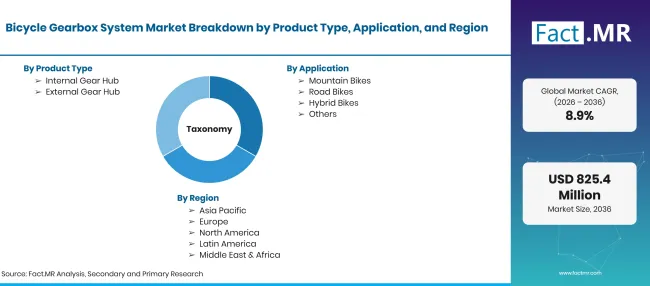
Factmr Bicycle Gearbox System Market Taxonomy | Source: Fact.MR
| Attribute | Details |
|---|---|
| Quantitative Units | USD Million in 2026 to USD Million by 2036 at 8.9% CAGR |
| Market Definition | Commercial shipments of sealed bicycle transmission systems, including multi-speed internal gear hubs, mid-frame central gearboxes, and continuously variable planetary drivetrains for bicycles and e-bikes. |
| Product Type | Internal Gear Hub; External Gear Hub |
| Application | Mountain Bikes; Road Bikes; Hybrid Bikes; Others |
| Distribution Channel | Offline Retail; Online Retail |
| End-User | Recreational Cyclists; Professional Cyclists |
| Regions Covered | North America; Latin America; Western Europe; Eastern Europe; East Asia; South Asia & Pacific; Middle East & Africa |
| Countries Covered | Japan; UK; USA; Germany; Brazil |
| Companies Profiled | Shimano Inc.; SRAM LLC; Rohloff AG; Pinion GmbH; Campagnolo S.r.l.; Effigear; Fallbrook Technologies Inc.; Nuvinci Cycling; SR Suntour Inc.; Microshift |
| Forecast Period | 2026 to 2036 |
| Approach | Primary interviews with bicycle frame designers, drivetrain engineers, e-bike system integrators, and independent bicycle retail owners combined with global bicycle production trade data audits. |
Source: Fact.MR analysis. Updated Oct 22, 2026
How is the market segmented?
-
By Product Type:
- Internal Gear Hub
- External Gear Hub
-
By Application:
- Mountain Bikes
- Road Bikes
- Hybrid Bikes
- Others
-
By Distribution Channel:
- Offline Retail
- Online Retail
-
By End-User:
- Recreational Cyclists
- Professional Cyclists
-
By Region:
- North America
- Latin America
- Western Europe
- Eastern Europe
- East Asia
- South Asia & Pacific
- Middle East & Africa
Frequently Asked Questions
How big is the bicycle gearbox system market in 2026?
What is the CAGR from 2026 to 2036?
Which product type leads?
Which application leads?
Which companies participate in bicycle gearbox systems?
Who worked on this report


Preview the report firsthand - request a free sample
Free SampleGet the brochure for pricing and purchase details
Download PDF