- Market Value (2025): USD 249.2 Mn
- Estimated Value (2026): USD 249.2 Mn
- Forecast Value (2036): USD 262.9 Mn
- CAGR (2026-2036): 5.5%
What is the Bicycle Pump Market forecast to be worth by 2036?
USD 262.9 million in 2026 to USD 449.1 million by 2036 at 5.5% CAGR.
- The bicycle pump market reached USD 249.2 million in 2025.
- Demand is projected to increase from USD 262.9 million in 2026 to USD 449.1 million by 2036.
- The market is forecast to record 5.5% CAGR from 2026 to 2036 as commuters and recreational riders keep inflation tools at home.
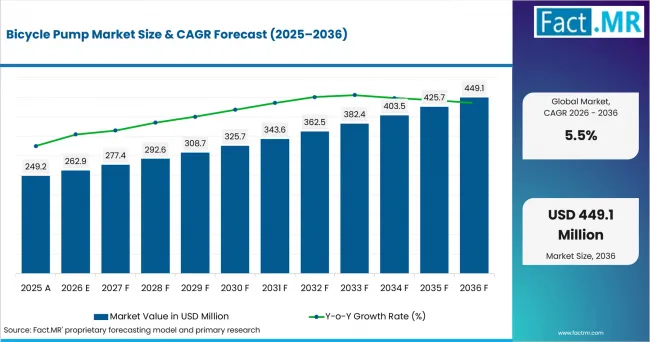
Bicycle Pump Market Value Analysis | Source: Fact.MR
What are the defining numbers behind Bicycle Pump Market growth?
USD 186.2 million absolute opportunity by 2036, led by Floor Bicycle Pumps, Metal Body Pump Systems and Individual Consumers.
- Demand Drivers in the Market
- Home riders need durable floor pumps because frequent pressure checks protect tire wear and riding comfort. BMV reported in April 2026 that 80% of Germans aged 14-69 used a bicycle or pedelec in 2025.
- Road cyclists rely on accurate gauges, so floor pump replacement is tied to pressure precision before rides.
- Specialty retailers benefit from pump add-on sales when new-bike buyers purchase repair kits.
- Service centers require sturdy metal bodies owing to repeated daily use across mixed tire valves. BTS reported in June 2026 that docked bikeshare trips on seven large U.S. systems rose 9.3% year on year in May 2026.
- Key Segments Analyzed
- By Product: Floor Bicycle Pumps is expected to hold 76.8% share in 2026 because workshop-style inflation remains the easiest home maintenance method.
- By Application: Road Cycling Applications is projected to account for 33.5% share in 2026 as road riders check pressure more often than casual utility users.
- By End Use: Individual Consumers is anticipated to capture 58.2% share in 2026 since most purchases are made for personal maintenance and ride preparation.
- By Technology: Manual Inflation Technology is estimated to represent 47.9% share in 2026 due to low price and familiar repair behavior.
- By Body Material: Metal Body Pump Systems is forecast to hold 69.4% share in 2026 owing to durability expectations for floor pumps and shop tools.
- By Distribution Channel: Offline Retail Channels is expected to account for 41.7% share in 2026 as shoppers often test gauges and hose fittings before purchase.
- Analyst Opinion at Fact.MR
- Shambhu Nath Jha, Principal Consultant at Fact.MR, states, “Bicycle pumps are simple products, yet selection depends on valve fit, gauge trust and body durability. Demand is expected to rise where riders treat tire pressure as routine maintenance. Suppliers should combine clear pressure readings with serviceable hoses and strong retail availability.”
- Strategic Implications
- Pump brands should make valve compatibility clear on packaging.
- Retailers should pair pumps with tubes and repair kits during bike sales.
- Service centers should stock metal-bodied pumps for heavy workshop use.
- Online sellers should show pressure range and valve head type.
Germany is projected to record 6.3% CAGR through 2036 supported by bicycle ownership. Brazil is expected to post 5.8% CAGR as urban mobility projects add cycle routes. The USA is anticipated to advance at 5.2% CAGR owing to bikeshare service needs. The UK is estimated to hold 4.7% CAGR as cycling miles remain part of active travel. Japan is forecast to reach 4.1% CAGR through station-area cycling infrastructure.
How does the Bicycle Pump Market break down by segment?
Floor Bicycle Pumps lead at 76.8%; Metal Body Pump Systems lead at 69.4%.
Which product dominates?
Floor Bicycle Pumps are projected to account for 76.8% share in 2026.
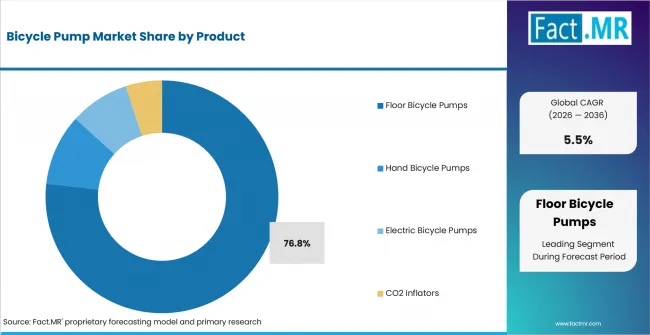
Bicycle Pump Market Analysis By Product | Source: Fact.MR
Floor bicycle pumps keep a wide share because they suit homes and service counters. Standard models serve casual riders, while high-pressure formats are selected by road cyclists. Hand pumps and CO2 inflators support roadside repair when riders need carry-friendly tools. Electric pumps are expected to gain attention where digital pressure setting reduces trial-and-error inflation.
What leads the Application segment?
Road Cycling Applications are expected to hold 33.5% share in 2026.
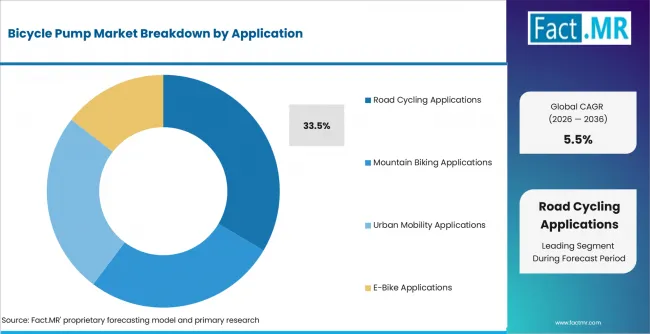
Bicycle Pump Market Analysis By Application | Source: Fact.MR
Road cycling applications lead because narrow tires need regular pressure checks. Recreational road cycling gives brands a volume base, while competitive road cycling raises demand for accurate gauges. Mountain biking requires higher-volume inflation and tougher portable pumps. Urban mobility applications are expected to add smaller but steady demand from commuters. In May 2026, UK DfT reported 3.7 billion pedal-cycle road miles in 2025, up 4.2% from 2024.
How does End Use shape demand?
Individual Consumers are anticipated to capture 58.2% share in 2026.
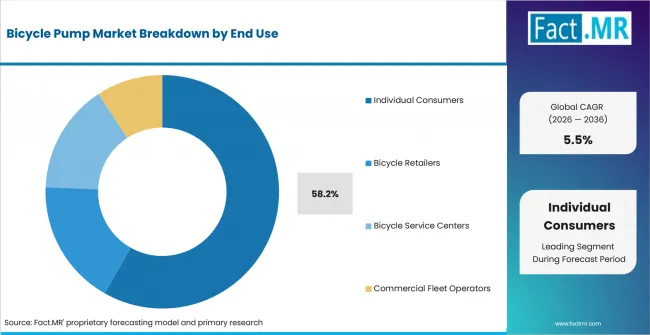
Bicycle Pump Market Analysis By End Use | Source: Fact.MR
Individual consumers account for the main demand base since pumps are purchased with bicycles and repair kits. Bicycle retailers and service centers buy fewer units, although they need stronger build quality. Fleet operators use pumps for shared bikes and workshop upkeep. The split keeps consumer packaging and service durability equally relevant.
What supports Manual Inflation Technology?
Manual Inflation Technology is estimated to represent 47.9% share in 2026.
Manual inflation technology stays ahead because it is low cost and familiar to riders. Electric inflation technology serves users who want fast pressure setting and auto-stop functions. Smart monitoring remains a smaller premium field tied to digital gauges. Valve compatibility improvements are expected to decide upgrades more often than pump size alone. In November 2025, Topeak detailed its E-Booster Digital Mini with a color display, preset pressure, auto-stop and 120 psi maximum pressure.
What supports Metal Body Pump Systems?
Metal Body Pump Systems are forecast to hold 69.4% share in 2026.
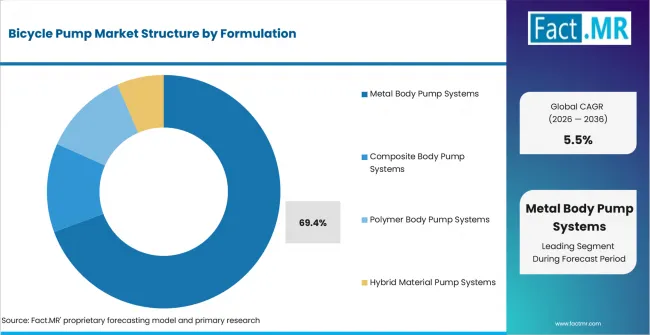
Bicycle Pump Market Analysis By Formulation | Source: Fact.MR
Metal body pump systems hold a wide share because shoppers associate metal barrels with stability and long service life. Aluminum systems help premium floor pumps balance lower weight with a rigid body. Steel systems suit workshop counters where repeated use is common. Composite and polymer bodies remain relevant for compact hand pumps and electric formats.
Which Distribution Channel leads?
Offline Retail Channels are expected to account for 41.7% share in 2026.
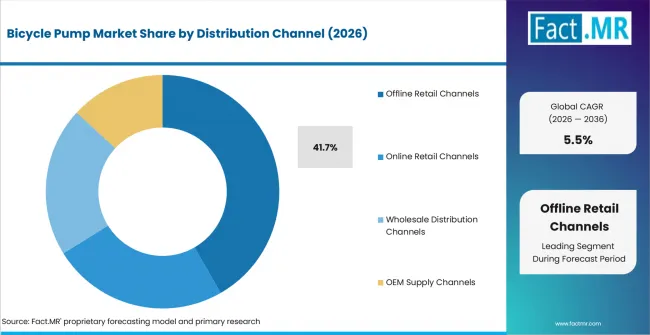
Bicycle Pump Market Analysis By Distribution Channel | Source: Fact.MR
Offline retail channels lead because shoppers compare valve heads and gauge readability before purchase. Specialty bicycle retailers retain a close link with premium floor pumps. Online channels serve compact electric pumps and brand-direct bundles. Digital listings need clear compatibility details because wrong valve-fit information increases returns.
What is accelerating Bicycle Pump Market adoption, and what is holding it back?
Routine tire maintenance drives it; low-cost substitutes restrain it.
Drivers Impact Analysis
| Driver | (~) % Impact on CAGR | Geographic Relevance | Impact Timeline |
|---|---|---|---|
| Home bicycle maintenance | +1.4% | Germany, USA, UK | Short term (<= 2 years) |
| Road cycling pressure checks | +1.1% | UK, Germany, Japan | Short term (<= 2 years) |
| E-bike ownership | +0.9% | Germany, Japan, USA | Medium term (2-4 years) |
| Service-center replacement | +0.7% | USA, Brazil, Japan | Medium term (2-4 years) |
| Valve compatibility upgrades | +0.5% | Europe, USA, Japan | Long term (>= 4 years) |
Source: Fact.MR analysis. Updated Aug 12, 2026
- Home bicycle maintenance: Floor pumps are expected to benefit when households maintain several bicycles and want one reliable gauge at home.
- Road cycling pressure checks: Road riders check pressure before more rides, so accurate gauge performance is projected to guide premium floor pump selection.
- E-bike ownership: Heavier commuter bicycles are anticipated to raise interest in sturdy pumps and compact electric inflators for routine pressure correction.
Opportunity Impact Analysis
| Opportunity | (~) % Impact on CAGR | Geographic Relevance | Impact Timeline |
|---|---|---|---|
| Compact electric inflators | +0.8% | USA, Germany, Japan | Short term (<= 2 years) |
| Valve compatibility upgrades | +0.6% | Europe, USA, Japan | Medium term (2-4 years) |
| Fleet maintenance kits | +0.5% | USA, Brazil | Medium term (2-4 years) |
| Brand-direct bundles | +0.3% | Global online channels | Long term (>= 4 years) |
Source: Fact.MR analysis. Updated Aug 12, 2026
- Compact electric inflators: Digital pressure setting is expected to open premium demand among riders who want quick inflation without carrying a large pump.
- Valve compatibility upgrades: Universal heads and Clik-ready parts are forecast to reduce user frustration during roadside repairs and shop demonstrations.
- Fleet maintenance kits: Bike-sharing and delivery operators are likely to purchase pumps as part of workshop kits where daily tire checks reduce downtime.
Restraints Impact Analysis
| Restraint | (~) % Impact on CAGR | Geographic Relevance | Impact Timeline |
|---|---|---|---|
| Long replacement cycle | -0.8% | Global | Short term (<= 2 years) |
| Low-cost imports | -0.6% | USA, Brazil, UK | Short term (<= 2 years) |
| Electric pump battery limits | -0.4% | Japan, Germany, USA | Medium term (2-4 years) |
| Valve-fit confusion | -0.3% | Online channels | Long term (>= 4 years) |
Source: Fact.MR analysis. Updated Aug 12, 2026
- Long replacement cycle: Durable pumps last for years, so repeat purchases are constrained unless hoses, gauges or valve heads fail.
- Low-cost imports: Entry-level pumps keep average selling prices under pressure and make premium upgrades harder for casual riders.
- Electric pump battery limits: Battery capacity and heat during repeated inflation are estimated to slow adoption in workshop-heavy use.
Which countries are scaling Bicycle Pump Market fastest?
The country comparison spans 2.2 percentage points and forms three practical growth bands across the forecast period.
- Germany remains 0.5 percentage point above Brazil through high bicycle ownership, regular cycling activity and strong home-maintenance demand.
- Brazil remains 0.6 percentage point above the USA as urban mobility projects, repair-access needs and regional distributor activity support pump demand.
- The USA remains 0.5 percentage point above the UK through bikeshare servicing, specialty retail depth and demand for compact inflation tools.
- The UK remains 0.6 percentage point above Japan as active-travel cycling and retail replacement support regular pump purchases.
- Japan closes the displayed range through urban cycling infrastructure, station-area parking and demand for compact inflation products.
Comparable CAGRs can create different entry conditions due to bicycle ownership, cycling activity, replacement cycles, retail access and valve-compatibility needs. Full report coverage includes North America, Latin America, Europe, East Asia, South Asia and Pacific, Middle East and Africa.
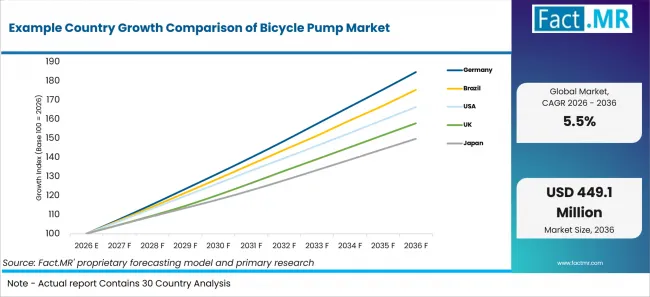
Example Country Growth Comparison Of Bicycle Pump Market | Source: Fact.MR
| Country | CAGR (2026-2036) |
|---|---|
| Germany | 6.3% |
| Brazil | 5.8% |
| USA | 5.2% |
| UK | 4.7% |
| Japan | 4.1% |
Source: Fact.MR analysis. Updated Aug 12, 2026
What supports Germany adoption?
6.3% CAGR through 2036, supported by household bicycle ownership and e-bike use.
Germany’s growth reflects a large installed bicycle base and regular cycling activity that support home maintenance and premium pump purchases. BMV reported that 41% of people aged 14 to 69 used a bicycle or pedelec regularly in 2025. Specialty retail and metal-body pumps support demand, while low-priced imports, cyclist safety concerns and uncertainty around electric inflator batteries can limit upgrades.
How is Brazil scaling demand?
5.8% CAGR through 2036, driven by urban mobility and repair-access needs.
Brazil’s growth is supported by mobility investment and bicycle use in areas where two-wheel access remains important. Basic hand pumps and wholesale channels support demand, while income sensitivity, uneven retail coverage and informal workshop conditions can restrain premium purchases.
How does the USA perform?
5.2% CAGR through 2036, backed by bikeshare use and specialty retail depth.
The USA’s growth reflects active bikeshare systems, specialty retail and growing demand for compact pumps and CO2 inflators. BTS reported docked bikeshare trips on six large systems grew 17.1% from January 2024 to January 2025, while NYC DOT said electric Citi Bike ridership surpassed 29 million trips in 2024. Retail visibility supports pump purchases, while low-cost online listings, existing household ownership and uneven bikeshare trends can slow replacement.
What supports UK demand?
4.7% CAGR through 2036, supported by active-travel cycling and retail replacement.
The UK’s growth is supported by active travel and household bicycle purchasing that keeps pump attachment demand visible. The Department for Transport recorded 53 cycling miles per person in England during 2024, up 12%. Specialty retail supports bundled purchases, while wet-weather seasonality, limited storage and lower cycling access among older consumers can restrain demand.
How is Japan developing demand?
4.1% CAGR through 2036, led by urban cycling infrastructure and station parking.
Japan’s growth reflects urban cycling infrastructure and policy support for everyday bicycle use. Japan’s Statistics Bureau reported that people aged 65 and over represented 29.4% of the population in 2025. Compact pumps and authorized bicycle stores support replacement demand, while aging demographics, small-home storage constraints and price resistance to electric inflators can limit growth.
Who leads the Bicycle Pump Market?
Topeak and Lezyne lead direct bicycle pump coverage, while SILCA and Blackburn Design strengthen premium and specialty retail supply.
Topeak has direct relevance through floor pumps, hand pumps, gauges and compact electric inflation products. Lezyne supports the market through floor pumps, hand pumps, CO2 systems and valve-head updates. SILCA serves the premium end through rebuildable parts and pressure accuracy.
Blackburn Design, Co-Luck Enterprise Co., Ltd. (GIYO) completes the profiled provider set. Blackburn Design supports specialty retail, Co-Luck Enterprise Co., Ltd. (GIYO) is active in pump manufacturing. Competition is expected to center on valve compatibility, gauge clarity, electric inflation speed and retail availability.
Which companies are the key providers?
Topeak and Lezyne are key providers. SILCA and Blackburn Design are also profiled. Co-Luck Enterprise Co., Ltd. (GIYO) completes the company set.
- Topeak
- Blackburn Design
- Lezyne
- SILCA
- Co-Luck Enterprise Co., Ltd. (GIYO)
Bibliography
- Department for Transport. (2025, August 27). NTS 2024: Active travel.
- Department for Transport. (2025, August 27). NTS 2024: Factsheet.
- Statistisches Bundesamt (Destatis). (2026, April 27). Jedes sechste Todesopfer im Straßenverkehr 2025 war mit dem Fahrrad unterwegs [Every sixth person killed in road traffic in 2025 was travelling by bicycle].
- Instituto Brasileiro de Geografia e Estatística. (2025, December 5). Censo Demográfico 2022: Favelas e Comunidades Urbanas—Características urbanísticas do entorno dos domicílios: Resultados do Universo.
- Instituto Brasileiro de Geografia e Estatística. (2026, February 27). IBGE releases per capita household earnings 2025 for Brazil and Federation Units.
- Lezyne Engineered Design. (2025, April 16). Lezyne & Clik Valve unite.
- Bureau of Transportation Statistics. (2025, February 11). Docked bikeshare trips—January 2025.
This Report Addresses
- The report provides strategic intelligence on the Bicycle Pump Market across Product and Application choices.
- Segment analysis covers Floor Bicycle Pumps and Metal Body Pump Systems as the share leaders within the 2026 market.
- Country outlook evaluates Germany, Brazil, the USA, the UK and Japan.
- Competitive analysis profiles Topeak, Blackburn Design, Lezyne, SILCA, Co-Luck Enterprise Co., Ltd. (GIYO).
- Product assessment covers floor pumps, hand pumps, electric bicycle pumps and CO2 inflators.
- Application assessment covers road cycling, mountain biking, urban mobility and e-bike use.
- The forecast is supported by provider checks, official sources and interviews.
What does the Bicycle Pump Market cover?
Floor pumps, hand pumps, electric inflators and CO2 inflators for bicycle tire inflation.
The Bicycle Pump Market covers products used to inflate bicycle tires across home, retail and service settings. It includes pumps sold for road bicycles, commuter bicycles and e-bikes.
The market is part of the broader bicycle accessories field but excludes unrelated maintenance products. Pumps sold with bicycle bundles are included only when inflation equipment is identifiable.
What is included in the scope?
Bicycle pump systems used by consumers, retailers, service centers and fleet operators.
Coverage includes floor pumps, hand pumps, electric pumps and CO2 inflators. The scope also includes valve heads, gauges and pump bodies sold as part of complete inflation products. Demand is linked to bicycle accessories, while component replacement connects the category with bicycle components and sensor-enabled add-ons in smart bicycle accessories.
What is excluded from the scope?
General bicycle tools and unrelated tire accessories are outside the scope.
The scope excludes lubricants, chain tools, tire sealant sold alone, bicycle tubes and unrelated workshop tools. Automotive air compressors are excluded unless sold for bicycles.
How Was the Analysis Built?
120+ sources, 35+ company portfolios and more than 20 interviews across 25+ countries.
- Primary Research: Primary research includes discussions with bicycle retailers, service centers, distributors, pump brands and repair technicians. These conversations examine product selection, valve issues and replacement timing.
- Desk Research: Desk research covers government statistics and transport data. It also reviews company product pages, official announcements and public policy sources.
- Market Sizing and Forecasting: Market estimates combine historical values with replacement cycles and ownership patterns. Cycling activity, pump pricing and provider participation are checked separately.
- Data Validation and Update Cycle: Findings are validated by comparing interviews with public data, product launches, retail listings and company portfolios. Updates review pump formats and channel shifts.
Segmentation
What is the report's scope and coverage?
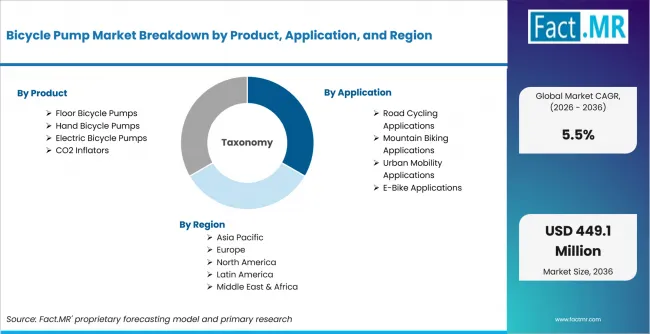
Bicycle Pump Market Breakdown By Product, Application, And Region | Source: Fact.MR
| Attribute | Details |
|---|---|
| Quantitative Units | USD million |
| Market Definition | Floor pumps, hand pumps, electric bicycle pumps and CO2 inflators used to inflate bicycle tires in home, retail, service and fleet settings |
| Product | Floor Bicycle Pumps; Hand Bicycle Pumps; Electric Bicycle Pumps; CO2 Inflators |
| Application | Road Cycling Applications; Mountain Biking Applications; Urban Mobility Applications; E-Bike Applications |
| End Use | Individual Consumers; Bicycle Retailers; Bicycle Service Centers; Commercial Fleet Operators |
| Technology | Manual Inflation Technology; Electric Inflation Technology; Smart Monitoring Technology; Valve Compatibility Technology |
| Body Material | Metal Body Pump Systems; Composite Body Pump Systems; Polymer Body Pump Systems; Hybrid Material Pump Systems |
| Distribution Channel | Offline Retail Channels; Online Retail Channels; Wholesale Distribution Channels; OEM Supply Channels |
| Regions Covered | North America; Latin America; Europe; East Asia; South Asia and Pacific; Middle East and Africa |
| Countries Covered | Germany; Brazil; USA; UK; Japan |
| Key Companies Profiled | Topeak; Blackburn Design; Lezyne; SILCA; Co-Luck Enterprise Co., Ltd. (GIYO) |
| Forecast Period | 2026 to 2036 |
| Approach | Hybrid top-down and bottom-up approach using bicycle ownership, cycling activity, pump replacement cycles, segment shares, retail channels, country adoption patterns and company portfolio review |
Source: Fact.MR analysis. Updated Aug 12, 2026
How is the market segmented?
-
By Product:
- Floor Bicycle Pumps
- Standard Floor Pumps
- High Pressure Floor Pumps
- Hand Bicycle Pumps
- Mini Hand Pumps
- High Volume Hand Pumps
- Electric Bicycle Pumps
- Cordless Electric Pumps
- Smart Electric Pumps
- CO2 Inflators
- Compact CO2 Inflators
- Performance CO2 Inflators
- Floor Bicycle Pumps
-
By Application:
- Road Cycling Applications
- Recreational Road Cycling
- Competitive Road Cycling
- Mountain Biking Applications
- Trail Riding Applications
- Urban Mobility Applications
- Daily Commuting Applications
- E-Bike Applications
- Road Cycling Applications
-
By End Use:
- Individual Consumers
- Recreational Cyclists
- Performance Cyclists
- Bicycle Retailers
- Bicycle Service Centers
- Commercial Fleet Operators
- Individual Consumers
-
By Technology
- Manual Inflation Technology
- Piston Driven Systems
- Electric Inflation Technology
- Smart Monitoring Technology
- Valve Compatibility Technology
- Manual Inflation Technology
-
By Body Material
- Metal Body Pump Systems
- Aluminum Pump Systems
- Steel Pump Systems
- Composite Body Pump Systems
- Polymer Body Pump Systems
- Hybrid Material Pump Systems
- Metal Body Pump Systems
-
By Distribution Channel
- Offline Retail Channels
- Specialty Bicycle Retailers
- Sporting Goods Retailers
- Online Retail Channels
- E-Commerce Platforms
- Wholesale Distribution Channels
- OEM Supply Channels
- Offline Retail Channels
-
By Region:
- Europe
- Germany
- UK
- Latin America
- Brazil
- North America
- USA
- East Asia
- Japan
Frequently Asked Questions
How big is the bicycle pump market in 2026?
What is the CAGR of the bicycle pump market from 2026 to 2036?
Which product leads the bicycle pump market?
Which application leads the bicycle pump market?
Who are the leading companies in the bicycle pump market?
Who worked on this report


Preview the report firsthand - request a free sample
Free SampleGet the brochure for pricing and purchase details
Download PDF