
- Market Value (2025): USD 210.0 Mn
- Estimated Value (2026): USD 219.4 Mn
- Forecast Value (2036): USD 350.7 Mn
- CAGR (2026-2036): 4.8%
Binocular Polarizing Microscope Market Forecast and Outlook 2026 to 2036
The binocular polarizing microscope market is anticipated to grow from USD 219.4 million in 2026 to USD 350.7 million by 2036, registering a CAGR of 4.8% over the ten-year period.
Demand for binocular polarizing microscopes is increasing as geological laboratories, universities and materials research facilities require accurate observation of minerals, rocks and other anisotropic specimens. Manufacturers are introducing instruments with improved illumination, ergonomic designs and digital imaging capabilities. On May 6, 2025, Leica Microsystems launched its Visoria series, including the Visoria P polarization microscope, offered with a binocular phototube or as an eyepiece-free digital configuration, for geological samples and materials analysis.
Key Takeaways from Binocular Polarizing Microscope Market
- Binocular Polarizing Microscope Market Value (2025): USD 210.0 million
- Binocular Polarizing Microscope Market Value (2026): USD 219.4 million
- Binocular Polarizing Microscope Market Forecast Value (2036): USD 350.7 million
- Binocular Polarizing Microscope Market Forecast CAGR (2026-2036): 4.8%
- Leading Application: Geology and mineralogy (28.0%)
- Key Market Participants: Evident Corporation, Carl Zeiss, Leica Microsystems, Nikon, Motic
- Key Growth Countries: India, China, South Korea, United Kingdom, United States
In April 2026, India's Ministry of Mines reported that the Geological Survey of India undertook 458 mineral exploration projects during its 2025-2026 field season, including 230 focused on critical minerals. Geological investigations create applications for polarizing microscopes in the examination of mineral properties and prepared rock thin sections. Universities, geological laboratories and research institutions use these instruments to study optical characteristics and identify mineral constituents.
Binocular Polarizing Microscope Market
| Metric | Value |
|---|---|
| Estimated Value in (2026) | USD 219.4 million |
| Forecast Value in (2036) | USD 350.7 million |
| Forecast CAGR (2026 to 2036) | 4.8% |
Source: Fact.MR analysis. Updated Nov 27, 2026
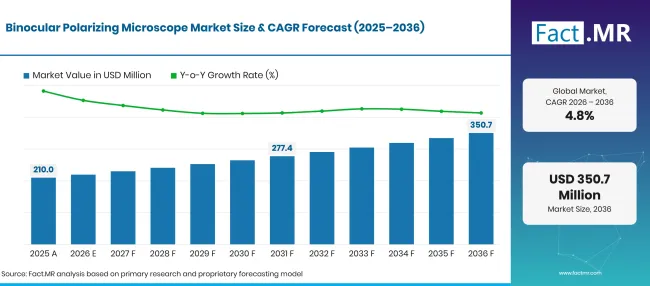
Binocular Polarizing Microscope Market Forecast Global | Source: Fact.MR
Category
| Category | Segments |
|---|---|
| Application | Geology and mineralogy, Education and teaching, Materials and polymer science, Forensics and pharmaceuticals, Gemmology and jewellery |
| Light Path | Transmitted-light, Transmitted and reflected light, Reflected-light, Research-grade with conoscopic accessories |
| Imaging Configuration | Eyepiece only, With camera port, Digital imaging, Motorised and automated |
| End User | Universities and schools, Industrial and quality laboratories, Mining and exploration companies, Government and forensic laboratories, Gem and jewellery laboratories |
| Country | India; China; South Korea; United Kingdom; United States |
Source: Fact.MR analysis. Updated Nov 27, 2026
Segmental Analysis
What makes geology and mineralogy the leading application segment in the Binocular Polarizing Microscope Market?
Binocular Polarizing Microscope Market Breakdown Application | Source: Fact.MR
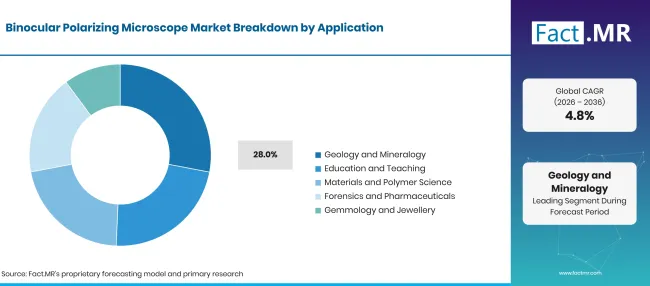
Geology and mineralogy account for 28.0% of market revenue in 2026, approximately USD 61.4 million. Polarizing microscopes help geologists identify minerals and examine the optical properties of rock thin sections. Leica Microsystems offers the Visoria P microscope for geological samples and materials analysis, supporting laboratory investigations involving mineral composition, crystal characteristics and rock structures.
Which factors support transmitted-light as the largest light path segment in the Binocular Polarizing Microscope Market?
Binocular Polarizing Microscope Market Breakdown Light Path | Source: Fact.MR
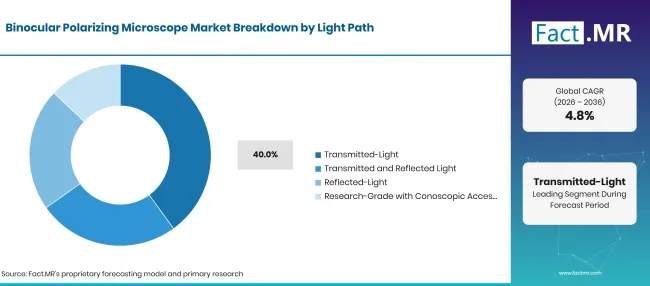
Transmitted-light polarizing microscopes generate approximately USD 87.8 million in 2026, representing 40.0% of market revenue. Their illumination systems allow light to pass through transparent specimens and prepared mineral sections. Nikon's ECLIPSE Ci-POL is a compact polarizing microscope for transmitted-light observation, with an optional episcopic illuminator, making this configuration suitable for examining mineral textures, optical properties and crystalline structures in geological laboratories.
What makes eyepiece only the leading imaging configuration segment in the Binocular Polarizing Microscope Market?
Binocular Polarizing Microscope Market Breakdown Imaging Configuration | Source: Fact.MR
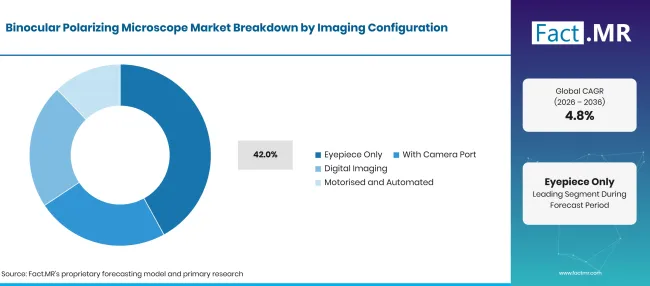
Eyepiece-only configurations hold a 42.0% revenue share in 2026, with sales reaching approximately USD 92.1 million. These microscopes allow researchers and students to observe specimens directly through binocular viewing heads without additional imaging equipment. Nikon offers binocular tube configurations for its ECLIPSE Ci-POL, supporting routine visual examinations in teaching and laboratory environments.
Which factors support universities and schools as the largest end user segment in the Binocular Polarizing Microscope Market?
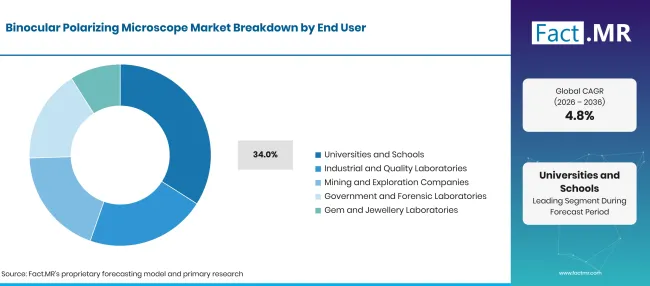
Binocular Polarizing Microscope Market Breakdown End User | Source: Fact.MR
Universities and schools contribute 34.0% of binocular polarizing microscope revenue in 2026, equivalent to approximately USD 74.6 million. Educational institutions use these instruments to teach optical mineralogy, petrography and materials science through practical specimen examination. Students observe mineral interference colours, crystal features and rock textures, gaining experience with polarized-light techniques used in geological research.
Binocular Polarizing Microscope Market: Drivers, Restraints and Trends
Drivers
Growing requirements for mineral identification, geological research and materials characterization support purchases of binocular polarizing microscopes. These instruments reveal optical properties of anisotropic specimens, including crystals and polymers. Leica Microsystems offers the Visoria P for examining geological samples and industrial materials.
Restraints
Long equipment service lives and limited laboratory budgets influence purchasing decisions among universities and research institutions. Alternative analytical techniques can also affect equipment selection. Maintenance requirements, specialized optical accessories and the availability of trained laboratory personnel add to operating costs for smaller facilities.
Trend
Digital Imaging: Manufacturers are incorporating compatible camera systems into polarizing microscopes to support specimen documentation and image analysis. Leica Microsystems offers Visoria P configurations with FLEXACAM cameras for geological applications. Digital imaging allows laboratories to capture mineral textures, preserve observations and share examination results.
Trend
Education Applications: Universities and teaching laboratories use polarizing microscopes to demonstrate crystal properties, mineral identification and optical behaviour under polarized illumination. Nikon offers the ECLIPSE E200 POL for educational applications. Practical microscopy sessions help students examine prepared rock sections and understand fundamental geological structures.
Binocular Polarizing Microscope Market Analysis by Key Country
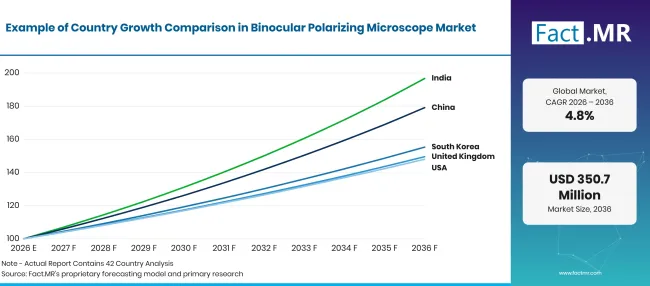
Binocular Polarizing Microscope Market Growth Index | Source: Fact.MR
| Country | CAGR (2026-2036) |
|---|---|
| India | 7.0% |
| China | 6.0% |
| South Korea | 4.5% |
| United Kingdom | 4.1% |
| United States | 4.0% |
Source: Fact.MR analysis.
Why is India the fastest-growing market for binocular polarizing microscopes?
Geological exploration and laboratory education provide opportunities for binocular polarizing microscope sales in India, where demand is forecast to rise at a 7.0% CAGR by 2036.
In April 2026, the Ministry of Mines reported that the Geological Survey of India undertook 458 mineral exploration projects during its 2025-2026 field season. Such investigations create opportunities for petrographic examination of rock samples. Universities also use polarized-light microscopy to teach mineral identification, crystal behaviour and thin-section interpretation.
What is shaping binocular polarizing microscopes demand in China?
Sales of binocular polarizing microscopes in China are anticipated to advance at a 6.0% CAGR over the next decade.
China's geological research programmes cover mineral deposits, rock formations and resource characterization. On 8 January 2025, the China Geological Survey announced lithium discoveries that raised China's share of global lithium reserves from 6% to 16.5%. Mineral research provides applications for optical examination of crystalline materials.
How is demand for binocular polarizing microscopes developing in South Korea?
Materials research provides a distinct source of demand for binocular polarizing microscopes in South Korea.
Sales are anticipated to increase at a 4.5% CAGR through 2036, compared with the worldwide rate of 4.8%. In 2025, the Korea Institute of Geoscience and Mineral Resources published a dataset examining the mineralogical characteristics of hydrothermally altered clay deposits in southwestern Korea. Research involving clay minerals and crystalline structures creates applications for polarized-light observation.
What is driving binocular polarizing microscopes demand in the United Kingdom?
Demand for binocular polarizing microscopes in the United Kingdom is anticipated to expand at a 4.1% CAGR over the forecast period.
The British Geological Survey holds roughly 190,000 sliced rock specimens in its national and international petrology collections, and makes polarising microscopes available for examining the thin sections. Universities and geological laboratories require polarizing instruments to examine mineral relationships, crystal orientation and rock formation histories.
Why is growth slower for binocular polarizing microscopes in the United States?
Established geological laboratories and university teaching facilities shape binocular polarizing microscope purchases in the United States.
The country's forecast CAGR of 4.0% is the lowest among the five countries. In August 2026, the U.S. National Science Foundation published its consolidated GEO Core funding opportunity for geoscience research, effective 17 August 2026, which includes an Earth Sciences program. Geological research and teaching laboratories use polarized-light examination to study prepared mineral specimens. For facilities with existing equipment, purchases may focus on instrument replacement, improved illumination and compatible digital imaging systems.
Competitive Landscape for Binocular Polarizing Microscope Market
Competition in binocular polarizing microscopes centers on optical precision, illumination flexibility and specialized accessories for mineral and materials examination. Nikon offers the ECLIPSE Ci-POL and LV100N POL LED with binocular viewing options, while Evident Corporation supplies the BX53-P for polarized-light observation, offered with trinocular tubes that add a camera port. Carl Zeiss offers the Axiolab 5 Pol with binocular phototubes for polarized transmitted-light work. Motic's BA310 POL serves geological and educational laboratories through transmitted-light microscopy. Leica Microsystems expanded its offering in May 2025 with the Visoria P, designed for examining anisotropic materials and geological specimens.
Instrument selection depends on polarization quality, rotating-stage accuracy, objective performance and ease of specimen observation. Research laboratories may prefer advanced conoscopic capabilities, while teaching institutions consider durable binocular configurations and straightforward operation. Manufacturers also differentiate their products through compatible cameras, optical accessories and technical support for specialized microscopy applications.
Recent Developments
- In May 2025, Leica Microsystems launched the Visoria series of upright microscopes, including the Visoria P polarization microscope for studying the optical properties of anisotropic materials and geological samples.
- In March 2025, Nikon launched the ECLIPSE LV100N POL LED, a polarizing microscope with episcopic and diascopic illumination for mineralogical and rock study, as part of its new ECLIPSE LV series.
Key Players in Binocular Polarizing Microscope Market
Key companies operating in the market include Evident Corporation, Carl Zeiss, Leica Microsystems, Nikon, and Motic.
- Evident Corporation
- Carl Zeiss
- Leica Microsystems
- Nikon
- Motic
Bibliography
- British Geological Survey. (n.d.). Petrology collections.
- China Geological Survey. (2025, January 8). Major breakthrough in China’s lithium exploration reshapes global lithium resource landscape.
- Korea Institute of Geoscience and Mineral Resources. (2025). Mineralogical dataset of hydrothermally altered clay deposits from Seongsan and Ogmaesan Mines, Haenam Area, Southwestern Korea.
- Leica Microsystems. (2025, May 6). New upright microscopes for enhanced user efficiency and comfort. leica-microsystems.com
- Ministry of Mines, Government of India. (2026, April 2). Geological Survey of India concludes Field Season 2025–26 with major achievements in mineral exploration and critical resource assessment.
- Nikon Corporation. (2025, March 12). Nikon launches new ECLIPSE LV Series microscopes.
- U.S. National Science Foundation. (2026, August 24). A new funding opportunity for core geoscience research.
Segmentation
Scope of Report
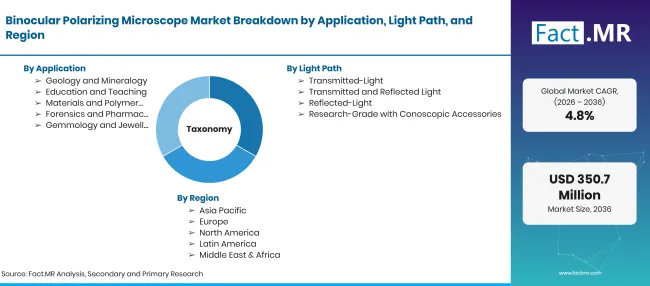
Binocular Polarizing Microscope Market Taxonomy | Source: Fact.MR
| Items | Values |
|---|---|
| Quantitative Units (2026) | USD 219.4 Million |
| Application | Geology and mineralogy, Education and teaching, Materials and polymer science, Forensics and pharmaceuticals, Gemmology and jewellery |
| Light Path | Transmitted-light, Transmitted and reflected light, Reflected-light, Research-grade with conoscopic accessories |
| Imaging Configuration | Eyepiece only, With camera port, Digital imaging, Motorised and automated |
| End User | Universities and schools, Industrial and quality laboratories, Mining and exploration companies, Government and forensic laboratories, Gem and jewellery laboratories |
| Regions Covered | North America, Latin America, Europe, Asia Pacific, Middle East & Africa |
| Countries Covered | India, China, South Korea, United Kingdom, United States, and other countries |
| Key Companies Profiled | Evident Corporation, Carl Zeiss, Leica Microsystems, Nikon, Motic |
| Additional Attributes | Dollar revenue in the Binocular Polarizing Microscope Market is segmented by application, light path, imaging configuration and end user and region. |
Source: Fact.MR analysis. Updated Nov 27, 2026
Binocular Polarizing Microscope Market by Segments
-
Application
- Geology and mineralogy
- Education and teaching
- Materials and polymer science
- Forensics and pharmaceuticals
- Gemmology and jewellery
-
Light Path
- Transmitted-light
- Transmitted and reflected light
- Reflected-light
- Research-grade with conoscopic accessories
-
Imaging Configuration
- Eyepiece only
- With camera port
- Digital imaging
- Motorised and automated
-
End User
- Universities and schools
- Industrial and quality laboratories
- Mining and exploration companies
- Government and forensic laboratories
- Gem and jewellery laboratories
-
Region:
- North America
- United States
- Canada
- Mexico
- Europe
- Germany
- United Kingdom
- France
- Italy
- Spain
- Rest of Europe
- Asia Pacific
- China
- India
- Japan
- South Korea
- Australia and New Zealand
- Rest of Asia Pacific
- Latin America
- Brazil
- Argentina
- Rest of Latin America
- Middle East & Africa
- GCC Countries
- South Africa
- Rest of Middle East & Africa
- North America
Table of Contents
Key Takeaways
- Market Size and CAGR
- Top Growth Driver
- Fastest Growing Segment
- Leading Region
- Key Companies
- Emerging Opportunities

