
- Market Value (2025): USD 800.0 Mn
- Estimated Value (2026): USD 844.0 Mn
- Forecast Value (2036): USD 1483.2 Mn
- CAGR (2026-2036): 5.8%
Capillary Columns Market Forecast and Outlook 2026 to 2036
The capillary column market is expected to increase from USD 844.0 million in 2026 to USD 1,483.2 million by 2036, reflecting a CAGR of 5.8% over the ten-year period.
Demand for capillary columns is increasing as environmental, pharmaceutical and food safety laboratories require accurate separation of complex chemical mixtures. Manufacturers are developing gas chromatography columns with improved inertness, lower detection limits and longer service life. In January 2026, Restek launched its RMX GC columns featuring TriMax deactivation technology, designed to reduce unwanted interactions between analytes and column surfaces.
Key Takeaways from Capillary Columns Market
- Capillary Columns Market Value (2025): USD 800.0 million
- Capillary Columns Market Value (2026): USD 844.0 million
- Capillary Columns Market Forecast Value (2036): USD 1,483.2 million
- Capillary Columns Market Forecast CAGR (2026-2036): 5.8%
- Leading Stationary Phase: Low-polarity polysiloxane (34.0%)
- Key Market Participants: Agilent Technologies, Thermo Fisher Scientific, Merck KGaA, Restek, Phenomenex
- Key Growth Countries: India, China, South Korea, United States, United Kingdom
In August 2026, the final annual report of the UK's Expert Committee on Pesticide Residues in Food noted that the Health and Safety Executive had reported on 3,550 food and drink samples tested for up to 427 pesticide residues each during 2025. Such monitoring activities create requirements for sensitive analytical methods capable of separating and identifying chemical residues in complex food samples. Gas chromatography laboratories use capillary columns with suitable stationary phases and low-bleed characteristics for compatible pesticide analyses.
Capillary Columns Market
| Metric | Value |
|---|---|
| Estimated Value in (2026) | USD 844.0 million |
| Forecast Value in (2036) | USD 1,483.2 million |
| Forecast CAGR (2026 to 2036) | 5.8% |
Source: Fact.MR analysis. Updated Nov 27, 2026
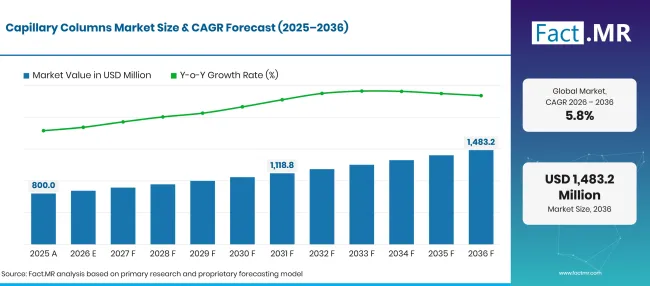
Capillary Columns Market Forecast Global | Source: Fact.MR
Category
| Category | Segments |
|---|---|
| Stationary Phase | Low-polarity polysiloxane, Mid-polarity phases, Polar wax phases, Chiral and other specialty phases, Porous-layer open tubular |
| Inner Diameter | 0.25 mm, 0.32 mm, 0.10 to 0.18 mm, 0.53 mm and wider |
| Application | Environmental and food safety, Petrochemical and energy, Pharmaceutical and life science, Academic research and other, Forensics and clinical |
| End User | Contract and testing laboratories, Industrial quality control laboratories, Pharmaceutical and biotechnology companies, Academic and government laboratories |
| Country | India; China; South Korea; United States; United Kingdom |
Source: Fact.MR analysis. Updated Nov 27, 2026
Segmental Analysis
What makes low-polarity polysiloxane the leading stationary phase segment in the Capillary Columns Market?
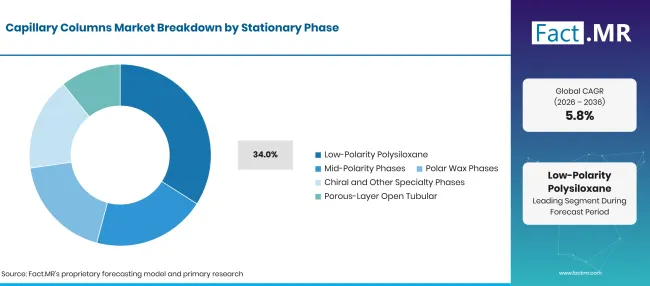
Capillary Columns Market Breakdown Stationary Phase | Source: Fact.MR
Low-polarity polysiloxane columns account for 34.0% of market revenue in 2026, approximately USD 287.0 million. Their stationary-phase chemistry supports gas chromatography separation of many volatile and semivolatile compounds. Agilent Technologies offers HP-5ms columns containing a 5% phenyl-methylpolysiloxane phase, with low-bleed characteristics suitable for GC-MS applications requiring sensitive chemical detection.
Which factors support 0.25 mm as the largest inner diameter segment in the Capillary Columns Market?
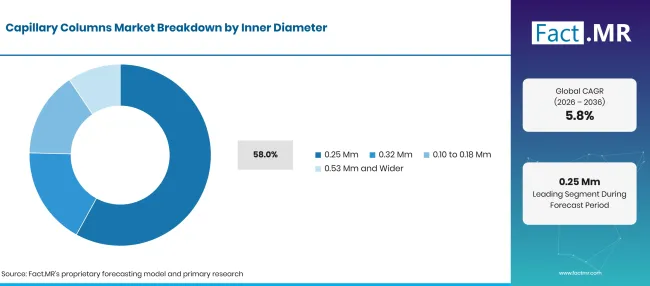
Capillary Columns Market Breakdown Inner Diameter | Source: Fact.MR
A 0.25 mm inner diameter represents 58.0% of capillary column revenue in 2026, equivalent to approximately USD 489.5 million. This configuration provides a practical balance between chromatographic efficiency, sample capacity and carrier gas requirements. Agilent's VF-Xms columns are available in 0.25 mm configurations, supporting compatibility with widely used gas chromatography instruments.
What makes environmental and food safety the leading application segment in the Capillary Columns Market?
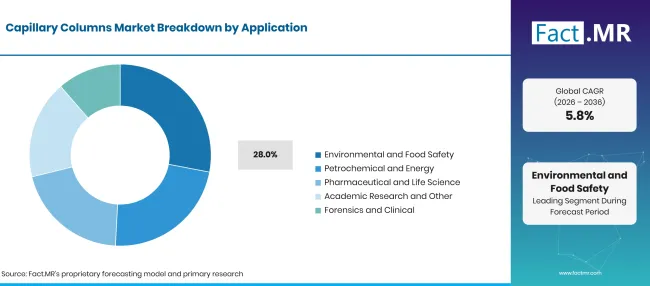
Capillary Columns Market Breakdown Application | Source: Fact.MR
Environmental and food safety applications generate approximately USD 236.3 million in 2026, representing 28.0% of market revenue. Laboratories use capillary columns to separate pesticide residues, volatile organic compounds and other chemicals suitable for gas chromatography analysis. Restek supplies specialized GC columns for environmental testing and food safety applications requiring reliable compound separation.
Which factors support contract and testing laboratories as the largest end user segment in the Capillary Columns Market?
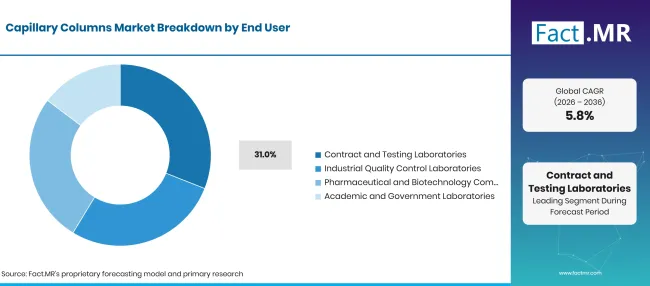
Capillary Columns Market Breakdown End User | Source: Fact.MR
Contract and testing laboratories contribute 31.0% of capillary column revenue in 2026, approximately USD 261.6 million. These facilities conduct chemical analyses for clients across food, environmental and industrial sectors. Repeated sample testing can expose columns to contamination, making periodic maintenance and replacement necessary to preserve chromatographic performance and reliable analytical results.
Capillary Columns Market: Drivers, Restraints and Trends
Drivers
Demand for capillary columns is supported by routine chemical testing in pharmaceutical, environmental and food safety laboratories. Gas chromatography requires stationary phases suited to specific compounds. Frequent sample analysis can cause column contamination, creating replacement requirements to maintain separation quality and analytical accuracy.
Restraints
Competition from liquid chromatography and lower-priced column suppliers influences purchasing decisions among analytical laboratories. Method-specific column qualification can increase testing costs and limit supplier changes. Laboratories must also consider stationary-phase compatibility, instrument specifications and reproducibility before selecting replacement capillary columns.
Trend
Low-Bleed and Inert Columns: Manufacturers are improving stationary-phase inertness to support sensitive GC-MS measurements of challenging compounds. In January 2026, Restek introduced RMX columns featuring TriMax deactivation technology. The design reduces unwanted surface interactions, improving peak shape and reproducibility in trace-level chemical analysis.
Trend
Faster Analysis: Analytical laboratories are selecting shorter and narrower capillary columns to reduce testing time while maintaining suitable separation performance. Merck provides guidance on column dimensions, including shorter configurations for simpler samples. Optimized column length, internal diameter and film thickness support faster chromatographic analysis.
Capillary Columns Market Analysis by Key Country
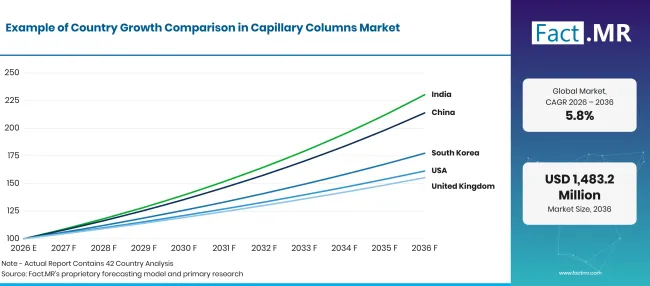
Capillary Columns Market Growth Index | Source: Fact.MR
| Country | CAGR (2026-2036) |
|---|---|
| India | 8.7% |
| China | 7.9% |
| South Korea | 5.9% |
| United States | 4.9% |
| United Kingdom | 4.5% |
Source: Fact.MR analysis.
Why is India the fastest-growing market for capillary columns?
Demand for capillary columns in India is anticipated to increase at an 8.7% CAGR over the forecast period.
Food quality testing, pharmaceutical analysis and environmental monitoring provide applications for gas chromatography. In 2026, a parliamentary response reported that the Food Safety and Standards Authority of India had notified 252 NABL-accredited laboratories for food sample analysis. These facilities conduct chemical assessments using methods suited to different substances.
How is demand for capillary columns developing in China?
Environmental emissions testing provides an important application for capillary columns in China, where sales are anticipated to expand at a 7.9% CAGR through 2036.
In February 2026, China's Ministry of Ecology and Environment published standard HJ 1458-2026 for determining 30 volatile organic compounds in stationary-source emissions using portable GC-MS, effective 1 May 2026. Laboratories selecting gas chromatography equipment consider stationary-phase chemistry, column dimensions and target compounds. Industrial emissions monitoring and chemical manufacturing activities create opportunities for specialized separation columns suited to environmental analysis requirements.
What is driving capillary columns demand in South Korea?
Sales of capillary columns in South Korea are anticipated to rise at a 5.9% CAGR over the next decade.
Pharmaceutical manufacturing, chemical analysis and food safety laboratories provide applications for chromatographic separation. In May 2026, South Korea's Ministry of Food and Drug Safety revised its Food Standards and Specifications (Notice No. 2026-40), adding and revising test methods that include pesticide and veterinary drug residue testing. Laboratories performing gas chromatography select columns according to analyte properties and separation conditions.
What is shaping capillary columns demand in the United States?
Demand for capillary columns in the United States is anticipated to grow at a 4.9% CAGR by 2036.
Environmental laboratories use gas chromatography to identify volatile organic compounds in industrial emissions and other samples. The Environmental Protection Agency's long-standing Method 18 (40 CFR Part 60, Appendix A-6) specifies gas chromatography for measuring gaseous organic compound emissions. Laboratories conducting regulated analyses require suitable column configurations, consistent retention performance and reliable separation.
Why is growth slower for capillary columns in the United Kingdom?
Food residue monitoring and established analytical laboratory operations shape capillary column purchases in the United Kingdom.
Sales are anticipated to increase at a 4.5% CAGR during the forecast period. In October 2026, the Health and Safety Executive's annual report on the 2025 monitoring programme stated that 3,550 samples from 32 food and drink commodities were analysed, of which 83 samples (2.34%) had residues above the maximum residue level. Laboratories using gas chromatography for suitable compounds require selective stationary phases and reliable separation performance.
Competitive Landscape for Capillary Columns Market
Competition in capillary columns revolves around stationary-phase selectivity, column inertness and consistent chromatographic separation. Agilent Technologies supplies HP-5ms low-bleed columns for GC-MS applications, while Thermo Fisher Scientific offers TRACE TR-5MS columns with thermal stability and low-bleed performance. Phenomenex provides Zebron columns for specialized chemical analysis, and Merck supplies chromatographic consumables for laboratory testing.
Restek strengthened its portfolio in January 2026 with RMX GC columns featuring TriMax deactivation technology to reduce unwanted interactions with active compounds. Laboratories compare column dimensions, separation efficiency, peak shape and reproducibility before selecting products. Suppliers offering reliable method compatibility and technical support can strengthen relationships with pharmaceutical, environmental and contract testing laboratories.
Recent Developments
- In January 2026, Restek launched its RMX GC columns with TriMax deactivation technology. The columns are designed to provide an inert surface, symmetrical peaks and trace-level detection for active compounds in GC-MS analysis.
- In August 2024, Agilent launched its J&W 5Q GC/MS columns, which combine ultra-inert performance with ultra-low bleed for trace-level analysis, including environmental and pesticide residue workflows.
Key Players in Capillary Columns Market
Key companies operating in the market include Agilent Technologies, Thermo Fisher Scientific, Merck KGaA, Restek, and Phenomenex.
- Agilent Technologies
- Thermo Fisher Scientific
- Merck KGaA
- Restek
- Phenomenex
Bibliography
- Agilent Technologies. (2024, August 15). Agilent announces innovative J&W 5Q GC/MS columns for superior gas chromatograph performance.
- Expert Committee on Pesticide Residues in Food. (2026, August 24). PRiF: Annual report for 2025.
- Health and Safety Executive. (2026, October 30). UK competent authorities for pesticide residues in food: annual report for 2025.
- Parliament of India. (2026). Food testing laboratory infrastructure (Rajya Sabha question 3652).
- Ministry of Ecology and Environment of the People’s Republic of China. (2026). HJ 1458-2026: Stationary source emission—Determination of 30 volatile organic compounds—Bag sampling/portable gas chromatography-mass spectrometry.
- Ministry of Food and Drug Safety, Republic of Korea. (2026, May 19). Food standards and specifications, Notice No. 2026-40.
- Restek Corporation. (2026, January 19). Restek launches next-generation RMX GC columns with TriMax technology.
- United States Environmental Protection Agency. (2025, April 1). Method 18—Measurement of gaseous organic compound emissions by gas chromatography.
Segmentation
Scope of Report
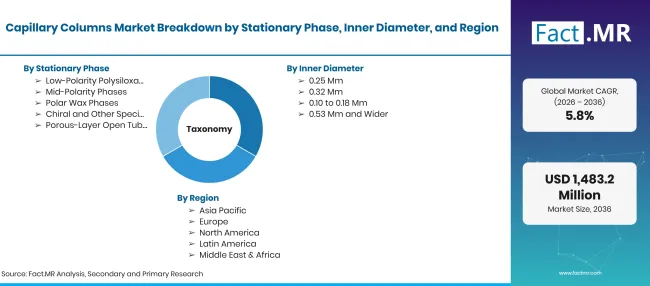
Capillary Columns Market Taxonomy | Source: Fact.MR
| Items | Values |
|---|---|
| Quantitative Units (2026) | USD 844.0 Million |
| Stationary Phase | Low-polarity polysiloxane, Mid-polarity phases, Polar wax phases, Chiral and other specialty phases, Porous-layer open tubular |
| Inner Diameter | 0.25 mm, 0.32 mm, 0.10 to 0.18 mm, 0.53 mm and wider |
| Application | Environmental and food safety, Petrochemical and energy, Pharmaceutical and life science, Academic research and other, Forensics and clinical |
| End User | Contract and testing laboratories, Industrial quality control laboratories, Pharmaceutical and biotechnology companies, Academic and government laboratories |
| Regions Covered | North America, Latin America, Europe, Asia Pacific, Middle East & Africa |
| Countries Covered | India, China, South Korea, United States, United Kingdom, and other countries |
| Key Companies Profiled | Agilent Technologies, Thermo Fisher Scientific, Merck KGaA, Restek, Phenomenex |
| Additional Attributes | Dollar revenue in the Capillary Columns Market is segmented by stationary phase, inner diameter, application and end user and region. |
Source: Fact.MR analysis. Updated Nov 27, 2026
Capillary Columns Market by Segments
-
Stationary Phase
- Low-polarity polysiloxane
- Mid-polarity phases
- Polar wax phases
- Chiral and other specialty phases
- Porous-layer open tubular
-
Inner Diameter
- 0.25 mm
- 0.32 mm
- 0.10 to 0.18 mm
- 0.53 mm and wider
-
Application
- Environmental and food safety
- Petrochemical and energy
- Pharmaceutical and life science
- Academic research and other
- Forensics and clinical
-
End User
- Contract and testing laboratories
- Industrial quality control laboratories
- Pharmaceutical and biotechnology companies
- Academic and government laboratories
-
Region:
- North America
- United States
- Canada
- Mexico
- Europe
- Germany
- United Kingdom
- France
- Italy
- Spain
- Rest of Europe
- Asia Pacific
- China
- India
- Japan
- South Korea
- Australia and New Zealand
- Rest of Asia Pacific
- Latin America
- Brazil
- Argentina
- Rest of Latin America
- Middle East & Africa
- GCC Countries
- South Africa
- Rest of Middle East & Africa
- North America
Table of Contents
Key Takeaways
- Market Size and CAGR
- Top Growth Driver
- Fastest Growing Segment
- Leading Region
- Key Companies
- Emerging Opportunities

