
- Market Value (2025): USD 17.0 Bn
- Estimated Value (2026): USD 17.80 Bn
- Forecast Value (2036): USD 29.00 Bn
- CAGR (2026-2036): 5.0%
Block Paving Market Forecast and Outlook 2026 to 2036
The block paving market is set to increase from USD 17.80 billion in 2026 to USD 29.00 billion by 2036, reflecting a CAGR of 5.0% over the ten-year period. Demand is supported by the use of concrete paving blocks in residential driveways, pedestrian walkways, commercial developments and urban infrastructure projects, where durability and ease of maintenance influence material selection.
Demand for block paving is increasing as residential developers and municipal authorities seek durable outdoor surfaces that also support rainwater management. Manufacturers are supplying permeable concrete pavers and interlocking blocks for driveways, parking areas and public spaces. In June 2025, the UK Department for Environment, Food & Rural Affairs published updated national standards for sustainable drainage systems, recognizing permeable block paving as a surface-water management solution. These standards could encourage wider use of permeable paving in construction projects across England, while similar drainage requirements create opportunities for paving manufacturers in other urban markets.
Key Takeaways from the Block Paving Market
- Sales of block paving stood at USD 17.0 billion in 2025
- Block Paving Market Value (2026): USD 17.80 billion
- Block Paving Market Forecast Value (2036): USD 29.00 billion
- Block Paving Market Forecast CAGR (2026-2036): 5.0%
- Leading Material: Concrete (66.0%)
- Key Market Participants: CRH, Wienerberger, Holcim, Marshalls, Unilock
- Key Growth Countries: India, China, Brazil, South Korea, Japan
In May 2026, CRH highlighted the role of permeable paving and other engineered drainage solutions in managing stormwater across European cities. Urban infrastructure projects increasingly require paving materials that combine surface durability with effective rainfall drainage. Suppliers such as CRH, Marshalls and Unilock offer concrete paving systems for pedestrian areas, commercial landscapes and permeable parking surfaces. Marshalls also provides Atlas Priora permeable paving for projects requiring coordinated surface finishes and drainage performance.
Block Paving Market
| Metric | Value |
|---|---|
| Estimated Value in (2026) | USD 17.80 billion |
| Forecast Value in (2036) | USD 29.00 billion |
| Forecast CAGR (2026 to 2036) | 5.0% |
Source: Fact.MR analysis.
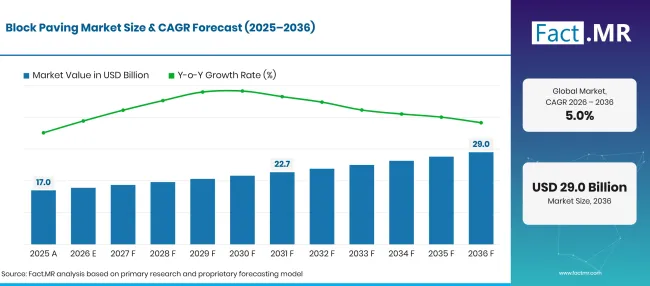
Block Paving Market Forecast Global | Source: Fact.MR
Category
| Category | Segments |
|---|---|
| Material | Concrete, Natural stone, Clay, Composite and other materials |
| Shape | Rectangular, Square, Interlocking shaped, Hexagonal and specialty |
| Product Type | Standard solid pavers, Permeable pavers, Decorative and textured pavers, Heavy-duty industrial pavers |
| Application | Driveways and residential outdoor, Roads and streets, Commercial and public plazas, Parking areas, Industrial yards, ports and airports |
| Key Countries | India; China; Brazil; South Korea; Japan |
Source: Fact.MR analysis.
Segmental Analysis
What makes concrete the leading material segment in the Block Paving Market?
Block Paving Market Breakdown Material | Source: Fact.MR
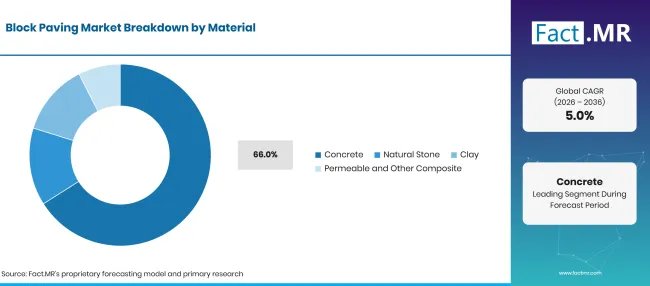
Concrete paving blocks account for 66.0% of market revenue in 2026, valued at approximately USD 11.75 billion. Their durability, affordability and availability in different shapes and surface finishes support use in residential and commercial projects. Manufacturers such as Marshalls supply concrete pavers for driveways, public walkways and parking areas, where load resistance and maintenance requirements influence material selection.
Which factors support rectangular as the largest shape segment in the Block Paving Market?
Block Paving Market Breakdown Shape | Source: Fact.MR
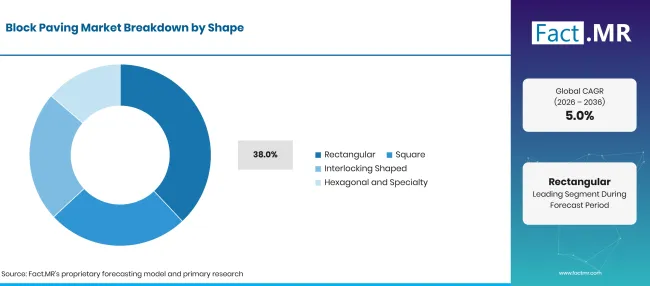
Rectangular paving blocks represent 38.0% of market revenue in 2026, equivalent to approximately USD 6.76 billion. Their regular dimensions allow installation in herringbone, running bond and basket weave patterns. Unilock offers rectangular paving products for residential and commercial surfaces, where layout flexibility, visual consistency and interlocking arrangements influence paving specifications.
What makes standard solid pavers the leading product type segment in the Block Paving Market?
Block Paving Market Breakdown Product Type | Source: Fact.MR
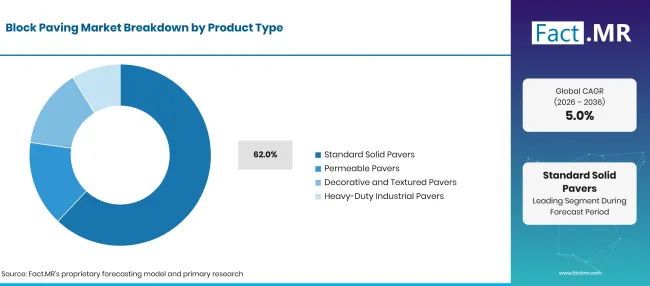
Standard solid pavers contribute 62.0% of market revenue in 2026, reaching approximately USD 11.04 billion. These products suit conventional driveways, pedestrian pathways and commercial outdoor surfaces requiring durable pavement construction. Unlike permeable configurations, standard solid paving generally relies on surface gradients and drainage infrastructure to manage rainwater runoff, making installation design an important consideration.
Which factors support driveways and residential outdoor as the largest application segment in the Block Paving Market?
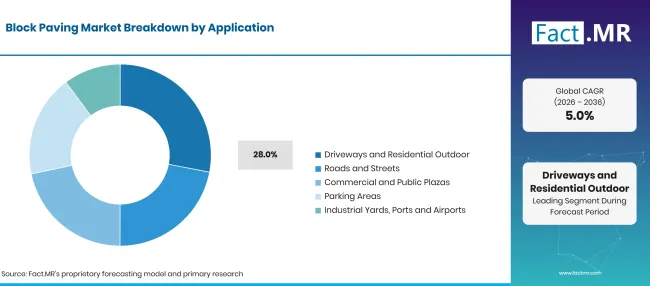
Block Paving Market Breakdown Application | Source: Fact.MR
Driveways and residential outdoor applications hold 28.0% of market revenue in 2026, amounting to approximately USD 4.98 billion. Homeowners select paving blocks for vehicle access, patios and garden pathways based on durability, appearance and maintenance needs. Concrete paving offers multiple colour and texture options, while individual damaged blocks can be replaced without resurfacing the entire area.
Block Paving Market- Drivers, Restraints & Trends
Drivers
Residential driveway construction and public infrastructure projects support block paving sales. Housing developers and municipal authorities use concrete paving blocks for driveways, pedestrian walkways and public spaces. Their modular design, available surface finishes and suitability for different loading conditions support residential landscaping and urban improvement projects.
Restraints
Construction delays, transportation expenses and alternative surfacing materials affect purchasing decisions. Block paving projects require suitable sub-base preparation, skilled installation and material transportation. Competition from asphalt and poured concrete surfaces, alongside higher installation costs for complex patterns, can influence purchasing decisions among residential developers and municipal contractors.
Trend
Sustainable drainage requirements encourage the use of permeable block paving systems. England's 2025 national drainage standards recognize permeable surfaces for managing rainwater runoff. Manufacturers offer permeable concrete pavers that allow water to pass through joints into underlying drainage layers, helping manage surface water.
Block Paving Market Analysis by Key Country
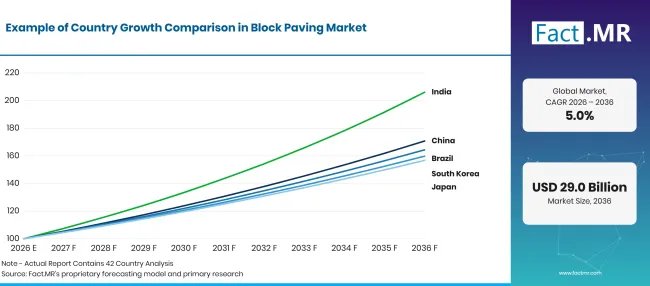
Block Paving Market Growth Index | Source: Fact.MR
| Country | CAGR (2026-2036) |
|---|---|
| India | 7.5% |
| China | 5.5% |
| Brazil | 5.1% |
| South Korea | 4.8% |
| Japan | 4.6% |
Source: Fact.MR analysis.
Why is India the fastest-growing market for block paving?
Sales of block paving in India are set to increase at a 7.5% CAGR during 2026-2036, supported by residential construction and urban infrastructure development.
In June 2026, the Ministry of Housing and Urban Affairs approved more than 2.13 lakh additional houses under PMAY-Urban 2.0. Housing developments create opportunities for concrete paving blocks used in driveways, pedestrian pathways and shared outdoor spaces. Manufacturers supplying rectangular and interlocking pavers can serve residential contractors and landscaping projects. Continued housing construction could support block paving sales across India's expanding urban areas.
What is shaping block paving demand in China?
Demand for block paving in China reflects extensive urban redevelopment activity, with a 5.5% CAGR forecast between 2026 and 2036.
In January 2026, the Ministry of Housing and Urban-Rural Development reported that China invested CNY 133.2 billion in renovating older residential communities during 2025. These projects create opportunities to improve pedestrian routes, communal spaces and outdoor surfaces. Concrete and permeable paving blocks can accommodate different landscaping and drainage requirements. Continued neighborhood renewal could encourage purchases of modular paving materials across Chinese cities.
How is demand for block paving developing in Brazil?
At a 5.1% CAGR during 2026-2036, sales of block paving in Brazil benefit from affordable housing construction and municipal infrastructure improvements.
In July 2026, the Brazilian government reported that Minha Casa, Minha Vida had contracted 2.35 million housing units since 2023. Residential developments require suitable surfaces for access roads, pedestrian areas and shared outdoor facilities. Concrete paving blocks offer different installation patterns and allow individual units to be replaced when damaged. Housing investment could strengthen sales among paving manufacturers serving residential developments and urban improvement projects.
What is driving block paving demand in South Korea?
Sales of block paving in South Korea are forecast to register a 4.8% CAGR between 2026 and 2036, reflecting investment in urban renewal and public-space improvements.
In December 2025, Busan Metropolitan City announced that four urban regeneration projects had secured KRW 40 billion in national government funding. Redevelopment activities can include pedestrian pathways, landscaped spaces and improvements to neighborhood accessibility. Suppliers offering decorative and permeable paving blocks can address different surface requirements. Urban regeneration and maintenance of existing walkways could sustain demand across South Korean cities.
Why is growth slower for block paving in Japan?
Demand for block paving in Japan is forecast to advance at a 4.6% CAGR during 2026-2036, the slowest among the five countries, as established infrastructure creates recurring maintenance requirements.
In August 2025, the Ministry of Land, Infrastructure, Transport and Tourism estimated construction investment of JPY 75.57 trillion for FY 2025, representing a 3.2% annual increase. Public infrastructure maintenance and residential improvements provide applications for modular paving blocks. Durable materials and accessible replacement options influence product selection. Established construction activity could sustain gradual block paving sales across Japan.
Competitive Landscape for Block Paving Market
Block paving suppliers compete by offering materials that balance surface durability, appearance, installation flexibility and drainage performance. CRH serves residential and commercial landscaping projects through its Belgard brand, which supplies concrete pavers for outdoor spaces. Wienerberger specializes in clay paving products, offering colour and texture options suited to traditional and contemporary designs.
Marshalls supplies concrete block paving and Priora permeable systems that support rainwater drainage in driveways and public areas. Unilock differentiates its products through EnduraColor technology, which improves surface colour retention and wear resistance. Holcim participates in the broader construction materials industry, supplying concrete solutions for infrastructure applications. Product availability, local distribution networks, installation costs and compliance with drainage specifications influence competition among paving manufacturers.
Recent Developments
- In January 2026, Holcim announced the completed acquisition of Alkern, a French precast concrete manufacturer offering paving blocks and drainage products, strengthening its presence in European landscaping and infrastructure markets.
- In April 2025, CRH subsidiary brand Belgard announced nationwide availability of its November porcelain paving collection, expanding its outdoor surfacing portfolio for residential landscaping and professional installation projects.
Key Players in Block Paving Market
Key companies operating in the market include CRH, Wienerberger, Holcim, Marshalls, and Unilock.
- CRH
- Wienerberger
- Holcim
- Marshalls
- Unilock
Bibliography
- Belgard. (2025, April 21). Belgard launches newest performance porcelain paver line, November [Press release]. Business Wire. h
- Department for Environment, Food & Rural Affairs. (2025, June 19). National standards for sustainable drainage systems.
- Government of Brazil, Secretariat of Social Communication. (2026, July 2). Caixa Econômica Federal celebrates historic R$1 trillion housing-credit portfolio.
- Holcim. (2026, January 6). Holcim acquires Alkern to expand in high-value building solutions.
- Marshalls. (2025, May 13). Priora 200 × 100 × 60 permeable block paving: Product data sheet.
- Ministry of Housing and Urban Affairs, Government of India. (2026, June 17). Government approves over 2.13 lakh additional houses under PMAY-U 2.0. Press Information Bureau.
- Ministry of Housing and Urban-Rural Development of the People’s Republic of China. (2026, January 28). China spends big on urban renewal in 2025. Government of China.
- Ministry of Land, Infrastructure, Transport and Tourism, Japan. (2025). Construction investment outlook for fiscal year 2025.
- Wienerberger AG. (2026). Annual Report 2025.
Segmentation
Scope of Report
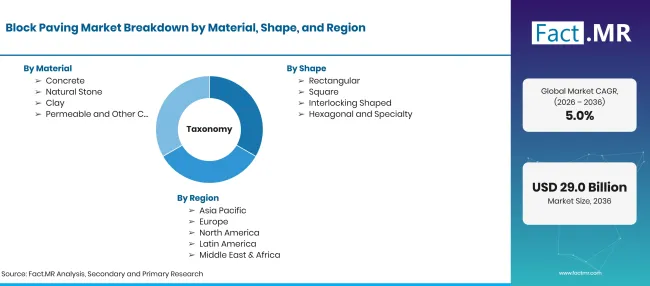
Block Paving Market Taxonomy | Source: Fact.MR
| Items | Values |
|---|---|
| Quantitative Units (2026) | USD 17.80 Billion |
| Material | Concrete, Natural stone, Clay, Composite and other materials |
| Shape | Rectangular, Square, Interlocking shaped, Hexagonal and specialty |
| Product Type | Standard solid pavers, Permeable pavers, Decorative and textured pavers, Heavy-duty industrial pavers |
| Application | Driveways and residential outdoor, Roads and streets, Commercial and public plazas, Parking areas, Industrial yards, ports and airports |
| Regions Covered | North America, Latin America, Europe, Asia Pacific, Middle East & Africa |
| Countries Covered | India, China, Brazil, South Korea, Japan, and other countries |
| Key Companies Profiled | CRH, Wienerberger, Holcim, Marshalls, Unilock |
| Additional Attributes | Dollar revenue in the Block Paving Market is segmented by material, shape, product type and application and region. |
Source: Fact.MR analysis. Updated Nov 27, 2026
Block Paving Market by Segments
-
Material
- Concrete
- Natural stone
- Clay
- Composite and other materials
-
Shape
- Rectangular
- Square
- Interlocking shaped
- Hexagonal and specialty
-
Product Type
- Standard solid pavers
- Permeable pavers
- Decorative and textured pavers
- Heavy-duty industrial pavers
-
Application
- Driveways and residential outdoor
- Roads and streets
- Commercial and public plazas
- Parking areas
- Industrial yards, ports and airports
-
Region:
- North America
- United States
- Canada
- Mexico
- Europe
- Germany
- United Kingdom
- France
- Italy
- Spain
- Rest of Europe
- Asia Pacific
- China
- India
- Japan
- South Korea
- Australia and New Zealand
- Rest of Asia Pacific
- Latin America
- Brazil
- Argentina
- Rest of Latin America
- Middle East & Africa
- GCC Countries
- South Africa
- Rest of Middle East & Africa
- North America
Table of Contents
Key Takeaways
- Market Size and CAGR
- Top Growth Driver
- Fastest Growing Segment
- Leading Region
- Key Companies
- Emerging Opportunities

