
- Market Value (2025): USD 940.0 Mn
- Estimated Value (2026): USD 985.1 Mn
- Forecast Value (2036): USD 1635.5 Mn
- CAGR (2026-2036): 5.2%
Support Balls Market Forecast and Outlook 2026 to 2036
According to the Fact.MR analysis, the support ball market was valued at USD 940.0 million in 2025 and is projected to grow from USD 985.1 million in 2026 to USD 1635.5 million by 2036. Demand for support balls is likely to grow at a CAGR of 5.2% over the forecast period.
Demand for support balls is rising as home exercisers, gyms, physiotherapy clinics and offices use inflatable balls for core training, balance, rehabilitation and seating. The key players are offering stability balls, anti-burst balls, massage and therapy balls and balance ball seats in several sizes and materials.
Key Takeaways from the Support Balls Market
- Support Balls Market Value (2025): USD 940.0 million
- Support Balls Market Value (2026): USD 985.1 million
- Support Balls Market Forecast Value (2036): USD 1635.5 million
- Support Balls Market Forecast CAGR (2026-2036): 5.2%
- Leading Product: Standard stability balls (37.0%)
- Key Market Participants: Decathlon, Performance Health (TheraBand), Gaiam, Togu, Ledragomma
- Key Growth Countries: China, South Korea, United Kingdom, United States, Germany
Home fitness, rehabilitation and interest in active seating are expected to support steady demand, with anti-burst and eco-friendly compounds gaining share. Demand for exercise balls is expected to remain steady as home fitness, physical rehabilitation and active-seating practices gain popularity across residential, healthcare and workplace settings. According to the Government of India’s, reflecting growing public engagement with physical activity. Rehabilitation exercises and low-impact fitness routines are creating opportunities for balance and stability equipment. Manufacturers are increasingly focusing on anti-burst construction, improved durability and environmentally responsible rubber and PVC compounds. These product innovations are expected to strengthen consumer preference for safer, sustainable exercise balls and support recurring retail and institutional sales. Fit India programme, more than 23.68 crore individuals had participated in fitness-related activities by June 2026.
Support Balls Market
| Metric | Value |
|---|---|
| Estimated Value in (2026) | USD 985.1 million |
| Forecast Value in (2036) | USD 1635.5 million |
| Forecast CAGR (2026 to 2036) | 5.2% |
Source: Fact.MR analysis.
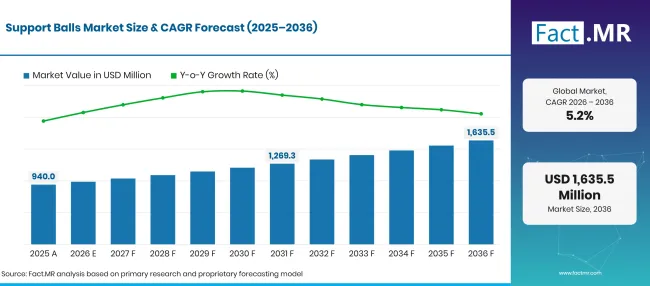
Support Balls Market Forecast Global | Source: Fact.MR
Category
| Category | Segments |
|---|---|
| Product | Standard stability balls, Anti-burst balls, Therapy and massage balls, Balance ball seats, Peanut and birthing balls |
| Material | PVC, TPE and eco-friendly compounds, Polyurethane and silicone, Foam, Rubber and latex |
| Diameter | 65 cm, 55 cm, 75 cm, Up to 45 cm, 85 cm and above |
| End User | Home fitness, Fitness centres and gyms, Rehabilitation and physiotherapy clinics, Schools and institutions, Maternity and birth centres |
| Region | China; South Korea; United Kingdom; United States; Germany |
Source: Fact.MR analysis.
Segmental Analysis
What is sustaining demand and sales of standard stability balls across fitness and rehabilitation settings?
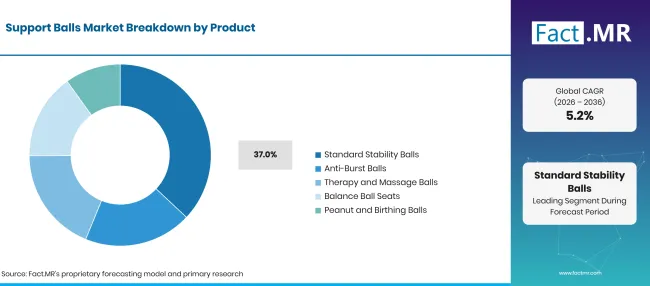
Support Balls Market Breakdown Product | Source: Fact.MR
Demand for standard stability balls is supported by their widespread adoption in home workouts, group exercise classes, physical therapy and functional training. This product segment accounts for 37.0% of market revenue in 2026, equivalent to approximately USD 364.5 million. Their affordability, versatility and suitability for different fitness routines encourage purchases by individual consumers and institutional buyers. The US Centers for Disease Control and Prevention reported that 47.2% of American adults met federal aerobic physical activity guidelines in 2024. This provides a broader indicator of the active fitness population supporting demand for accessible exercise equipment.
Which material advantages are keeping PVC at the forefront of support ball manufacturing?
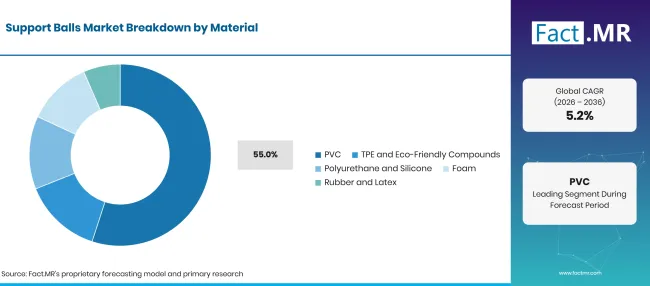
Support Balls Market Breakdown Material | Source: Fact.MR
Sales of PVC-based support balls benefit from the material's affordability, flexibility, durability and suitability for mass-produced exercise equipment. PVC represents 55.0% of market revenue in 2026, approximately USD 541.8 million. India's Department of Chemicals and Petrochemicals reported domestic PVC production of approximately 1.51 million metric tonnes in FY 2024–25, demonstrating the established scale of the country's PVC manufacturing industry. The availability of commercial polymer production supports downstream product manufacturing, including fitness accessories. Meanwhile, interest in alternative materials is encouraging manufacturers to explore recyclable and lower-impact formulations.
How is the 65 cm size preference translating into support ball sales?
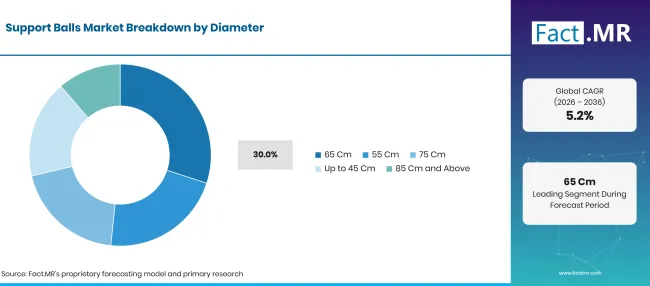
Support Balls Market Breakdown Diameter | Source: Fact.MR
Demand for 65 cm support balls is supported by their suitability for standard adult exercise routines, posture training and stability exercises. This diameter accounts for 30.0% of market revenue in 2026, representing approximately USD 295.5 million. The US National Center for Health Statistics reported an average adult male height of 175.1 cm and an average adult female height of 161.2 cm in its 2021–2023 anthropometric survey. These measurements provide useful context for adult exercise-ball sizing and product selection, although individual height and exercise requirements determine the appropriate ball diameter.
What is encouraging home fitness purchases and adoption of support balls?
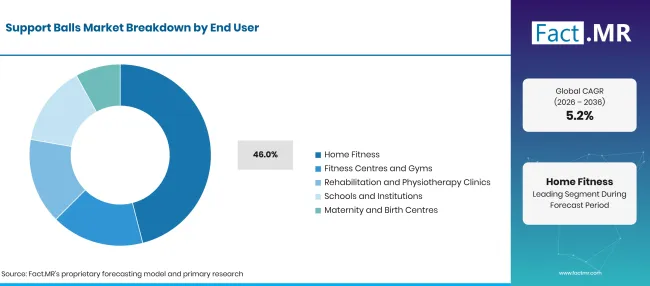
Support Balls Market Breakdown End User | Source: Fact.MR
Sales of support balls through home fitness channels are supported by consumers seeking affordable, compact and versatile exercise equipment for personal workouts, stretching and active sitting. This end-user segment accounts for 46.0% of market revenue in 2026, approximately USD 453.1 million. The US Bureau of Labor Statistics reported that average household expenditure on sports, recreation and exercise equipment reached USD 225 in 2024, while spending on social, recreation and health club memberships averaged USD 272. These figures demonstrate an established household expenditure base for fitness equipment alongside organized fitness participation.
Support Balls Market-Drivers, Restraints & Trends
Drivers: Increasing Participation in Physical Activity and Strength Training
Demand for support balls is supported by growing interest in physical activity, strength training and exercises that improve core stability, balance and posture. According to the US Centers for Disease Control and Prevention (CDC), 47.2% of American adults aged 18 years and older met federal aerobic physical activity guidelines in 2024, according to its April 2026 statistical report. Additionally, 26.4% of adults met both aerobic and muscle-strengthening activity guidelines in 2024, according to the US Department of Health and Human Services' Healthy People 2030 database. These indicators demonstrate continued participation in structured physical activity and muscle conditioning. Support balls serve as versatile equipment for balance exercises, core strengthening, flexibility training and rehabilitation programmes, supporting demand from households, fitness facilities and physical therapy providers.
Restraints: Product Durability and Safety Considerations
The support balls market faces limitations from the durability of existing products, relatively low replacement frequency and consumer concerns about product safety. However, the US Consumer Product Safety Commission (CPSC) maintains a continuously updated database of product recalls and safety warnings, reflecting the importance of product testing, hazard prevention and consumer protection. For manufacturers, maintaining appropriate weight limits, material strength, anti-burst construction and clear usage instructions is important for building consumer confidence. These requirements can increase product-development and quality-control costs, particularly for manufacturers targeting rehabilitation centres, gyms and household users.
Opportunity: Anti-Burst and Safer Support Ball Designs
Demand for safer exercise equipment creates opportunities for manufacturers offering anti-burst support balls with clearly specified load capacities and improved material construction. The US CDC's April 2026 National Center for Health Statistics report found that only 22.4% of adults with disabilities met federal aerobic physical activity guidelines in 2024, compared with 49.8% of adults without disabilities. This substantial participation gap highlights the importance of accessible physical activity and appropriately designed exercise equipment. Support balls can serve as supplementary tools in supervised balance, mobility and rehabilitation exercises. Manufacturers can target physiotherapy providers, rehabilitation centres and home users with products featuring controlled deflation, reinforced construction and clearly communicated safety ratings.
Trend: Increasing Attention to Recyclable and Environmentally Responsible Materials
Environmental considerations are encouraging manufacturers to examine recyclable materials, alternative polymers and more responsible product lifecycles. According to India's Press Information Bureau, government data reported that 196.97 lakh metric tonnes of plastic waste had been recycled under the Extended Producer Responsibility framework as of March 2026, supported by 2,986 registered plastic waste recyclers. This demonstrates the growing scale of India's organized plastic recycling infrastructure. For support ball manufacturers, these developments create opportunities to investigate recyclable compounds, PVC-free alternatives and improved material recovery options. Product developers must also consider flexibility, durability, elasticity and burst resistance when evaluating alternative materials.
Support Balls Market Analysis by Key Country
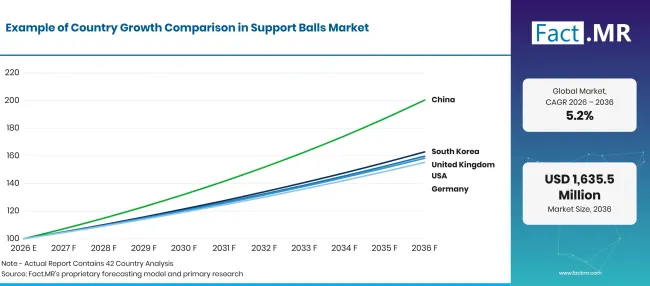
Support Balls Market Growth Index | Source: Fact.MR
| Country | CAGR (2026-2036) |
|---|---|
| China | 7.2% |
| South Korea | 5.0% |
| United Kingdom | 4.8% |
| United States | 4.7% |
| Germany | 4.5% |
Source: Fact.MR analysis.
What is accelerating support ball demand and online sales growth in China?
Demand for support balls in China is projected to increase at a 7.2% CAGR through 2036, making it the fastest-growing market among the five countries.
A large consumer base, expanding e-commerce channels and domestic fitness equipment manufacturing support sales opportunities. China's National Bureau of Statistics reported that retail sales of sports and recreational articles increased by 15.7% in 2025, while online retail sales of physical goods grew by 5.2%. These developments demonstrate expanding consumer expenditure on recreational products and wider digital distribution, creating opportunities for exercise-ball manufacturers and online fitness equipment retailers.
Which fitness participation trends are supporting support ball purchases in South Korea?
Sales of support balls in South Korea are expected to grow at a 5.0% CAGR through 2036, slightly below the global market rate of 5.2%.
Growing participation in fitness activities, strength training and home exercise supports demand for stability and rehabilitation equipment. South Korea's Ministry of Culture, Sports and Tourism reported that the national sports participation rate reached 62.9% in 2025, increasing 2.2 percentage points year on year. Weight training ranked among the country's most popular activities, with 17.5% participation, creating a supportive environment for affordable exercise accessories.
How are home exercise and physical activity trends influencing support ball demand in the United Kingdom?
Demand for support balls in the United Kingdom is forecast to expand at a 4.8% CAGR through 2036, below the global rate of 5.2%.
Home fitness, physiotherapy and personal wellness activities provide opportunities for exercise-ball suppliers targeting individual consumers and rehabilitation users. The UK's Office for National Statistics reported in June 2026 that 64.6% of adults met recommended physical activity levels, compared with 63.8% in the previous year and 61.4% in 2019–2020. Rising participation supports the broader market for accessible fitness accessories, including stability and exercise balls.
What is sustaining consumer demand for support balls across the United States?
Demand for support balls in the United States is expected to increase at a 4.7% CAGR through 2036, remaining below the global growth rate of 5.2%.
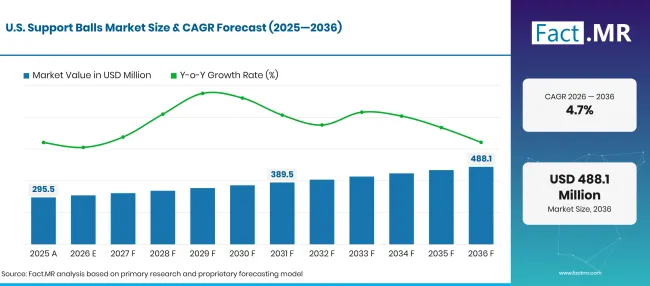
Support Balls Market Forecast Usa | Source: Fact.MR
Established home-fitness purchasing habits, physical activity participation and rehabilitation applications provide a consistent customer base. The US Centers for Disease Control and Prevention reported in April 2026 that 47.2% of adults met federal aerobic physical activity guidelines in 2024. Participation reached 54.0% among adults aged 18 to 34, highlighting an active consumer group for home exercise products. These conditions support continued sales through online retailers and fitness equipment distributors.
Which household fitness trends are keeping support ball demand steady in Germany?
Sales of support balls in Germany are projected to grow at a 4.5% CAGR through 2036, the slowest among the five profiled countries.
Household fitness equipment ownership, rehabilitation activities and workplace wellness applications sustain demand despite the market's relatively mature position. Germany's Federal Statistical Office reported in February 2026 that 26% of households owned at least one fitness machine or equipment item. Its time-use survey also found that residents aged 10 and above spent an average of 34 minutes daily on sports activities in 2022. These indicators demonstrate an established home-fitness culture supporting steady exercise equipment purchases.
Competitive Landscape for Support Balls Market
The support ball market is relatively concentrated, with Decathlon, Performance Health (TheraBand), Gaiam, Togu and Ledragomma together hold about 60% of 2026 revenue, based on Fact.MR estimates. Competition centers on burst resistance, material quality, brand and price, and presence in online and sporting-goods retail. Sporting-goods retailers and therapy-product brands lead, with many low-cost producers supplying private labels.
Recent Developments
- On June 26, 2025, Decathlon announced a global innovation partnership with RHEON LABS to develop advanced materials for sports products. The collaboration initially targeted performance apparel, with further development planned across other categories, including Domyos fitness products, for 2026. The partnership reflects Decathlon's strategy of incorporating advanced materials and technology into fitness and sporting equipment.
- On April 2, 2026, Decathlon reported that ecodesigned products accounted for 53.9% of its total sales in 2025. The company also sold 1.6 million second-hand products across 43 markets and operated 1,746 repair workshops. These developments demonstrate its increasing emphasis on sustainable product design, longer product lifecycles and circular business models.
- On December 22, 2025, Performance Health published its 2025 product-year review, identifying the THERABAND Glute Band Loops Pack and THERABAND Non-Latex Tubing as among its most popular new products released during the year. The announcement highlights continued product development in rehabilitation, resistance training and home exercise. The company also highlighted interest in its existing THERABAND Standard Exercise Balls.
- On April 10, 2026, Performance Health announced new products and expanded solutions for recovery, pain relief and self-care in its 2026 health and wellness portfolio. This development reflects the company's broader strategy of expanding rehabilitation and wellness equipment offerings.
- On February 20, 2026, TOGU announced its 70th anniversary, highlighting its development as a manufacturer of air-filled fitness, therapy and exercise products since 1956. The company highlighted established products such as the Powerball ABS exercise balls, Dynair Ball Cushions, Aero-Step and Jumper. Its anniversary announcement also emphasized its continued commitment to manufacturing and product development in Prien-Bachham, Germany. This development strengthens the company's positioning in the exercise-ball and rehabilitation equipment industry, although it is an anniversary announcement rather than a newly launched support-ball product.
Key Players in Support Balls Market
Key companies operating in the market include Decathlon, Performance Health (TheraBand), Gaiam, Togu, and Ledragomma.
- Decathlon
- Performance Health (TheraBand)
- Gaiam
- Togu
- Ledragomma
Bibliography
- Centers for Disease Control and Prevention. (2026, April). Aerobic physical activity among adults. National Center for Health Statistics.
- Centers for Disease Control and Prevention. (n.d.). Exercise or physical activity statistics. National Center for Health Statistics.
- Department of Chemicals and Petrochemicals. (2026). Annual report 2024–25: At a glance [PDF]. Government of India.
- Decathlon. (n.d.). Decathlon and Rheon Labs announce global innovation partnership [Press release].
- Federal Statistical Office of Germany. (2026, February). Number of the week: Fitness equipment in households. Destatis.
- Ministry of Culture, Sports and Tourism. (n.d.). Sports participation rate. Government of the Republic of Korea.
- National Bureau of Statistics of China. (2026, February 28). Statistical communiqué of the People’s Republic of China on the 2025 national economic and social development. Government of China.
- Office for National Statistics. (2026, June). Measuring progress, wellbeing and beyond GDP in the UK. Government of the United Kingdom.
- Performance Health. (n.d.). A year in review: What you loved in 2025.
- Press Information Bureau. (2026, March). Plastic waste recycling and extended producer responsibility statistics. Government of India.
- TOGU. (n.d.). Trust built over generations: 70 years of TOGU.
- U.S. Bureau of Labor Statistics. (2026, January). The new year and household spending.
- U.S. Consumer Product Safety Commission. (n.d.). Product recalls and safety warnings.
- U.S. Department of Health and Human Services. (n.d.). Healthy People 2030: Increase the proportion of adults who do enough aerobic and muscle strengthening activity, PA-05. Office of Disease Prevention and Health Promotion.
- Fryar, C. D., Gu, Q., Afful, J., Carroll, M. D., & Ogden, C. L. (2025, June 25). Anthropometric reference data for children and adults: United States, August 2021–August 2023 (National Health Statistics Report). National Center for Health Statistics, Centers for Disease Control and Prevention.
- Decathlon. (2026). Global annual results 2025 [Press release].
Segmentation
Scope of Report
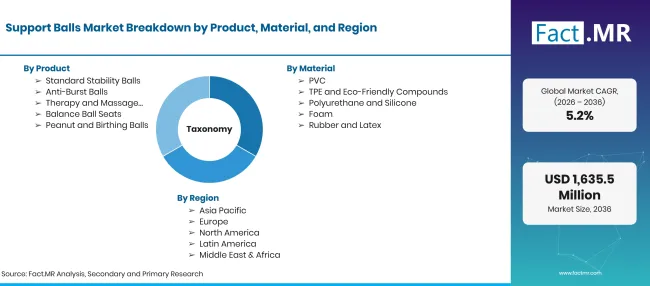
Support Balls Market Taxonomy | Source: Fact.MR
| Items | Values |
|---|---|
| Quantitative Units (2026) | USD 985.1 Million |
| Product | Standard stability balls, Anti-burst balls, Therapy and massage balls, Balance ball seats, Peanut and birthing balls |
| Material | PVC, TPE and eco-friendly compounds, Polyurethane and silicone, Foam, Rubber and latex |
| Diameter | 65 cm, 55 cm, 75 cm, Up to 45 cm, 85 cm and above |
| End User | Home fitness, Fitness centres and gyms, Rehabilitation and physiotherapy clinics, Schools and institutions, Maternity and birth centres |
| Regions Covered | North America, Latin America, Europe, Asia Pacific, Middle East & Africa |
| Countries Covered | China, South Korea, United Kingdom, United States, Germany, and other countries |
| Key Companies Profiled | Decathlon, Performance Health (TheraBand), Gaiam, Togu, Ledragomma |
| Additional Attributes | Dollar revenue in the Support Balls Market is segmented by product, material, diameter and end user and region. |
Source: Fact.MR analysis.
Support Balls Market by Segments
-
Product
- Standard stability balls
- Anti-burst balls
- Therapy and massage balls
- Balance ball seats
- Peanut and birthing balls
-
Material
- PVC
- TPE and eco-friendly compounds
- Polyurethane and silicone
- Foam
- Rubber and latex
-
Diameter
- 65 cm
- 55 cm
- 75 cm
- Up to 45 cm
- 85 cm and above
-
End User
- Home fitness
- Fitness centres and gyms
- Rehabilitation and physiotherapy clinics
- Schools and institutions
- Maternity and birth centres
-
Region:
- North America
- United States
- Canada
- Mexico
- Europe
- Germany
- United Kingdom
- France
- Italy
- Spain
- Rest of Europe
- Asia Pacific
- China
- India
- Japan
- South Korea
- Australia and New Zealand
- Rest of Asia Pacific
- Latin America
- Brazil
- Argentina
- Rest of Latin America
- Middle East & Africa
- GCC Countries
- South Africa
- Rest of Middle East & Africa
- North America
Table of Contents
Key Takeaways
- Market Size and CAGR
- Top Growth Driver
- Fastest Growing Segment
- Leading Region
- Key Companies
- Emerging Opportunities

