Biochar Integrated Granular Fertility Blend Market
Biochar Integrated Granular Fertility Blend Market Size and Share Forecast Outlook 2026 to 2036
Biochar integrated granular fertility blend market is projected to grow from USD 0.3 billion in 2026 to USD 1.2 billion by 2036, at a CAGR of 15.9%. Standard will dominate with a 50.9% market share, while liquid will lead the form segment with a 46.4% share.
Biochar Integrated Granular Fertility Blend Market Forecast and Outlook 2026 to 2036
Projected to expand from USD 0.27 billion in 2026 to USD 1.18 billion by 2036, the biochar integrated granular fertility blend market is set to grow at an impressive CAGR of 15.9%. This remarkable growth trajectory highlights a significant evolution in sustainable soil management, merging the ancient practice of biochar amendment with modern precision fertilizer technology.
Key Takeaways from the Biochar Integrated Granular Fertility Blend Market
- Market Value for 2026: USD 0.27 Billion
- Market Value for 2036: USD 1.18 Billion
- Forecast CAGR (2026-2036): 15.9%
- Leading Application Share (2026): Standard (51%)
- Leading Form Share (2026): Liquid (46%)
- Leading Channel Share (2026): Direct (65%)
- Key Players in the Market: Nutrien, Yara International, ICL Group, EuroChem, UPL, BASF SE

These innovative blends combine pyrolyzed organic biomass with tailored mineral nutrients in a single, easy-to-apply granular form. This fusion creates a synergistic product designed to enhance soil health, boost nutrient use efficiency, and sequester carbon directly at the point of application.
Standard application blends dominate the market, capturing a 51% share, as they offer a versatile entry point for broad-acre adoption across diverse cropping systems. Liquid formulations, while seemingly counterintuitive for a carbon-based product, lead the form segment with a 46% share, primarily representing concentrated biochar slurries and liquid nutrient suspensions used in fertigation or as coating agents.
Direct sales channels account for 65% of the market, reflecting the need for close technical collaboration between specialty manufacturers and large-scale farming operations or land restoration projects to ensure correct product selection and agronomic integration.
Market expansion is propelled by the global urgency to address soil degradation and atmospheric carbon levels simultaneously. Biochar’s porous structure acts as a long-term soil conditioner, improving water retention, nutrient holding capacity, and microbial habitat.
When co-formulated with fertilizers, it reduces nutrient leaching and volatilization, delivering agronomic and environmental benefits in one application. This positions biochar-integrated blends as a cornerstone technology for regenerative agriculture, carbon farming initiatives, and efforts to build climate-resilient food systems.
Metric
| Metric | Value |
|---|---|
| Market Value (2026) | USD 0.27 Billion |
| Market Forecast Value (2036) | USD 1.18 Billion |
| Forecast CAGR (2026-2036) | 15.9% |
Category
| Category | Segments |
|---|---|
| Application | Standard, Premium, Industrial, Other |
| Form | Liquid, Solid, Gas, Gel |
| Channel | Direct, Retail, Online, Distributor |
| Region | North America, Latin America, Western Europe, Eastern Europe, East Asia, South Asia & Pacific, MEA |
Segmental Analysis
By Application, Which Program Type is Driving Initial Market Penetration?
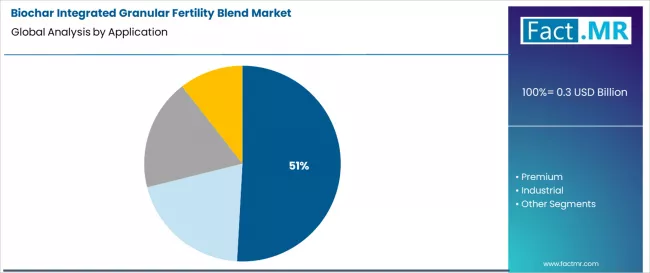
The standard application segment leads with a 51% share. These blends offer a balanced ratio of biochar to NPK nutrients, designed for general soil enhancement and carbon addition in common row crops like corn, soybeans, and wheat.
Their popularity stems from providing a manageable entry point for farmers new to biochar, delivering observable benefits in soil structure and nutrient efficiency without the complexity or cost of highly customized, crop-specific formulations. This category serves as the foundational volume driver for market education and adoption.
By Form, How is Biochar Being Integrated into Modern Application Systems?
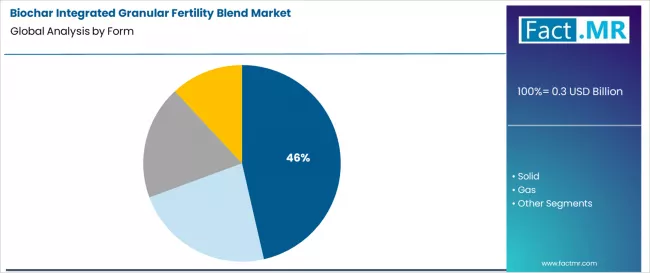
Liquid formulations hold the largest form share at 46%. This includes colloidal biochar suspensions that can be injected into irrigation systems and liquid nutrient solutions used to coat or infuse granular biochar carriers.
The liquid form factor is critical for enabling the use of biochar in existing fertigation infrastructure and for ensuring uniform field coverage. Advanced liquid integration allows for precise placement and immediate nutrient availability, overcoming traditional handling challenges associated with fine, dusty raw biochar powder.
By Channel, Why is Direct Engagement Essential for This Technology?

The direct channel is dominant, controlling 65% of the market. The effective use of biochar blends requires understanding soil types, carbon goals, and long-term management plans. Manufacturers and their technical experts work directly with large farms, carbon project developers, and government agencies to conduct site assessments, calculate appropriate application rates for both fertility and carbon sequestration, and provide ongoing support. This direct relationship is necessary to build trust in a product where benefits accumulate over seasons and to navigate emerging carbon credit landscapes.
What are the Drivers, Restraints, and Key Trends of the Market?
The primary driver is the accelerating convergence of agricultural productivity and climate change mitigation. Carbon credit markets and government incentives for soil carbon sequestration are creating new revenue streams that improve the economics of biochar use. Simultaneously, growers face deteriorating soil health and increasing input costs, making biochar’s dual role as a soil conditioner and nutrient efficiency booster highly attractive. Regulatory pressures to reduce nutrient runoff and corporate sustainability commitments within food supply chains provide additional powerful market pull.
A significant restraint is the current higher cost per unit of nutrient compared to conventional fertilizers, given the additional processing for biochar production and integration. The variable quality of biochar based on feedstock and pyrolysis conditions can lead to inconsistent field performance, necessitating reliable product standards. A lack of immediate, dramatic visual crop responses can slow adoption, as benefits are often realized in improved soil resilience and yield stability over multiple years.
Key trends include the development of engineered biochar with enhanced nutrient loading capabilities, using chemical or physical activation to increase its cation exchange capacity. There is a strong movement toward validated carbon accounting protocols for biochar application, turning blended fertilizer use into a verifiable carbon removal activity. The market is also seeing innovation in regional production networks that convert local agricultural or forestry waste into biochar for local blending, reducing transportation costs and creating circular economies.
Analysis of the Biochar Integrated Granular Fertility Blend Market by Key Countries
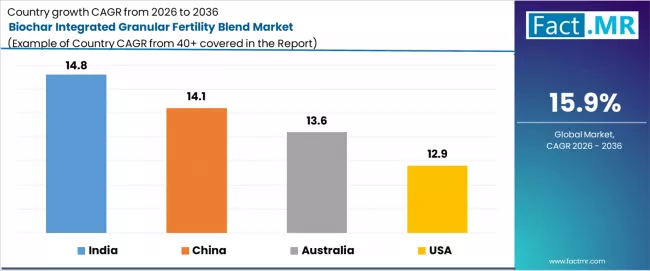
| Country | CAGR (2026-2036) |
|---|---|
| India | 14.8% |
| China | 14.1% |
| Australia | 13.6% |
| USA | 12.9% |
How are USA’s Carbon Markets and Large-Scale Farming Synergizing for Adoption?
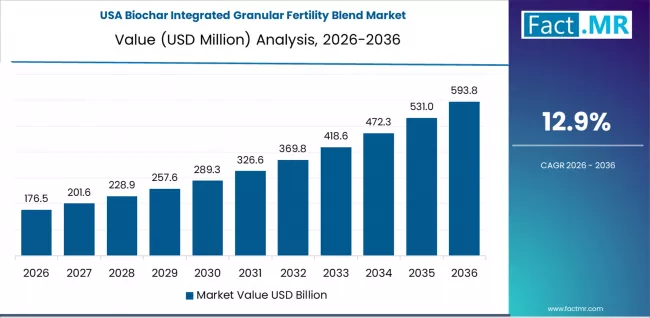
A rapidly evolving voluntary carbon market and significant federal funding for climate-smart agriculture through programs like the USDA’s Partnerships for Climate-Smart Commodities fuel the USA’s 12.9% growth.
Large-scale commodity crop farmers are partnering with ag-retailers and carbon project developers to apply biochar blends as a method to generate sellable carbon credits while addressing on-farm issues like compaction and nutrient loss. The focus is on creating scalable, verified protocols that integrate seamlessly with existing no-till and precision nutrient management systems.
What role does Australia's Focus on Arid Land Management Play?
Australia's 13.6% CAGR is driven by its acute challenges with poor, weathered soils and variable rainfall. Australian research has extensively demonstrated biochar’s ability to improve water retention in sandy soils. Blends are increasingly used in high-value horticulture and in broadacre systems in the wheat belt to enhance drought resilience.
The country’s established carbon farming initiative (CFI) provides a clear methodology for earning Australian Carbon Credit Units (ACCUs) through biochar application, creating a direct financial incentive.
How is China's Dual Carbon Strategy and Soil Policy Influencing State-Led Scaling?
China's 14.1% growth is directly linked to its 2060 carbon neutrality goal and its national soil health and pollution control agendas. The government is investing in large-scale projects that utilize agricultural and forestry waste to produce biochar, which is then blended with fertilizers for application on marginal and degraded lands.
This state-sponsored model aims to simultaneously manage waste streams, improve soil fertility for food security, and contribute to the national carbon sink, driving demand through top-down policy implementation.
Why is India's Need for Soil Organic Matter a Critical Adoption Driver?
India's leading CAGR of 14.8% stems from a critical need to replenish severely depleted soil organic carbon across its intensive agricultural landscapes. Government programs promoting sustainable alternatives to crop residue burning are creating a feedstock stream for biochar production.
Blended products are seen as a practical way to return carbon to the soil while delivering immediate nutrient benefits to smallholder and large-scale farmers alike. The potential to improve fertilizer use efficiency aligns perfectly with national goals to reduce subsidy burdens and increase farm profitability.
Competitive Landscape of the Biochar Integrated Granular Fertility Blend Market

The competitive landscape is a dynamic mix of global fertilizer companies, dedicated biochar producers, and carbon project developers forming strategic alliances. Competition centers on securing access to consistent, high-quality biochar feedstock, developing patented integration and coating technologies, and building scientifically robust carbon quantification methodologies.
Success requires navigating both agronomic and environmental markets, demanding expertise in fertilizer chemistry, soil science, and carbon finance. Establishing credibility through peer-reviewed research and large-scale, monitored demonstration projects is a key differentiator for securing long-term offtake agreements.
Key Players in the Biochar Integrated Granular Fertility Blend Market
- Nutrien
- Yara International
- ICL Group
- EuroChem
- UPL
- BASF SE
Scope of Report
| Items | Values |
|---|---|
| Quantitative Units | USD Billion |
| Application | Standard, Premium, Industrial, Other |
| Form | Liquid, Solid, Gas, Gel |
| Channel | Direct, Retail, Online, Distributor |
| Key Countries | USA, Australia, China, India |
| Key Companies | Nutrien, Yara International, ICL Group, EuroChem, UPL, BASF SE |
| Additional Analysis | Biochar production technologies (pyrolysis, gasification) and feedstock impact; nutrient loading and release kinetics from biochar carriers; long-term soil carbon sequestration potential and permanence; life-cycle assessment (LCA) of blended products; regulatory frameworks for biochar as a soil amendment and carbon removal tool. |
Market by Segments
-
Application :
- Standard
- Premium
- Industrial
- Other
-
Form :
- Liquid
- Solid
- Gas
- Gel
-
Channel :
- Direct
- Retail
- Online
- Distributor
-
Region :
-
North America
- USA
- Canada
-
Latin America
- Brazil
- Mexico
- Argentina
- Rest of Latin America
-
Western Europe
- Germany
- UK
- France
- Spain
- Italy
- BENELUX
- Rest of Western Europe
-
Eastern Europe
- Russia
- Poland
- Czech Republic
- Rest of Eastern Europe
-
East Asia
- China
- Japan
- South Korea
- Rest of East Asia
-
South Asia & Pacific
- India
- ASEAN
- Australia
- Rest of South Asia & Pacific
-
MEA
- Saudi Arabia
- UAE
- Turkiye
- Rest of MEA
-
Table of Content
- Executive Summary
- Global Market Outlook
- Demand to side Trends
- Supply to side Trends
- Technology Roadmap Analysis
- Analysis and Recommendations
- Market Overview
- Market Coverage / Taxonomy
- Market Definition / Scope / Limitations
- Market Background
- Market Dynamics
- Drivers
- Restraints
- Opportunity
- Trends
- Scenario Forecast
- Demand in Optimistic Scenario
- Demand in Likely Scenario
- Demand in Conservative Scenario
- Opportunity Map Analysis
- Product Life Cycle Analysis
- Supply Chain Analysis
- Investment Feasibility Matrix
- Value Chain Analysis
- PESTLE and Porter’s Analysis
- Regulatory Landscape
- Regional Parent Market Outlook
- Production and Consumption Statistics
- Import and Export Statistics
- Market Dynamics
- Global Market Analysis 2021 to 2025 and Forecast, 2026 to 2036
- Historical Market Size Value (USD Million) Analysis, 2021 to 2025
- Current and Future Market Size Value (USD Million) Projections, 2026 to 2036
- Y to o to Y Growth Trend Analysis
- Absolute $ Opportunity Analysis
- Global Market Pricing Analysis 2021 to 2025 and Forecast 2026 to 2036
- Global Market Analysis 2021 to 2025 and Forecast 2026 to 2036, By Application
- Introduction / Key Findings
- Historical Market Size Value (USD Million) Analysis By Application, 2021 to 2025
- Current and Future Market Size Value (USD Million) Analysis and Forecast By Application, 2026 to 2036
- Standard
- Premium
- Industrial
- Other
- Standard
- Y to o to Y Growth Trend Analysis By Application, 2021 to 2025
- Absolute $ Opportunity Analysis By Application, 2026 to 2036
- Global Market Analysis 2021 to 2025 and Forecast 2026 to 2036, By Form
- Introduction / Key Findings
- Historical Market Size Value (USD Million) Analysis By Form, 2021 to 2025
- Current and Future Market Size Value (USD Million) Analysis and Forecast By Form, 2026 to 2036
- Liquid
- Solid
- Gas
- Gel
- Liquid
- Y to o to Y Growth Trend Analysis By Form, 2021 to 2025
- Absolute $ Opportunity Analysis By Form, 2026 to 2036
- Global Market Analysis 2021 to 2025 and Forecast 2026 to 2036, By Channel
- Introduction / Key Findings
- Historical Market Size Value (USD Million) Analysis By Channel, 2021 to 2025
- Current and Future Market Size Value (USD Million) Analysis and Forecast By Channel, 2026 to 2036
- Direct
- Retail
- Online
- Distributor
- Direct
- Y to o to Y Growth Trend Analysis By Channel, 2021 to 2025
- Absolute $ Opportunity Analysis By Channel, 2026 to 2036
- Global Market Analysis 2021 to 2025 and Forecast 2026 to 2036, By Region
- Introduction
- Historical Market Size Value (USD Million) Analysis By Region, 2021 to 2025
- Current Market Size Value (USD Million) Analysis and Forecast By Region, 2026 to 2036
- North America
- Latin America
- Western Europe
- Eastern Europe
- East Asia
- South Asia and Pacific
- Middle East & Africa
- Market Attractiveness Analysis By Region
- North America Market Analysis 2021 to 2025 and Forecast 2026 to 2036, By Country
- Historical Market Size Value (USD Million) Trend Analysis By Market Taxonomy, 2021 to 2025
- Market Size Value (USD Million) Forecast By Market Taxonomy, 2026 to 2036
- By Country
- USA
- Canada
- Mexico
- By Application
- By Form
- By Channel
- By Country
- Market Attractiveness Analysis
- By Country
- By Application
- By Form
- By Channel
- Key Takeaways
- Latin America Market Analysis 2021 to 2025 and Forecast 2026 to 2036, By Country
- Historical Market Size Value (USD Million) Trend Analysis By Market Taxonomy, 2021 to 2025
- Market Size Value (USD Million) Forecast By Market Taxonomy, 2026 to 2036
- By Country
- Brazil
- Chile
- Rest of Latin America
- By Application
- By Form
- By Channel
- By Country
- Market Attractiveness Analysis
- By Country
- By Application
- By Form
- By Channel
- Key Takeaways
- Western Europe Market Analysis 2021 to 2025 and Forecast 2026 to 2036, By Country
- Historical Market Size Value (USD Million) Trend Analysis By Market Taxonomy, 2021 to 2025
- Market Size Value (USD Million) Forecast By Market Taxonomy, 2026 to 2036
- By Country
- Germany
- UK
- Italy
- Spain
- France
- Nordic
- BENELUX
- Rest of Western Europe
- By Application
- By Form
- By Channel
- By Country
- Market Attractiveness Analysis
- By Country
- By Application
- By Form
- By Channel
- Key Takeaways
- Eastern Europe Market Analysis 2021 to 2025 and Forecast 2026 to 2036, By Country
- Historical Market Size Value (USD Million) Trend Analysis By Market Taxonomy, 2021 to 2025
- Market Size Value (USD Million) Forecast By Market Taxonomy, 2026 to 2036
- By Country
- Russia
- Poland
- Hungary
- Balkan & Baltic
- Rest of Eastern Europe
- By Application
- By Form
- By Channel
- By Country
- Market Attractiveness Analysis
- By Country
- By Application
- By Form
- By Channel
- Key Takeaways
- East Asia Market Analysis 2021 to 2025 and Forecast 2026 to 2036, By Country
- Historical Market Size Value (USD Million) Trend Analysis By Market Taxonomy, 2021 to 2025
- Market Size Value (USD Million) Forecast By Market Taxonomy, 2026 to 2036
- By Country
- China
- Japan
- South Korea
- By Application
- By Form
- By Channel
- By Country
- Market Attractiveness Analysis
- By Country
- By Application
- By Form
- By Channel
- Key Takeaways
- South Asia and Pacific Market Analysis 2021 to 2025 and Forecast 2026 to 2036, By Country
- Historical Market Size Value (USD Million) Trend Analysis By Market Taxonomy, 2021 to 2025
- Market Size Value (USD Million) Forecast By Market Taxonomy, 2026 to 2036
- By Country
- India
- ASEAN
- Australia & New Zealand
- Rest of South Asia and Pacific
- By Application
- By Form
- By Channel
- By Country
- Market Attractiveness Analysis
- By Country
- By Application
- By Form
- By Channel
- Key Takeaways
- Middle East & Africa Market Analysis 2021 to 2025 and Forecast 2026 to 2036, By Country
- Historical Market Size Value (USD Million) Trend Analysis By Market Taxonomy, 2021 to 2025
- Market Size Value (USD Million) Forecast By Market Taxonomy, 2026 to 2036
- By Country
- Kingdom of Saudi Arabia
- Other GCC Countries
- Turkiye
- South Africa
- Other African Union
- Rest of Middle East & Africa
- By Application
- By Form
- By Channel
- By Country
- Market Attractiveness Analysis
- By Country
- By Application
- By Form
- By Channel
- Key Takeaways
- Key Countries Market Analysis
- USA
- Pricing Analysis
- Market Share Analysis, 2025
- By Application
- By Form
- By Channel
- Canada
- Pricing Analysis
- Market Share Analysis, 2025
- By Application
- By Form
- By Channel
- Mexico
- Pricing Analysis
- Market Share Analysis, 2025
- By Application
- By Form
- By Channel
- Brazil
- Pricing Analysis
- Market Share Analysis, 2025
- By Application
- By Form
- By Channel
- Chile
- Pricing Analysis
- Market Share Analysis, 2025
- By Application
- By Form
- By Channel
- Germany
- Pricing Analysis
- Market Share Analysis, 2025
- By Application
- By Form
- By Channel
- UK
- Pricing Analysis
- Market Share Analysis, 2025
- By Application
- By Form
- By Channel
- Italy
- Pricing Analysis
- Market Share Analysis, 2025
- By Application
- By Form
- By Channel
- Spain
- Pricing Analysis
- Market Share Analysis, 2025
- By Application
- By Form
- By Channel
- France
- Pricing Analysis
- Market Share Analysis, 2025
- By Application
- By Form
- By Channel
- India
- Pricing Analysis
- Market Share Analysis, 2025
- By Application
- By Form
- By Channel
- ASEAN
- Pricing Analysis
- Market Share Analysis, 2025
- By Application
- By Form
- By Channel
- Australia & New Zealand
- Pricing Analysis
- Market Share Analysis, 2025
- By Application
- By Form
- By Channel
- China
- Pricing Analysis
- Market Share Analysis, 2025
- By Application
- By Form
- By Channel
- Japan
- Pricing Analysis
- Market Share Analysis, 2025
- By Application
- By Form
- By Channel
- South Korea
- Pricing Analysis
- Market Share Analysis, 2025
- By Application
- By Form
- By Channel
- Russia
- Pricing Analysis
- Market Share Analysis, 2025
- By Application
- By Form
- By Channel
- Poland
- Pricing Analysis
- Market Share Analysis, 2025
- By Application
- By Form
- By Channel
- Hungary
- Pricing Analysis
- Market Share Analysis, 2025
- By Application
- By Form
- By Channel
- Kingdom of Saudi Arabia
- Pricing Analysis
- Market Share Analysis, 2025
- By Application
- By Form
- By Channel
- Turkiye
- Pricing Analysis
- Market Share Analysis, 2025
- By Application
- By Form
- By Channel
- South Africa
- Pricing Analysis
- Market Share Analysis, 2025
- By Application
- By Form
- By Channel
- USA
- Market Structure Analysis
- Competition Dashboard
- Competition Benchmarking
- Market Share Analysis of Top Players
- By Regional
- By Application
- By Form
- By Channel
- Competition Analysis
- Competition Deep Dive
- Nutrien
- Overview
- Product Portfolio
- Profitability by Market Segments (Product/Age /Sales Channel/Region)
- Sales Footprint
- Strategy Overview
- Marketing Strategy
- Product Strategy
- Channel Strategy
- Yara International
- ICL Group
- EuroChem
- UPL
- BASF SE
- Nutrien
- Competition Deep Dive
- Assumptions & Acronyms Used
- Research Methodology
List Of Table
- Table 1: Global Market Value (USD Million) Forecast by Region, 2021 to 2036
- Table 2: Global Market Value (USD Million) Forecast by Application, 2021 to 2036
- Table 3: Global Market Value (USD Million) Forecast by Form, 2021 to 2036
- Table 4: Global Market Value (USD Million) Forecast by Channel, 2021 to 2036
- Table 5: North America Market Value (USD Million) Forecast by Country, 2021 to 2036
- Table 6: North America Market Value (USD Million) Forecast by Application, 2021 to 2036
- Table 7: North America Market Value (USD Million) Forecast by Form, 2021 to 2036
- Table 8: North America Market Value (USD Million) Forecast by Channel, 2021 to 2036
- Table 9: Latin America Market Value (USD Million) Forecast by Country, 2021 to 2036
- Table 10: Latin America Market Value (USD Million) Forecast by Application, 2021 to 2036
- Table 11: Latin America Market Value (USD Million) Forecast by Form, 2021 to 2036
- Table 12: Latin America Market Value (USD Million) Forecast by Channel, 2021 to 2036
- Table 13: Western Europe Market Value (USD Million) Forecast by Country, 2021 to 2036
- Table 14: Western Europe Market Value (USD Million) Forecast by Application, 2021 to 2036
- Table 15: Western Europe Market Value (USD Million) Forecast by Form, 2021 to 2036
- Table 16: Western Europe Market Value (USD Million) Forecast by Channel, 2021 to 2036
- Table 17: Eastern Europe Market Value (USD Million) Forecast by Country, 2021 to 2036
- Table 18: Eastern Europe Market Value (USD Million) Forecast by Application, 2021 to 2036
- Table 19: Eastern Europe Market Value (USD Million) Forecast by Form, 2021 to 2036
- Table 20: Eastern Europe Market Value (USD Million) Forecast by Channel, 2021 to 2036
- Table 21: East Asia Market Value (USD Million) Forecast by Country, 2021 to 2036
- Table 22: East Asia Market Value (USD Million) Forecast by Application, 2021 to 2036
- Table 23: East Asia Market Value (USD Million) Forecast by Form, 2021 to 2036
- Table 24: East Asia Market Value (USD Million) Forecast by Channel, 2021 to 2036
- Table 25: South Asia and Pacific Market Value (USD Million) Forecast by Country, 2021 to 2036
- Table 26: South Asia and Pacific Market Value (USD Million) Forecast by Application, 2021 to 2036
- Table 27: South Asia and Pacific Market Value (USD Million) Forecast by Form, 2021 to 2036
- Table 28: South Asia and Pacific Market Value (USD Million) Forecast by Channel, 2021 to 2036
- Table 29: Middle East & Africa Market Value (USD Million) Forecast by Country, 2021 to 2036
- Table 30: Middle East & Africa Market Value (USD Million) Forecast by Application, 2021 to 2036
- Table 31: Middle East & Africa Market Value (USD Million) Forecast by Form, 2021 to 2036
- Table 32: Middle East & Africa Market Value (USD Million) Forecast by Channel, 2021 to 2036
List Of Figures
- Figure 1: Global Market Pricing Analysis
- Figure 2: Global Market Value (USD Million) Forecast 2021 to 2036
- Figure 3: Global Market Value Share and BPS Analysis by Application, 2026 and 2036
- Figure 4: Global Market Y to o to Y Growth Comparison by Application, 2026 to 2036
- Figure 5: Global Market Attractiveness Analysis by Application
- Figure 6: Global Market Value Share and BPS Analysis by Form, 2026 and 2036
- Figure 7: Global Market Y to o to Y Growth Comparison by Form, 2026 to 2036
- Figure 8: Global Market Attractiveness Analysis by Form
- Figure 9: Global Market Value Share and BPS Analysis by Channel, 2026 and 2036
- Figure 10: Global Market Y to o to Y Growth Comparison by Channel, 2026 to 2036
- Figure 11: Global Market Attractiveness Analysis by Channel
- Figure 12: Global Market Value (USD Million) Share and BPS Analysis by Region, 2026 and 2036
- Figure 13: Global Market Y to o to Y Growth Comparison by Region, 2026 to 2036
- Figure 14: Global Market Attractiveness Analysis by Region
- Figure 15: North America Market Incremental Dollar Opportunity, 2026 to 2036
- Figure 16: Latin America Market Incremental Dollar Opportunity, 2026 to 2036
- Figure 17: Western Europe Market Incremental Dollar Opportunity, 2026 to 2036
- Figure 18: Eastern Europe Market Incremental Dollar Opportunity, 2026 to 2036
- Figure 19: East Asia Market Incremental Dollar Opportunity, 2026 to 2036
- Figure 20: South Asia and Pacific Market Incremental Dollar Opportunity, 2026 to 2036
- Figure 21: Middle East & Africa Market Incremental Dollar Opportunity, 2026 to 2036
- Figure 22: North America Market Value Share and BPS Analysis by Country, 2026 and 2036
- Figure 23: North America Market Value Share and BPS Analysis by Application, 2026 and 2036
- Figure 24: North America Market Y to o to Y Growth Comparison by Application, 2026 to 2036
- Figure 25: North America Market Attractiveness Analysis by Application
- Figure 26: North America Market Value Share and BPS Analysis by Form, 2026 and 2036
- Figure 27: North America Market Y to o to Y Growth Comparison by Form, 2026 to 2036
- Figure 28: North America Market Attractiveness Analysis by Form
- Figure 29: North America Market Value Share and BPS Analysis by Channel, 2026 and 2036
- Figure 30: North America Market Y to o to Y Growth Comparison by Channel, 2026 to 2036
- Figure 31: North America Market Attractiveness Analysis by Channel
- Figure 32: Latin America Market Value Share and BPS Analysis by Country, 2026 and 2036
- Figure 33: Latin America Market Value Share and BPS Analysis by Application, 2026 and 2036
- Figure 34: Latin America Market Y to o to Y Growth Comparison by Application, 2026 to 2036
- Figure 35: Latin America Market Attractiveness Analysis by Application
- Figure 36: Latin America Market Value Share and BPS Analysis by Form, 2026 and 2036
- Figure 37: Latin America Market Y to o to Y Growth Comparison by Form, 2026 to 2036
- Figure 38: Latin America Market Attractiveness Analysis by Form
- Figure 39: Latin America Market Value Share and BPS Analysis by Channel, 2026 and 2036
- Figure 40: Latin America Market Y to o to Y Growth Comparison by Channel, 2026 to 2036
- Figure 41: Latin America Market Attractiveness Analysis by Channel
- Figure 42: Western Europe Market Value Share and BPS Analysis by Country, 2026 and 2036
- Figure 43: Western Europe Market Value Share and BPS Analysis by Application, 2026 and 2036
- Figure 44: Western Europe Market Y to o to Y Growth Comparison by Application, 2026 to 2036
- Figure 45: Western Europe Market Attractiveness Analysis by Application
- Figure 46: Western Europe Market Value Share and BPS Analysis by Form, 2026 and 2036
- Figure 47: Western Europe Market Y to o to Y Growth Comparison by Form, 2026 to 2036
- Figure 48: Western Europe Market Attractiveness Analysis by Form
- Figure 49: Western Europe Market Value Share and BPS Analysis by Channel, 2026 and 2036
- Figure 50: Western Europe Market Y to o to Y Growth Comparison by Channel, 2026 to 2036
- Figure 51: Western Europe Market Attractiveness Analysis by Channel
- Figure 52: Eastern Europe Market Value Share and BPS Analysis by Country, 2026 and 2036
- Figure 53: Eastern Europe Market Value Share and BPS Analysis by Application, 2026 and 2036
- Figure 54: Eastern Europe Market Y to o to Y Growth Comparison by Application, 2026 to 2036
- Figure 55: Eastern Europe Market Attractiveness Analysis by Application
- Figure 56: Eastern Europe Market Value Share and BPS Analysis by Form, 2026 and 2036
- Figure 57: Eastern Europe Market Y to o to Y Growth Comparison by Form, 2026 to 2036
- Figure 58: Eastern Europe Market Attractiveness Analysis by Form
- Figure 59: Eastern Europe Market Value Share and BPS Analysis by Channel, 2026 and 2036
- Figure 60: Eastern Europe Market Y to o to Y Growth Comparison by Channel, 2026 to 2036
- Figure 61: Eastern Europe Market Attractiveness Analysis by Channel
- Figure 62: East Asia Market Value Share and BPS Analysis by Country, 2026 and 2036
- Figure 63: East Asia Market Value Share and BPS Analysis by Application, 2026 and 2036
- Figure 64: East Asia Market Y to o to Y Growth Comparison by Application, 2026 to 2036
- Figure 65: East Asia Market Attractiveness Analysis by Application
- Figure 66: East Asia Market Value Share and BPS Analysis by Form, 2026 and 2036
- Figure 67: East Asia Market Y to o to Y Growth Comparison by Form, 2026 to 2036
- Figure 68: East Asia Market Attractiveness Analysis by Form
- Figure 69: East Asia Market Value Share and BPS Analysis by Channel, 2026 and 2036
- Figure 70: East Asia Market Y to o to Y Growth Comparison by Channel, 2026 to 2036
- Figure 71: East Asia Market Attractiveness Analysis by Channel
- Figure 72: South Asia and Pacific Market Value Share and BPS Analysis by Country, 2026 and 2036
- Figure 73: South Asia and Pacific Market Value Share and BPS Analysis by Application, 2026 and 2036
- Figure 74: South Asia and Pacific Market Y to o to Y Growth Comparison by Application, 2026 to 2036
- Figure 75: South Asia and Pacific Market Attractiveness Analysis by Application
- Figure 76: South Asia and Pacific Market Value Share and BPS Analysis by Form, 2026 and 2036
- Figure 77: South Asia and Pacific Market Y to o to Y Growth Comparison by Form, 2026 to 2036
- Figure 78: South Asia and Pacific Market Attractiveness Analysis by Form
- Figure 79: South Asia and Pacific Market Value Share and BPS Analysis by Channel, 2026 and 2036
- Figure 80: South Asia and Pacific Market Y to o to Y Growth Comparison by Channel, 2026 to 2036
- Figure 81: South Asia and Pacific Market Attractiveness Analysis by Channel
- Figure 82: Middle East & Africa Market Value Share and BPS Analysis by Country, 2026 and 2036
- Figure 83: Middle East & Africa Market Value Share and BPS Analysis by Application, 2026 and 2036
- Figure 84: Middle East & Africa Market Y to o to Y Growth Comparison by Application, 2026 to 2036
- Figure 85: Middle East & Africa Market Attractiveness Analysis by Application
- Figure 86: Middle East & Africa Market Value Share and BPS Analysis by Form, 2026 and 2036
- Figure 87: Middle East & Africa Market Y to o to Y Growth Comparison by Form, 2026 to 2036
- Figure 88: Middle East & Africa Market Attractiveness Analysis by Form
- Figure 89: Middle East & Africa Market Value Share and BPS Analysis by Channel, 2026 and 2036
- Figure 90: Middle East & Africa Market Y to o to Y Growth Comparison by Channel, 2026 to 2036
- Figure 91: Middle East & Africa Market Attractiveness Analysis by Channel
- Figure 92: Global Market - Tier Structure Analysis
- Figure 93: Global Market - Company Share Analysis
- FAQs -
How big is the biochar integrated granular fertility blend market in 2026?
The global biochar integrated granular fertility blend market is estimated to be valued at USD 0.3 billion in 2026.
What will be the size of biochar integrated granular fertility blend market in 2036?
The market size for the biochar integrated granular fertility blend market is projected to reach USD 1.2 billion by 2036.
How much will be the biochar integrated granular fertility blend market growth between 2026 and 2036?
The biochar integrated granular fertility blend market is expected to grow at a 15.9% CAGR between 2026 and 2036.
What are the key product types in the biochar integrated granular fertility blend market?
The key product types in biochar integrated granular fertility blend market are standard, premium, industrial and other.
Which form segment to contribute significant share in the biochar integrated granular fertility blend market in 2026?
In terms of form, liquid segment to command 46.4% share in the biochar integrated granular fertility blend market in 2026.