Pollinator-Safe Floral Attractant and Repellent Blend Market

Pollinator-Safe Floral Attractant and Repellent Blend Market Size and Share Forecast Outlook 2026 to 2036

Pollinator-safe floral attractant and repellent blend market is projected to grow from USD 0.4 billion in 2026 to USD 1.4 billion by 2036, at a CAGR of 12.4%. Attractant-Dominant Blends will dominate with a 34.0% market share, while plant-derived volatiles will lead the active ingredient source segment with a 41.0% share.

Pollinator-Safe Floral Attractant and Repellent Blend Market Forecast and Outlook 2026 to 2036

The global pollinator-safe floral attractant & repellent blend market is projected to grow from USD 0.43 billion in 2026 to approximately USD 1.38 billion by 2036, recording a forecast CAGR of 12.4%. Attractant-dominant blends lead the functional blend type segment with a 34% share, plant-derived volatiles dominate active ingredient sources with 41%, and foliar spray commands the application mode segment with a 46% market share.

Key Takeaways from the Pollinator-Safe Floral Attractant & Repellent Blend Market Report

  • Pollinator-Safe Floral Attractant & Repellent Blend Market Value (2026): USD 0.43 billion
  • Pollinator-Safe Floral Attractant & Repellent Blend Market Forecast Value (2036): USD 1.38 billion
  • Pollinator-Safe Floral Attractant & Repellent Blend Market Forecast CAGR (2026 to 2036): 12.4%
  • Leading Functional Blend Type: Attractant-Dominant Blends (34.00%)
  • Leading Active Ingredient Source: Plant-Derived Volatiles (41.00%)
  • Leading Application Mode: Foliar Spray (46.00%)
  • Key Growth Regions: North America, Latin America, Western Europe, Eastern Europe, East Asia, South Asia & Pacific, MEA
  • Key Players: Bayer CropScience, BASF SE, Syngenta Group, ISCA Technologies, Russell IPM Ltd
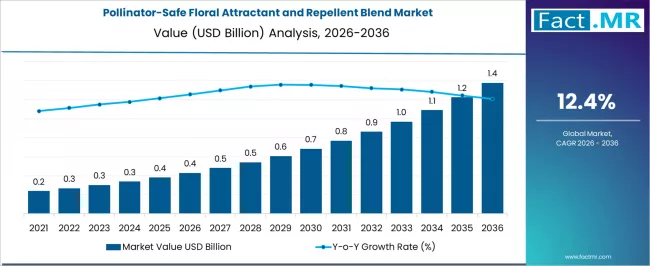
Pollinator Safe Floral Attractant And Repellent Blend Market Market Value Analysis

This growth is driven by the critical need to reconcile effective pest management with pollinator protection, a pressing concern for agricultural sustainability and biodiversity. These intelligent blends work by manipulating pest and beneficial insect behavior, luring pests away from crops or repelling them while minimizing impact on bees and other pollinators.

Increasing regulatory scrutiny on neonicotinoids and other insecticides toxic to pollinators is a primary market catalyst, compelling the adoption of selective, behavior-modifying alternatives. The rising economic valuation of pollination services in major cropping systems further underscores the need for safe solutions. Advancements in the understanding of insect olfaction and plant volatile chemistry enable the design of more effective and specific blends.

Market expansion is closely tied to the growth of integrated pest and pollinator management (IPPM) strategies, particularly in high-value fruit, vegetable, and nut crops that are both pest-sensitive and pollinator-dependent. The convergence of ecological necessity, regulatory shifts, and technological innovation establishes this market as a vital component of the future sustainable crop protection portfolio.

Pollinator-Safe Floral Attractant and Repellent Blend Market

Metric Value
Estimated Value (2026E) USD 0.43 billion
Forecast Value (2036F) USD 1.38 billion
Forecast CAGR (2026 to 2036) 12.4%

Category

Category Segments
Functional Blend Type Attractant-Dominant Blends, Repellent-Dominant Blends, Balanced Attractant–Repellent Systems, Crop-Specific Floral Mimic Blends
Active Ingredient Source Plant-Derived Volatiles, Essential Oil Extracts, Microbial Fermentation-Derived Compounds, Synthetic Nature-Identical Molecules
Application Mode Foliar Spray, Dispenser / Lure Systems, Seed & Soil-Adjacent Application, Drone & Precision Placement
Region North America, Latin America, Western Europe, Eastern Europe, East Asia, South Asia & Pacific, MEA

Segmental Analysis

How do Attractant-Dominant Blends Lead by Diverting Pests from Crops?
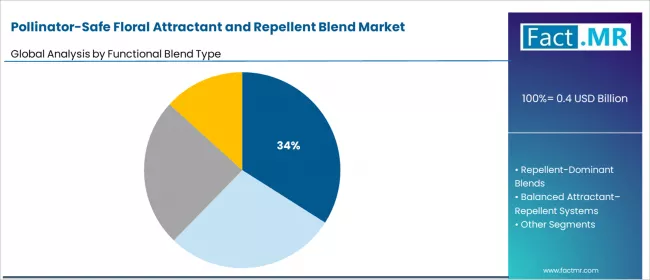
Pollinator Safe Floral Attractant And Repellent Blend Market Analysis By Functional Blend Type

Attractant-dominant blends, holding a 34% market share, function primarily through the push-pull or lure-and-kill strategy. These formulations use volatile compounds to mimic attractive host plants or oviposition sites, effectively drawing pests away from the cash crop to a designated trap crop or an area containing insecticides.

This approach offers high selectivity, protecting the target crop while concentrating pests for control, thereby minimizing broad-spectrum insecticide use in the main field. Their effectiveness against a range of Lepidoptera and Coleoptera pests in high-value systems, coupled with a clear operational model that integrates well with monitoring, establishes them as a primary tool for behavior-based diversion and population suppression.

What establishes Plant-Derived Volatiles as the Preferred Source for Safety and Specificity?
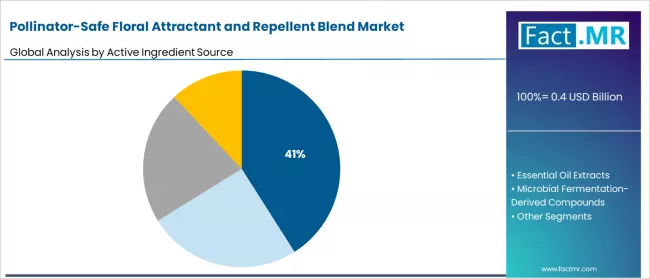
Pollinator Safe Floral Attractant And Repellent Blend Market Analysis By Active Ingredient Source

Plant-derived volatiles lead the active ingredient segment with a 41% share, favored for their natural origin, complex blend of compounds that are difficult for pests to develop resistance against, and inherent compatibility with pollinator safety. These volatiles, often extracted or distilled from non-crop plants, provide the authentic chemical signals that insects encounter in their ecological niche.

Their use aligns perfectly with organic certification standards and meets consumer demand for bio-based inputs. While sourcing and standardization can be challenges, advancements in plant science and extraction technology are improving yield and consistency, making these naturally sourced signals the gold standard for efficacy and ecological harmony in behavioral pest management.

Why does Foliar Spray Application Maintain Dominance for Broad-Acre Behavioral Modification?
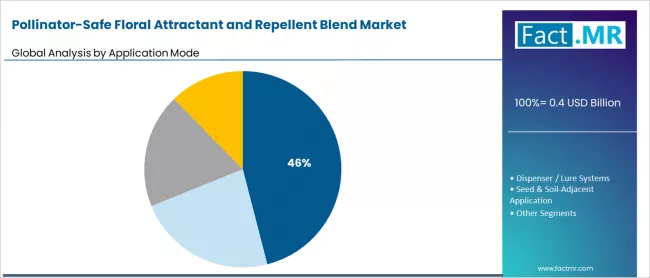
Pollinator Safe Floral Attractant And Repellent Blend Market Analysis By Application Mode

Foliar spray is the leading application mode with a 46% share due to its practicality for applying volatile blends over large areas to create a pervasive behavioral-modifying atmosphere in the crop canopy. This method allows for the uniform deposition of attractant or repellent compounds on foliage, where they can volatilize and interact with pests throughout the field.

It integrates seamlessly into standard spray programs and offers the flexibility for timely reapplication based on pest pressure. For attractant-dominant strategies, sprays can be used to treat trap crops; for repellent-dominant strategies, they can be applied directly to the main crop. This versatility and ease of use secure its position as the most accessible and scalable application method.

What are the Drivers, Restraints, and Key Trends of the Pollinator-Safe Floral Attractant and Repellent Blend Market?

Market growth is driven by acute regulatory and consumer pressure to protect pollinators, the rising economic cost of pollinator decline, and the need for tools to manage insecticide-resistant pests. The expansion of organic farming and IPM mandates further accelerates adoption. Key restraints include the higher cost per acre compared to conventional insecticides and variable efficacy that can be influenced by environmental conditions like wind and rain. The success of these blends often requires a more sophisticated understanding of pest ecology and timing than conventional spray-and-kill approaches, posing an educational barrier.

Key trends involve the development of multi-sensory blends that combine visual cues including specific UV-reflective colors with olfactory volatiles for enhanced efficacy. There is growing research into tailoring blends to specific crop-pest-pollinator triads for hyper-localized effectiveness. The integration of application with precision mapping and drone technology to target border rows or trap crops with high accuracy is also an emerging trend, optimizing material use and impact.

Analysis of the Pollinator-Safe Floral Attractant and Repellent Blend Market by Key Countries
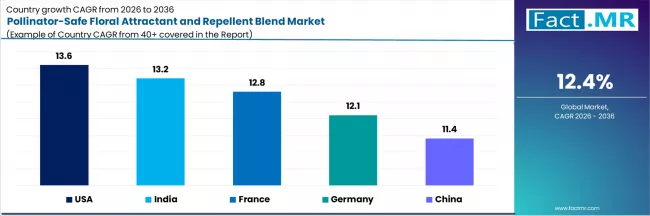
Pollinator Safe Floral Attractant And Repellent Blend Market Cagr Analysis By Country

Country CAGR (2026-2036)
USA 13.60%
India 13.20%
France 12.80%
Germany 12.10%
China 11.40%

How does the USA Lead Adoption through Regulatory Action and Almond Industry Demand?
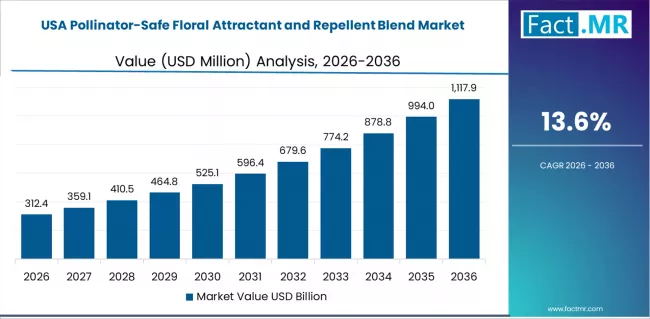
Pollinator Safe Floral Attractant And Repellent Blend Market Country Value Analysis

The USA exhibits a 13.60% CAGR, driven by strong regulatory frameworks protecting pollinators and the immense, pollinator-dependent almond industry in California, which creates a powerful demand for safe pest management solutions.

Retailer and food company sustainability commitments further push adoption. USDA programs often provide cost-sharing for practices that benefit pollinators, making these technologies more economically viable for growers of berries, apples, and cucurbits across the country.

What drives India's High Growth in the Context of Pollinator Conservation Awareness?

India's market shows a high CAGR of 13.20%, fueled by increasing awareness of pollinator decline's impact on productivity of key crops like mustard, cucurbits, and fruits. Government initiatives promoting natural farming and reducing pesticide load dovetail with this technology.

The large and growing organic sector and the need for export-compliant, residue-free produce from horticulture are significant drivers, though cost sensitivity remains a challenge for widespread adoption.

Why does France Exemplify European Leadership with Stringent Pesticide Policies?

France's market grows at a 12.80% CAGR, acting as a European leader due to its pioneering national policies drastically restricting pesticide use such as the Ecophyto plan and protecting pollinators.

The strong French organic sector and consumer activism create a ready market. Adoption is advanced in vineyards, apple orchards, and oilseed rape, where these blends are used to protect crops while complying with some of the world's most stringent agricultural environmental regulations.

How does Germany's Market Advance on Precision and Ecological Farming Trends?

Germany follows with a 12.10% CAGR, where growth is underpinned by a national focus on precision agriculture and ecological focus areas within farms. German farmers and cooperatives are early adopters of high-tech, sustainable solutions.

The use of these blends is often part of sophisticated, monitored IPM programs in fruit growing and horticulture, supported by strong agricultural advisory services and alignment with EU Green Deal objectives.

What Fuels China's Market Development in Protected Agriculture and Green Policy?

China's market expands at an 11.40% CAGR, supported by the massive scale of its protected agriculture (greenhouses) where pollinator services are often used for crop production. National policies promoting green pest control and reducing chemical fertilizer and pesticide use provide a favorable framework. The technology is gaining traction in high-value export-oriented vegetable and fruit production in Eastern China, where meeting international safety standards is paramount.

Competitive Landscape of the Pollinator-Safe Floral Attractant and Repellent Blend Market
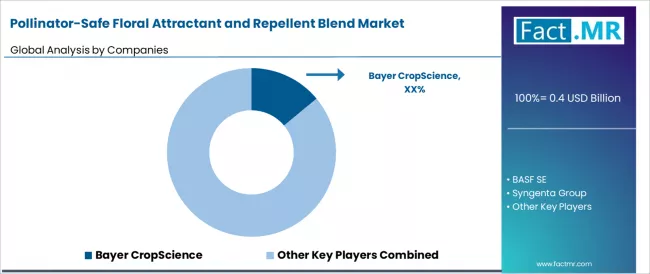
Pollinator Safe Floral Attractant And Repellent Blend Market Analysis By Company

The competitive landscape includes agrochemical majors with dedicated biocontrol divisions and specialized semiochemical/biological companies. Competition centers on proprietary knowledge of insect behavior and the chemistry of plant-insect interactions. Companies compete by developing unique, patent-protected volatile blends for specific high-value pest problems.

Strategic activities focus on building strong partnerships with pollinator health organizations and university entomology departments to validate product safety and efficacy. A significant go-to-market challenge involves educating growers on the different paradigm of behavior-based control, requiring substantial investment in demonstration plots and technical field support. Success depends on creating easy-to-use, reliable products that seamlessly integrate into existing crop management schedules while providing clear economic and ecological benefits.

Key Players Profiled in the Pollinator-Safe Floral Attractant and Repellent Blend Market

  • Bayer CropScience
  • BASF SE
  • Syngenta Group
  • ISCA Technologies
  • Russell IPM Ltd

Scope of the Report

Items Values
Quantitative Units (2026) USD 0.43 Billion
Functional Blend Type Attractant-Dominant Blends, Repellent-Dominant Blends, Balanced Attractant–Repellent Systems, Crop-Specific Floral Mimic Blends
Active Ingredient Source Plant-Derived Volatiles, Essential Oil Extracts, Microbial Fermentation-Derived Compounds, Synthetic Nature-Identical Molecules
Application Mode Foliar Spray, Dispenser / Lure Systems, Seed & Soil-Adjacent Application, Drone & Precision Placement
Regions Covered North America, Latin America, Western Europe, Eastern Europe, East Asia, South Asia & Pacific, MEA
Countries Covered USA, India, France, Germany, China and others
Key Companies Profiled Bayer CropScience, BASF SE, Syngenta Group, ISCA Technologies, Russell IPM Ltd
Additional Attributes Dollar sales by blend type, ingredient source, and application mode; regional demand analysis; competitive landscape; grower adoption drivers; pollinator safety validation standards; integration with IPM programs

Key Segments Profiled

  • Functional Blend Type :

    • Attractant-Dominant Blends
    • Repellent-Dominant Blends
    • Balanced Attractant–Repellent Systems
    • Crop-Specific Floral Mimic Blends
  • Active Ingredient Source :

    • Plant-Derived Volatiles
    • Essential Oil Extracts
    • Microbial Fermentation-Derived Compounds
    • Synthetic Nature-Identical Molecules
  • Application Mode :

    • Foliar Spray
    • Dispenser / Lure Systems
    • Seed & Soil-Adjacent Application
    • Drone & Precision Placement
  • Region :

    • North America

      • USA
      • Canada
    • Latin America

      • Brazil
      • Mexico
      • Argentina
      • Chile
      • Rest of Latin America
    • Western Europe

      • Germany
      • UK
      • France
      • Spain
      • Italy
      • BENELUX
      • Rest of Western Europe
    • Eastern Europe

      • Poland
      • Czech Republic
      • Austria
      • Hungary
      • Rest of Eastern Europe
    • East Asia

      • China
      • Japan
      • South Korea
      • Rest of East Asia
    • South Asia & Pacific

      • India
      • Indonesia
      • Australia
      • Rest of South Asia & Pacific
    • MEA

      • Saudi Arabia
      • UAE
      • Türkiye
      • Rest of MEA

Table of Content

  1. Executive Summary
    • Global Market Outlook
    • Demand to side Trends
    • Supply to side Trends
    • Technology Roadmap Analysis
    • Analysis and Recommendations
  2. Market Overview
    • Market Coverage / Taxonomy
    • Market Definition / Scope / Limitations
  3. Market Background
    • Market Dynamics
      • Drivers
      • Restraints
      • Opportunity
      • Trends
    • Scenario Forecast
      • Demand in Optimistic Scenario
      • Demand in Likely Scenario
      • Demand in Conservative Scenario
    • Opportunity Map Analysis
    • Product Life Cycle Analysis
    • Supply Chain Analysis
    • Investment Feasibility Matrix
    • Value Chain Analysis
    • PESTLE and Porter’s Analysis
    • Regulatory Landscape
    • Regional Parent Market Outlook
    • Production and Consumption Statistics
    • Import and Export Statistics
  4. Global Market Analysis 2021 to 2025 and Forecast, 2026 to 2036
    • Historical Market Size Value (USD Million) Analysis, 2021 to 2025
    • Current and Future Market Size Value (USD Million) Projections, 2026 to 2036
      • Y to o to Y Growth Trend Analysis
      • Absolute $ Opportunity Analysis
  5. Global Market Pricing Analysis 2021 to 2025 and Forecast 2026 to 2036
  6. Global Market Analysis 2021 to 2025 and Forecast 2026 to 2036, By Functional Blend Type
    • Introduction / Key Findings
    • Historical Market Size Value (USD Million) Analysis By Functional Blend Type, 2021 to 2025
    • Current and Future Market Size Value (USD Million) Analysis and Forecast By Functional Blend Type, 2026 to 2036
      • Attractant-Dominant Blends
      • Repellent-Dominant Blends
      • Balanced Attractant–Repellent Systems
      • Crop-Specific Floral Mimic Blends
    • Y to o to Y Growth Trend Analysis By Functional Blend Type, 2021 to 2025
    • Absolute $ Opportunity Analysis By Functional Blend Type, 2026 to 2036
  7. Global Market Analysis 2021 to 2025 and Forecast 2026 to 2036, By Active Ingredient Source
    • Introduction / Key Findings
    • Historical Market Size Value (USD Million) Analysis By Active Ingredient Source, 2021 to 2025
    • Current and Future Market Size Value (USD Million) Analysis and Forecast By Active Ingredient Source, 2026 to 2036
      • Plant-Derived Volatiles
      • Essential Oil Extracts
      • Microbial Fermentation-Derived Compounds
      • Synthetic Nature-Identical Molecules
    • Y to o to Y Growth Trend Analysis By Active Ingredient Source, 2021 to 2025
    • Absolute $ Opportunity Analysis By Active Ingredient Source, 2026 to 2036
  8. Global Market Analysis 2021 to 2025 and Forecast 2026 to 2036, By Application Mode
    • Introduction / Key Findings
    • Historical Market Size Value (USD Million) Analysis By Application Mode, 2021 to 2025
    • Current and Future Market Size Value (USD Million) Analysis and Forecast By Application Mode, 2026 to 2036
      • Foliar Spray
      • Dispenser / Lure Systems
      • Seed & Soil-Adjacent Application
      • Drone & Precision Placement
    • Y to o to Y Growth Trend Analysis By Application Mode, 2021 to 2025
    • Absolute $ Opportunity Analysis By Application Mode, 2026 to 2036
  9. Global Market Analysis 2021 to 2025 and Forecast 2026 to 2036, By Region
    • Introduction
    • Historical Market Size Value (USD Million) Analysis By Region, 2021 to 2025
    • Current Market Size Value (USD Million) Analysis and Forecast By Region, 2026 to 2036
      • North America
      • Latin America
      • Western Europe
      • Eastern Europe
      • East Asia
      • South Asia and Pacific
      • Middle East & Africa
    • Market Attractiveness Analysis By Region
  10. North America Market Analysis 2021 to 2025 and Forecast 2026 to 2036, By Country
    • Historical Market Size Value (USD Million) Trend Analysis By Market Taxonomy, 2021 to 2025
    • Market Size Value (USD Million) Forecast By Market Taxonomy, 2026 to 2036
      • By Country
        • USA
        • Canada
        • Mexico
      • By Functional Blend Type
      • By Active Ingredient Source
      • By Application Mode
    • Market Attractiveness Analysis
      • By Country
      • By Functional Blend Type
      • By Active Ingredient Source
      • By Application Mode
    • Key Takeaways
  11. Latin America Market Analysis 2021 to 2025 and Forecast 2026 to 2036, By Country
    • Historical Market Size Value (USD Million) Trend Analysis By Market Taxonomy, 2021 to 2025
    • Market Size Value (USD Million) Forecast By Market Taxonomy, 2026 to 2036
      • By Country
        • Brazil
        • Chile
        • Rest of Latin America
      • By Functional Blend Type
      • By Active Ingredient Source
      • By Application Mode
    • Market Attractiveness Analysis
      • By Country
      • By Functional Blend Type
      • By Active Ingredient Source
      • By Application Mode
    • Key Takeaways
  12. Western Europe Market Analysis 2021 to 2025 and Forecast 2026 to 2036, By Country
    • Historical Market Size Value (USD Million) Trend Analysis By Market Taxonomy, 2021 to 2025
    • Market Size Value (USD Million) Forecast By Market Taxonomy, 2026 to 2036
      • By Country
        • Germany
        • UK
        • Italy
        • Spain
        • France
        • Nordic
        • BENELUX
        • Rest of Western Europe
      • By Functional Blend Type
      • By Active Ingredient Source
      • By Application Mode
    • Market Attractiveness Analysis
      • By Country
      • By Functional Blend Type
      • By Active Ingredient Source
      • By Application Mode
    • Key Takeaways
  13. Eastern Europe Market Analysis 2021 to 2025 and Forecast 2026 to 2036, By Country
    • Historical Market Size Value (USD Million) Trend Analysis By Market Taxonomy, 2021 to 2025
    • Market Size Value (USD Million) Forecast By Market Taxonomy, 2026 to 2036
      • By Country
        • Russia
        • Poland
        • Hungary
        • Balkan & Baltic
        • Rest of Eastern Europe
      • By Functional Blend Type
      • By Active Ingredient Source
      • By Application Mode
    • Market Attractiveness Analysis
      • By Country
      • By Functional Blend Type
      • By Active Ingredient Source
      • By Application Mode
    • Key Takeaways
  14. East Asia Market Analysis 2021 to 2025 and Forecast 2026 to 2036, By Country
    • Historical Market Size Value (USD Million) Trend Analysis By Market Taxonomy, 2021 to 2025
    • Market Size Value (USD Million) Forecast By Market Taxonomy, 2026 to 2036
      • By Country
        • China
        • Japan
        • South Korea
      • By Functional Blend Type
      • By Active Ingredient Source
      • By Application Mode
    • Market Attractiveness Analysis
      • By Country
      • By Functional Blend Type
      • By Active Ingredient Source
      • By Application Mode
    • Key Takeaways
  15. South Asia and Pacific Market Analysis 2021 to 2025 and Forecast 2026 to 2036, By Country
    • Historical Market Size Value (USD Million) Trend Analysis By Market Taxonomy, 2021 to 2025
    • Market Size Value (USD Million) Forecast By Market Taxonomy, 2026 to 2036
      • By Country
        • India
        • ASEAN
        • Australia & New Zealand
        • Rest of South Asia and Pacific
      • By Functional Blend Type
      • By Active Ingredient Source
      • By Application Mode
    • Market Attractiveness Analysis
      • By Country
      • By Functional Blend Type
      • By Active Ingredient Source
      • By Application Mode
    • Key Takeaways
  16. Middle East & Africa Market Analysis 2021 to 2025 and Forecast 2026 to 2036, By Country
    • Historical Market Size Value (USD Million) Trend Analysis By Market Taxonomy, 2021 to 2025
    • Market Size Value (USD Million) Forecast By Market Taxonomy, 2026 to 2036
      • By Country
        • Kingdom of Saudi Arabia
        • Other GCC Countries
        • Turkiye
        • South Africa
        • Other African Union
        • Rest of Middle East & Africa
      • By Functional Blend Type
      • By Active Ingredient Source
      • By Application Mode
    • Market Attractiveness Analysis
      • By Country
      • By Functional Blend Type
      • By Active Ingredient Source
      • By Application Mode
    • Key Takeaways
  17. Key Countries Market Analysis
    • USA
      • Pricing Analysis
      • Market Share Analysis, 2025
        • By Functional Blend Type
        • By Active Ingredient Source
        • By Application Mode
    • Canada
      • Pricing Analysis
      • Market Share Analysis, 2025
        • By Functional Blend Type
        • By Active Ingredient Source
        • By Application Mode
    • Mexico
      • Pricing Analysis
      • Market Share Analysis, 2025
        • By Functional Blend Type
        • By Active Ingredient Source
        • By Application Mode
    • Brazil
      • Pricing Analysis
      • Market Share Analysis, 2025
        • By Functional Blend Type
        • By Active Ingredient Source
        • By Application Mode
    • Chile
      • Pricing Analysis
      • Market Share Analysis, 2025
        • By Functional Blend Type
        • By Active Ingredient Source
        • By Application Mode
    • Germany
      • Pricing Analysis
      • Market Share Analysis, 2025
        • By Functional Blend Type
        • By Active Ingredient Source
        • By Application Mode
    • UK
      • Pricing Analysis
      • Market Share Analysis, 2025
        • By Functional Blend Type
        • By Active Ingredient Source
        • By Application Mode
    • Italy
      • Pricing Analysis
      • Market Share Analysis, 2025
        • By Functional Blend Type
        • By Active Ingredient Source
        • By Application Mode
    • Spain
      • Pricing Analysis
      • Market Share Analysis, 2025
        • By Functional Blend Type
        • By Active Ingredient Source
        • By Application Mode
    • France
      • Pricing Analysis
      • Market Share Analysis, 2025
        • By Functional Blend Type
        • By Active Ingredient Source
        • By Application Mode
    • India
      • Pricing Analysis
      • Market Share Analysis, 2025
        • By Functional Blend Type
        • By Active Ingredient Source
        • By Application Mode
    • ASEAN
      • Pricing Analysis
      • Market Share Analysis, 2025
        • By Functional Blend Type
        • By Active Ingredient Source
        • By Application Mode
    • Australia & New Zealand
      • Pricing Analysis
      • Market Share Analysis, 2025
        • By Functional Blend Type
        • By Active Ingredient Source
        • By Application Mode
    • China
      • Pricing Analysis
      • Market Share Analysis, 2025
        • By Functional Blend Type
        • By Active Ingredient Source
        • By Application Mode
    • Japan
      • Pricing Analysis
      • Market Share Analysis, 2025
        • By Functional Blend Type
        • By Active Ingredient Source
        • By Application Mode
    • South Korea
      • Pricing Analysis
      • Market Share Analysis, 2025
        • By Functional Blend Type
        • By Active Ingredient Source
        • By Application Mode
    • Russia
      • Pricing Analysis
      • Market Share Analysis, 2025
        • By Functional Blend Type
        • By Active Ingredient Source
        • By Application Mode
    • Poland
      • Pricing Analysis
      • Market Share Analysis, 2025
        • By Functional Blend Type
        • By Active Ingredient Source
        • By Application Mode
    • Hungary
      • Pricing Analysis
      • Market Share Analysis, 2025
        • By Functional Blend Type
        • By Active Ingredient Source
        • By Application Mode
    • Kingdom of Saudi Arabia
      • Pricing Analysis
      • Market Share Analysis, 2025
        • By Functional Blend Type
        • By Active Ingredient Source
        • By Application Mode
    • Turkiye
      • Pricing Analysis
      • Market Share Analysis, 2025
        • By Functional Blend Type
        • By Active Ingredient Source
        • By Application Mode
    • South Africa
      • Pricing Analysis
      • Market Share Analysis, 2025
        • By Functional Blend Type
        • By Active Ingredient Source
        • By Application Mode
  18. Market Structure Analysis
    • Competition Dashboard
    • Competition Benchmarking
    • Market Share Analysis of Top Players
      • By Regional
      • By Functional Blend Type
      • By Active Ingredient Source
      • By Application Mode
  19. Competition Analysis
    • Competition Deep Dive
      • Bayer CropScience
        • Overview
        • Product Portfolio
        • Profitability by Market Segments (Product/Age /Sales Channel/Region)
        • Sales Footprint
        • Strategy Overview
          • Marketing Strategy
          • Product Strategy
          • Channel Strategy
      • BASF SE
      • Syngenta Group
      • ISCA Technologies
      • Russell IPM
  20. Assumptions & Acronyms Used
  21. Research Methodology

List Of Table

  • Table 1: Global Market Value (USD Million) Forecast by Region, 2021 to 2036
  • Table 2: Global Market Value (USD Million) Forecast by Functional Blend Type, 2021 to 2036
  • Table 3: Global Market Value (USD Million) Forecast by Active Ingredient Source, 2021 to 2036
  • Table 4: Global Market Value (USD Million) Forecast by Application Mode, 2021 to 2036
  • Table 5: North America Market Value (USD Million) Forecast by Country, 2021 to 2036
  • Table 6: North America Market Value (USD Million) Forecast by Functional Blend Type, 2021 to 2036
  • Table 7: North America Market Value (USD Million) Forecast by Active Ingredient Source, 2021 to 2036
  • Table 8: North America Market Value (USD Million) Forecast by Application Mode, 2021 to 2036
  • Table 9: Latin America Market Value (USD Million) Forecast by Country, 2021 to 2036
  • Table 10: Latin America Market Value (USD Million) Forecast by Functional Blend Type, 2021 to 2036
  • Table 11: Latin America Market Value (USD Million) Forecast by Active Ingredient Source, 2021 to 2036
  • Table 12: Latin America Market Value (USD Million) Forecast by Application Mode, 2021 to 2036
  • Table 13: Western Europe Market Value (USD Million) Forecast by Country, 2021 to 2036
  • Table 14: Western Europe Market Value (USD Million) Forecast by Functional Blend Type, 2021 to 2036
  • Table 15: Western Europe Market Value (USD Million) Forecast by Active Ingredient Source, 2021 to 2036
  • Table 16: Western Europe Market Value (USD Million) Forecast by Application Mode, 2021 to 2036
  • Table 17: Eastern Europe Market Value (USD Million) Forecast by Country, 2021 to 2036
  • Table 18: Eastern Europe Market Value (USD Million) Forecast by Functional Blend Type, 2021 to 2036
  • Table 19: Eastern Europe Market Value (USD Million) Forecast by Active Ingredient Source, 2021 to 2036
  • Table 20: Eastern Europe Market Value (USD Million) Forecast by Application Mode, 2021 to 2036
  • Table 21: East Asia Market Value (USD Million) Forecast by Country, 2021 to 2036
  • Table 22: East Asia Market Value (USD Million) Forecast by Functional Blend Type, 2021 to 2036
  • Table 23: East Asia Market Value (USD Million) Forecast by Active Ingredient Source, 2021 to 2036
  • Table 24: East Asia Market Value (USD Million) Forecast by Application Mode, 2021 to 2036
  • Table 25: South Asia and Pacific Market Value (USD Million) Forecast by Country, 2021 to 2036
  • Table 26: South Asia and Pacific Market Value (USD Million) Forecast by Functional Blend Type, 2021 to 2036
  • Table 27: South Asia and Pacific Market Value (USD Million) Forecast by Active Ingredient Source, 2021 to 2036
  • Table 28: South Asia and Pacific Market Value (USD Million) Forecast by Application Mode, 2021 to 2036
  • Table 29: Middle East & Africa Market Value (USD Million) Forecast by Country, 2021 to 2036
  • Table 30: Middle East & Africa Market Value (USD Million) Forecast by Functional Blend Type, 2021 to 2036
  • Table 31: Middle East & Africa Market Value (USD Million) Forecast by Active Ingredient Source, 2021 to 2036
  • Table 32: Middle East & Africa Market Value (USD Million) Forecast by Application Mode, 2021 to 2036

List Of Figures

  • Figure 1: Global Market Pricing Analysis
  • Figure 2: Global Market Value (USD Million) Forecast 2021 to 2036
  • Figure 3: Global Market Value Share and BPS Analysis by Functional Blend Type, 2026 and 2036
  • Figure 4: Global Market Y to o to Y Growth Comparison by Functional Blend Type, 2026 to 2036
  • Figure 5: Global Market Attractiveness Analysis by Functional Blend Type
  • Figure 6: Global Market Value Share and BPS Analysis by Active Ingredient Source, 2026 and 2036
  • Figure 7: Global Market Y to o to Y Growth Comparison by Active Ingredient Source, 2026 to 2036
  • Figure 8: Global Market Attractiveness Analysis by Active Ingredient Source
  • Figure 9: Global Market Value Share and BPS Analysis by Application Mode, 2026 and 2036
  • Figure 10: Global Market Y to o to Y Growth Comparison by Application Mode, 2026 to 2036
  • Figure 11: Global Market Attractiveness Analysis by Application Mode
  • Figure 12: Global Market Value (USD Million) Share and BPS Analysis by Region, 2026 and 2036
  • Figure 13: Global Market Y to o to Y Growth Comparison by Region, 2026 to 2036
  • Figure 14: Global Market Attractiveness Analysis by Region
  • Figure 15: North America Market Incremental Dollar Opportunity, 2026 to 2036
  • Figure 16: Latin America Market Incremental Dollar Opportunity, 2026 to 2036
  • Figure 17: Western Europe Market Incremental Dollar Opportunity, 2026 to 2036
  • Figure 18: Eastern Europe Market Incremental Dollar Opportunity, 2026 to 2036
  • Figure 19: East Asia Market Incremental Dollar Opportunity, 2026 to 2036
  • Figure 20: South Asia and Pacific Market Incremental Dollar Opportunity, 2026 to 2036
  • Figure 21: Middle East & Africa Market Incremental Dollar Opportunity, 2026 to 2036
  • Figure 22: North America Market Value Share and BPS Analysis by Country, 2026 and 2036
  • Figure 23: North America Market Value Share and BPS Analysis by Functional Blend Type, 2026 and 2036
  • Figure 24: North America Market Y to o to Y Growth Comparison by Functional Blend Type, 2026 to 2036
  • Figure 25: North America Market Attractiveness Analysis by Functional Blend Type
  • Figure 26: North America Market Value Share and BPS Analysis by Active Ingredient Source, 2026 and 2036
  • Figure 27: North America Market Y to o to Y Growth Comparison by Active Ingredient Source, 2026 to 2036
  • Figure 28: North America Market Attractiveness Analysis by Active Ingredient Source
  • Figure 29: North America Market Value Share and BPS Analysis by Application Mode, 2026 and 2036
  • Figure 30: North America Market Y to o to Y Growth Comparison by Application Mode, 2026 to 2036
  • Figure 31: North America Market Attractiveness Analysis by Application Mode
  • Figure 32: Latin America Market Value Share and BPS Analysis by Country, 2026 and 2036
  • Figure 33: Latin America Market Value Share and BPS Analysis by Functional Blend Type, 2026 and 2036
  • Figure 34: Latin America Market Y to o to Y Growth Comparison by Functional Blend Type, 2026 to 2036
  • Figure 35: Latin America Market Attractiveness Analysis by Functional Blend Type
  • Figure 36: Latin America Market Value Share and BPS Analysis by Active Ingredient Source, 2026 and 2036
  • Figure 37: Latin America Market Y to o to Y Growth Comparison by Active Ingredient Source, 2026 to 2036
  • Figure 38: Latin America Market Attractiveness Analysis by Active Ingredient Source
  • Figure 39: Latin America Market Value Share and BPS Analysis by Application Mode, 2026 and 2036
  • Figure 40: Latin America Market Y to o to Y Growth Comparison by Application Mode, 2026 to 2036
  • Figure 41: Latin America Market Attractiveness Analysis by Application Mode
  • Figure 42: Western Europe Market Value Share and BPS Analysis by Country, 2026 and 2036
  • Figure 43: Western Europe Market Value Share and BPS Analysis by Functional Blend Type, 2026 and 2036
  • Figure 44: Western Europe Market Y to o to Y Growth Comparison by Functional Blend Type, 2026 to 2036
  • Figure 45: Western Europe Market Attractiveness Analysis by Functional Blend Type
  • Figure 46: Western Europe Market Value Share and BPS Analysis by Active Ingredient Source, 2026 and 2036
  • Figure 47: Western Europe Market Y to o to Y Growth Comparison by Active Ingredient Source, 2026 to 2036
  • Figure 48: Western Europe Market Attractiveness Analysis by Active Ingredient Source
  • Figure 49: Western Europe Market Value Share and BPS Analysis by Application Mode, 2026 and 2036
  • Figure 50: Western Europe Market Y to o to Y Growth Comparison by Application Mode, 2026 to 2036
  • Figure 51: Western Europe Market Attractiveness Analysis by Application Mode
  • Figure 52: Eastern Europe Market Value Share and BPS Analysis by Country, 2026 and 2036
  • Figure 53: Eastern Europe Market Value Share and BPS Analysis by Functional Blend Type, 2026 and 2036
  • Figure 54: Eastern Europe Market Y to o to Y Growth Comparison by Functional Blend Type, 2026 to 2036
  • Figure 55: Eastern Europe Market Attractiveness Analysis by Functional Blend Type
  • Figure 56: Eastern Europe Market Value Share and BPS Analysis by Active Ingredient Source, 2026 and 2036
  • Figure 57: Eastern Europe Market Y to o to Y Growth Comparison by Active Ingredient Source, 2026 to 2036
  • Figure 58: Eastern Europe Market Attractiveness Analysis by Active Ingredient Source
  • Figure 59: Eastern Europe Market Value Share and BPS Analysis by Application Mode, 2026 and 2036
  • Figure 60: Eastern Europe Market Y to o to Y Growth Comparison by Application Mode, 2026 to 2036
  • Figure 61: Eastern Europe Market Attractiveness Analysis by Application Mode
  • Figure 62: East Asia Market Value Share and BPS Analysis by Country, 2026 and 2036
  • Figure 63: East Asia Market Value Share and BPS Analysis by Functional Blend Type, 2026 and 2036
  • Figure 64: East Asia Market Y to o to Y Growth Comparison by Functional Blend Type, 2026 to 2036
  • Figure 65: East Asia Market Attractiveness Analysis by Functional Blend Type
  • Figure 66: East Asia Market Value Share and BPS Analysis by Active Ingredient Source, 2026 and 2036
  • Figure 67: East Asia Market Y to o to Y Growth Comparison by Active Ingredient Source, 2026 to 2036
  • Figure 68: East Asia Market Attractiveness Analysis by Active Ingredient Source
  • Figure 69: East Asia Market Value Share and BPS Analysis by Application Mode, 2026 and 2036
  • Figure 70: East Asia Market Y to o to Y Growth Comparison by Application Mode, 2026 to 2036
  • Figure 71: East Asia Market Attractiveness Analysis by Application Mode
  • Figure 72: South Asia and Pacific Market Value Share and BPS Analysis by Country, 2026 and 2036
  • Figure 73: South Asia and Pacific Market Value Share and BPS Analysis by Functional Blend Type, 2026 and 2036
  • Figure 74: South Asia and Pacific Market Y to o to Y Growth Comparison by Functional Blend Type, 2026 to 2036
  • Figure 75: South Asia and Pacific Market Attractiveness Analysis by Functional Blend Type
  • Figure 76: South Asia and Pacific Market Value Share and BPS Analysis by Active Ingredient Source, 2026 and 2036
  • Figure 77: South Asia and Pacific Market Y to o to Y Growth Comparison by Active Ingredient Source, 2026 to 2036
  • Figure 78: South Asia and Pacific Market Attractiveness Analysis by Active Ingredient Source
  • Figure 79: South Asia and Pacific Market Value Share and BPS Analysis by Application Mode, 2026 and 2036
  • Figure 80: South Asia and Pacific Market Y to o to Y Growth Comparison by Application Mode, 2026 to 2036
  • Figure 81: South Asia and Pacific Market Attractiveness Analysis by Application Mode
  • Figure 82: Middle East & Africa Market Value Share and BPS Analysis by Country, 2026 and 2036
  • Figure 83: Middle East & Africa Market Value Share and BPS Analysis by Functional Blend Type, 2026 and 2036
  • Figure 84: Middle East & Africa Market Y to o to Y Growth Comparison by Functional Blend Type, 2026 to 2036
  • Figure 85: Middle East & Africa Market Attractiveness Analysis by Functional Blend Type
  • Figure 86: Middle East & Africa Market Value Share and BPS Analysis by Active Ingredient Source, 2026 and 2036
  • Figure 87: Middle East & Africa Market Y to o to Y Growth Comparison by Active Ingredient Source, 2026 to 2036
  • Figure 88: Middle East & Africa Market Attractiveness Analysis by Active Ingredient Source
  • Figure 89: Middle East & Africa Market Value Share and BPS Analysis by Application Mode, 2026 and 2036
  • Figure 90: Middle East & Africa Market Y to o to Y Growth Comparison by Application Mode, 2026 to 2036
  • Figure 91: Middle East & Africa Market Attractiveness Analysis by Application Mode
  • Figure 92: Global Market - Tier Structure Analysis
  • Figure 93: Global Market - Company Share Analysis

- FAQs -

How big is the pollinator-safe floral attractant and repellent blend market in 2026?

The global pollinator-safe floral attractant and repellent blend market is estimated to be valued at USD 0.4 billion in 2026.

What will be the size of pollinator-safe floral attractant and repellent blend market in 2036?

The market size for the pollinator-safe floral attractant and repellent blend market is projected to reach USD 1.4 billion by 2036.

How much will be the pollinator-safe floral attractant and repellent blend market growth between 2026 and 2036?

The pollinator-safe floral attractant and repellent blend market is expected to grow at a 12.4% CAGR between 2026 and 2036.

What are the key product types in the pollinator-safe floral attractant and repellent blend market?

The key product types in pollinator-safe floral attractant and repellent blend market are attractant-dominant blends, repellent-dominant blends, balanced attractant–repellent systems and crop-specific floral mimic blends.

Which active ingredient source segment to contribute significant share in the pollinator-safe floral attractant and repellent blend market in 2026?

In terms of active ingredient source, plant-derived volatiles segment to command 41.0% share in the pollinator-safe floral attractant and repellent blend market in 2026.

Pollinator-Safe Floral Attractant and Repellent Blend Market