Subsoil Nutrient Lift Fertility Program Market
Subsoil Nutrient Lift Fertility Program Market Size and Share Forecast Outlook 2026 to 2036
Subsoil nutrient lift fertility program market is projected to grow from USD 80.9 million in 2026 to USD 225.5 million by 2036, at a CAGR of 10.8%. Cereals will dominate with a 49.4% market share, while granular will lead the form segment with a 38.3% share.
Subsoil Nutrient Lift Fertility Program Market Forecast and Outlook 2026 to 2036
The global market for subsoil nutrient lift fertility programs is projected to grow from USD 80.87 million in 2026 to USD 225.53 million by 2036, expanding at a CAGR of 10.8%. This growth addresses a critical inefficiency in modern agriculture. This includes stratification and immobilization of nutrients in the subsoil beyond the reach of shallow-rooted crops. These programs employ specialized agronomic strategies and tailored fertilizer products to actively mobilize and transport nutrients from deeper soil layers into the active root zone, enhancing overall nutrient capture and cycling.
Key Takeaways from the Subsoil Nutrient Lift Fertility Program Market
- Market Value for 2026: USD 80.87 Million
- Market Value for 2036: USD 225.53 Million
- Forecast CAGR (2026 to 2036): 10.8%
- Leading Crop Share (2026): Cereals (49%)
- Leading Form Share (2026): Granular (38%)
- Leading Sales Channel Share (2026): Ag-Retailers (55%)
- Key Players in the Market: Nutrien, Yara International, EuroChem, ICL Group, Corteva, Syngenta
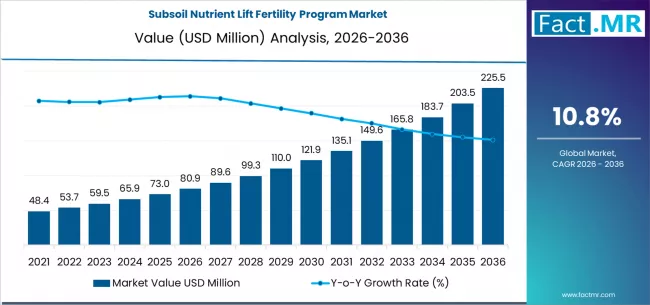
Cereal crops are the primary application segment, commanding a 49% share, given their extensive root systems and the significant yield impact of accessing deep nitrogen and potassium reserves. Granular formulations are the leading product type with a 38% share, as they are well-suited for deep placement or as carrier products for nutrients designed to migrate downward. Ag-retailers are the dominant sales channel, responsible for 55% of the market, as their role in providing integrated soil testing, product recommendations, and management advice is crucial for implementing these technically nuanced programs.
Market expansion is driven by the limitations of surface-only fertilization, particularly in conservation tillage systems where nutrients accumulate near the soil surface. Subsoil nutrient lift programs counteract this stratification, improve fertilizer use efficiency, and leverage existing nutrient capital that has leached over time. By enhancing the plant's access to a larger soil volume, these programs build crop resilience against mid-season drought and reduce the environmental footprint of agriculture by minimizing new fertilizer requirements.
Metric
| Metric | Value |
|---|---|
| Market Value (2026) | USD 80.87 Million |
| Market Forecast Value (2036) | USD 225.53 Million |
| Forecast CAGR (2026 to 2036) | 10.8% |
Category
| Category | Segments |
|---|---|
| Crop | Cereals, Oilseeds, Fruits, Vegetables |
| Form | Granular, Liquid, Powder, Suspension |
| Sales Channel | Ag-Retailers, Direct-to-Farmer, Online Marketplaces, Cooperatives |
| Region | North America, Latin America, Western Europe, Eastern Europe, East Asia, South Asia & Pacific, MEA |
Segmental Analysis
By Crop, Which System Benefits Most from Accessing Deep Nutrients?
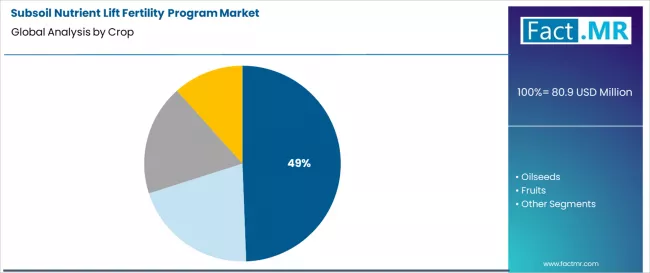
Cereal crops lead with a 49% share. Their fibrous root systems and high demand for nitrogen and potassium during grain fill make them ideal candidates for subsoil nutrient lift. Programs that successfully mobilize deep nitrogen reserves can significantly reduce top-dressing requirements and improve yield stability, particularly in dryland systems or under conservation agriculture where surface nutrients may be inaccessible during dry spells.
By Form, Which is Engineered for Subsoil Interaction?
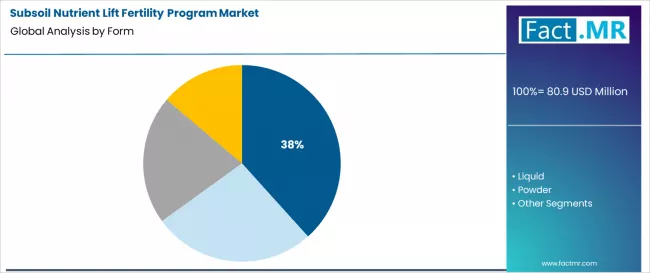
Granular formulations hold the largest share at 38%. Specific granular products, such as those containing elemental sulfur or certain nitrate forms, are designed to facilitate the downward movement of key nutrients like phosphorus and potassium by altering pH or providing a mobile anion carrier. Their use is a deliberate strategy to place a nutrient pump in the soil profile that works over time to enrich the root zone from below.
By Sales Channel, Who Guides the Complex Soil Management Process?

Ag-Retailers are the pivotal channel, facilitating 55% of sales. Implementing a successful subsoil lift program requires deep understanding of a field's history, soil texture, and existing nutrient stratification.
Retail agronomists use soil core tests to diagnose stratification and then design multi-year programs involving specific fertilizer types, cover crops to biotillate the subsoil, and moisture management advice. This is a service-intensive offering beyond a simple product sale.
What are the Drivers, Restraints, and Key Trends of the Market?
The primary driver is the widespread adoption of no-till and reduced-tillage practices, which inherently lead to nutrient stratification near the soil surface. This creates a yield-limiting condition that subsoil lift programs are designed to solve. Increasing fertilizer costs also motivate farmers to better utilize nutrients already present in their soil profile. Furthermore, the need for drought resilience makes accessing deeper soil moisture, which is coupled with nutrient availability, a critical management goal.
A key restraint is the long-term nature of the results; rebuilding subsoil fertility and correcting stratification is a multi-season process. This delayed ROI can deter adoption. The programs also require more sophisticated soil testing and agronomic planning, raising the knowledge barrier for implementation. In some soil types with high clay content or hardpans, physical barriers may limit root and nutrient movement, reducing program efficacy without complementary mechanical intervention.
Trends include the development of biological lift agents, such as specific fungi and bacteria that solubilize fixed phosphorus and potassium in the subsoil and facilitate their transport. There is growing integration of deep-rooted cover crops such as radishes and alfalfa into these programs to naturally cycle nutrients upward. The market is also moving toward precision subsoil mapping using electromagnetic induction or gamma radiometrics to identify zones of high deep-nutrient potential for targeted program investment.
Analysis of the Subsoil Nutrient Lift Fertility Program Market by Key Countries

| Country | CAGR (2026 to 2036) |
|---|---|
| India | 15.6% |
| China | 14.8% |
| USA | 13.9% |
| Netherlands | 12.7% |
How does Widespread Conservation Tillage in the US Drive Program Adoption?
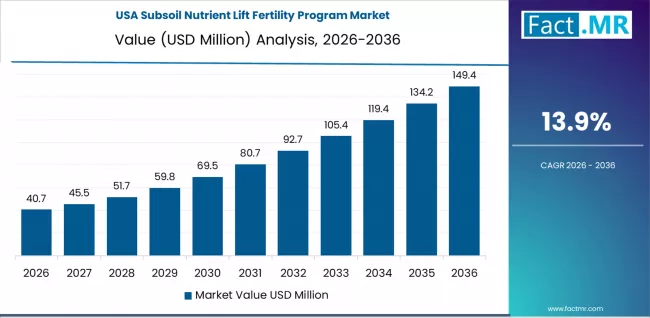
The USA's 13.9% growth is concentrated in the Midwest and Great Plains, where decades of no-till corn and soybean production have created severe phosphorus and potassium stratification.
Subsoil lift programs are increasingly viewed as the necessary next step in mature conservation systems to unlock yield potential and improve nutrient efficiency. These programs are often delivered through ag-retailers as a premium soil health service.
What role does China's 'Fertilizer Zero-Growth' Policy Play in Promoting Nutrient Recycling?
China's 14.8% CAGR aligns with its national policy to cap synthetic fertilizer use. Subsoil nutrient lift programs offer a pathway to maintain or increase yields by accessing legacy nutrients without applying more top-dressed fertilizer.
State-supported research and demonstration plots are promoting these techniques, especially in key cereal production regions, to achieve policy goals and reduce environmental impact.
Why is India's Groundwater Depletion Making Subsoil Moisture and Nutrient Access Critical?
India's leading CAGR of 15.6% is driven by the synergy between water and nutrient stress. As groundwater tables fall, roots must go deeper for water. Programs that simultaneously lift subsoil nutrients ensure that deep-rooted crops are not nutrient-deficient.
This integrated approach to managing deep soil resources is gaining traction among progressive farmers and is being promoted by extension services to combat declining water use efficiency.
How does the Netherlands' Intensive Farming and Precision Focus Enable Advanced Programs?
The Netherlands' 12.7% growth reflects its leadership in high-precision, input-efficient agriculture. Dutch farmers and researchers are pioneering the use of specific organic acids and biologicals in fertigation to chelate and mobilize micronutrients from the subsoil for high-value greenhouse and field vegetables. This precision approach to subsoil mining is a natural extension of the country's focus on maximizing resource use efficiency in a constrained environment.
Competitive Landscape of the Subsoil Nutrient Lift Fertility Program Market
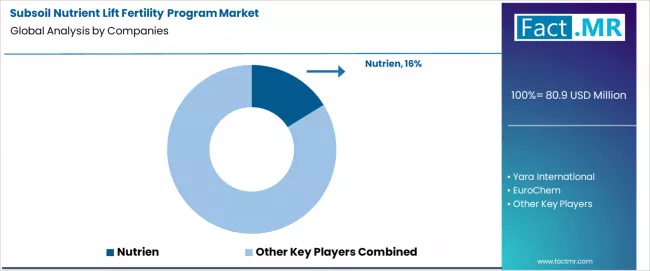
The competitive landscape features a blend of global fertilizer companies and specialty biological firms. Competition centers on proprietary product technologies, whether advanced chelating agents, specialized microbial consortia, or nutrient delivery polymers, that demonstrably improve nutrient mobility in the soil profile. Success is equally dependent on building a strong technical service platform capable of detailed soil audit and program monitoring, transforming the product sale into a long-term agronomic partnership.
Key Players in the Subsoil Nutrient Lift Fertility Program Market
- Nutrien
- Yara International
- EuroChem
- ICL Group
- Corteva
- Syngenta
Scope of Report
| Items | Values |
|---|---|
| Quantitative Units | USD Million |
| Crop | Cereals, Oilseeds, Fruits, Vegetables |
| Form | Granular, Liquid, Powder, Suspension |
| Sales Channel | Ag-Retailers, Direct-to-Farmer, Online Marketplaces, Cooperatives |
| Key Countries | USA, China, India, Netherlands |
| Key Companies | Nutrien, Yara International, EuroChem, ICL Group, Corteva, Syngenta |
| Additional Analysis | Soil chemistry of nutrient stratification and mobility; mechanisms of nutrient uplift via mass flow and diffusion; role of soil biology in nutrient cycling; economic analysis of accessing legacy soil nutrients vs. new fertilizer application; integration with irrigation management for enhanced lift. |
Market by Segments
Crop :
- Cereals
- Oilseeds
- Fruits
- Vegetables
Form :
- Granular
- Liquid
- Powder
- Suspension
Sales Channel :
- Ag-Retailers
- Direct-to-Farmer
- Online Marketplaces
- Cooperatives
Region :
- North America
- USA
- Canada
- Latin America
- Brazil
- Mexico
- Argentina
- Rest of Latin America
- Western Europe
- Netherlands
- Germany
- UK
- France
- Spain
- Italy
- BENELUX
- Rest of Western Europe
- Eastern Europe
- Russia
- Poland
- Czech Republic
- Rest of Eastern Europe
- East Asia
- China
- Japan
- South Korea
- Rest of East Asia
- South Asia & Pacific
- India
- ASEAN
- Australia
- Rest of South Asia & Pacific
- MEA
- Saudi Arabia
- UAE
- Turkiye
- Rest of MEA
Table of Content
- Executive Summary
- Global Market Outlook
- Demand to side Trends
- Supply to side Trends
- Technology Roadmap Analysis
- Analysis and Recommendations
- Market Overview
- Market Coverage / Taxonomy
- Market Definition / Scope / Limitations
- Market Background
- Market Dynamics
- Drivers
- Restraints
- Opportunity
- Trends
- Scenario Forecast
- Demand in Optimistic Scenario
- Demand in Likely Scenario
- Demand in Conservative Scenario
- Opportunity Map Analysis
- Product Life Cycle Analysis
- Supply Chain Analysis
- Investment Feasibility Matrix
- Value Chain Analysis
- PESTLE and Porter’s Analysis
- Regulatory Landscape
- Regional Parent Market Outlook
- Production and Consumption Statistics
- Import and Export Statistics
- Market Dynamics
- Global Market Analysis 2021 to 2025 and Forecast, 2026 to 2036
- Historical Market Size Value (USD Million) Analysis, 2021 to 2025
- Current and Future Market Size Value (USD Million) Projections, 2026 to 2036
- Y to o to Y Growth Trend Analysis
- Absolute $ Opportunity Analysis
- Global Market Pricing Analysis 2021 to 2025 and Forecast 2026 to 2036
- Global Market Analysis 2021 to 2025 and Forecast 2026 to 2036, By Crop
- Introduction / Key Findings
- Historical Market Size Value (USD Million) Analysis By Crop, 2021 to 2025
- Current and Future Market Size Value (USD Million) Analysis and Forecast By Crop, 2026 to 2036
- Cereals
- Oilseeds
- Fruits
- Vegetables
- Cereals
- Y to o to Y Growth Trend Analysis By Crop, 2021 to 2025
- Absolute $ Opportunity Analysis By Crop, 2026 to 2036
- Global Market Analysis 2021 to 2025 and Forecast 2026 to 2036, By Form
- Introduction / Key Findings
- Historical Market Size Value (USD Million) Analysis By Form, 2021 to 2025
- Current and Future Market Size Value (USD Million) Analysis and Forecast By Form, 2026 to 2036
- Granular
- Liquid
- Powder
- Suspension
- Granular
- Y to o to Y Growth Trend Analysis By Form, 2021 to 2025
- Absolute $ Opportunity Analysis By Form, 2026 to 2036
- Global Market Analysis 2021 to 2025 and Forecast 2026 to 2036, By Sales Channel
- Introduction / Key Findings
- Historical Market Size Value (USD Million) Analysis By Sales Channel, 2021 to 2025
- Current and Future Market Size Value (USD Million) Analysis and Forecast By Sales Channel, 2026 to 2036
- Ag-Retailers
- Direct-to-Farmer
- Online Marketplaces
- Cooperatives
- Ag-Retailers
- Y to o to Y Growth Trend Analysis By Sales Channel, 2021 to 2025
- Absolute $ Opportunity Analysis By Sales Channel, 2026 to 2036
- Global Market Analysis 2021 to 2025 and Forecast 2026 to 2036, By Region
- Introduction
- Historical Market Size Value (USD Million) Analysis By Region, 2021 to 2025
- Current Market Size Value (USD Million) Analysis and Forecast By Region, 2026 to 2036
- North America
- Latin America
- Western Europe
- Eastern Europe
- East Asia
- South Asia and Pacific
- Middle East & Africa
- Market Attractiveness Analysis By Region
- North America Market Analysis 2021 to 2025 and Forecast 2026 to 2036, By Country
- Historical Market Size Value (USD Million) Trend Analysis By Market Taxonomy, 2021 to 2025
- Market Size Value (USD Million) Forecast By Market Taxonomy, 2026 to 2036
- By Country
- USA
- Canada
- Mexico
- By Crop
- By Form
- By Sales Channel
- By Country
- Market Attractiveness Analysis
- By Country
- By Crop
- By Form
- By Sales Channel
- Key Takeaways
- Latin America Market Analysis 2021 to 2025 and Forecast 2026 to 2036, By Country
- Historical Market Size Value (USD Million) Trend Analysis By Market Taxonomy, 2021 to 2025
- Market Size Value (USD Million) Forecast By Market Taxonomy, 2026 to 2036
- By Country
- Brazil
- Chile
- Rest of Latin America
- By Crop
- By Form
- By Sales Channel
- By Country
- Market Attractiveness Analysis
- By Country
- By Crop
- By Form
- By Sales Channel
- Key Takeaways
- Western Europe Market Analysis 2021 to 2025 and Forecast 2026 to 2036, By Country
- Historical Market Size Value (USD Million) Trend Analysis By Market Taxonomy, 2021 to 2025
- Market Size Value (USD Million) Forecast By Market Taxonomy, 2026 to 2036
- By Country
- Germany
- UK
- Italy
- Spain
- France
- Nordic
- BENELUX
- Rest of Western Europe
- By Crop
- By Form
- By Sales Channel
- By Country
- Market Attractiveness Analysis
- By Country
- By Crop
- By Form
- By Sales Channel
- Key Takeaways
- Eastern Europe Market Analysis 2021 to 2025 and Forecast 2026 to 2036, By Country
- Historical Market Size Value (USD Million) Trend Analysis By Market Taxonomy, 2021 to 2025
- Market Size Value (USD Million) Forecast By Market Taxonomy, 2026 to 2036
- By Country
- Russia
- Poland
- Hungary
- Balkan & Baltic
- Rest of Eastern Europe
- By Crop
- By Form
- By Sales Channel
- By Country
- Market Attractiveness Analysis
- By Country
- By Crop
- By Form
- By Sales Channel
- Key Takeaways
- East Asia Market Analysis 2021 to 2025 and Forecast 2026 to 2036, By Country
- Historical Market Size Value (USD Million) Trend Analysis By Market Taxonomy, 2021 to 2025
- Market Size Value (USD Million) Forecast By Market Taxonomy, 2026 to 2036
- By Country
- China
- Japan
- South Korea
- By Crop
- By Form
- By Sales Channel
- By Country
- Market Attractiveness Analysis
- By Country
- By Crop
- By Form
- By Sales Channel
- Key Takeaways
- South Asia and Pacific Market Analysis 2021 to 2025 and Forecast 2026 to 2036, By Country
- Historical Market Size Value (USD Million) Trend Analysis By Market Taxonomy, 2021 to 2025
- Market Size Value (USD Million) Forecast By Market Taxonomy, 2026 to 2036
- By Country
- India
- ASEAN
- Australia & New Zealand
- Rest of South Asia and Pacific
- By Crop
- By Form
- By Sales Channel
- By Country
- Market Attractiveness Analysis
- By Country
- By Crop
- By Form
- By Sales Channel
- Key Takeaways
- Middle East & Africa Market Analysis 2021 to 2025 and Forecast 2026 to 2036, By Country
- Historical Market Size Value (USD Million) Trend Analysis By Market Taxonomy, 2021 to 2025
- Market Size Value (USD Million) Forecast By Market Taxonomy, 2026 to 2036
- By Country
- Kingdom of Saudi Arabia
- Other GCC Countries
- Turkiye
- South Africa
- Other African Union
- Rest of Middle East & Africa
- By Crop
- By Form
- By Sales Channel
- By Country
- Market Attractiveness Analysis
- By Country
- By Crop
- By Form
- By Sales Channel
- Key Takeaways
- Key Countries Market Analysis
- USA
- Pricing Analysis
- Market Share Analysis, 2025
- By Crop
- By Form
- By Sales Channel
- Canada
- Pricing Analysis
- Market Share Analysis, 2025
- By Crop
- By Form
- By Sales Channel
- Mexico
- Pricing Analysis
- Market Share Analysis, 2025
- By Crop
- By Form
- By Sales Channel
- Brazil
- Pricing Analysis
- Market Share Analysis, 2025
- By Crop
- By Form
- By Sales Channel
- Chile
- Pricing Analysis
- Market Share Analysis, 2025
- By Crop
- By Form
- By Sales Channel
- Germany
- Pricing Analysis
- Market Share Analysis, 2025
- By Crop
- By Form
- By Sales Channel
- UK
- Pricing Analysis
- Market Share Analysis, 2025
- By Crop
- By Form
- By Sales Channel
- Italy
- Pricing Analysis
- Market Share Analysis, 2025
- By Crop
- By Form
- By Sales Channel
- Spain
- Pricing Analysis
- Market Share Analysis, 2025
- By Crop
- By Form
- By Sales Channel
- France
- Pricing Analysis
- Market Share Analysis, 2025
- By Crop
- By Form
- By Sales Channel
- India
- Pricing Analysis
- Market Share Analysis, 2025
- By Crop
- By Form
- By Sales Channel
- ASEAN
- Pricing Analysis
- Market Share Analysis, 2025
- By Crop
- By Form
- By Sales Channel
- Australia & New Zealand
- Pricing Analysis
- Market Share Analysis, 2025
- By Crop
- By Form
- By Sales Channel
- China
- Pricing Analysis
- Market Share Analysis, 2025
- By Crop
- By Form
- By Sales Channel
- Japan
- Pricing Analysis
- Market Share Analysis, 2025
- By Crop
- By Form
- By Sales Channel
- South Korea
- Pricing Analysis
- Market Share Analysis, 2025
- By Crop
- By Form
- By Sales Channel
- Russia
- Pricing Analysis
- Market Share Analysis, 2025
- By Crop
- By Form
- By Sales Channel
- Poland
- Pricing Analysis
- Market Share Analysis, 2025
- By Crop
- By Form
- By Sales Channel
- Hungary
- Pricing Analysis
- Market Share Analysis, 2025
- By Crop
- By Form
- By Sales Channel
- Kingdom of Saudi Arabia
- Pricing Analysis
- Market Share Analysis, 2025
- By Crop
- By Form
- By Sales Channel
- Turkiye
- Pricing Analysis
- Market Share Analysis, 2025
- By Crop
- By Form
- By Sales Channel
- South Africa
- Pricing Analysis
- Market Share Analysis, 2025
- By Crop
- By Form
- By Sales Channel
- USA
- Market Structure Analysis
- Competition Dashboard
- Competition Benchmarking
- Market Share Analysis of Top Players
- By Regional
- By Crop
- By Form
- By Sales Channel
- Competition Analysis
- Competition Deep Dive
- Nutrien
- Overview
- Product Portfolio
- Profitability by Market Segments (Product/Age /Sales Channel/Region)
- Sales Footprint
- Strategy Overview
- Marketing Strategy
- Product Strategy
- Channel Strategy
- Yara International
- EuroChem
- ICL Group
- Corteva
- Syngenta
- Nutrien
- Competition Deep Dive
- Assumptions & Acronyms Used
- Research Methodology
List Of Table
- Table 1: Global Market Value (USD Million) Forecast by Region, 2021 to 2036
- Table 2: Global Market Value (USD Million) Forecast by Crop, 2021 to 2036
- Table 3: Global Market Value (USD Million) Forecast by Form, 2021 to 2036
- Table 4: Global Market Value (USD Million) Forecast by Sales Channel, 2021 to 2036
- Table 5: North America Market Value (USD Million) Forecast by Country, 2021 to 2036
- Table 6: North America Market Value (USD Million) Forecast by Crop, 2021 to 2036
- Table 7: North America Market Value (USD Million) Forecast by Form, 2021 to 2036
- Table 8: North America Market Value (USD Million) Forecast by Sales Channel, 2021 to 2036
- Table 9: Latin America Market Value (USD Million) Forecast by Country, 2021 to 2036
- Table 10: Latin America Market Value (USD Million) Forecast by Crop, 2021 to 2036
- Table 11: Latin America Market Value (USD Million) Forecast by Form, 2021 to 2036
- Table 12: Latin America Market Value (USD Million) Forecast by Sales Channel, 2021 to 2036
- Table 13: Western Europe Market Value (USD Million) Forecast by Country, 2021 to 2036
- Table 14: Western Europe Market Value (USD Million) Forecast by Crop, 2021 to 2036
- Table 15: Western Europe Market Value (USD Million) Forecast by Form, 2021 to 2036
- Table 16: Western Europe Market Value (USD Million) Forecast by Sales Channel, 2021 to 2036
- Table 17: Eastern Europe Market Value (USD Million) Forecast by Country, 2021 to 2036
- Table 18: Eastern Europe Market Value (USD Million) Forecast by Crop, 2021 to 2036
- Table 19: Eastern Europe Market Value (USD Million) Forecast by Form, 2021 to 2036
- Table 20: Eastern Europe Market Value (USD Million) Forecast by Sales Channel, 2021 to 2036
- Table 21: East Asia Market Value (USD Million) Forecast by Country, 2021 to 2036
- Table 22: East Asia Market Value (USD Million) Forecast by Crop, 2021 to 2036
- Table 23: East Asia Market Value (USD Million) Forecast by Form, 2021 to 2036
- Table 24: East Asia Market Value (USD Million) Forecast by Sales Channel, 2021 to 2036
- Table 25: South Asia and Pacific Market Value (USD Million) Forecast by Country, 2021 to 2036
- Table 26: South Asia and Pacific Market Value (USD Million) Forecast by Crop, 2021 to 2036
- Table 27: South Asia and Pacific Market Value (USD Million) Forecast by Form, 2021 to 2036
- Table 28: South Asia and Pacific Market Value (USD Million) Forecast by Sales Channel, 2021 to 2036
- Table 29: Middle East & Africa Market Value (USD Million) Forecast by Country, 2021 to 2036
- Table 30: Middle East & Africa Market Value (USD Million) Forecast by Crop, 2021 to 2036
- Table 31: Middle East & Africa Market Value (USD Million) Forecast by Form, 2021 to 2036
- Table 32: Middle East & Africa Market Value (USD Million) Forecast by Sales Channel, 2021 to 2036
List Of Figures
- Figure 1: Global Market Pricing Analysis
- Figure 2: Global Market Value (USD Million) Forecast 2021-2036
- Figure 3: Global Market Value Share and BPS Analysis by Crop, 2026 and 2036
- Figure 4: Global Market Y to o to Y Growth Comparison by Crop, 2026-2036
- Figure 5: Global Market Attractiveness Analysis by Crop
- Figure 6: Global Market Value Share and BPS Analysis by Form, 2026 and 2036
- Figure 7: Global Market Y to o to Y Growth Comparison by Form, 2026-2036
- Figure 8: Global Market Attractiveness Analysis by Form
- Figure 9: Global Market Value Share and BPS Analysis by Sales Channel, 2026 and 2036
- Figure 10: Global Market Y to o to Y Growth Comparison by Sales Channel, 2026-2036
- Figure 11: Global Market Attractiveness Analysis by Sales Channel
- Figure 12: Global Market Value (USD Million) Share and BPS Analysis by Region, 2026 and 2036
- Figure 13: Global Market Y to o to Y Growth Comparison by Region, 2026-2036
- Figure 14: Global Market Attractiveness Analysis by Region
- Figure 15: North America Market Incremental Dollar Opportunity, 2026-2036
- Figure 16: Latin America Market Incremental Dollar Opportunity, 2026-2036
- Figure 17: Western Europe Market Incremental Dollar Opportunity, 2026-2036
- Figure 18: Eastern Europe Market Incremental Dollar Opportunity, 2026-2036
- Figure 19: East Asia Market Incremental Dollar Opportunity, 2026-2036
- Figure 20: South Asia and Pacific Market Incremental Dollar Opportunity, 2026-2036
- Figure 21: Middle East & Africa Market Incremental Dollar Opportunity, 2026-2036
- Figure 22: North America Market Value Share and BPS Analysis by Country, 2026 and 2036
- Figure 23: North America Market Value Share and BPS Analysis by Crop, 2026 and 2036
- Figure 24: North America Market Y to o to Y Growth Comparison by Crop, 2026-2036
- Figure 25: North America Market Attractiveness Analysis by Crop
- Figure 26: North America Market Value Share and BPS Analysis by Form, 2026 and 2036
- Figure 27: North America Market Y to o to Y Growth Comparison by Form, 2026-2036
- Figure 28: North America Market Attractiveness Analysis by Form
- Figure 29: North America Market Value Share and BPS Analysis by Sales Channel, 2026 and 2036
- Figure 30: North America Market Y to o to Y Growth Comparison by Sales Channel, 2026-2036
- Figure 31: North America Market Attractiveness Analysis by Sales Channel
- Figure 32: Latin America Market Value Share and BPS Analysis by Country, 2026 and 2036
- Figure 33: Latin America Market Value Share and BPS Analysis by Crop, 2026 and 2036
- Figure 34: Latin America Market Y to o to Y Growth Comparison by Crop, 2026-2036
- Figure 35: Latin America Market Attractiveness Analysis by Crop
- Figure 36: Latin America Market Value Share and BPS Analysis by Form, 2026 and 2036
- Figure 37: Latin America Market Y to o to Y Growth Comparison by Form, 2026-2036
- Figure 38: Latin America Market Attractiveness Analysis by Form
- Figure 39: Latin America Market Value Share and BPS Analysis by Sales Channel, 2026 and 2036
- Figure 40: Latin America Market Y to o to Y Growth Comparison by Sales Channel, 2026-2036
- Figure 41: Latin America Market Attractiveness Analysis by Sales Channel
- Figure 42: Western Europe Market Value Share and BPS Analysis by Country, 2026 and 2036
- Figure 43: Western Europe Market Value Share and BPS Analysis by Crop, 2026 and 2036
- Figure 44: Western Europe Market Y to o to Y Growth Comparison by Crop, 2026-2036
- Figure 45: Western Europe Market Attractiveness Analysis by Crop
- Figure 46: Western Europe Market Value Share and BPS Analysis by Form, 2026 and 2036
- Figure 47: Western Europe Market Y to o to Y Growth Comparison by Form, 2026-2036
- Figure 48: Western Europe Market Attractiveness Analysis by Form
- Figure 49: Western Europe Market Value Share and BPS Analysis by Sales Channel, 2026 and 2036
- Figure 50: Western Europe Market Y to o to Y Growth Comparison by Sales Channel, 2026-2036
- Figure 51: Western Europe Market Attractiveness Analysis by Sales Channel
- Figure 52: Eastern Europe Market Value Share and BPS Analysis by Country, 2026 and 2036
- Figure 53: Eastern Europe Market Value Share and BPS Analysis by Crop, 2026 and 2036
- Figure 54: Eastern Europe Market Y to o to Y Growth Comparison by Crop, 2026-2036
- Figure 55: Eastern Europe Market Attractiveness Analysis by Crop
- Figure 56: Eastern Europe Market Value Share and BPS Analysis by Form, 2026 and 2036
- Figure 57: Eastern Europe Market Y to o to Y Growth Comparison by Form, 2026-2036
- Figure 58: Eastern Europe Market Attractiveness Analysis by Form
- Figure 59: Eastern Europe Market Value Share and BPS Analysis by Sales Channel, 2026 and 2036
- Figure 60: Eastern Europe Market Y to o to Y Growth Comparison by Sales Channel, 2026-2036
- Figure 61: Eastern Europe Market Attractiveness Analysis by Sales Channel
- Figure 62: East Asia Market Value Share and BPS Analysis by Country, 2026 and 2036
- Figure 63: East Asia Market Value Share and BPS Analysis by Crop, 2026 and 2036
- Figure 64: East Asia Market Y to o to Y Growth Comparison by Crop, 2026-2036
- Figure 65: East Asia Market Attractiveness Analysis by Crop
- Figure 66: East Asia Market Value Share and BPS Analysis by Form, 2026 and 2036
- Figure 67: East Asia Market Y to o to Y Growth Comparison by Form, 2026-2036
- Figure 68: East Asia Market Attractiveness Analysis by Form
- Figure 69: East Asia Market Value Share and BPS Analysis by Sales Channel, 2026 and 2036
- Figure 70: East Asia Market Y to o to Y Growth Comparison by Sales Channel, 2026-2036
- Figure 71: East Asia Market Attractiveness Analysis by Sales Channel
- Figure 72: South Asia and Pacific Market Value Share and BPS Analysis by Country, 2026 and 2036
- Figure 73: South Asia and Pacific Market Value Share and BPS Analysis by Crop, 2026 and 2036
- Figure 74: South Asia and Pacific Market Y to o to Y Growth Comparison by Crop, 2026-2036
- Figure 75: South Asia and Pacific Market Attractiveness Analysis by Crop
- Figure 76: South Asia and Pacific Market Value Share and BPS Analysis by Form, 2026 and 2036
- Figure 77: South Asia and Pacific Market Y to o to Y Growth Comparison by Form, 2026-2036
- Figure 78: South Asia and Pacific Market Attractiveness Analysis by Form
- Figure 79: South Asia and Pacific Market Value Share and BPS Analysis by Sales Channel, 2026 and 2036
- Figure 80: South Asia and Pacific Market Y to o to Y Growth Comparison by Sales Channel, 2026-2036
- Figure 81: South Asia and Pacific Market Attractiveness Analysis by Sales Channel
- Figure 82: Middle East & Africa Market Value Share and BPS Analysis by Country, 2026 and 2036
- Figure 83: Middle East & Africa Market Value Share and BPS Analysis by Crop, 2026 and 2036
- Figure 84: Middle East & Africa Market Y to o to Y Growth Comparison by Crop, 2026-2036
- Figure 85: Middle East & Africa Market Attractiveness Analysis by Crop
- Figure 86: Middle East & Africa Market Value Share and BPS Analysis by Form, 2026 and 2036
- Figure 87: Middle East & Africa Market Y to o to Y Growth Comparison by Form, 2026-2036
- Figure 88: Middle East & Africa Market Attractiveness Analysis by Form
- Figure 89: Middle East & Africa Market Value Share and BPS Analysis by Sales Channel, 2026 and 2036
- Figure 90: Middle East & Africa Market Y to o to Y Growth Comparison by Sales Channel, 2026-2036
- Figure 91: Middle East & Africa Market Attractiveness Analysis by Sales Channel
- Figure 92: Global Market - Tier Structure Analysis
- Figure 93: Global Market - Company Share Analysis
- FAQs -
How big is the subsoil nutrient lift fertility program market in 2026?
The global subsoil nutrient lift fertility program market is estimated to be valued at USD 80.9 million in 2026.
What will be the size of subsoil nutrient lift fertility program market in 2036?
The market size for the subsoil nutrient lift fertility program market is projected to reach USD 225.5 million by 2036.
How much will be the subsoil nutrient lift fertility program market growth between 2026 and 2036?
The subsoil nutrient lift fertility program market is expected to grow at a 10.8% CAGR between 2026 and 2036.
What are the key product types in the subsoil nutrient lift fertility program market?
The key product types in subsoil nutrient lift fertility program market are cereals, oilseeds, fruits and vegetables.
Which form segment to contribute significant share in the subsoil nutrient lift fertility program market in 2026?
In terms of form, granular segment to command 38.3% share in the subsoil nutrient lift fertility program market in 2026.