- Market Value (2025): USD 9.5 Bn
- Estimated Value (2026): USD 10.5 Bn
- Forecast Value (2036): USD 31.9 Bn
- CAGR (2026-2036): 11.6%
What is the Biodegradable Plastic Market forecast to be worth by 2036?
USD 10.5 billion in 2026 to USD 31.9 billion by 2036 at an 11.6% CAGR.
- The biodegradable plastic market was valued at USD 9.5 billion in 2025.
- As per Fact.MR analysis, sales are projected to reach from USD 10.5 billion in 2026 to USD 31.9 billion in 2036 as packaging converters and specialist product makers add qualified biodegradable resin grades.
- The 11.6% CAGR forecast for 2026 to 2036 reflects opportunities in packaging conversion and selected single-use products.
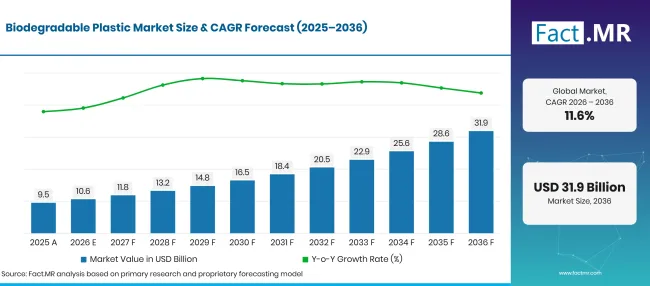
Biodegradable Plastic Market Forecast Global | Source: Fact.MR
| Year | Basis | Market Value (USD Billion) |
|---|---|---|
| 2025 | Calculated estimate | 9.5 |
| 2026 | Estimate | 10.6 |
| 2036 | Forecast | 31.9 |
| CAGR 2026 to 2036 | Forecast period | 11.6% |
Source: Fact.MR analysis. Updated Oct 24, 2026
What are the defining numbers behind Biodegradable Plastic Market growth?
The forecast adds USD 21.3 billion in annual sales between 2026 and 2036.
- Demand Drivers in the Market
- Food-packaging converters value certified compostable formats when customers have access to suitable organics collection.
- Packaging waste remains a material selection issue. Eurostat reported in October 2025 that each EU resident generated 35.3 kg of plastic packaging waste in 2023 [2]. Resin makers need to demonstrate where biodegradable products offer a workable disposal pathway.
- Agricultural-film producers consider biodegradable grades for applications where collecting contaminated film is difficult. Soil biodegradation needs separate testing because industrial composting certification alone does not describe performance in the field.
- Product manufacturers increasingly ask resin suppliers for extrusion guidance and consistent delivery specifications. Technical support reduces conversion trials and helps producers manage sealing behavior and finished-product strength.
- Key Segments Analyzed
- By Product Type: Polylactic Acid (PLA) is projected to represent 30.8% of 2026 sales, supported by established film and rigid-product processing uses.
- By End-user: Packaging is forecast to account for 42.3% of 2026 value as converters develop compostable flexible and food-service formats.
- Analyst Opinion at Fact.MR
- Shambhu Nath Jha, Principal Consultant at Fact.MR, states, “Biodegradable plastics compete first on whether they work in the finished product and its actual disposal system. Producers that pair verified end-of-life claims with stable resin quality are better placed to earn repeat orders. Commercial uptake depends on whether each formulation performs well in its intended application and disposal setting.”
- Strategic Implications
- Resin producers should publish grade-specific composting or biodegradation evidence alongside processing instructions.
- Packaging converters should test sealing strength and shelf-life performance before replacing an incumbent material.
- Agricultural product makers should distinguish soil-biodegradable films from products intended only for industrial composting.
- Retail and food-service brands should coordinate packaging claims with the collection services available to customers.
Among the five countries assessed, Germany is forecast at 14.1% CAGR, followed by the UK at 12.3%. Brazil reaches 11.0%, Japan posts 10.4%, and the USA records 9.3% through 2036. These paths reflect different mixes of packaging rules, resin conversion capability and downstream waste handling.
How does the Biodegradable Plastic Market break down by segment?
PLA represents 30.8% of 2026 product-type value; packaging accounts for 42.3% of end-user sales.
Which Product Type dominates?
Polylactic Acid (PLA) leads with 30.8% share in 2026.
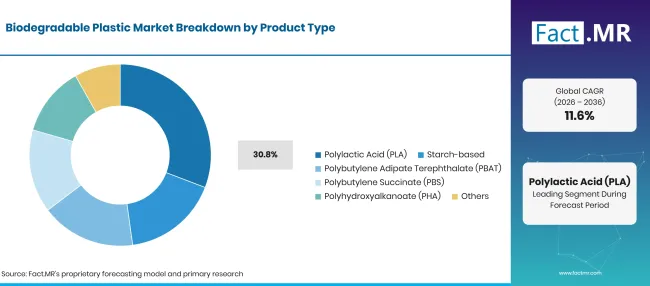
Biodegradable Plastic Market Breakdown Product Type | Source: Fact.MR
| Product Type | Share (2026) |
|---|---|
| Polylactic Acid (PLA) | 30.8% |
| Other product types combined | 69.2% |
| Total | 100.0% |
Source: Fact.MR analysis. Updated Oct 24, 2026
PLA is processed into rigid food-service items and selected flexible products. Its manufacturing route starts with fermented sugars and converts lactic acid into polymer resin. Converters evaluate clarity and stiffness alongside heat performance, since a workable end-of-life claim does not remove normal packaging specifications. Starch-based resins serve bags and flexible products, often as blends. PBAT contributes flexibility in compostable compounds, while PBS offers another polyester route. PHA grades attract interest where a different biodegradation profile is needed. Kaneka describes Green Planet as a PHBH polymer produced by microbial fermentation from plant oils [3].
What leads the End-user segment?
Packaging is projected to capture 42.3% share in 2026.
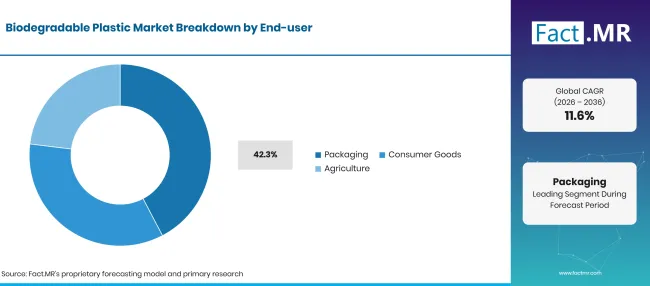
Biodegradable Plastic Market Breakdown End User | Source: Fact.MR
| End-user | Share (2026) |
|---|---|
| Packaging | 42.3% |
| Other end-users combined | 57.7% |
| Total | 100.0% |
Source: Fact.MR analysis. Updated Oct 24, 2026
Packaging holds the largest share because converters purchase biodegradable films and molded products for repeat production. Food-contaminated applications can have a practical link to composting, provided collection and treatment facilities accept the products. The EU packaging framework has made product-specific disposal criteria more important for development teams. Consumer goods include smaller durable and disposable items where appearance and processing matter. Agriculture covers mulch and related products whose useful life and field conditions differ from household packaging.
What is accelerating Biodegradable Plastic Market adoption, and what is holding it back?
Packaging conversion and grade availability support adoption. Resin cost, disposal infrastructure and confusion over degradation claims limit the addressable applications.
Drivers Impact Analysis
| DRIVER | (~) % IMPACT ON CAGR | GEOGRAPHIC RELEVANCE | IMPACT TIMELINE |
|---|---|---|---|
| Use-specific compostable packaging | +1.0% | Europe, North America | Short to medium term |
| New PLA production capacity | +0.8% | Asia and export markets | Medium term (2–4 years) |
| Specialist agricultural applications | +0.6% | Brazil, Japan, Europe | Medium term (2–4 years) |
| Material qualification by converters | +0.5% | Global | Short term (<= 2 years) |
Source: Fact.MR analysis. Updated Oct 24, 2026
Opportunity Impact Analysis
| OPPORTUNITY | (~) % IMPACT ON CAGR | GEOGRAPHIC RELEVANCE | IMPACT TIMELINE |
|---|---|---|---|
| Compostable food-service products | +0.8% | Europe, USA | Medium term (2–4 years) |
| Resin blending for flexible products | +0.6% | Global | Short to medium term |
| Field-tested agricultural films | +0.4% | Brazil, Japan | Medium term (2–4 years) |
Source: Fact.MR analysis. Updated Oct 24, 2026
Restraints Impact Analysis
| RESTRAINT | (~) % IMPACT ON CAGR | GEOGRAPHIC RELEVANCE | IMPACT TIMELINE |
|---|---|---|---|
| Limited processing and collection options | -0.6% | Global | Short to long term |
| Cost against established resins | -0.5% | Global | Short term (<= 2 years) |
| Certification and labeling complexity | -0.4% | Europe, Japan, USA | Medium term (2–4 years) |
Source: Fact.MR analysis. Updated Oct 24, 2026
Which countries are scaling the Biodegradable Plastic Market through 2036?
| Country | CAGR (2026 to 2036) |
|---|---|
| Germany | 14.1% |
| United Kingdom | 12.3% |
| Brazil | 11.0% |
| Japan | 10.4% |
| United States | 9.3% |
Source: Fact.MR analysis. Updated Oct 24, 2026
What supports Germany’s adoption?
14.1% CAGR, linked to packaging design and certified compostable grades.
German packaging converters are expected to test biodegradable resins where their finished products have a clear composting route. Destatis published figures in February 2026 showing that German collection systems took back about 8.83 million tonnes of packaging in 2024 [8]. For film manufacturers, that established collection network encourages material choices based on actual treatment conditions. European packaging rules published in January 2025 give greater attention to compostability for certain uses [1].
How is the United Kingdom developing adoption?
12.3% CAGR, tied to packaging fees and carefully selected compostable products.
In the United Kingdom, packaging producers compare biodegradable grades with recycled-content plastics before changing established film or container lines. The Department for Environment, Food & Rural Affairs published a £423-per-tonne base fee in June 2025 for plastic packaging under the 2025–2026 extended producer responsibility framework [9]. This creates a clear financial reason to examine packaging design, although biodegradability itself is a different property from recyclability.
What is supporting Brazil’s biodegradable plastic market?
11.0% CAGR, shaped by resin feedstocks and packaging recovery requirements.
Brazilian resin manufacturers have access to agricultural feedstocks that are relevant to fermentation-based polymers, while packaging producers continue to assess the cost of converting those feedstocks into commercial grades. A federal government release in November 2025 set a national plastic-packaging recovery target of 32% for 2026 [4]. The October 2025 decree also set a separate recycled-content target of 22% for 2026 [5]. These requirements influence packaging design and recovery plans, but a biodegradable product needs its own suitable disposal route.
How is Japan developing biodegradable plastic use?
10.4% CAGR, related to material quality and targeted applications.
Japanese manufacturers tend to assess the performance of each biodegradable polymer grade before introducing it into regular production. The Ministry of the Environment reported in March 2026 that Japan generated 38.11 million tonnes of municipal waste during fiscal 2024 [6]. Waste-handling requirements encourage packaging companies to establish the destination of used films and molded products during design.
What is supporting United States adoption?
9.3% CAGR, influenced by certified materials and local organic-waste collection.
In the United States, food-service operators are expected to consider biodegradable and compostable plastics where collection systems accept the finished articles. PLA producers supply grades for selected cups and containers, while compounders serve flexible packaging with more specific performance needs. In June 2025, the U.S. Department of Agriculture updated its BioPreferred Program rules for labeling and testing qualifying biobased products [10].
Who leads the Biodegradable Plastic Market?
Commercial competition spans polymer producers and specialist compounders. NatureWorks supplies Ingeo PLA, while TotalEnergies Corbion offers Luminy PLA. BASF markets ecovio compostable polymers, and Novamont develops Mater-Bi formulations for films and bags. Kaneka supplies Green Planet PHBH, while CJ CheilJedang operates in PHA materials. Mitsubishi Chemical Corporation / PTT MCC Biochem Co., Ltd., Kingfa and Biome Bioplastics take part through relevant resin or compound portfolios. Teknor Apex (Danimer Scientific)’s biodegradable materials business was acquired by Teknor Apex in June 2025 after Danimer entered bankruptcy proceedings [7].
What separates these suppliers is not simply a biodegradable claim. Customers compare individual grades for conversion behavior and the relevant decomposition test. Resin availability, batch consistency and technical assistance often determine whether a promising pilot material reaches full production. Companies with feedstock or polymer manufacturing capacity also differ from compounders that focus on blending and application support.
Which companies are the key providers?
Key companies include NatureWorks LLC; BASF SE; Novamont SpA; TotalEnergies Corbion; Teknor Apex (Danimer Scientific); CJ CheilJedang; Mitsubishi Chemical Corporation / PTT MCC Biochem Co., Ltd.; Kingfa Sci. and Tech; Kaneka Corporation; Biome Bioplastics.
- NatureWorks LLC
- BASF SE
- Novamont SpA
- TotalEnergies Corbion
- Teknor Apex (Danimer Scientific)
- CJ CheilJedang
- Mitsubishi Chemical Corporation / PTT MCC Biochem Co., Ltd.
- Kingfa Sci. and Tech
- Kaneka Corporation
- Biome Bioplastics
Bibliography
- [1] European Commission. (2026, March 30). Commission publishes guidance to support implementation of new packaging rules, for a more sustainable and competitive EU packaging sector.
- [2] Eurostat. (2025, October 22). Plastic packaging waste in the EU: 35.3 kg per person.
- [3] Kaneka Corporation. (2025, May 20). KANEKA Biodegradable Polymer Green Planet™ adopted in an industry first by Shionogi Pharma for pharmaceutical packaging banding films.
- [4] Departamento Nacional de Infraestrutura de Transportes. (2025, November 19). Nova regulamentação nacional incentiva a logística reversa de embalagens plásticas.
- [5] Presidência da República. (2025, October 21). Decreto nº 12.688, de 21 de outubro de 2025.
- [6] Ministry of the Environment, Government of Japan. (2026, March 27). Municipal solid waste generation and disposal in FY2024.
- [7] Teknor Apex. (2025, June 10). Teknor Apex acquires Danimer Scientific to further diversify sustainable materials portfolio.
- [8] Statistisches Bundesamt (Destatis). (2026, February 23). Abfallentsorgung 2024: Art und Menge der gesammelten oder zurückgenommenen Verpackungen.
- [9] Department for Environment, Food & Rural Affairs. (2025, June 30). Extended producer responsibility for packaging: 2025 base fees.
- [10] U.S. Department of Agriculture, Rural Development. (2025, June 26). BioPreferred Program to implement new “streamlining” rule.
This Report Answers
- What value biodegradable plastic sales are projected to reach in 2026 and 2036.
- Which polymer types account for the greatest share of 2026 sales.
- How packaging uses shape product testing and material certification.
- Why selected national packaging and waste policies affect commercial adoption.
- How supplier grade availability and conversion costs shape market competition.
What does the Biodegradable Plastic Market cover?
The market covers biodegradable plastic resins and commercial compounds sold for use in packaging and related finished goods. Included materials have biodegradation pathways that must be assessed against the intended conditions. A plastic made from renewable feedstock is not automatically biodegradable, and a biodegradable grade is not always home compostable.
What is included in the scope?
PLA and starch-based resins are included alongside PBAT, PBS and PHA materials that meet applicable biodegradation criteria. Commercial blends are included when sold as biodegradable plastic compounds. Product performance claims are interpreted in relation to the exact test conditions and final formulation.
What is excluded from the scope?
Conventional non-biodegradable polyethylene and polypropylene are excluded. Bio-based polymers without demonstrated biodegradation under relevant conditions are also outside the boundary. Paper-only compostable packages, finished-product retail margins and recycling services are not counted as biodegradable polymer sales.
How Was the Analysis Built?
The analysis draws on 120+ sources, 35+ company portfolios, 25+ countries, and more than 20 industry interviews.
- Primary Research: Primary research includes discussions with manufacturers, service providers, technology developers, distributors, end users, and subject-matter experts. These conversations examine purchasing priorities, product adoption, operational challenges, approval requirements, competitive positioning, and the factors that influence wider market acceptance.
- Desk Research: Desk research covers government statistics, regulatory publications, company filings, trade data, technical studies, industry associations, standards, public policy, and other authoritative sources. Every source used in the analysis is documented in the bibliography.
- Market Sizing and Forecasting: Market estimates combine historical performance, demand indicators, pricing and volume trends, segment shares, company participation, country-level growth, adoption patterns, investment activity, and barriers to market expansion.
- Data Validation and Update Cycle: Findings are validated by comparing primary interviews with public data, company activity, regulatory changes, trade patterns, and industry developments. Regular updates review new product launches, capacity changes, partnerships, approvals, and shifts in commercial adoption.
Segmentation
What is the report’s scope and coverage?
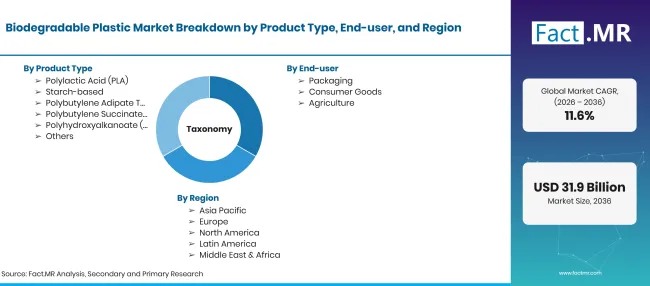
Biodegradable Plastic Market Taxonomy | Source: Fact.MR
| Attribute | Details |
|---|---|
| Quantitative Units | USD Billion, 2026 to 2036; CAGR |
| Market Definition | Sales of biodegradable plastic polymers and compounds for conversion into commercial products |
| Product Type | PLA; Starch-based; PBAT; PBS; PHA; Others |
| End-user | Packaging; Consumer Goods; Agriculture |
| Regions Covered | North America; Latin America; Western Europe; Eastern Europe; East Asia; South Asia & Pacific; Middle East & Africa |
| Countries Covered | Germany; United Kingdom; Brazil; Japan; United States |
| Companies Profiled | NatureWorks LLC; BASF SE; Novamont SpA; TotalEnergies Corbion; Teknor Apex (Danimer Scientific); CJ CheilJedang; Mitsubishi Chemical Corporation / PTT MCC Biochem Co., Ltd.; Kingfa Sci. and Tech; Kaneka Corporation; Biome Bioplastics. |
| Forecast Period | 2026 to 2036 |
| Approach | Product-grade mapping, use-case review, regulation and public waste statistics, and producer capacity evidence |
Source: Fact.MR analysis. Updated Oct 24, 2026
How is the market segmented?
-
By Product Type
- Polylactic Acid (PLA)
- Starch-based
- Polybutylene Adipate Terephthalate (PBAT)
- Polybutylene Succinate (PBS)
- Polyhydroxyalkanoate (PHA)
- Others
-
By End-user
- Packaging
- Consumer Goods
- Agriculture
-
By Region
- North America
- Latin America
- Western Europe
- Eastern Europe
- East Asia
- South Asia & Pacific
- Middle East & Africa
Frequently Asked Questions
How big is the Biodegradable Plastic Market in 2026?
What is the CAGR of the Biodegradable Plastic Market from 2026 to 2036?
Which product type leads the Biodegradable Plastic Market?
Which end-user leads the Biodegradable Plastic Market?
Who are the leading companies in the Biodegradable Plastic Market?
Who worked on this report


Preview the report firsthand - request a free sample
Free SampleGet the brochure for pricing and purchase details
Download PDF