- Base Value(2025): 113.2 Bn
- Estimated Value(2026): 119.5 Bn
- Forecast Value (2036): 206.1 Bn
- CAGR (2026 - 2036): 5.6%
Sustainable Plastic Packaging Market Forecast and Outlook 2026 to 2036
In 2025, the sustainable plastic packaging market surpassed a valuation of USD 113.2 billion. Based on Fact.MR analysis, demand for sustainable plastic packaging is estimated to grow to USD 119.5 billion in 2026 and USD 206.1 billion by 2036. Fact.MR projects a CAGR of 5.6% during the forecast period.
Between 2026 and 2036, the sustainable plastic packaging market is projected to create an absolute dollar opportunity of USD 86.6 billion. This expansion reflects the structural shift by major FMCG, food and beverage, and personal care brands toward certified sustainable packaging formats driven by extended producer responsibility legislation, retailer sustainability mandates, and consumer preference for visible eco-credentials. Constraint comes from the cost premium of certified recyclable and biodegradable materials relative to conventional plastics, which moderate’s adoption pace in price-sensitive emerging markets.
Peter Konieczny, CEO of Amcor said, "Fiscal year 2025 marks an inflection point on our journey... With industry-leading innovation and global scale, the new Amcor is more ready than ever to deliver breakthrough solutions. We believe that all packaging can be circular and that packaging waste can be eliminated."
Country growth reflects EPR regulations, retailer requirements, and brand sustainability commitments. South Korea leads with 7.9% CAGR supported by strict recycled content rules. Japan follows at 7.3% driven by the Plastic Resource Circulation Act. China records 7.0% due to plastic pollution control policies and growth in recyclable e commerce packaging. The United States grows at 6.7% supported by state level EPR laws. The United Kingdom expands at 6.3% driven by the Plastic Packaging Tax and recycled content requirements.
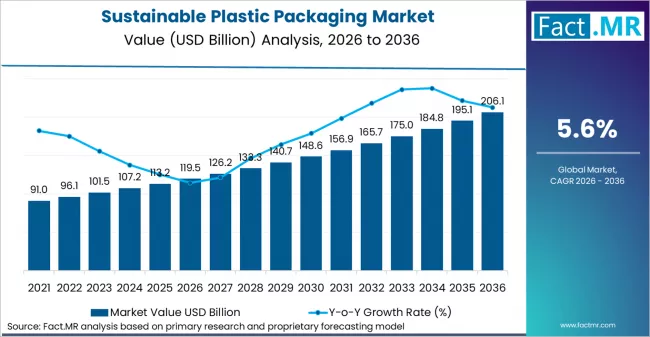
Sustainable Plastic Packaging Market Market Value Analysis | Source: Fact.MR
| Metric | Value |
|---|---|
| Estimated Value in 2026 | USD 119.5 billion |
| Forecast Value in 2036 | USD 206.1 billion |
| Forecast CAGR (2026 to 2036) | 5.6% |
Source: Fact.MR analysis. Updated Mar 5, 2026
Market Definition
The sustainable plastic packaging market includes packaging made from recycled, recyclable, reusable, or biodegradable plastics used to protect and transport consumer and industrial goods across food, beverage, personal care, healthcare, and other sectors.
Market Inclusions
Includes global and regional revenue forecasts from 2026 to 2036 by packaging type, process, and end use. Covers rigid, flexible, and industrial formats across recyclable, reusable, and biodegradable materials, along with pricing trends, EPR compliance costs, and retailer sustainability mandates.
Market Exclusions
Excludes conventional virgin plastic packaging without sustainable content. Glass, paper, metal, and non-plastic bio based packaging are not included. Packaging machinery, labelling systems, and recycling infrastructure investments are also excluded.
Research Methodology
- Primary Research: Interviews were conducted with packaging material manufacturers, CPG procurement managers, EPR consultants, retailer sustainability teams, and certification bodies across major regions.
- Desk Research: Sources included brand sustainability reports, EPR regulatory databases, EU packaging regulations, national plastic policy records, retailer sustainability programmes, and packaging industry reports.
- Market Sizing and Forecasting: A hybrid model combined packaging volume estimates by region and sector with sustainable packaging adoption rates by material type. Growth assumptions considered EPR timelines, brand sustainability targets, and recycled content pricing.
- Data Validation and Update Cycle: Results were validated using manufacturer revenues, brand sustainability disclosures, EPR implementation records, and packaging trade data. Forecasts are reviewed annually for regulatory and feedstock pricing changes.
Summary
- Market Definition
- Sustainable plastic packaging includes rigid, flexible, and industrial formats made from recycled, recyclable, reusable, or biodegradable plastics used across consumer and industrial applications.
- Demand Drivers
- EPR regulations in the EU, UK, US, South Korea, and Japan are pushing brands to adopt recyclable and recycled content packaging formats.
- FMCG brands such as Unilever, Nestlé, and PepsiCo have sustainability targets for 2025 and 2030, increasing demand for certified sustainable packaging.
- Consumer demand and retailer sustainability policies at Walmart, Carrefour, and Tesco are encouraging brands to adopt visible sustainable packaging solutions.
- Key Segments Analyzed
- By Type: Flexible packaging holds about 66% share in 2026 due to lightweight design, cost efficiency, and growing use of recyclable mono material films.
- By Packaging: Primary packaging accounts for about 54% share in 2026 due to direct consumer visibility and high packaging volume in food and personal care products.
- By Process: Recyclable packaging holds around 50% share in 2026 due to lower costs and wider regulatory acceptance compared with biodegradable alternatives.
- By Region, Asia Pacific leads, contributing the highest expansion rates.
- Analyst Opinion at FACT.MR
- Shambhu Nath Jha, Principal Consultant at Fact.MR, opines, “EPR compliance, brand sustainability pledges, and recycled material pricing will shape procurement strategies. Flexible recyclable formats and primary food packaging will capture most of the USD 86.6 billion growth opportunity through 2036.”
- Strategic Implications
- Packaging companies should accelerate certification of recyclable mono material flexible films to meet upcoming EU and US recyclability standards.
- Suppliers should support brands with EPR compliance documentation and advisory services to strengthen long term customer relationships.
- Manufacturers should build partnerships with recycled resin suppliers to stabilise PCR material pricing and reduce cost volatility.
- Methodology
- Market sizing combined packaging volume estimates with sustainable format adoption rates validated through manufacturer revenues and brand sustainability disclosures.
- EPR regulations, brand sustainability targets, and certification adoption rates were benchmarked using regulatory databases, brand reports, and industry association records.
- Regional forecasts used packaging trade data, retail sustainability programmes, EPR investments, and interviews with packaging procurement managers and suppliers.
Segmental Analysis
Sustainable Plastic Packaging Market Analysis by Type
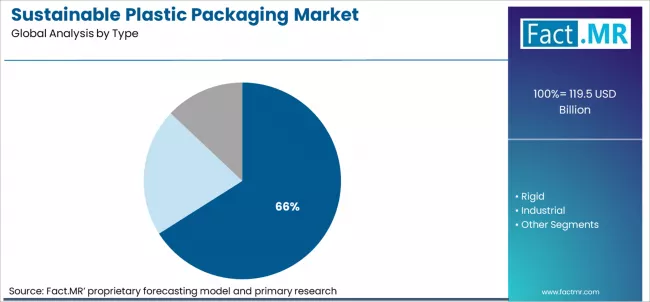
Sustainable Plastic Packaging Market Analysis By Type | Source: Fact.MR
Based on FACT.MR’s report, flexible packaging is expected to hold about 66% share in 2026. Flexible formats support recyclable mono material films and recycled content laminates while maintaining lower costs compared with rigid alternatives.
- Amcor AmPrima Recyclable Flexible Platform Expansion: In 2024, Amcor expanded its AmPrima recyclable flexible packaging platform to support high barrier food and dairy applications for European and North American markets. [5]
- Mondi Mono Material Recyclable Film Technology Launch: In 2025, Mondi introduced EcoVantage mono material polypropylene films for snack, pet food, and confectionery packaging to replace multilayer flexible structures. [6]
- E Commerce Sustainable Flexible Packaging Procurement Trend: In 2024, companies including Amazon and Cainiao expanded requirements for recyclable mailers and void fill packaging across e commerce logistics networks. [7]
Sustainable Plastic Packaging Market Analysis by Packaging
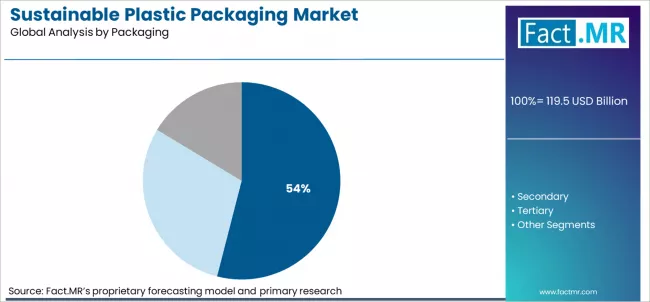
Sustainable Plastic Packaging Market Analysis By Packaging | Source: Fact.MR
Based on FACT.MR’s report, primary packaging is expected to hold about 54% share in 2026 because it directly communicates sustainability claims to consumers at the point of sale.
- WestRock Recyclable Primary Packaging Investment: In 2024, WestRock expanded recycled content resin sourcing and sustainable packaging solutions for food and personal care primary packaging in North America. [8]
- Tetra Laval Recyclable Primary Carton Technology Development: In 2025, Tetra Laval continued development of recyclable beverage carton technology with sustainable plastic barrier layers for liquid food packaging. [9]
- Secondary and Tertiary Sustainable Packaging Adoption in Retail: In 2025, retailers such as Carrefour and Tesco increased adoption of recycled content shrink wrap, stretch film, and pallet wrap for logistics packaging. [10]
Drivers, Restraints, and Opportunities
FACT.MR analysts observe that the sustainable plastic packaging market has evolved from a voluntary compliance segment into a regulated industry. Valued at USD 113.2 billion, demand is now driven by binding regulations such as EPR laws in Europe, plastic taxes in the UK, and recycled content mandates in the United States.
The market faces a cost challenge between sustainable and conventional plastics. Recyclable flexible films can cost 15 to 35 percent more than standard multilayer packaging, while biodegradable options are even more expensive. Brands adopt sustainable packaging faster in premium products, while lower cost segments convert more slowly. This balance supports the overall 5.6 percent CAGR.
- EU Packaging and Packaging Waste Regulation Mandate: The EU PPWR approved in 2024 introduces recycled content requirements of 10 to 35 percent by 2030 and mandates recyclable packaging formats. Companies such as Amcor, Mondi, and Berry Global are developing compliant packaging solutions. [2]
- South Korea Mandatory Recycled Content and EPR Expansion: South Korea expanded EPR rules and recycled content targets under the Act on the Promotion of Saving and Recycling of Resources. Updated eco label standards announced in 2025 are increasing demand for certified sustainable packaging. [3]
- China Plastic Pollution Control Action Plan Execution: China’s updated Plastic Pollution Control Action Plan extended restrictions on single use plastics and introduced procurement targets for sustainable packaging. E commerce firms such as JD.com and Cainiao are adopting recyclable packaging across fulfilment networks. [4]
Regional Analysis
The sustainable plastic packaging market is analysed across North America, Latin America, Europe, Asia Pacific, and Middle East and Africa, covering 40+ countries with distinct demand profiles shaped by EPR legislation maturity, recycled content mandate stringency, brand sustainability commitment timelines, and domestic recycling infrastructure capacity. The full report offers market attractiveness analysis based on regulatory enforcement timelines and CPG brand conversion rates.
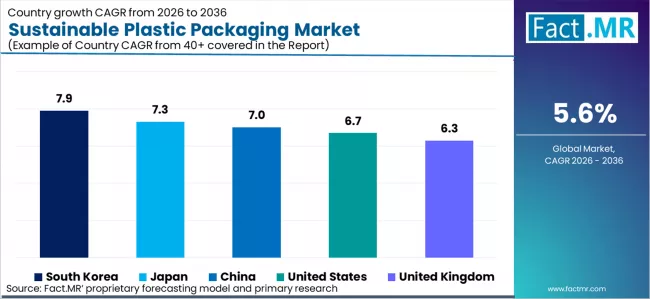
Sustainable Plastic Packaging Market Cagr Analysis By Country | Source: Fact.MR
| Country | CAGR (2026-2036) |
|---|---|
| South Korea | 7.9% |
| Japan | 7.3% |
| China | 7.0% |
| United Kingdom | 6.3% |
| United States | 6.7% |
Source: Fact.MR analysis. Updated Mar 5, 2026
Source: Fact.MR (FACT.MR) analysis, based on proprietary forecasting model and primary research
Asia Pacific Sustainable Plastic Packaging Market Analysis
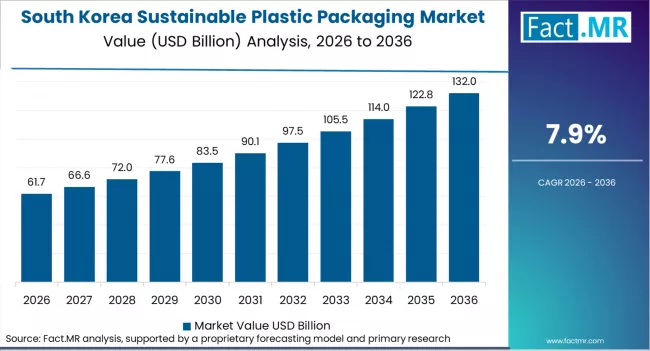
Sustainable Plastic Packaging Market Country Value Analysis | Source: Fact.MR
Asia Pacific is the fastest growing region for sustainable plastic packaging. Growth is supported by strong regulations in South Korea and Japan and large scale packaging demand from China’s e commerce and FMCG sectors. The region combines regulatory pressure with high packaging volumes, making it a major growth driver for recyclable flexible packaging.
- South Korea: Demand for sustainable plastic packaging in South Korea is projected to grow at a 7.9% CAGR through 2036. Updated EPR rules under the Act on the Promotion of Saving and Recycling of Resources increased recycled content requirements from 2024. New eco label verification standards introduced in 2025 require third party certification of recycled content. Major brands such as Amorepacific and CJ CheilJedang are expanding procurement from certified packaging suppliers.
- Japan: Demand for sustainable plastic packaging in Japan is projected to grow at a 7.3% CAGR through 2036. The Plastic Resource Circulation Act requires businesses to reduce single use plastics and adopt sustainable alternatives. Updated guidelines in 2024 expanded these rules to additional packaging formats. Companies such as Kao Corporation and Lion Corporation are increasing supplier qualification for recyclable packaging.
- China: Demand for sustainable plastic packaging in China is projected to grow at a 7.0% CAGR through 2036. The Plastic Pollution Control Action Plan expanded restrictions on single use plastics and introduced green procurement targets. E commerce companies including Alibaba Cainiao and JD.com are increasing adoption of recyclable packaging formats across logistics networks.
FACT.MR's Asia Pacific analysis of the sustainable plastic packaging market covers China, Japan, South Korea, India, Australia and New Zealand, ASEAN, and Rest of Asia Pacific. Readers can find country CAGR forecasts, EPR regulation timelines, brand conversion trends, and recyclable material supply chain benchmarks.
Europe Sustainable Plastic Packaging Market Analysis
Europe is the global regulatory benchmark for sustainable packaging. Regulations such as the EU Packaging and Packaging Waste Regulation, UK Plastic Packaging Tax, and national EPR frameworks are driving adoption of sustainable packaging formats.
- United Kingdom: Demand for sustainable plastic packaging in the United Kingdom is projected to grow at a 6.3% CAGR through 2036. The UK Plastic Packaging Tax applies to packaging containing less than 30% recycled content, encouraging brands to adopt sustainable packaging. Retailers such as Tesco have increased recycled content in their own brand packaging to meet sustainability targets.
FACT.MR's European analysis of the sustainable plastic packaging market covers Germany, France, the United Kingdom, Italy, Spain, the Netherlands, the Nordics, and Rest of Europe. Readers can find EU PPWR compliance timelines, Plastic Packaging Tax impacts, brand sustainability conversion trends, and country level forecasts.
North America Sustainable Plastic Packaging Market Analysis
North America is a large and growing market supported by state level EPR laws in the United States and sustainability commitments by major consumer brands. Regulatory activity in states such as California and Oregon is increasing packaging compliance investment.
- United States: Demand for sustainable plastic packaging in the United States is projected to grow at a 6.7% CAGR through 2036. California’s SB 54 law requires all plastic packaging to be recyclable or compostable by 2032 with recycled content targets starting from 2025. Companies such as The Clorox Company and Del Monte Foods are expanding packaging qualification programmes to meet these requirements.
FACT.MR's North American analysis of the sustainable plastic packaging market covers the United States, Canada, and Mexico. Readers can find state EPR timelines, brand sustainability adoption trends, recycled content pricing data, and country level forecasts.
Latin America Sustainable Plastic Packaging Market Analysis
Latin America is an emerging market supported by Brazil’s waste management policies and sustainability commitments by multinational brands operating in the region.
- Brazil: Demand for sustainable plastic packaging in Brazil is projected to grow at a 5.5% CAGR through 2036. Brazil’s National Solid Waste Policy requires packaging producers to implement recycling and take back systems. Packaging suppliers are expanding recyclable and recycled content packaging solutions to meet brand sustainability requirements.
FACT.MR's Latin American analysis of the sustainable plastic packaging market covers Brazil, Chile, Ecuador, and Rest of Latin America. Readers can find PNRS policy timelines, brand sustainability adoption trends, recyclable material supply chain benchmarks, and country level growth forecasts.
Competitive Aligners for Market Players
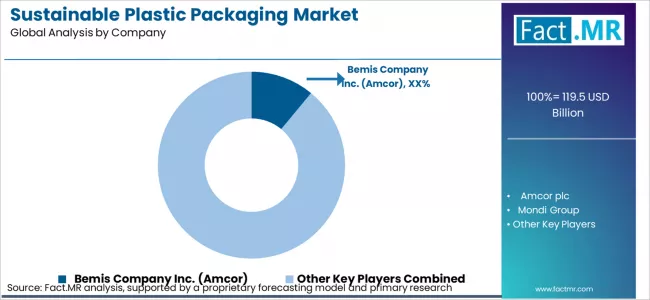
Sustainable Plastic Packaging Market Analysis By Company | Source: Fact.MR
The global sustainable plastic packaging market shows moderate concentration among large integrated suppliers, while many smaller regional converters operate in local markets. Companies such as Amcor plc, Mondi Group, WestRock Company, Berry Global, and Tetra Laval International hold strong positions in certified sustainable packaging. Their leadership comes from proprietary recyclable material platforms, global brand relationships, and strong regulatory compliance expertise. Bemis Company, now part of Amcor, also strengthens Amcor’s presence in North America’s flexible sustainable packaging segment.
For large brand customers, supplier selection depends heavily on certification credibility and compliance documentation. Suppliers that can verify recycled content and meet multi region recyclability standards often gain long term specification approval.
Major competitive advantages come from integrated supply chains and certified recyclable material technologies. Companies with direct access to recycled resin sources and certified mono material film platforms have stronger market positions. Amcor’s AmPrima platform, Mondi’s flexible packaging expertise, and WestRock’s multi format sustainable packaging portfolio allow them to support diverse customer needs. Global consumer brands often work with a limited number of trusted suppliers to simplify compliance management. Large FMCG companies usually maintain at least two approved suppliers to reduce risk. However, switching suppliers is difficult because certification and testing can take six to eighteen months.
Recent Developments
- In November 2024, Amcor plc announced expansion of its AmPrima high-barrier certified recyclable flexible packaging platform to include chilled and frozen food applications, targeting European food brand customers requiring OPRL-certified flexible packaging ahead of EU PPWR 2030 compliance deadlines.
- In February 2025, Mondi Group disclosed commercial launch of its EcoVantage mono-material polypropylene flexible film range, certified under How2Recycle and OPRL schemes for snack food, petfood, and confectionery brand customers in North America and Europe, addressing the largest-volume flexible packaging category by end-use.
Key Players
- Bemis Company Inc. (Amcor)
- Amcor plc
- Mondi Group
- WestRock Company
- Tetra Laval International SA
- Berry Global Group Inc.
- Constantia Flexibles Group GmbH
- Huhtamaki Oyj
Bibliography
- [1] Amcor plc. (2025). FY2025 First Half Results Presentation: Sustainable Packaging Platform Growth and Customer Demand Trends. February 2025. amcor.com/investors
- [2] European Parliament and Council. (2024). Regulation on Packaging and Packaging Waste (PPWR) Agreed Text November 2024: Recycled Content Thresholds and Recyclability Requirements for Plastic Packaging. EUR-Lex.
- [3] Ministry of Environment, Republic of Korea. (2025). Updated Eco-Label Certification Criteria for Plastic Packaging: Third-Party Verification Requirements. January 2025. me.go.kr
- [4] National Development and Reform Commission, People's Republic of China. (2024). Updated Plastic Pollution Control Action Plan: Single-Use Plastic Restriction Expansion and Provincial Green Procurement Targets. ndrc.gov.cn
- [5] Amcor plc. (2024). Press Release: AmPrima High-Barrier Certified Recyclable Flexible Packaging Platform Expansion to Chilled and Frozen Food Applications. November 2024. amcor.com
- [6] Mondi Group. (2025). Press Release: EcoVantage Mono-Material Polypropylene Flexible Film Range Commercial Launch for Snack Food and Petfood Brand Customers. February 2025. mondigroup.com
- [7] Amazon / Cainiao. (2024). Sustainable Packaging Programme Disclosure: Certified Recyclable Mailer and Void-Fill Packaging Requirements for Vendor Networks. 2024. amazon.com/packaging; cainiao.com
- [8] WestRock Company. (2024). Sustainability Report FY2024: Recycled-Content Resin Sourcing Partnership and Primary Packaging Sustainable Material Capability Expansion. westrock.com
- [9] Tetra Laval International SA. (2025). Announcement: Next-Generation Fully Recyclable Beverage Carton Platform Development with Sustainable Plastic Barrier Layer Certification. January 2025. tetrapak.com
- [10] Carrefour Group / Tesco plc. (2025). Sustainability Programme Update: Secondary and Tertiary Plastic Packaging Recycled-Content Conversion Requirements for Own-Brand Suppliers. 2025. carrefour.com; tescoplc.com
This Report Addresses
- Strategic intelligence on EPR regulation timelines, brand sustainability pledge conversion, recyclable material certification, recycled content pricing, and retailer sustainability mandates.
- Market forecast from USD 119.5 billion in 2026 to USD 206.1 billion by 2036 at 5.6% CAGR, segmented by type, packaging tier, process, end use, and region.
- Growth opportunities in recyclable flexible food packaging, primary CPG packaging conversion, sustainable e commerce mailers, and healthcare recyclable packaging.
- Regional outlook with country CAGR for South Korea 7.9%, Japan 7.3%, China 7.0%, United States 6.7%, and United Kingdom 6.3%.
- Competitive analysis of Amcor, Mondi, WestRock, Berry Global, Tetra Laval, and Constantia Flexibles covering certified platforms, PCR sourcing, and brand partnerships.
- Technology tracking including AmPrima recyclable films, EcoVantage mono material films, PLA biodegradable packaging, refill systems, and recyclable healthcare packaging.
- Regulatory analysis covering EU PPWR 2030 rules, UK Plastic Packaging Tax, California SB 54 EPR law, South Korea recycling mandates, Japan Plastic Resource Circulation Act, and China plastic pollution policies.
- Report delivered in Excel datasets, PowerPoint summary, and detailed PDF supported by regulatory records, brand disclosures, and primary research.
Segmentation
Scope of Report
| Items | Values |
|---|---|
| Quantitative Units | USD 119.5 billion (2026) to USD 206.1 billion (2036), at a CAGR of 5.6% |
| Market Definition | Sustainable plastic packaging includes rigid, flexible, and industrial formats made from recycled, recyclable, reusable, or biodegradable plastics used to package and protect goods across food, beverage, personal care, healthcare, and other industries. |
| Type Segmentation | Rigid, Flexible (66%), Industrial |
| Packaging Segmentation | Primary Packaging (54%), Secondary Packaging, Tertiary Packaging |
| Process Segmentation | Recyclable (50%), Reusable, Biodegradable |
| End Use Segmentation | Food & Beverage, Personal Care, Healthcare, Others |
| Application Coverage | Food and beverage packaging, personal care containers, healthcare recyclable packaging, e commerce mailers and void fill, retail secondary packaging, and industrial recycled stretch and shrink films. |
| Regions Covered | Asia Pacific, Europe, North America, Latin America, Middle East and Africa |
| Countries Covered | China, Japan, South Korea, India, Australia and New Zealand, ASEAN, Rest of Asia Pacific, Germany, United Kingdom, France, Italy, Spain, Netherlands, Nordics, Rest of Europe, United States, Canada, Mexico, Brazil, Chile, Ecuador, Rest of Latin America, Kingdom of Saudi Arabia, United Arab Emirates, South Africa, Turkey, Rest of Middle East and Africa |
| Key Companies Profiled | Bemis Company Inc. (Amcor), Amcor plc, Mondi Group, WestRock Company, Tetra Laval International SA, Berry Global Group Inc., Constantia Flexibles Group GmbH, Huhtamaki Oyj |
| Forecast Period | 2026 to 2036 |
| Approach | A hybrid top down and bottom up model was used. Top down inputs included total plastic packaging demand by region, EPR regulation timelines, and brand sustainability targets. Bottom up inputs included sustainable packaging cost premiums, recycled material prices, certification adoption, and brand procurement insights from industry interviews. |
Source: Fact.MR analysis. Updated Mar 5, 2026
Sustainable Plastic Packaging Market by Segment
-
By Type
- Rigid
- Flexible
- Industrial
-
By Packaging
- Primary Packaging
- Secondary Packaging
- Tertiary Packaging
-
By Process
- Recyclable
- Reusable
- Biodegradable
-
By End Use
- Food & Beverage
- Personal Care
- Healthcare
- Others
-
By Region
- North America
- United States
- Canada
- Mexico
- Europe
- Germany
- United Kingdom
- France
- Italy
- Spain
- Netherlands
- Nordics
- Rest of Europe
- Asia Pacific
- China
- Japan
- South Korea
- India
- Australia and New Zealand
- ASEAN
- Rest of Asia Pacific
- Latin America
- Brazil
- Chile
- Ecuador
- Rest of Latin America
- Middle East and Africa
- Kingdom of Saudi Arabia
- United Arab Emirates
- South Africa
- Turkey
- Rest of Middle East and Africa
- North America
Frequently Asked Questions
How large is the sustainable plastic packaging market in 2025?
What will the market size be in 2026?
What is the projected market size by 2036?
What is the expected CAGR for the forecast period 2026 to 2036?
Which type segment is poised to lead the sustainable plastic packaging market?
Which packaging tier holds the largest share?
Which process segment commands the largest share?
Which country shows the fastest growth rate?
How fast is the sustainable plastic packaging market expected to expand in Japan?
What is the forecast CAGR for the United States sustainable plastic packaging market?
Who worked on this report


Preview the report firsthand - request a free sample
Free SampleGet the brochure for pricing and purchase details
Download PDF