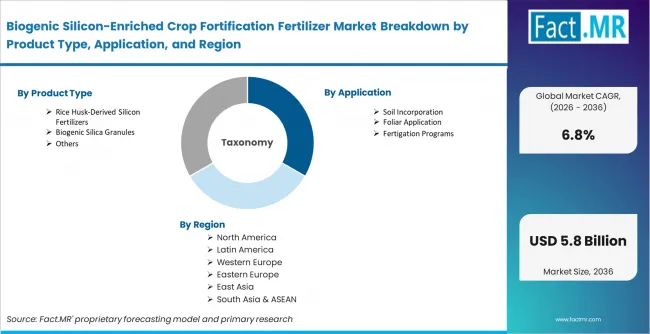
The Biogenic Silicon-Enriched Crop Fortification Fertilizer Market is segmented by Product Type, Application Method, Crop Type, and Region. Forecast for 2026 to 2036.
By Fact.MR Chemical & Materials DeskLead analyst:
S.N. JhaPublished :
Updated :
16 min read
Fact-checked under the Fact.MR editorial process
Biogenic Silicon-Enriched Crop Fortification Fertilizer Market Forecast and Outlook By Fact.MR
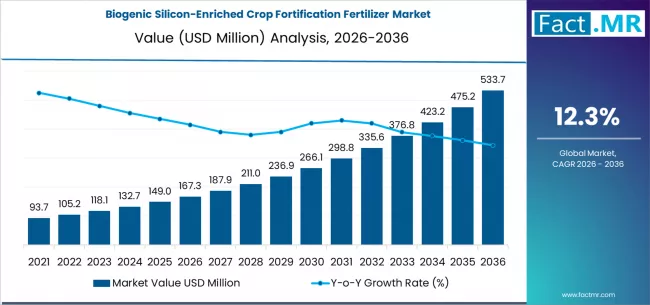
The biogenic silicon-enriched crop fortification fertilizer market was valued at USD 2.6 billion in 2025.
According to Fact.MR, demand is projected to reach USD 2.8 billion in 2026 and expand to USD 5.4 billion by 2036, reflecting a CAGR of 6.8% during the forecast period.
Summary of Biogenic Silicon-Enriched Crop Fortification Fertilizer Market
Market Definition
The market includes biogenic silicon-enriched fertilizers and fertilizer-compatible inputs designed to fortify crops through silicon supplementation from biologically derived silica sources.
Demand Drivers
Silicon is beneficial to many crops when added to some soils as a fertilizer, which supports the commercial role of fortification products in responsive crop systems.
Rice and sugarcane remain strong agronomic anchors because both crops have well-established silicon response literature and crop-specific fertilizer relevance.
Rice husk and related biogenic feedstocks are improving the commercial appeal of this market by linking silicon fortification with circular material use and agricultural waste valorization.
Key Segments Analyzed
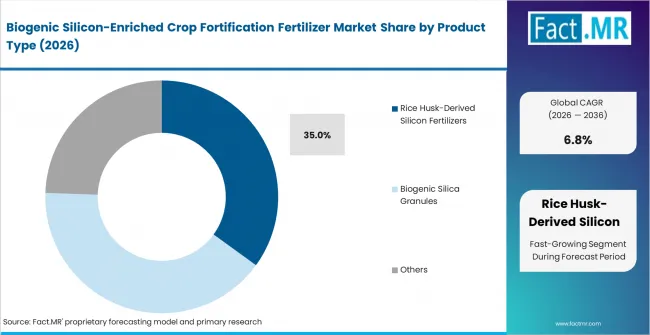
By Product Type: Rice husk-derived silicon fertilizers are estimated to lead with approximately 35% share in 2026, supported by feedstock availability and strong biogenic silica positioning.
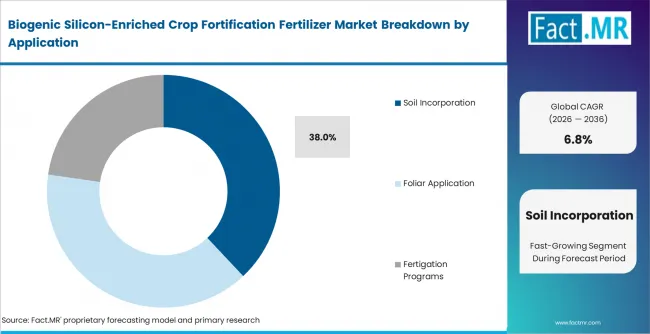
By Application: Soil incorporation is expected to hold approximately 38% share in 2026, driven by compatibility with broad-acre crop programs and silicon-responsive soils.
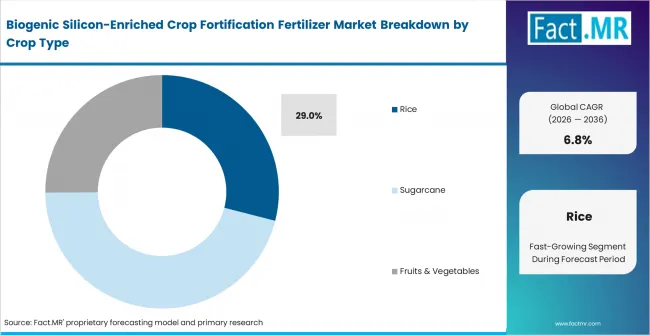
By Crop Type: Rice is projected to account for approximately 29% share in 2026, supported by strong silicon accumulation and crop-response relevance.
By End Use: Large farms are expected to contribute approximately 27% share in 2026, backed by wider access to input programs and larger silicon-responsive acreage.
By Geography: India leads growth at 8.3% CAGR through 2036, supported by rice, sugarcane, and protected-cultivation demand.
Analyst Opinion at Fact.MR
Shambhu Nath Jha, Senior Analyst at Fact.MR, opines, “CXOs should read this market as a crop-fortification and resilience category rather than a minor specialty nutrient category. Growers are adopting biogenic silicon products for stronger plant structure, stress moderation, and crop stability, not simple nutrient replacement.”
Strategic Implications
Invest in rice husk-derived and other biologically sourced silicon formats that can support both sustainability positioning and agronomic response.
Build product portfolios around crop-specific silicon response, especially in rice, sugarcane, greenhouse vegetables, and stress-prone horticulture.
Position liquid and multi-nutrient silicon programs where growers need easier integration into existing fertigation or foliar nutrition schedules.
Methodology
Market sizing uses silicon-responsive crop relevance, biological silica feedstock suitability, and adoption potential across fortification fertilizer programs.
Analysis includes extension guidance on silicon benefits, USDA ARS delivery research, and published review literature on biogenic silica sourcing.
Forecasts account for rising stress-management demand, crop fortification trends, and broader use of silicon in professional crop nutrition.
The market is projected to generate USD 2.6 billion in absolute opportunity between 2026 and 2036. Growth is being supported by wider use of silicon in stress-prone crop systems, rising interest in fortification-oriented plant nutrition, and greater commercial use of rice husk-derived silica as a fertilizer-linked input. Rutgers notes that silicon is beneficial to many crops when added to some soils as a fertilizer, while USDA ARS points out that growers can supply supplemental silicon either through liquid fertilizers or through amendments mixed into growing media.
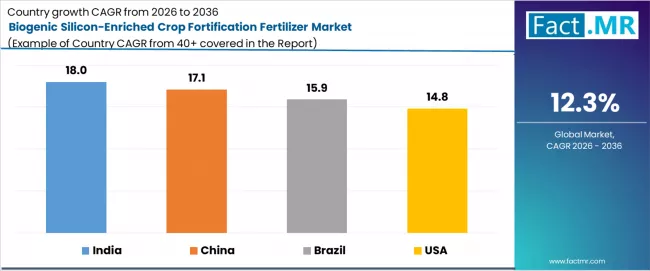
India is projected to lead with a CAGR of 8.3% through 2036, driven by rice intensity, sugarcane relevance, and broader interest in crop-fortification inputs. Brazil follows at 7.7% CAGR from 2026 to 2036, supported by sugarcane nutrition and tropical stress-management needs. China is expected to grow at 7.2% CAGR by 2036, underpinned by intensive crop production and higher-value horticulture. The United States records 6.9% CAGR from 2026 to 2036, backed by specialty crop fortification and controlled-environment adoption. Mexico grows at 6.3% CAGR by 2036, supported by horticulture and irrigated crop systems. This divergence reflects different levels of silicon-responsive crop acreage, stress exposure, irrigation intensity, and grower familiarity with silicon-fed production systems.
Segmental Analysis
Biogenic Silicon-Enriched Crop Fortification Fertilizer Market Analysis by Product Type
Biogenic Silicon Enriched Crop Fortification Fertilizer Market Analysis By Product Type | Source: Fact.MR
Rice husk-derived silicon fertilizers are estimated to hold 35% share in 2026. They lead because rice husk is one of the most visible biological silica feedstocks in the current literature and offers a clear route to producing biogenic silica for agricultural applications. Recent review work describes rice husk as a practical precursor for silica and silicon materials, while broader biogenic silica literature identifies rice husk-derived silica as accessible and cost-effective for value-added agricultural use. Liquid silicon fortification fertilizers remain important because USDA ARS notes that supplemental silicon can be supplied through liquid fertilizer, which expands relevance in greenhouse and specialty crop systems. Multi-nutrient silicon blends are also gaining traction where suppliers want to combine fortification with easier program adoption inside standard fertility schedules.
Rice Husk Feedstock Logic: Rice husk-derived silica benefits from strong feedstock availability and clearer sustainability positioning.
Liquid Delivery Relevance: USDA ARS notes that silicon can be delivered through liquid fertilizer, which supports product expansion beyond dry soil applications.
Program Integration: Multi-nutrient silicon formats gain traction where growers prefer fortification without creating a separate nutrient pass.
Biogenic Silicon-Enriched Crop Fortification Fertilizer Market Analysis by Application
Soil incorporation is expected to hold approximately 38% share in 2026. This segment leads because many silicon-responsive crops still rely on pre-plant or soil-linked delivery routes, especially where silicon is used to build a more sustained supply in the crop root environment. UF/IFAS recommendations for sugarcane are explicitly tied to calcium silicate application on soils low in soluble silicon, which reinforces the practical role of soil application in the category. Foliar and fertigation programs remain important in greenhouse vegetables, ornamentals, and other technically managed systems, though broad-acre commercial use still favors soil incorporation because it fits conventional fertilizer handling more easily. Application leadership in this market depends on whether the silicon source can be integrated with minimal operational change while still delivering fortification value.
Soil Program Strength: Soil incorporation remains easier to scale in rice, sugarcane, and other broad-acre programs.
Liquid Flexibility: Liquid and fertigation programs are gaining relevance where growers need easier integration into controlled feeding systems.
Operational Fit: Farmers favor application routes that strengthen crop fortification without creating a separate management burden.
Biogenic Silicon-Enriched Crop Fortification Fertilizer Market Analysis by Crop Type
Biogenic Silicon Enriched Crop Fortification Fertilizer Market Analysis By Crop Type | Source: Fact.MR
Rice is projected to account for approximately 29% share in 2026. It leads because rice is one of the clearest silicon-accumulating crops in agronomy literature, and recent review work continues to position silicon fertilization as a meaningful route to more sustainable rice production. Sugarcane also remains highly important, with UF/IFAS continuing to treat silicon as a beneficial nutrient for the crop and linking calcium silicate use with yield gains where soils are low in soluble silicon. Fruits and vegetables create additional opportunity in protected cultivation and high-value production, where silicon’s role in stress moderation and crop quality becomes more visible. Crop leadership in this market is shaped by silicon responsiveness and stress-exposure logic rather than by acreage alone.
Rice Anchor Crop: Rice remains a commercial anchor because it is a strong silicon accumulator with a clearer fertilizer-response history.
Sugarcane Pull: Sugarcane keeps strong relevance because silicon recommendation systems already exist in low-soluble-Si soils.
Horticulture Upside: High-value vegetables and ornamentals create strong fortification demand where crop quality and stress tolerance matter more visibly.
Drivers, Restraints, and Opportunities
Biogenic Silicon Enriched Crop Fortification Fertilizer Market Opportunity Matrix Growth Vs Value | Source: Fact.MR
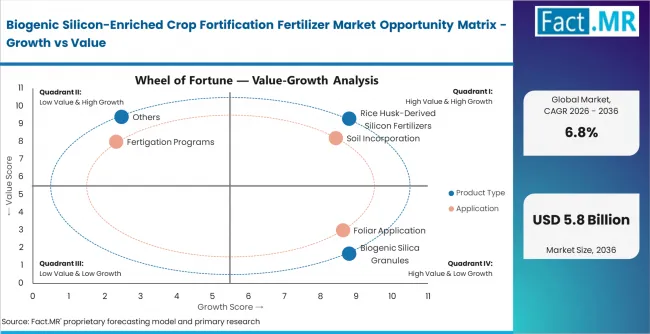
Fact.MR analysts observe that the biogenic silicon-enriched crop fortification fertilizer market is being shaped by the growing need to protect crops from yield instability under multiple stress conditions. Structural demand is anchored in the fact that silicon is repeatedly described as a beneficial element for many crops and as a practical tool for improving plant response under biotic and abiotic stress. The commercial case becomes stronger when this silicon is sourced from agricultural residues such as rice husk, because suppliers can position the input as both crop-fortifying and circular-material based. That dual logic is helping the market move beyond narrow specialty use.
The main restraint is uneven response across crops and soils. Silicon is beneficial, but it is not treated as an essential element for most plants, and not every crop system shows the same economic return from silicon application. This raises the proof burden for suppliers, especially in broad-acre markets where growers need clearer evidence before adding another nutrient input. Another restraint is delivery fit. Some products work better through soil programs, while others are more suitable for liquid feeding or substrate amendment, and that can fragment the market by crop and production system.
Rice Husk Silica Expansion:Biogenic silica from rice husk offers a clear opportunity because the feedstock is abundant and already well recognized in review literature.
Greenhouse Fortification: Container crops and controlled-environment systems create attractive demand because silicon can be supplied through liquid fertilizers or growing-media amendments.
Stress-Management Positioning: Silicon-fortification products have higher-value opportunity where growers buy for crop resilience and quality protection rather than for yield alone.
Regional Analysis
The biogenic silicon-enriched crop fortification fertilizer market is assessed across North America, Europe, Asia Pacific, Latin America, and Middle East and Africa, covering 40+ countries with demand profiles shaped by silicon-responsive crop acreage, crop-stress exposure, greenhouse intensity, and availability of biogenic silica feedstocks. The full report provides market attractiveness analysis by region and country.
Top Country Growth Comparison Biogenic Silicon Enriched Crop Fortification Fertilizer Market Cagr (2026 2036) | Source: Fact.MR
Country
CAGR (2026 to 2036)
India
8.3%
Brazil
7.7%
China
7.2%
United States
6.9%
Mexico
6.3%
Source: Fact.MR analysis. Updated Jun 15, 2026
Source: Fact.MR analysis, based on proprietary forecasting model and primary research
Biogenic Silicon Enriched Crop Fortification Fertilizer Market Cagr Analysis By Country | Source: Fact.MR
North America Biogenic Silicon-Enriched Crop Fortification Fertilizer Market Analysis
Biogenic Silicon Enriched Crop Fortification Fertilizer Market Country Value Analysis | Source: Fact.MR
North America remains an important commercial region because it combines specialty crop systems, greenhouse production, and crop-fortification use cases where silicon can be integrated into technical nutrition programs. USDA ARS research on soilless substrates and additives supports this relevance by highlighting both liquid fertilizer and amendment-based silicon delivery routes for container-grown crops. Demand in this region is strongest where crop quality, stress protection, and controlled-environment production justify silicon use more clearly than in undifferentiated field nutrition.
United States: Specialty crops, greenhouse production, and broader technical nutrition use continue to support demand in the United States. The market is projected to expand at a CAGR of 6.9% through 2036, driven by increasing focus on yield optimization, precision agriculture practices, and controlled-environment farming. Growers are adopting advanced nutrient solutions to improve crop quality and consistency, especially in high-value horticulture and protected cultivation systems.
Mexico: Export horticulture and irrigated crop systems create practical fit for silicon fortification inputs. Sales of biogenic silicon-enriched crop fortification fertilizers in Mexico are likely to rise at 6.3% CAGR during the forecast period.
Fact.MR’s analysis of North America covers the United States, Canada, and Mexico. Includes greenhouse nutrition, specialty crop fortification, and controlled-environment silicon delivery.
Asia Pacific and Latin America Biogenic Silicon-Enriched Crop Fortification Fertilizer Market Analysis
Asia Pacific and Latin America offer the strongest long-term expansion potential because rice, sugarcane, and tropical stress-prone crop systems are more commercially important across these regions. Demand is likely to strengthen where growers move from general fertilizer use toward crop fortification and resilience-oriented input strategies. The relevance of rice husk as a silica feedstock also gives Asia a clearer supply-side advantage in biogenic silicon production. Latin America remains attractive because sugarcane and tropical crop systems align well with silicon response literature and stress-management use cases.
India: Rice cultivation, sugarcane farming, and the steady rise of protected horticulture continue to support demand across India. The market is projected to grow at an 8.3% CAGR through 2036, driven by increasing focus on crop resilience, soil health, and yield improvement in both staple and high-value crops. Adoption is strengthening across regions with intensive irrigation and greenhouse expansion, where nutrient efficiency and stress tolerance are becoming more critical.
Brazil: Sugarcane production and large-scale crop fortification programs underpin growth in Brazil. Biogenic silicon-enriched crop fortification fertilizer demand is expected to rise at a 7.7% CAGR by 2036, supported by the country’s large agricultural base and focus on improving crop durability under variable climatic conditions. Expansion is particularly visible in commercial farming zones where input optimization and productivity gains remain central.
China: Intensive crop production systems and the shift toward higher-value horticulture continues to support demand in China. The market is projected to grow at a 7.2% CAGR from 2026 to 2036, driven by increasing emphasis on yield quality, soil management, and efficient nutrient use. Adoption is rising across greenhouse cultivation and high-output farming regions where consistent crop performance is a priority.
Fact.MR’s analysis covers India, China, Japan, ASEAN, Australia, Brazil, Argentina, and Rest of Latin America. Includes rice and sugarcane fortification demand, stress-management nutrient programs, and biogenic silica feedstock relevance.
Competitive Aligners for Market Players
Biogenic Silicon Enriched Crop Fortification Fertilizer Market Analysis By Company | Source: Fact.MR
The biogenic silicon-enriched crop fortification fertilizer market is moderately concentrated at the formulation level, while distribution and technical support remain fragmented. Competitive strength comes from the ability to combine biologically sourced silica with a clear crop-response story. Suppliers need more than a sustainable-input claim. They need to show why silicon fortification matters for specific crops, stress conditions, and delivery systems.
Competitive advantage is defined by feedstock credibility, formulation stability, and ease of integration into existing nutrient routines. Rice husk-derived products benefit from clearer circular-material positioning. Liquid and soluble silicon products benefit from stronger compatibility with greenhouse and fertigation programs. Multi-nutrient silicon blends gain attention where growers want crop fortification without adding a separate application pass. Buyers in this market typically choose on technical confidence and visible crop benefit rather than on silicon content alone.
Buyer dynamics vary by crop type and agronomic sophistication. Rice and sugarcane growers adopt where silicon response is more established. Greenhouse and specialty crop growers adopt where quality protection and stress moderation justify a premium input. Broader field-crop adoption will depend on whether suppliers can demonstrate repeatable agronomic and economic value under real production conditions. Competitive intensity is therefore rising fastest in crop-specific and stress-management-driven programs rather than in general fertility markets.
Key Players
Yara International ASA
ICL Group Ltd.
Haifa Group
UPL Ltd.
Agripower Australia Ltd.
Deepak Fertilisers and Petrochemicals Corporation Ltd.
Bibliography
Yara New Zealand. (n.d.). YaraVita Actisil. Yara International ASA.
ICL Growing Solutions. (n.d.). Vitalnova SiLK 0-10-19. ICL Group Ltd.
Strategic intelligence on biogenic silicon-enriched crop fortification fertilizer demand across rice, sugarcane, horticulture, and greenhouse crop systems.
Growth opportunity mapping across rice husk-derived silicon fertilizers, biogenic silica granules, liquid fortification products, and multi-nutrient silicon blends.
Segment analysis by product type, application, crop type, and end use.
Regional outlook covering North America, Europe, Asia Pacific, Latin America, and Middle East and Africa.
Competitive analysis of Yara International, ICL Group, Haifa Group, Nutrien, EuroChem, and other participants.
Crop fortification analysis covering stress moderation, silicon-responsive crop systems, biogenic feedstock relevance, and liquid versus soil delivery logic.
Report delivered in PDF, Excel datasets, and presentation formats. Supported by primary interviews, extension guidance, and published silicon-fertilization literature.
The market covers fertilizer and fertilizer-compatible products enriched with silicon derived from biogenic feedstocks such as rice husk ash, plant-based silica residues, and related biological silica sources. These products are used to fortify crops by improving stress tolerance, supporting stronger plant structure, and enhancing crop performance in systems where silicon supplementation is agronomically beneficial.
Covers global and regional forecasts from 2026 to 2036. Includes rice husk-derived silicon fertilizers, biogenic silica granules, liquid silicon fortification fertilizers, silicon-enriched NPK blends, and multi-nutrient silicon products used in field crops, horticulture, sugarcane, rice, and greenhouse programs. Covers products positioned for silicon fortification, stress-mitigation support, and stronger crop resilience through biological silica sourcing.
Excludes conventional bulk fertilizers without a silicon-fortification claim or function. Omits standard liming silicates sold only for soil correction without crop-fortification positioning. Excludes industrial silica materials not intended for agricultural use, and excludes general biostimulants unless silicon enrichment is part of the product’s commercial role in crop nutrition.
Biogenic Silicon-Enriched Crop Fortification Fertilizer Market Research Methodology
Primary Research
Interviews with rice and sugarcane agronomy teams, greenhouse nutrient managers, specialty crop advisors, silicon product distributors, and fertilizer formulators across major agricultural regions.
Desk Research
Uses university and extension materials on silicon fertilization, USDA ARS findings on silicon delivery through liquid and media amendments, crop-specific recommendations for rice and sugarcane, and review literature on rice husk-derived biogenic silica.
Market-Sizing and Forecasting
Hybrid model using silicon-responsive crop acreage, stress-management relevance, biogenic silica feedstock availability, liquid-versus-solid delivery suitability, and adoption potential across crop-fortification fertilizer programs.
Data Validation and Update Cycle
Validated using extension recommendations, published crop-response literature, silicon delivery research, and recurring checks on biogenic silica sourcing relevance in fertilizer-linked agricultural systems.
Market Breakdown
Segmentation
Scope of Report
Biogenic Silicon Enriched Crop Fortification Fertilizer Market Breakdown By Product Type, Application, And Region | Source: Fact.MR
Attribute
Details
Quantitative Units
USD billion (2026) to USD billion (2036), at a CAGR
Market Definition
Fertilizers and fertilizer-compatible products enriched with biogenic silicon from agricultural residue-derived silica sources, used to fortify crops through stronger stress tolerance, plant structure, and crop performance support.
North America, Europe, Asia Pacific, Latin America, Middle East and Africa
Countries Covered
United States, Canada, Mexico, Spain, Netherlands, Germany, France, India, China, Australia, Brazil, Argentina, and 40+ countries
Key Companies Profiled
Yara International ASA, ICL Group Ltd., Haifa Group, UPL Ltd.
Forecast Period
2026 to 2036
Approach
Hybrid top-down and bottom-up model using silicon-responsive crop relevance, biogenic silica feedstock availability, stress-management need, and primary interviews with growers, distributors, and agronomy teams.
Source: Fact.MR analysis. Updated Jun 15, 2026
Biogenic Silicon-Enriched Crop Fortification Fertilizer Market by Segments
By Product Type:
Rice Husk-Derived Silicon Fertilizers
Biogenic Silica Granules
Liquid Silicon Fortification Fertilizers
Silicon-Enriched NPK Blends
Multi-Nutrient Silicon Fortification Inputs
Others
By Application:
Soil Incorporation
Foliar Application
Fertigation Programs
Seedling and Transplant Programs
Others
By Crop Type:
Rice
Sugarcane
Fruits & Vegetables
Cereals & Grains
Plantation Crops
Others
By Region:
North America
United States
Canada
Latin America
Brazil
Mexico
Argentina
Chile
Rest of Latin America
Western Europe
Germany
France
United Kingdom
Italy
Spain
Nordic Countries
BENELUX
Rest of Western Europe
Eastern Europe
Russia
Poland
Hungary
Balkan and Baltic
Rest of Eastern Europe
East Asia
China
Japan
South Korea
South Asia and Pacific
India
ASEAN
Australia and New Zealand
Rest of South Asia and Pacific
Middle East and Africa
Kingdom of Saudi Arabia
Other GCC Countries
Turkey
South Africa
Rest of Middle East and Africa
Questions Answered
Frequently Asked Questions
What is the expected CAGR from 2026 to 2036?
Fact.MR projects a CAGR of 6.8% for the global biogenic silicon-enriched crop fortification fertilizer market during the 2026 to 2036 forecast period.
Which product type is poised to lead the market?
Rice husk-derived silicon fertilizers lead with approximately 35% share in 2026, driven by feedstock availability and strong biogenic silica positioning.
Which application segment holds the largest share?
Soil incorporation leads with approximately 38% share in 2026, supported by broad fit in rice, sugarcane, and other field programs.
Which crop segment is expected to remain strongest?
Rice is projected to account for approximately 29% share in 2026, supported by strong silicon accumulation and clearer fertilizer-response relevance.
Which end-use segment is likely to remain commercially important?
Large farms are expected to contribute approximately 27% share in 2026 because they manage broader silicon-responsive acreage and structured input programs.
Which country shows the fastest growth?
India leads at 8.3% CAGR through 2036, driven by rice, sugarcane, and protected-cultivation demand.
What is driving demand for biogenic silicon-enriched crop fortification fertilizers?
Demand is being driven by stronger interest in crop resilience, silicon-responsive nutrition, and the use of rice husk and similar feedstocks as agricultural silica sources.
What is the key challenge in this market?
The main challenge is that crop response varies by species, soil, and delivery route, so buyers need clearer proof before scaling silicon fortification programs.
What makes this market different from standard specialty fertilizer demand?
This market is shaped by crop-fortification value, stress-management logic, and biologically sourced silica positioning rather than by nutrient replacement alone.
.webp "Top Country Growth Comparison Biogenic Silicon Enriched Crop Fortification Fertilizer Market Cagr (2026 2036)")