Microbiome-Tuned Fertilizer Coating System Market

Microbiome-Tuned Fertilizer Coating System Market Size and Share Forecast Outlook 2026 to 2036

Microbiome-tuned fertilizer coating system market is projected to grow from USD 98.9 million in 2026 to USD 526.7 million by 2036, at a CAGR of 18.2%. Corn/Maize will dominate with a 47.6% market share, while polymer will lead the coating type segment with a 49.2% share.

Microbiome-Tuned Fertilizer Coating System Market Forecast and Outlook 2026 to 2036

Projected to surge from USD 98.94 million in 2026 to USD 526.69 million by 2036, the microbiome-tuned fertilizer coating system market is poised for exceptional growth at a CAGR of 18.2%. This explosive expansion signifies a paradigm shift from chemistry-alone to biology-integrated crop nutrition.

Key Takeaways from the Microbiome-Tuned Fertilizer Coating System Market

  • Market Value for 2026: USD 98.94 Million
  • Market Value for 2036: USD 526.69 Million
  • Forecast CAGR (2026-2036): 18.2%
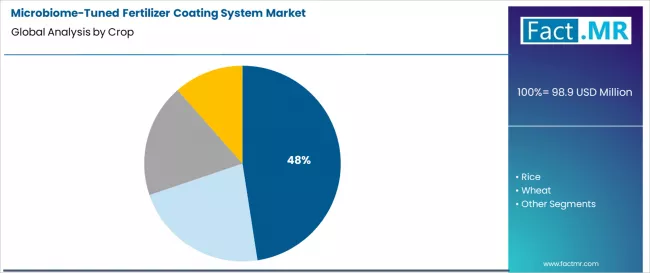
  • Leading Crop Share (2026): Corn/Maize (48%)
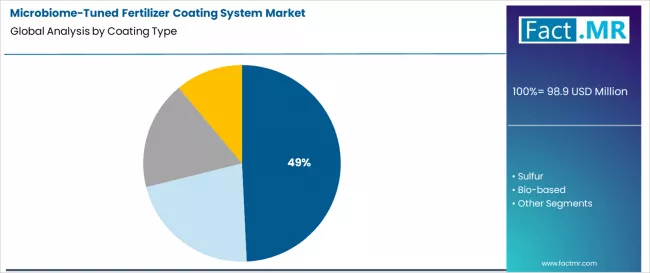
  • Leading Coating Type Share (2026): Polymer (49%)
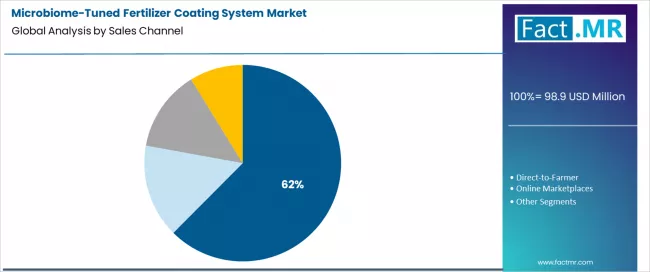
  • Leading Sales Channel Share (2026): Ag-Retailers (62%)
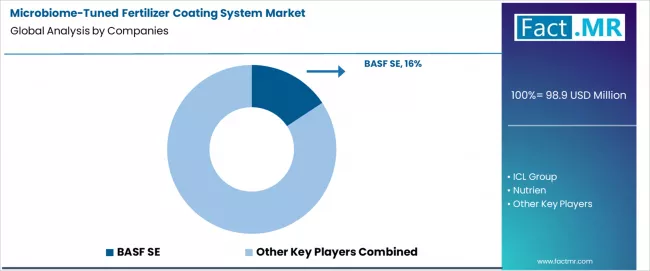
  • Key Players in the Market: BASF SE, ICL Group, Nutrien, Yara International, Syngenta, Novonesis

Microbiome Tuned Fertilizer Coating System Market Market Value Analysis

These advanced systems encapsulate fertilizer granules with specialized coatings that contain and protect tailored microbial consortia such as nitrogen-fixing bacteria, phosphorus-solubilizing fungi, and biocontrol agents, synchronizing nutrient release with the biological activity of a revived soil microbiome.

Corn/maize cultivation is the dominant crop segment, commanding a 48% share, driven by its high nitrogen demand and the significant potential for microbiome coatings to enhance nutrient fixation and uptake efficiency.

Polymer-based coatings are the leading technology, holding a 49% share, as their engineered porosity and degradation profiles allow for the controlled release of both nutrients and living microorganisms. Ag-retailers are the indispensable sales channel, accounting for 62% of the market, due to their critical role in educating growers on this symbiotic technology and providing the necessary agronomic support for successful implementation.

Market growth is fueled by the urgent need to restore soil biological health and create self-sustaining nutrient cycles. These coatings deliver a double payload: the fertilizer nourishes the crop, while the introduced or protected microbes enhance soil structure, fix atmospheric nitrogen, unlock bound phosphorus, and suppress pathogens.

This approach reduces dependency on synthetic inputs, minimizes environmental losses, and builds long-term soil resilience, positioning microbiome-tuned coatings as a foundational tool for regenerative and precision agriculture.

Metric

Metric Value
Market Value (2026) USD 98.94 Million
Market Forecast Value (2036) USD 526.69 Million
Forecast CAGR (2026-2036) 18.2%

Category

Category Segments
Crop Corn/Maize, Rice, Wheat, Sugarcane
Coating Type Polymer, Sulfur, Bio-based, Inhibitor-Infused
Sales Channel Ag-Retailers, Direct-to-Farmer, Online Marketplaces, Cooperatives
Region North America, Latin America, Western Europe, Eastern Europe, East Asia, South Asia & Pacific, MEA

Segmental Analysis

By Crop, Which System Maximizes the Nitrogen-Fixing Synergy?

Microbiome Tuned Fertilizer Coating System Market Analysis By Crop

Corn/maize leads with a 48% share. This crop’s high nitrogen requirement creates a perfect economic and agronomic case for coatings infused with nitrogen-fixing bacteria like Azospirillum.

The coating protects these microbes during storage and application, delivering them directly to the seed rhizosphere where they can establish symbiotic relationships, reducing the need for synthetic nitrogen fertilizer. The scale of corn production amplifies the impact of even a marginal reduction in fertilizer use, driving widespread adoption.

By Coating Type, Which Technology Best Safeguards Microbial Viability?

Microbiome Tuned Fertilizer Coating System Market Analysis By Coating Type

Polymer coatings are foremost, holding a 49% share. Advanced polymer matrices are engineered to be more than just physical barriers for nutrients; they create a micro-environment that buffers microbes against desiccation, temperature extremes, and chemical toxicity from the fertilizer core.

These coatings can be designed to degrade in response to soil moisture or microbial activity, ensuring timely release of both nutrients and biology, a level of control unmatched by traditional sulfur or clay-based coatings.

By Sales Channel, Who Bridges the Gap Between Biology and Agronomy?

Microbiome Tuned Fertilizer Coating System Market Analysis By Sales Channel

Ag-retailers are the pivotal channel, facilitating 62% of sales. Success with microbiome-tuned products requires understanding soil health status, proper storage conditions, and compatible agronomic practices.

Retail agronomists provide this essential service, testing soils to recommend specific microbial blends, ensuring proper product handling to maintain microbial viability, and integrating these biological tools into a holistic crop management plan.

What are the Drivers, Restraints, and Key Trends of the Market?

The primary driver is the global push for agricultural decarbonization and sustainable intensification. Microbiome-tuned coatings offer a direct path to reduce synthetic fertilizer use and its associated greenhouse gas emissions.

Growing regulatory scrutiny of chemical inputs and consumer demand for sustainably produced food further propel adoption. The declining cost of microbial screening and fermentation technology is also making these advanced coatings more economically viable for broad-acre crops.

A significant restraint is the biological complexity and sensitivity of the products. Improper storage, harsh chemical tank mixes, or extreme environmental conditions can compromise microbial viability after application, leading to inconsistent results.

The regulatory pathway for these combination products can be complex and varies by region. The agronomic benefits, while real, may take a season or more to fully manifest, testing farmer patience compared to immediate chemical responses.

Key trends include the development of multi-functional coatings that combine nutrient-use-efficiency inhibitors with beneficial microbes for a compounded effect. There is intense research into microbial consortia specifically tailored to crop genotypes and local soil conditions, moving towards hyper-personalized biologicals.

The market is also moving toward digital integration, using soil DNA sequencing to diagnose microbial deficiencies and then prescribing a specific coated fertilizer to correct the imbalance.

Analysis of the Microbiome-Tuned Fertilizer Coating System Market by Key Countries

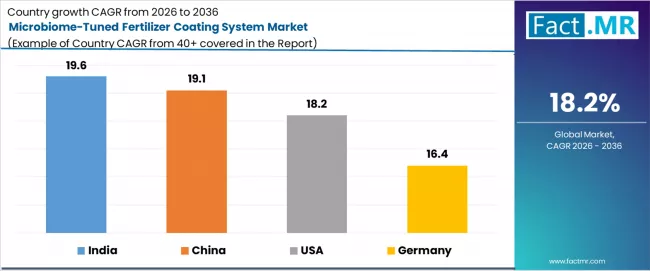
Microbiome Tuned Fertilizer Coating System Market Cagr Analysis By Country

Country CAGR (2026-2036)
India 19.6%
China 19.1%
USA 18.2%
Germany 16.4%

How are Carbon Markets and Precision Agriculture Converging in USA to Drive Adoption?

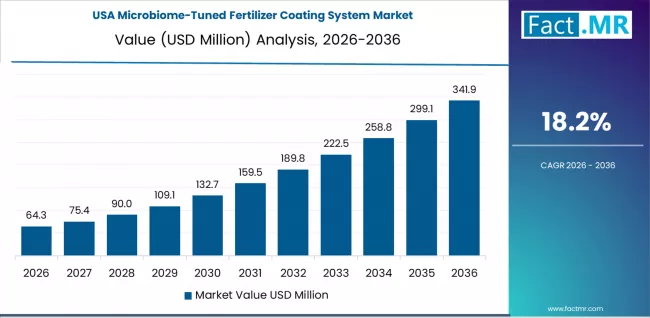
Microbiome Tuned Fertilizer Coating System Market Country Value Analysis

The USA's growth rate of 18.2% is fueled by the intersection of voluntary carbon markets and advanced farming practices. Microbiome-tuned coatings are used to verify reductions in synthetic nitrogen application, generating carbon credits.

The precision agriculture infrastructure allows for variable-rate application of these coatings based on soil health maps, maximizing ROI and biological impact across heterogeneous fields, particularly in the Corn Belt.

What is the Impact of China's 'Green Agriculture' Policy on Large-Scale Biological Adoption?

China's 19.1% CAGR is a direct result of its national Green Development policy for agriculture, which mandates reductions in chemical fertilizer use. State-owned farms and large cooperatives are deploying microbiome-tuned coatings at scale to meet these targets while maintaining yield. Government-backed research is focused on developing domestic microbial strains and coating technologies, creating a self-reliant and policy-driven market for biological fertility solutions.

Why is Germany a Hub for High-Precision, Regulation-Driven Biological Engineering?

Germany's 16.4% growth reflects its stringent EU regulatory environment and engineering precision. German companies are leaders in developing rigorous quality control for microbial viability within coatings and creating products that meet the high evidence standards of the EU Fertilising Products Regulation. Adoption is driven by the need to comply with strict nitrate directives and by high-value crop producers seeking to enhance quality and sustainability through biological means.

How is India's Smallholder Landscape Adapting to Microbial Coating Technology?

Innovative delivery models that make the technology accessible to smallholders propel India’s leading CAGR of 19.6%. Agri-input companies and government programs are promoting small-format, single-use packages of coated fertilizer for crops like rice and wheat. These "bio-boosted" fertilizers are sold with simple instructions, demystifying microbial technology and providing an easy entry point for millions of farmers to improve soil health and reduce input costs.

Competitive Landscape of the Microbiome-Tuned Fertilizer Coating System Market

Microbiome Tuned Fertilizer Coating System Market Analysis By Company

The competitive landscape is defined by strategic partnerships between established fertilizer coating specialists, global biologicals companies, and biotechnology startups. Competition revolves around proprietary microbial strains, advanced encapsulation technologies that ensure long-term shelf life and field efficacy, and robust field trial data across geographies.

Success requires a dual expertise in polymer science and microbiology, as well as the ability to navigate complex regulatory frameworks for combined products. Building strong technical service networks to support correct product use is equally critical.

Key Players in the Microbiome-Tuned Fertilizer Coating System Market

  • BASF SE
  • ICL Group
  • Nutrien
  • Yara International
  • Syngenta
  • Novonesis

Scope of Report

Items Values
Quantitative Units USD Million
Crop Corn/Maize, Rice, Wheat, Sugarcane
Coating Type Polymer, Sulfur, Bio-based, Inhibitor-Infused
Sales Channel Ag-Retailers, Direct-to-Farmer, Online Marketplaces, Cooperatives
Key Countries USA, China, Germany, India
Key Companies BASF SE, ICL Group, Nutrien, Yara International, Syngenta, Novonesis
Additional Analysis Microbial encapsulation and shelf-life stabilization technologies; soil ecology and microbiome succession post-application; compatibility of microbial coatings with chemical seed treatments; quantification of nitrogen fixation and phosphorus solubilization in field conditions; lifecycle analysis of coated vs. conventional fertilizers.

Market by Segments

  • Crop :

    • Corn/Maize
    • Rice
    • Wheat
    • Sugarcane
  • Coating Type :

    • Polymer
    • Sulfur
    • Bio-based
    • Inhibitor-Infused
  • Sales Channel :

    • Ag-Retailers
    • Direct-to-Farmer
    • Online Marketplaces
    • Cooperatives
  • Region :

    • North America

      • USA
      • Canada
    • Latin America

      • Brazil
      • Mexico
      • Argentina
      • Rest of Latin America
    • Western Europe

      • Germany
      • UK
      • France
      • Spain
      • Italy
      • BENELUX
      • Rest of Western Europe
    • Eastern Europe

      • Russia
      • Poland
      • Czech Republic
      • Rest of Eastern Europe
    • East Asia

      • China
      • Japan
      • South Korea
      • Rest of East Asia
    • South Asia & Pacific

      • India
      • ASEAN
      • Australia
      • Rest of South Asia & Pacific
    • MEA

      • Saudi Arabia
      • UAE
      • Turkiye
      • Rest of MEA

Table of Content

  1. Executive Summary
    • Global Market Outlook
    • Demand to side Trends
    • Supply to side Trends
    • Technology Roadmap Analysis
    • Analysis and Recommendations
  2. Market Overview
    • Market Coverage / Taxonomy
    • Market Definition / Scope / Limitations
  3. Market Background
    • Market Dynamics
      • Drivers
      • Restraints
      • Opportunity
      • Trends
    • Scenario Forecast
      • Demand in Optimistic Scenario
      • Demand in Likely Scenario
      • Demand in Conservative Scenario
    • Opportunity Map Analysis
    • Product Life Cycle Analysis
    • Supply Chain Analysis
    • Investment Feasibility Matrix
    • Value Chain Analysis
    • PESTLE and Porter’s Analysis
    • Regulatory Landscape
    • Regional Parent Market Outlook
    • Production and Consumption Statistics
    • Import and Export Statistics
  4. Global Market Analysis 2021 to 2025 and Forecast, 2026 to 2036
    • Historical Market Size Value (USD Million) Analysis, 2021 to 2025
    • Current and Future Market Size Value (USD Million) Projections, 2026 to 2036
      • Y to o to Y Growth Trend Analysis
      • Absolute $ Opportunity Analysis
  5. Global Market Pricing Analysis 2021 to 2025 and Forecast 2026 to 2036
  6. Global Market Analysis 2021 to 2025 and Forecast 2026 to 2036, By Crop
    • Introduction / Key Findings
    • Historical Market Size Value (USD Million) Analysis By Crop, 2021 to 2025
    • Current and Future Market Size Value (USD Million) Analysis and Forecast By Crop, 2026 to 2036
      • Corn/Maize
      • Rice
      • Wheat
      • Sugarcane
    • Y to o to Y Growth Trend Analysis By Crop, 2021 to 2025
    • Absolute $ Opportunity Analysis By Crop, 2026 to 2036
  7. Global Market Analysis 2021 to 2025 and Forecast 2026 to 2036, By Coating Type
    • Introduction / Key Findings
    • Historical Market Size Value (USD Million) Analysis By Coating Type, 2021 to 2025
    • Current and Future Market Size Value (USD Million) Analysis and Forecast By Coating Type, 2026 to 2036
      • Polymer
      • Sulfur
      • Bio-based
      • Inhibitor-Infused
    • Y to o to Y Growth Trend Analysis By Coating Type, 2021 to 2025
    • Absolute $ Opportunity Analysis By Coating Type, 2026 to 2036
  8. Global Market Analysis 2021 to 2025 and Forecast 2026 to 2036, By Sales Channel
    • Introduction / Key Findings
    • Historical Market Size Value (USD Million) Analysis By Sales Channel, 2021 to 2025
    • Current and Future Market Size Value (USD Million) Analysis and Forecast By Sales Channel, 2026 to 2036
      • Ag-Retailers
      • Direct-to-Farmer
      • Online Marketplaces
      • Cooperatives
    • Y to o to Y Growth Trend Analysis By Sales Channel, 2021 to 2025
    • Absolute $ Opportunity Analysis By Sales Channel, 2026 to 2036
  9. Global Market Analysis 2021 to 2025 and Forecast 2026 to 2036, By Region
    • Introduction
    • Historical Market Size Value (USD Million) Analysis By Region, 2021 to 2025
    • Current Market Size Value (USD Million) Analysis and Forecast By Region, 2026 to 2036
      • North America
      • Latin America
      • Western Europe
      • Eastern Europe
      • East Asia
      • South Asia and Pacific
      • Middle East & Africa
    • Market Attractiveness Analysis By Region
  10. North America Market Analysis 2021 to 2025 and Forecast 2026 to 2036, By Country
    • Historical Market Size Value (USD Million) Trend Analysis By Market Taxonomy, 2021 to 2025
    • Market Size Value (USD Million) Forecast By Market Taxonomy, 2026 to 2036
      • By Country
        • USA
        • Canada
        • Mexico
      • By Crop
      • By Coating Type
      • By Sales Channel
    • Market Attractiveness Analysis
      • By Country
      • By Crop
      • By Coating Type
      • By Sales Channel
    • Key Takeaways
  11. Latin America Market Analysis 2021 to 2025 and Forecast 2026 to 2036, By Country
    • Historical Market Size Value (USD Million) Trend Analysis By Market Taxonomy, 2021 to 2025
    • Market Size Value (USD Million) Forecast By Market Taxonomy, 2026 to 2036
      • By Country
        • Brazil
        • Chile
        • Rest of Latin America
      • By Crop
      • By Coating Type
      • By Sales Channel
    • Market Attractiveness Analysis
      • By Country
      • By Crop
      • By Coating Type
      • By Sales Channel
    • Key Takeaways
  12. Western Europe Market Analysis 2021 to 2025 and Forecast 2026 to 2036, By Country
    • Historical Market Size Value (USD Million) Trend Analysis By Market Taxonomy, 2021 to 2025
    • Market Size Value (USD Million) Forecast By Market Taxonomy, 2026 to 2036
      • By Country
        • Germany
        • UK
        • Italy
        • Spain
        • France
        • Nordic
        • BENELUX
        • Rest of Western Europe
      • By Crop
      • By Coating Type
      • By Sales Channel
    • Market Attractiveness Analysis
      • By Country
      • By Crop
      • By Coating Type
      • By Sales Channel
    • Key Takeaways
  13. Eastern Europe Market Analysis 2021 to 2025 and Forecast 2026 to 2036, By Country
    • Historical Market Size Value (USD Million) Trend Analysis By Market Taxonomy, 2021 to 2025
    • Market Size Value (USD Million) Forecast By Market Taxonomy, 2026 to 2036
      • By Country
        • Russia
        • Poland
        • Hungary
        • Balkan & Baltic
        • Rest of Eastern Europe
      • By Crop
      • By Coating Type
      • By Sales Channel
    • Market Attractiveness Analysis
      • By Country
      • By Crop
      • By Coating Type
      • By Sales Channel
    • Key Takeaways
  14. East Asia Market Analysis 2021 to 2025 and Forecast 2026 to 2036, By Country
    • Historical Market Size Value (USD Million) Trend Analysis By Market Taxonomy, 2021 to 2025
    • Market Size Value (USD Million) Forecast By Market Taxonomy, 2026 to 2036
      • By Country
        • China
        • Japan
        • South Korea
      • By Crop
      • By Coating Type
      • By Sales Channel
    • Market Attractiveness Analysis
      • By Country
      • By Crop
      • By Coating Type
      • By Sales Channel
    • Key Takeaways
  15. South Asia and Pacific Market Analysis 2021 to 2025 and Forecast 2026 to 2036, By Country
    • Historical Market Size Value (USD Million) Trend Analysis By Market Taxonomy, 2021 to 2025
    • Market Size Value (USD Million) Forecast By Market Taxonomy, 2026 to 2036
      • By Country
        • India
        • ASEAN
        • Australia & New Zealand
        • Rest of South Asia and Pacific
      • By Crop
      • By Coating Type
      • By Sales Channel
    • Market Attractiveness Analysis
      • By Country
      • By Crop
      • By Coating Type
      • By Sales Channel
    • Key Takeaways
  16. Middle East & Africa Market Analysis 2021 to 2025 and Forecast 2026 to 2036, By Country
    • Historical Market Size Value (USD Million) Trend Analysis By Market Taxonomy, 2021 to 2025
    • Market Size Value (USD Million) Forecast By Market Taxonomy, 2026 to 2036
      • By Country
        • Kingdom of Saudi Arabia
        • Other GCC Countries
        • Turkiye
        • South Africa
        • Other African Union
        • Rest of Middle East & Africa
      • By Crop
      • By Coating Type
      • By Sales Channel
    • Market Attractiveness Analysis
      • By Country
      • By Crop
      • By Coating Type
      • By Sales Channel
    • Key Takeaways
  17. Key Countries Market Analysis
    • USA
      • Pricing Analysis
      • Market Share Analysis, 2025
        • By Crop
        • By Coating Type
        • By Sales Channel
    • Canada
      • Pricing Analysis
      • Market Share Analysis, 2025
        • By Crop
        • By Coating Type
        • By Sales Channel
    • Mexico
      • Pricing Analysis
      • Market Share Analysis, 2025
        • By Crop
        • By Coating Type
        • By Sales Channel
    • Brazil
      • Pricing Analysis
      • Market Share Analysis, 2025
        • By Crop
        • By Coating Type
        • By Sales Channel
    • Chile
      • Pricing Analysis
      • Market Share Analysis, 2025
        • By Crop
        • By Coating Type
        • By Sales Channel
    • Germany
      • Pricing Analysis
      • Market Share Analysis, 2025
        • By Crop
        • By Coating Type
        • By Sales Channel
    • UK
      • Pricing Analysis
      • Market Share Analysis, 2025
        • By Crop
        • By Coating Type
        • By Sales Channel
    • Italy
      • Pricing Analysis
      • Market Share Analysis, 2025
        • By Crop
        • By Coating Type
        • By Sales Channel
    • Spain
      • Pricing Analysis
      • Market Share Analysis, 2025
        • By Crop
        • By Coating Type
        • By Sales Channel
    • France
      • Pricing Analysis
      • Market Share Analysis, 2025
        • By Crop
        • By Coating Type
        • By Sales Channel
    • India
      • Pricing Analysis
      • Market Share Analysis, 2025
        • By Crop
        • By Coating Type
        • By Sales Channel
    • ASEAN
      • Pricing Analysis
      • Market Share Analysis, 2025
        • By Crop
        • By Coating Type
        • By Sales Channel
    • Australia & New Zealand
      • Pricing Analysis
      • Market Share Analysis, 2025
        • By Crop
        • By Coating Type
        • By Sales Channel
    • China
      • Pricing Analysis
      • Market Share Analysis, 2025
        • By Crop
        • By Coating Type
        • By Sales Channel
    • Japan
      • Pricing Analysis
      • Market Share Analysis, 2025
        • By Crop
        • By Coating Type
        • By Sales Channel
    • South Korea
      • Pricing Analysis
      • Market Share Analysis, 2025
        • By Crop
        • By Coating Type
        • By Sales Channel
    • Russia
      • Pricing Analysis
      • Market Share Analysis, 2025
        • By Crop
        • By Coating Type
        • By Sales Channel
    • Poland
      • Pricing Analysis
      • Market Share Analysis, 2025
        • By Crop
        • By Coating Type
        • By Sales Channel
    • Hungary
      • Pricing Analysis
      • Market Share Analysis, 2025
        • By Crop
        • By Coating Type
        • By Sales Channel
    • Kingdom of Saudi Arabia
      • Pricing Analysis
      • Market Share Analysis, 2025
        • By Crop
        • By Coating Type
        • By Sales Channel
    • Turkiye
      • Pricing Analysis
      • Market Share Analysis, 2025
        • By Crop
        • By Coating Type
        • By Sales Channel
    • South Africa
      • Pricing Analysis
      • Market Share Analysis, 2025
        • By Crop
        • By Coating Type
        • By Sales Channel
  18. Market Structure Analysis
    • Competition Dashboard
    • Competition Benchmarking
    • Market Share Analysis of Top Players
      • By Regional
      • By Crop
      • By Coating Type
      • By Sales Channel
  19. Competition Analysis
    • Competition Deep Dive
      • BASF SE
        • Overview
        • Product Portfolio
        • Profitability by Market Segments (Product/Age /Sales Channel/Region)
        • Sales Footprint
        • Strategy Overview
          • Marketing Strategy
          • Product Strategy
          • Channel Strategy
      • ICL Group
      • Nutrien
      • Yara International
      • Syngenta
      • Novonesis
  20. Assumptions & Acronyms Used
  21. Research Methodology

List Of Table

  • Table 1: Global Market Value (USD Million) Forecast by Region, 2021 to 2036
  • Table 2: Global Market Value (USD Million) Forecast by Crop, 2021 to 2036
  • Table 3: Global Market Value (USD Million) Forecast by Coating Type, 2021 to 2036
  • Table 4: Global Market Value (USD Million) Forecast by Sales Channel, 2021 to 2036
  • Table 5: North America Market Value (USD Million) Forecast by Country, 2021 to 2036
  • Table 6: North America Market Value (USD Million) Forecast by Crop, 2021 to 2036
  • Table 7: North America Market Value (USD Million) Forecast by Coating Type, 2021 to 2036
  • Table 8: North America Market Value (USD Million) Forecast by Sales Channel, 2021 to 2036
  • Table 9: Latin America Market Value (USD Million) Forecast by Country, 2021 to 2036
  • Table 10: Latin America Market Value (USD Million) Forecast by Crop, 2021 to 2036
  • Table 11: Latin America Market Value (USD Million) Forecast by Coating Type, 2021 to 2036
  • Table 12: Latin America Market Value (USD Million) Forecast by Sales Channel, 2021 to 2036
  • Table 13: Western Europe Market Value (USD Million) Forecast by Country, 2021 to 2036
  • Table 14: Western Europe Market Value (USD Million) Forecast by Crop, 2021 to 2036
  • Table 15: Western Europe Market Value (USD Million) Forecast by Coating Type, 2021 to 2036
  • Table 16: Western Europe Market Value (USD Million) Forecast by Sales Channel, 2021 to 2036
  • Table 17: Eastern Europe Market Value (USD Million) Forecast by Country, 2021 to 2036
  • Table 18: Eastern Europe Market Value (USD Million) Forecast by Crop, 2021 to 2036
  • Table 19: Eastern Europe Market Value (USD Million) Forecast by Coating Type, 2021 to 2036
  • Table 20: Eastern Europe Market Value (USD Million) Forecast by Sales Channel, 2021 to 2036
  • Table 21: East Asia Market Value (USD Million) Forecast by Country, 2021 to 2036
  • Table 22: East Asia Market Value (USD Million) Forecast by Crop, 2021 to 2036
  • Table 23: East Asia Market Value (USD Million) Forecast by Coating Type, 2021 to 2036
  • Table 24: East Asia Market Value (USD Million) Forecast by Sales Channel, 2021 to 2036
  • Table 25: South Asia and Pacific Market Value (USD Million) Forecast by Country, 2021 to 2036
  • Table 26: South Asia and Pacific Market Value (USD Million) Forecast by Crop, 2021 to 2036
  • Table 27: South Asia and Pacific Market Value (USD Million) Forecast by Coating Type, 2021 to 2036
  • Table 28: South Asia and Pacific Market Value (USD Million) Forecast by Sales Channel, 2021 to 2036
  • Table 29: Middle East & Africa Market Value (USD Million) Forecast by Country, 2021 to 2036
  • Table 30: Middle East & Africa Market Value (USD Million) Forecast by Crop, 2021 to 2036
  • Table 31: Middle East & Africa Market Value (USD Million) Forecast by Coating Type, 2021 to 2036
  • Table 32: Middle East & Africa Market Value (USD Million) Forecast by Sales Channel, 2021 to 2036

List Of Figures

  • Figure 1: Global Market Pricing Analysis
  • Figure 2: Global Market Value (USD Million) Forecast 2021 to 2036
  • Figure 3: Global Market Value Share and BPS Analysis by Crop, 2026 and 2036
  • Figure 4: Global Market Y to o to Y Growth Comparison by Crop, 2026 to 2036
  • Figure 5: Global Market Attractiveness Analysis by Crop
  • Figure 6: Global Market Value Share and BPS Analysis by Coating Type, 2026 and 2036
  • Figure 7: Global Market Y to o to Y Growth Comparison by Coating Type, 2026 to 2036
  • Figure 8: Global Market Attractiveness Analysis by Coating Type
  • Figure 9: Global Market Value Share and BPS Analysis by Sales Channel, 2026 and 2036
  • Figure 10: Global Market Y to o to Y Growth Comparison by Sales Channel, 2026 to 2036
  • Figure 11: Global Market Attractiveness Analysis by Sales Channel
  • Figure 12: Global Market Value (USD Million) Share and BPS Analysis by Region, 2026 and 2036
  • Figure 13: Global Market Y to o to Y Growth Comparison by Region, 2026 to 2036
  • Figure 14: Global Market Attractiveness Analysis by Region
  • Figure 15: North America Market Incremental Dollar Opportunity, 2026 to 2036
  • Figure 16: Latin America Market Incremental Dollar Opportunity, 2026 to 2036
  • Figure 17: Western Europe Market Incremental Dollar Opportunity, 2026 to 2036
  • Figure 18: Eastern Europe Market Incremental Dollar Opportunity, 2026 to 2036
  • Figure 19: East Asia Market Incremental Dollar Opportunity, 2026 to 2036
  • Figure 20: South Asia and Pacific Market Incremental Dollar Opportunity, 2026 to 2036
  • Figure 21: Middle East & Africa Market Incremental Dollar Opportunity, 2026 to 2036
  • Figure 22: North America Market Value Share and BPS Analysis by Country, 2026 and 2036
  • Figure 23: North America Market Value Share and BPS Analysis by Crop, 2026 and 2036
  • Figure 24: North America Market Y to o to Y Growth Comparison by Crop, 2026 to 2036
  • Figure 25: North America Market Attractiveness Analysis by Crop
  • Figure 26: North America Market Value Share and BPS Analysis by Coating Type, 2026 and 2036
  • Figure 27: North America Market Y to o to Y Growth Comparison by Coating Type, 2026 to 2036
  • Figure 28: North America Market Attractiveness Analysis by Coating Type
  • Figure 29: North America Market Value Share and BPS Analysis by Sales Channel, 2026 and 2036
  • Figure 30: North America Market Y to o to Y Growth Comparison by Sales Channel, 2026 to 2036
  • Figure 31: North America Market Attractiveness Analysis by Sales Channel
  • Figure 32: Latin America Market Value Share and BPS Analysis by Country, 2026 and 2036
  • Figure 33: Latin America Market Value Share and BPS Analysis by Crop, 2026 and 2036
  • Figure 34: Latin America Market Y to o to Y Growth Comparison by Crop, 2026 to 2036
  • Figure 35: Latin America Market Attractiveness Analysis by Crop
  • Figure 36: Latin America Market Value Share and BPS Analysis by Coating Type, 2026 and 2036
  • Figure 37: Latin America Market Y to o to Y Growth Comparison by Coating Type, 2026 to 2036
  • Figure 38: Latin America Market Attractiveness Analysis by Coating Type
  • Figure 39: Latin America Market Value Share and BPS Analysis by Sales Channel, 2026 and 2036
  • Figure 40: Latin America Market Y to o to Y Growth Comparison by Sales Channel, 2026 to 2036
  • Figure 41: Latin America Market Attractiveness Analysis by Sales Channel
  • Figure 42: Western Europe Market Value Share and BPS Analysis by Country, 2026 and 2036
  • Figure 43: Western Europe Market Value Share and BPS Analysis by Crop, 2026 and 2036
  • Figure 44: Western Europe Market Y to o to Y Growth Comparison by Crop, 2026 to 2036
  • Figure 45: Western Europe Market Attractiveness Analysis by Crop
  • Figure 46: Western Europe Market Value Share and BPS Analysis by Coating Type, 2026 and 2036
  • Figure 47: Western Europe Market Y to o to Y Growth Comparison by Coating Type, 2026 to 2036
  • Figure 48: Western Europe Market Attractiveness Analysis by Coating Type
  • Figure 49: Western Europe Market Value Share and BPS Analysis by Sales Channel, 2026 and 2036
  • Figure 50: Western Europe Market Y to o to Y Growth Comparison by Sales Channel, 2026 to 2036
  • Figure 51: Western Europe Market Attractiveness Analysis by Sales Channel
  • Figure 52: Eastern Europe Market Value Share and BPS Analysis by Country, 2026 and 2036
  • Figure 53: Eastern Europe Market Value Share and BPS Analysis by Crop, 2026 and 2036
  • Figure 54: Eastern Europe Market Y to o to Y Growth Comparison by Crop, 2026 to 2036
  • Figure 55: Eastern Europe Market Attractiveness Analysis by Crop
  • Figure 56: Eastern Europe Market Value Share and BPS Analysis by Coating Type, 2026 and 2036
  • Figure 57: Eastern Europe Market Y to o to Y Growth Comparison by Coating Type, 2026 to 2036
  • Figure 58: Eastern Europe Market Attractiveness Analysis by Coating Type
  • Figure 59: Eastern Europe Market Value Share and BPS Analysis by Sales Channel, 2026 and 2036
  • Figure 60: Eastern Europe Market Y to o to Y Growth Comparison by Sales Channel, 2026 to 2036
  • Figure 61: Eastern Europe Market Attractiveness Analysis by Sales Channel
  • Figure 62: East Asia Market Value Share and BPS Analysis by Country, 2026 and 2036
  • Figure 63: East Asia Market Value Share and BPS Analysis by Crop, 2026 and 2036
  • Figure 64: East Asia Market Y to o to Y Growth Comparison by Crop, 2026 to 2036
  • Figure 65: East Asia Market Attractiveness Analysis by Crop
  • Figure 66: East Asia Market Value Share and BPS Analysis by Coating Type, 2026 and 2036
  • Figure 67: East Asia Market Y to o to Y Growth Comparison by Coating Type, 2026 to 2036
  • Figure 68: East Asia Market Attractiveness Analysis by Coating Type
  • Figure 69: East Asia Market Value Share and BPS Analysis by Sales Channel, 2026 and 2036
  • Figure 70: East Asia Market Y to o to Y Growth Comparison by Sales Channel, 2026 to 2036
  • Figure 71: East Asia Market Attractiveness Analysis by Sales Channel
  • Figure 72: South Asia and Pacific Market Value Share and BPS Analysis by Country, 2026 and 2036
  • Figure 73: South Asia and Pacific Market Value Share and BPS Analysis by Crop, 2026 and 2036
  • Figure 74: South Asia and Pacific Market Y to o to Y Growth Comparison by Crop, 2026 to 2036
  • Figure 75: South Asia and Pacific Market Attractiveness Analysis by Crop
  • Figure 76: South Asia and Pacific Market Value Share and BPS Analysis by Coating Type, 2026 and 2036
  • Figure 77: South Asia and Pacific Market Y to o to Y Growth Comparison by Coating Type, 2026 to 2036
  • Figure 78: South Asia and Pacific Market Attractiveness Analysis by Coating Type
  • Figure 79: South Asia and Pacific Market Value Share and BPS Analysis by Sales Channel, 2026 and 2036
  • Figure 80: South Asia and Pacific Market Y to o to Y Growth Comparison by Sales Channel, 2026 to 2036
  • Figure 81: South Asia and Pacific Market Attractiveness Analysis by Sales Channel
  • Figure 82: Middle East & Africa Market Value Share and BPS Analysis by Country, 2026 and 2036
  • Figure 83: Middle East & Africa Market Value Share and BPS Analysis by Crop, 2026 and 2036
  • Figure 84: Middle East & Africa Market Y to o to Y Growth Comparison by Crop, 2026 to 2036
  • Figure 85: Middle East & Africa Market Attractiveness Analysis by Crop
  • Figure 86: Middle East & Africa Market Value Share and BPS Analysis by Coating Type, 2026 and 2036
  • Figure 87: Middle East & Africa Market Y to o to Y Growth Comparison by Coating Type, 2026 to 2036
  • Figure 88: Middle East & Africa Market Attractiveness Analysis by Coating Type
  • Figure 89: Middle East & Africa Market Value Share and BPS Analysis by Sales Channel, 2026 and 2036
  • Figure 90: Middle East & Africa Market Y to o to Y Growth Comparison by Sales Channel, 2026 to 2036
  • Figure 91: Middle East & Africa Market Attractiveness Analysis by Sales Channel
  • Figure 92: Global Market - Tier Structure Analysis
  • Figure 93: Global Market - Company Share Analysis

- FAQs -

How big is the microbiome-tuned fertilizer coating system market in 2026?

The global microbiome-tuned fertilizer coating system market is estimated to be valued at USD 98.9 million in 2026.

What will be the size of microbiome-tuned fertilizer coating system market in 2036?

The market size for the microbiome-tuned fertilizer coating system market is projected to reach USD 526.7 million by 2036.

How much will be the microbiome-tuned fertilizer coating system market growth between 2026 and 2036?

The microbiome-tuned fertilizer coating system market is expected to grow at a 18.2% CAGR between 2026 and 2036.

What are the key product types in the microbiome-tuned fertilizer coating system market?

The key product types in microbiome-tuned fertilizer coating system market are corn/maize, rice, wheat and sugarcane.

Which coating type segment to contribute significant share in the microbiome-tuned fertilizer coating system market in 2026?

In terms of coating type, polymer segment to command 49.2% share in the microbiome-tuned fertilizer coating system market in 2026.

Microbiome-Tuned Fertilizer Coating System Market